Overview
Quantum numbers are a set of four numerical values that completely describe the unique quantum state of an electron within an atom. These numbers emerge from the mathematical solutions to the Schrödinger equation and provide a systematic way to organize electrons in atoms according to the principles of quantum mechanics. Understanding quantum numbers is fundamental to General Chemistry because they explain electron configuration, orbital shapes, and the underlying basis for the periodic table's organization.
For the MCAT, quantum numbers represent a critical bridge between abstract quantum theory and practical chemical behavior. They explain why atoms have specific electronic structures, why certain elements exhibit particular chemical properties, and how the periodic table reflects underlying quantum mechanical principles. Questions involving Quantum numbers frequently appear in the context of Atomic Structure and Periodic Trends, electron configuration problems, and periodic property predictions. The MCAT expects students to not only recall the four quantum numbers but also apply them to determine valid electron states, predict orbital characteristics, and explain periodic trends.
The mastery of Quantum numbers MCAT content connects directly to broader General Chemistry topics including electron configuration, orbital hybridization, molecular orbital theory, periodic trends (ionization energy, atomic radius, electronegativity), and chemical bonding. Without a solid understanding of quantum numbers, students struggle to rationalize why elements in the same group share similar properties or why transition metals exhibit variable oxidation states. This topic serves as the quantum mechanical foundation for understanding all of chemistry at the atomic level.
Learning Objectives
- [ ] Define quantum numbers using accurate General Chemistry terminology
- [ ] Explain why quantum numbers matter for the MCAT
- [ ] Apply quantum numbers to exam-style questions
- [ ] Identify common mistakes related to quantum numbers
- [ ] Connect quantum numbers to related General Chemistry concepts
- [ ] Determine whether a given set of four quantum numbers represents a valid electron state
- [ ] Predict the maximum number of electrons that can occupy a given orbital, subshell, or shell
- [ ] Relate quantum numbers to orbital shapes, orientations, and energy levels
Prerequisites
- Atomic structure basics: Understanding protons, neutrons, electrons, and the nuclear model is essential because quantum numbers describe electron arrangements around nuclei
- Basic algebra and mathematical notation: Quantum numbers involve integer values and mathematical relationships that require comfort with variables and equations
- Wave-particle duality: Recognizing that electrons exhibit both wave and particle properties provides context for why quantum numbers exist as discrete values
- Energy levels and shells: Familiarity with the concept that electrons occupy specific energy levels helps contextualize the principal quantum number
- Orbital concept: A basic understanding that electrons occupy three-dimensional regions called orbitals is necessary before learning how quantum numbers define these orbitals
Why This Topic Matters
Clinical and Real-World Significance
Quantum numbers underpin our understanding of how atoms interact to form molecules, which is fundamental to all of biochemistry and pharmacology. The electronic structure determined by quantum numbers dictates how drugs bind to receptors, how enzymes catalyze reactions, and how biological molecules absorb light. For example, the absorption spectra of hemoglobin that allow pulse oximeters to measure blood oxygen saturation depend on electronic transitions between quantum states. Magnetic resonance imaging (MRI) exploits the spin quantum number of hydrogen nuclei to create detailed anatomical images.
MCAT Exam Statistics
Quantum numbers appear in approximately 2-4% of Chemical and Physical Foundations of Biological Systems questions, typically integrated with electron configuration, periodic trends, or spectroscopy topics. Questions rarely ask students to simply recite quantum number rules; instead, they present scenarios requiring application of quantum number principles to solve problems. Common question formats include:
- Identifying invalid quantum number sets among multiple choices
- Determining the number of electrons in a specific subshell or orbital
- Predicting which element corresponds to a given electron configuration
- Explaining periodic trends based on electronic structure
- Analyzing spectroscopic data in the context of electron transitions
Passage-based questions often embed quantum number concepts within broader discussions of atomic spectroscopy, photoelectron spectroscopy, or transition metal chemistry. Discrete questions frequently test whether students can quickly identify violations of quantum number rules or apply the Pauli exclusion principle.
Core Concepts
The Four Quantum Numbers
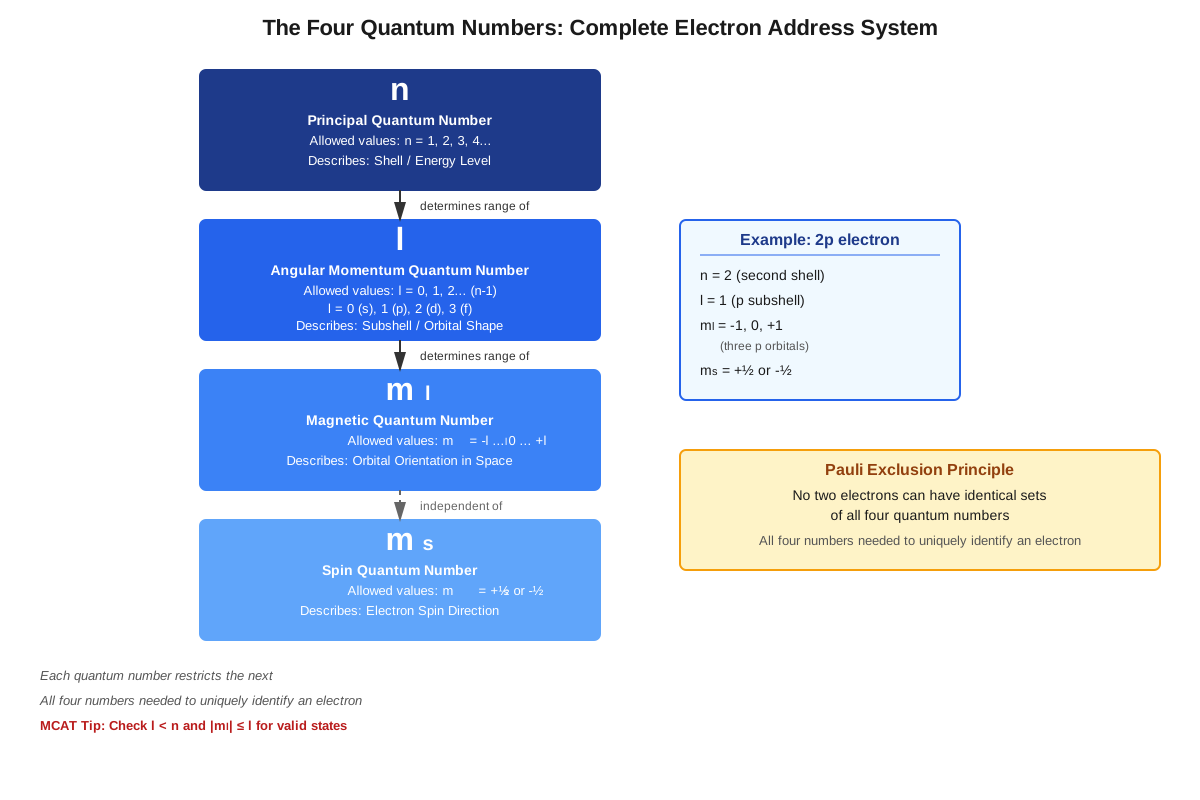
Quantum numbers consist of four distinct values that together specify the complete quantum state of an electron in an atom. Each quantum number provides specific information about the electron's energy, spatial distribution, and intrinsic properties.
Principal Quantum Number (n)
The principal quantum number, symbolized as n, determines the electron's energy level or shell and is the primary determinant of an electron's energy in a hydrogen atom. This quantum number can take any positive integer value: n = 1, 2, 3, 4, and so on.
Key characteristics of n:
- Indicates the relative size of the orbital (larger n means larger orbital)
- Determines the electron's average distance from the nucleus
- Relates to the shell designation (n = 1 is the K shell, n = 2 is the L shell, n = 3 is the M shell, etc.)
- The maximum number of electrons in a shell is given by 2n²
For example, when n = 1, the electron occupies the first shell closest to the nucleus with the lowest energy. When n = 3, the electron is in the third shell, farther from the nucleus and at higher energy. The energy difference between levels decreases as n increases, meaning the gap between n = 1 and n = 2 is much larger than between n = 5 and n = 6.
Angular Momentum Quantum Number (ℓ)
The angular momentum quantum number (also called the azimuthal quantum number), symbolized as ℓ, defines the shape of the orbital and the subshell to which the electron belongs. This quantum number can take integer values from 0 to (n - 1).
Relationship between ℓ values and orbital types:
| ℓ value | Subshell designation | Orbital shape | Number of orbitals |
|---|---|---|---|
| 0 | s | Spherical | 1 |
| 1 | p | Dumbbell/figure-eight | 3 |
| 2 | d | Complex (cloverleaf) | 5 |
| 3 | f | Very complex | 7 |
The angular momentum quantum number determines the orbital angular momentum of the electron. For a given principal quantum number n, there are n possible values of ℓ. For instance, when n = 3, ℓ can be 0, 1, or 2, corresponding to 3s, 3p, and 3d subshells respectively.
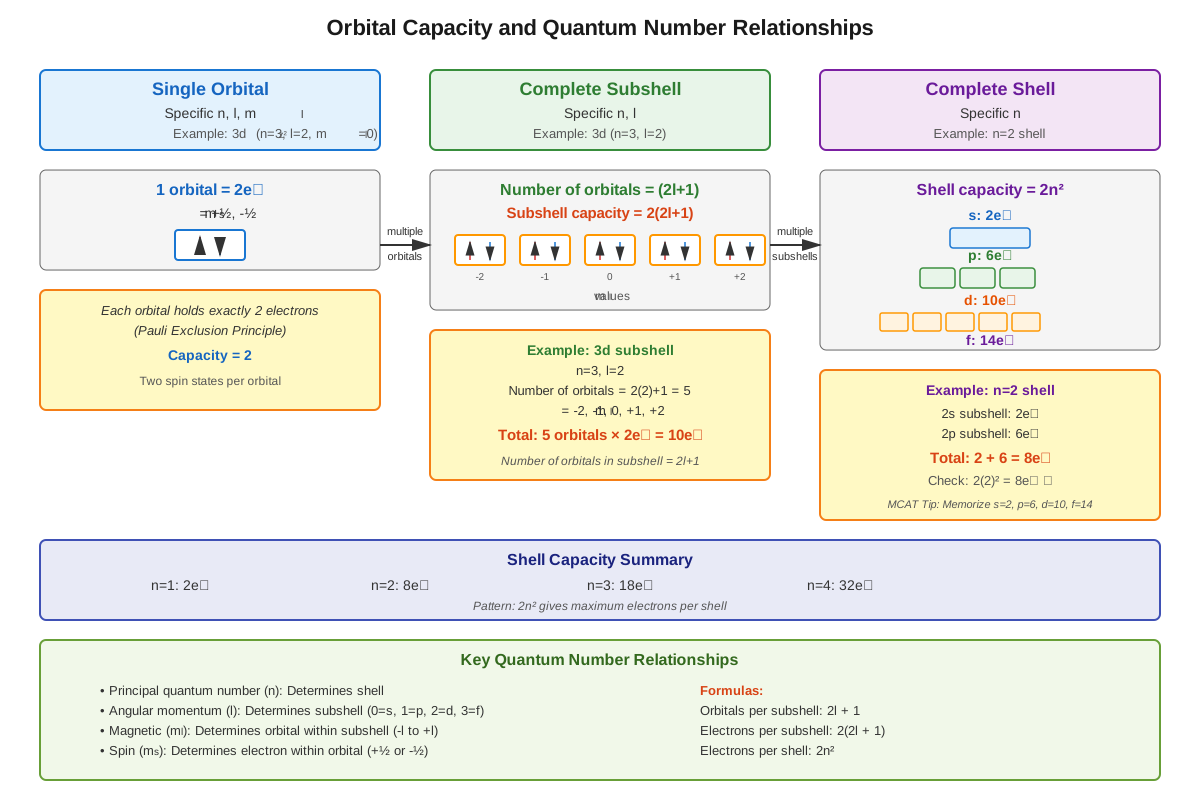
The number of orbitals in a subshell is given by (2ℓ + 1), which explains why s subshells have 1 orbital, p subshells have 3 orbitals, d subshells have 5 orbitals, and f subshells have 7 orbitals.
Magnetic Quantum Number (mℓ)
The magnetic quantum number, symbolized as mℓ (or sometimes m), specifies the orientation of the orbital in three-dimensional space. This quantum number can take integer values from -ℓ to +ℓ, including zero.
For a given value of ℓ, there are (2ℓ + 1) possible values of mℓ:
- When ℓ = 0 (s orbital): mℓ = 0 (one orientation)
- When ℓ = 1 (p orbitals): mℓ = -1, 0, +1 (three orientations: px, py, pz)
- When ℓ = 2 (d orbitals): mℓ = -2, -1, 0, +1, +2 (five orientations)
- When ℓ = 3 (f orbitals): mℓ = -3, -2, -1, 0, +1, +2, +3 (seven orientations)
The magnetic quantum number gets its name because these different orbital orientations become distinguishable in the presence of an external magnetic field, causing slight energy differences (Zeeman effect). In the absence of a magnetic field, all orbitals within a subshell are degenerate (have the same energy).
Spin Quantum Number (ms)
The spin quantum number, symbolized as ms (or s), describes the intrinsic angular momentum of the electron, commonly called "spin." This quantum number can only take one of two values: +½ or -½ (sometimes written as +1/2 and -1/2, or represented by arrows ↑ and ↓).
The spin quantum number is fundamentally different from the other three quantum numbers because it doesn't arise from the spatial properties of the electron's wave function but rather from the electron's intrinsic quantum mechanical property. The two possible values represent "spin up" and "spin down" states, though these terms are metaphorical—electrons don't literally spin like tops.
The Pauli exclusion principle states that no two electrons in an atom can have the same set of all four quantum numbers. Since an orbital is defined by specific values of n, ℓ, and mℓ, and since ms can only be +½ or -½, each orbital can hold a maximum of two electrons with opposite spins.
Quantum Number Rules and Restrictions
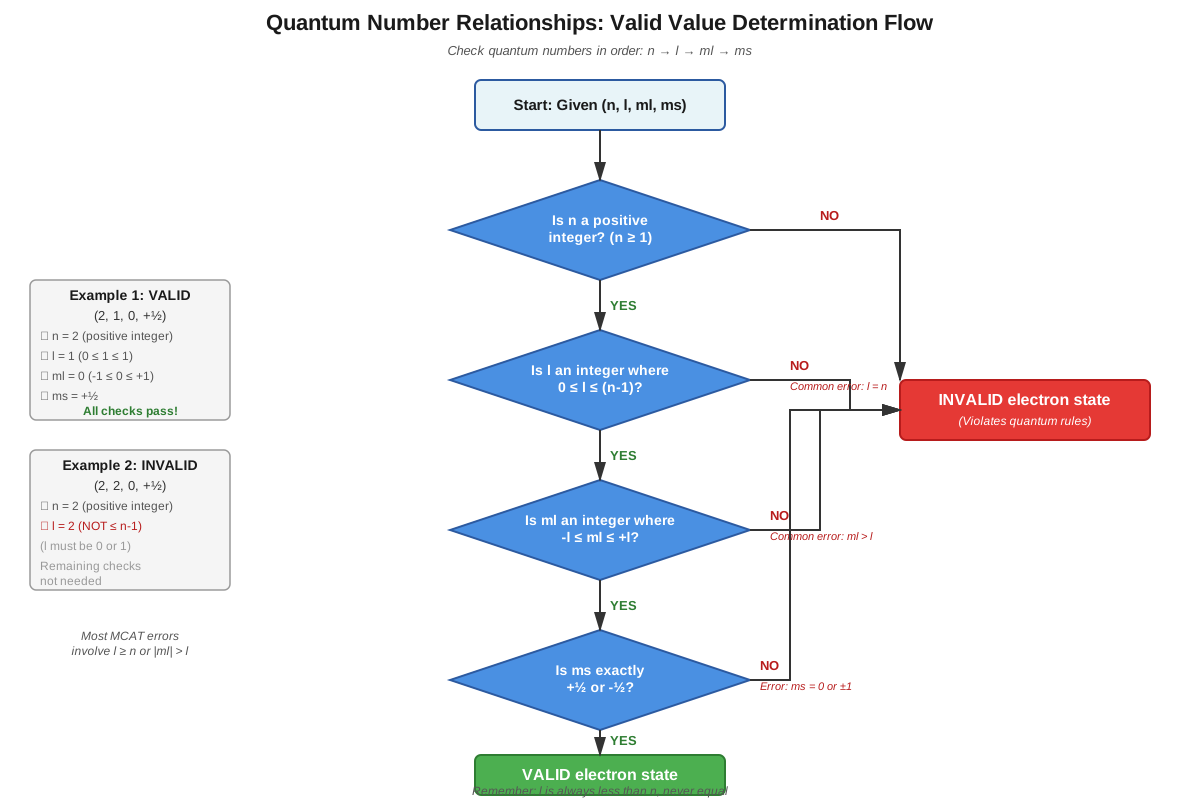
Understanding the allowed values and relationships between quantum numbers is crucial for MCAT success:
- n must be a positive integer: 1, 2, 3, 4...
- ℓ must be an integer from 0 to (n - 1)
- mℓ must be an integer from -ℓ to +ℓ
- ms must be either +½ or -½
These rules create specific constraints. For example:
- If n = 2, then ℓ can only be 0 or 1 (not 2 or higher)
- If ℓ = 1, then mℓ can be -1, 0, or +1 (not -2 or +2)
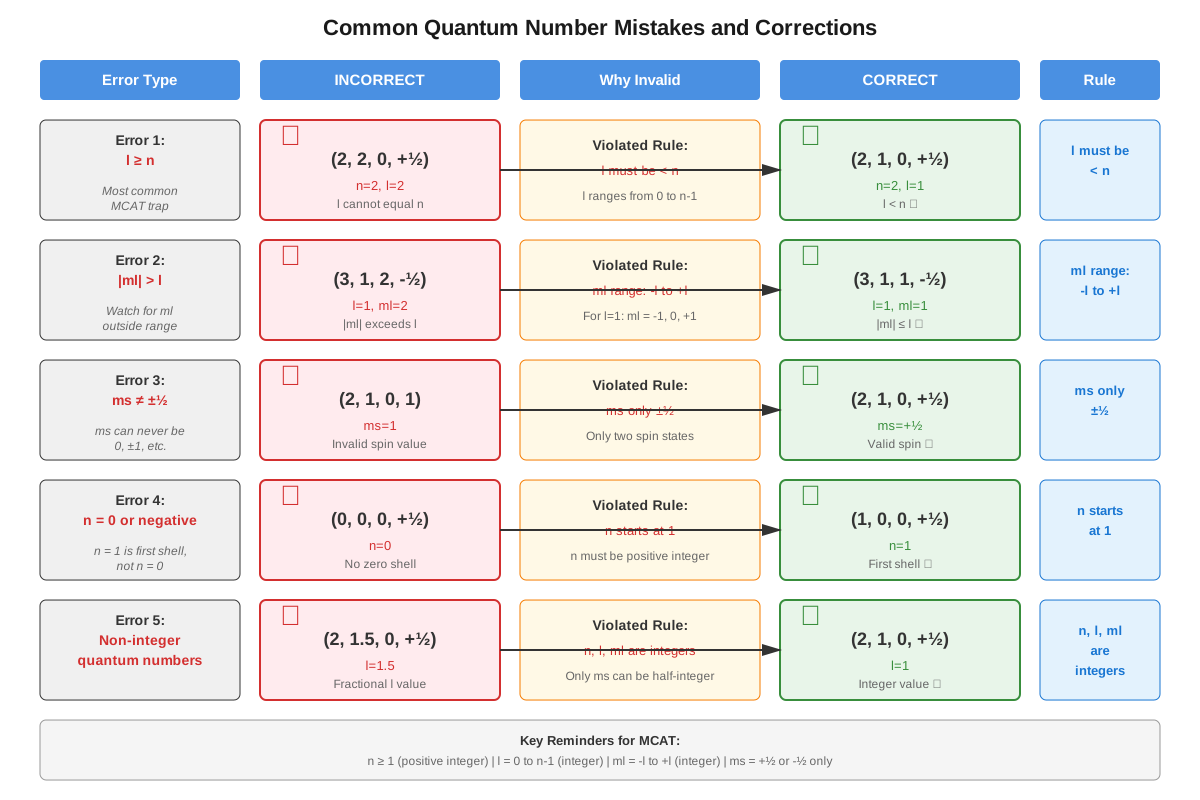
- The quantum number set (2, 2, 0, +½) is invalid because ℓ cannot equal n
- The quantum number set (3, 1, 2, -½) is invalid because mℓ cannot exceed ℓ
Electron Capacity Calculations
Quantum numbers allow calculation of maximum electron capacity at various levels:
For a single orbital (defined by n, ℓ, and mℓ): Maximum 2 electrons (differing only in ms)
For a subshell (defined by n and ℓ): Maximum electrons = 2(2ℓ + 1)
- s subshell (ℓ = 0): 2 electrons
- p subshell (ℓ = 1): 6 electrons
- d subshell (ℓ = 2): 10 electrons
- f subshell (ℓ = 3): 14 electrons
For a shell (defined by n): Maximum electrons = 2n²
- n = 1: 2 electrons
- n = 2: 8 electrons
- n = 3: 18 electrons
- n = 4: 32 electrons
Concept Relationships
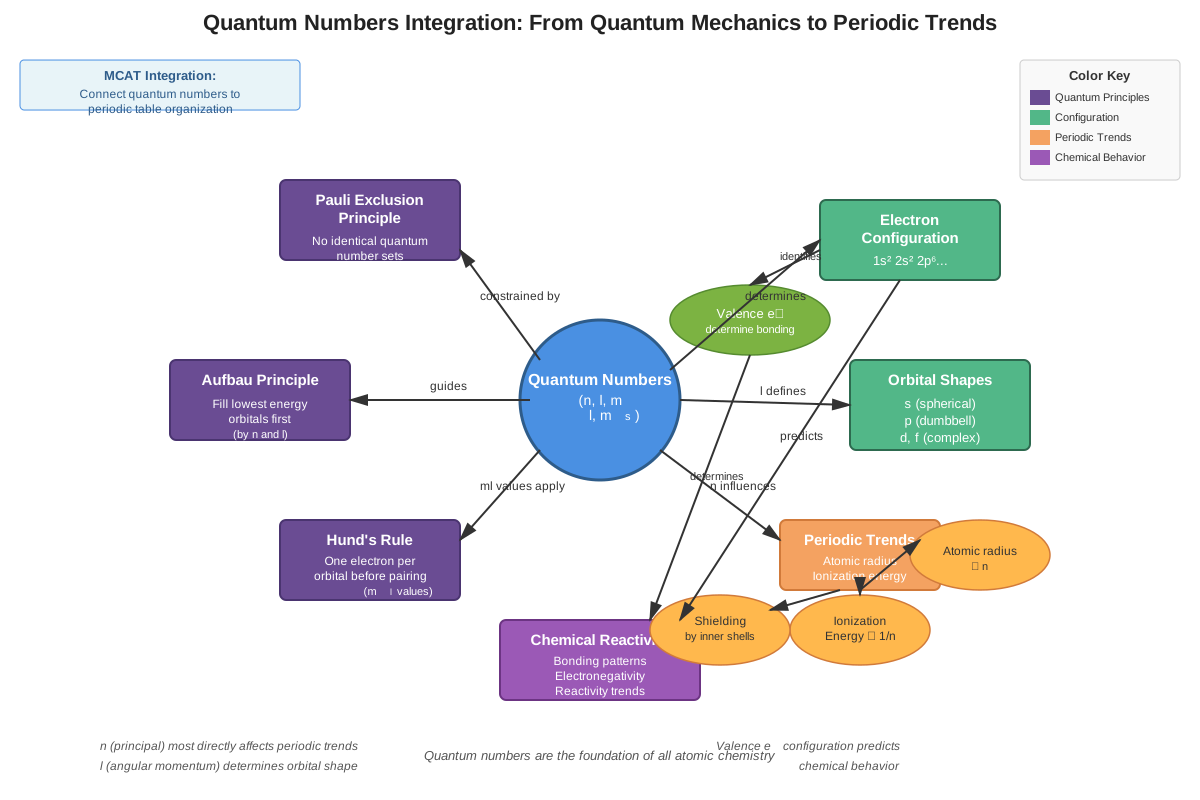
The four quantum numbers form a hierarchical system where each successive quantum number provides increasingly specific information about an electron's state. The principal quantum number (n) establishes the foundation by defining the shell and primary energy level → this constrains the angular momentum quantum number (ℓ) to values less than n, which defines the subshell and orbital shape → the value of ℓ then constrains the magnetic quantum number (mℓ) to a range of values that specify orbital orientation → finally, the spin quantum number (ms) distinguishes between the two electrons that can occupy the same orbital.
This hierarchical relationship connects directly to electron configuration principles. When writing electron configurations, the notation 3p⁴ implicitly contains quantum number information: the "3" represents n = 3, the "p" indicates ℓ = 1, and the superscript "4" tells us four electrons are distributed among the three p orbitals (mℓ = -1, 0, +1) according to Hund's rule, with specific ms values.
Quantum numbers provide the theoretical foundation for periodic trends. Elements in the same group have similar valence electron configurations (same ℓ value for outermost electrons), explaining their similar chemical properties. The filling order of subshells based on increasing energy (1s, 2s, 2p, 3s, 3p, 4s, 3d...) reflects the combined effects of n and ℓ on electron energy in multi-electron atoms.
The connection extends to atomic spectroscopy: when electrons transition between quantum states (different n values), they absorb or emit photons with energies equal to the difference between energy levels. The discrete nature of quantum numbers explains why atomic spectra consist of discrete lines rather than continuous bands.
Understanding quantum numbers also enables comprehension of magnetism in atoms. Unpaired electrons (orbitals with only one electron, thus only one ms value occupied) create magnetic moments, explaining paramagnetism. Paired electrons (both ms values occupied in an orbital) have canceling magnetic moments, contributing to diamagnetism.
High-Yield Facts
⭐ The four quantum numbers are n (principal), ℓ (angular momentum), mℓ (magnetic), and ms (spin), and they completely describe an electron's quantum state.
⭐ The Pauli exclusion principle states that no two electrons in an atom can have identical sets of all four quantum numbers.
⭐ The principal quantum number n can be any positive integer (1, 2, 3...), and the maximum number of electrons in a shell is 2n².
⭐ The angular momentum quantum number ℓ ranges from 0 to (n-1), with ℓ = 0, 1, 2, 3 corresponding to s, p, d, f subshells respectively.
⭐ The magnetic quantum number mℓ ranges from -ℓ to +ℓ in integer steps, giving (2ℓ + 1) orbitals per subshell.
- The spin quantum number ms can only be +½ or -½, representing the two possible spin states of an electron.
- Each orbital (defined by unique n, ℓ, and mℓ values) can hold a maximum of two electrons with opposite spins.
- The number of orbitals in a subshell equals (2ℓ + 1): s has 1, p has 3, d has 5, f has 7 orbitals.
- For n = 3, the possible subshells are 3s (ℓ = 0), 3p (ℓ = 1), and 3d (ℓ = 2); 3f does not exist because ℓ cannot equal or exceed n.
- In a multi-electron atom, electrons in the same subshell (same n and ℓ) but different orbitals (different mℓ) have the same energy in the absence of external fields (degenerate orbitals).
- The quantum number set must satisfy all restrictions simultaneously: if any single rule is violated, the entire set is invalid.
- The maximum number of electrons in subshells: s = 2, p = 6, d = 10, f = 14, calculated as 2(2ℓ + 1).
Quick check — test yourself on Quantum numbers so far.
Try Flashcards →Common Misconceptions
Misconception: The principal quantum number n can be zero or negative.
Correction: The principal quantum number must be a positive integer (1, 2, 3, 4...). The value n = 0 is not physically meaningful because it would imply an electron with zero energy at zero distance from the nucleus, which violates quantum mechanical principles.
Misconception: An electron with n = 3 can have ℓ = 3.
Correction: The angular momentum quantum number ℓ must be less than n, ranging from 0 to (n-1). For n = 3, the maximum value of ℓ is 2, corresponding to the 3d subshell. The 3f subshell does not exist. This is one of the most commonly tested violations on the MCAT.
Misconception: The magnetic quantum number mℓ can take any integer value.
Correction: The magnetic quantum number is constrained by ℓ and must range from -ℓ to +ℓ. For example, if ℓ = 1 (p orbital), mℓ can only be -1, 0, or +1. A value like mℓ = 2 would be invalid for a p orbital.
Misconception: The spin quantum number ms can be any fraction or integer.
Correction: The spin quantum number can only be +½ or -½ (sometimes written as +0.5 or -0.5). These are the only two possible values. Values like 0, 1, or ¾ are invalid for ms.
Misconception: Two electrons in the same orbital can have the same spin.
Correction: The Pauli exclusion principle requires that electrons in the same orbital (same n, ℓ, and mℓ) must have opposite spins (different ms values). If two electrons had the same spin, all four quantum numbers would be identical, violating the exclusion principle.
Misconception: All orbitals within a shell have the same energy.
Correction: In multi-electron atoms, orbitals with different ℓ values have different energies even within the same shell due to electron-electron repulsion and shielding effects. For example, 3s < 3p < 3d in terms of energy. Only orbitals within the same subshell (same n and ℓ) are degenerate in the absence of external fields.
Misconception: The quantum number set (4, 2, -1, 0) is valid.
Correction: This set is invalid because ms must be ±½, not 0. The spin quantum number cannot be zero; it must be either +½ or -½.
Misconception: Quantum numbers only apply to hydrogen atoms.
Correction: Quantum numbers apply to all atoms. While the energy levels are simplest in hydrogen (depending only on n), the quantum number system describes electron states in all atoms. In multi-electron atoms, both n and ℓ affect energy due to electron-electron interactions.
Worked Examples
Example 1: Identifying Valid Quantum Number Sets
Question: Which of the following sets of quantum numbers (n, ℓ, mℓ, ms) represents a valid electron state?
A) (3, 2, -1, +½)
B) (2, 2, 0, -½)
C) (4, 1, 2, +½)
D) (3, 1, 0, 0)
Solution:
Let's evaluate each set systematically by checking all quantum number rules:
Option A: (3, 2, -1, +½)
- Check n: n = 3 is a positive integer ✓
- Check ℓ: ℓ = 2, and 0 ≤ 2 ≤ (3-1) = 2 ✓
- Check mℓ: mℓ = -1, and -2 ≤ -1 ≤ +2 ✓
- Check ms: ms = +½ is one of the two allowed values ✓
- This set is VALID (represents an electron in a 3d orbital)
Option B: (2, 2, 0, -½)
- Check n: n = 2 is a positive integer ✓
- Check ℓ: ℓ = 2, but ℓ must be ≤ (n-1) = 1 ✗
- This set is INVALID because ℓ cannot equal n
Option C: (4, 1, 2, +½)
- Check n: n = 4 is a positive integer ✓
- Check ℓ: ℓ = 1, and 0 ≤ 1 ≤ (4-1) = 3 ✓
- Check mℓ: mℓ = 2, but for ℓ = 1, mℓ must be between -1 and +1 ✗
- This set is INVALID because mℓ exceeds ℓ
Option D: (3, 1, 0, 0)
- Check n: n = 3 is a positive integer ✓
- Check ℓ: ℓ = 1, and 0 ≤ 1 ≤ (3-1) = 2 ✓
- Check mℓ: mℓ = 0, and -1 ≤ 0 ≤ +1 ✓
- Check ms: ms = 0, but ms must be ±½ ✗
- This set is INVALID because ms cannot be zero
Answer: A
This question demonstrates the importance of checking each quantum number against its specific rules. The MCAT frequently includes sets that violate just one rule, requiring careful systematic evaluation.
Example 2: Calculating Electron Capacity
Question: An atom has electrons filling all orbitals through the n = 3 shell. How many total electrons does this atom contain, and what element is it?
Solution:
To find the total number of electrons, we need to calculate the capacity of each shell and sum them:
Shell n = 1:
- Maximum electrons = 2n² = 2(1)² = 2 electrons
- Contains: 1s² (one s subshell with 2 electrons)
Shell n = 2:
- Maximum electrons = 2n² = 2(2)² = 8 electrons
- Contains: 2s² 2p⁶ (one s subshell with 2 electrons + one p subshell with 6 electrons)
Shell n = 3:
- Maximum electrons = 2n² = 2(3)² = 18 electrons
- Contains: 3s² 3p⁶ 3d¹⁰ (one s subshell with 2 electrons + one p subshell with 6 electrons + one d subshell with 10 electrons)
Total electrons = 2 + 8 + 18 = 28 electrons
An atom with 28 electrons (and therefore 28 protons in a neutral atom) is nickel (Ni).
Verification using subshell capacities:
- s subshells (ℓ = 0): 2(2×0 + 1) = 2 electrons each
- p subshells (ℓ = 1): 2(2×1 + 1) = 6 electrons each
- d subshells (ℓ = 2): 2(2×2 + 1) = 10 electrons each
This example illustrates how quantum numbers directly determine electron configuration and atomic identity. Understanding the relationship between n, the number of subshells, and electron capacity is essential for quickly solving MCAT problems involving electron configuration.
Additional insight: Note that in reality, the 4s orbital fills before 3d due to energy considerations in multi-electron atoms, so the actual electron configuration of nickel is [Ar] 4s² 3d⁸ rather than filling 3d completely first. However, this question asks specifically about the capacity through n = 3, testing pure quantum number knowledge rather than filling order.
Exam Strategy
Approaching Quantum Number Questions
When encountering quantum number problems on the MCAT, employ this systematic approach:
- Identify what's being asked: Is the question asking you to validate a quantum number set, determine electron capacity, or connect quantum numbers to electron configuration?
- Check restrictions in order: Always evaluate quantum numbers in the sequence n → ℓ → mℓ → ms, because each depends on the previous one. This prevents wasted time checking later quantum numbers when an earlier one is already invalid.
- Use the process of elimination aggressively: MCAT questions often include answer choices with common violations. Quickly eliminate options that violate basic rules (ℓ ≥ n, |mℓ| > ℓ, ms ≠ ±½).
Trigger Words and Phrases
Watch for these key phrases that signal quantum number concepts:
- "Valid electron state" or "possible set of quantum numbers": Check all four quantum number restrictions
- "Maximum number of electrons": Calculate using 2n² for shells, 2(2ℓ + 1) for subshells, or 2 for individual orbitals
- "Orbital orientation" or "spatial orientation": Focus on mℓ values
- "Same subshell": Electrons share the same n and ℓ values
- "Degenerate orbitals": Orbitals with the same energy (same n and ℓ, different mℓ)
- "Pauli exclusion principle": No two electrons can have identical sets of all four quantum numbers
Common Trap Patterns
The MCAT frequently includes these trap answers:
- ℓ = n: This is always invalid; ℓ must be less than n
- ms = 0 or ms = 1: The spin quantum number can only be ±½
- mℓ values outside the range -ℓ to +ℓ: For example, mℓ = 2 when ℓ = 1
- Confusing subshell capacity with orbital capacity: An orbital holds 2 electrons, but a p subshell holds 6
Time Management
Quantum number questions typically require 30-60 seconds if you know the rules well. If a question asks you to evaluate multiple quantum number sets:
- Scan all options first to identify obvious violations
- Eliminate clearly wrong answers before detailed analysis
- Don't waste time double-checking valid sets once you've confirmed all four quantum numbers follow the rules
For calculation questions (electron capacity), memorize the key formulas (2n², 2(2ℓ + 1)) to avoid deriving them under time pressure. These calculations should take no more than 20-30 seconds.
Memory Techniques
Mnemonic for Subshell Letters
"Smart Professors Don't Fail" helps remember the subshell sequence:
- Smart = s subshell (ℓ = 0)
- Professors = p subshell (ℓ = 1)
- Don't = d subshell (ℓ = 2)
- Fail = f subshell (ℓ = 3)
Quantum Number Hierarchy Visualization
Think of quantum numbers as a mailing address system:
- n = Country (broadest category, defines the shell)
- ℓ = State/Province (defines the subshell within the shell)
- mℓ = Street address (specific orbital within the subshell)
- ms = Apartment number (which of two electrons in the orbital)
Just as you need all four parts to uniquely identify a location, you need all four quantum numbers to uniquely identify an electron.
Remembering Quantum Number Ranges
"Never Less than zero, More than ℓ, Spin is half":
- Never: n is never zero or negative (starts at 1)
- Less than zero: ℓ starts at zero and goes up to (n-1)
- More than ℓ: mℓ cannot exceed ℓ in magnitude
- Spin is half: ms is always ±½
Electron Capacity Quick Reference
Use the "2-6-10-14 pattern" for subshell capacities:
- s holds 2 (remember: "s" looks like 2)
- p holds 6 (remember: "p" has 6 strokes when written in print)
- d holds 10 (remember: "d" for "decade" = 10)
- f holds 14 (remember: "f" for "fortnight" = 14 days)
Pauli Exclusion Principle Memory Aid
"No two electrons can share all four numbers" - imagine electrons as people with social security numbers; each must have a unique complete identifier. If three quantum numbers match, the fourth (ms) must differ.
Summary
Quantum numbers provide a complete mathematical description of electron states in atoms, forming the foundation for understanding atomic structure, electron configuration, and periodic trends. The four quantum numbers—principal (n), angular momentum (ℓ), magnetic (mℓ), and spin (ms)—work hierarchically to specify an electron's energy level, orbital shape, spatial orientation, and spin state. The principal quantum number determines the shell and primary energy, ranging from 1 to infinity. The angular momentum quantum number defines the subshell (s, p, d, f) and ranges from 0 to (n-1). The magnetic quantum number specifies orbital orientation within a subshell, ranging from -ℓ to +ℓ. The spin quantum number distinguishes between the two electrons in an orbital, taking values of +½ or -½. The Pauli exclusion principle requires that no two electrons share identical sets of all four quantum numbers, limiting each orbital to two electrons with opposite spins. Understanding these rules enables calculation of electron capacities (2n² per shell, 2(2ℓ+1) per subshell), validation of quantum number sets, and prediction of atomic properties—all essential skills for MCAT success in General Chemistry.
Key Takeaways
- The four quantum numbers (n, ℓ, mℓ, ms) completely and uniquely describe any electron's quantum state in an atom
- Quantum numbers follow strict hierarchical rules: n ≥ 1, 0 ≤ ℓ ≤ (n-1), -ℓ ≤ mℓ ≤ +ℓ, ms = ±½
- The Pauli exclusion principle states no two electrons can have identical sets of all four quantum numbers, limiting orbitals to two electrons
- Maximum electron capacity formulas: 2n² for shells, 2(2ℓ+1) for subshells, 2 for individual orbitals
- Subshell designations (s, p, d, f) correspond to ℓ values (0, 1, 2, 3) and contain 1, 3, 5, 7 orbitals respectively
- MCAT questions typically test quantum number validity, electron capacity calculations, and connections to electron configuration
- Systematic checking of quantum number restrictions in order (n → ℓ → mℓ → ms) efficiently identifies invalid sets
Related Topics
Electron Configuration: Quantum numbers provide the theoretical basis for electron configuration notation and filling order. Mastering quantum numbers enables understanding of why electrons fill orbitals in specific sequences and how to write ground-state and excited-state configurations.
Periodic Trends: The organization of the periodic table directly reflects quantum mechanical principles. Elements in the same group have similar valence electron configurations (same ℓ values), explaining periodic trends in ionization energy, atomic radius, and electronegativity.
Atomic Spectroscopy: Electron transitions between quantum states (different n values) produce atomic spectra. Understanding quantum numbers explains why atomic spectra are discrete rather than continuous and enables calculation of photon energies.
Molecular Orbital Theory: Quantum numbers extend to molecular systems where atomic orbitals combine to form molecular orbitals. The principles learned here apply to understanding bonding and antibonding orbitals.
Magnetism and Paramagnetism: The spin quantum number explains magnetic properties of atoms and ions. Unpaired electrons (incomplete ms pairing) create paramagnetic behavior, while paired electrons result in diamagnetism.
Practice CTA
Now that you've mastered the theoretical foundation of quantum numbers, it's time to solidify your understanding through active practice. Challenge yourself with practice questions that require you to identify valid quantum number sets, calculate electron capacities, and connect quantum numbers to real chemical systems. Use flashcards to drill the quantum number rules and restrictions until they become automatic. The difference between knowing quantum numbers conceptually and applying them rapidly under exam conditions comes from deliberate practice. Your investment in mastering this foundational topic will pay dividends throughout your MCAT preparation, as quantum numbers underpin countless questions in atomic structure, bonding, and periodic trends. You've got this—now prove it with practice!
Sign up free to keep reading
Create a free AnvayaPrep account to finish this MCAT guide on Quantum numbers — plus flashcards and practice questions.