Overview
Cell potential is a fundamental concept in electrochemistry that quantifies the driving force behind electron transfer in oxidation-reduction (redox) reactions. In the context of General Chemistry, cell potential represents the voltage difference between two half-cells in an electrochemical cell and determines whether a redox reaction will proceed spontaneously. Understanding cell potential is essential for predicting reaction spontaneity, calculating equilibrium constants, and analyzing energy transformations in chemical systems. The cell potential MCAT questions frequently test students' ability to interpret standard reduction potentials, calculate cell voltages under various conditions, and connect electrochemical principles to thermodynamic concepts.
For the MCAT, cell potential serves as a bridge between multiple high-yield topics including thermodynamics, kinetics, and acid-base chemistry. The exam regularly presents passages involving biological electron transport chains, concentration cells, and electrochemical sensors, all of which require mastery of cell potential calculations and conceptual understanding. Students must be comfortable manipulating the Nernst equation, interpreting reduction potential tables, and predicting the direction of electron flow in galvanic and electrolytic cells.
Cell potential General Chemistry concepts integrate seamlessly with broader MCAT themes, particularly in biochemistry (electron transport chain, oxidative phosphorylation) and physics (electrical circuits, energy conservation). The quantitative nature of cell potential calculations makes this topic particularly high-yield, as the MCAT frequently tests mathematical problem-solving skills within scientific contexts. Mastering cell potential provides students with powerful tools for analyzing energy transformations and predicting chemical behavior across multiple disciplines tested on the exam.
Learning Objectives
- [ ] Define cell potential using accurate General Chemistry terminology
- [ ] Explain why cell potential matters for the MCAT
- [ ] Apply cell potential to exam-style questions
- [ ] Identify common mistakes related to cell potential
- [ ] Connect cell potential to related General Chemistry concepts
- [ ] Calculate standard cell potential from reduction potential tables
- [ ] Use the Nernst equation to determine cell potential under non-standard conditions
- [ ] Predict reaction spontaneity from cell potential values and relate to Gibbs free energy
- [ ] Distinguish between galvanic and electrolytic cells based on cell potential
Prerequisites
- Oxidation-reduction reactions: Understanding electron transfer, oxidation states, and balancing redox equations is essential for identifying which species are oxidized or reduced in electrochemical cells
- Thermodynamics fundamentals: Knowledge of Gibbs free energy, spontaneity, and the relationship between ΔG and equilibrium constants provides the foundation for connecting cell potential to reaction favorability
- Basic electrochemistry terminology: Familiarity with anodes, cathodes, oxidation, and reduction enables proper interpretation of cell diagrams and half-reactions
- Logarithms and exponentials: Mathematical facility with natural logarithms is necessary for manipulating the Nernst equation and relating cell potential to concentration
- Stoichiometry and molarity: Calculating concentrations and understanding mole ratios is required for applying the Nernst equation to real systems
Why This Topic Matters
Cell potential concepts appear with remarkable frequency on the MCAT, typically in 2-4 discrete questions per exam and in at least one passage-based question set. The Chemical and Physical Foundations of Biological Systems section regularly features electrochemistry passages involving biological redox systems, batteries, or analytical techniques like potentiometry. Understanding cell potential is crucial for interpreting data about mitochondrial electron transport, where the sequential transfer of electrons through protein complexes with progressively more positive reduction potentials drives ATP synthesis.
In clinical and research contexts, cell potential principles underlie numerous diagnostic and therapeutic applications. Blood glucose meters use electrochemical sensors that generate measurable voltages proportional to glucose concentration. Nerve impulse transmission depends on electrochemical gradients across cell membranes, creating potential differences that propagate signals. Cardiac pacemakers rely on controlled electrochemical reactions to generate electrical impulses. Understanding cell potential also illuminates how organisms extract energy from nutrients through controlled electron transfer, making this topic essential for comprehending metabolism and bioenergetics.
MCAT passages commonly present cell potential in several formats: experimental setups measuring voltages under varying conditions, biological systems involving electron carriers (NAD+/NADH, FAD/FADH2), comparison of different battery types, or analytical chemistry applications. Questions may ask students to calculate cell potentials, predict spontaneity, determine concentration from voltage measurements, or explain why certain reactions occur in specific sequences. The integration of quantitative calculations with conceptual understanding makes cell potential a discriminating topic that separates high-scoring students from average performers.
Core Concepts
Standard Cell Potential (E°cell)
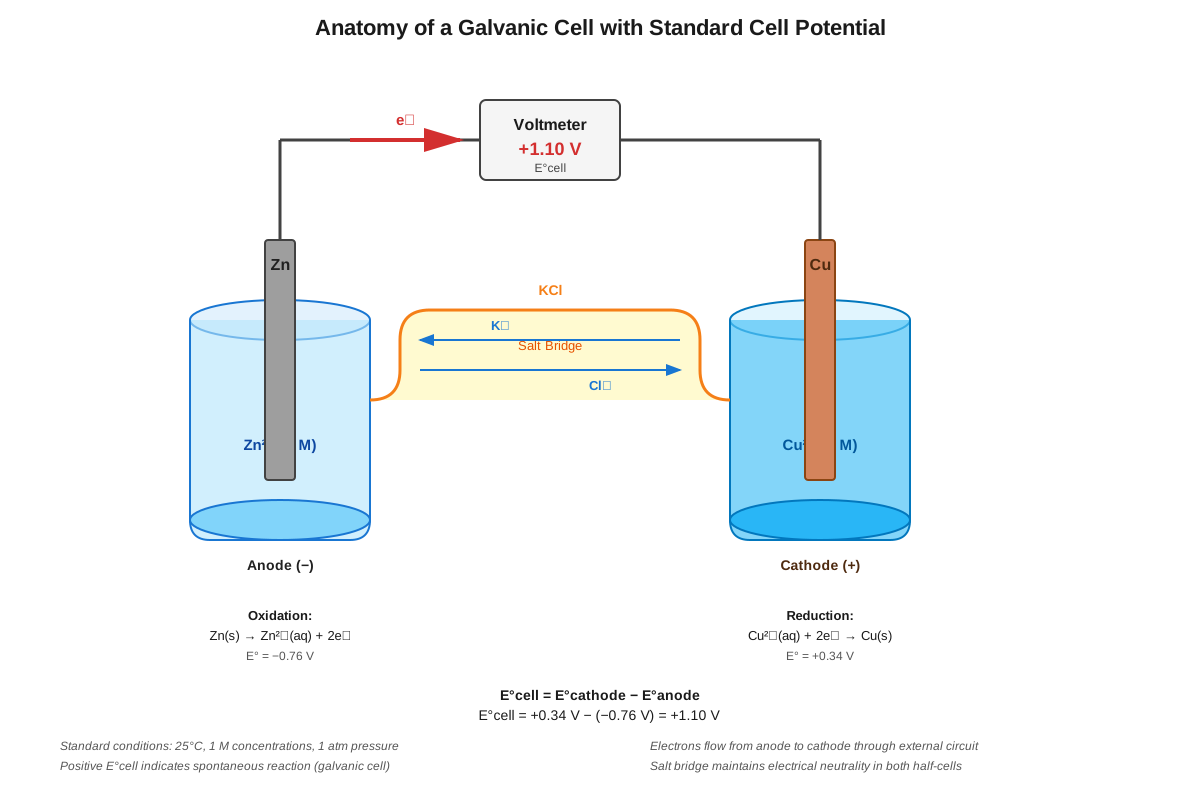
Standard cell potential (E°cell) represents the voltage difference between two electrodes when all species are at standard conditions: 1 M concentration for aqueous species, 1 atm pressure for gases, and 25°C (298 K) temperature. This value quantifies the intrinsic driving force for electron transfer in a redox reaction. The standard cell potential is calculated by subtracting the standard reduction potential of the anode (oxidation half-reaction) from that of the cathode (reduction half-reaction):
E°cell = E°cathode - E°anodeAlternatively, since oxidation is the reverse of reduction:
E°cell = E°reduction + E°oxidationwhere E°oxidation = -E°reduction for the species being oxidized.
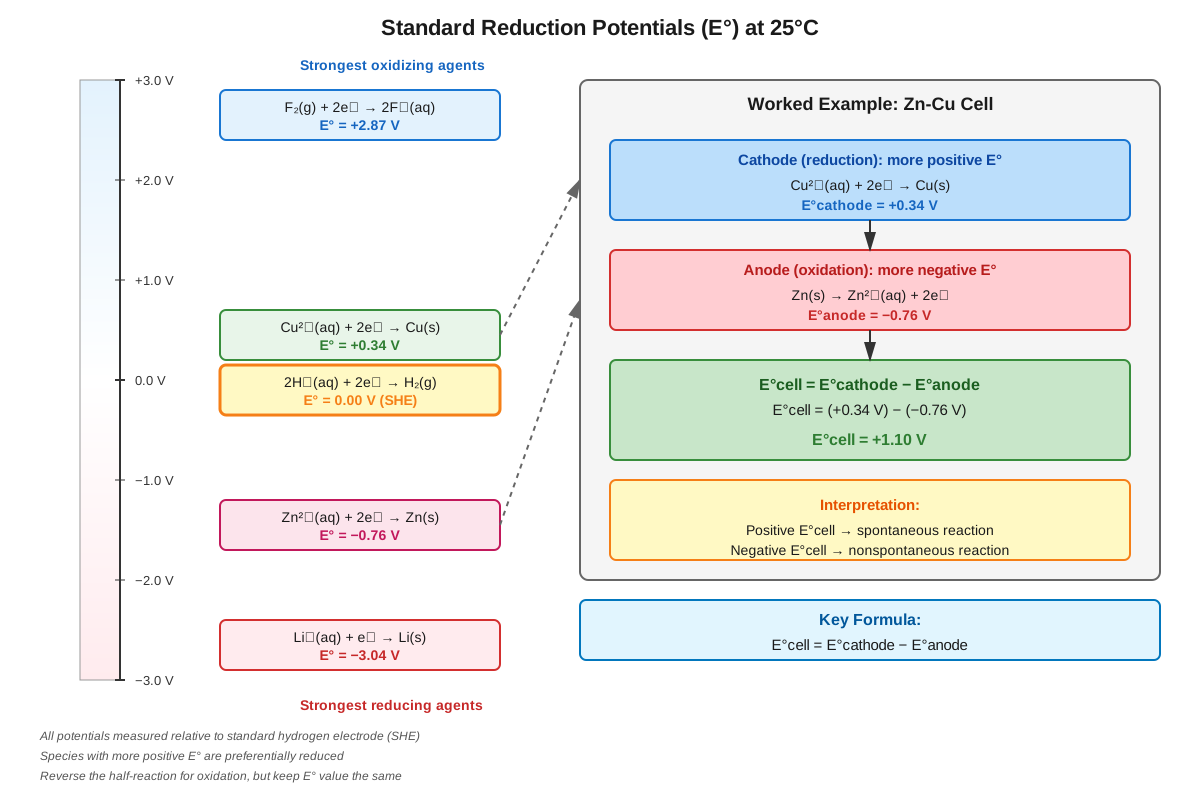
Standard reduction potentials are tabulated values measured relative to the standard hydrogen electrode (SHE), which is arbitrarily assigned a potential of 0.00 V. Species with more positive reduction potentials are stronger oxidizing agents (more readily reduced), while those with more negative reduction potentials are stronger reducing agents (more readily oxidized). The MCAT provides reduction potential tables when needed, but students must know how to interpret and apply them correctly.
Relationship Between Cell Potential and Spontaneity
The sign and magnitude of cell potential directly indicate reaction spontaneity through its relationship with Gibbs free energy:
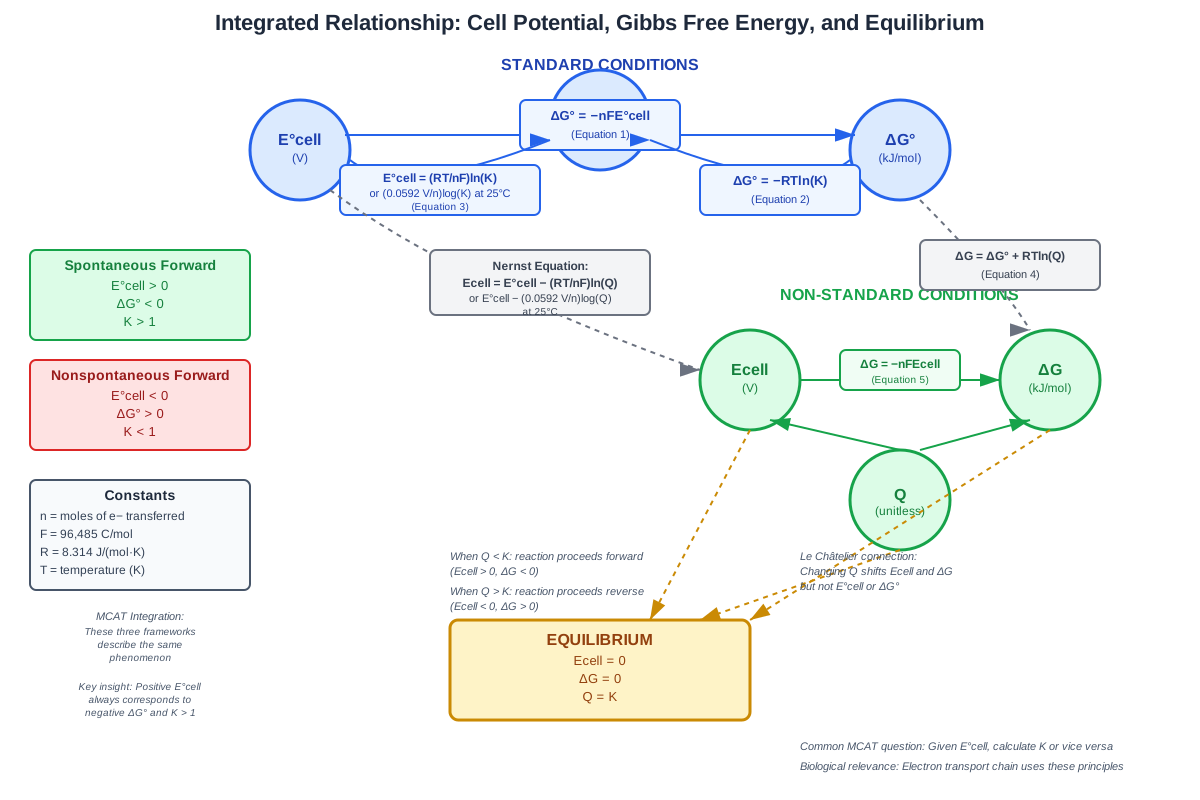
ΔG = -nFE°cellwhere:
- ΔG = Gibbs free energy change (J/mol)
- n = number of moles of electrons transferred
- F = Faraday's constant (96,485 C/mol or approximately 96,500 C/mol)
- E°cell = standard cell potential (V)
This equation reveals three critical relationships:
| E°cell | ΔG | Reaction Spontaneity | Cell Type |
|---|---|---|---|
| Positive (> 0) | Negative (< 0) | Spontaneous | Galvanic (voltaic) |
| Zero (= 0) | Zero (= 0) | At equilibrium | Neither |
| Negative (< 0) | Positive (> 0) | Non-spontaneous | Electrolytic (requires external voltage) |
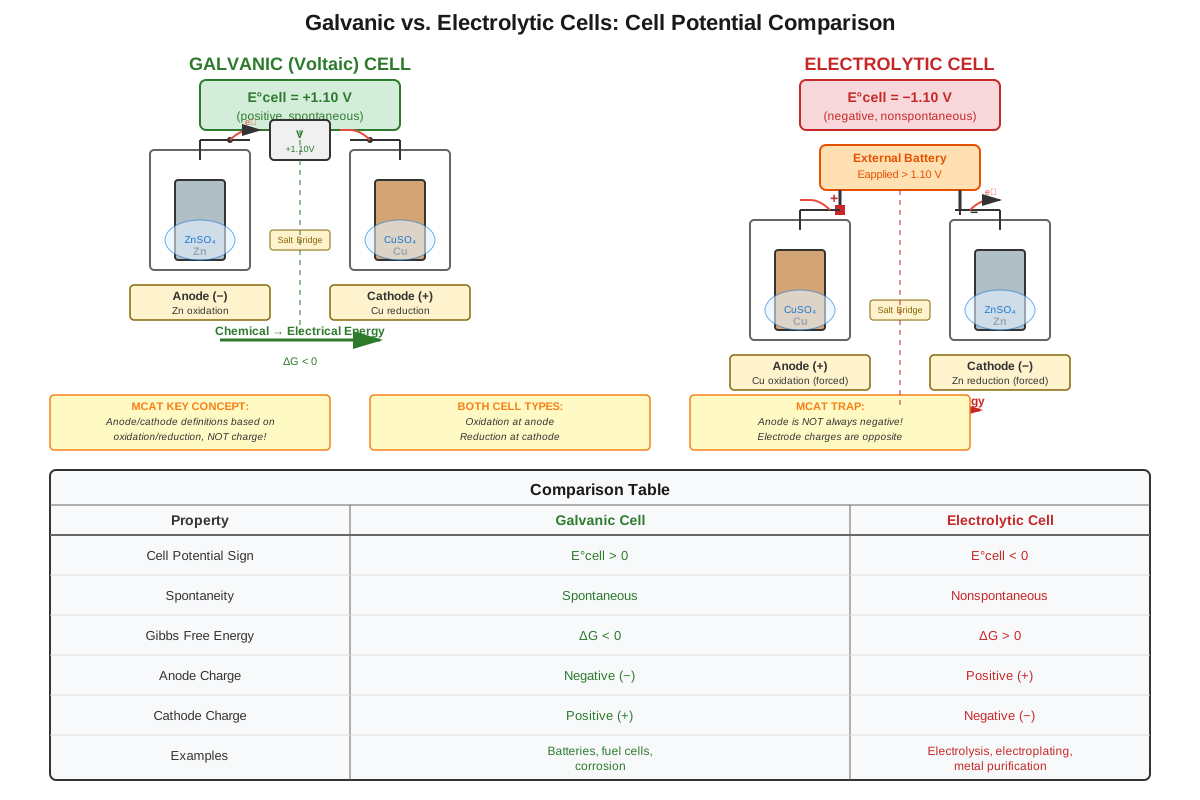
A galvanic cell (also called a voltaic cell) operates spontaneously, converting chemical energy into electrical energy. A electrolytic cell requires external electrical energy to drive a non-spontaneous reaction, converting electrical energy into chemical energy. The MCAT frequently tests the ability to distinguish these cell types and predict which reactions will occur spontaneously.
The Nernst Equation
The Nernst equation extends cell potential calculations to non-standard conditions, accounting for the effects of concentration, pressure, and temperature:
Ecell = E°cell - (RT/nF) × ln(Q)At 25°C (298 K), this simplifies to:
Ecell = E°cell - (0.0592/n) × log(Q)where:
- Ecell = cell potential under non-standard conditions
- E°cell = standard cell potential
- R = gas constant (8.314 J/mol·K)
- T = temperature (K)
- n = moles of electrons transferred
- F = Faraday's constant
- Q = reaction quotient
The reaction quotient Q is calculated using the same principles as equilibrium constants, with products in the numerator and reactants in the denominator, each raised to their stoichiometric coefficients. Pure solids and liquids are omitted from Q.
The Nernst equation reveals that:
- Increasing product concentration decreases cell potential
- Increasing reactant concentration increases cell potential
- At equilibrium, Ecell = 0 and Q = K
Relationship to Equilibrium Constant
At equilibrium, the cell potential equals zero, allowing derivation of the relationship between standard cell potential and the equilibrium constant:
E°cell = (0.0592/n) × log(K)This equation demonstrates that:
- Large positive E°cell values correspond to large K values (products strongly favored)
- Large negative E°cell values correspond to small K values (reactants strongly favored)
- E°cell = 0 corresponds to K = 1 (equal concentrations at equilibrium)
This relationship provides a powerful tool for connecting electrochemical measurements to thermodynamic equilibrium, a connection the MCAT frequently exploits in integrated questions.
Concentration Cells
A concentration cell consists of two identical electrodes immersed in solutions of the same species but at different concentrations. Despite having E°cell = 0 (since both half-reactions involve the same species), these cells generate voltage due to concentration differences. The Nernst equation predicts that electrons flow from the lower concentration electrode (anode) to the higher concentration electrode (cathode), driven by the tendency to equalize concentrations.
For a concentration cell:
Ecell = (0.0592/n) × log([cathode]/[anode])Concentration cells illustrate the fundamental principle that chemical systems spontaneously move toward equilibrium, generating electrical energy in the process. The MCAT uses concentration cells to test conceptual understanding of the Nernst equation and the relationship between concentration gradients and electrical potential.
Reduction Potential Tables and Predicting Reactions
Standard reduction potential tables list half-reactions in order of decreasing reduction potential. To predict whether a redox reaction will occur spontaneously:
- Identify the two half-reactions involved
- The species with the more positive reduction potential will be reduced (cathode)
- The species with the more negative reduction potential will be oxidized (anode)
- Calculate E°cell = E°cathode - E°anode
- If E°cell > 0, the reaction is spontaneous as written
This systematic approach prevents errors and provides a reliable method for analyzing complex redox scenarios. The MCAT may present reduction potentials in non-standard order or require students to identify which of several possible reactions will occur preferentially.
Concept Relationships
Cell potential serves as the central organizing principle connecting multiple electrochemistry concepts. The standard reduction potential of individual half-reactions combines to produce standard cell potential, which directly determines reaction spontaneity through the relationship with Gibbs free energy. This thermodynamic connection extends to equilibrium constants, creating a unified framework for understanding chemical favorability.
The Nernst equation modifies standard cell potential based on concentration and temperature, demonstrating how cell potential responds to changing conditions. This relationship explains concentration cells, where identical electrodes at different concentrations generate voltage despite having zero standard cell potential. The Nernst equation also reveals that at equilibrium, cell potential equals zero, connecting electrochemical measurements to equilibrium thermodynamics.
The distinction between galvanic cells (positive cell potential, spontaneous) and electrolytic cells (negative cell potential, non-spontaneous) flows directly from the sign of cell potential. This classification connects to practical applications: galvanic cells include batteries and biological electron transport, while electrolytic cells enable electroplating and electrolysis.
Relationship map:
Standard Reduction Potentials → Standard Cell Potential → Gibbs Free Energy → Spontaneity → Cell Type (Galvanic vs. Electrolytic)
Standard Cell Potential + Concentration/Temperature → Nernst Equation → Non-Standard Cell Potential → Concentration Cells
Cell Potential at Equilibrium (= 0) → Equilibrium Constant → Thermodynamic Favorability
High-Yield Facts
⭐ Standard cell potential is calculated as E°cell = E°cathode - E°anode, where cathode is the reduction half-reaction and anode is the oxidation half-reaction
⭐ Positive E°cell indicates a spontaneous reaction (galvanic cell); negative E°cell indicates a non-spontaneous reaction requiring external voltage (electrolytic cell)
⭐ The relationship ΔG = -nFE°cell connects cell potential to thermodynamics; negative ΔG corresponds to positive E°cell
⭐ The Nernst equation at 25°C is Ecell = E°cell - (0.0592/n) × log(Q), where n is moles of electrons transferred and Q is the reaction quotient
⭐ At equilibrium, Ecell = 0, and the relationship E°cell = (0.0592/n) × log(K) connects standard cell potential to the equilibrium constant
- Species with more positive reduction potentials are stronger oxidizing agents and will be preferentially reduced
- The standard hydrogen electrode (SHE) is assigned E° = 0.00 V and serves as the reference for all reduction potentials
- In concentration cells, electrons flow from lower concentration (anode) to higher concentration (cathode) to equalize concentrations
- Faraday's constant (F = 96,485 C/mol) represents the charge of one mole of electrons and appears in all equations relating cell potential to energy
- Increasing product concentration decreases cell potential (makes it less positive or more negative), while increasing reactant concentration increases cell potential
- The number of electrons transferred (n) affects the relationship between cell potential and free energy but does NOT affect the standard cell potential itself when balancing equations
Quick check — test yourself on Cell potential so far.
Try Flashcards →Common Misconceptions
Misconception: Multiplying a half-reaction by a coefficient changes its standard reduction potential.
Correction: Standard reduction potentials are intensive properties that do not change when half-reactions are multiplied by coefficients. However, when calculating ΔG or using the Nernst equation, the number of electrons transferred (n) must reflect the balanced overall equation.
Misconception: The anode is always negative and the cathode is always positive.
Correction: In galvanic cells, the anode is negative (lower potential) and the cathode is positive (higher potential). However, in electrolytic cells, the external power source makes the anode positive and the cathode negative. The defining characteristic is that oxidation always occurs at the anode and reduction always occurs at the cathode, regardless of cell type.
Misconception: A larger standard cell potential means the reaction proceeds faster.
Correction: Cell potential indicates thermodynamic favorability (spontaneity and equilibrium position) but provides no information about reaction rate (kinetics). A highly favorable reaction (large positive E°cell) may proceed extremely slowly without a catalyst or appropriate activation energy.
Misconception: In the Nernst equation, Q includes all species in the cell.
Correction: The reaction quotient Q includes only aqueous and gaseous species, with each raised to its stoichiometric coefficient. Pure solids and liquids (including electrodes and water as solvent) are omitted from Q, just as in equilibrium constant expressions.
Misconception: Cell potential depends on the amount of material present.
Correction: Cell potential is an intensive property that depends on the identity and concentration of species, not on the quantity of material. Doubling the size of a battery doubles its capacity (total charge available) but does not change its voltage. This is why E° values don't change when half-reactions are multiplied by coefficients.
Misconception: The standard cell potential can be calculated by adding the two standard reduction potentials.
Correction: Standard cell potential is calculated by subtracting the anode potential from the cathode potential: E°cell = E°cathode - E°anode. Since the anode undergoes oxidation (the reverse of reduction), this is equivalent to E°cell = E°reduction + E°oxidation, where E°oxidation = -E°reduction for the oxidized species.
Worked Examples
Example 1: Calculating Standard Cell Potential and Predicting Spontaneity
Question: Given the following standard reduction potentials, determine whether the reaction between zinc metal and copper(II) ions is spontaneous under standard conditions and calculate the standard cell potential.
Cu²⁺(aq) + 2e⁻ → Cu(s) E° = +0.34 V
Zn²⁺(aq) + 2e⁻ → Zn(s) E° = -0.76 V
Solution:
Step 1: Identify which species will be oxidized and which will be reduced.
Copper has the more positive reduction potential (+0.34 V > -0.76 V), so Cu²⁺ will be reduced (cathode). Zinc has the more negative reduction potential, so Zn will be oxidized (anode).
Step 2: Write the half-reactions:
- Cathode (reduction): Cu²⁺(aq) + 2e⁻ → Cu(s) E°cathode = +0.34 V
- Anode (oxidation): Zn(s) → Zn²⁺(aq) + 2e⁻ E°anode = -0.76 V
Step 3: Calculate standard cell potential:
E°cell = E°cathode - E°anode
E°cell = (+0.34 V) - (-0.76 V)
E°cell = +1.10 V
Step 4: Determine spontaneity:
Since E°cell = +1.10 V > 0, the reaction is spontaneous under standard conditions. This is a galvanic cell.
Step 5: Write the overall balanced equation:
Zn(s) + Cu²⁺(aq) → Zn²⁺(aq) + Cu(s)
Connection to learning objectives: This example demonstrates how to apply reduction potential tables to calculate standard cell potential and predict reaction spontaneity, addressing the core skill of using electrochemical data to analyze redox reactions.
Example 2: Applying the Nernst Equation
Question: A concentration cell is constructed with two silver electrodes. One electrode is immersed in 0.10 M Ag⁺ solution, and the other is immersed in 1.0 M Ag⁺ solution. Calculate the cell potential at 25°C.
The half-reaction is: Ag⁺(aq) + e⁻ → Ag(s)
Solution:
Step 1: Recognize this is a concentration cell.
Since both electrodes involve the same species, E°cell = 0 V.
Step 2: Identify the cathode and anode.
The higher concentration (1.0 M) will be reduced at the cathode. The lower concentration (0.10 M) will be oxidized at the anode.
Step 3: Write the overall cell reaction:
Ag⁺(1.0 M) + e⁻ → Ag(s) (cathode)
Ag(s) → Ag⁺(0.10 M) + e⁻ (anode)
Overall: Ag⁺(1.0 M) → Ag⁺(0.10 M)
Step 4: Calculate the reaction quotient Q:
Q = [Ag⁺]anode / [Ag⁺]cathode = 0.10 M / 1.0 M = 0.10
Step 5: Apply the Nernst equation:
Ecell = E°cell - (0.0592/n) × log(Q)
Ecell = 0 - (0.0592/1) × log(0.10)
Ecell = 0 - (0.0592) × (-1)
Ecell = +0.0592 V
Step 6: Verify the result makes sense.
The positive cell potential confirms that electrons flow from the lower concentration (anode) to the higher concentration (cathode), which is thermodynamically favorable as the system moves toward equilibrium (equal concentrations).
Connection to learning objectives: This example illustrates the application of the Nernst equation to non-standard conditions and demonstrates how concentration differences drive electron flow in concentration cells, even when standard cell potential is zero.
Exam Strategy
When approaching MCAT questions on cell potential, begin by identifying whether the question asks for standard or non-standard conditions. Standard conditions (1 M, 1 atm, 25°C) require only the basic E°cell = E°cathode - E°anode calculation, while non-standard conditions signal the need for the Nernst equation. The exam typically provides reduction potential tables and necessary constants, so focus on proper application rather than memorization of specific values.
Trigger words and phrases to recognize:
- "Standard conditions" or "all species at 1 M" → use E°cell calculations only
- "Concentration of X is changed" or "non-standard conditions" → apply Nernst equation
- "Spontaneous" or "will this reaction occur" → evaluate the sign of E°cell or ΔG
- "At equilibrium" → set Ecell = 0 and solve for K or concentrations
- "Galvanic cell" or "battery" → expect positive E°cell
- "Electrolytic cell" or "electrolysis" → expect negative E°cell requiring external voltage
Process-of-elimination strategies:
- Eliminate answer choices with incorrect signs (positive vs. negative) based on spontaneity
- Check units carefully—cell potential should be in volts, not joules or other energy units
- Verify that the magnitude is reasonable (most cell potentials fall between -3 V and +3 V)
- For Nernst equation problems, eliminate answers that don't show the expected trend (increasing reactant concentration should increase Ecell)
Time allocation: Standard cell potential calculations should take 30-60 seconds. Nernst equation problems may require 60-90 seconds due to logarithm calculations. If a problem requires both ΔG calculation and cell potential determination, budget 90-120 seconds. Don't spend excessive time on complex logarithm arithmetic—the MCAT often designs answer choices to allow estimation or uses simple values like log(10) = 1 or log(0.1) = -1.
Common question formats:
- Direct calculation: "What is the standard cell potential?"
- Comparison: "Which reaction has the most positive cell potential?"
- Prediction: "Will this reaction occur spontaneously?"
- Application: "How does increasing [X] affect cell potential?"
- Integration: "Calculate ΔG from the given cell potential"
Exam Tip: When using reduction potential tables, always identify the cathode (more positive E°) first, then the anode. This prevents sign errors in the E°cell calculation. Remember: "Red Cat" (reduction at cathode) and "An Ox" (anode oxidation).
Memory Techniques
For the Nernst Equation components: "Really Tired Night Fighting" helps remember R, T, n, F appear in the Nernst equation denominator (RT/nF).
For cell potential and spontaneity: "Positive Proceeds" reminds you that positive E°cell means the reaction proceeds spontaneously (galvanic cell).
For calculating E°cell: "Cats Are Super" → Cathode minus Anode equals Standard cell potential (E°cell = E°cathode - E°anode).
For electrode identification: "RED CAT and AN OX" is the classic mnemonic:
- REDuction occurs at the CAThode
- ANode is where OXidation occurs
For the relationship between ΔG and E°cell: Visualize the equation ΔG = -nFE°cell as a seesaw: when E°cell goes up (positive), ΔG goes down (negative), indicating spontaneity. The negative sign creates this inverse relationship.
For concentration cells: "Low to High Concentration" (LHC) reminds you that electrons flow from Low concentration (anode) to High concentration (Cathode).
For reduction potential trends: "Positive Oxidizers" reminds you that species with more Positive reduction potentials are stronger Oxidizing agents (more readily reduced).
Visualization strategy: Picture a waterfall representing electron flow. Water (electrons) naturally flows downhill from higher elevation (more negative potential, anode) to lower elevation (more positive potential, cathode). The height difference represents E°cell, and the spontaneous flow represents a galvanic cell. Pumping water uphill requires external energy, just as electrolytic cells require external voltage.
Summary
Cell potential quantifies the driving force for electron transfer in redox reactions and serves as a critical link between electrochemistry and thermodynamics. Standard cell potential (E°cell) is calculated by subtracting the anode potential from the cathode potential, with positive values indicating spontaneous reactions (galvanic cells) and negative values indicating non-spontaneous reactions requiring external voltage (electrolytic cells). The fundamental relationship ΔG = -nFE°cell connects cell potential directly to Gibbs free energy and reaction spontaneity. The Nernst equation extends these principles to non-standard conditions, revealing how concentration, pressure, and temperature affect cell potential. At equilibrium, cell potential equals zero, enabling calculation of equilibrium constants from standard cell potentials. Mastery of cell potential requires facility with reduction potential tables, comfort with logarithmic calculations in the Nernst equation, and the ability to connect electrochemical measurements to thermodynamic principles. For MCAT success, students must recognize trigger words indicating standard versus non-standard conditions, systematically identify cathodes and anodes, and apply the appropriate equations while avoiding common sign errors and misconceptions about intensive versus extensive properties.
Key Takeaways
- Standard cell potential (E°cell = E°cathode - E°anode) determines reaction spontaneity: positive values indicate spontaneous galvanic cells, while negative values indicate non-spontaneous electrolytic cells requiring external voltage
- The relationship ΔG = -nFE°cell directly connects electrochemistry to thermodynamics, with the negative sign creating an inverse relationship between cell potential and free energy
- The Nernst equation (Ecell = E°cell - (0.0592/n) × log(Q) at 25°C) accounts for non-standard conditions, showing that increasing product concentration decreases cell potential while increasing reactant concentration increases it
- Reduction potential tables list half-reactions in order of oxidizing strength; species with more positive E° values are stronger oxidizing agents and will be preferentially reduced at the cathode
- At equilibrium, Ecell = 0, enabling calculation of equilibrium constants from standard cell potentials through E°cell = (0.0592/n) × log(K)
- Cell potential is an intensive property independent of the amount of material present; multiplying half-reactions by coefficients does not change E° values, though n must reflect the balanced equation in ΔG and Nernst calculations
- Concentration cells generate voltage from concentration differences alone despite having E°cell = 0, with electrons flowing from lower to higher concentration to establish equilibrium
Related Topics
Thermodynamics and Gibbs Free Energy: The relationship between cell potential and ΔG provides a quantitative bridge between electrochemistry and thermodynamics, enabling prediction of spontaneity and calculation of equilibrium constants. Mastering cell potential deepens understanding of how energy transformations drive chemical reactions.
Oxidation-Reduction Reactions: Cell potential calculations require identifying oxidation states and balancing redox equations. Advanced study of redox chemistry builds on cell potential concepts to analyze complex multi-step electron transfer processes.
Electrochemical Cells and Applications: Understanding cell potential enables analysis of batteries, fuel cells, corrosion, and electrolysis. These practical applications demonstrate how electrochemical principles govern energy storage and conversion technologies.
Biochemical Electron Transport: The mitochondrial electron transport chain operates through sequential redox reactions with progressively more positive reduction potentials. Cell potential concepts explain how organisms extract energy from nutrients through controlled electron transfer.
Chemical Kinetics: While cell potential determines thermodynamic favorability, kinetics governs reaction rates. Integrating these topics reveals why some thermodynamically favorable reactions proceed slowly without catalysts or appropriate conditions.
Practice CTA
Now that you've mastered the fundamental concepts of cell potential, it's time to solidify your understanding through active practice. Attempt the practice questions and flashcards to test your ability to calculate cell potentials, apply the Nernst equation, and predict reaction spontaneity under various conditions. Focus on problems that integrate cell potential with thermodynamics and require multi-step reasoning, as these mirror the complexity of MCAT passages. Remember that electrochemistry questions often discriminate between high-scoring and average students, making this practice time particularly valuable. Each problem you solve strengthens your pattern recognition and builds the confidence needed to tackle even the most challenging MCAT electrochemistry scenarios. Your investment in mastering cell potential will pay dividends across multiple sections of the exam!
Sign up free to keep reading
Create a free AnvayaPrep account to finish this MCAT guide on Cell potential — plus flashcards and practice questions.