Overview
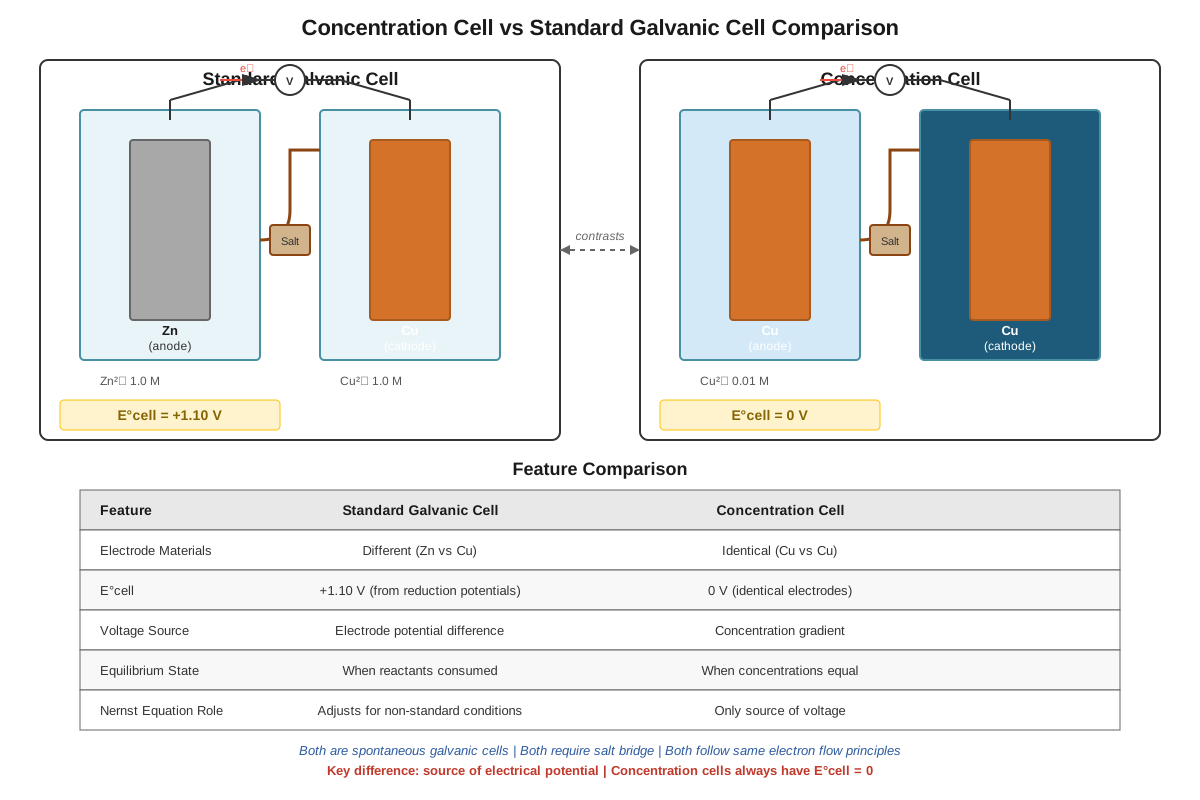
Concentration cells represent a fascinating subset of electrochemical cells where electrical potential arises not from different electrode materials, but from differences in ion concentrations between two half-cells. Unlike standard galvanic cells that utilize different metals or redox couples, concentration cells employ identical electrodes immersed in solutions of the same electrolyte but at different concentrations. This concentration gradient drives electron flow as the system attempts to reach equilibrium, converting chemical potential energy into electrical energy.
Understanding concentration cells is essential for MCAT success because they elegantly demonstrate the relationship between thermodynamics and electrochemistry. These cells provide a practical application of the Nernst equation, illustrating how concentration affects cell potential—a concept that appears frequently in both passage-based and discrete questions on the exam. The MCAT tests not only the ability to calculate cell potentials under non-standard conditions but also the conceptual understanding of why concentration differences generate voltage and how these systems evolve toward equilibrium.
Within the broader landscape of General Chemistry, concentration cells bridge multiple high-yield topics including thermodynamics, equilibrium, solution chemistry, and redox reactions. They exemplify Le Chatelier's principle in an electrochemical context and demonstrate how the Gibbs free energy change relates to electrical work. Mastery of concentration cells strengthens understanding of biological systems where concentration gradients drive essential processes, from nerve impulse transmission to ATP synthesis in mitochondria. This topic connects fundamental chemical principles to physiological applications, making it particularly relevant for the biochemistry and biological sciences sections of the MCAT.
Learning Objectives
- [ ] Define concentration cells using accurate General Chemistry terminology
- [ ] Explain why concentration cells matters for the MCAT
- [ ] Apply concentration cells to exam-style questions
- [ ] Identify common mistakes related to concentration cells
- [ ] Connect concentration cells to related General Chemistry concepts
- [ ] Calculate cell potential for concentration cells using the Nernst equation under various conditions
- [ ] Predict the direction of electron flow and ion migration in concentration cells based on concentration gradients
- [ ] Analyze how concentration cells reach equilibrium and determine the final state of the system
Prerequisites
- Standard reduction potentials and electrochemical series: Essential for understanding that concentration cells have E°cell = 0 V since both electrodes are identical
- Nernst equation fundamentals: Required to calculate non-standard cell potentials based on concentration differences
- Galvanic cell structure and function: Necessary to understand electron flow, anode/cathode designation, and salt bridge function
- Redox reactions and half-reactions: Needed to write balanced equations for oxidation and reduction occurring at each electrode
- Logarithmic functions: Critical for manipulating the Nernst equation and understanding the relationship between concentration ratios and voltage
- Thermodynamics basics (ΔG and spontaneity): Helps explain why concentration cells operate spontaneously until equilibrium is reached
Why This Topic Matters
Concentration cells appear with notable frequency on the MCAT, particularly in passages involving electrochemistry, thermodynamics, or biological systems. Approximately 2-3 questions per exam directly or indirectly test concentration cell concepts, making this a high-yield topic that warrants thorough understanding. The MCAT favors questions that require application of the Nernst equation to non-standard conditions, interpretation of concentration gradients, and prediction of system behavior over time.
From a clinical and real-world perspective, concentration cells model numerous physiological processes. The resting membrane potential of neurons functions as a biological concentration cell, where potassium and sodium ion gradients across the cell membrane generate electrical potential. Similarly, the proton gradient across the inner mitochondrial membrane drives ATP synthesis through chemiosmotic coupling—essentially a biological concentration cell converting chemical potential into biochemical energy. Understanding concentration cells provides insight into how organisms harness concentration gradients for energy transduction, signal transmission, and maintaining homeostasis.
On the MCAT, concentration cells commonly appear in passages describing experimental setups where students must identify which electrode serves as the anode or cathode based solely on concentration information, calculate cell potentials using modified forms of the Nernst equation, or predict how cell voltage changes as the system approaches equilibrium. Questions may present data tables showing concentration changes over time and ask students to interpret trends or calculate potentials at specific timepoints. The interdisciplinary nature of this topic means it can appear in General Chemistry sections, biochemistry passages about cellular respiration, or biology passages about neural signaling.
Core Concepts
Definition and Structure of Concentration Cells
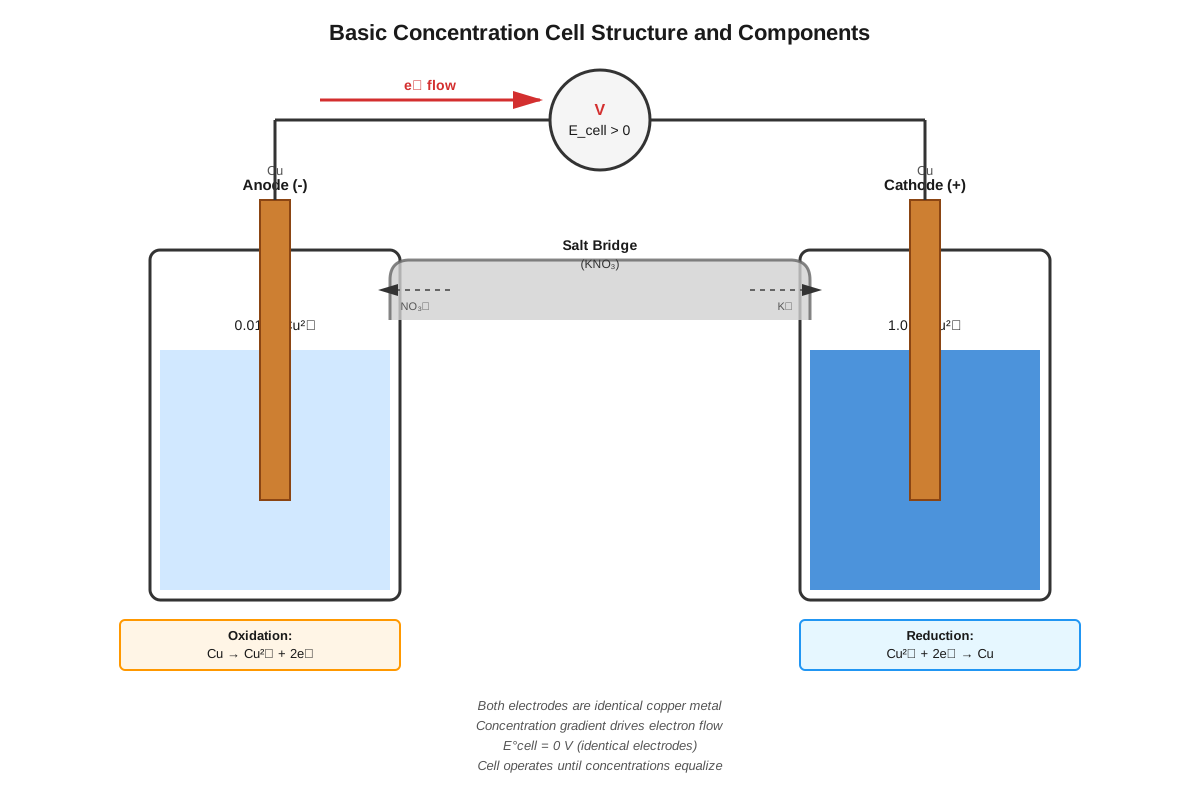
A concentration cell is a galvanic (voltaic) cell in which both electrodes are composed of the same material and are immersed in solutions containing the same ions but at different concentrations. The driving force for electron flow arises exclusively from the concentration gradient between the two half-cells, not from inherent differences in reduction potential between different metals. The standard cell potential (E°cell) for a concentration cell equals zero volts because both half-reactions involve the same species with identical standard reduction potentials. However, under non-standard conditions, the concentration difference creates a measurable voltage.
The basic structure includes two identical metal electrodes, each immersed in a solution of its own ions at different concentrations. These half-cells are connected by a salt bridge or porous membrane that allows ion migration while preventing bulk mixing of solutions. An external wire connects the electrodes, providing a pathway for electron flow. For example, a copper concentration cell might consist of two copper electrodes, one immersed in 1.0 M Cu²⁺ solution and the other in 0.01 M Cu²⁺ solution.
Electrochemical Principles Governing Concentration Cells
The operation of concentration cells follows fundamental electrochemical principles. The electrode immersed in the more dilute solution serves as the anode (site of oxidation), while the electrode in the more concentrated solution functions as the cathode (site of reduction). This arrangement makes thermodynamic sense: oxidation at the anode increases the concentration of ions in the dilute solution, while reduction at the cathode decreases the concentration in the concentrated solution, driving both solutions toward equal concentration.
At the anode (dilute solution), the metal undergoes oxidation:
M(s) → M^n+(aq) + ne⁻At the cathode (concentrated solution), metal ions undergo reduction:
M^n+(aq) + ne⁻ → M(s)The net result is the transfer of metal ions from the concentrated solution to the dilute solution, with electrons flowing through the external circuit from anode to cathode. The salt bridge maintains electrical neutrality by allowing anions to migrate toward the anode and cations toward the cathode.
The Nernst Equation Applied to Concentration Cells
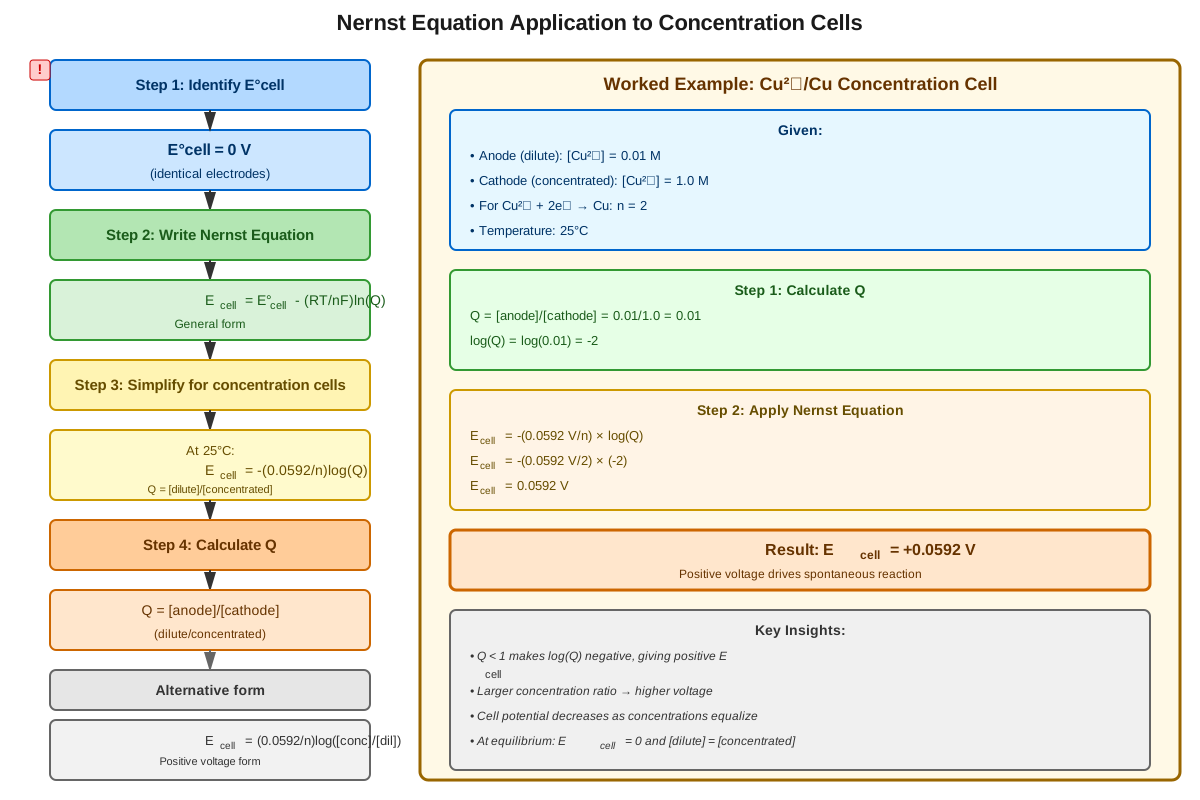
The Nernst equation quantifies the relationship between concentration and cell potential. For a general electrochemical cell at 25°C:
E_cell = E°_cell - (0.0592/n) × log(Q)Where:
- E_cell = cell potential under non-standard conditions
- E°_cell = standard cell potential
- n = number of electrons transferred
- Q = reaction quotient
For concentration cells, since E°_cell = 0 V (identical electrodes), the equation simplifies to:
E_cell = -(0.0592/n) × log(Q)Or equivalently:
E_cell = (0.0592/n) × log([M^n+]_cathode/[M^n+]_anode)This form explicitly shows that cell potential depends on the concentration ratio. The greater the concentration difference, the larger the cell potential. As the cell operates and concentrations equilibrate, E_cell decreases, approaching zero when concentrations become equal.
Thermodynamic Considerations
The spontaneity of concentration cell operation relates directly to thermodynamics through the relationship:
ΔG = -nFE_cellWhere:
- ΔG = Gibbs free energy change
- n = moles of electrons transferred
- F = Faraday's constant (96,485 C/mol)
- E_cell = cell potential
Since concentration cells generate positive voltage (E_cell > 0), ΔG is negative, confirming spontaneous operation. The system proceeds spontaneously toward equilibrium (equal concentrations), where ΔG = 0 and E_cell = 0. This demonstrates Le Chatelier's principle: the system responds to the concentration gradient by shifting to minimize the difference.
Concentration Cell Behavior Over Time
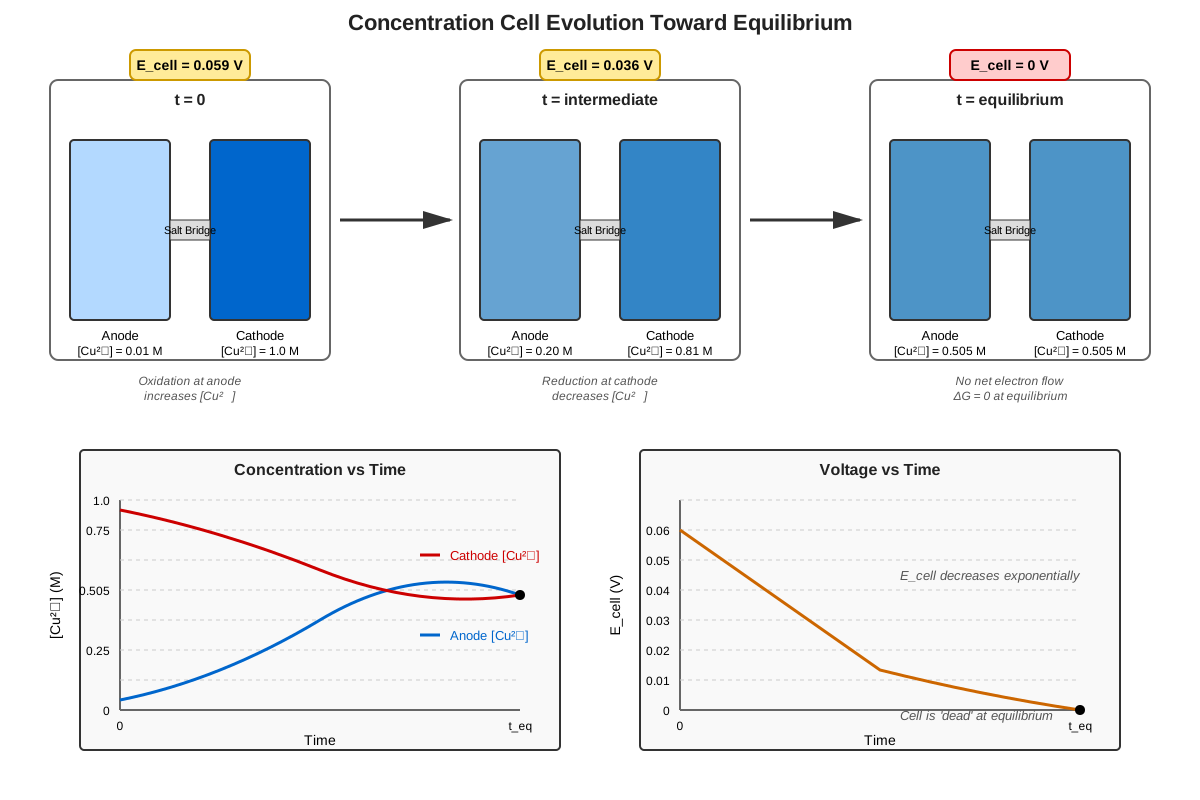
As a concentration cell operates, several predictable changes occur:
- Concentration changes: The dilute solution becomes more concentrated (oxidation adds ions), while the concentrated solution becomes more dilute (reduction removes ions)
- Voltage decrease: As concentrations approach equality, the concentration ratio approaches 1, and log(1) = 0, so E_cell approaches 0
- Current decrease: Following Ohm's law, decreasing voltage leads to decreasing current
- Equilibrium state: When concentrations equalize, no further net electron flow occurs, and the cell is "dead"
The rate of these changes depends on factors including electrode surface area, solution volumes, temperature, and external resistance in the circuit.
Types of Concentration Cells
Metal-ion concentration cells are the most common type, featuring identical metal electrodes in solutions of different metal ion concentrations. Example: Cu(s) | Cu²⁺(dilute) || Cu²⁺(concentrated) | Cu(s)
Gas concentration cells utilize identical inert electrodes (often platinum) exposed to the same gas at different partial pressures. Example: Pt(s) | H₂(low P) | H⁺(aq) || H⁺(aq) | H₂(high P) | Pt(s). The electrode exposed to higher gas pressure serves as the anode.
Amalgam concentration cells employ mercury amalgams containing different concentrations of dissolved metal, though these are less commonly tested on the MCAT.
Practical Applications and Biological Relevance
Concentration cells model several biological systems. Membrane potentials in neurons arise from concentration differences of K⁺, Na⁺, and Cl⁻ ions across the cell membrane. The Nernst potential for a specific ion represents the voltage that would exactly balance the concentration gradient for that ion—essentially a biological concentration cell at equilibrium for one ion species.
pH meters function as concentration cells, measuring hydrogen ion concentration differences between a reference electrode and a sensing electrode. The voltage generated is proportional to pH difference, allowing precise pH determination.
In industrial applications, concentration cells can cause corrosion when the same metal experiences different oxygen concentrations (differential aeration cells), leading to localized oxidation and material degradation.
Concept Relationships
The understanding of concentration cells builds hierarchically from fundamental electrochemistry concepts. Standard reduction potentials provide the foundation, establishing that identical electrodes have identical E° values, yielding E°_cell = 0 V. This zero standard potential makes concentration cells unique and emphasizes that non-standard conditions drive their operation.
The Nernst equation serves as the central mathematical tool, connecting concentration cells to thermodynamics through the relationship between Q (reaction quotient), E_cell, and ΔG. As concentration cells operate, they demonstrate Le Chatelier's principle in action: the system shifts to relieve the concentration stress, moving toward equilibrium.
Galvanic cell principles govern electron flow direction, anode/cathode designation, and the role of the salt bridge. However, concentration cells require careful analysis because the anode and cathode cannot be identified by electrode material—only by concentration. This connects to solution chemistry and the concept that chemical potential depends on concentration.
The relationship map flows as follows:
Identical electrodes → E°_cell = 0 → Concentration difference creates non-standard conditions → Nernst equation calculates E_cell → Positive E_cell indicates spontaneous operation → ΔG < 0 confirms spontaneity → System evolves toward equilibrium → Concentrations equalize → E_cell approaches 0 → Equilibrium reached
This topic also connects forward to biological systems, where concentration gradients drive membrane potentials, and to kinetics, where concentration affects reaction rates. Understanding concentration cells enhances comprehension of buffer systems, solubility equilibria, and acid-base chemistry, all of which involve concentration-dependent equilibria.
Quick check — test yourself on Concentration cells so far.
Try Flashcards →High-Yield Facts
⭐ In concentration cells, E°_cell = 0 V because both electrodes are identical; all voltage arises from concentration differences
⭐ The electrode in the more dilute solution always serves as the anode (oxidation occurs), while the electrode in the more concentrated solution serves as the cathode (reduction occurs)
⭐ For concentration cells, E_cell = (0.0592/n) × log([concentrated]/[dilute]) at 25°C
⭐ As a concentration cell operates, E_cell decreases and approaches zero as concentrations equilibrate
⭐ The greater the concentration ratio between half-cells, the larger the initial cell potential
- Concentration cells operate spontaneously (ΔG < 0) until concentrations become equal, at which point ΔG = 0 and the cell reaches equilibrium
- Electrons always flow from the dilute solution electrode (anode) to the concentrated solution electrode (cathode) through the external circuit
- The salt bridge allows anions to migrate toward the anode and cations toward the cathode, maintaining electrical neutrality
- Concentration cells demonstrate that cell potential depends on both the identity of species involved (through E°) and their concentrations (through Q)
- Biological membrane potentials function as concentration cells, with the Nernst equation predicting equilibrium potential for specific ions
- In gas concentration cells, the electrode exposed to lower gas pressure serves as the cathode, while higher pressure corresponds to the anode
- Concentration cells will never reverse polarity during normal operation; they simply approach zero voltage as equilibrium is reached
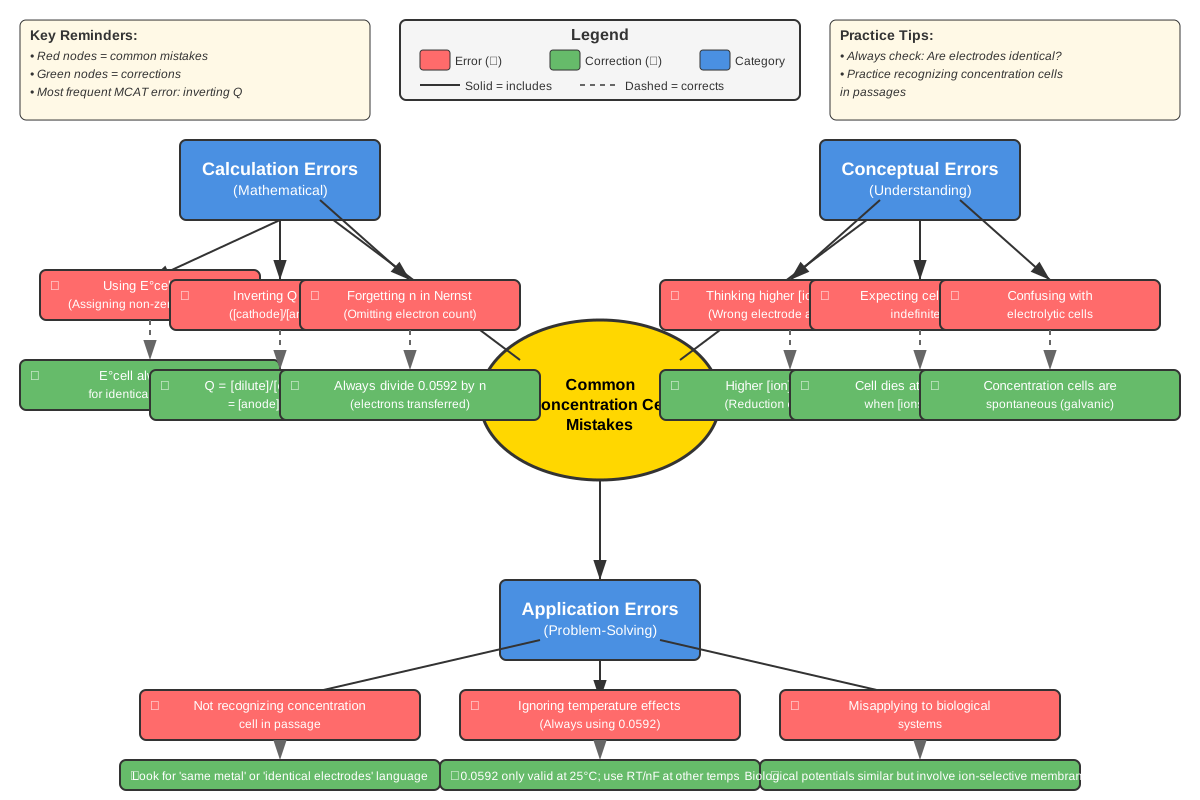
Common Misconceptions
Misconception: Concentration cells have no voltage because E°_cell = 0 V
Correction: While E°_cell = 0 V, concentration cells generate voltage under non-standard conditions. The Nernst equation shows that concentration differences create measurable potential. E°_cell represents standard conditions (1 M concentrations), which don't exist in functioning concentration cells.
Misconception: The electrode in the more concentrated solution is always the anode
Correction: The opposite is true. The electrode in the more dilute solution serves as the anode (oxidation site), while the more concentrated solution contains the cathode (reduction site). This arrangement drives the system toward equal concentrations.
Misconception: Concentration cells can continue generating voltage indefinitely
Correction: Concentration cells are self-limiting. As they operate, concentrations equilibrate, reducing the concentration gradient and therefore the voltage. When concentrations become equal, E_cell = 0 and no further net electron flow occurs.
Misconception: The Nernst equation cannot be used when E°_cell = 0
Correction: The Nernst equation applies to all electrochemical cells, including concentration cells. When E°_cell = 0, the equation simplifies to E_cell = -(0.0592/n) × log(Q), which directly relates voltage to the concentration ratio.
Misconception: Increasing the volume of solutions in a concentration cell increases its voltage
Correction: Cell voltage depends on concentration ratios, not absolute amounts. Doubling both solution volumes while maintaining concentration ratios does not change E_cell. However, larger volumes do allow the cell to operate longer before reaching equilibrium.
Misconception: Salt bridges are unnecessary in concentration cells since both solutions contain the same ions
Correction: Salt bridges remain essential for maintaining electrical neutrality. Without a salt bridge, charge imbalance would quickly halt electron flow. The salt bridge allows ion migration to balance the charge changes from oxidation and reduction.
Misconception: At equilibrium, the concentrations in both half-cells equal the average of the initial concentrations
Correction: This is only true if both half-cells have equal volumes. The final equilibrium concentration depends on the total moles of ions and total volume. With unequal volumes, the equilibrium concentration will be closer to the initial concentration of the larger volume solution.
Worked Examples
Example 1: Calculating Cell Potential for a Copper Concentration Cell
Problem: A concentration cell consists of two copper electrodes. One electrode is immersed in 0.010 M Cu²⁺ solution, and the other is immersed in 1.0 M Cu²⁺ solution at 25°C. Calculate the cell potential and identify the anode and cathode.
Solution:
Step 1: Identify the anode and cathode
- The electrode in the more dilute solution (0.010 M) serves as the anode
- The electrode in the more concentrated solution (1.0 M) serves as the cathode
Step 2: Write the half-reactions
- Anode (oxidation): Cu(s) → Cu²⁺(aq) + 2e⁻
- Cathode (reduction): Cu²⁺(aq) + 2e⁻ → Cu(s)
Step 3: Determine n (electrons transferred)
- n = 2 (from the half-reactions)
Step 4: Apply the Nernst equation for concentration cells
E_cell = (0.0592/n) × log([Cu²⁺]_cathode/[Cu²⁺]_anode)
E_cell = (0.0592/2) × log(1.0/0.010)
E_cell = 0.0296 × log(100)
E_cell = 0.0296 × 2
E_cell = 0.0592 VAnswer: The cell potential is 0.0592 V or approximately 59.2 mV. The electrode in 0.010 M Cu²⁺ is the anode, and the electrode in 1.0 M Cu²⁺ is the cathode.
Connection to learning objectives: This example demonstrates application of the Nernst equation to concentration cells and proper identification of anode/cathode based on concentration differences.
Example 2: Predicting Concentration Changes Over Time
Problem: A silver concentration cell operates with initial concentrations of 0.10 M Ag⁺ at the anode and 1.0 M Ag⁺ at the cathode. Both half-cells contain 100 mL of solution. After the cell operates for some time, the anode solution concentration increases to 0.20 M. What is the new cathode concentration and the new cell potential? (Assume no volume change)
Solution:
Step 1: Calculate moles of Ag⁺ transferred
- Initial moles at anode: 0.10 M × 0.100 L = 0.010 mol
- Final moles at anode: 0.20 M × 0.100 L = 0.020 mol
- Moles added to anode solution: 0.020 - 0.010 = 0.010 mol
Step 2: Calculate new cathode concentration
- Initial moles at cathode: 1.0 M × 0.100 L = 0.10 mol
- Moles removed from cathode: 0.010 mol (same as added to anode)
- Final moles at cathode: 0.10 - 0.010 = 0.090 mol
- New cathode concentration: 0.090 mol / 0.100 L = 0.90 M
Step 3: Calculate new cell potential
- For Ag⁺ + e⁻ → Ag, n = 1
E_cell = (0.0592/1) × log([Ag⁺]_cathode/[Ag⁺]_anode)
E_cell = 0.0592 × log(0.90/0.20)
E_cell = 0.0592 × log(4.5)
E_cell = 0.0592 × 0.653
E_cell = 0.0387 VAnswer: The new cathode concentration is 0.90 M, and the new cell potential is approximately 38.7 mV.
Key insight: Notice that the cell potential decreased from its initial value as concentrations became more similar. This demonstrates how concentration cells approach equilibrium over time. The cell would reach equilibrium when both solutions reach 0.55 M (average of 0.10 and 1.0 M with equal volumes), at which point E_cell = 0.
Connection to learning objectives: This example illustrates how concentration cells evolve toward equilibrium and requires application of stoichiometry, solution chemistry, and the Nernst equation.
Exam Strategy
When approaching MCAT questions on concentration cells, follow this systematic strategy:
Step 1: Identify that you're dealing with a concentration cell
Trigger phrases include "identical electrodes," "same metal in different concentrations," or "solutions of varying concentration." If E°_cell is given as zero or both electrodes are the same material, you're working with a concentration cell.
Step 2: Immediately determine anode and cathode
Remember the rule: dilute = anode, concentrated = cathode. This is opposite to what many students initially expect. Mark this clearly in your work to avoid confusion.
Step 3: Set up the Nernst equation correctly
For concentration cells at 25°C, use: E_cell = (0.0592/n) × log([concentrated]/[dilute])
Ensure the concentration ratio has the concentrated solution in the numerator. Double-check the value of n from the half-reaction.
Step 4: Watch for time-evolution questions
If the question asks about the cell "after some time" or "as it operates," recognize that concentrations are changing and voltage is decreasing. The system moves toward equilibrium where E_cell = 0.
Process of elimination tips:
- Eliminate any answer choice suggesting voltage increases over time (voltage always decreases in concentration cells)
- Eliminate choices that place the anode in the concentrated solution
- For calculation questions, eliminate answers that would require E°_cell ≠ 0
- If asked about equilibrium state, eliminate any choice suggesting continued electron flow or non-zero voltage
Time allocation:
Concentration cell calculations typically require 60-90 seconds. If a question involves multiple steps (finding concentrations, then calculating voltage), allocate up to 2 minutes. For conceptual questions about anode/cathode identification or direction of electron flow, aim for 30-45 seconds.
Red flag phrases that indicate common traps:
- "Standard conditions" (reminds you E°_cell = 0, but actual E_cell ≠ 0)
- "At equilibrium" (means E_cell = 0 and concentrations are equal)
- "Initially" vs. "after operating" (signals time-dependent changes)
Memory Techniques
Mnemonic for anode/cathode identification: "DILATE"
- DILute solution = Anode
- ConcenTRATEd solution = CaTHODE
Visualization strategy:
Picture water flowing downhill from high concentration (mountain) to low concentration (valley). Electrons flow "uphill" through the external circuit (from dilute to concentrated), while ions flow "downhill" through the solution (from concentrated to dilute). This creates a memorable image of the concentration gradient driving the process.
Acronym for concentration cell characteristics: "ZERO DRIVES"
- Zero standard potential (E°_cell = 0)
- Electrons flow from dilute to concentrated
- Reduction at concentrated electrode
- Oxidation at dilute electrode
- Decreasing voltage over time
- Reaches equilibrium eventually
- Identical electrodes
- Voltage depends on concentration ratio
- Energy from concentration gradient
- Spontaneous until equilibrium
Formula memory aid:
For the simplified Nernst equation, remember "0.06 over n times log of C-over-C" (0.0592/n × log[concentrated/dilute]). The "C-over-C" reminds you that concentrated goes on top of the fraction.
Conceptual anchor:
Link concentration cells to a familiar experience: perfume diffusing in a room. Just as perfume molecules spontaneously move from high concentration (near the bottle) to low concentration (across the room), concentration cells spontaneously operate to equalize concentrations. The difference is that concentration cells capture this spontaneous process as electrical energy.
Summary
Concentration cells are electrochemical cells that generate voltage from concentration differences rather than from different electrode materials. With identical electrodes yielding E°_cell = 0 V, all electrical potential arises from non-standard conditions described by the Nernst equation. The electrode in the more dilute solution functions as the anode (oxidation site), while the electrode in the more concentrated solution serves as the cathode (reduction site), driving the system toward equilibrium. As the cell operates, the dilute solution becomes more concentrated and the concentrated solution becomes more dilute, causing cell potential to decrease toward zero. The Nernst equation quantifies this relationship: E_cell = (0.0592/n) × log([concentrated]/[dilute]) at 25°C. Concentration cells model important biological phenomena including membrane potentials and demonstrate fundamental principles of thermodynamics, electrochemistry, and equilibrium. For MCAT success, students must master anode/cathode identification based on concentration, apply the Nernst equation correctly, predict system evolution over time, and recognize connections to biological systems.
Key Takeaways
- Concentration cells have E°_cell = 0 V because both electrodes are identical; voltage arises entirely from concentration differences between half-cells
- The dilute solution always contains the anode (oxidation), while the concentrated solution contains the cathode (reduction)—remember "DILATE"
- Apply the simplified Nernst equation: E_cell = (0.0592/n) × log([concentrated]/[dilute]) at 25°C to calculate cell potential
- Concentration cells spontaneously operate until concentrations equalize, at which point E_cell = 0 and equilibrium is reached
- As concentration cells operate, voltage continuously decreases as the concentration gradient diminishes
- Biological membrane potentials function as concentration cells, making this concept essential for understanding neural signaling and cellular energetics
- Master the relationship between concentration ratio and voltage: larger ratios produce greater initial voltages, but all concentration cells eventually reach zero potential
Related Topics
Nernst Equation and Non-Standard Conditions: Concentration cells provide the clearest application of the Nernst equation. Mastering concentration cells builds skills for calculating cell potentials under any non-standard conditions, including temperature variations and partial pressure effects in gas electrodes.
Membrane Potentials and the Nernst Potential: Understanding concentration cells directly enables comprehension of how ion concentration gradients across biological membranes generate electrical potentials. The Goldman-Hodgkin-Katz equation extends these principles to multiple ions.
Thermodynamics and Electrochemistry: The relationship between ΔG, E_cell, and spontaneity becomes concrete through concentration cells. This connection is essential for understanding coupled reactions and energy transduction in biological systems.
Le Chatelier's Principle and Chemical Equilibrium: Concentration cells demonstrate equilibrium principles in an electrochemical context, showing how systems respond to concentration stresses and evolve toward equilibrium states.
Corrosion and Differential Aeration Cells: Concentration cells explain certain corrosion mechanisms where oxygen concentration differences create localized anodes and cathodes on metal surfaces, leading to material degradation.
Practice CTA
Now that you've mastered the fundamentals of concentration cells, it's time to solidify your understanding through active practice. Attempt the practice questions and flashcards associated with this topic to test your ability to identify anode/cathode configurations, apply the Nernst equation under various conditions, and predict system behavior over time. Focus especially on questions that require you to integrate concentration cell concepts with thermodynamics and biological applications—these interdisciplinary questions frequently appear on the MCAT. Remember, understanding concentration cells not only helps you answer direct electrochemistry questions but also strengthens your grasp of membrane potentials, cellular energetics, and equilibrium principles that appear throughout the exam. Your investment in mastering this high-yield topic will pay dividends across multiple MCAT sections!
Sign up free to keep reading
Create a free AnvayaPrep account to finish this MCAT guide on Concentration cells — plus flashcards and practice questions.