Overview
The Nernst equation stands as one of the most powerful quantitative tools in electrochemistry, bridging thermodynamics and electrical potential to predict the behavior of electrochemical cells under non-standard conditions. While standard reduction potentials provide a foundation for understanding redox reactions, real-world systems—including biological cells, batteries, and industrial processes—rarely operate at standard conditions (1 M concentrations, 1 atm pressure, 25°C). The Nernst equation allows calculation of cell potential at any concentration, making it indispensable for predicting reaction spontaneity and equilibrium positions in practical scenarios.
For the MCAT, the Nernst equation represents a high-yield integration point where General Chemistry concepts converge with biological applications. Test-makers frequently use this equation to assess understanding of electrochemical cells, concentration effects on cell potential, and the relationship between thermodynamics and electrochemistry. Questions may appear as standalone calculations, within passage-based scenarios involving biological membranes and ion gradients, or as conceptual items testing directional changes in cell potential with varying concentrations.
Mastery of the Nernst equation requires synthesizing multiple foundational concepts: standard reduction potentials, the relationship between Gibbs free energy and cell potential, reaction quotients, and logarithmic functions. This topic connects directly to Le Chatelier's principle, equilibrium constants, and thermodynamic spontaneity—all critical areas for MCAT success. Understanding how concentration changes affect electrochemical potential also provides essential background for biological topics like nerve impulse transmission and cellular respiration, making this equation a bridge between general and biochemical applications.
Learning Objectives
- [ ] Define the Nernst equation using accurate General Chemistry terminology
- [ ] Explain why the Nernst equation matters for the MCAT
- [ ] Apply the Nernst equation to exam-style questions
- [ ] Identify common mistakes related to Nernst equation calculations
- [ ] Connect the Nernst equation to related General Chemistry concepts
- [ ] Calculate cell potential under non-standard conditions given appropriate data
- [ ] Predict the direction of spontaneous electron flow based on concentration changes
- [ ] Determine equilibrium constants from standard cell potentials using the Nernst equation
- [ ] Analyze how temperature variations affect electrochemical cell potential
Prerequisites
- Standard reduction potentials (E°): Essential for calculating standard cell potential, which serves as the baseline for Nernst equation calculations
- Oxidation-reduction reactions: Understanding electron transfer is fundamental to identifying which species are oxidized/reduced and determining the number of electrons transferred (n)
- Galvanic and electrolytic cells: The Nernst equation applies to both spontaneous and non-spontaneous electrochemical processes
- Gibbs free energy (ΔG): The relationship ΔG = -nFE connects thermodynamic spontaneity to electrochemical potential
- Reaction quotient (Q): The Nernst equation incorporates Q to account for non-standard concentrations
- Logarithmic functions: The equation uses natural or common logarithms, requiring comfort with log properties
- Le Chatelier's principle: Helps predict qualitatively how concentration changes affect cell potential
Why This Topic Matters
The Nernst equation appears with remarkable frequency on the MCAT, typically in 2-4 questions per exam either directly or embedded within passages. Its clinical and biological significance cannot be overstated: the equation mathematically describes the membrane potential in neurons, the driving force behind action potentials, and the concentration gradients that power ATP synthesis in mitochondria. Medical students will encounter these principles repeatedly in physiology, pharmacology, and pathology.
On the MCAT, this topic appears in multiple contexts. Passage-based questions might present experimental data on concentration cells, ask students to predict potential changes when ion concentrations vary, or require calculation of equilibrium constants from electrochemical measurements. Discrete questions often test conceptual understanding: "How does doubling the concentration of Cu²⁺ affect the cell potential?" or "At what concentration ratio does the cell reach equilibrium?" The equation also appears in biological passages discussing nerve transmission, where the Goldman equation (a multi-ion extension of the Nernst equation) governs resting membrane potential.
Understanding the Nernst equation demonstrates higher-order thinking that MCAT test-makers value: the ability to apply mathematical relationships to predict chemical behavior, connect macroscopic observations to molecular-level processes, and integrate multiple concepts simultaneously. Questions testing this topic frequently discriminate between high-scoring and average students, making it a critical area for competitive applicants.
Core Concepts
The Nernst Equation: Mathematical Formulation
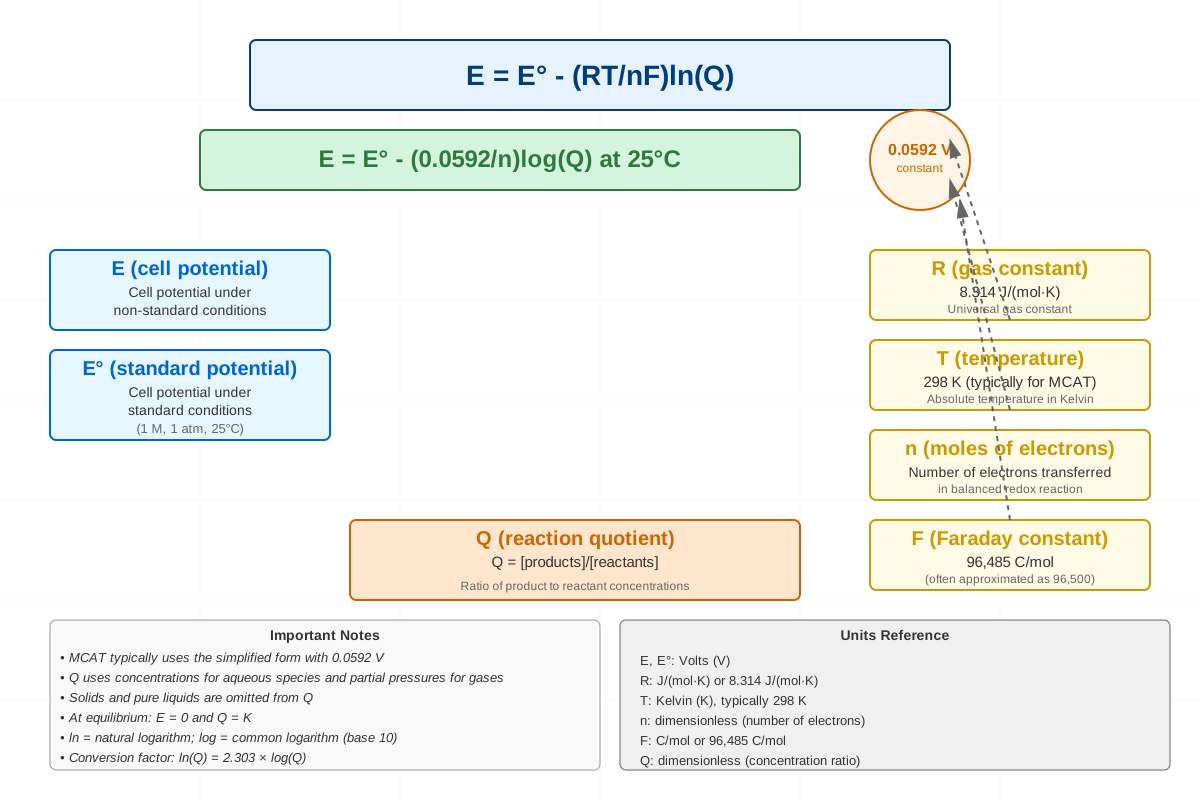
The Nernst equation quantifies the relationship between cell potential and reactant/product concentrations. Two equivalent forms exist, differing only in the logarithm base used:
E = E° - (RT/nF) × ln(Q)    [natural logarithm form]
E = E° - (0.0592/n) × log(Q)    [common logarithm form at 25°C]
Where:
- E = cell potential under non-standard conditions (volts)
- E° = standard cell potential (volts)
- R = universal gas constant (8.314 J/mol·K)
- T = absolute temperature (Kelvin)
- n = number of moles of electrons transferred in the balanced equation
- F = Faraday's constant (96,485 C/mol or approximately 96,500 C/mol)
- Q = reaction quotient
For MCAT purposes, the simplified form at 25°C (298 K) is most commonly used:
E = E° - (0.0592 V/n) × log(Q)The constant 0.0592 V results from evaluating (RT/F) × ln(10) at 25°C, converting natural to common logarithm.
Understanding Each Component
Standard Cell Potential (E°): This represents the voltage when all species are at standard conditions (1 M concentration for aqueous species, 1 atm for gases, pure solids/liquids). Calculate E° by subtracting the standard reduction potential of the anode from that of the cathode:
E°cell = E°cathode - E°anodeNumber of Electrons (n): This critical value comes from the balanced half-reactions. Common errors arise when students use the stoichiometric coefficient instead of the actual electron count. For example, in the reaction:
Zn(s) + Cu²⁺(aq) → Zn²⁺(aq) + Cu(s)Two electrons transfer (n = 2), regardless of whether you write the equation with different coefficients.
Reaction Quotient (Q): Constructed identically to an equilibrium constant expression, Q uses actual concentrations (or partial pressures for gases):
Q = [products]/[reactants]Crucially, pure solids and liquids do not appear in Q—only aqueous ions and gases. For the zinc-copper cell above:
Q = [Zn²⁺]/[Cu²⁺]Concentration Effects on Cell Potential
The Nernst equation reveals how concentration changes affect electrochemical potential. When Q < 1 (reactants exceed products), the logarithm term is negative, making the second term positive, so E > E°. The reaction proceeds more favorably than under standard conditions. Conversely, when Q > 1 (products exceed reactants), E < E°, and the driving force decreases.
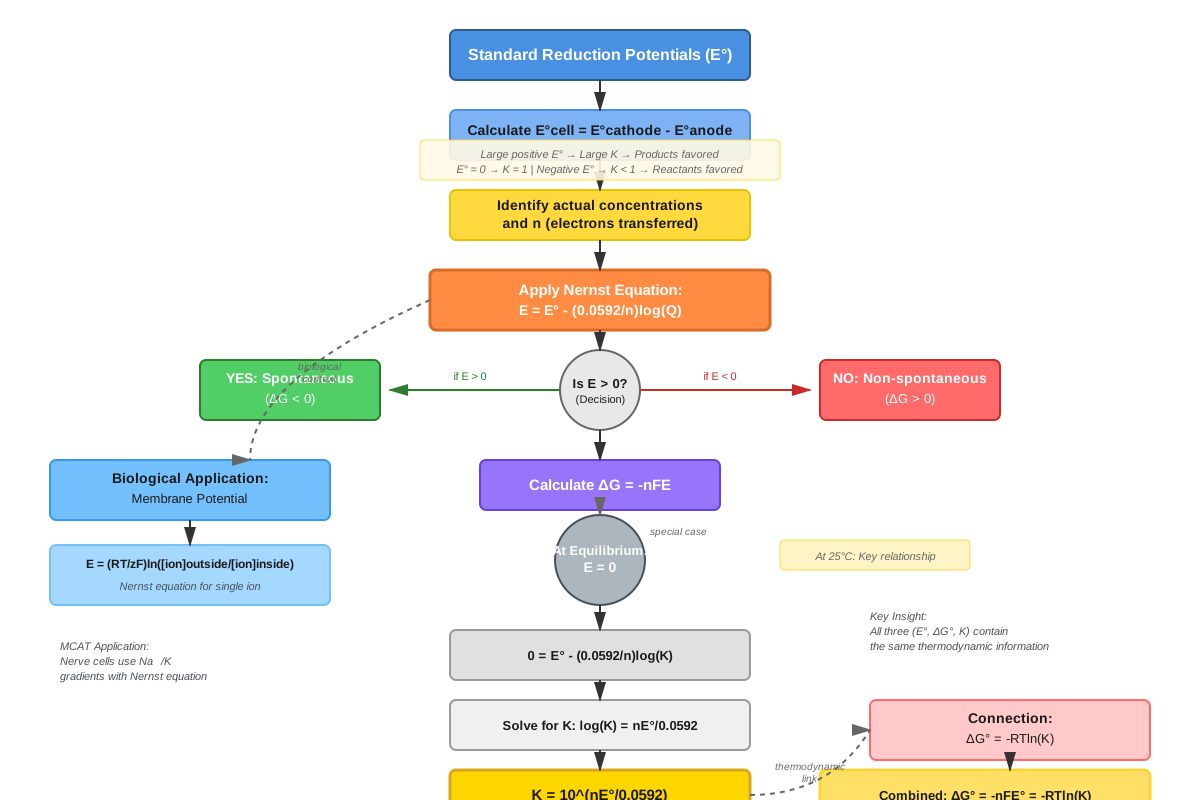
At equilibrium, no net electron flow occurs, so E = 0. Setting E to zero in the Nernst equation yields:
0 = E° - (0.0592/n) × log(Keq)
E° = (0.0592/n) × log(Keq)
Rearranging:
log(Keq) = nE°/0.0592This powerful relationship connects electrochemistry to equilibrium, allowing calculation of Keq from electrochemical measurements.
Temperature Dependence
While the MCAT typically assumes 25°C, understanding temperature effects demonstrates conceptual mastery. The full Nernst equation shows that increasing temperature increases the magnitude of the (RT/nF) coefficient, making concentration effects more pronounced. For endothermic reactions (positive ΔS), higher temperatures favor spontaneity; for exothermic reactions, lower temperatures are favorable.
Concentration Cells
A concentration cell consists of identical electrodes in solutions of different concentrations. Since E° = 0 (identical half-reactions), the entire driving force comes from the concentration gradient:
E = -(0.0592/n) × log(Q)Electrons flow from the lower concentration (anode) to higher concentration (cathode), equalizing concentrations. This principle underlies biological ion pumps and membrane potentials.
Sign Conventions and Spontaneity
A positive E indicates a spontaneous reaction (ΔG < 0), while negative E indicates non-spontaneity (ΔG > 0). The relationship:
ΔG = -nFEconnects electrochemical and thermodynamic spontaneity. As concentrations change, E changes, potentially reversing reaction spontaneity. A reaction spontaneous under standard conditions (E° > 0) may become non-spontaneous if product concentrations become sufficiently high.
Biological Applications
In neurons, the Nernst potential for a specific ion represents the membrane potential at which that ion experiences no net driving force. For potassium:
EK = (0.0592/1) × log([K⁺]out/[K⁺]in)At 25°C with typical concentrations ([K⁺]out = 5 mM, [K⁺]in = 150 mM), this yields approximately -90 mV. The actual resting potential (-70 mV) differs because multiple ions contribute, but the Nernst equation provides the theoretical limit for each ion.
Concept Relationships
The Nernst equation serves as a conceptual hub connecting multiple electrochemistry and thermodynamics principles. Standard reduction potentials provide the E° value, which represents the baseline driving force. The reaction quotient (Q) links to equilibrium concepts, showing how the system's position relative to equilibrium affects spontaneity. When Q = Keq, the system reaches equilibrium, and E = 0.
The relationship flows: Thermodynamics (ΔG) → Electrochemistry (E) → Concentration effects (Q). The fundamental equation ΔG = -nFE connects free energy to cell potential, while the Nernst equation extends this to non-standard conditions. Le Chatelier's principle provides qualitative predictions that the Nernst equation quantifies: increasing product concentration shifts equilibrium toward reactants, decreasing E.
Oxidation-reduction reactions determine which species lose/gain electrons, establishing the direction of electron flow. The number of electrons transferred (n) affects how sensitively E responds to concentration changes—reactions transferring more electrons show smaller potential changes per concentration unit. Logarithmic relationships mean that concentration changes affect potential proportionally to the log of the concentration ratio, not linearly.
In biological contexts, the Nernst equation connects to membrane transport, action potentials, and cellular energetics. The concentration gradients that power ATP synthesis in mitochondria create electrochemical potentials quantified by this equation. Understanding these connections transforms the Nernst equation from an isolated formula into an integrative tool spanning general chemistry, biochemistry, and physiology.
Quick check — test yourself on Nernst equation so far.
Try Flashcards →High-Yield Facts
⭐ The simplified Nernst equation at 25°C is E = E° - (0.0592/n) × log(Q), where 0.0592 V is the evaluated constant
⭐ At equilibrium, E = 0, allowing calculation of Keq from E° using log(Keq) = nE°/0.0592
⭐ Pure solids and liquids do not appear in the reaction quotient Q—only aqueous ions and gases
⭐ Increasing product concentration decreases E; increasing reactant concentration increases E
⭐ The number of electrons (n) comes from the balanced half-reactions, not stoichiometric coefficients
- A positive E indicates spontaneous reaction (ΔG < 0); negative E indicates non-spontaneity (ΔG > 0)
- Concentration cells have E° = 0, so all driving force comes from concentration differences
- The relationship ΔG = -nFE connects thermodynamic and electrochemical spontaneity
- Doubling a concentration changes log(Q) by approximately 0.3 (since log(2) ≈ 0.3)
- For single-ion systems, the Nernst equation predicts membrane potential in biological cells
- Temperature increases amplify the effect of concentration on cell potential
- When Q < 1, E > E° (reaction more favorable than standard conditions)
- The Faraday constant (F ≈ 96,500 C/mol) converts between moles of electrons and charge
Common Misconceptions
Misconception: The Nernst equation only applies to galvanic cells.
Correction: The Nernst equation applies to any electrochemical system, including electrolytic cells. It predicts the potential required to drive non-spontaneous reactions and the potential generated by spontaneous ones.
Misconception: The value of n changes with the stoichiometric coefficients used to balance the equation.
Correction: The number of electrons transferred (n) is an intrinsic property of the redox reaction and remains constant regardless of how you multiply the equation. If you double all coefficients, you must also double n to maintain the correct E value.
Misconception: All species in the reaction appear in the reaction quotient Q.
Correction: Only aqueous ions and gases appear in Q. Pure solids and liquids have activities of 1 and do not appear in the expression. For example, in Zn(s) + Cu²⁺(aq) → Zn²⁺(aq) + Cu(s), Q = [Zn²⁺]/[Cu²⁺].
Misconception: Increasing the concentration of any species increases the cell potential.
Correction: The effect depends on whether the species is a reactant or product. Increasing reactant concentration increases E (makes reaction more favorable), while increasing product concentration decreases E (makes reaction less favorable).
Misconception: At equilibrium, E° = 0.
Correction: At equilibrium, E = 0 (the actual cell potential), but E° (the standard cell potential) remains constant. The standard potential is an intrinsic property of the reaction, while the actual potential varies with conditions.
Misconception: The Nernst equation can be used with any temperature by simply substituting T.
Correction: While the full form E = E° - (RT/nF)ln(Q) accommodates any temperature, the simplified form E = E° - (0.0592/n)log(Q) is valid only at 25°C (298 K). At other temperatures, you must use the full equation or recalculate the constant.
Misconception: A negative E value means the reaction cannot occur.
Correction: A negative E indicates the reaction is non-spontaneous in the forward direction under the given conditions. The reverse reaction is spontaneous, or the forward reaction can be driven by applying external voltage (electrolysis).
Worked Examples
Example 1: Calculating Cell Potential Under Non-Standard Conditions
Problem: A galvanic cell consists of a zinc electrode in 0.10 M Zn²⁺ solution and a copper electrode in 2.0 M Cu²⁺ solution at 25°C. Given E°(Cu²⁺/Cu) = +0.34 V and E°(Zn²⁺/Zn) = -0.76 V, calculate the cell potential.
Solution:
Step 1: Write the half-reactions and overall reaction.
- Reduction (cathode): Cu²⁺(aq) + 2e⁻ → Cu(s)
- Oxidation (anode): Zn(s) → Zn²⁺(aq) + 2e⁻
- Overall: Zn(s) + Cu²⁺(aq) → Zn²⁺(aq) + Cu(s)
Step 2: Calculate E°cell.
E°cell = E°cathode - E°anode = 0.34 V - (-0.76 V) = 1.10 VStep 3: Determine n (number of electrons transferred).
From the half-reactions, n = 2.
Step 4: Write the reaction quotient Q.
Q = [Zn²⁺]/[Cu²⁺] = 0.10/2.0 = 0.050Note: Solids (Zn and Cu) do not appear in Q.
Step 5: Apply the Nernst equation.
E = E° - (0.0592/n) × log(Q)
E = 1.10 - (0.0592/2) × log(0.050)
E = 1.10 - (0.0296) × (-1.30)
E = 1.10 + 0.038
E = 1.14 VInterpretation: The cell potential (1.14 V) exceeds the standard potential (1.10 V) because Q < 1. The low product concentration and high reactant concentration make the reaction more favorable than under standard conditions. This demonstrates how concentration gradients can enhance electrochemical driving force.
Example 2: Determining Equilibrium Constant from Standard Potential
Problem: For the reaction 2Fe³⁺(aq) + Sn²⁺(aq) → 2Fe²⁺(aq) + Sn⁴⁺(aq), E°cell = +0.617 V at 25°C. Calculate the equilibrium constant.
Solution:
Step 1: Identify n from the balanced equation.
Two electrons transfer (Sn²⁺ loses 2e⁻ to become Sn⁴⁺), so n = 2.
Step 2: At equilibrium, E = 0. Use the relationship:
log(Keq) = nE°/0.0592
log(Keq) = (2)(0.617)/0.0592
log(Keq) = 1.234/0.0592
log(Keq) = 20.8
Step 3: Solve for Keq.
Keq = 10^20.8 ≈ 6 × 10^20Interpretation: The enormous equilibrium constant indicates this reaction proceeds essentially to completion. The large positive E° corresponds to a highly favorable reaction. This example illustrates how electrochemical measurements provide thermodynamic information, connecting E° to Keq through the Nernst equation.
Exam Strategy
When approaching Nernst equation questions on the MCAT, first identify whether the question asks for a calculation or conceptual understanding. Calculation questions typically provide all necessary values; conceptual questions test directional changes or qualitative predictions.
Trigger words indicating Nernst equation application include: "non-standard conditions," "concentration changes," "cell potential at equilibrium," "membrane potential," "concentration cell," and "effect of dilution on voltage." Passages describing biological membranes, ion gradients, or batteries operating under varying conditions often require Nernst equation reasoning.
Step-by-step approach for calculations:
- Write the balanced overall reaction to identify n
- Calculate E°cell if not provided (E°cathode - E°anode)
- Construct Q using only aqueous ions and gases
- Apply E = E° - (0.0592/n) × log(Q)
- Check if the answer makes physical sense (E > E° when Q < 1)
For conceptual questions, use qualitative reasoning before calculating. If a question asks how doubling [Cu²⁺] affects E in a zinc-copper cell, recognize that Cu²⁺ is a reactant, so increasing its concentration increases E. This eliminates wrong answers quickly without full calculation.
Process-of-elimination tips: If E° is positive and all concentrations are standard, E must equal E°. If products are diluted or reactants concentrated, E must exceed E°. If the question states "at equilibrium," E = 0 regardless of other conditions. Eliminate answers violating these principles.
Time allocation: Simple Nernst calculations require 60-90 seconds. Complex problems involving equilibrium constant determination may need 2 minutes. If a calculation appears time-intensive, check whether qualitative reasoning suffices—many MCAT questions test conceptual understanding rather than computational skill.
Common trap answers: Watch for options that use n incorrectly (using stoichiometric coefficients instead of electrons transferred), include solids/liquids in Q, or reverse the sign of the logarithmic term. Test-makers frequently include answers representing these errors.
Memory Techniques
Mnemonic for Nernst equation structure: "Everyone Eats Rice Today, Not Fancy Lobster Quiche"
- E = E° - (RT/nF) × ln(Q)
Simplified form memory aid: "Point-oh-five-nine-two over n times log Q"
- The constant 0.0592 at 25°C is worth memorizing precisely
Q construction rule: "Solids and Liquids Stay Low" (don't appear in Q)
- Only aqueous and gaseous species appear in the reaction quotient
Concentration effect: "Reactants Raise, Products Pull down"
- Increasing reactants raises E; increasing products pulls E down
Equilibrium relationship: "Zero Equals Equilibrium"
- When E = 0, the system is at equilibrium
Sign check: "Positive Proceeds"
- Positive E means spontaneous (proceeds forward)
Visualization strategy: Picture a battery draining as products accumulate. As Q increases (more products), the voltage (E) decreases, eventually reaching zero when the battery is "dead" (equilibrium). This mental image connects concentration changes to potential changes.
Number of electrons: Count electrons in the half-reaction showing the species you're most familiar with, then verify both half-reactions transfer the same number.
Summary
The Nernst equation quantifies how electrochemical cell potential varies with concentration, temperature, and reaction progress, extending standard potential calculations to real-world conditions. At 25°C, the equation E = E° - (0.0592/n) × log(Q) relates actual potential (E) to standard potential (E°), number of electrons transferred (n), and the reaction quotient (Q). This relationship reveals that increasing reactant concentration enhances cell potential while increasing product concentration diminishes it. At equilibrium, E equals zero, connecting electrochemical measurements to equilibrium constants through log(Keq) = nE°/0.0592. The equation bridges thermodynamics and electrochemistry via ΔG = -nFE, enabling prediction of reaction spontaneity under any conditions. For the MCAT, mastery requires both computational facility with the equation and conceptual understanding of how concentration changes affect electrochemical driving force. Biological applications include membrane potentials and ion gradients, making this equation essential for integrating general chemistry with physiological concepts. Success demands careful attention to n (from balanced half-reactions), proper Q construction (excluding solids and liquids), and recognition that E° is an intrinsic property while E varies with conditions.
Key Takeaways
- The Nernst equation E = E° - (0.0592/n) × log(Q) at 25°C predicts cell potential under non-standard conditions
- At equilibrium, E = 0, allowing calculation of Keq from E° using log(Keq) = nE°/0.0592
- The reaction quotient Q includes only aqueous ions and gases, never pure solids or liquids
- Increasing reactant concentration increases E (more favorable); increasing product concentration decreases E (less favorable)
- The number of electrons (n) comes from balanced half-reactions and determines how sensitively E responds to concentration changes
- Positive E indicates spontaneous reaction (ΔG < 0); negative E indicates non-spontaneity requiring external energy input
- The Nernst equation connects electrochemistry to biological systems, predicting membrane potentials and ion gradient effects
Related Topics
Goldman Equation: Extends the Nernst equation to multiple ions simultaneously, essential for understanding actual resting membrane potentials in neurons where Na⁺, K⁺, and Cl⁻ all contribute. Mastering the single-ion Nernst equation provides the foundation for this multi-ion extension.
Electrochemical Cells and Cell Diagrams: Understanding cell notation, anode/cathode identification, and electron flow direction provides context for applying the Nernst equation to real electrochemical systems.
Thermodynamics and Gibbs Free Energy: The relationship ΔG = -nFE connects electrochemical and thermodynamic spontaneity, with the Nernst equation showing how ΔG varies with concentration through ΔG = ΔG° + RT ln(Q).
Equilibrium Constants and Reaction Quotients: The Nernst equation's use of Q directly parallels equilibrium expressions, and the connection between E° and Keq demonstrates how electrochemical measurements determine equilibrium positions.
Oxidation-Reduction Reactions: Identifying oxidation states, balancing redox equations, and determining electron transfer are prerequisites for correctly applying the Nernst equation.
Biological Membrane Transport: Active transport, ion channels, and membrane potentials all involve electrochemical gradients quantified by the Nernst equation, making this topic essential for MCAT biochemistry and physiology passages.
Practice CTA
Now that you've mastered the theoretical framework of the Nernst equation, it's time to solidify your understanding through active practice. Attempt the practice questions and flashcards to test your ability to apply this equation under time pressure, identify common traps, and integrate this concept with related electrochemistry topics. Remember: the Nernst equation appears frequently on the MCAT precisely because it requires synthesis of multiple concepts—thermodynamics, equilibrium, logarithms, and electrochemistry. Each practice problem strengthens the neural pathways that will serve you on test day. You've invested the time to understand deeply; now invest the effort to practice deliberately, and watch your confidence and accuracy soar!
Sign up free to keep reading
Create a free AnvayaPrep account to finish this MCAT guide on Nernst equation — plus flashcards and practice questions.