Overview
Electrolysis is a fundamental electrochemical process in which electrical energy is used to drive a non-spontaneous chemical reaction. Unlike galvanic (voltaic) cells that spontaneously generate electrical current from chemical reactions, electrolytic cells require an external power source to force electrons to flow in a direction opposite to their natural tendency. This process is essential for industrial applications such as metal purification, electroplating, and the production of reactive elements like chlorine and sodium. For MCAT preparation, understanding electrolysis is critical because it represents the inverse of spontaneous electrochemical processes and requires students to integrate concepts from thermodynamics, oxidation-reduction chemistry, and electrical circuits.
Electrolysis General Chemistry forms a cornerstone of the Electrochemistry unit, appearing frequently on the MCAT in both discrete questions and passage-based formats. The exam tests not only the theoretical understanding of how electrolytic cells function but also the ability to predict products, calculate quantities using Faraday's laws, and distinguish between electrolytic and galvanic processes. Questions often present scenarios involving the electrolysis of aqueous solutions where students must determine which species will be oxidized or reduced based on standard reduction potentials and concentration effects.
The Electrolysis MCAT content connects directly to broader General Chemistry principles including thermodynamics (ΔG, spontaneity), stoichiometry, redox reactions, and solution chemistry. Mastering electrolysis enables students to understand the complete picture of electrochemical cells, recognize the relationship between electrical and chemical energy, and apply quantitative reasoning to predict reaction outcomes. This topic bridges conceptual understanding with mathematical problem-solving, making it a high-yield area for exam preparation.
Learning Objectives
- [ ] Define Electrolysis using accurate General Chemistry terminology
- [ ] Explain why Electrolysis matters for the MCAT
- [ ] Apply Electrolysis to exam-style questions
- [ ] Identify common mistakes related to Electrolysis
- [ ] Connect Electrolysis to related General Chemistry concepts
- [ ] Calculate the mass of products formed during electrolysis using Faraday's laws
- [ ] Predict which species will be oxidized and reduced in aqueous electrolysis based on reduction potentials
- [ ] Distinguish between electrolytic and galvanic cells in terms of spontaneity, electrode designations, and electron flow
Prerequisites
- Oxidation-Reduction Reactions: Understanding electron transfer, oxidation states, and balancing redox equations is essential for identifying what occurs at each electrode during electrolysis
- Standard Reduction Potentials: Knowledge of E° values and the electrochemical series enables prediction of which species will preferentially undergo oxidation or reduction
- Thermodynamics and Gibbs Free Energy: The relationship between ΔG and spontaneity (ΔG = -nFE°) explains why electrolysis requires external energy input
- Stoichiometry and Mole Concepts: Quantitative calculations in electrolysis depend on converting between moles of electrons, moles of substance, and mass
- Basic Circuit Concepts: Understanding current, voltage, and the flow of charge helps visualize how electrical energy drives chemical reactions
Why This Topic Matters
Electrolysis has profound real-world applications that extend beyond the laboratory. The Hall-Héroult process uses electrolysis to extract aluminum from bauxite ore, making modern aviation and construction possible. Electroplating protects metals from corrosion and provides decorative finishes on jewelry and automotive parts. Water electrolysis produces hydrogen gas for fuel cells, representing a potential clean energy solution. In medicine, electrolysis is used in certain surgical procedures and for permanent hair removal. The chlor-alkali process, which produces chlorine gas and sodium hydroxide through brine electrolysis, supplies essential chemicals for water purification, pharmaceuticals, and manufacturing.
On the MCAT, electrolysis appears in approximately 2-4 questions per exam, representing roughly 5-8% of the General Chemistry content. Questions typically fall into three categories: conceptual questions about cell components and electron flow (40%), quantitative problems using Faraday's laws (35%), and prediction of electrolysis products in aqueous solutions (25%). The topic frequently appears in passage-based questions that describe industrial processes, experimental setups, or novel applications of electrochemistry. Students must be able to quickly identify whether a cell is electrolytic or galvanic, determine the direction of electron flow, and perform calculations relating charge, current, time, and mass.
Common exam scenarios include: passages describing the purification of copper through electrolysis, questions about the electrolysis of molten salts versus aqueous solutions, experimental setups measuring the efficiency of electrolytic processes, and problems requiring students to calculate how long a current must be applied to produce a specific mass of product. The MCAT particularly favors questions that integrate multiple concepts, such as combining electrolysis calculations with thermodynamic reasoning or requiring students to explain why certain products form preferentially over others.
Core Concepts
Definition and Fundamental Principles
Electrolysis is the process of using electrical energy to drive a non-spontaneous chemical reaction. In an electrolytic cell, an external power source (such as a battery or DC power supply) forces electrons to flow through a circuit, causing oxidation at one electrode and reduction at the other. The key distinguishing feature of electrolysis is that the reaction has a positive Gibbs free energy (ΔG > 0) and would not occur spontaneously without the input of electrical energy.
The relationship between spontaneity and cell potential is given by:
ΔG = -nFE°cellFor electrolysis, E°cell is negative (the reverse of the spontaneous direction), making ΔG positive. The external power source must provide a voltage greater than |E°cell| to overcome this thermodynamic barrier and drive the reaction forward.
Components of an Electrolytic Cell
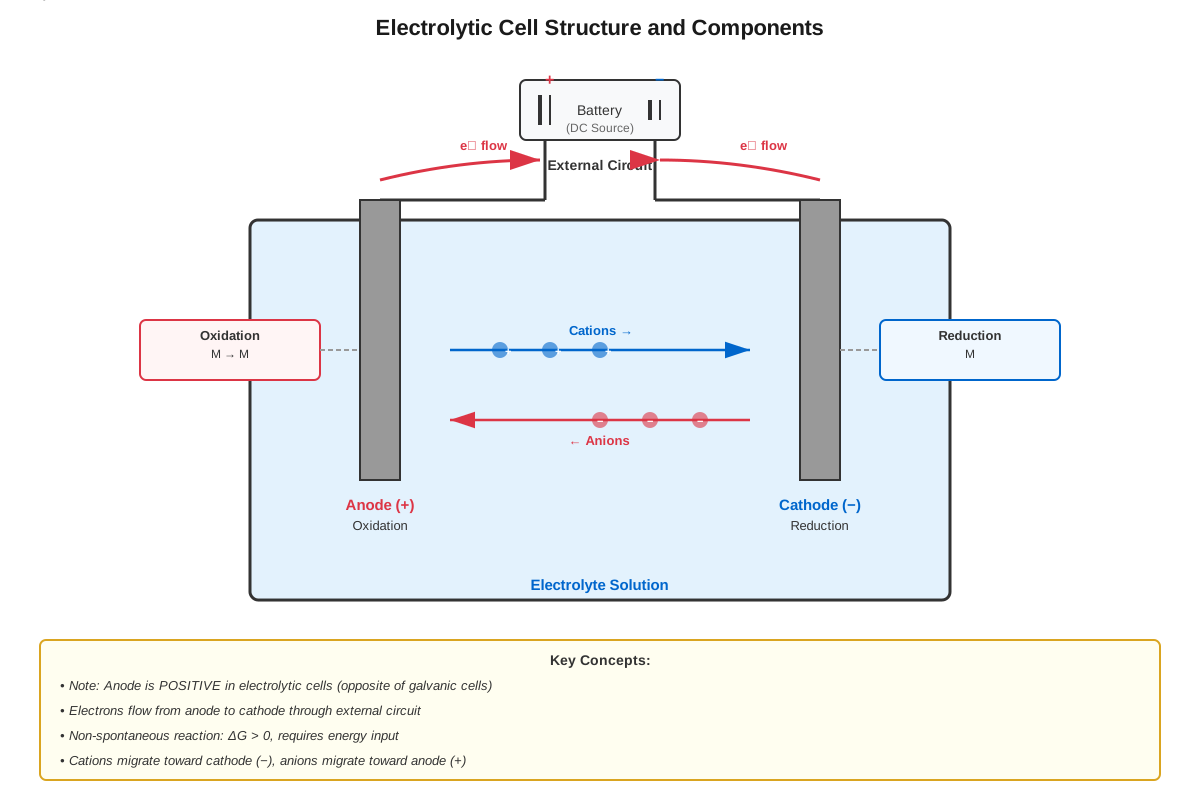
An electrolytic cell consists of several essential components:
- External power source: Provides the electrical energy needed to drive the non-spontaneous reaction
- Anode: The electrode where oxidation occurs (electrons are removed from species)
- Cathode: The electrode where reduction occurs (electrons are added to species)
- Electrolyte: A conducting medium (molten salt or aqueous solution) that allows ion migration
- Electrodes: Typically inert materials like platinum or graphite, though sometimes the anode itself is oxidized
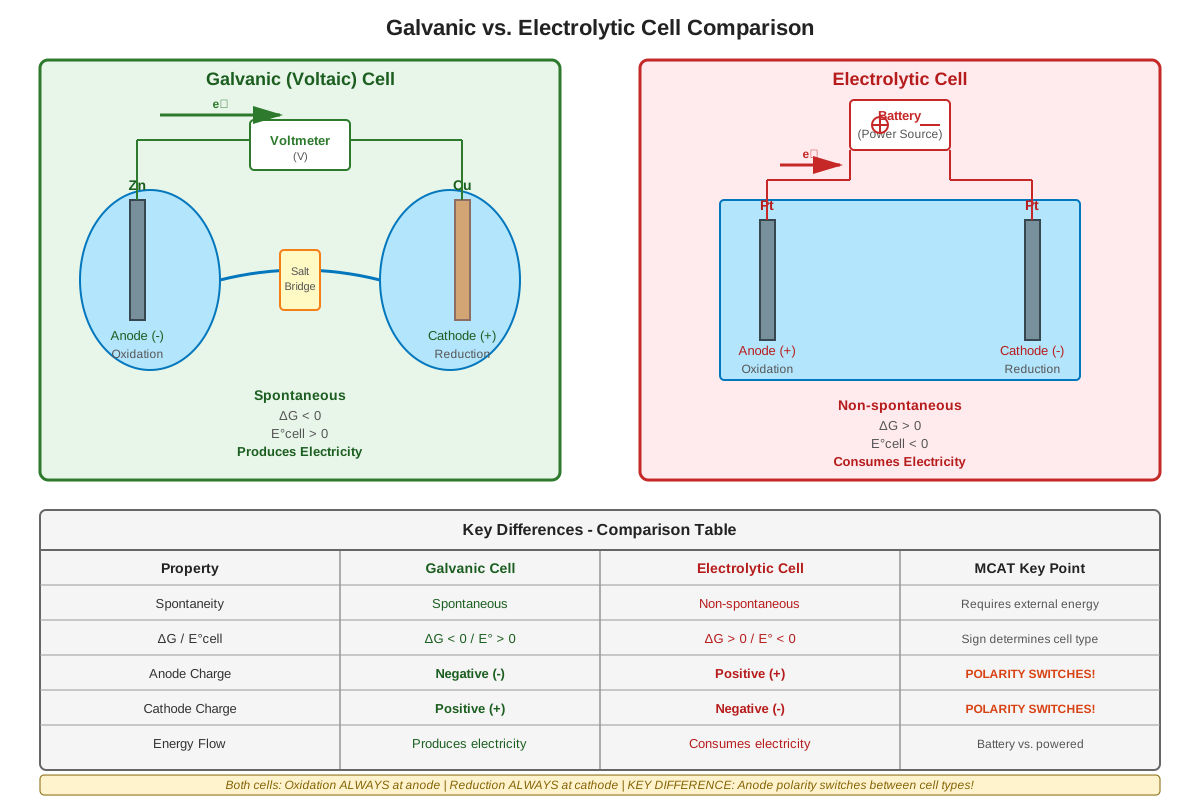
Exam Tip: In electrolytic cells, the anode is connected to the positive terminal of the power source and the cathode to the negative terminal. This is opposite to the charge designation in galvanic cells where the anode is negative and cathode is positive.
Electrode Reactions and Electron Flow
During electrolysis, the external power source pulls electrons from the anode and pushes them toward the cathode through the external circuit. At the anode (oxidation), species lose electrons, which flow through the wire to the cathode where reduction occurs as species gain electrons.
Oxidation at Anode: Species → Species^n+ + ne^-
Reduction at Cathode: Species^n+ + ne^- → Species
Within the electrolyte solution, cations migrate toward the cathode (attracted to the negative terminal) and anions migrate toward the anode (attracted to the positive terminal). This ion migration completes the circuit and maintains electrical neutrality in the solution.
Comparison: Electrolytic vs. Galvanic Cells
| Feature | Galvanic Cell | Electrolytic Cell |
|---|---|---|
| Spontaneity | Spontaneous (ΔG < 0) | Non-spontaneous (ΔG > 0) |
| E°cell | Positive | Negative |
| Energy conversion | Chemical → Electrical | Electrical → Chemical |
| Anode charge | Negative (-) | Positive (+) |
| Cathode charge | Positive (+) | Negative (-) |
| Electron flow | Anode → Cathode (external) | Anode → Cathode (external) |
| Purpose | Generate electricity | Drive reactions |
Electrolysis of Molten Salts
The electrolysis of molten (liquid) salts is the simplest case because only the cation and anion of the salt are present—no water or other species complicate the product prediction. The cation is reduced at the cathode, and the anion is oxidized at the anode.
Example: Electrolysis of molten NaCl
- Cathode (reduction): Na^+ + e^- → Na(l)
- Anode (oxidation): 2Cl^- → Cl₂(g) + 2e^-
- Overall: 2NaCl(l) → 2Na(l) + Cl₂(g)
This process is used industrially to produce sodium metal and chlorine gas, both highly reactive substances that cannot be obtained easily through other chemical means.
Electrolysis of Aqueous Solutions
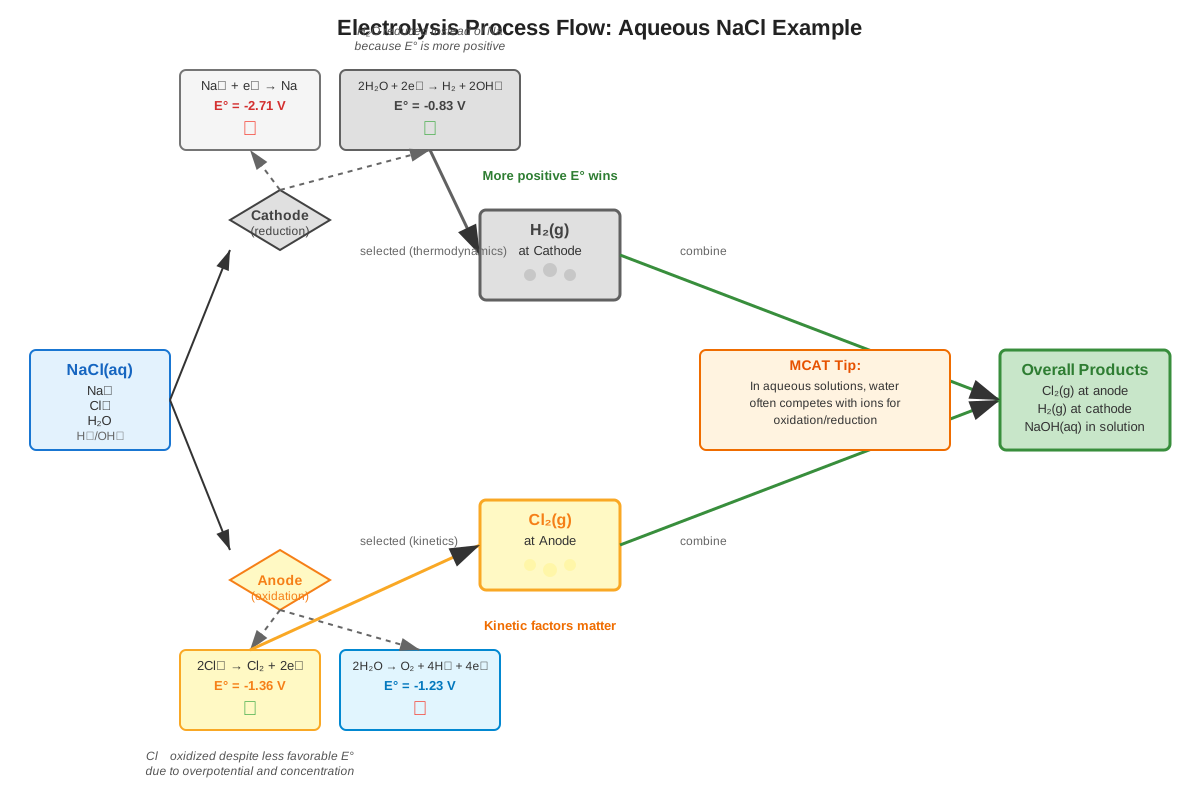
Electrolysis of aqueous solutions is more complex because water itself can be oxidized or reduced, competing with the dissolved ions. The species that is actually oxidized or reduced depends on the standard reduction potentials and concentration (overpotential effects).
At the Cathode (Reduction): The species with the more positive (less negative) reduction potential is preferentially reduced. Common possibilities include:
- Metal cations: M^n+ + ne^- → M(s)
- Water: 2H₂O + 2e^- → H₂(g) + 2OH^- (E° = -0.83 V)
- Hydrogen ions: 2H^+ + 2e^- → H₂(g) (E° = 0.00 V)
At the Anode (Oxidation): The species with the more negative (less positive) reduction potential is preferentially oxidized (easier to oxidize). Common possibilities include:
- Water: 2H₂O → O₂(g) + 4H^+ + 4e^- (E° = +1.23 V)
- Hydroxide: 4OH^- → O₂(g) + 2H₂O + 4e^- (E° = +0.40 V)
- Halide ions: 2X^- → X₂ + 2e^- (varies by halogen)
High-Yield Concept: Active metals (Groups 1 and 2, and aluminum) have very negative reduction potentials, so water is preferentially reduced instead of the metal cation in aqueous solutions. Similarly, oxyanions (SO₄²^-, NO₃^-, PO₄³^-) are not easily oxidized, so water is oxidized instead.
Faraday's Laws of Electrolysis
Faraday's laws provide the quantitative relationship between the amount of electrical charge passed through an electrolytic cell and the amount of chemical change that occurs.
First Law: The mass of substance produced at an electrode is directly proportional to the quantity of electricity (charge) passed through the cell.
Second Law: For a given quantity of electricity, the mass of substance produced is proportional to its equivalent weight (molar mass divided by the number of electrons transferred).
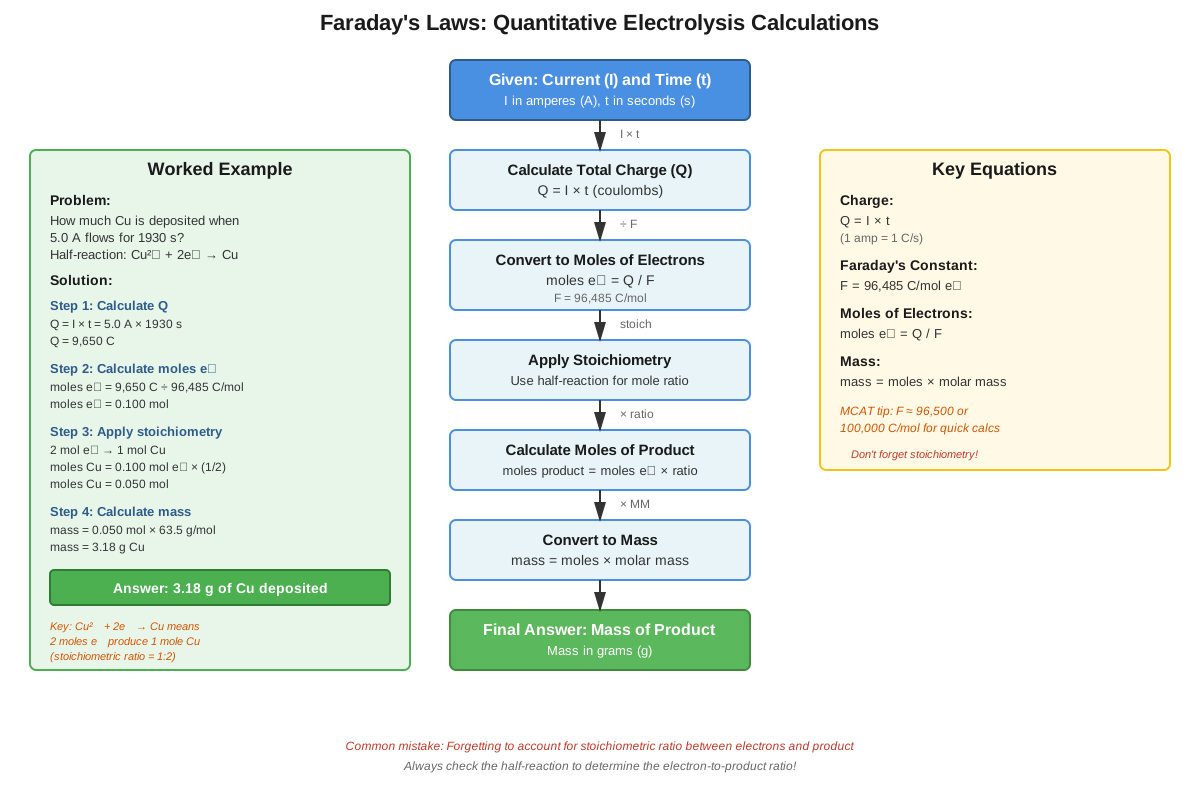
The fundamental equation for electrolysis calculations is:
Q = I × t = n × FWhere:
- Q = total charge (coulombs, C)
- I = current (amperes, A)
- t = time (seconds, s)
- n = moles of electrons
- F = Faraday's constant (96,485 C/mol e^-)
To calculate mass of product:
mass = (I × t × M) / (n × F)Where:
- M = molar mass of the product
- n = number of electrons required per mole of product
Overpotential and Kinetic Factors
Overpotential (or overvoltage) is the additional voltage beyond the thermodynamic minimum required to drive an electrolysis reaction at a practical rate. Kinetic barriers, particularly for gas evolution reactions, mean that the actual voltage needed exceeds the calculated E°cell value. This is especially significant for oxygen and hydrogen gas production.
For MCAT purposes, overpotential explains why certain predictions based solely on reduction potentials may not match experimental observations. For example, oxygen evolution from water oxidation has a significant overpotential, making it easier to oxidize certain anions (like Cl^-) than standard potentials would suggest.
Applications and Industrial Processes
Electroplating: Depositing a thin layer of metal onto a surface by making the object the cathode in an electrolytic cell containing metal cations.
Electrorefining: Purifying metals (especially copper) by making impure metal the anode, which dissolves, and pure metal deposits at the cathode.
Production of Elements: Obtaining reactive metals (Na, K, Ca, Al) and halogens (Cl₂, F₂) that cannot be isolated by chemical reduction.
Water Splitting: Producing hydrogen and oxygen gases for fuel and industrial applications.
Concept Relationships
The concepts within electrolysis form an interconnected framework. The fundamental definition of electrolysis as a non-spontaneous process requiring external energy directly connects to thermodynamics (ΔG > 0, E°cell < 0). This thermodynamic understanding leads to the need for an external power source in the electrolytic cell design.
The electrode reactions (oxidation at anode, reduction at cathode) depend on understanding redox chemistry and standard reduction potentials. These potentials determine product prediction in aqueous solutions, where competition between water and dissolved ions occurs. The overpotential concept modifies these predictions by introducing kinetic factors.
Faraday's laws connect the electrical aspects (current, time, charge) to the chemical outcomes (moles, mass), bridging the gap between circuit concepts and stoichiometry. This quantitative framework enables calculation of efficiency and yield in industrial applications.
The relationship map flows as:
Thermodynamics (ΔG, E°) → Non-spontaneity → Need for external power → Electrolytic cell setup → Electrode reactions → Product prediction (modified by overpotential) → Quantitative analysis (via Faraday's laws) → Applications
Connections to prerequisite topics include:
- Redox reactions provide the foundation for identifying oxidation and reduction
- Standard reduction potentials enable prediction of which species react
- Thermodynamics explains why external energy is required
- Stoichiometry is essential for Faraday's law calculations
Connections to related topics include:
- Galvanic cells represent the spontaneous counterpart to electrolysis
- Batteries can serve as the power source for electrolysis
- Corrosion can be prevented using electrolytic protection methods
- Concentration cells and Nernst equation explain concentration effects on potential
Quick check — test yourself on Electrolysis so far.
Try Flashcards →High-Yield Facts
⭐ Electrolysis requires an external power source to drive a non-spontaneous reaction (ΔG > 0, E°cell < 0)
⭐ In electrolytic cells, oxidation occurs at the anode (positive terminal) and reduction occurs at the cathode (negative terminal)
⭐ During aqueous electrolysis, water can be oxidized (to O₂) or reduced (to H₂), competing with dissolved ions
⭐ Active metals (Groups 1, 2, Al) are not reduced from aqueous solutions; water is reduced to H₂ instead
⭐ Faraday's constant (F = 96,485 C/mol e^-) relates charge to moles of electrons: Q = nF
- Oxyanions (SO₄²^-, NO₃^-, PO₄³^-) are not easily oxidized; water is oxidized to O₂ instead at the anode
- The amount of substance produced is directly proportional to current × time (Q = I × t)
- Halide ions can be oxidized to halogens, with the ease of oxidation increasing down the group (I^- > Br^- > Cl^- > F^-)
- Electron flow in the external circuit is always from anode to cathode in both galvanic and electrolytic cells
- Cations migrate toward the cathode; anions migrate toward the anode within the electrolyte
- Electroplating uses the object to be plated as the cathode in an electrolytic cell
- One mole of electrons (1 Faraday) will deposit one equivalent of substance (molar mass/charge)
Common Misconceptions
Misconception: The anode is always negative and the cathode is always positive.
Correction: In electrolytic cells, the anode is positive (connected to the positive terminal of the power source) and the cathode is negative. This is opposite to galvanic cells. However, oxidation always occurs at the anode and reduction at the cathode regardless of cell type.
Misconception: Any metal cation can be reduced to metal during aqueous electrolysis.
Correction: Active metals (Groups 1, 2, and aluminum) have such negative reduction potentials that water is preferentially reduced to hydrogen gas instead. Only metals with reduction potentials more positive than water (-0.83 V) can be deposited from aqueous solution.
Misconception: The species with the highest concentration is always oxidized or reduced first.
Correction: While concentration affects the actual potential (via the Nernst equation), the primary determinant is the standard reduction potential. A species with a much more favorable potential will react preferentially even at lower concentration, though very large concentration differences can shift the outcome.
Misconception: Electrolysis and galvanic cells have electrons flowing in opposite directions.
Correction: In both cell types, electrons flow from anode to cathode through the external circuit. The difference is that in galvanic cells this occurs spontaneously, while in electrolytic cells an external power source forces this flow against the natural tendency.
Misconception: The voltage of the power source must exactly equal |E°cell| to drive electrolysis.
Correction: The applied voltage must exceed |E°cell| to overcome the thermodynamic barrier, and in practice must be even higher to overcome overpotential (kinetic barriers) and resistance in the circuit. The minimum theoretical voltage is |E°cell|, but the practical voltage is significantly higher.
Misconception: Faraday's constant can be used directly with time in minutes or hours.
Correction: The equation Q = I × t requires time in seconds because current (amperes) is defined as coulombs per second. Time must be converted to seconds before calculation, or the current must be converted to coulombs per minute/hour.
Worked Examples
Example 1: Calculating Mass of Product
Question: A current of 5.00 A is passed through molten CaCl₂ for 2.00 hours. Calculate the mass of calcium metal produced at the cathode.
Solution:
Step 1: Identify the cathode reaction
At the cathode, Ca²⁺ is reduced: Ca²⁺ + 2e^- → Ca(s)
This shows that 2 moles of electrons produce 1 mole of Ca.
Step 2: Calculate total charge passed
Q = I × t
First convert time to seconds: 2.00 hours × 3600 s/hour = 7200 s
Q = 5.00 A × 7200 s = 36,000 C
Step 3: Calculate moles of electrons
n(e^-) = Q / F = 36,000 C / 96,485 C/mol = 0.373 mol e^-
Step 4: Calculate moles of calcium
From the stoichiometry, 2 mol e^- produces 1 mol Ca
n(Ca) = 0.373 mol e^- × (1 mol Ca / 2 mol e^-) = 0.187 mol Ca
Step 5: Calculate mass of calcium
mass = n × M = 0.187 mol × 40.08 g/mol = 7.49 g Ca
Answer: 7.49 g of calcium metal is produced.
Connection to Learning Objectives: This problem applies Faraday's laws to calculate product mass, demonstrating the quantitative relationship between electrical charge and chemical change. It reinforces the stoichiometric relationship between electrons and products.
Example 2: Product Prediction in Aqueous Electrolysis
Question: An aqueous solution of NiSO₄ is electrolyzed using inert electrodes. Predict the products at each electrode and write the half-reactions. Given: E°(Ni²⁺/Ni) = -0.26 V, E°(H₂O/H₂) = -0.83 V, E°(O₂/H₂O) = +1.23 V.
Solution:
Step 1: Identify possible cathode reactions (reduction)
- Ni²⁺ + 2e^- → Ni(s) E° = -0.26 V
- 2H₂O + 2e^- → H₂(g) + 2OH^- E° = -0.83 V
The more positive (less negative) reduction potential is favored.
Since -0.26 V > -0.83 V, nickel will be reduced preferentially.
Cathode reaction: Ni²⁺ + 2e^- → Ni(s)
Product: Nickel metal deposits on the cathode
Step 2: Identify possible anode reactions (oxidation)
- SO₄²^- → oxidation products (very difficult; oxyanions resist oxidation)
- 2H₂O → O₂(g) + 4H^+ + 4e^- E° = +1.23 V
Since sulfate is an oxyanion with very high oxidation resistance, water will be oxidized instead.
Anode reaction: 2H₂O → O₂(g) + 4H^+ + 4e^-
Product: Oxygen gas evolves at the anode
Step 3: Write the overall reaction
Balance electrons (multiply cathode reaction by 2):
- Cathode: 2Ni²⁺ + 4e^- → 2Ni(s)
- Anode: 2H₂O → O₂(g) + 4H^+ + 4e^-
- Overall: 2Ni²⁺ + 2H₂O → 2Ni(s) + O₂(g) + 4H^+
Answer: Nickel metal forms at the cathode; oxygen gas forms at the anode.
Connection to Learning Objectives: This problem demonstrates how to predict electrolysis products in aqueous solutions by comparing reduction potentials and recognizing that water can compete with dissolved ions. It illustrates the principle that oxyanions are not easily oxidized, and metals with moderately negative potentials can be deposited from aqueous solution.
Exam Strategy
When approaching MCAT questions on electrolysis, follow this systematic strategy:
1. Identify the cell type immediately: Look for keywords like "external power source," "battery connected," "non-spontaneous," or "electrolysis" to confirm you're dealing with an electrolytic cell rather than a galvanic cell.
2. Determine electrode identities: Remember that in electrolytic cells, the anode is positive and the cathode is negative (opposite to galvanic cells). Oxidation always occurs at the anode; reduction always occurs at the cathode.
3. For product prediction questions:
- List all possible species that could be oxidized (at anode) or reduced (at cathode)
- Compare standard reduction potentials
- Apply the rules: more positive E° is reduced; more negative E° is oxidized
- Remember special cases: active metals won't deposit from aqueous solution; oxyanions won't oxidize
4. For calculation questions:
- Write out the electrode reaction to determine the electron stoichiometry
- Convert all time units to seconds
- Use Q = I × t to find total charge
- Convert charge to moles of electrons using F = 96,485 C/mol
- Apply stoichiometry to find moles of product
- Convert to mass if needed
5. Trigger words to watch for:
- "Molten" or "fused" = simple case, only cation and anion present
- "Aqueous" = water can compete; check potentials carefully
- "Inert electrodes" = electrodes don't participate in reaction
- "Active electrodes" = anode material may be oxidized
- "Current efficiency" = not all charge produces the desired product
6. Process of elimination tips:
- Eliminate answers showing active metals depositing from aqueous solution
- Eliminate answers showing oxyanions being oxidized when water is present
- Eliminate answers with incorrect electron flow direction
- Eliminate answers with incorrect electrode designations (anode/cathode)
7. Time allocation: Spend 60-70 seconds on straightforward conceptual questions, 90-120 seconds on calculation problems. If a calculation seems complex, estimate using round numbers first to eliminate obviously wrong answers.
Exam Tip: If you're unsure about product prediction, remember the mnemonic "Active metals and oxyanions stay in solution" – this eliminates many wrong answers quickly.
Memory Techniques
Mnemonic for Electrode Processes: "An Ox" and "Red Cat"
- Anode = Oxidation
- Reduction = Cathode
Mnemonic for Electrolytic Cell Polarity: "Electrolytic cells have Anode Positive"
- Electrolytic → Anode is Positive (and cathode is negative)
- This is opposite to galvanic cells
Mnemonic for Ion Migration: "Cats go to Cat-hodes" (cations to cathode) and "Anions to Anodes"
Visualization Strategy for Electron Flow: Picture a battery with its terminals labeled. The negative terminal pushes electrons out (toward cathode), and the positive terminal pulls electrons in (from anode). Electrons always flow anode → cathode externally, but the battery forces this flow in electrolysis.
Acronym for Aqueous Electrolysis Rules: "WASP"
- Water competes with ions
- Active metals stay in solution (water reduced instead)
- Standard potentials determine products
- Positive E° reduced; negative E° oxidized
Memory Aid for Faraday's Constant: Think "approximately 100,000" (actually 96,485, but 100,000 is close enough for estimation and easier to remember). For quick calculations, use 96,500 or even 100,000 to check if your answer is in the right ballpark.
Visualization for Overpotential: Imagine trying to push a boulder uphill – the thermodynamic calculation tells you the height of the hill (E°cell), but you need extra energy to overcome friction and actually move it (overpotential). This extra "push" is why the applied voltage exceeds the calculated minimum.
Summary
Electrolysis is the process of using electrical energy from an external power source to drive non-spontaneous chemical reactions (ΔG > 0, E°cell < 0). In electrolytic cells, oxidation occurs at the anode (positive terminal) and reduction occurs at the cathode (negative terminal), with electrons flowing from anode to cathode through the external circuit. Product prediction depends on comparing standard reduction potentials, with the more positive potential being reduced and the more negative being oxidized. In aqueous solutions, water can compete with dissolved ions, and special rules apply: active metals (Groups 1, 2, Al) cannot be deposited because water is reduced instead, and oxyanions are not oxidized because water oxidizes preferentially. Quantitative calculations use Faraday's laws, relating charge (Q = I × t) to moles of electrons (n = Q/F) and ultimately to mass of products through stoichiometry. Understanding overpotential explains why practical voltages exceed theoretical minimums. Mastery of electrolysis requires integrating redox chemistry, thermodynamics, reduction potentials, and stoichiometric calculations to predict products and solve quantitative problems.
Key Takeaways
- Electrolysis uses external electrical energy to drive non-spontaneous reactions in electrolytic cells where ΔG > 0 and E°cell < 0
- Oxidation always occurs at the anode and reduction at the cathode; in electrolytic cells specifically, the anode is positive and cathode is negative
- Product prediction in aqueous electrolysis requires comparing reduction potentials while remembering that active metals won't deposit and oxyanions won't oxidize
- Faraday's laws provide the quantitative framework: Q = I × t = nF, connecting electrical charge to moles of electrons and ultimately to mass of products
- The key distinction between electrolytic and galvanic cells is spontaneity and energy conversion direction, not the direction of electron flow (which is anode → cathode in both)
- Overpotential explains why applied voltages must exceed the theoretical minimum calculated from standard potentials
- Industrial applications including electroplating, metal purification, and production of reactive elements demonstrate the practical importance of electrolysis
Related Topics
Galvanic (Voltaic) Cells: The spontaneous counterpart to electrolytic cells, where chemical energy is converted to electrical energy. Understanding galvanic cells provides contrast and helps distinguish between spontaneous and non-spontaneous electrochemical processes.
Nernst Equation: Allows calculation of cell potential under non-standard conditions, explaining how concentration affects which species are oxidized or reduced during electrolysis. Mastering electrolysis provides the foundation for understanding concentration effects.
Corrosion and Electrochemical Protection: Corrosion is a spontaneous electrochemical process that can be prevented using electrolytic methods (cathodic protection). Understanding electrolysis enables comprehension of how applied current prevents unwanted oxidation.
Batteries and Fuel Cells: These devices can serve as power sources for electrolysis, and understanding energy conversion in both directions (chemical ↔ electrical) provides a complete picture of electrochemical systems.
Thermodynamics of Electrochemical Cells: The relationship between ΔG, E°cell, and equilibrium constants (ΔG° = -RT ln K = -nFE°) connects electrochemistry to broader thermodynamic principles. Electrolysis mastery reinforces understanding of non-spontaneous processes.
Practice CTA
Now that you've mastered the core concepts of electrolysis, it's time to solidify your understanding through active practice. Attempt the practice questions to test your ability to predict products, perform Faraday's law calculations, and distinguish between electrolytic and galvanic cells. Use the flashcards to reinforce high-yield facts and commit key relationships to memory. Remember, the MCAT rewards not just knowledge but the ability to apply concepts quickly and accurately under time pressure. Each practice problem you solve builds the pattern recognition and problem-solving speed essential for test day success. You've built a strong foundation—now strengthen it through deliberate practice!
Sign up free to keep reading
Create a free AnvayaPrep account to finish this MCAT guide on Electrolysis — plus flashcards and practice questions.