Overview
The Arrhenius equation is a fundamental mathematical relationship in General Chemistry that quantifies how reaction rates depend on temperature and activation energy. Named after Swedish chemist Svante Arrhenius, this equation provides the theoretical framework for understanding why chemical reactions accelerate at higher temperatures and why some reactions proceed rapidly while others require significant energy input to occur at appreciable rates. For the MCAT, the Arrhenius equation bridges conceptual understanding of kinetics and equilibrium with quantitative problem-solving skills, making it an essential tool for analyzing reaction mechanisms, enzyme catalysis, and thermodynamic principles.
The Arrhenius equation appears regularly on the MCAT in both discrete questions and passage-based contexts, particularly in sections testing General Chemistry and biochemistry concepts. Students must not only memorize the equation but also understand its components, interpret graphical representations (especially Arrhenius plots), and apply it to predict how changes in temperature or activation energy affect reaction rates. The equation serves as a bridge between thermodynamics and kinetics, connecting concepts like activation energy, transition states, and catalysis to measurable reaction rates.
Mastery of the Arrhenius equation MCAT content requires understanding both its exponential and logarithmic forms, recognizing how it relates to collision theory and transition state theory, and applying it to biological systems where temperature sensitivity determines enzyme function and metabolic rates. This topic integrates mathematical reasoning with chemical intuition, making it a high-yield area for demonstrating scientific competency on the exam.
Learning Objectives
- [ ] Define the Arrhenius equation using accurate General Chemistry terminology
- [ ] Explain why the Arrhenius equation matters for the MCAT
- [ ] Apply the Arrhenius equation to exam-style questions
- [ ] Identify common mistakes related to the Arrhenius equation
- [ ] Connect the Arrhenius equation to related General Chemistry concepts
- [ ] Derive and manipulate the logarithmic form of the Arrhenius equation
- [ ] Interpret Arrhenius plots and extract activation energy from graphical data
- [ ] Predict quantitative changes in reaction rate given changes in temperature or activation energy
- [ ] Compare the effects of catalysts versus temperature changes using the Arrhenius framework
Prerequisites
- Reaction kinetics fundamentals: Understanding rate laws, rate constants, and reaction order is essential because the Arrhenius equation specifically describes how the rate constant (k) varies with temperature
- Activation energy concept: Knowledge of energy barriers and transition states provides the conceptual foundation for understanding why Ea appears in the equation
- Exponential and logarithmic functions: Mathematical facility with natural logarithms and exponential relationships is necessary for manipulating both forms of the equation
- Gas constant (R): Familiarity with R = 8.314 J/(mol·K) and unit conversions ensures proper calculation setup
- Temperature scales: Ability to convert between Celsius and Kelvin is critical since the equation requires absolute temperature
Why This Topic Matters
The Arrhenius equation has profound real-world significance in pharmaceutical development, food preservation, and biological systems. Medications must remain stable at room temperature, requiring pharmaceutical chemists to use Arrhenius relationships to predict shelf life and degradation rates. Enzymes in the human body operate within narrow temperature ranges because their catalytic efficiency depends on activation energy barriers that the Arrhenius equation quantifies. Understanding why fever accelerates metabolic reactions or why hypothermia slows physiological processes requires Arrhenius-based reasoning.
On the MCAT, the Arrhenius equation appears in approximately 2-4 questions per exam administration, representing medium-yield content that frequently appears in Chemical and Physical Foundations passages. Questions typically present experimental data showing reaction rates at different temperatures, requiring students to calculate activation energy, predict rate changes, or interpret Arrhenius plots. The equation also appears in biochemistry contexts involving enzyme kinetics, where temperature effects on kcat or Vmax require Arrhenius analysis.
Common exam presentations include: (1) passages describing temperature-dependent reaction studies with data tables requiring Arrhenius plot construction, (2) discrete questions asking for rate constant predictions at new temperatures, (3) experimental design questions about determining activation energy, and (4) conceptual questions comparing catalyzed versus uncatalyzed reactions. The MCAT particularly favors questions that integrate graphical interpretation with mathematical calculation, making Arrhenius plots a high-yield sub-topic.
Core Concepts
The Arrhenius Equation: Exponential Form
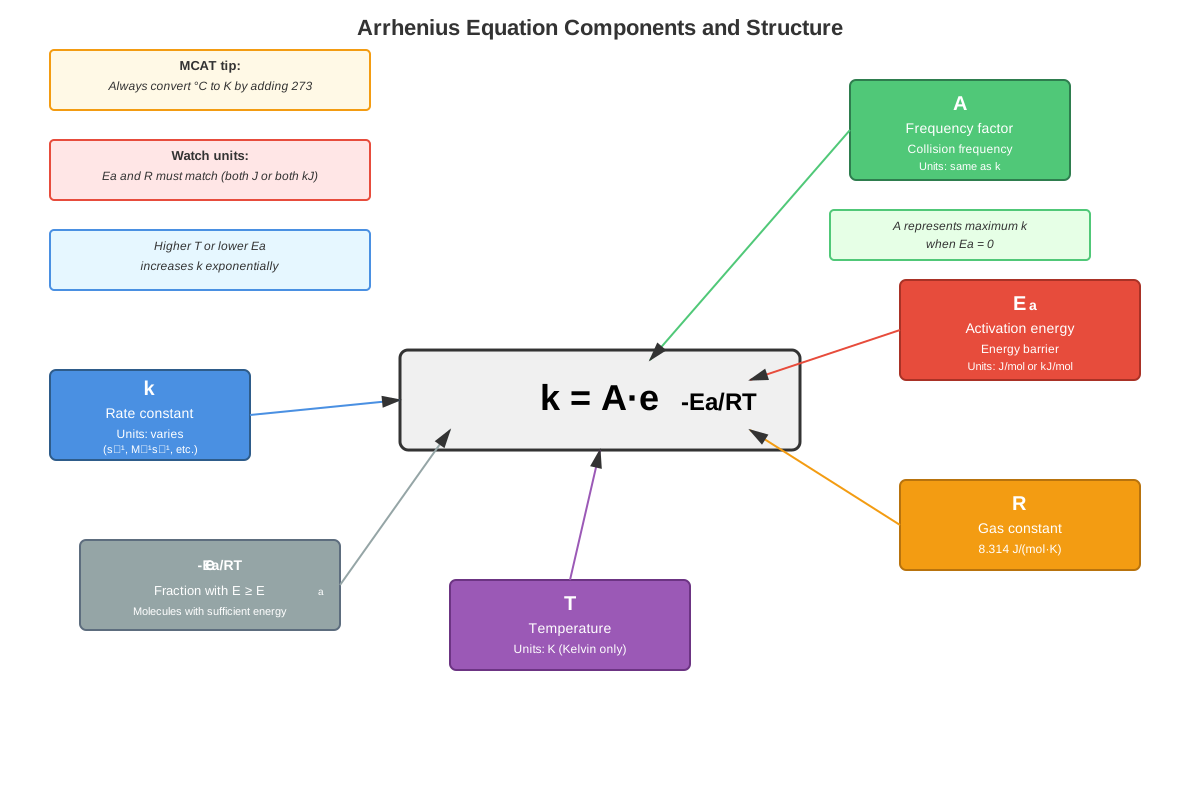
The Arrhenius equation in its standard exponential form is:
k = A·e^(-Ea/RT)Where:
- k = rate constant for the reaction (units vary with reaction order)
- A = frequency factor or pre-exponential factor (same units as k)
- Ea = activation energy (typically in J/mol or kJ/mol)
- R = universal gas constant (8.314 J/(mol·K))
- T = absolute temperature in Kelvin
The frequency factor (A) represents the frequency of collisions with proper molecular orientation. It accounts for the fact that not all molecular collisions lead to reaction—molecules must collide with correct spatial orientation for bonds to break and form. The A factor is temperature-independent and reflects the intrinsic properties of the reacting molecules, including their size, shape, and the complexity of the reaction mechanism.
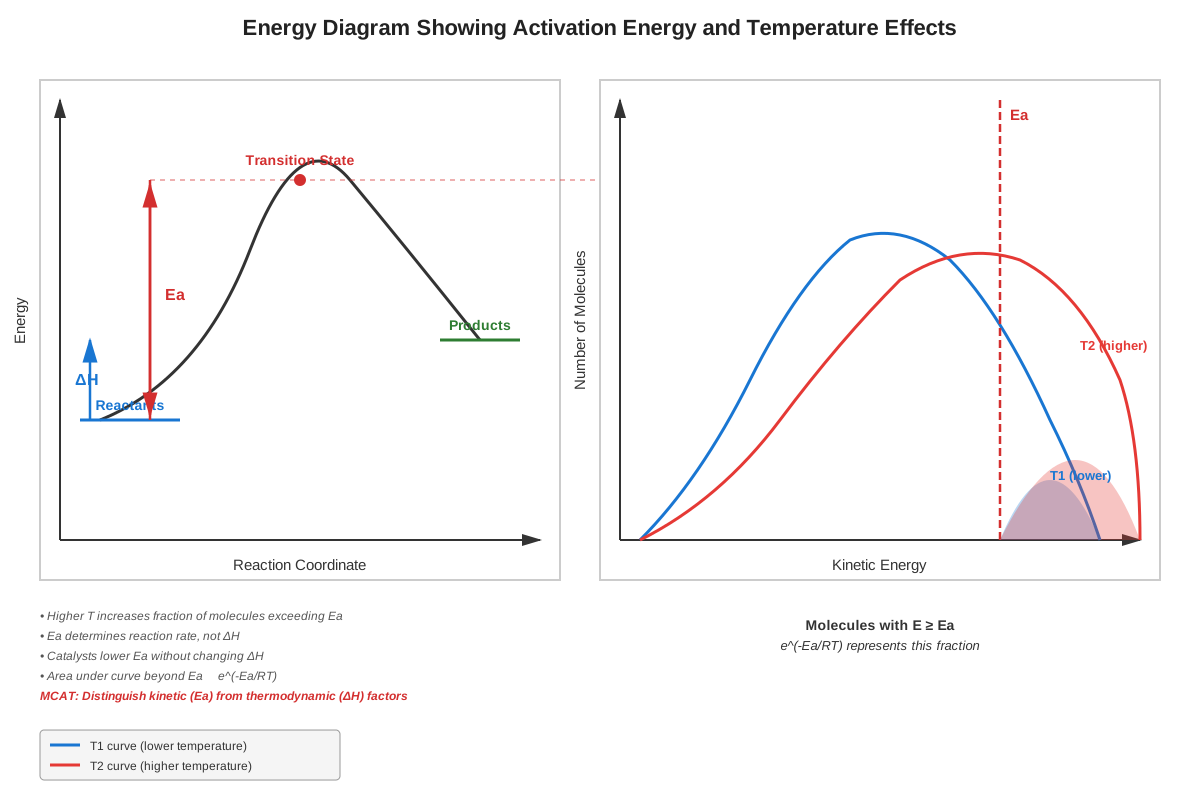
The exponential term e^(-Ea/RT) represents the fraction of molecules possessing sufficient energy to overcome the activation energy barrier at temperature T. This term explains why reaction rates increase dramatically with temperature: as T increases, the negative exponent becomes less negative, making the exponential term larger and thus increasing k.
The Arrhenius Equation: Logarithmic Form
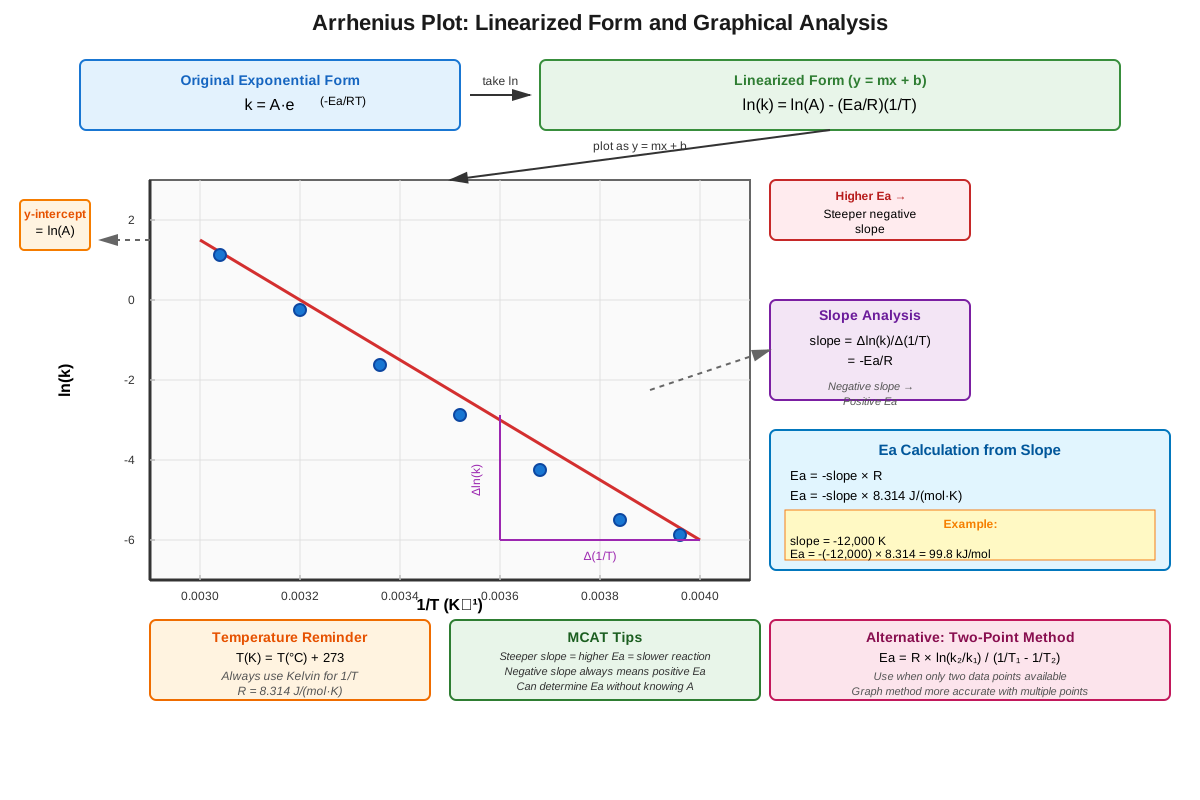
Taking the natural logarithm of both sides yields the logarithmic form:
ln(k) = ln(A) - Ea/RTThis form is particularly valuable because it resembles the equation of a straight line (y = mx + b). When ln(k) is plotted against 1/T, the result is an Arrhenius plot with:
- Slope = -Ea/R
- Y-intercept = ln(A)
This linear relationship allows experimental determination of activation energy from temperature-dependent rate data without knowing the reaction mechanism or the A factor initially.
Two-Point Form of the Arrhenius Equation
For comparing rate constants at two different temperatures, the two-point Arrhenius equation is derived by subtracting the logarithmic form at two temperatures:
ln(k₂/k₁) = (Ea/R)·(1/T₁ - 1/T₂)Or equivalently:
ln(k₂/k₁) = (Ea/R)·((T₂ - T₁)/(T₁·T₂))This form is extremely high-yield for the MCAT because it allows direct calculation of how much the rate constant changes between two temperatures without needing to know the A factor. This equation is the most commonly tested form in MCAT problem-solving contexts.
Activation Energy and Temperature Dependence
Activation energy (Ea) represents the minimum energy required for reactant molecules to reach the transition state and form products. Higher activation energies create steeper energy barriers, making reactions more temperature-sensitive. The Arrhenius equation quantifies this relationship: reactions with high Ea values show dramatic rate increases with small temperature increases, while reactions with low Ea values are relatively temperature-insensitive.
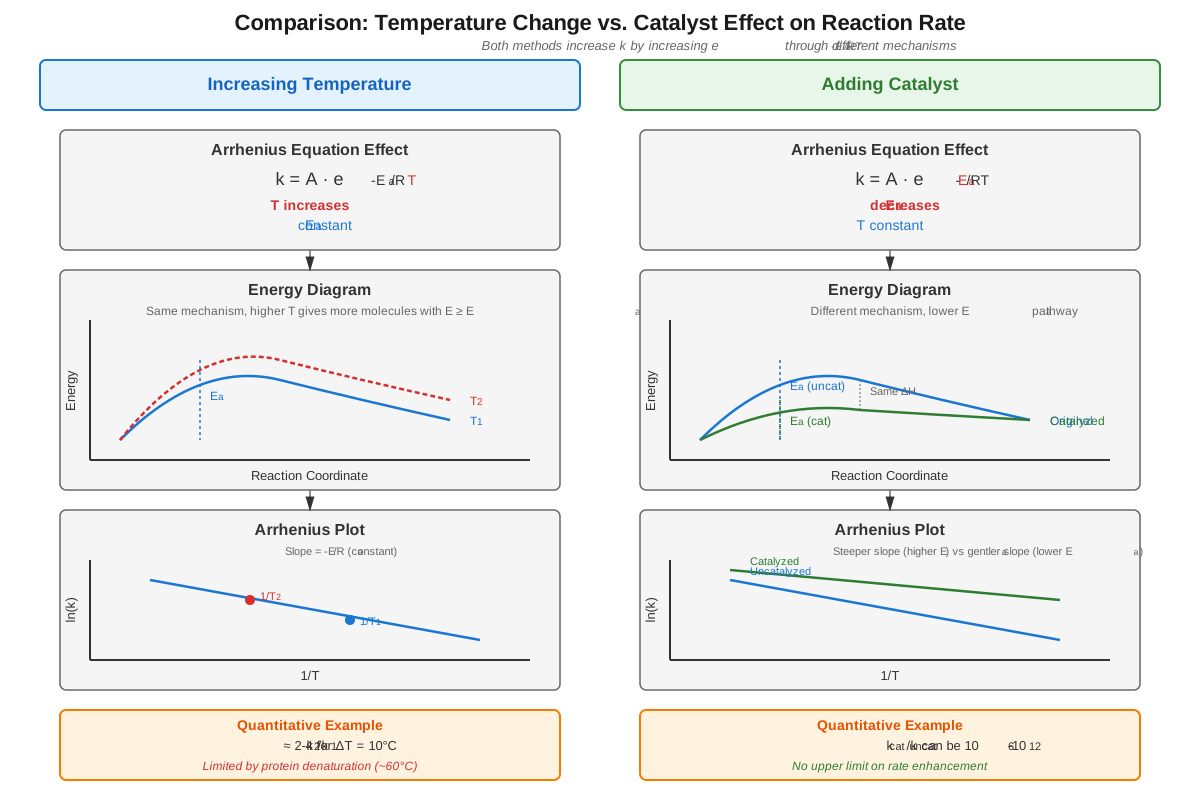
For biological systems, this principle explains why enzyme-catalyzed reactions are temperature-sensitive. A 10°C temperature increase typically doubles or triples reaction rates (the "Q₁₀ rule"), which can be derived from Arrhenius principles. However, excessive temperatures denature proteins, creating an optimal temperature range for biological function.
Catalysis and the Arrhenius Equation
Catalysts increase reaction rates by providing alternative reaction pathways with lower activation energies. In Arrhenius terms, a catalyst decreases Ea without changing the frequency factor A or the temperature T. Since k depends exponentially on -Ea/RT, even modest reductions in Ea produce substantial increases in k.
The table below compares uncatalyzed versus catalyzed reactions:
| Parameter | Uncatalyzed Reaction | Catalyzed Reaction |
|---|---|---|
| Activation Energy (Ea) | Higher | Lower |
| Rate Constant (k) | Smaller | Larger |
| Frequency Factor (A) | Unchanged | Unchanged |
| Temperature Dependence | More sensitive | Less sensitive |
| Equilibrium Position | Unchanged | Unchanged |
Importantly, catalysts do not affect the thermodynamic equilibrium position (Keq) because they accelerate both forward and reverse reactions equally. This distinction between kinetic effects (rate) and thermodynamic effects (equilibrium) is frequently tested on the MCAT.
Arrhenius Plots and Graphical Analysis
An Arrhenius plot graphs ln(k) on the y-axis versus 1/T on the x-axis. The resulting straight line has:
- Negative slope because Ea is positive (reactions require energy input)
- Steeper slope for reactions with higher activation energies
- Y-intercept equal to ln(A)
From experimental data, activation energy is calculated as:
Ea = -slope × R = -slope × 8.314 J/(mol·K)MCAT questions often present Arrhenius plots and ask students to compare activation energies of different reactions, identify which reaction is more temperature-sensitive, or calculate Ea from the slope. Remember that 1/T increases as temperature decreases, so the right side of an Arrhenius plot represents lower temperatures.
Units and Dimensional Analysis
Proper unit management is critical for Arrhenius calculations:
- Ea must be in J/mol (not kJ/mol) when using R = 8.314 J/(mol·K)
- T must be in Kelvin (add 273.15 to Celsius values)
- R value must match Ea units: use 8.314 J/(mol·K) or 0.008314 kJ/(mol·K)
- k units depend on reaction order but cancel in ratio calculations
The exponential term -Ea/RT must be dimensionless, which serves as a check for proper unit usage.
Concept Relationships
The Arrhenius equation serves as a central hub connecting multiple kinetics and equilibrium concepts. At its foundation, the equation builds on collision theory, which states that reactions occur when molecules collide with sufficient energy and proper orientation. The frequency factor A quantifies collision frequency and orientation requirements, while the exponential term addresses the energy requirement.
The relationship flows as follows: Collision Theory → provides theoretical basis for → Arrhenius Equation → quantifies → Temperature Dependence of Rate Constants → explains → Catalysis Effects → connects to → Enzyme Kinetics.
Activation energy (Ea) connects the Arrhenius equation to reaction coordinate diagrams and transition state theory. The transition state represents the highest energy point along the reaction pathway, and Ea measures the energy difference between reactants and this transition state. Catalysts lower Ea by stabilizing the transition state, which the Arrhenius equation then translates into quantitative rate increases.
The Arrhenius equation also connects to thermodynamics through the relationship between kinetics and equilibrium. While the Arrhenius equation describes how quickly equilibrium is reached (kinetics), it does not determine the equilibrium position itself (thermodynamics). The equilibrium constant Keq relates to the difference in activation energies for forward and reverse reactions: Keq = kforward/kreverse.
For enzyme kinetics, the Arrhenius equation explains temperature effects on kcat (the catalytic rate constant) and helps predict optimal enzyme operating temperatures. This connects to Michaelis-Menten kinetics and biochemical regulation in biological systems.
Quick check — test yourself on Arrhenius equation so far.
Try Flashcards →High-Yield Facts
⭐ The Arrhenius equation in exponential form is k = A·e^(-Ea/RT), where k is the rate constant, A is the frequency factor, Ea is activation energy, R is the gas constant, and T is absolute temperature
⭐ The two-point form ln(k₂/k₁) = (Ea/R)·(1/T₁ - 1/T₂) is the most commonly tested version for MCAT calculations
⭐ An Arrhenius plot of ln(k) versus 1/T yields a straight line with slope = -Ea/R
⭐ Catalysts increase reaction rates by decreasing activation energy (Ea), not by changing temperature or the frequency factor
⭐ Higher activation energies produce steeper Arrhenius plot slopes and greater temperature sensitivity
- The gas constant R = 8.314 J/(mol·K) must match the units of activation energy (J/mol)
- Temperature must always be converted to Kelvin (K = °C + 273.15) before using the Arrhenius equation
- The frequency factor A has the same units as the rate constant k and represents collision frequency with proper orientation
- Reactions with low activation energies (< 50 kJ/mol) proceed rapidly at room temperature
- A 10°C temperature increase typically doubles or triples reaction rates for biological systems (Q₁₀ effect)
- The exponential term e^(-Ea/RT) represents the fraction of molecules with energy ≥ Ea at temperature T
- Catalysts do not affect the equilibrium constant (Keq) because they lower Ea equally for forward and reverse reactions
- On an Arrhenius plot, the right side (higher 1/T values) represents lower temperatures
- The natural logarithm of the rate constant ratio ln(k₂/k₁) is directly proportional to the temperature difference
- Enzyme denaturation at high temperatures represents a limitation of Arrhenius predictions for biological systems
Common Misconceptions
Misconception: The Arrhenius equation applies to equilibrium constants (Keq) the same way it applies to rate constants (k).
Correction: The Arrhenius equation specifically describes rate constants, not equilibrium constants. While temperature affects both, Keq depends on ΔG° through the relationship ΔG° = -RT ln(Keq), which is a thermodynamic relationship distinct from the kinetic Arrhenius equation.
Misconception: Increasing temperature always increases the rate constant by the same factor regardless of activation energy.
Correction: The temperature sensitivity of a reaction depends strongly on Ea. Reactions with high activation energies show much larger rate increases for a given temperature change than reactions with low activation energies. The exponential dependence on -Ea/RT makes high-Ea reactions more temperature-sensitive.
Misconception: Catalysts increase the frequency factor (A) in the Arrhenius equation.
Correction: Catalysts work by decreasing the activation energy (Ea), not by changing the frequency factor A. The frequency factor relates to collision frequency and molecular orientation, which are intrinsic properties of the reactants that catalysts do not alter.
Misconception: On an Arrhenius plot, a steeper slope indicates a faster reaction.
Correction: A steeper (more negative) slope indicates higher activation energy, which means the reaction is more temperature-sensitive, not necessarily faster. The absolute rate depends on both Ea and the temperature at which the reaction is run. A reaction with high Ea might be slow at low temperatures but fast at high temperatures.
Misconception: The units of Ea don't matter as long as calculations are consistent.
Correction: The gas constant R must match the units of Ea. Using R = 8.314 J/(mol·K) requires Ea in J/mol, while R = 0.008314 kJ/(mol·K) requires Ea in kJ/mol. Mismatched units produce incorrect results by factors of 1000.
Misconception: The Arrhenius equation predicts that reaction rates increase indefinitely with temperature.
Correction: While the mathematical equation shows continuous increase, real systems have limitations. For biological systems, proteins denature at high temperatures. For gas-phase reactions, other factors like equilibrium shifts and side reactions become important. The Arrhenius equation is most accurate over moderate temperature ranges.
Misconception: A larger frequency factor (A) always means a faster reaction.
Correction: While a larger A contributes to a larger rate constant k, the exponential term e^(-Ea/RT) often dominates. A reaction with a small A but very low Ea can be much faster than a reaction with large A but high Ea.
Worked Examples
Example 1: Calculating Activation Energy from Two-Point Data
Problem: A reaction has a rate constant k₁ = 2.5 × 10⁻³ s⁻¹ at T₁ = 298 K and k₂ = 7.5 × 10⁻³ s⁻¹ at T₂ = 318 K. Calculate the activation energy for this reaction.
Solution:
Step 1: Identify the appropriate equation. Since we have rate constants at two temperatures, use the two-point form:
ln(k₂/k₁) = (Ea/R)·(1/T₁ - 1/T₂)Step 2: Calculate the rate constant ratio:
k₂/k₁ = (7.5 × 10⁻³)/(2.5 × 10⁻³) = 3.0
ln(3.0) = 1.099
Step 3: Calculate the temperature term:
1/T₁ - 1/T₂ = 1/298 - 1/318
= 0.003356 - 0.003145
= 0.000211 K⁻¹
Step 4: Solve for Ea:
1.099 = (Ea/8.314)·(0.000211)
Ea = 1.099/(0.000211 × 8.314)
Ea = 1.099/0.001754
Ea = 626.5 J/mol = 62.7 kJ/molInterpretation: This moderate activation energy (62.7 kJ/mol) indicates the reaction is temperature-sensitive. The rate tripled with a 20 K temperature increase, which is consistent with typical chemical reactions. This value would be reduced if a catalyst were added.
Example 2: Comparing Catalyzed and Uncatalyzed Reactions
Problem: An uncatalyzed reaction has Ea = 85 kJ/mol and k = 1.2 × 10⁻⁴ s⁻¹ at 298 K. A catalyst reduces the activation energy to 55 kJ/mol. Calculate the rate constant for the catalyzed reaction at the same temperature.
Solution:
Step 1: Recognize that both reactions have the same frequency factor A and temperature T. Write the Arrhenius equation for both:
Uncatalyzed: k₁ = A·e^(-85000/(8.314×298))
Catalyzed: k₂ = A·e^(-55000/(8.314×298))
Step 2: Take the ratio to eliminate A:
k₂/k₁ = e^(-55000/(8.314×298))/e^(-85000/(8.314×298))
k₂/k₁ = e^[(85000-55000)/(8.314×298)]
k₂/k₁ = e^[30000/2477.6]
k₂/k₁ = e^12.11
k₂/k₁ = 1.82 × 10⁵
Step 3: Calculate k₂:
k₂ = k₁ × 1.82 × 10⁵
k₂ = 1.2 × 10⁻⁴ × 1.82 × 10⁵
k₂ = 21.8 s⁻¹Interpretation: The catalyst increased the rate constant by approximately 180,000-fold by reducing Ea by 30 kJ/mol. This dramatic effect demonstrates why catalysts are essential in biological systems and industrial processes. Note that the equilibrium position remains unchanged—the catalyst accelerates both forward and reverse reactions equally.
Exam Strategy
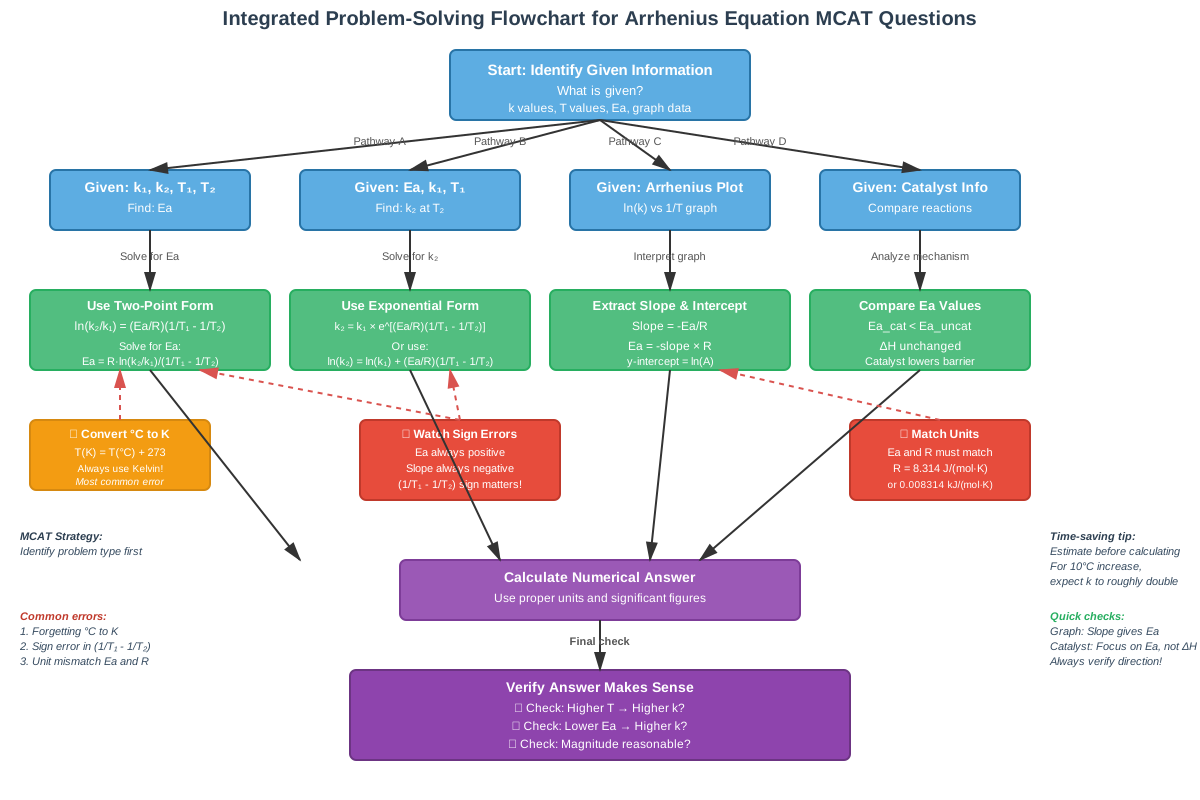
When approaching Arrhenius equation MCAT questions, first identify which form of the equation is most appropriate. If the question provides rate constants at two temperatures and asks about activation energy or rate changes, immediately think of the two-point form. If the question presents a graph of ln(k) versus 1/T, recognize it as an Arrhenius plot and remember that slope = -Ea/R.
Trigger words and phrases to watch for:
- "Temperature dependence" → Arrhenius equation application
- "Activation energy" → May require Arrhenius plot interpretation or calculation
- "Catalyst effect" → Compare Ea values using Arrhenius framework
- "Rate constant at different temperatures" → Two-point form
- "Frequency factor" or "pre-exponential factor" → Focus on A term
- "Slope of the line" in a kinetics graph → Likely Arrhenius plot
Process-of-elimination strategies:
- Eliminate answer choices with incorrect units (Ea should be in kJ/mol or J/mol, not kJ or J alone)
- Eliminate choices suggesting catalysts change equilibrium constants
- Eliminate choices claiming higher Ea means faster reactions (higher Ea means more temperature-sensitive, not necessarily faster)
- For Arrhenius plots, eliminate choices that confuse slope with y-intercept
Time allocation: Arrhenius calculations can be time-intensive. If a question requires complex logarithmic calculations, consider whether estimation or answer choice elimination can save time. For example, if k doubles with a temperature increase, ln(2) ≈ 0.7, which can be used for quick estimation. Budget 1.5-2 minutes for calculation-heavy Arrhenius questions.
Exam Tip: Always convert Celsius to Kelvin before any Arrhenius calculation. This is the most common source of errors. Write "K = °C + 273" at the top of your scratch paper as a reminder.
Exam Tip: When comparing two reactions on an Arrhenius plot, the reaction with the steeper (more negative) slope has higher activation energy and is more temperature-sensitive, but not necessarily faster at any given temperature.
Memory Techniques
Mnemonic for Arrhenius equation components: "Kate's Awesome Exponential Energy Reaches Temperature"
- Kate = k (rate constant)
- Awesome = A (frequency factor)
- Exponential = e (exponential function)
- Energy = Ea (activation energy)
- Reaches = R (gas constant)
- Temperature = T (absolute temperature)
Visualization for temperature effects: Picture molecules as runners approaching a hill (activation energy barrier). At low temperature, few runners have enough energy to climb the hill. As temperature increases, more runners gain energy and successfully cross. The height of the hill is Ea, and catalysts effectively lower the hill without changing the number or speed of runners.
Acronym for Arrhenius plot interpretation: "SINY"
- Slope = -Ea/R (negative slope)
- Intercept = ln(A) (y-intercept)
- Negative relationship (inverse relationship with 1/T)
- Y-axis = ln(k)
Memory aid for two-point form: "Larger k, Larger T" - When comparing two rate constants, the larger k corresponds to the larger T. This helps avoid mixing up k₁/k₂ with T₁/T₂ in the equation.
Conceptual anchor: Remember "CAT" for catalyst effects:
- Catalysts
- Alter (decrease)
- The activation energy (not A or T)
Summary
The Arrhenius equation (k = A·e^(-Ea/RT)) is a fundamental relationship in General Chemistry that quantifies how reaction rate constants depend on temperature and activation energy. The equation exists in exponential, logarithmic (ln(k) = ln(A) - Ea/RT), and two-point forms, with the two-point form being most commonly tested on the MCAT. Arrhenius plots (ln(k) vs. 1/T) provide a graphical method for determining activation energy from the slope (-Ea/R). Catalysts increase reaction rates by decreasing Ea without affecting the frequency factor A or the equilibrium constant. Higher activation energies produce greater temperature sensitivity, explaining why biological systems operate within narrow temperature ranges. Mastery requires understanding both conceptual relationships (how Ea affects temperature dependence) and quantitative skills (calculating Ea from experimental data, predicting rate changes with temperature). The equation bridges collision theory, transition state theory, and practical applications in enzyme kinetics and chemical kinetics.
Key Takeaways
- The Arrhenius equation k = A·e^(-Ea/RT) relates rate constants to temperature and activation energy, with all temperatures in Kelvin and R = 8.314 J/(mol·K)
- The two-point form ln(k₂/k₁) = (Ea/R)·(1/T₁ - 1/T₂) is the highest-yield equation for MCAT calculations involving rate changes with temperature
- Arrhenius plots (ln(k) vs. 1/T) have slope = -Ea/R, allowing experimental determination of activation energy from temperature-dependent rate data
- Catalysts increase reaction rates by decreasing activation energy (Ea), not by changing the frequency factor (A) or temperature (T)
- Higher activation energies produce steeper Arrhenius plot slopes and greater temperature sensitivity, but do not necessarily indicate faster reactions at a given temperature
- The exponential dependence on -Ea/RT means small changes in Ea or T can produce large changes in k, explaining the dramatic effects of catalysts and temperature on reaction rates
- Proper unit management is critical: Ea must match R units (J/mol with 8.314 J/(mol·K)), and temperature must always be in Kelvin
Related Topics
Reaction Coordinate Diagrams: Visual representations of energy changes during reactions, showing how Ea relates to the transition state and how catalysts provide alternative pathways with lower activation barriers. Mastering Arrhenius concepts enables quantitative interpretation of these qualitative diagrams.
Enzyme Kinetics and Michaelis-Menten Equation: The temperature dependence of kcat and Vmax follows Arrhenius relationships, connecting chemical kinetics to biochemical systems. Understanding Arrhenius principles is essential for predicting enzyme behavior at different temperatures.
Collision Theory and Transition State Theory: These theoretical frameworks provide the molecular-level explanation for why the Arrhenius equation works, describing how molecular collisions and transition state formation determine reaction rates.
Thermodynamics and Gibbs Free Energy: While the Arrhenius equation describes kinetics (how fast), thermodynamics describes equilibrium (how far). Understanding both allows complete analysis of chemical reactions, including the relationship between kinetic barriers and thermodynamic favorability.
Catalysis Mechanisms: Detailed study of how catalysts work at the molecular level, including heterogeneous catalysis, enzyme catalysis, and acid-base catalysis, all interpreted through the Arrhenius framework of activation energy reduction.
Practice CTA
Now that you've mastered the theoretical foundations of the Arrhenius equation, it's time to solidify your understanding through active practice. Attempt the practice questions and flashcards associated with this topic, focusing on both calculation-based problems and conceptual questions about temperature dependence and catalysis. Pay special attention to Arrhenius plot interpretation, as this frequently appears in MCAT passages. Remember: understanding the "why" behind the equation is just as important as performing calculations correctly. Each practice problem you complete strengthens your ability to recognize Arrhenius applications in diverse contexts, building the pattern recognition skills essential for MCAT success. You've got this!
Sign up free to keep reading
Create a free AnvayaPrep account to finish this MCAT guide on Arrhenius equation — plus flashcards and practice questions.