Overview
The equilibrium constant is a fundamental quantitative measure in General Chemistry that describes the ratio of product concentrations to reactant concentrations when a reversible chemical reaction reaches equilibrium. This dimensionless value, denoted as K, provides critical information about the position of equilibrium and the extent to which a reaction proceeds toward products or remains predominantly as reactants. Understanding the equilibrium constant is essential for predicting reaction behavior, calculating concentrations at equilibrium, and interpreting how systems respond to external perturbations—all skills frequently tested on the MCAT.
For the MCAT, the equilibrium constant appears across multiple contexts within Kinetics and Equilibrium and connects to acid-base chemistry, solubility, and thermodynamics. Test-makers frequently present passages involving buffer systems, titrations, or biochemical reactions where students must calculate K values, interpret their magnitude, or predict shifts in equilibrium position. The ability to write equilibrium expressions correctly, manipulate them algebraically, and understand their thermodynamic implications distinguishes high-scoring students from those who struggle with chemical reasoning questions.
Mastery of equilibrium constants provides the foundation for understanding Le Châtelier's principle, reaction quotients, and the relationship between thermodynamics and chemical equilibrium. This topic bridges kinetic concepts (reaction rates) with thermodynamic principles (Gibbs free energy), making it a central organizing concept in General Chemistry. Students who develop strong intuition about equilibrium constants can rapidly analyze complex chemical systems and make accurate predictions about reaction behavior under various conditions.
Learning Objectives
- [ ] Define equilibrium constant using accurate General Chemistry terminology
- [ ] Explain why equilibrium constant matters for the MCAT
- [ ] Apply equilibrium constant to exam-style questions
- [ ] Identify common mistakes related to equilibrium constant
- [ ] Connect equilibrium constant to related General Chemistry concepts
- [ ] Write correct equilibrium expressions for homogeneous and heterogeneous equilibria
- [ ] Calculate equilibrium constants from concentration or pressure data
- [ ] Predict the direction of reaction shift using the reaction quotient (Q) versus K
- [ ] Relate equilibrium constant values to the thermodynamic favorability of reactions
Prerequisites
- Stoichiometry and balanced chemical equations: Equilibrium expressions require correctly balanced equations to determine proper exponents
- Molarity and concentration units: Equilibrium constants for solutions use molar concentrations in their expressions
- Reversible reactions: Understanding that reactions can proceed in both forward and reverse directions is fundamental to equilibrium concepts
- Basic algebra and logarithms: Manipulating equilibrium expressions and relating K to ΔG° requires mathematical facility
- States of matter: Distinguishing between gases, liquids, solids, and aqueous solutions determines what appears in equilibrium expressions
Why This Topic Matters
The equilibrium constant appears in approximately 3-5% of MCAT Chemical and Physical Foundations questions, making it a medium-yield but essential topic. Questions involving equilibrium constants often integrate multiple concepts, requiring students to combine stoichiometry, thermodynamics, and chemical reasoning. The MCAT frequently tests this concept through passage-based questions involving biochemical equilibria (enzyme kinetics, protein folding), acid-base systems (Ka, Kb, buffer calculations), and solubility equilibria (Ksp).
Clinically, equilibrium principles govern oxygen binding to hemoglobin, drug-receptor interactions, and metabolic pathway regulation. The oxygen-hemoglobin dissociation curve, a high-yield MCAT topic, directly applies equilibrium concepts to explain how pH, temperature, and 2,3-BPG shift binding affinity. Understanding equilibrium constants enables medical professionals to predict how changing physiological conditions affect drug efficacy, enzyme activity, and metabolic balance.
On the MCAT, equilibrium constant questions typically appear in three formats: (1) calculation problems requiring students to determine K from experimental data, (2) conceptual questions asking students to predict equilibrium shifts or compare K values, and (3) passage-based questions integrating equilibrium with thermodynamics, kinetics, or acid-base chemistry. Recognizing these patterns and developing systematic approaches to each question type significantly improves performance.
Core Concepts
Definition and Mathematical Expression
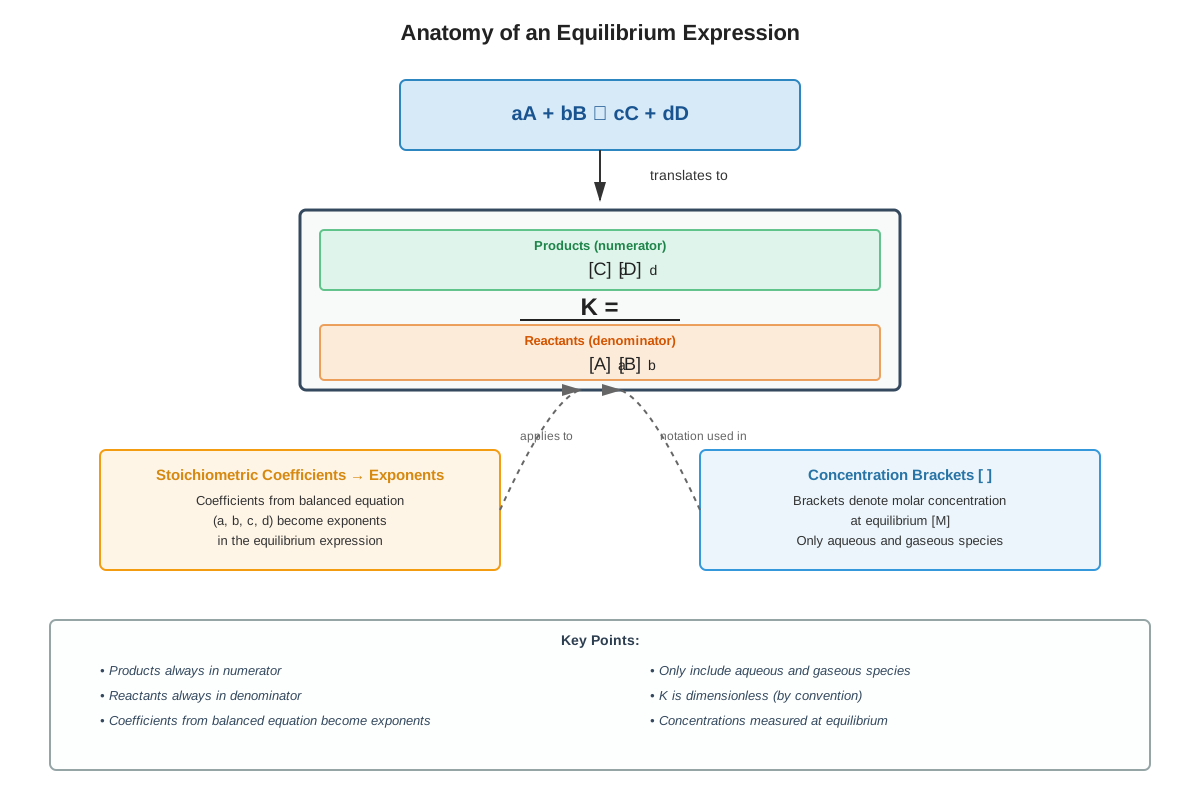
The equilibrium constant (K) quantifies the ratio of product concentrations to reactant concentrations at equilibrium, with each concentration raised to the power of its stoichiometric coefficient. For a general reversible reaction:
aA + bB ⇌ cC + dDThe equilibrium constant expression is:
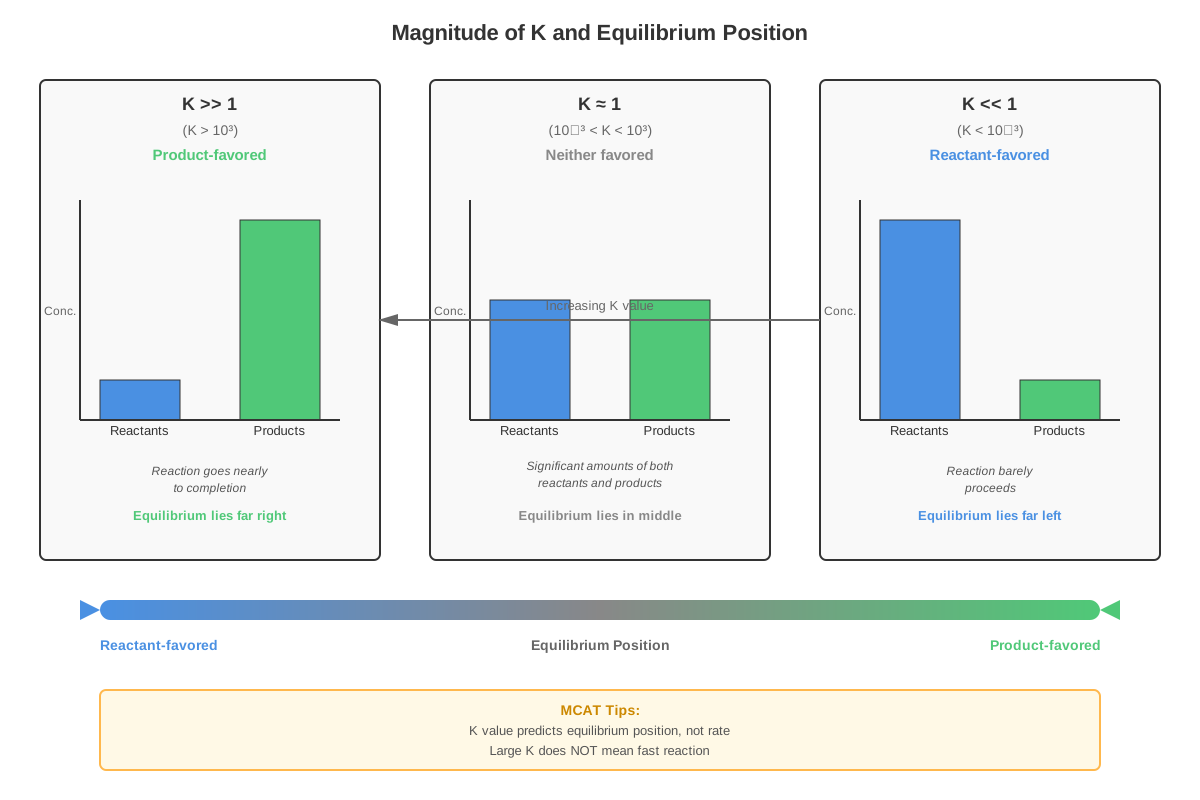
K = [C]^c[D]^d / [A]^a[B]^bThe square brackets denote molar concentrations (mol/L) at equilibrium. The magnitude of K indicates the position of equilibrium: K >> 1 means products predominate at equilibrium, K << 1 means reactants predominate, and K ≈ 1 indicates comparable amounts of reactants and products.
Types of Equilibrium Constants
Different equilibrium constants apply to specific types of reactions:
| Constant | Name | Application | Expression Form |
|---|---|---|---|
| Kc | Concentration equilibrium constant | Reactions in solution | Uses molar concentrations |
| Kp | Pressure equilibrium constant | Gas-phase reactions | Uses partial pressures (atm) |
| Ka | Acid dissociation constant | Weak acid equilibria | [H⁺][A⁻]/[HA] |
| Kb | Base dissociation constant | Weak base equilibria | [BH⁺][OH⁻]/[B] |
| Kw | Water autoionization constant | Water equilibrium | [H⁺][OH⁻] = 1.0 × 10⁻¹⁴ at 25°C |
| Ksp | Solubility product constant | Sparingly soluble salts | Product of ion concentrations |
For gas-phase reactions, Kp and Kc relate through the equation:
Kp = Kc(RT)^Δnwhere Δn is the change in moles of gas (moles of gaseous products minus moles of gaseous reactants), R is the gas constant, and T is temperature in Kelvin.
Writing Equilibrium Expressions
Correct equilibrium expressions follow specific rules:
- Include only species whose concentrations can change: Aqueous solutions and gases appear in the expression
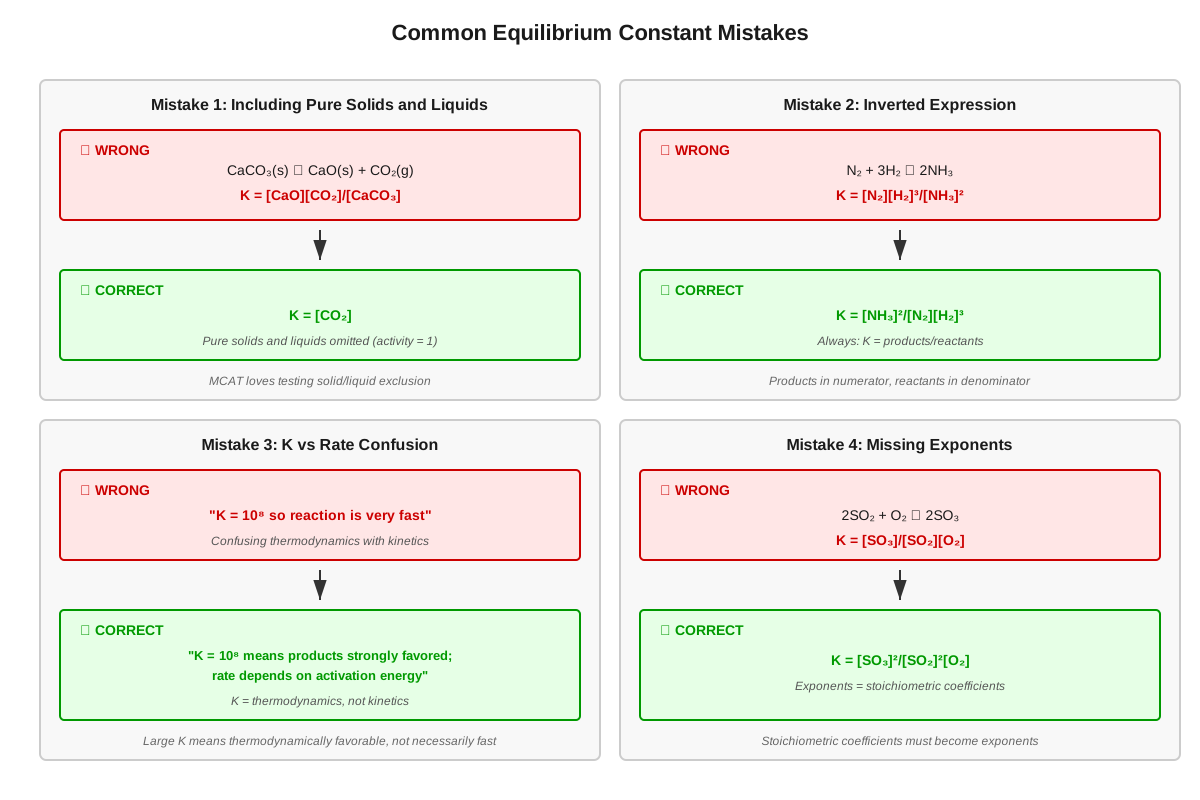
- Exclude pure solids and pure liquids: Their "concentrations" are incorporated into the K value
- Use stoichiometric coefficients as exponents: The balanced equation determines these powers
- Products in numerator, reactants in denominator: This convention is universal
For heterogeneous equilibria involving multiple phases, only aqueous and gaseous species appear. For example, the dissolution of calcium carbonate:
CaCO₃(s) ⇌ Ca²⁺(aq) + CO₃²⁻(aq)The equilibrium expression is:
Ksp = [Ca²⁺][CO₃²⁻]The solid CaCO₃ does not appear because its activity is defined as 1.
Reaction Quotient (Q)
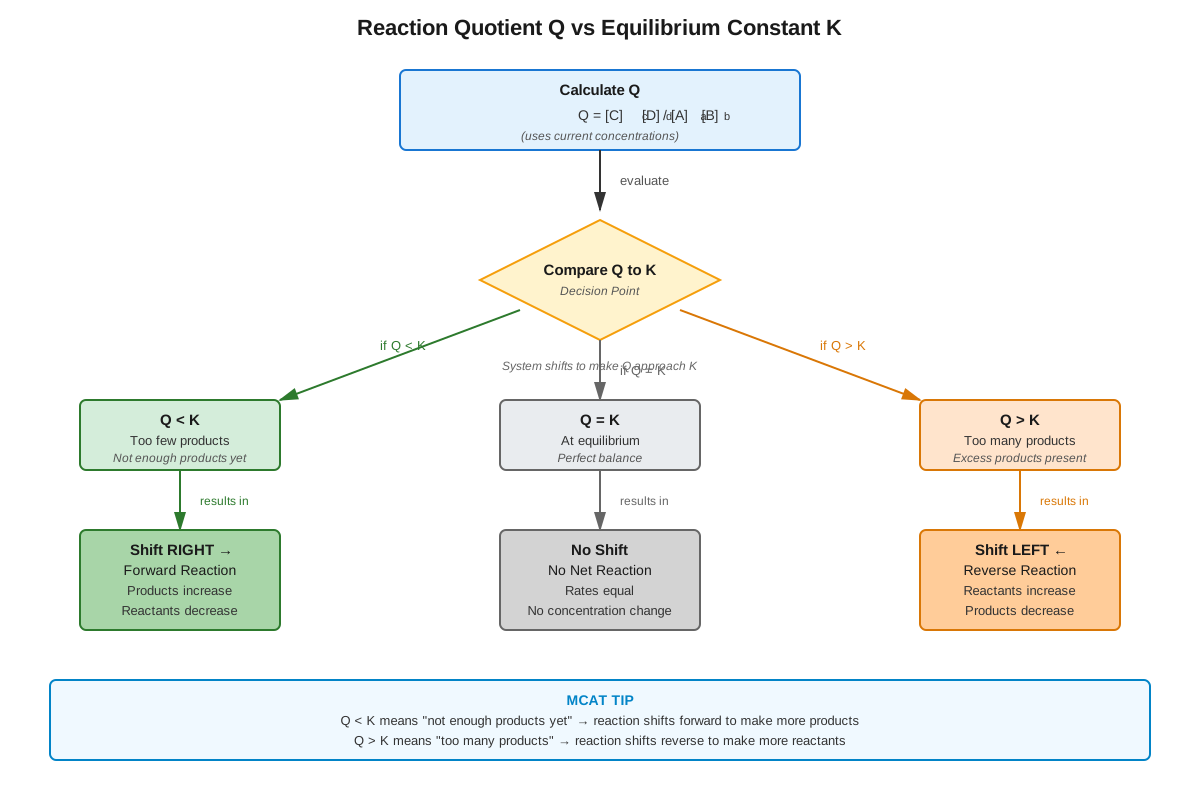
The reaction quotient (Q) has the same mathematical form as K but uses concentrations at any point in time, not just at equilibrium. Comparing Q to K predicts the direction of reaction shift:
- Q < K: Reaction proceeds forward (toward products) to reach equilibrium
- Q = K: System is at equilibrium; no net change occurs
- Q > K: Reaction proceeds in reverse (toward reactants) to reach equilibrium
This comparison is essential for MCAT questions involving Le Châtelier's principle and predicting system responses to concentration changes.
Relationship to Thermodynamics
The equilibrium constant connects directly to the standard Gibbs free energy change (ΔG°) through the fundamental equation:
ΔG° = -RT ln(K)This relationship reveals that:
- K > 1 corresponds to ΔG° < 0 (thermodynamically favorable reaction)
- K < 1 corresponds to ΔG° > 0 (thermodynamically unfavorable reaction)
- K = 1 corresponds to ΔG° = 0 (no driving force in either direction)
At 25°C (298 K), this simplifies to:
ΔG° = -5.71 log(K) kJ/molThis connection allows students to interconvert between thermodynamic and equilibrium perspectives on chemical reactions.
Temperature Dependence
Equilibrium constants change with temperature according to the van 't Hoff equation:
ln(K₂/K₁) = -ΔH°/R (1/T₂ - 1/T₁)For exothermic reactions (ΔH° < 0), increasing temperature decreases K because heat is a product. For endothermic reactions (ΔH° > 0), increasing temperature increases K because heat is a reactant. This temperature dependence explains why Le Châtelier's principle predicts equilibrium shifts in response to temperature changes.
Manipulating Equilibrium Expressions
When reactions are combined, reversed, or multiplied by coefficients, their equilibrium constants transform predictably:
- Reversing a reaction: K_reverse = 1/K_forward
- Multiplying coefficients by n: K_new = (K_original)^n
- Adding reactions: K_overall = K₁ × K₂
These relationships enable calculation of equilibrium constants for complex reactions from known values of simpler reactions—a common MCAT problem type.
Concept Relationships
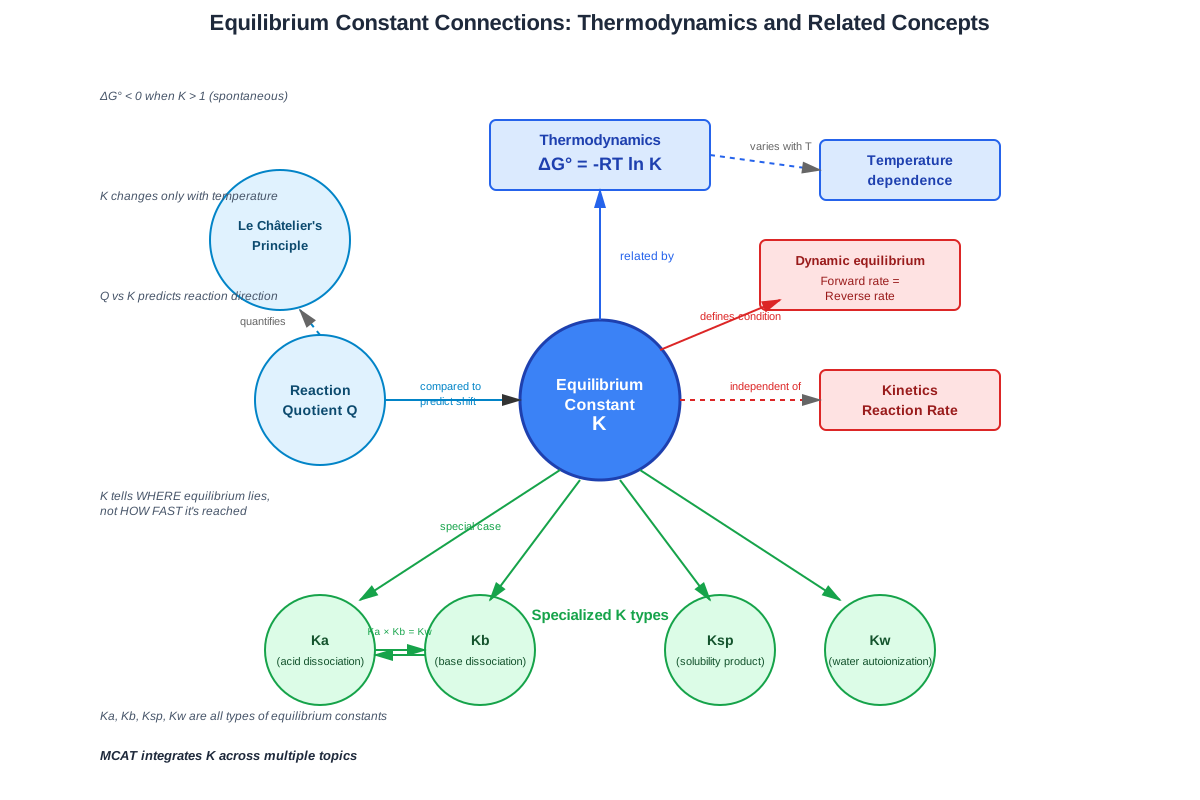
The equilibrium constant serves as a central hub connecting multiple General Chemistry concepts. Stoichiometry provides the balanced equations necessary to write correct equilibrium expressions, with coefficients becoming exponents in the K expression. Thermodynamics relates to equilibrium through the ΔG° = -RT ln(K) equation, showing that equilibrium position reflects the thermodynamic favorability of reactions.
Kinetics and Equilibrium connect through the relationship between forward and reverse rate constants: K = k_forward/k_reverse. This demonstrates that equilibrium is a dynamic state where forward and reverse reactions occur at equal rates, not a static condition. Le Châtelier's principle uses the reaction quotient Q compared to K to predict how systems respond to stress, creating a conceptual bridge between equilibrium constants and qualitative predictions.
Acid-base chemistry extensively applies equilibrium concepts through Ka and Kb values, which determine pH, buffer capacity, and titration curves. The relationship Ka × Kb = Kw for conjugate acid-base pairs exemplifies how equilibrium constants combine. Solubility equilibria use Ksp values to predict precipitation and dissolution, connecting to common ion effects and complex ion formation.
The conceptual flow progresses: Balanced equation → Equilibrium expression → Calculate K → Compare Q to K → Predict direction of shift → Apply Le Châtelier's principle → Connect to ΔG° and thermodynamics. This integrated understanding enables students to approach complex MCAT passages systematically.
Quick check — test yourself on Equilibrium constant so far.
Try Flashcards →High-Yield Facts
⭐ The equilibrium constant expression includes only aqueous and gaseous species; pure solids and liquids are excluded
⭐ K >> 1 indicates product-favored equilibrium; K << 1 indicates reactant-favored equilibrium
⭐ The relationship ΔG° = -RT ln(K) connects thermodynamics to equilibrium position
⭐ When Q < K, the reaction proceeds forward; when Q > K, the reaction proceeds in reverse
⭐ For conjugate acid-base pairs, Ka × Kb = Kw = 1.0 × 10⁻¹⁴ at 25°C
- Equilibrium constants are temperature-dependent but independent of initial concentrations
- Catalysts do not change K values; they only accelerate the approach to equilibrium
- For gas-phase reactions, Kp = Kc(RT)^Δn where Δn is the change in moles of gas
- Reversing a reaction inverts its equilibrium constant: K_reverse = 1/K_forward
- Adding reactions multiplies their equilibrium constants: K_total = K₁ × K₂
- The magnitude of K provides no information about reaction rate or mechanism
- At equilibrium, ΔG = 0 (not ΔG°), meaning no net driving force exists
- Equilibrium constants are dimensionless by convention, though they have implicit units
- Increasing temperature increases K for endothermic reactions and decreases K for exothermic reactions
- The equilibrium constant for a reaction multiplied by coefficient n is K^n
Common Misconceptions
Misconception: A large equilibrium constant means the reaction occurs rapidly.
Correction: K indicates the position of equilibrium (extent of reaction), not the rate. A reaction with K >> 1 may proceed extremely slowly if the activation energy is high. Kinetics and thermodynamics are independent properties.
Misconception: Pure solids and liquids should be included in equilibrium expressions with concentration = 1.
Correction: Pure solids and liquids are excluded entirely from equilibrium expressions because their activities are constant and incorporated into the K value itself. Including them with any numerical value is incorrect.
Misconception: Changing the initial concentrations of reactants changes the equilibrium constant.
Correction: K is constant at a given temperature regardless of initial concentrations. Changing initial amounts shifts the equilibrium position (changes equilibrium concentrations) but does not change K.
Misconception: Adding a catalyst increases the equilibrium constant.
Correction: Catalysts accelerate both forward and reverse reactions equally, allowing the system to reach equilibrium faster without changing the equilibrium position or K value. Only temperature changes affect K.
Misconception: When Q = K, no reaction is occurring.
Correction: At equilibrium (Q = K), forward and reverse reactions continue at equal rates, creating a dynamic equilibrium. The concentrations remain constant because formation and consumption rates balance, not because reactions cease.
Misconception: ΔG° = 0 at equilibrium.
Correction: At equilibrium, ΔG = 0 (no net driving force), but ΔG° is the standard free energy change and relates to K through ΔG° = -RT ln(K). Only when K = 1 does ΔG° = 0.
Misconception: Kp and Kc are always equal for gas-phase reactions.
Correction: Kp = Kc(RT)^Δn, so they are equal only when Δn = 0 (equal moles of gaseous reactants and products). When Δn ≠ 0, Kp and Kc differ numerically.
Worked Examples
Example 1: Calculating K from Equilibrium Concentrations
Problem: At equilibrium, a reaction vessel contains 0.40 M N₂, 0.20 M H₂, and 0.60 M NH₃. Calculate the equilibrium constant for the reaction:
N₂(g) + 3H₂(g) ⇌ 2NH₃(g)Solution:
Step 1: Write the equilibrium expression based on the balanced equation.
K = [NH₃]² / ([N₂][H₂]³)Step 2: Substitute the equilibrium concentrations.
K = (0.60)² / ((0.40)(0.20)³)Step 3: Calculate the numerical value.
K = 0.36 / ((0.40)(0.008))
K = 0.36 / 0.0032
K = 112.5Interpretation: K >> 1 indicates this reaction is product-favored at equilibrium. The large K value means ammonia formation is thermodynamically favorable under these conditions, consistent with the Haber process for industrial ammonia synthesis.
MCAT Connection: This problem type tests the learning objective of applying equilibrium constant calculations to exam-style questions. Students must recognize the correct form of the equilibrium expression and perform accurate calculations.
Example 2: Predicting Reaction Direction Using Q
Problem: For the reaction CO(g) + 2H₂(g) ⇌ CH₃OH(g) with K = 14.5 at a certain temperature, a mixture contains 0.30 M CO, 0.10 M H₂, and 0.020 M CH₃OH. Will the reaction proceed forward or reverse to reach equilibrium?
Solution:
Step 1: Calculate the reaction quotient Q using the same expression as K.
Q = [CH₃OH] / ([CO][H₂]²)Step 2: Substitute the current (non-equilibrium) concentrations.
Q = 0.020 / ((0.30)(0.10)²)
Q = 0.020 / ((0.30)(0.01))
Q = 0.020 / 0.003
Q = 6.67
Step 3: Compare Q to K.
Q (6.67) < K (14.5)
Conclusion: Since Q < K, the reaction will proceed forward (toward products) to reach equilibrium. The system currently has too little product relative to reactants compared to the equilibrium ratio, so methanol formation will increase.
MCAT Connection: This problem demonstrates how to use Q versus K comparisons to predict equilibrium shifts, a high-yield skill for Le Châtelier's principle questions. Understanding this concept enables students to analyze how systems respond to concentration changes without performing complex calculations.
Exam Strategy
When approaching equilibrium constant questions on the MCAT, first identify the question type: calculation (finding K or equilibrium concentrations), conceptual (interpreting K magnitude or predicting shifts), or integrated (combining equilibrium with thermodynamics or kinetics). For calculation problems, immediately write the equilibrium expression to organize your thinking and ensure correct stoichiometric exponents.
Trigger words that signal equilibrium constant questions include: "at equilibrium," "equilibrium constant," "K value," "reaction quotient," "position of equilibrium," "extent of reaction," and "thermodynamically favorable." When passages mention "dynamic equilibrium" or "reversible reaction," anticipate questions involving K or Q.
For process-of-elimination, remember that equilibrium constants are always positive (never negative) and temperature-dependent. Eliminate answer choices suggesting K changes with concentration, pressure (for Kc), or catalyst addition. When comparing K values, larger K means more product-favored, allowing quick elimination of reversed interpretations.
Time allocation: Simple K calculations should take 30-45 seconds. Problems requiring ICE tables (Initial, Change, Equilibrium) may need 90-120 seconds. For passage-based questions, spend 15-20 seconds identifying the relevant equilibrium expression before attempting calculations. If a calculation appears complex, check whether the question asks for a qualitative prediction (Q vs. K) rather than a numerical answer—many students waste time calculating when conceptual reasoning suffices.
Exam Tip: When writing equilibrium expressions during the exam, double-check that exponents match stoichiometric coefficients and that only aqueous/gaseous species appear. This 5-second verification prevents the most common errors.
Memory Techniques
K-magnitude mnemonic: "King-sized products" (K >> 1 means products predominate) versus "Kinda small reactants remain" (K << 1 means reactants predominate).
Q versus K decision tree: Visualize a number line with K marked. If Q is to the left (smaller), the reaction moves right (forward). If Q is to the right (larger), the reaction moves left (reverse). This spatial representation helps students quickly determine reaction direction.
Equilibrium expression construction: Remember "Products on Penthouse" (products in numerator/top) and "Reactants in Root cellar" (reactants in denominator/bottom).
Temperature effects: "Heat Up for Endothermic" (heating increases K for endothermic reactions, ΔH° > 0) and "Cool Down for Exothermic" (cooling increases K for exothermic reactions, ΔH° < 0).
Thermodynamic connection: The acronym "GLEN" helps remember ΔG° = -RT ln(K): Gibbs, Ln, Equilibrium, Negative sign.
Heterogeneous equilibria: "Solids and Liquids Stay Low" (excluded from expressions) while "Aqueous and Gases Appear Guaranteed."
Summary
The equilibrium constant quantifies the ratio of product to reactant concentrations at equilibrium, providing essential information about reaction extent and thermodynamic favorability. Writing correct equilibrium expressions requires including only aqueous and gaseous species with stoichiometric coefficients as exponents. The magnitude of K indicates equilibrium position: large K values signify product-favored reactions, while small K values indicate reactant-favored systems. The reaction quotient Q, calculated using the same expression as K but with non-equilibrium concentrations, predicts reaction direction by comparison to K. Equilibrium constants connect to thermodynamics through ΔG° = -RT ln(K) and depend on temperature according to the van 't Hoff equation. For the MCAT, students must master calculating K from data, writing equilibrium expressions for various reaction types, predicting equilibrium shifts using Q versus K, and recognizing connections between equilibrium constants and acid-base chemistry, solubility, and thermodynamics. Understanding that K reflects position but not rate, that catalysts don't change K, and that only temperature affects K values distinguishes sophisticated chemical reasoning from superficial memorization.
Key Takeaways
- The equilibrium constant K = [products]^coefficients / [reactants]^coefficients includes only aqueous and gaseous species
- K >> 1 indicates product-favored equilibrium; K << 1 indicates reactant-favored equilibrium; K ≈ 1 indicates comparable amounts
- Comparing Q to K predicts reaction direction: Q < K means forward shift, Q > K means reverse shift, Q = K means equilibrium
- The relationship ΔG° = -RT ln(K) connects equilibrium position to thermodynamic favorability
- Equilibrium constants depend only on temperature; they are independent of initial concentrations, pressure, and catalysts
- For conjugate acid-base pairs, Ka × Kb = Kw, enabling calculation of one constant from the other
- Manipulating reactions (reversing, multiplying, adding) transforms K values predictably (invert, raise to power, multiply)
Related Topics
Le Châtelier's Principle: Understanding how systems at equilibrium respond to stress (concentration, pressure, temperature changes) builds directly on equilibrium constant concepts and Q versus K comparisons.
Acid-Base Equilibria: Ka and Kb are specific applications of equilibrium constants to weak acid and base dissociation, essential for pH calculations and buffer problems.
Solubility Equilibria: Ksp represents the equilibrium constant for dissolution of sparingly soluble salts, connecting to precipitation reactions and common ion effects.
Thermodynamics: The relationship between ΔG°, ΔH°, ΔS°, and K provides a complete picture of reaction spontaneity and equilibrium position.
Chemical Kinetics: Understanding that K = k_forward/k_reverse connects equilibrium thermodynamics to reaction mechanisms and rate laws.
Mastering equilibrium constants enables progression to these advanced topics and provides the quantitative foundation for analyzing complex chemical systems on the MCAT.
Practice CTA
Now that you've mastered the core concepts of equilibrium constants, reinforce your understanding by attempting practice questions and reviewing flashcards. Focus on problems requiring you to write equilibrium expressions, calculate K values from data, and predict reaction shifts using Q versus K comparisons. The more you practice applying these concepts to diverse question formats, the more confident and efficient you'll become on test day. Remember: equilibrium constant questions reward systematic thinking and careful attention to stoichiometry—skills that improve dramatically with deliberate practice. You've built a strong foundation; now strengthen it through application!
Sign up free to keep reading
Create a free AnvayaPrep account to finish this MCAT guide on Equilibrium constant — plus flashcards and practice questions.