Overview
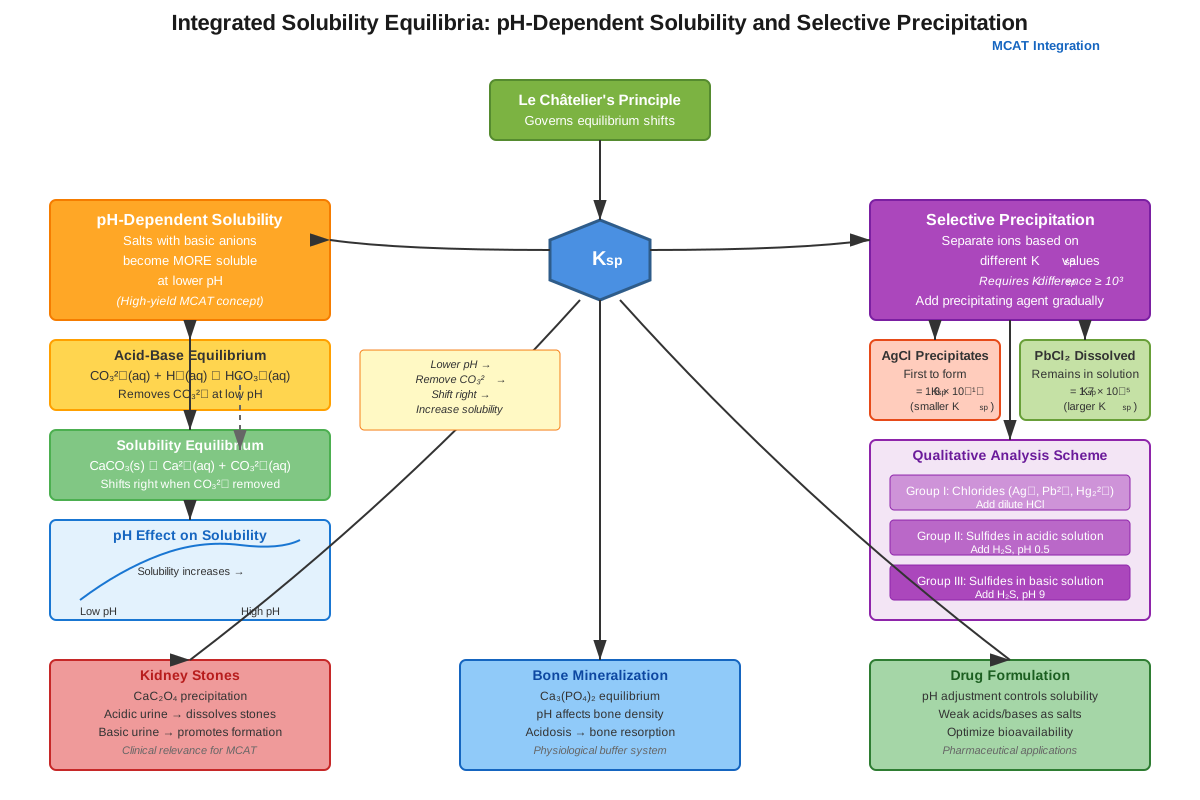
The solubility product (Ksp) represents one of the most clinically and experimentally relevant applications of equilibrium principles in General Chemistry. This equilibrium constant governs the dissolution of sparingly soluble ionic compounds, determining the maximum concentration of ions that can exist in solution before precipitation occurs. Understanding solubility equilibria is essential for predicting whether a precipitate will form under specific conditions, calculating ion concentrations in saturated solutions, and manipulating solubility through the common ion effect or pH adjustments.
For the MCAT, solubility product concepts appear frequently in both standalone questions and passage-based scenarios, particularly in contexts involving kidney stone formation, drug precipitation in biological fluids, qualitative analysis schemes, and buffer systems. The topic bridges fundamental equilibrium principles with practical applications in physiology and pharmacology. Questions often require students to write equilibrium expressions, perform calculations involving ion concentrations, predict precipitation using the reaction quotient (Q), and apply Le Châtelier's principle to solubility scenarios.
Within the broader framework of Kinetics and Equilibrium, solubility product connects directly to equilibrium constant expressions, Le Châtelier's principle, and the common ion effect. It also interfaces with acid-base chemistry (when dealing with pH-dependent solubility), thermodynamics (through the relationship between Ksp and Gibbs free energy), and electrochemistry (in the context of selective precipitation). Mastering this topic provides the foundation for understanding complex equilibria involving multiple simultaneous equilibria and selective precipitation techniques used in both laboratory and physiological contexts.
Learning Objectives
- [ ] Define solubility product using accurate General Chemistry terminology
- [ ] Explain why solubility product matters for the MCAT
- [ ] Apply solubility product to exam-style questions
- [ ] Identify common mistakes related to solubility product
- [ ] Connect solubility product to related General Chemistry concepts
- [ ] Calculate ion concentrations in saturated solutions from Ksp values
- [ ] Predict precipitation by comparing Q and Ksp
- [ ] Analyze how the common ion effect influences solubility
- [ ] Evaluate the effect of pH on the solubility of salts containing basic or acidic ions
Prerequisites
- Equilibrium constants and expressions: Understanding how to write and manipulate equilibrium constant expressions is fundamental to working with Ksp
- Stoichiometry and molar relationships: Required for converting between molar solubility and ion concentrations in solution
- Le Châtelier's principle: Essential for predicting how changes in conditions affect solubility equilibria
- Ionic compounds and dissociation: Knowledge of how ionic compounds dissociate into constituent ions in aqueous solution
- Molarity and concentration calculations: Necessary for all quantitative solubility problems
Why This Topic Matters
The solubility product MCAT questions test both conceptual understanding and quantitative problem-solving skills, making this a medium-yield topic that appears in approximately 2-4 questions per exam. These questions frequently appear in the Chemical and Physical Foundations of Biological Systems section, often embedded within passages discussing physiological processes, pharmaceutical formulations, or analytical chemistry techniques.
Clinically, solubility equilibria govern critical physiological processes including kidney stone formation (calcium oxalate, calcium phosphate, and uric acid stones), bone mineralization and resorption (calcium phosphate equilibria), tooth decay and remineralization (hydroxyapatite solubility), and drug bioavailability (many drugs have pH-dependent solubility). Understanding these principles allows medical professionals to design interventions that manipulate solubility—for example, alkalinizing urine to prevent uric acid stone formation or acidifying solutions to dissolve certain precipitates.
On the MCAT, solubility product General Chemistry concepts commonly appear in passages describing: qualitative analysis schemes for identifying unknown ions, buffer systems where precipitation might occur, physiological scenarios involving mineral homeostasis, pharmaceutical formulation challenges, environmental chemistry contexts (hard water, mineral deposition), and experimental procedures requiring selective precipitation. Questions may ask students to rank compounds by solubility, calculate whether precipitation will occur given specific ion concentrations, determine the effect of adding a common ion, or explain how pH changes affect solubility.
Core Concepts
Definition and Equilibrium Expression
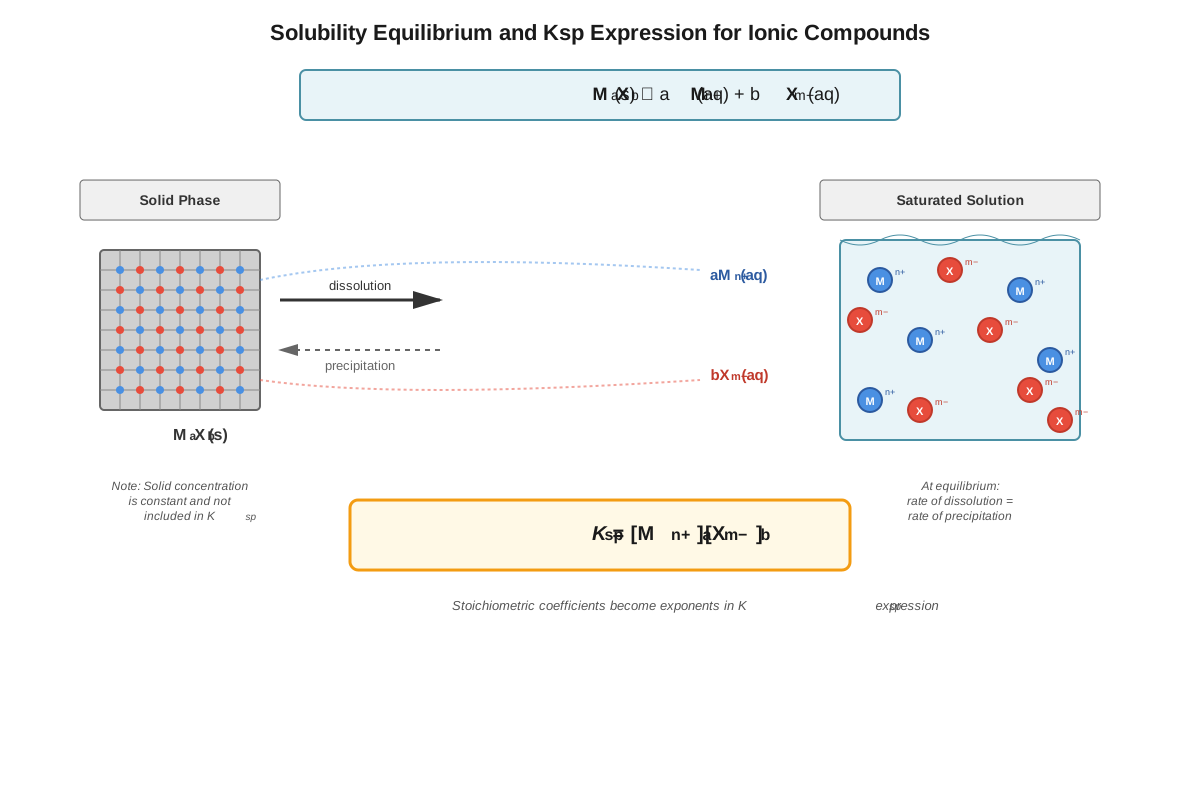
The solubility product constant (Ksp) is the equilibrium constant for the dissolution of a sparingly soluble ionic compound in water. When an ionic solid dissolves, it establishes an equilibrium between the solid phase and its constituent ions in solution. For a general salt with the formula AxBy that dissociates according to:
AxBy(s) ⇌ xA^n+(aq) + yB^m-(aq)The solubility product expression is:
Ksp = [A^n+]^x[B^m-]^yCritically, the solid phase does not appear in the equilibrium expression because the activity of a pure solid is defined as 1. The Ksp value is temperature-dependent and specific to each compound. Larger Ksp values indicate greater solubility, though direct comparison is only valid for compounds with identical stoichiometry.
Molar Solubility vs. Solubility Product
Molar solubility (s) represents the number of moles of solute that dissolve per liter of solution to reach saturation. This differs from Ksp, which is expressed in terms of ion concentrations. The relationship between molar solubility and Ksp depends on the stoichiometry of dissolution:
| Compound Type | Example | Dissolution Equation | Ksp Expression | Relationship to s |
|---|---|---|---|---|
| AB | AgCl | AgCl(s) ⇌ Ag⁺ + Cl⁻ | Ksp = [Ag⁺][Cl⁻] | Ksp = s² |
| AB₂ | CaF₂ | CaF₂(s) ⇌ Ca²⁺ + 2F⁻ | Ksp = [Ca²⁺][F⁻]² | Ksp = 4s³ |
| A₂B | Ag₂CrO₄ | Ag₂CrO₄(s) ⇌ 2Ag⁺ + CrO₄²⁻ | Ksp = [Ag⁺]²[CrO₄²⁻] | Ksp = 4s³ |
| A₃B | Ca₃(PO₄)₂ | Ca₃(PO₄)₂(s) ⇌ 3Ca²⁺ + 2PO₄³⁻ | Ksp = [Ca²⁺]³[PO₄³⁻]² | Ksp = 108s⁵ |
Understanding these relationships is crucial for converting between Ksp values and actual solubility in grams per liter or other practical units.
The Reaction Quotient and Precipitation
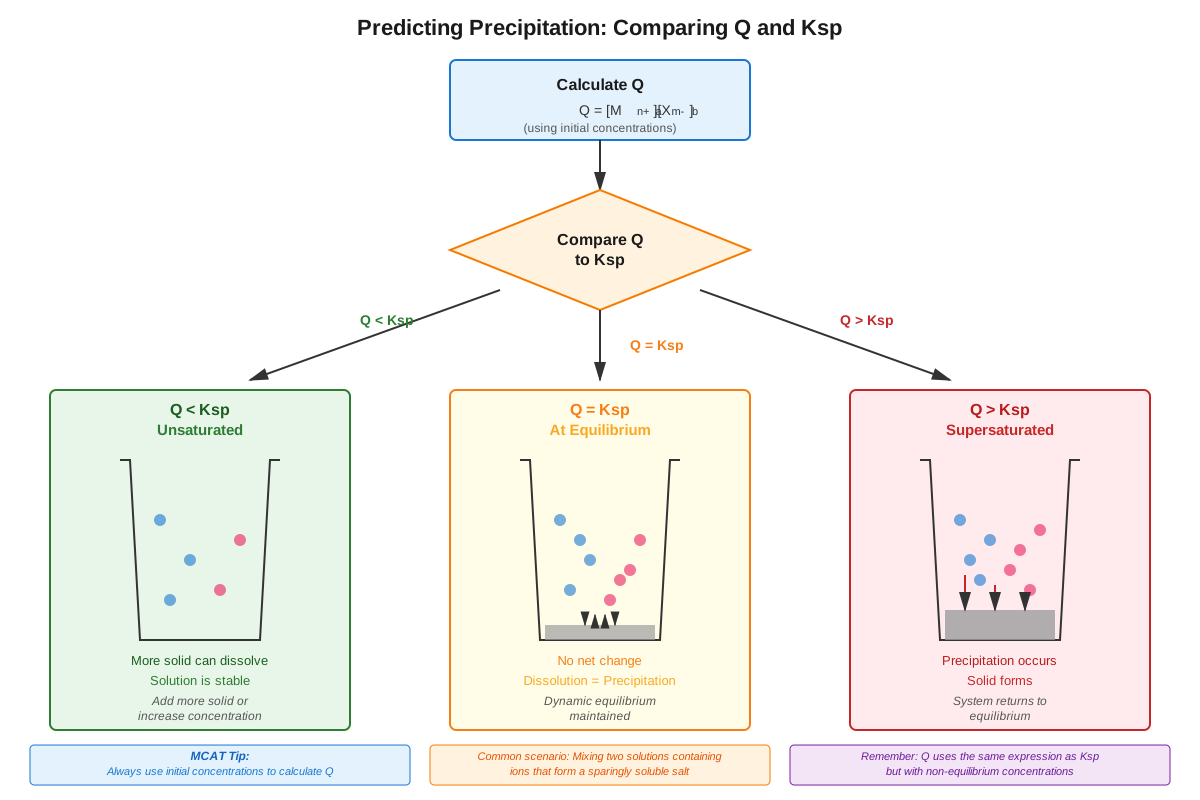
The reaction quotient (Q) has the same mathematical form as Ksp but uses actual ion concentrations rather than equilibrium concentrations. Comparing Q to Ksp predicts whether precipitation will occur:
- Q < Ksp: The solution is unsaturated; no precipitate forms, and more solid can dissolve
- Q = Ksp: The solution is saturated and at equilibrium
- Q > Ksp: The solution is supersaturated; precipitation will occur until Q = Ksp
This comparison is the foundation for predicting precipitation in mixing problems. When two solutions containing ions are mixed, calculate the new concentrations (accounting for dilution), compute Q, and compare to Ksp.
The Common Ion Effect
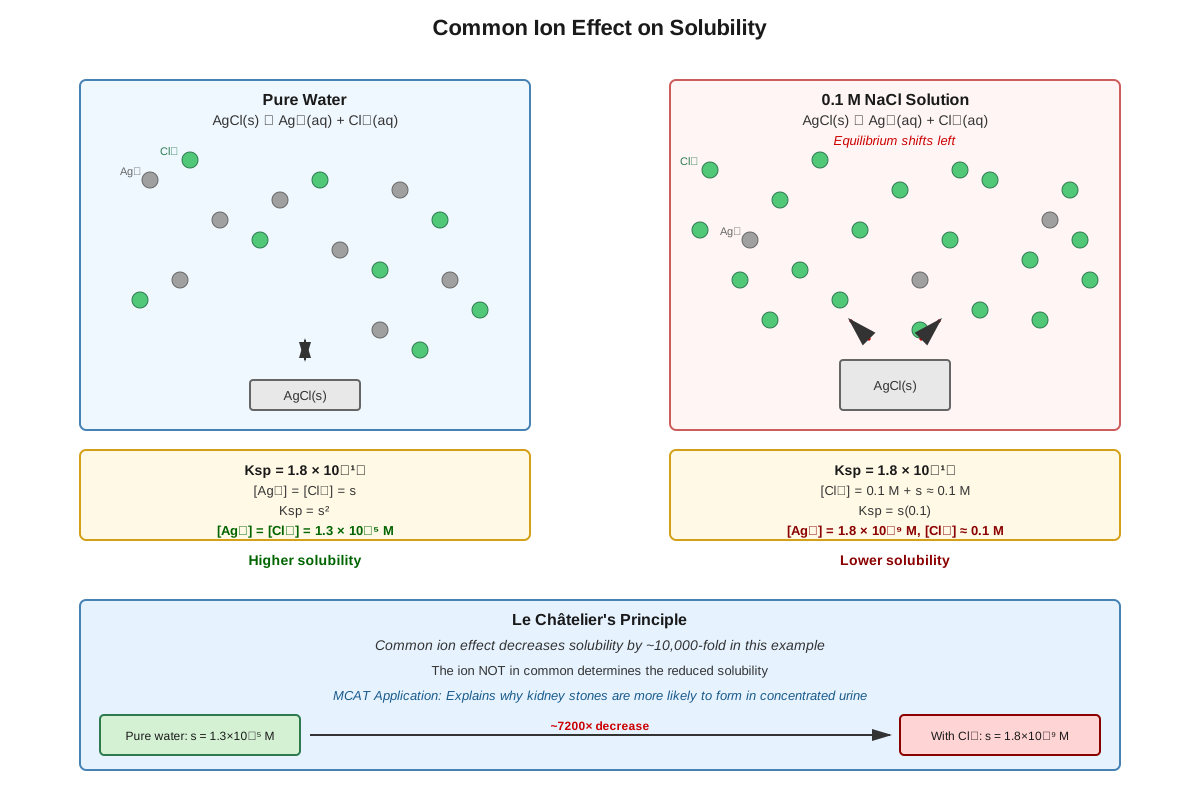
The common ion effect describes the decrease in solubility of an ionic compound when a soluble salt containing one of its ions is added to the solution. This phenomenon is a direct application of Le Châtelier's principle: adding a product ion shifts the equilibrium toward the solid, decreasing solubility.
For example, the solubility of AgCl in pure water is determined solely by its Ksp. However, in a solution already containing Cl⁻ ions (from NaCl, for instance), the solubility of AgCl decreases significantly. If the initial [Cl⁻] is much larger than the molar solubility of AgCl, the solubility can be approximated by:
Ksp = [Ag⁺][Cl⁻]
s ≈ Ksp/[Cl⁻]initial
This approximation assumes that the contribution of Cl⁻ from AgCl dissolution is negligible compared to the common ion concentration.
pH-Dependent Solubility
Salts containing basic anions (conjugate bases of weak acids) exhibit pH-dependent solubility. As pH decreases (increasing [H⁺]), the basic anion is protonated, effectively removing it from the solubility equilibrium and increasing solubility. Common examples include:
- Calcium carbonate (CaCO₃): In acidic conditions, CO₃²⁻ is protonated to HCO₃⁻ and H₂CO₃, increasing solubility
- Calcium phosphate (Ca₃(PO₄)₂): PO₄³⁻ is highly basic and readily protonated in acidic solutions
- Metal hydroxides: Solubility increases dramatically in acidic solutions as OH⁻ is neutralized
Conversely, salts of weak acids become more soluble in basic solutions if the cation can form hydroxide complexes. This pH dependence is exploited in qualitative analysis schemes and has important physiological implications.
Selective Precipitation
Selective precipitation involves adding a precipitating agent gradually to separate ions based on their different Ksp values. The ion forming the compound with the smallest Ksp precipitates first. This technique is fundamental to qualitative analysis schemes and is used to purify solutions or recover specific ions.
For example, when adding Cl⁻ to a solution containing both Ag⁺ and Pb²⁺, AgCl (Ksp = 1.8 × 10⁻¹⁰) precipitates before PbCl₂ (Ksp = 1.7 × 10⁻⁵). Calculations can determine the concentration range where one ion precipitates while the other remains in solution.
Concept Relationships
The solubility product concept sits at the intersection of multiple equilibrium principles. Ksp expressions derive directly from the general equilibrium constant formulation, with the specific feature that the solid phase activity equals one. This connects to the broader understanding of heterogeneous equilibria in Kinetics and Equilibrium.
The common ion effect represents a specific application of Le Châtelier's principle: adding a product shifts equilibrium toward reactants (the solid), decreasing solubility. This same principle explains why removing an ion (through complexation or precipitation with another reagent) increases solubility.
pH-dependent solubility creates a bridge between solubility equilibria and acid-base chemistry. When a salt contains the conjugate base of a weak acid, two equilibria operate simultaneously: the solubility equilibrium and the acid-base equilibrium. These coupled equilibria must be considered together, often requiring the use of Ka values alongside Ksp.
The relationship between Q and Ksp parallels the relationship between Q and K for any equilibrium, providing a thermodynamic criterion for spontaneity. When Q > Ksp, precipitation is thermodynamically favorable (ΔG < 0 for the precipitation reaction). This connects to thermodynamics and the relationship ΔG° = -RT ln K.
Selective precipitation integrates stoichiometry, dilution calculations, and equilibrium principles, requiring students to track multiple ions simultaneously and apply Ksp concepts to each potential precipitate. This represents the most complex application of solubility product principles.
Conceptual flow: Equilibrium constant principles → Ksp definition and expression → Molar solubility calculations → Q vs. Ksp predictions → Common ion effect → pH-dependent solubility → Selective precipitation strategies
Quick check — test yourself on Solubility product so far.
Try Flashcards →High-Yield Facts
⭐ The solubility product expression includes only dissolved ions raised to powers equal to their stoichiometric coefficients; the solid does not appear
⭐ When Q > Ksp, precipitation occurs; when Q < Ksp, the solution can dissolve more solid; when Q = Ksp, the system is at equilibrium
⭐ The common ion effect decreases solubility by shifting equilibrium toward the solid phase according to Le Châtelier's principle
⭐ For an AB-type salt, Ksp = s²; for an AB₂-type salt, Ksp = 4s³; the relationship depends on stoichiometry
⭐ Salts containing basic anions (like CO₃²⁻, PO₄³⁻, S²⁻) become more soluble in acidic solutions due to protonation of the anion
- Ksp values are temperature-dependent; most ionic compounds become more soluble at higher temperatures
- Comparing Ksp values directly only predicts relative solubility for compounds with identical stoichiometry
- In selective precipitation, the ion forming the salt with the smallest Ksp precipitates first when a common ion is added gradually
- The solubility of a salt in a solution containing a common ion can be approximated as s ≈ Ksp/[common ion] when the common ion concentration is much larger than s
- Complex ion formation can dramatically increase the solubility of otherwise insoluble salts by removing free metal ions from solution
Common Misconceptions
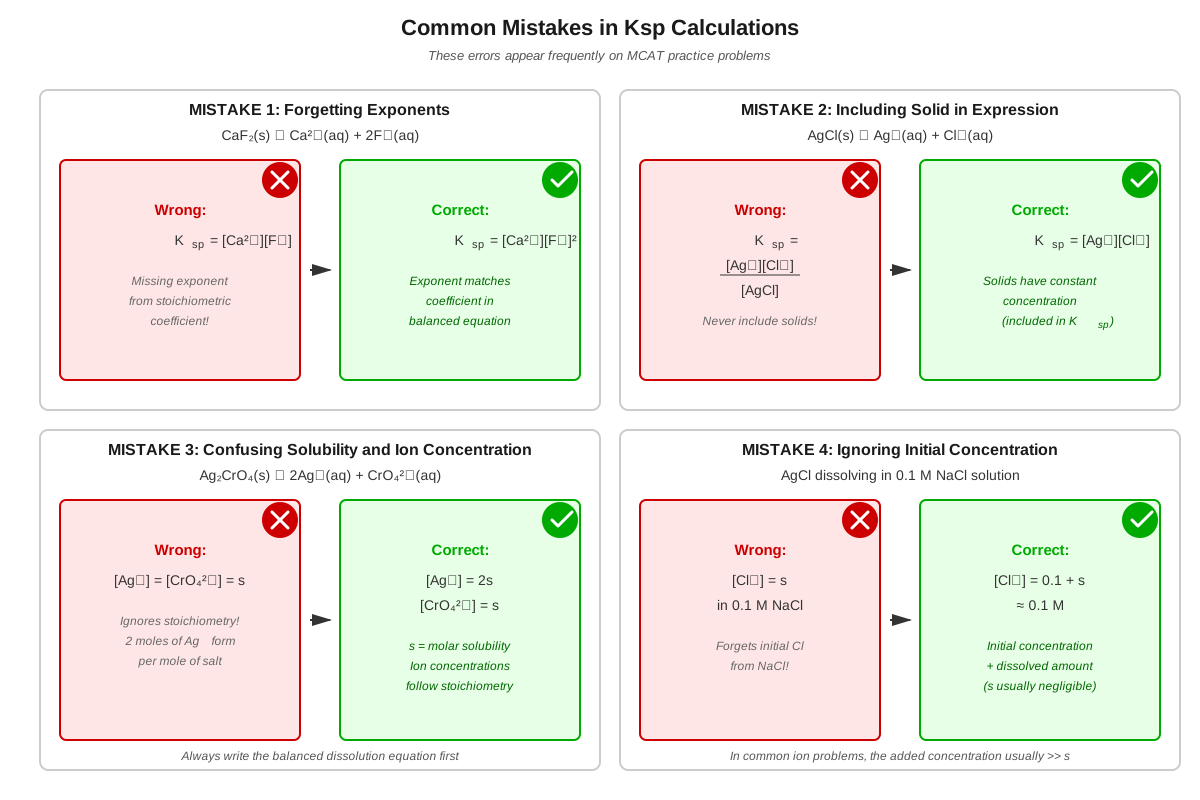
Misconception: A larger Ksp always means greater solubility in grams per liter.
Correction: Ksp values can only be directly compared for compounds with identical stoichiometry. A compound with formula AB₂ and Ksp = 1 × 10⁻⁸ may be more or less soluble than a compound AB with Ksp = 1 × 10⁻¹⁰, depending on the molar masses and the mathematical relationship between Ksp and molar solubility. Always convert to molar solubility first when comparing different compound types.
Misconception: The solid phase appears in the Ksp expression.
Correction: Pure solids have an activity of 1 and do not appear in equilibrium expressions. Only the dissolved ions appear in the Ksp expression. The presence of excess solid ensures the system can reach equilibrium but doesn't affect the mathematical expression.
Misconception: Adding more solid to a saturated solution increases ion concentrations.
Correction: Once a solution is saturated (at equilibrium), adding more solid does not change ion concentrations. The system is already at equilibrium, and Ksp is satisfied. The additional solid simply remains undissolved. Only changing temperature or adding/removing ions affects the equilibrium position.
Misconception: The common ion effect increases solubility.
Correction: The common ion effect decreases solubility. Adding an ion that is already a product of the dissolution equilibrium shifts the equilibrium toward the solid (reactant side) by Le Châtelier's principle, reducing the amount of solid that can dissolve.
Misconception: All salts become more soluble in acidic solutions.
Correction: Only salts containing basic anions (conjugate bases of weak acids) show increased solubility in acidic solutions. Salts like NaCl, which contain the conjugate base of a strong acid, show no pH-dependent solubility because Cl⁻ is not protonated by H⁺. The anion must be able to accept a proton for pH to affect solubility.
Misconception: When calculating Q after mixing solutions, the original concentrations can be used directly.
Correction: When solutions are mixed, dilution occurs. The new concentrations must be calculated using the dilution formula (M₁V₁ = M₂V₂) or by considering the new total volume before calculating Q. Failing to account for dilution is one of the most common errors in precipitation problems.
Worked Examples
Example 1: Calculating Molar Solubility from Ksp
Problem: The Ksp of calcium fluoride (CaF₂) is 3.9 × 10⁻¹¹ at 25°C. Calculate the molar solubility of CaF₂ in pure water and the concentration of fluoride ions in a saturated solution.
Solution:
Step 1: Write the balanced dissolution equation.
CaF₂(s) ⇌ Ca²⁺(aq) + 2F⁻(aq)Step 2: Write the Ksp expression.
Ksp = [Ca²⁺][F⁻]² = 3.9 × 10⁻¹¹Step 3: Define molar solubility (s) and express ion concentrations in terms of s.
If s moles of CaF₂ dissolve per liter:
- [Ca²⁺] = s
- [F⁻] = 2s (because each CaF₂ produces 2 F⁻ ions)
Step 4: Substitute into the Ksp expression.
Ksp = (s)(2s)² = 4s³ = 3.9 × 10⁻¹¹Step 5: Solve for s.
s³ = (3.9 × 10⁻¹¹)/4 = 9.75 × 10⁻¹²
s = (9.75 × 10⁻¹²)^(1/3) = 2.1 × 10⁻⁴ M
Step 6: Calculate [F⁻].
[F⁻] = 2s = 2(2.1 × 10⁻⁴) = 4.2 × 10⁻⁴ MAnswer: The molar solubility of CaF₂ is 2.1 × 10⁻⁴ M, and the fluoride ion concentration is 4.2 × 10⁻⁴ M.
Key Concept: This problem demonstrates the critical relationship between molar solubility and Ksp for an AB₂-type salt, where Ksp = 4s³. The stoichiometry of dissolution determines the mathematical relationship.
Example 2: Predicting Precipitation Using Q
Problem: A solution is prepared by mixing 100 mL of 0.0020 M AgNO₃ with 100 mL of 0.0015 M NaCl. Will AgCl precipitate? (Ksp of AgCl = 1.8 × 10⁻¹⁰)
Solution:
Step 1: Calculate the concentrations after mixing (accounting for dilution).
Total volume = 100 mL + 100 mL = 200 mL
[Ag⁺] = (0.0020 M)(100 mL)/(200 mL) = 0.0010 M
[Cl⁻] = (0.0015 M)(100 mL)/(200 mL) = 0.00075 M
Step 2: Calculate the reaction quotient Q.
Q = [Ag⁺][Cl⁻] = (0.0010)(0.00075) = 7.5 × 10⁻⁷Step 3: Compare Q to Ksp.
Q = 7.5 × 10⁻⁷
Ksp = 1.8 × 10⁻¹⁰
Q > Ksp
Step 4: Draw conclusion.
Since Q > Ksp, the solution is supersaturated with respect to AgCl, and precipitation will occur until equilibrium is reestablished (Q = Ksp).
Answer: Yes, AgCl will precipitate.
Key Concept: This problem illustrates the critical importance of accounting for dilution when mixing solutions and demonstrates how comparing Q to Ksp predicts precipitation. This type of calculation appears frequently on the MCAT in both standalone questions and passage-based scenarios.
Exam Strategy
When approaching solubility product MCAT questions, first identify the question type: Is it asking for a calculation (molar solubility, ion concentration, or precipitation prediction) or a conceptual understanding (common ion effect, pH dependence, or Le Châtelier's principle application)?
Trigger words and phrases to watch for:
- "Saturated solution" → equilibrium condition, use Ksp
- "Will precipitation occur?" → calculate Q and compare to Ksp
- "In the presence of..." or "containing..." → likely common ion effect
- "Acidic conditions" or "pH" → consider pH-dependent solubility
- "Molar solubility" vs. "solubility product" → distinguish between s and Ksp
- "Selective precipitation" → compare Ksp values and calculate threshold concentrations
Process-of-elimination strategies:
- Eliminate answers that violate the common ion effect (suggesting solubility increases when a common ion is added)
- Eliminate answers that incorrectly include the solid in the Ksp expression
- For ranking solubility questions, eliminate answers that directly rank by Ksp without considering stoichiometry
- Eliminate answers suggesting pH affects salts with anions from strong acids (like Cl⁻, NO₃⁻)
Calculation approach:
- Always write the balanced dissolution equation first
- Write the Ksp expression before substituting numbers
- Define variables clearly (especially molar solubility s)
- For mixing problems, calculate diluted concentrations before computing Q
- Check that your answer makes chemical sense (e.g., solubility should be small for sparingly soluble salts)
Time allocation: Straightforward Ksp calculations should take 60-90 seconds. More complex problems involving the common ion effect or selective precipitation may require 2-3 minutes. If a problem requires extensive calculation, look for approximations (like assuming the common ion concentration doesn't change significantly) or conceptual shortcuts.
Exam Tip: When comparing solubilities of different compounds, convert Ksp to molar solubility first. Never compare Ksp values directly unless the compounds have identical stoichiometry (both AB, both AB₂, etc.).
Memory Techniques
Ksp Stoichiometry Relationships - "ABBA Rule"
- AB compounds: Ksp = s² (one of each ion)
- AB₂ or A₂B compounds: Ksp = 4s³ (remember the "4" for the coefficient)
- A₃B or AB₃ compounds: Ksp = 27s⁴ (3³ = 27)
Q vs. Ksp Predictions - "QPK"
- Quotient Precipitates when Ksp is exceeded
- Q > Ksp → Precipitate forms
- Q < Ksp → Can dissolve more
- Q = Ksp → At equilibrium
Common Ion Effect - "COPS"
- Common ion
- Opposes dissolution
- Product added
- Shifts left (toward solid)
pH-Dependent Solubility - "BASIC"
- Basic anions
- Are protonated
- Solubility
- Increases in
- Cidic solutions
Visualization Strategy: Picture the dissolution equilibrium as a two-way street. The solid is on one side, dissolved ions on the other. Adding a common ion creates "traffic" on the dissolved side, forcing the equilibrium back toward the solid. Removing ions (through protonation or complexation) creates "space" on the dissolved side, pulling more solid into solution.
Summary
The solubility product (Ksp) is an equilibrium constant that quantifies the dissolution of sparingly soluble ionic compounds, expressed as the product of ion concentrations raised to their stoichiometric coefficients. Understanding Ksp enables prediction of precipitation through comparison with the reaction quotient Q: when Q exceeds Ksp, precipitation occurs. The common ion effect, a direct application of Le Châtelier's principle, decreases solubility by shifting equilibrium toward the solid when a product ion is added. Salts containing basic anions exhibit pH-dependent solubility, becoming more soluble in acidic conditions as the anion is protonated. Quantitative problems require careful attention to stoichiometry when relating molar solubility to Ksp, and mixing problems demand accounting for dilution before calculating Q. Selective precipitation exploits differences in Ksp values to separate ions. Mastery of these concepts requires both conceptual understanding of equilibrium principles and facility with calculations involving ion concentrations, dilution, and stoichiometric relationships.
Key Takeaways
- The solubility product constant (Ksp) is the equilibrium constant for dissolution of a sparingly soluble salt, expressed only in terms of dissolved ion concentrations
- Precipitation occurs when Q > Ksp; the solution can dissolve more solid when Q < Ksp; equilibrium exists when Q = Ksp
- The common ion effect decreases solubility by shifting equilibrium toward the solid according to Le Châtelier's principle
- The relationship between Ksp and molar solubility depends on dissolution stoichiometry: Ksp = s² for AB salts, Ksp = 4s³ for AB₂ salts
- Salts containing basic anions (conjugate bases of weak acids) become more soluble in acidic solutions due to protonation of the anion
- When mixing solutions, always account for dilution before calculating Q to predict precipitation
- Selective precipitation separates ions based on different Ksp values, with the least soluble compound precipitating first
Related Topics
Complex Ion Formation and Solubility: Building on solubility equilibria, complex ion formation can dramatically increase the solubility of otherwise insoluble salts by removing free metal ions from solution through coordination with ligands. This topic integrates coordination chemistry with equilibrium principles.
Qualitative Analysis Schemes: These systematic procedures for identifying unknown ions rely heavily on selective precipitation and pH-dependent solubility, representing a practical application of all solubility product concepts.
Buffer Systems and Precipitation: Understanding when precipitation might occur in buffer solutions requires simultaneous consideration of acid-base equilibria and solubility equilibria, particularly for salts like calcium phosphate in physiological buffers.
Thermodynamics of Dissolution: The relationship between Ksp and Gibbs free energy (ΔG° = -RT ln Ksp) connects solubility equilibria to thermodynamic spontaneity and provides insight into temperature dependence of solubility.
Electrochemistry and Selective Precipitation: Selective precipitation plays a crucial role in electrochemical cells and electroplating, where controlling ion concentrations through precipitation prevents unwanted reactions.
Practice CTA
Now that you've mastered the core concepts of solubility product, it's time to solidify your understanding through active practice. Work through the practice questions to test your ability to calculate molar solubility, predict precipitation, and apply the common ion effect. Use the flashcards to reinforce high-yield facts and relationships between Ksp and molar solubility for different stoichiometries. Remember, the MCAT rewards both conceptual understanding and computational facility—practice both types of problems to achieve mastery. You've built a strong foundation; now apply it to achieve your target score!
Sign up free to keep reading
Create a free AnvayaPrep account to finish this MCAT guide on Solubility product — plus flashcards and practice questions.