Overview
Osmotic pressure is a fundamental colligative property of solutions that describes the pressure required to prevent the net flow of solvent molecules across a semipermeable membrane. In General Chemistry, osmotic pressure represents one of the four major colligative properties—alongside vapor pressure lowering, boiling point elevation, and freezing point depression—that depend solely on the number of solute particles in solution rather than their chemical identity. Understanding osmotic pressure is essential for the MCAT because it bridges multiple disciplines: it appears in General Chemistry passages involving Solutions and Phase Behavior, connects to biological membrane transport in biology passages, and underlies critical physiological processes such as fluid balance, kidney function, and cellular homeostasis.
The significance of osmotic pressure MCAT questions extends beyond simple calculation problems. Test-makers frequently embed osmotic pressure concepts within complex passages involving dialysis, intravenous fluid administration, plant cell turgor, or experimental setups measuring colligative properties. Students must recognize when osmotic pressure is the relevant phenomenon, distinguish it from related concepts like diffusion and hydrostatic pressure, and apply the van't Hoff equation appropriately. The topic requires integration of solution concentration units, ideal gas law principles, and membrane permeability concepts.
Mastering osmotic pressure General Chemistry provides a foundation for understanding more advanced topics in biochemistry and physiology tested on the MCAT. The principles governing osmotic pressure directly relate to tonicity of solutions, the behavior of red blood cells in different environments, and the energetics of active transport systems. This topic exemplifies how fundamental chemistry principles manifest in biological systems, making it a high-yield area where interdisciplinary connections frequently appear on exam day.
Learning Objectives
- [ ] Define osmotic pressure using accurate General Chemistry terminology
- [ ] Explain why osmotic pressure matters for the MCAT
- [ ] Apply osmotic pressure to exam-style questions
- [ ] Identify common mistakes related to osmotic pressure
- [ ] Connect osmotic pressure to related General Chemistry concepts
- [ ] Calculate osmotic pressure using the van't Hoff equation for both electrolyte and non-electrolyte solutions
- [ ] Predict the direction of solvent flow across semipermeable membranes based on concentration gradients
- [ ] Distinguish between osmotic pressure, osmolarity, and tonicity in biological contexts
- [ ] Analyze experimental data to determine molecular weight using osmotic pressure measurements
Prerequisites
- Solution concentration units (molarity, molality, mole fraction): Essential for calculating osmotic pressure and interpreting solution compositions in problems
- Colligative properties fundamentals: Osmotic pressure is one of four colligative properties that share common mathematical relationships and conceptual frameworks
- Ideal gas law (PV = nRT): The van't Hoff equation for osmotic pressure is directly analogous to the ideal gas law
- Semipermeable membranes: Understanding selective permeability is necessary to grasp why osmotic pressure develops
- Electrolyte dissociation and van't Hoff factor (i): Critical for correctly calculating osmotic pressure of ionic compounds
- Thermodynamic principles: Osmotic pressure represents a thermodynamic equilibrium between chemical potential differences
Why This Topic Matters
Clinical and Real-World Significance
Osmotic pressure governs numerous physiological processes that appear regularly in MCAT passages. Intravenous fluid selection depends on matching the osmotic pressure of administered solutions to blood plasma to prevent cell lysis or crenation. Kidney function relies on osmotic gradients in the nephron to concentrate urine and maintain fluid balance. Edema formation, whether from hypoalbuminemia or increased capillary hydrostatic pressure, involves disruption of normal osmotic pressure relationships. Plant cells maintain turgor pressure through osmotic mechanisms, and food preservation techniques like salting or sugaring work by creating osmotic stress that dehydrates microorganisms.
MCAT Exam Statistics
Osmotic pressure appears in approximately 3-5% of General Chemistry questions and frequently in interdisciplinary passages combining chemistry with biology or biochemistry. Questions typically fall into three categories: direct calculation problems requiring the van't Hoff equation (30%), conceptual questions about direction of water flow or membrane behavior (50%), and data interpretation questions involving experimental determination of molecular weight or membrane permeability (20%). The topic appears most commonly in passages about kidney physiology, cell biology, or experimental chemistry techniques.
Common Exam Contexts
MCAT passages featuring osmotic pressure often present scenarios involving dialysis (either medical hemodialysis or laboratory separation techniques), osmometry experiments to determine molecular weights of unknown compounds, or physiological situations requiring fluid management. Discrete questions may test the relationship between osmotic pressure and other colligative properties, or ask students to predict cellular responses to hypertonic, hypotonic, or isotonic solutions. Recognizing osmotic pressure as the relevant concept when passages mention semipermeable membranes, concentration gradients, or solvent movement is a critical skill.
Core Concepts
Definition and Fundamental Principles
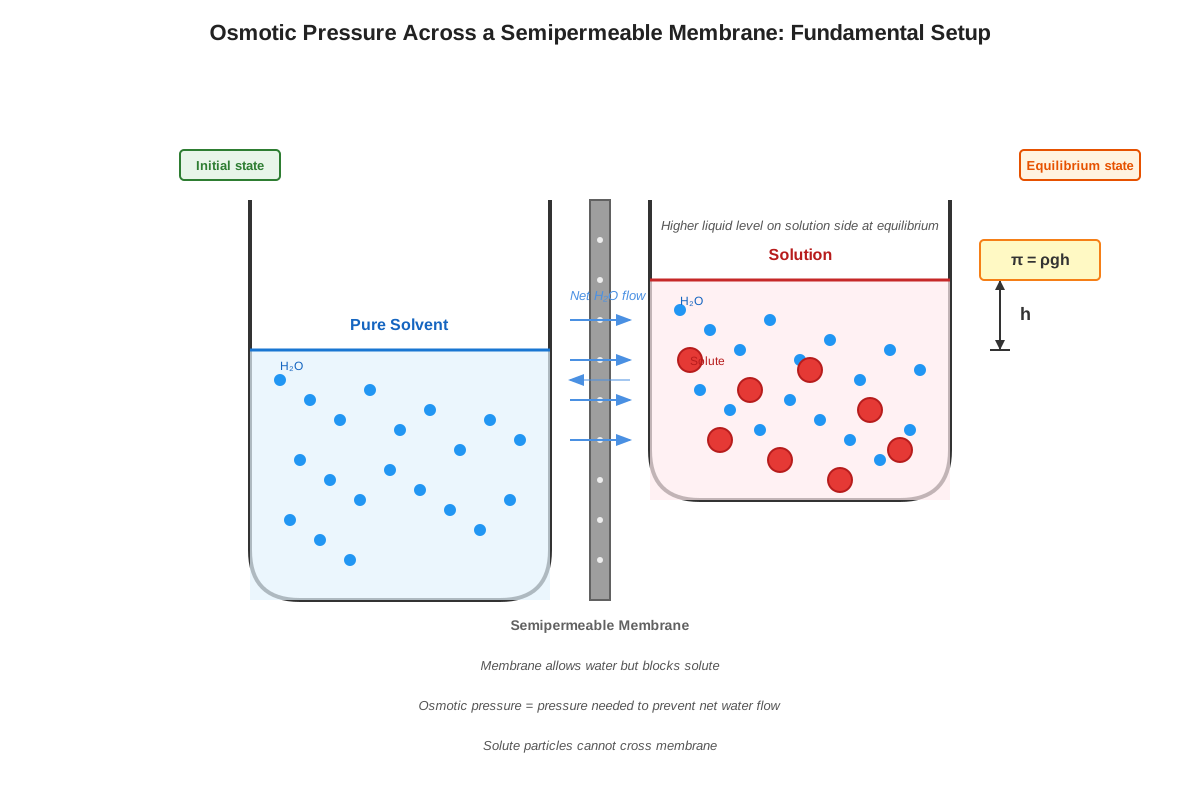
Osmotic pressure (π) is defined as the minimum pressure that must be applied to a solution to prevent the inward flow of solvent across a semipermeable membrane. More precisely, it represents the pressure difference required to establish equilibrium between pure solvent and solution separated by a membrane permeable only to solvent molecules. This phenomenon arises from the thermodynamic drive to equalize the chemical potential of the solvent on both sides of the membrane.
When a semipermeable membrane separates a solution from pure solvent, solvent molecules move from the region of higher solvent chemical potential (pure solvent) to lower solvent chemical potential (solution) through a process called osmosis. This net solvent flow continues until either the chemical potentials equalize or an opposing pressure builds up sufficient to halt the flow. The pressure required to prevent this osmotic flow defines the osmotic pressure of the solution.
The van't Hoff Equation
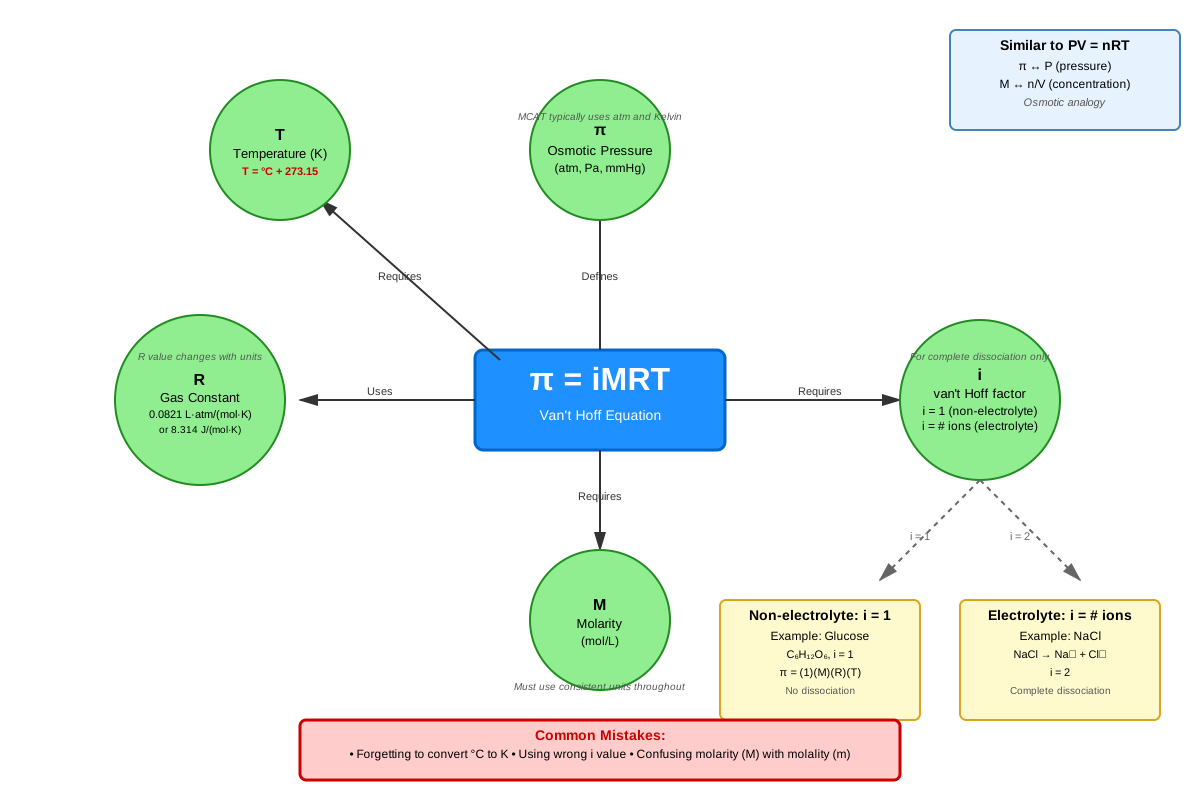
The quantitative relationship for osmotic pressure is given by the van't Hoff equation:
π = iMRTWhere:
- π = osmotic pressure (typically in atm)
- i = van't Hoff factor (number of particles per formula unit)
- M = molarity of the solution (mol/L)
- R = ideal gas constant (0.0821 L·atm/mol·K)
- T = absolute temperature (Kelvin)
This equation reveals the direct proportionality between osmotic pressure and solution concentration, temperature, and the number of dissolved particles. The structural similarity to the ideal gas law (PV = nRT) is not coincidental—both describe pressure arising from particle collisions, whether gas molecules hitting container walls or solute particles affecting solvent chemical potential.
Van't Hoff Factor and Particle Count
The van't Hoff factor (i) accounts for the number of particles produced when a solute dissolves. For non-electrolytes like glucose or sucrose, i = 1 because these compounds remain intact in solution. For electrolytes, i equals the number of ions produced per formula unit under ideal conditions:
| Compound | Formula | Ideal i | Example |
|---|---|---|---|
| Glucose | C₆H₁₂O₆ | 1 | Non-electrolyte |
| NaCl | NaCl | 2 | Na⁺ + Cl⁻ |
| CaCl₂ | CaCl₂ | 3 | Ca²⁺ + 2Cl⁻ |
| Na₂SO₄ | Na₂SO₄ | 3 | 2Na⁺ + SO₄²⁻ |
| AlCl₃ | AlCl₃ | 4 | Al³⁺ + 3Cl⁻ |
In real solutions, especially at higher concentrations, the actual van't Hoff factor may be less than the theoretical value due to ion pairing and interionic attractions. However, MCAT problems typically assume ideal behavior unless otherwise specified.
Osmolarity and Osmolality
Osmolarity represents the total concentration of osmotically active particles in solution, calculated as:
Osmolarity (Osm/L) = i × MFor example, a 0.15 M NaCl solution has an osmolarity of 2 × 0.15 = 0.30 Osm/L or 300 mOsm/L. This unit directly relates to osmotic pressure since π is proportional to osmolarity.
Osmolality (Osm/kg) uses molality instead of molarity as the concentration unit. While osmolarity changes with temperature (due to volume expansion), osmolality remains constant, making it preferred for clinical measurements. For dilute aqueous solutions near room temperature, osmolarity and osmolality are approximately equal.
Tonicity and Cellular Responses
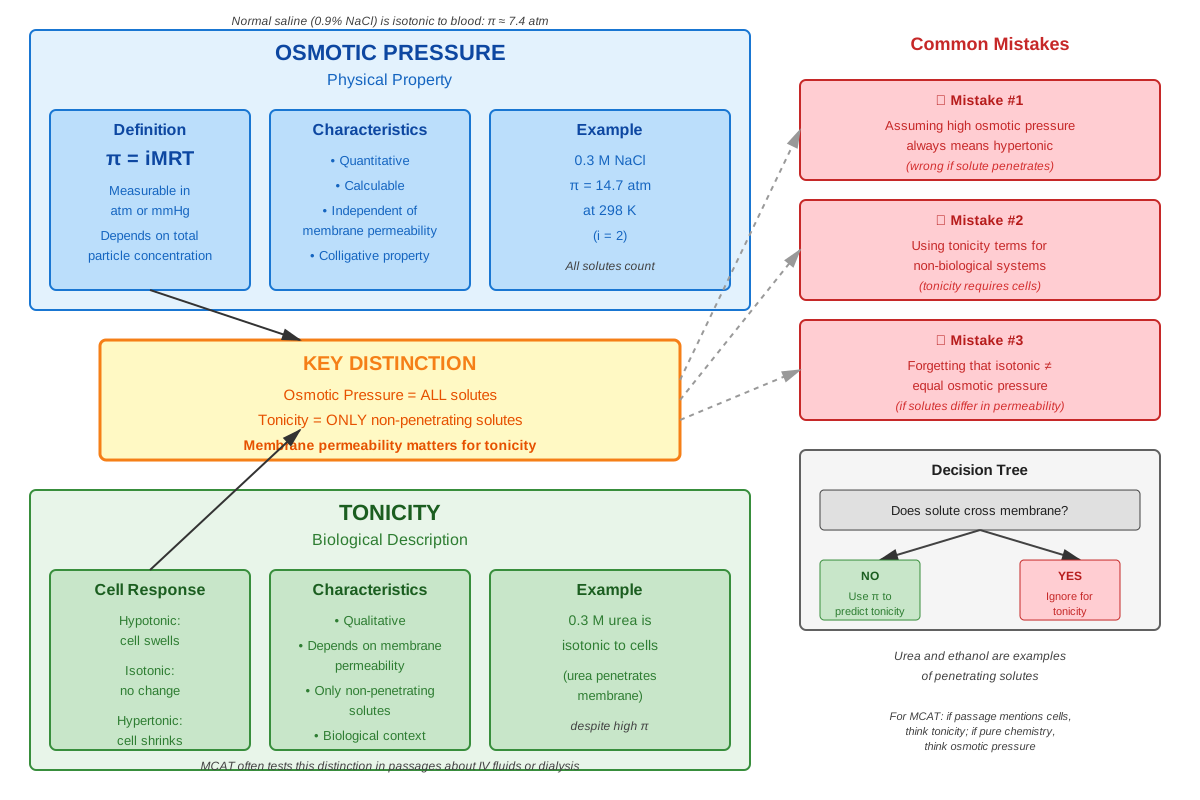
Tonicity describes the effect of a solution on cell volume and differs conceptually from osmolarity. Tonicity considers only non-penetrating solutes—those that cannot cross the cell membrane. A solution's tonicity determines the direction of water movement and resulting cellular response:
- Isotonic solutions: Equal osmotic pressure to cell interior; no net water movement; cells maintain normal volume (e.g., 0.9% NaCl or 5% glucose for human cells)
- Hypertonic solutions: Higher osmotic pressure than cell interior; water moves out of cells; cells shrink (crenation in animal cells, plasmolysis in plant cells)
- Hypotonic solutions: Lower osmotic pressure than cell interior; water moves into cells; cells swell (hemolysis in animal cells, turgor in plant cells)
Critically, a solution can be isosmotic (same osmolarity) but not isotonic if it contains penetrating solutes. For example, a urea solution isosmotic with blood will still cause cell lysis because urea crosses cell membranes, failing to oppose water influx.
Osmotic Pressure as a Colligative Property
As a colligative property, osmotic pressure depends only on the number of solute particles, not their identity. This characteristic makes osmotic pressure measurements useful for determining molecular weights of unknown compounds, particularly large molecules like proteins where other colligative properties produce changes too small to measure accurately.
The relationship between osmotic pressure and other colligative properties follows from their common origin in solvent chemical potential reduction:
- All colligative properties are proportional to solute mole fraction (or molality/molarity in dilute solutions)
- All increase linearly with the number of dissolved particles
- All are independent of solute chemical nature (assuming ideal behavior)
Reverse Osmosis
Reverse osmosis occurs when applied pressure exceeds the osmotic pressure, forcing solvent to flow from solution to pure solvent—opposite the natural osmotic direction. This process is exploited in water purification systems, desalination plants, and laboratory concentration techniques. The applied pressure must overcome the osmotic pressure of the solution being purified, which is why seawater desalination (osmotic pressure ≈ 25 atm) requires substantial energy input.
Concept Relationships
Osmotic pressure connects to multiple concepts within Solutions and Phase Behavior and broader General Chemistry. The van't Hoff equation links osmotic pressure directly to solution concentration (molarity) and temperature, establishing that π increases linearly with both variables. The van't Hoff factor connects osmotic pressure to electrolyte dissociation and ionic equilibria, requiring students to determine particle count from chemical formulas.
Within colligative properties, osmotic pressure relates mathematically to vapor pressure lowering (Raoult's law), boiling point elevation, and freezing point depression—all stem from the same thermodynamic principle of solvent chemical potential reduction. The magnitude of osmotic pressure effects is typically much larger than other colligative properties for the same solution, making osmotic pressure measurements more practical for dilute solutions.
The concept flow follows this pattern:
Solute dissolution → Particle count (van't Hoff factor) → Osmolarity calculation → Osmotic pressure determination → Prediction of solvent flow direction → Cellular or system response
Osmotic pressure also connects to thermodynamics through chemical potential and free energy concepts, to kinetics through membrane transport rates, and to equilibrium through the balance between osmotic and hydrostatic pressures. In biological contexts, osmotic pressure links to membrane structure, active transport (which can work against osmotic gradients), and homeostasis mechanisms.
High-Yield Facts
⭐ Osmotic pressure is directly proportional to molarity, temperature, and the van't Hoff factor: π = iMRT
⭐ The van't Hoff factor equals the number of particles produced per formula unit: i = 1 for non-electrolytes, i = 2 for NaCl, i = 3 for CaCl₂
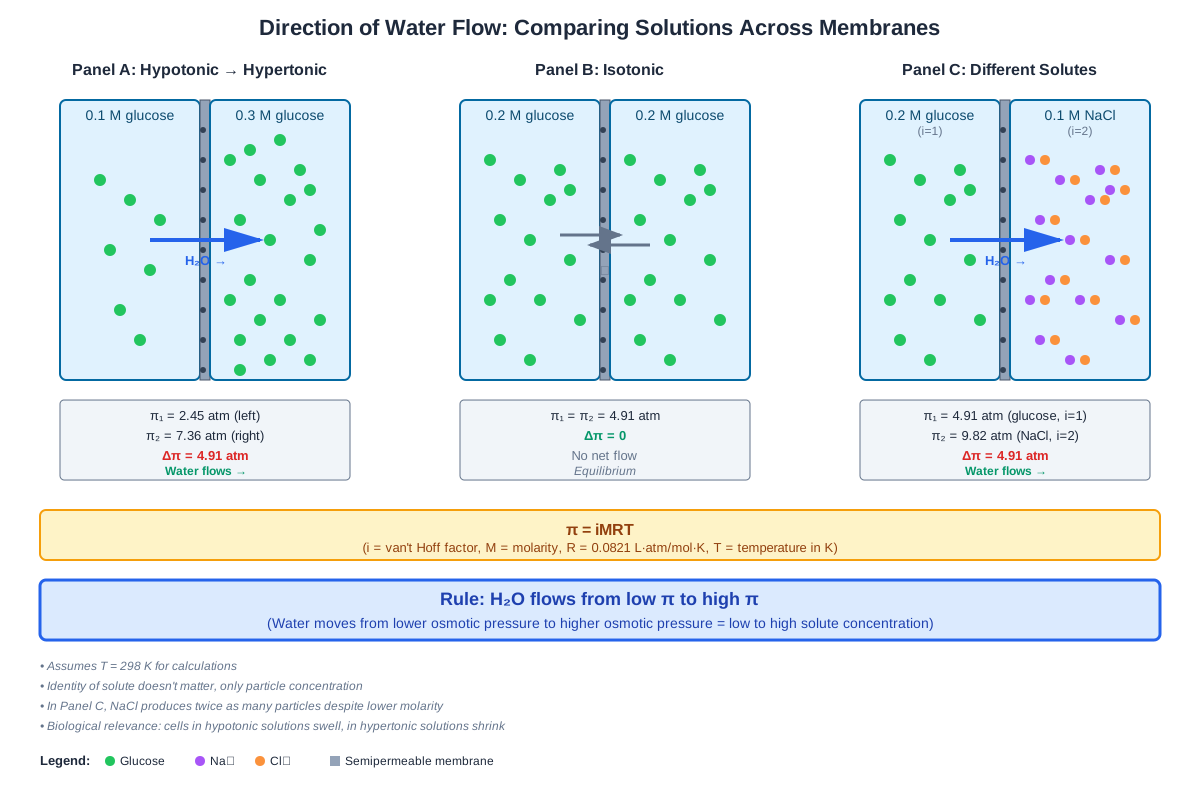
⭐ Water moves from regions of low solute concentration (high water potential) to high solute concentration (low water potential) across semipermeable membranes
⭐ Isotonic solutions have equal osmotic pressure to the reference solution (typically cell cytoplasm); 0.9% NaCl is isotonic with human blood
⭐ Osmotic pressure is the largest colligative property effect for a given solution concentration, making it most useful for molecular weight determination
- Osmolarity (Osm/L) = i × M, representing total osmotically active particle concentration
- Reverse osmosis requires applied pressure greater than the solution's osmotic pressure
- Tonicity depends only on non-penetrating solutes, while osmolarity includes all dissolved particles
- At 25°C, a 1 M solution of a non-electrolyte has an osmotic pressure of approximately 24.5 atm
- Hypertonic solutions cause cell crenation (animal) or plasmolysis (plant); hypotonic solutions cause hemolysis (animal) or turgor (plant)
- The ideal gas constant R = 0.0821 L·atm/mol·K is used in osmotic pressure calculations
- Osmotic pressure measurements can determine molecular weights of proteins and polymers that are too large for other methods
Quick check — test yourself on Osmotic pressure so far.
Try Flashcards →Common Misconceptions
Misconception: Osmotic pressure is the pressure exerted by solute particles pushing on the membrane.
Correction: Osmotic pressure is the pressure required to prevent solvent flow; it represents the thermodynamic drive for solvent to move into the solution, not a physical force exerted by solute molecules.
Misconception: Higher osmotic pressure means water flows out of that solution.
Correction: Water flows toward the solution with higher osmotic pressure (higher solute concentration). The solution with higher osmotic pressure has lower water chemical potential, so water moves into it.
Misconception: Isotonic and isosmotic mean the same thing.
Correction: Isosmotic solutions have equal total osmolarity, but isotonic solutions have equal osmotic pressure considering only non-penetrating solutes. A urea solution can be isosmotic with blood but not isotonic because urea crosses cell membranes.
Misconception: The van't Hoff factor for NaCl is always exactly 2.
Correction: While the ideal van't Hoff factor for NaCl is 2, the actual value in real solutions is often 1.8-1.9 due to ion pairing and interionic attractions. MCAT problems typically assume ideal behavior unless stated otherwise.
Misconception: Osmotic pressure only matters for biological membranes.
Correction: Osmotic pressure is a fundamental property of any solution separated from pure solvent (or another solution) by a semipermeable membrane, whether biological, synthetic, or experimental. It applies to dialysis tubing, reverse osmosis filters, and laboratory osmometers.
Misconception: Temperature doesn't significantly affect osmotic pressure.
Correction: Osmotic pressure is directly proportional to absolute temperature (π = iMRT). A temperature increase from 25°C to 37°C (298 K to 310 K) increases osmotic pressure by approximately 4%, which can be physiologically significant.
Misconception: Osmotic pressure and hydrostatic pressure are the same thing.
Correction: Hydrostatic pressure is the physical pressure exerted by a fluid column due to gravity. Osmotic pressure is a colligative property arising from solute concentration differences. They can oppose each other, as in capillaries where hydrostatic pressure drives fluid out while osmotic pressure (from plasma proteins) draws fluid in.
Worked Examples
Example 1: Calculating Osmotic Pressure of an Electrolyte Solution
Problem: Calculate the osmotic pressure of a 0.050 M CaCl₂ solution at 25°C. Assume ideal behavior.
Solution:
Step 1: Identify the given information and required equation.
- M = 0.050 mol/L
- T = 25°C = 298 K
- R = 0.0821 L·atm/mol·K
- Equation: π = iMRT
Step 2: Determine the van't Hoff factor.
CaCl₂ dissociates according to: CaCl₂ → Ca²⁺ + 2Cl⁻
This produces 3 particles per formula unit, so i = 3
Step 3: Substitute values into the equation.
π = (3)(0.050 mol/L)(0.0821 L·atm/mol·K)(298 K)
Step 4: Calculate.
π = 3 × 0.050 × 0.0821 × 298
π = 3.67 atm
Answer: The osmotic pressure is 3.67 atm.
Key Insight: This problem tests the learning objective of applying the van't Hoff equation while correctly accounting for electrolyte dissociation. Students must remember that CaCl₂ produces three ions, not two, which is a common error. The relatively high osmotic pressure (3.67 atm for a 0.050 M solution) demonstrates why osmotic pressure is the most sensitive colligative property.
Example 2: Predicting Cellular Response to Solutions
Problem: A plant cell with an internal osmolarity of 400 mOsm/L is placed in three different solutions: (A) 200 mOsm/L sucrose, (B) 400 mOsm/L sucrose, and (C) 600 mOsm/L sucrose. Predict the cell's response in each solution and explain the osmotic pressure relationships.
Solution:
Step 1: Analyze Solution A (200 mOsm/L).
- External osmolarity < internal osmolarity
- External osmotic pressure < internal osmotic pressure
- This is a hypotonic solution
- Water will move INTO the cell (from low to high solute concentration)
- The cell will swell, developing turgor pressure against the cell wall
- Plant cells have rigid cell walls, so they become turgid but don't burst
Step 2: Analyze Solution B (400 mOsm/L).
- External osmolarity = internal osmolarity
- External osmotic pressure = internal osmotic pressure
- This is an isotonic solution
- No NET water movement (water moves equally in both directions)
- The cell maintains its normal volume
- The cell is flaccid (no turgor pressure)
Step 3: Analyze Solution C (600 mOsm/L).
- External osmolarity > internal osmolarity
- External osmotic pressure > internal osmotic pressure
- This is a hypertonic solution
- Water will move OUT of the cell (toward higher solute concentration)
- The cell will shrink, and the plasma membrane pulls away from the cell wall
- This process is called plasmolysis
Osmotic Pressure Calculations (at 25°C = 298 K):
- Cell interior: π = (0.400 Osm/L)(0.0821)(298) = 9.8 atm
- Solution A: π = (0.200 Osm/L)(0.0821)(298) = 4.9 atm
- Solution B: π = (0.400 Osm/L)(0.0821)(298) = 9.8 atm
- Solution C: π = (0.600 Osm/L)(0.0821)(298) = 14.7 atm
Key Insight: This problem integrates multiple learning objectives: predicting solvent flow direction, connecting osmotic pressure to biological responses, and distinguishing between hypertonic, isotonic, and hypotonic solutions. The substantial osmotic pressure differences (nearly 10 atm between solutions A and C) explain why cells are so sensitive to osmotic stress. Note that sucrose is a non-electrolyte (i = 1), so osmolarity equals molarity.
Exam Strategy
Approaching MCAT Questions on Osmotic Pressure
When encountering osmotic pressure questions, first identify whether the question asks for calculation, conceptual understanding, or prediction of outcomes. For calculation problems, immediately write down the van't Hoff equation (π = iMRT) and identify each variable from the passage or question stem. Pay special attention to temperature units—convert Celsius to Kelvin before calculating.
For conceptual questions about water movement, remember the key principle: water flows toward higher solute concentration (equivalently, toward higher osmotic pressure or lower water potential). Draw a simple diagram showing the membrane with concentrations on each side if needed. This visualization prevents the common error of predicting water flow in the wrong direction.
Trigger Words and Phrases
Watch for these key terms that signal osmotic pressure is relevant:
- "Semipermeable membrane" or "selectively permeable"
- "Dialysis" or "osmometer"
- "Isotonic," "hypertonic," or "hypotonic"
- "Crenation," "hemolysis," "plasmolysis," or "turgor"
- "Colligative property"
- "Molecular weight determination"
- "Intravenous fluid" or "IV solution"
- "Osmolarity" or "osmolality"
Passages describing experimental setups with U-tubes, membranes separating solutions, or measurements of pressure differences across membranes almost always involve osmotic pressure.
Process of Elimination Tips
When evaluating answer choices:
- Eliminate answers with incorrect van't Hoff factors: If a question involves NaCl and an answer uses i = 1, eliminate it immediately.
- Check directional logic: Eliminate any answer stating water moves from high to low osmotic pressure (it's the opposite).
- Verify unit consistency: Answers mixing concentration units (M vs. m) or pressure units (atm vs. mmHg) incorrectly can be eliminated.
- Compare relative magnitudes: Osmotic pressure should be larger than other colligative property effects for the same solution. If an answer shows freezing point depression of 10°C but osmotic pressure of only 1 atm, it's likely incorrect.
- Consider biological reasonableness: For physiological questions, normal plasma osmolarity is approximately 300 mOsm/L. Answers suggesting values far from this range for "normal" conditions are suspect.
Time Allocation
For straightforward calculation problems, allocate 60-90 seconds: 20 seconds to identify variables, 30 seconds to calculate, and 10-20 seconds to verify. For passage-based questions requiring interpretation, spend 90-120 seconds: 30 seconds reviewing relevant passage information, 40 seconds reasoning through the concept, and 20-30 seconds selecting and confirming the answer. Don't get bogged down in complex calculations—MCAT math is designed to be manageable without a calculator, so if your calculation becomes unwieldy, recheck your setup.
Memory Techniques
Mnemonic for Water Movement Direction
"Salt Sucks": Salt (solute) sucks water toward it. Water always moves toward the solution with higher solute concentration (higher osmotic pressure). This simple phrase prevents the most common error in osmotic pressure problems.
Van't Hoff Equation Mnemonic
"I Must Remember Temperature": The first letters correspond to π = iMRT, helping recall the equation structure. Remember that π (pi) represents pressure, connecting to the "I" sound at the start.
Tonicity Memory Aid
"Hyper-Shrink, Hypo-Swell, Iso-Same":
- Hypertonic → cells shrink (crenate)
- Hypotonic → cells swell (may lyse)
- Isotonic → cells stay the same
Van't Hoff Factor Visualization
Picture ionic compounds "breaking apart" in water:
- NaCl → 2 pieces (Na⁺ and Cl⁻)
- CaCl₂ → 3 pieces (Ca²⁺ and 2 Cl⁻)
- Na₂SO₄ → 3 pieces (2 Na⁺ and SO₄²⁻)
Visualize the compound physically splitting to count particles, which gives you the van't Hoff factor.
R Constant Recall
For the gas constant, remember "0.0821 Liters Atmosphere" matches the units L·atm/mol·K. The value 0.0821 can be remembered as approximately 1/12 (0.0833), close enough for estimation.
Summary
Osmotic pressure represents the pressure required to prevent solvent flow across a semipermeable membrane from pure solvent into solution, arising from the thermodynamic drive to equalize solvent chemical potential. Quantified by the van't Hoff equation (π = iMRT), osmotic pressure depends on solution concentration, temperature, and the number of dissolved particles per solute formula unit. As a colligative property, it provides the most sensitive method for determining molecular weights of large molecules and plays critical roles in biological systems, from cellular volume regulation to kidney function. Understanding the distinction between osmolarity (total particle concentration), osmolality (particles per kg solvent), and tonicity (effect on cell volume considering only non-penetrating solutes) is essential for MCAT success. Water always flows toward regions of higher solute concentration (higher osmotic pressure), causing cells to shrink in hypertonic solutions, swell in hypotonic solutions, and maintain volume in isotonic solutions. Mastery requires both computational facility with the van't Hoff equation and conceptual understanding of membrane transport, making osmotic pressure a high-yield topic bridging General Chemistry and biological sciences.
Key Takeaways
- Osmotic pressure (π = iMRT) is directly proportional to molarity, temperature, and particle number, making it the most sensitive colligative property for dilute solutions
- Water flows from low to high solute concentration (equivalently, from low to high osmotic pressure), a principle governing all osmotic phenomena
- The van't Hoff factor (i) equals the number of particles produced per formula unit: 1 for non-electrolytes, 2 for NaCl, 3 for CaCl₂ and Na₂SO₄
- Tonicity differs from osmolarity because tonicity considers only non-penetrating solutes that affect cell volume, while osmolarity includes all dissolved particles
- Isotonic solutions (0.9% NaCl for human cells) maintain cell volume, hypertonic solutions cause shrinkage, and hypotonic solutions cause swelling
- Osmotic pressure measurements determine molecular weights of proteins and polymers too large for other colligative property methods
- Reverse osmosis requires applied pressure exceeding osmotic pressure to force solvent from solution to pure solvent, enabling desalination and purification
Related Topics
Colligative Properties: Vapor pressure lowering, boiling point elevation, and freezing point depression share mathematical relationships with osmotic pressure and all depend on solute particle concentration. Mastering osmotic pressure provides a foundation for understanding these related phenomena.
Membrane Transport: Active transport, facilitated diffusion, and ion channels work in conjunction with or against osmotic gradients. Understanding osmotic pressure is prerequisite to analyzing energy requirements for transport processes.
Acid-Base Chemistry: Buffer solutions and pH calculations connect to osmotic pressure through ionic strength and particle concentration effects. Electrolyte dissociation principles apply to both topics.
Chemical Equilibrium: The equilibrium between osmotic and hydrostatic pressures in biological systems exemplifies Le Chatelier's principle and equilibrium constant applications in physiological contexts.
Kidney Physiology: The nephron's countercurrent multiplier system creates osmotic gradients essential for urine concentration, directly applying osmotic pressure principles to organ-level function.
Thermodynamics: Chemical potential, free energy, and entropy changes underlie osmotic pressure at a fundamental level, connecting this topic to broader thermodynamic principles tested on the MCAT.
Practice CTA
Now that you've mastered the core concepts of osmotic pressure, reinforce your understanding by working through practice questions and flashcards. Focus on problems requiring both calculation and conceptual reasoning—the MCAT tests both skills. Challenge yourself with interdisciplinary passages connecting osmotic pressure to biological systems, as these represent the highest-yield question types. Pay special attention to questions involving electrolyte solutions where van't Hoff factor errors are common. Remember, consistent practice with immediate feedback is the most effective way to achieve automaticity with osmotic pressure problems, freeing cognitive resources for complex passage analysis on test day. You've built a strong foundation—now apply it!
Sign up free to keep reading
Create a free AnvayaPrep account to finish this MCAT guide on Osmotic pressure — plus flashcards and practice questions.