Overview
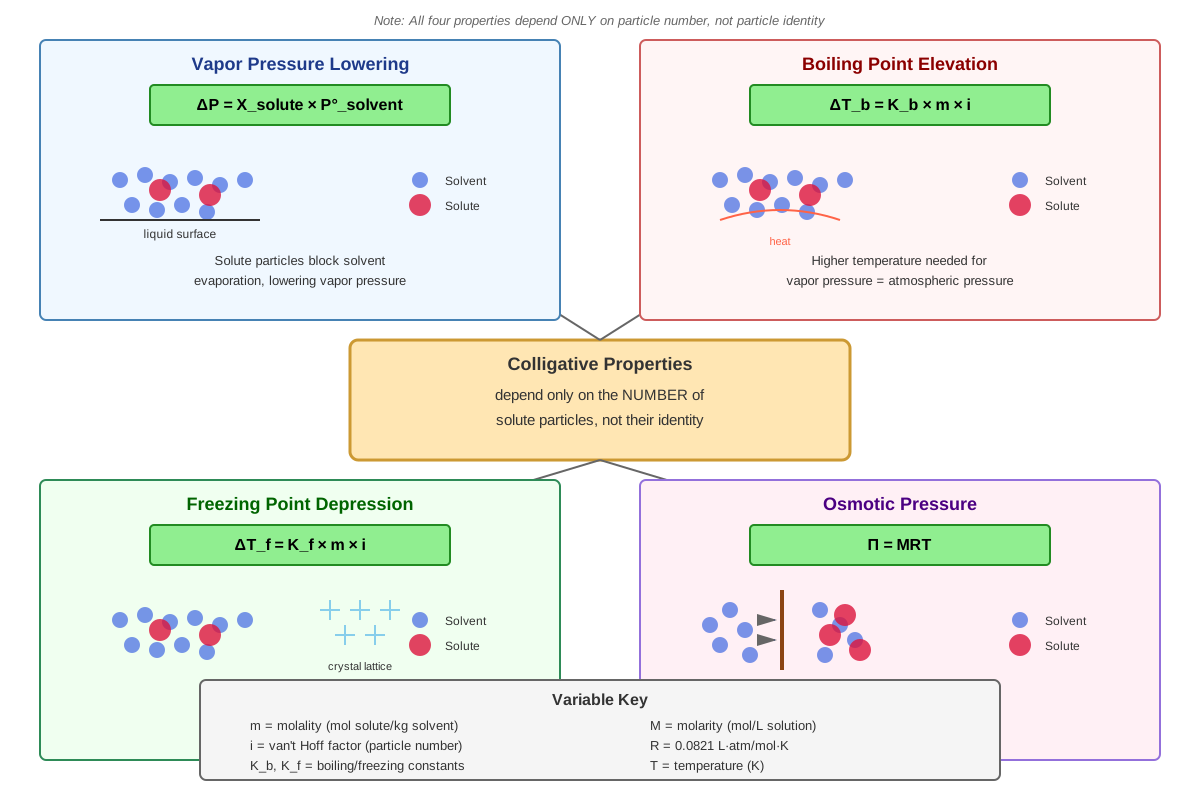
Colligative properties are a fundamental class of solution behaviors in General Chemistry that depend solely on the number of solute particles present in a solution, not on the identity or chemical nature of those particles. These properties include vapor pressure lowering, boiling point elevation, freezing point depression, and osmotic pressure. Understanding colligative properties is essential for the MCAT because they bridge multiple disciplines tested on the exam: they appear in general chemistry passages involving solutions, in biological contexts such as osmosis across cell membranes, and in clinical scenarios involving intravenous fluid administration and kidney function.
The MCAT frequently tests colligative properties through both direct calculation questions and conceptual applications in passage-based scenarios. Students must be comfortable with both quantitative problem-solving (using equations like ΔTf = Kf·m·i) and qualitative reasoning about how solute concentration affects solution behavior. These properties are particularly high-yield because they connect to broader themes in Solutions and Phase Behavior, including solution concentration units, intermolecular forces, and phase diagrams.
Mastery of Colligative properties MCAT content requires understanding the molecular basis for these phenomena: how solute particles disrupt the solvent's ability to enter or exit different phases. This topic integrates with thermodynamics (entropy and free energy), kinetics (rates of phase transitions), and biochemistry (membrane transport and cellular homeostasis). The ability to predict and calculate changes in physical properties based on solute concentration is a core competency that appears across multiple MCAT sections, making this a medium-importance topic with broad applicability.
Learning Objectives
- [ ] Define Colligative properties using accurate General Chemistry terminology
- [ ] Explain why Colligative properties matters for the MCAT
- [ ] Apply Colligative properties to exam-style questions
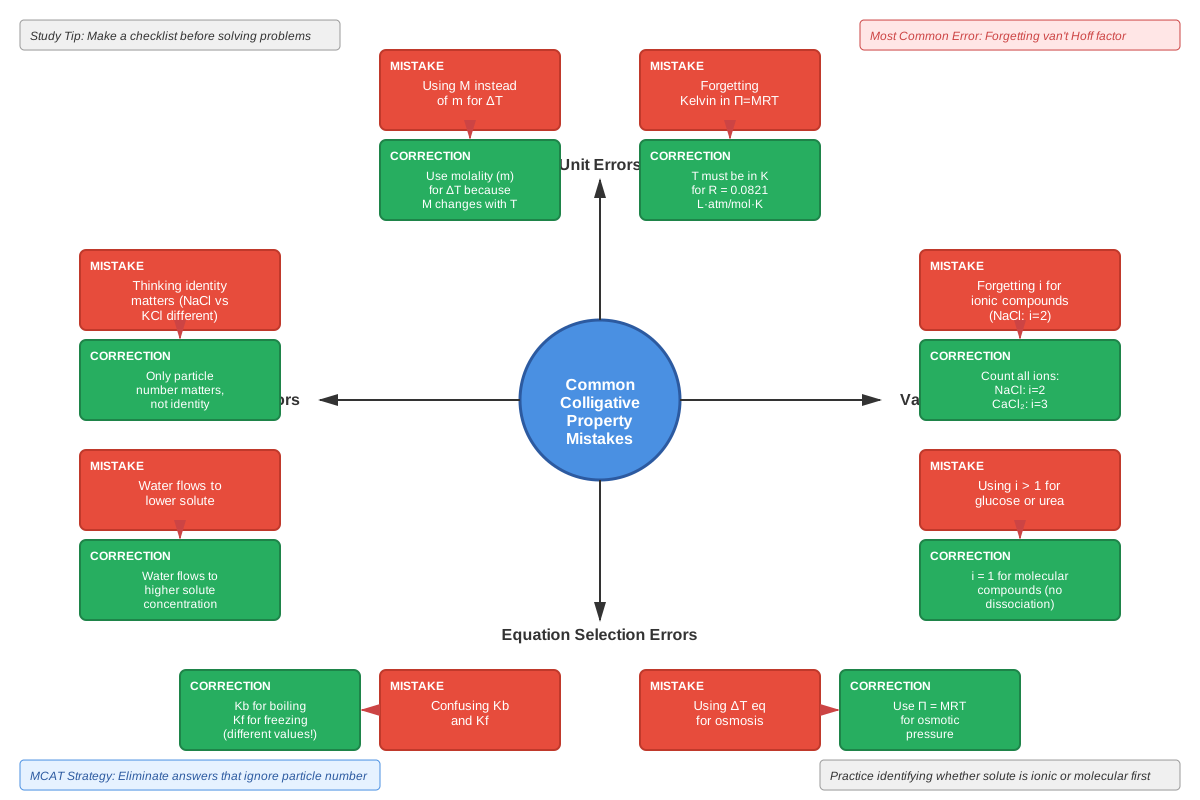
- [ ] Identify common mistakes related to Colligative properties
- [ ] Connect Colligative properties to related General Chemistry concepts
- [ ] Calculate quantitative changes in boiling point, freezing point, and osmotic pressure given solution composition
- [ ] Predict the relative magnitude of colligative effects for ionic versus molecular solutes
- [ ] Analyze biological and clinical scenarios involving osmosis and tonicity using colligative property principles
Prerequisites
- Solution concentration units (molarity, molality, mole fraction): Essential for calculating colligative property changes, as most equations use molality
- Intermolecular forces: Understanding how solute particles interact with solvent molecules explains the molecular basis of colligative properties
- Phase diagrams and phase transitions: Colligative properties modify the conditions under which phase changes occur
- Basic thermodynamics (entropy, enthalpy): The driving forces behind colligative phenomena relate to entropy changes in solutions
- Stoichiometry and dissociation of ionic compounds: Necessary for determining the van't Hoff factor (i) in calculations
Why This Topic Matters
Colligative properties have profound clinical and biological significance that makes them relevant to multiple MCAT sections. In medicine, understanding osmotic pressure is critical for formulating intravenous fluids, managing electrolyte imbalances, and understanding kidney function. The concept of tonicity—whether a solution is isotonic, hypertonic, or hypotonic relative to cells—directly derives from colligative properties and appears frequently in biological passages. Freezing point depression explains why salt is used to de-ice roads and why antifreeze protects car engines, providing real-world contexts for MCAT questions.
On the MCAT, colligative properties appear in approximately 2-4 questions per exam, either as standalone calculation problems in the Chemical and Physical Foundations section or embedded within biological passages in the Biological and Biochemical Foundations section. Questions typically test: (1) quantitative calculations using colligative property equations, (2) conceptual understanding of why these properties depend only on particle number, (3) comparison of ionic versus molecular solutes, and (4) application to biological systems, particularly osmosis across membranes.
Common exam presentations include: passages describing experimental determination of molecular weight using freezing point depression, clinical vignettes involving fluid balance and cell swelling/shrinking, and discrete questions requiring calculation of boiling point elevation or osmotic pressure. The MCAT particularly favors questions that integrate colligative properties with other concepts, such as determining whether a compound is ionic or molecular based on observed freezing point depression, or predicting the direction of water movement across a semipermeable membrane.
Core Concepts
Definition and Fundamental Principle
Colligative properties are physical properties of solutions that depend exclusively on the ratio of solute particles to solvent molecules, regardless of the chemical identity of the solute. The term "colligative" derives from the Latin word meaning "bound together," reflecting how these properties relate to the collective effect of solute particles. The four primary colligative properties are:
- Vapor pressure lowering (Raoult's Law)
- Boiling point elevation
- Freezing point depression
- Osmotic pressure
The fundamental principle underlying all colligative properties is that solute particles disrupt the solvent's ability to undergo phase transitions. At the molecular level, solute particles occupy positions at the liquid surface (reducing vapor pressure), interfere with crystal lattice formation (lowering freezing point), require additional thermal energy to escape the liquid phase (raising boiling point), and create concentration gradients that drive solvent movement (osmotic pressure).
Vapor Pressure Lowering and Raoult's Law
When a non-volatile solute dissolves in a solvent, the vapor pressure of the solution becomes lower than that of the pure solvent. This occurs because solute particles occupy surface positions, reducing the number of solvent molecules that can escape into the vapor phase. Raoult's Law quantifies this relationship:
P_solution = X_solvent × P°_solventWhere:
- P_solution = vapor pressure of the solution
- X_solvent = mole fraction of solvent
- P°_solvent = vapor pressure of pure solvent
For dilute solutions, the change in vapor pressure (ΔP) can be expressed as:
ΔP = X_solute × P°_solventThis relationship is particularly important for understanding why solutions have different boiling and freezing points than pure solvents. The MCAT may present vapor pressure lowering in the context of distillation, humidity control, or as the theoretical basis for other colligative properties.
Boiling Point Elevation
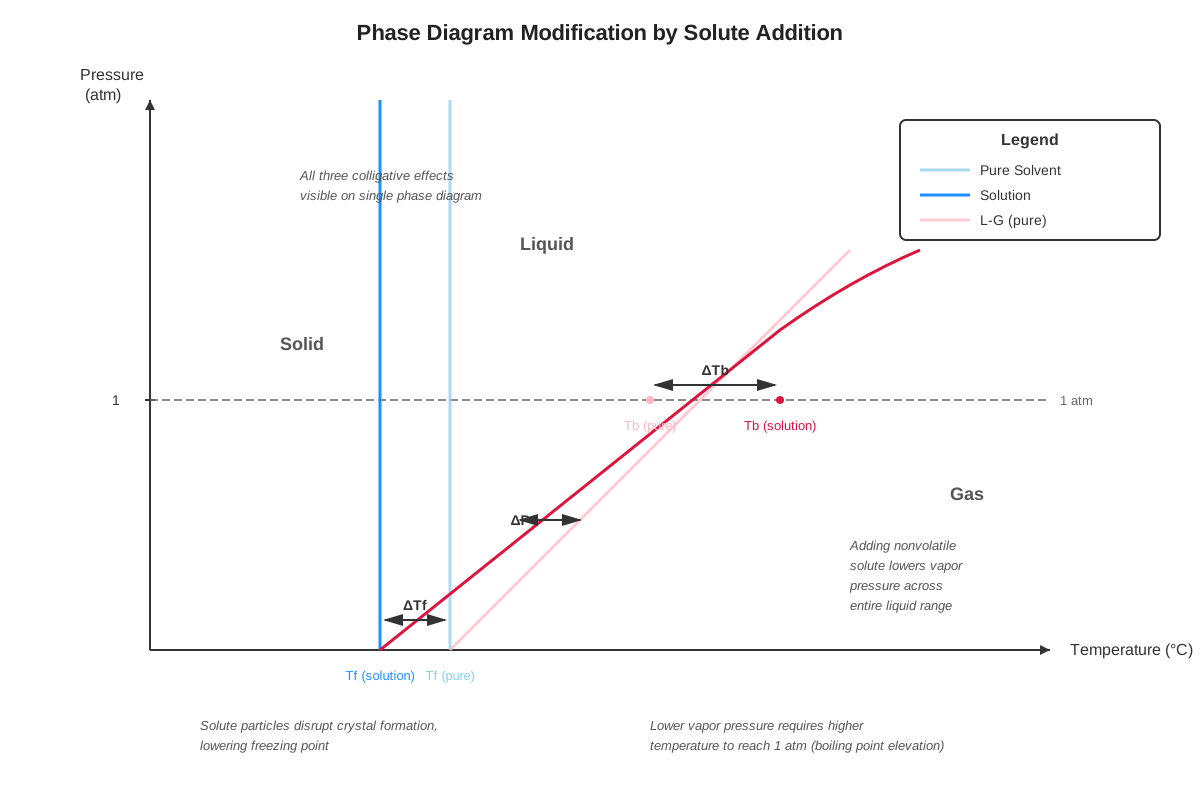
The boiling point elevation occurs because the reduced vapor pressure of a solution means that a higher temperature is required for the vapor pressure to equal atmospheric pressure (the definition of boiling point). The quantitative relationship is:
ΔT_b = K_b × m × iWhere:
- ΔT_b = change in boiling point (always positive)
- K_b = ebullioscopic constant (specific to each solvent; for water, K_b = 0.512 °C/m)
- m = molality of the solution (mol solute/kg solvent)
- i = van't Hoff factor (number of particles per formula unit)
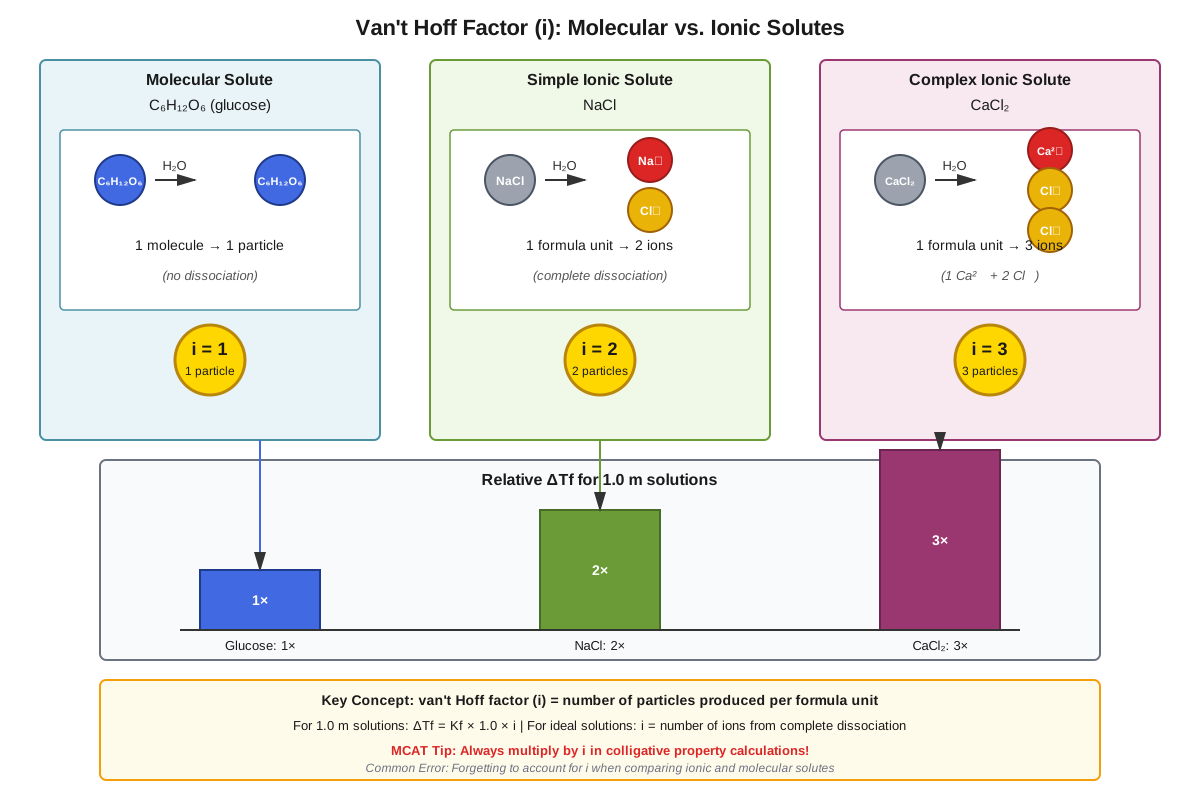
The van't Hoff factor is crucial: for molecular solutes like glucose, i = 1; for NaCl, i ≈ 2; for CaCl₂, i ≈ 3. In reality, i is often slightly less than the theoretical value due to ion pairing in solution, but the MCAT typically uses ideal values unless otherwise specified.
Freezing Point Depression
Freezing point depression is perhaps the most commonly tested colligative property on the MCAT. Solute particles interfere with the formation of the ordered solid crystal lattice, requiring a lower temperature to achieve freezing. The equation mirrors that for boiling point elevation:
ΔT_f = K_f × m × iWhere:
- ΔT_f = change in freezing point (always positive, representing a decrease)
- K_f = cryoscopic constant (for water, K_f = 1.86 °C/m)
- m = molality
- i = van't Hoff factor
Note that K_f is typically larger than K_b for the same solvent, meaning freezing point changes are more dramatic than boiling point changes for the same solute concentration. This principle is used experimentally to determine molecular weights of unknown compounds and explains biological antifreeze proteins in cold-water fish.
Osmotic Pressure
Osmotic pressure (π) is the pressure required to prevent the net flow of solvent across a semipermeable membrane from a region of lower solute concentration to higher solute concentration. This is the most biologically relevant colligative property, as it governs water movement across cell membranes. The equation is:
π = iMRTWhere:
- π = osmotic pressure (in atm)
- i = van't Hoff factor
- M = molarity (mol/L)
- R = ideal gas constant (0.0821 L·atm/mol·K)
- T = absolute temperature (Kelvin)
Note that osmotic pressure uses molarity rather than molality, unlike the other colligative properties. This is because osmotic pressure is measured as a pressure difference across a membrane, making volume-based concentration more practical.
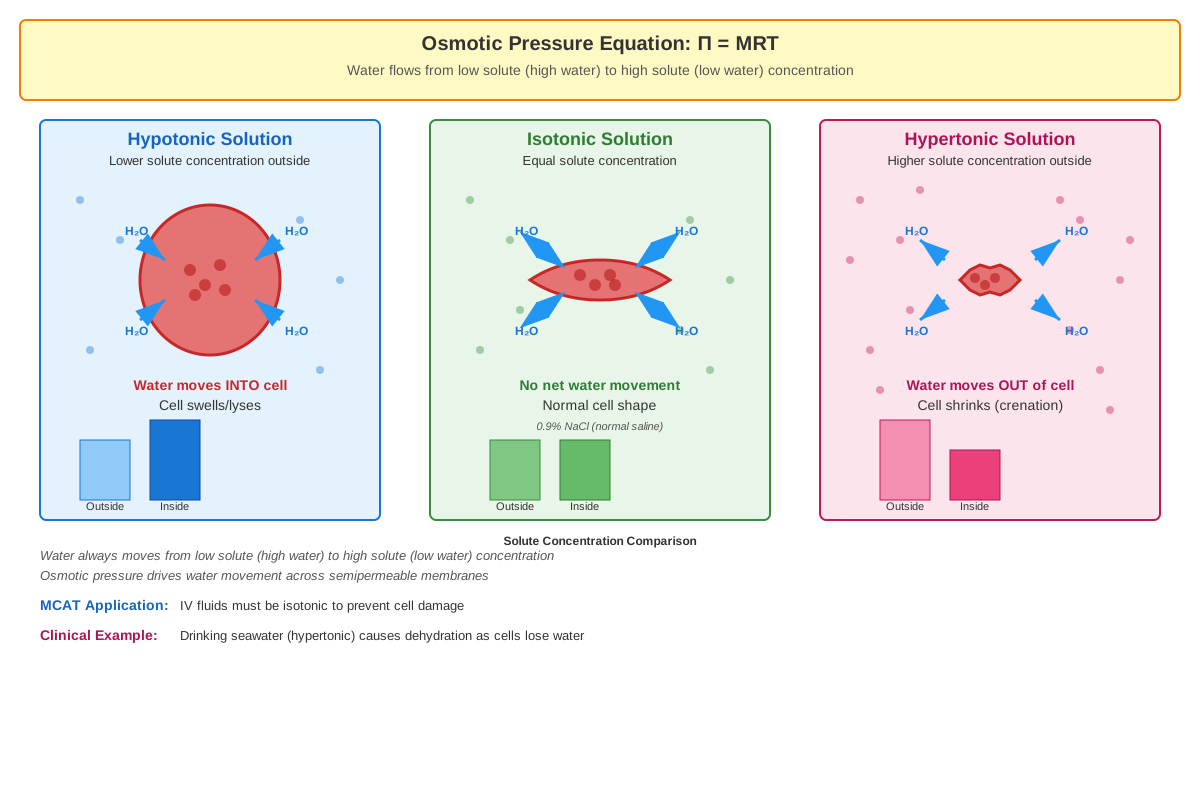
Tonicity describes the relative concentration of solutes in two solutions separated by a semipermeable membrane:
- Isotonic: equal solute concentration; no net water movement
- Hypertonic: higher solute concentration; water moves into this solution
- Hypotonic: lower solute concentration; water moves out of this solution
The Van't Hoff Factor in Detail
The van't Hoff factor (i) represents the number of particles produced when one formula unit of solute dissolves. Understanding i is critical for MCAT success:
| Solute Type | Example | Theoretical i | Typical Actual i |
|---|---|---|---|
| Non-electrolyte | Glucose, sucrose | 1 | 1 |
| Strong electrolyte (1:1) | NaCl, KBr | 2 | 1.8-1.9 |
| Strong electrolyte (1:2) | CaCl₂, Na₂SO₄ | 3 | 2.5-2.7 |
| Strong electrolyte (2:3) | Al₂(SO₄)₃ | 5 | 4.2-4.5 |
| Weak electrolyte | Acetic acid | 1 < i < 2 | Depends on Ka |
The discrepancy between theoretical and actual i values results from ion pairing and interionic attractions in solution. At higher concentrations, oppositely charged ions associate temporarily, reducing the effective number of independent particles. The MCAT typically uses ideal values unless the question specifically addresses non-ideal behavior.
Molecular Basis and Entropy
The underlying thermodynamic explanation for colligative properties involves entropy. When solute dissolves in solvent, the entropy of the system increases due to greater disorder. This entropy increase stabilizes the liquid phase relative to both solid and gas phases:
- Freezing point depression: The liquid solution has higher entropy than pure liquid, so more thermal energy must be removed (lower temperature) to achieve the entropy decrease required for solidification
- Boiling point elevation: The liquid solution has higher entropy, requiring more thermal energy (higher temperature) to overcome the entropy advantage and vaporize
- Osmotic pressure: Water moves from low to high solute concentration to maximize entropy by equalizing concentrations
This entropy-based explanation helps students understand why colligative properties depend only on particle number: each particle contributes equally to the entropy increase, regardless of its identity.
Concept Relationships
The four colligative properties are interconnected through their common dependence on solute particle concentration. Vapor pressure lowering serves as the foundational concept: because solute particles reduce vapor pressure, the solution must be heated to a higher temperature to achieve boiling (boiling point elevation) and cooled to a lower temperature to achieve freezing (freezing point depression). Osmotic pressure represents the same principle applied across a membrane rather than within a single phase.
These concepts connect to prerequisite knowledge in several ways: Solution concentration units (particularly molality and molarity) are essential for calculations. Intermolecular forces explain why solute particles disrupt solvent behavior—the solute-solvent interactions compete with solvent-solvent interactions. Phase diagrams are modified by colligative properties; adding solute shifts the liquid-solid and liquid-gas equilibrium lines. Thermodynamics provides the entropy-based explanation for why these phenomena occur.
Colligative properties also connect forward to more advanced topics: Osmosis is fundamental to understanding cell membrane transport, kidney function, and plant physiology. Electrolyte solutions and the van't Hoff factor connect to acid-base chemistry and ionic equilibria. Molecular weight determination using freezing point depression links to analytical chemistry and biochemistry.
The relationship map: Solute dissolution → Increased solution entropy → Disrupted phase equilibria → Vapor pressure lowering → Boiling point elevation AND Freezing point depression. Simultaneously: Concentration gradient across membrane → Osmotic pressure → Water movement → Tonicity effects on cells.
High-Yield Facts
⭐ Colligative properties depend only on the number of solute particles, not their identity or chemical nature
⭐ The van't Hoff factor (i) for NaCl is approximately 2, for CaCl₂ is approximately 3, and for glucose is 1
⭐ Freezing point depression uses ΔTf = Kf × m × i, where Kf for water is 1.86 °C/m
⭐ Osmotic pressure is calculated using π = iMRT, and uses molarity (not molality) as the concentration unit
⭐ Water moves from hypotonic to hypertonic solutions across semipermeable membranes
- Boiling point elevation uses ΔTb = Kb × m × i, where Kb for water is 0.512 °C/m
- Raoult's Law states that vapor pressure of a solution equals the mole fraction of solvent times the vapor pressure of pure solvent
- Molality (mol/kg solvent) is used for freezing point and boiling point calculations because it doesn't change with temperature
- The magnitude of freezing point depression is typically larger than boiling point elevation for the same solute concentration (Kf > Kb)
- Isotonic solutions have the same osmotic pressure as blood (approximately 0.9% NaCl or 5% glucose)
- Ion pairing causes actual van't Hoff factors to be slightly lower than theoretical values, especially at high concentrations
- Colligative properties can be used to determine molecular weight of unknown compounds experimentally
- Non-volatile solutes are required for vapor pressure lowering; volatile solutes follow different rules
- The osmotic pressure equation resembles the ideal gas law (PV = nRT), reflecting similar particle-based behavior
Quick check — test yourself on Colligative properties so far.
Try Flashcards →Common Misconceptions
Misconception: Colligative properties depend on the type of solute dissolved.
Correction: Colligative properties depend exclusively on the number of solute particles, not their chemical identity. One mole of glucose particles produces the same freezing point depression as one mole of urea particles, but different from one mole of NaCl (which produces approximately two moles of particles).
Misconception: The van't Hoff factor for NaCl is always exactly 2.
Correction: While the theoretical van't Hoff factor for NaCl is 2 (one Na⁺ and one Cl⁻), the actual value is typically 1.8-1.9 due to ion pairing in solution. However, the MCAT usually assumes ideal behavior (i = 2) unless the question specifically addresses non-ideal solutions.
Misconception: Molarity and molality are interchangeable in colligative property calculations.
Correction: Molality (mol/kg solvent) is used for freezing point depression and boiling point elevation because it doesn't change with temperature. Molarity (mol/L solution) is used for osmotic pressure calculations. Using the wrong concentration unit will yield incorrect answers.
Misconception: A hypertonic solution has lower solute concentration than the reference solution.
Correction: A hypertonic solution has higher solute concentration and higher osmotic pressure than the reference solution. Water moves into hypertonic solutions, causing cells placed in them to shrink (crenate). The prefix "hyper-" means "above" or "excessive."
Misconception: Freezing point depression means the freezing point increases.
Correction: "Depression" means lowering—the freezing point decreases (becomes more negative). A solution freezes at a lower temperature than pure solvent. The ΔTf value is positive, representing the magnitude of decrease: Tf(solution) = Tf(pure solvent) - ΔTf.
Misconception: Colligative properties only apply to aqueous solutions.
Correction: Colligative properties apply to any solution, though water is the most commonly tested solvent on the MCAT. Each solvent has its own Kf and Kb values. The principles remain the same regardless of solvent identity.
Misconception: Osmotic pressure can be negative.
Correction: Osmotic pressure is always positive—it represents the pressure that must be applied to prevent water movement. The direction of water movement is determined by comparing osmotic pressures of two solutions, but each solution's osmotic pressure itself is positive.
Worked Examples
Example 1: Freezing Point Depression Calculation
Question: A solution is prepared by dissolving 18.0 g of glucose (C₆H₁₂O₆, MW = 180 g/mol) in 200 g of water. Calculate the freezing point of this solution. (Kf for water = 1.86 °C/m)
Solution:
Step 1: Calculate moles of glucose
- Moles = mass / molecular weight = 18.0 g / 180 g/mol = 0.100 mol
Step 2: Calculate molality
- Molality = moles solute / kg solvent = 0.100 mol / 0.200 kg = 0.500 m
Step 3: Determine van't Hoff factor
- Glucose is a molecular compound (non-electrolyte), so i = 1
Step 4: Calculate freezing point depression
- ΔTf = Kf × m × i = 1.86 °C/m × 0.500 m × 1 = 0.93 °C
Step 5: Calculate final freezing point
- Tf(solution) = Tf(pure water) - ΔTf = 0.00 °C - 0.93 °C = -0.93 °C
Answer: The solution freezes at -0.93 °C
Key concepts: This problem tests understanding of molality calculation, recognition that glucose doesn't dissociate (i = 1), and proper application of the freezing point depression equation. Note that the freezing point decreases, becoming negative.
Example 2: Osmotic Pressure and Tonicity
Question: Two solutions are separated by a semipermeable membrane permeable only to water. Solution A contains 0.15 M NaCl. Solution B contains 0.30 M glucose. At 37 °C (310 K), what is the osmotic pressure difference between the solutions, and in which direction will water move? (R = 0.0821 L·atm/mol·K)
Solution:
Step 1: Calculate osmotic pressure of Solution A (NaCl)
- NaCl dissociates into 2 ions, so i = 2
- πA = iMRT = 2 × 0.15 M × 0.0821 L·atm/mol·K × 310 K
- πA = 7.63 atm
Step 2: Calculate osmotic pressure of Solution B (glucose)
- Glucose doesn't dissociate, so i = 1
- πB = iMRT = 1 × 0.30 M × 0.0821 L·atm/mol·K × 310 K
- πB = 7.63 atm
Step 3: Compare osmotic pressures
- πA = πB = 7.63 atm
- The solutions are isotonic
Step 4: Determine water movement
- Since the solutions have equal osmotic pressure, there is no net water movement
Answer: Both solutions have an osmotic pressure of 7.63 atm, they are isotonic, and there is no net water movement.
Key concepts: This problem illustrates that different solutes can create isotonic solutions if their effective particle concentrations are equal. The 0.15 M NaCl (producing 0.30 M particles) is isotonic with 0.30 M glucose (producing 0.30 M particles). This principle is critical for understanding physiological saline solutions and IV fluid formulation.
Example 3: Molecular Weight Determination
Question: A 5.00 g sample of an unknown molecular compound is dissolved in 100.0 g of water. The freezing point of the solution is measured to be -0.465 °C. What is the molecular weight of the unknown compound? (Kf for water = 1.86 °C/m)
Solution:
Step 1: Calculate ΔTf
- ΔTf = 0.00 °C - (-0.465 °C) = 0.465 °C
Step 2: Determine van't Hoff factor
- The problem states it's a molecular compound, so i = 1
Step 3: Calculate molality using ΔTf = Kf × m × i
- 0.465 °C = 1.86 °C/m × m × 1
- m = 0.465 / 1.86 = 0.250 m
Step 4: Calculate moles of solute
- Molality = moles / kg solvent
- 0.250 m = moles / 0.100 kg
- Moles = 0.0250 mol
Step 5: Calculate molecular weight
- MW = mass / moles = 5.00 g / 0.0250 mol = 200 g/mol
Answer: The molecular weight of the unknown compound is 200 g/mol.
Key concepts: This problem demonstrates how colligative properties can be used analytically to determine molecular weight. The MCAT may present this in experimental contexts or ask students to identify an unknown compound from a list of possibilities based on calculated molecular weight.
Exam Strategy
When approaching Colligative properties MCAT questions, first identify which of the four properties is being tested. Look for trigger words: "freezing point," "boiling point," "osmotic pressure," or "vapor pressure." Immediately determine whether you need to calculate a quantitative value or apply conceptual understanding.
For calculation questions, follow this systematic approach:
- Identify the given information and what's being asked
- Determine the appropriate equation (ΔTf, ΔTb, or π)
- Calculate or identify the van't Hoff factor (i)—this is where many students make errors
- Ensure you're using the correct concentration unit (molality vs. molarity)
- Perform the calculation with proper units
- Check if your answer makes physical sense
Trigger phrases to watch for:
- "Non-volatile solute" → vapor pressure lowering, Raoult's Law
- "Semipermeable membrane" → osmotic pressure, tonicity
- "Cell placed in solution" → osmosis, hypertonic/hypotonic/isotonic
- "Molecular weight determination" → use colligative property to calculate MW
- "Ionic compound" or "dissociates" → remember to use i > 1
- "Ideal solution" → use theoretical van't Hoff factors
Process of elimination tips:
- Eliminate answers where ionic compounds are treated as i = 1
- Eliminate answers that show freezing point increasing or boiling point decreasing
- For tonicity questions, eliminate options that have water moving in the wrong direction
- If comparing two solutions, eliminate answers that don't account for different van't Hoff factors
Time allocation: Straightforward calculation questions should take 60-90 seconds. Passage-based questions requiring conceptual application may take 90-120 seconds. If a question requires multiple steps (e.g., calculating molality, then ΔTf, then final temperature), budget 2 minutes. Don't get bogged down in complex calculations—the MCAT rarely requires extensive arithmetic.
Common question formats:
- Direct calculation: "What is the freezing point of..."
- Comparison: "Which solution has the highest boiling point?"
- Experimental: "A scientist measures... what is the molecular weight?"
- Biological application: "A cell is placed in solution X... what happens?"
For passage-based questions, scan for data tables with concentrations, temperatures, or molecular weights. These often signal colligative property questions. Pay attention to whether compounds are ionic or molecular—this information may be embedded in the passage rather than explicitly stated in the question.
Memory Techniques
Mnemonic for the four colligative properties: "Very Big Frogs Occasionally"
- Vapor pressure lowering
- Boiling point elevation
- Freezing point depression
- Osmotic pressure
Mnemonic for van't Hoff factors: "Glucose Goes Solo, Salt Splits in Two"
- Glucose (molecular) = i of 1
- Salt/NaCl (ionic) = i of 2
Mnemonic for tonicity and water movement: "Water Wants to Dilute"
- Water always moves toward higher solute concentration (hypertonic side) to dilute it
Visualization for osmotic pressure: Picture a U-tube with a semipermeable membrane at the bottom. The side with more solute particles has a higher water column—that height difference represents osmotic pressure. Water moves from the lower column (hypotonic) to the higher column (hypertonic).
Acronym for equation variables: "Kids Make Ice" for the freezing point equation
- Kf (cryoscopic constant)
- m (molality)
- i (van't Hoff factor)
Memory aid for Kf vs. Kb: "Freezing is Bigger" (Kf > Kb for water: 1.86 vs. 0.512)
Conceptual visualization: Imagine solute particles as "obstacles" in the solvent. More obstacles make it harder for solvent molecules to escape (lower vapor pressure, higher boiling point) and harder to organize into a crystal (lower freezing point). This physical picture helps remember that all colligative properties increase with more solute particles.
Number memory: For water, remember "1.86 and 0.512" by thinking "almost 2, about half" (Kf ≈ 2, Kb ≈ 0.5)
Summary
Colligative properties represent a fundamental principle in General Chemistry: certain solution properties depend exclusively on the number of dissolved particles, not their chemical identity. The four primary colligative properties—vapor pressure lowering, boiling point elevation, freezing point depression, and osmotic pressure—all result from solute particles disrupting the solvent's ability to undergo phase transitions. Quantitative calculations require understanding the van't Hoff factor (i), which accounts for dissociation of ionic compounds, and proper use of concentration units (molality for ΔTf and ΔTb, molarity for π). The molecular basis involves entropy: dissolved solute increases solution entropy, stabilizing the liquid phase relative to solid and gas phases. For the MCAT, students must master both computational skills (using equations like ΔTf = Kf·m·i and π = iMRT) and conceptual applications, particularly osmosis and tonicity in biological systems. Understanding that water moves from hypotonic to hypertonic solutions and that isotonic solutions have equal osmotic pressures is essential for biological passages. The ability to determine van't Hoff factors correctly and distinguish between ionic and molecular solutes is critical for exam success.
Key Takeaways
- Colligative properties depend only on the number of solute particles, not their identity—this is the defining characteristic that unifies vapor pressure lowering, boiling point elevation, freezing point depression, and osmotic pressure
- The van't Hoff factor (i) accounts for dissociation: i = 1 for molecular solutes like glucose, i ≈ 2 for NaCl, i ≈ 3 for CaCl₂—correctly identifying i is crucial for accurate calculations
- Freezing point depression (ΔTf = Kf·m·i) and boiling point elevation (ΔTb = Kb·m·i) use molality, while osmotic pressure (π = iMRT) uses molarity—using the wrong concentration unit is a common error
- Water moves from hypotonic (lower solute) to hypertonic (higher solute) solutions across semipermeable membranes; isotonic solutions have equal osmotic pressures and no net water movement
- For water, Kf = 1.86 °C/m and Kb = 0.512 °C/m—freezing point changes are larger than boiling point changes for the same solute concentration
- Colligative properties have extensive biological applications, particularly osmosis in cells, kidney function, and IV fluid formulation—expect integration with biological passages on the MCAT
- The molecular basis is entropy: solute particles increase solution disorder, requiring more extreme conditions (higher temperature for boiling, lower temperature for freezing) to achieve phase transitions
Related Topics
Raoult's Law and Ideal Solutions: Extends vapor pressure lowering to solutions of volatile components; important for understanding distillation and partial pressures in mixtures. Mastering basic colligative properties provides the foundation for understanding deviations from ideality.
Electrolyte Solutions and Ionic Equilibria: Connects the van't Hoff factor to degree of dissociation, weak electrolytes, and acid-base chemistry. Understanding why i varies for weak acids/bases requires integration with equilibrium concepts.
Membrane Transport and Cell Biology: Osmosis is the biological application of osmotic pressure; connects to active transport, facilitated diffusion, and cellular homeostasis. Colligative property mastery is essential for understanding how cells regulate water balance.
Thermodynamics and Entropy: The deeper explanation for why colligative properties exist involves Gibbs free energy and entropy of mixing. Advanced understanding connects ΔG = ΔH - TΔS to phase equilibria.
Phase Diagrams: Colligative properties modify phase diagrams by shifting equilibrium lines; connects to the Clausius-Clapeyron equation and pressure-temperature relationships for phase transitions.
Analytical Chemistry and Molecular Weight Determination: Experimental techniques using freezing point depression or osmotic pressure to determine molecular weights of unknown compounds; connects to laboratory methods and data interpretation.
Practice CTA
Now that you've mastered the core concepts of colligative properties, it's time to solidify your understanding through active practice. Work through the practice questions to test your ability to calculate freezing point depression, boiling point elevation, and osmotic pressure under various conditions. Use the flashcards to reinforce key equations, van't Hoff factors, and conceptual relationships. Pay special attention to questions involving ionic compounds and biological applications—these are high-yield for the MCAT. Remember, colligative properties appear across multiple sections of the exam, so developing both computational fluency and conceptual understanding will serve you well. You've got this—consistent practice with these foundational concepts will build the confidence and speed you need for test day success!
Sign up free to keep reading
Create a free AnvayaPrep account to finish this MCAT guide on Colligative properties — plus flashcards and practice questions.