Overview
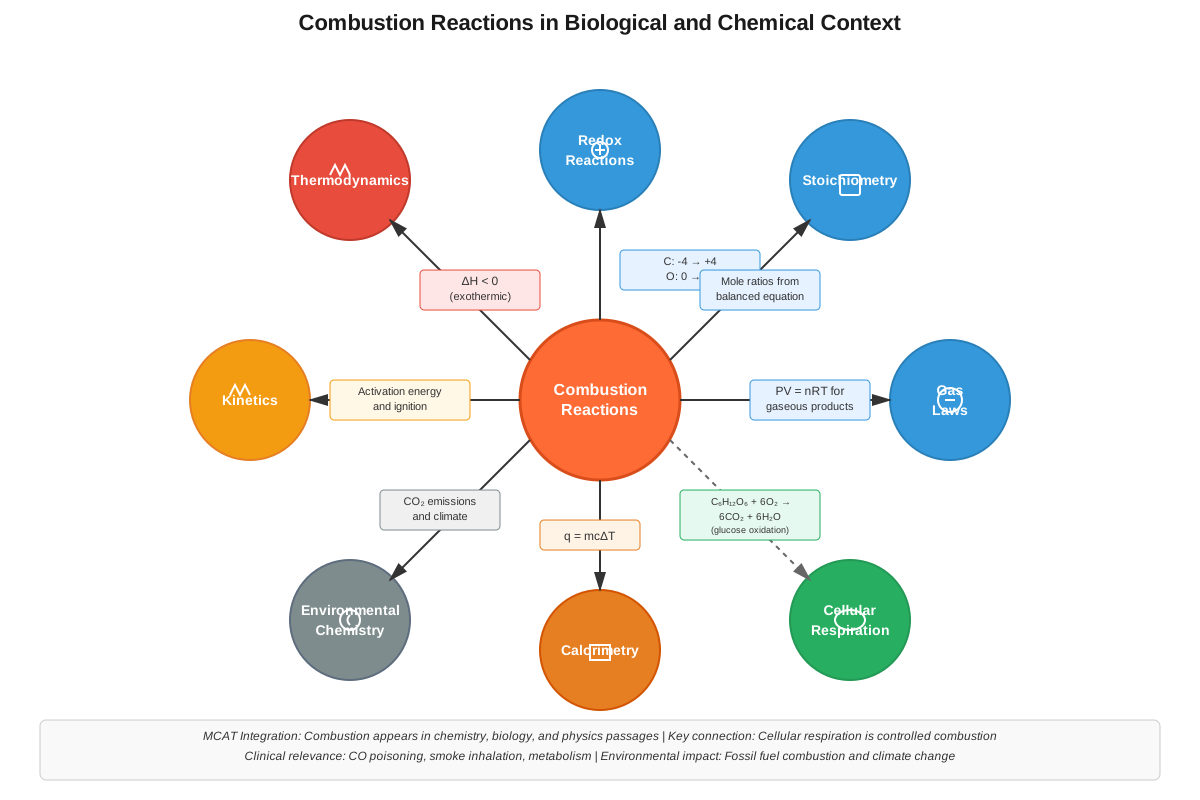
Combustion reactions represent a fundamental class of chemical transformations that involve the rapid reaction of a substance with an oxidizing agent, typically oxygen, producing heat and light. These exothermic reactions are ubiquitous in both natural and industrial processes, from cellular respiration to the burning of fossil fuels. For MCAT preparation, understanding combustion reactions is essential because they integrate multiple core concepts in General Chemistry, including stoichiometry, thermodynamics, oxidation-reduction processes, and gas laws.
On the MCAT, combustion reactions frequently appear in both discrete questions and passage-based contexts within the Chemical and Physical Foundations of Biological Systems section. The exam tests not only the ability to write and balance combustion equations but also to apply stoichiometric principles, predict products, calculate energy changes, and connect combustion to biological processes like metabolism. Questions may involve determining limiting reagents, calculating theoretical yields, or analyzing the environmental impact of combustion products—all skills that require mastery of fundamental stoichiometric relationships.
The significance of combustion reactions extends beyond isolated chemical equations. They serve as a bridge connecting Stoichiometry and Reactions to thermochemistry, kinetics, and even biological systems. Understanding how organic compounds combust provides insight into calorimetry experiments, energy metabolism in living organisms, and the chemical basis of respiration. This topic exemplifies how General Chemistry principles apply to real-world phenomena, making it both conceptually important and practically relevant for future medical professionals who must understand energy transformations in biological systems.
Learning Objectives
- [ ] Define combustion reactions using accurate General Chemistry terminology
- [ ] Explain why combustion reactions matter for the MCAT
- [ ] Apply combustion reactions to exam-style questions
- [ ] Identify common mistakes related to combustion reactions
- [ ] Connect combustion reactions to related General Chemistry concepts
- [ ] Write and balance complete and incomplete combustion equations for hydrocarbons and other organic compounds
- [ ] Calculate stoichiometric quantities (mass, moles, volume) for reactants and products in combustion reactions
- [ ] Predict products of combustion reactions based on oxygen availability and compound composition
- [ ] Analyze the thermodynamic properties of combustion reactions and calculate enthalpy changes
Prerequisites
- Balancing chemical equations: Essential for writing correct combustion equations and performing stoichiometric calculations
- Mole concept and molar mass: Required to convert between mass and moles when solving combustion problems
- Stoichiometric ratios: Necessary to determine quantitative relationships between reactants and products
- Basic thermochemistry: Needed to understand the exothermic nature of combustion and calculate energy changes
- Oxidation states: Important for recognizing combustion as a redox process and understanding electron transfer
- Molecular formulas: Critical for identifying the elemental composition of compounds undergoing combustion
Why This Topic Matters
Combustion reactions have profound clinical and real-world significance that extends far beyond the chemistry laboratory. In medicine, understanding combustion principles helps explain cellular respiration, where glucose undergoes controlled "combustion" to produce ATP, carbon dioxide, and water. Carbon monoxide poisoning, a medical emergency, results from incomplete combustion and demonstrates the clinical relevance of combustion chemistry. Additionally, understanding combustion helps medical professionals comprehend smoke inhalation injuries, thermal burns, and the metabolic processes that sustain life.
From an MCAT perspective, combustion reactions appear with moderate frequency across multiple question formats. Approximately 3-5% of Chemical and Physical Foundations questions involve combustion directly or indirectly. The exam commonly presents combustion in several contexts: stoichiometry calculations requiring determination of limiting reagents and theoretical yields; thermochemistry passages involving calorimetry and enthalpy of combustion; environmental chemistry scenarios discussing greenhouse gases and air pollution; and biochemistry passages connecting combustion to cellular respiration and metabolism.
Combustion questions typically appear in three formats on the MCAT. First, discrete questions may ask students to balance combustion equations or calculate masses of products formed. Second, passage-based questions often embed combustion within larger experimental contexts, such as bomb calorimetry experiments measuring food energy content or studies of fuel efficiency. Third, combustion principles frequently appear in interdisciplinary passages that connect chemistry to biology, such as comparing cellular respiration to combustion or analyzing the carbon cycle. Mastering this topic provides a competitive advantage because it requires integrating multiple chemical principles—a skill the MCAT explicitly tests.
Core Concepts
Definition and Classification of Combustion Reactions
A combustion reaction is a rapid chemical reaction between a fuel (typically containing carbon and hydrogen) and an oxidizing agent (usually oxygen gas), producing heat, light, and oxidized products. These reactions are always exothermic, releasing substantial energy as chemical bonds in the reactants break and new, more stable bonds form in the products. Combustion represents a specific type of oxidation-reduction (redox) reaction where the fuel is oxidized and oxygen is reduced.
Combustion reactions are classified into two main categories based on oxygen availability:
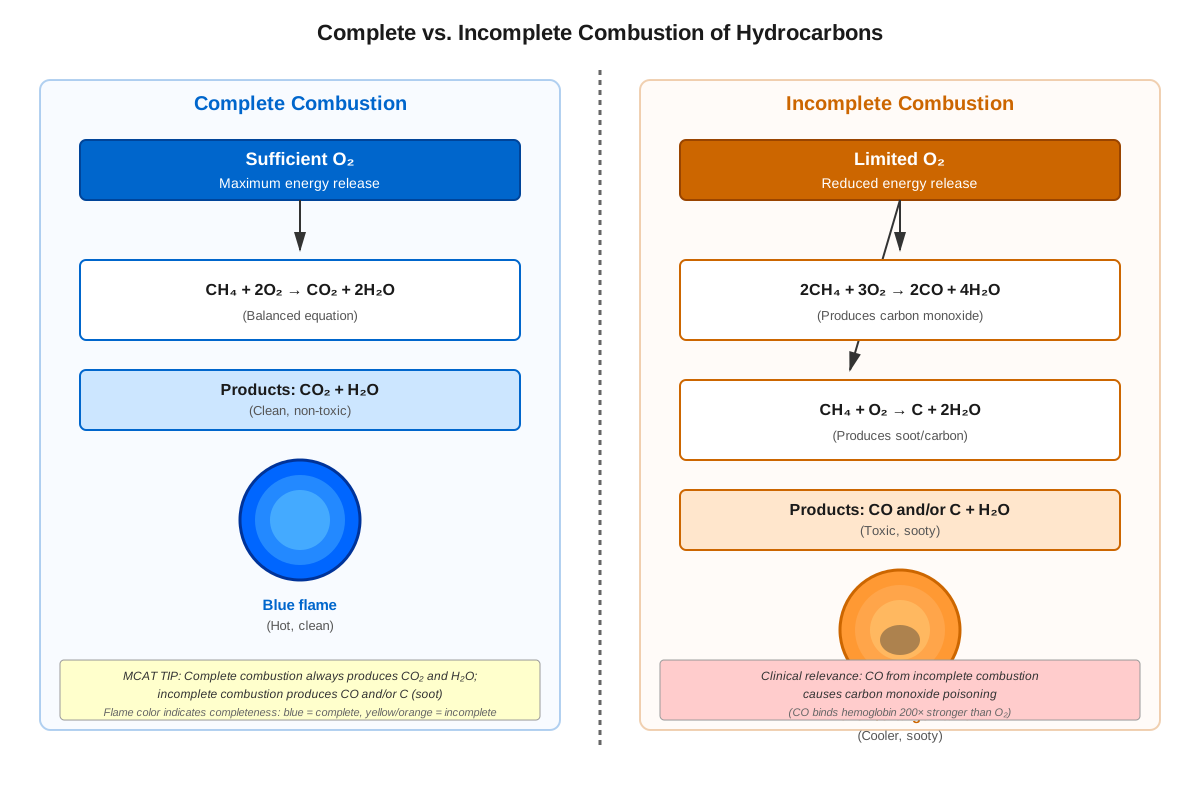
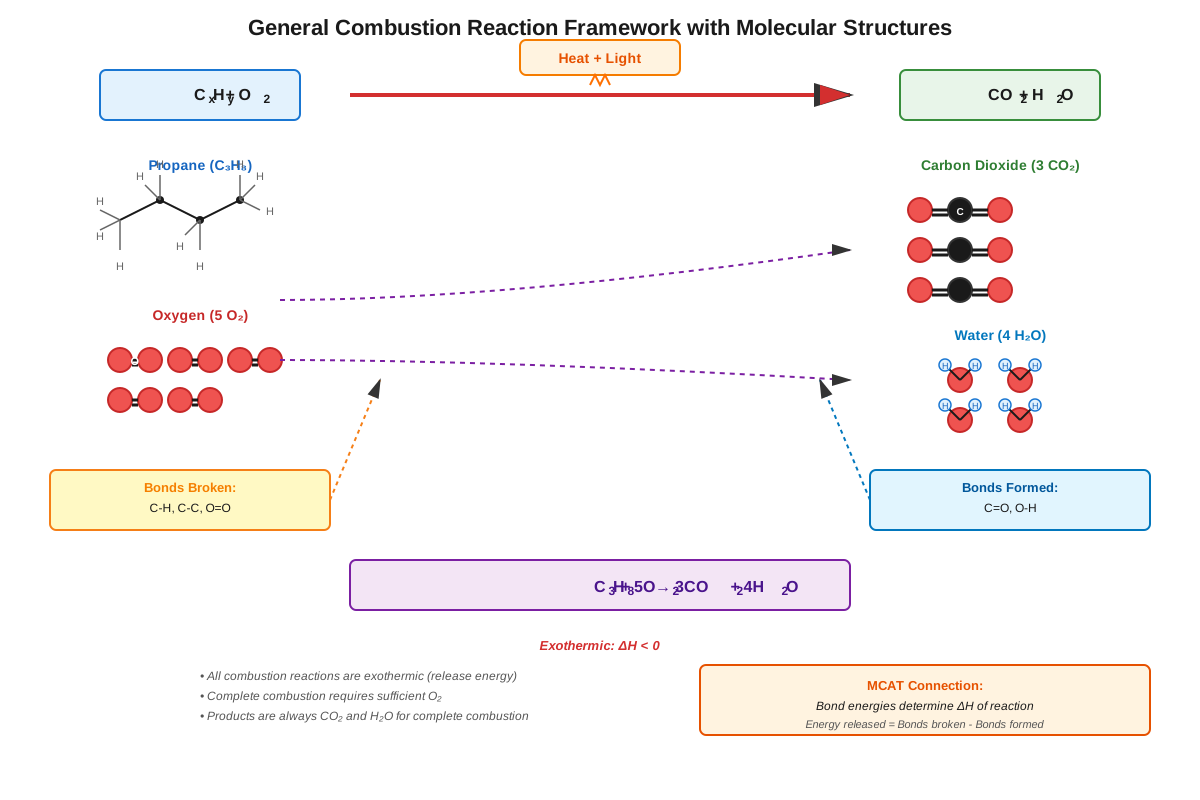
Complete combustion occurs when sufficient oxygen is present to fully oxidize the fuel. For hydrocarbons (compounds containing only carbon and hydrogen), complete combustion produces carbon dioxide (CO₂) and water (H₂O) as the only products. The general equation for complete hydrocarbon combustion is:
CₓHᵧ + (x + y/4)O₂ → xCO₂ + (y/2)H₂OIncomplete combustion occurs when oxygen supply is limited, resulting in partial oxidation of the fuel. This produces carbon monoxide (CO), elemental carbon (soot), or other partially oxidized products alongside carbon dioxide and water. Incomplete combustion releases less energy than complete combustion because the products retain more chemical potential energy.
Balancing Combustion Equations
Balancing combustion equations requires systematic application of stoichiometric principles. The process follows these steps:
- Write the unbalanced equation with the fuel and oxygen as reactants
- Balance carbon atoms first by adjusting the coefficient of CO₂
- Balance hydrogen atoms by adjusting the coefficient of H₂O
- Balance oxygen atoms last by adjusting the coefficient of O₂
- If fractional coefficients appear, multiply all coefficients by the appropriate factor to obtain whole numbers
For example, balancing the combustion of propane (C₃H₈):
C₃H₈ + O₂ → CO₂ + H₂O (unbalanced)
C₃H₈ + O₂ → 3CO₂ + H₂O (carbon balanced)
C₃H₈ + O₂ → 3CO₂ + 4H₂O (hydrogen balanced)
C₃H₈ + 5O₂ → 3CO₂ + 4H₂O (oxygen balanced)
For compounds containing oxygen, nitrogen, or other elements, additional considerations apply. Nitrogen typically forms N₂ gas, sulfur forms SO₂, and any oxygen in the fuel reduces the amount of O₂ needed from the atmosphere.
Stoichiometry of Combustion Reactions
Stoichiometry and Reactions involving combustion require careful attention to molar relationships. The balanced equation provides mole ratios that enable calculation of reactant consumption and product formation. Key stoichiometric calculations include:
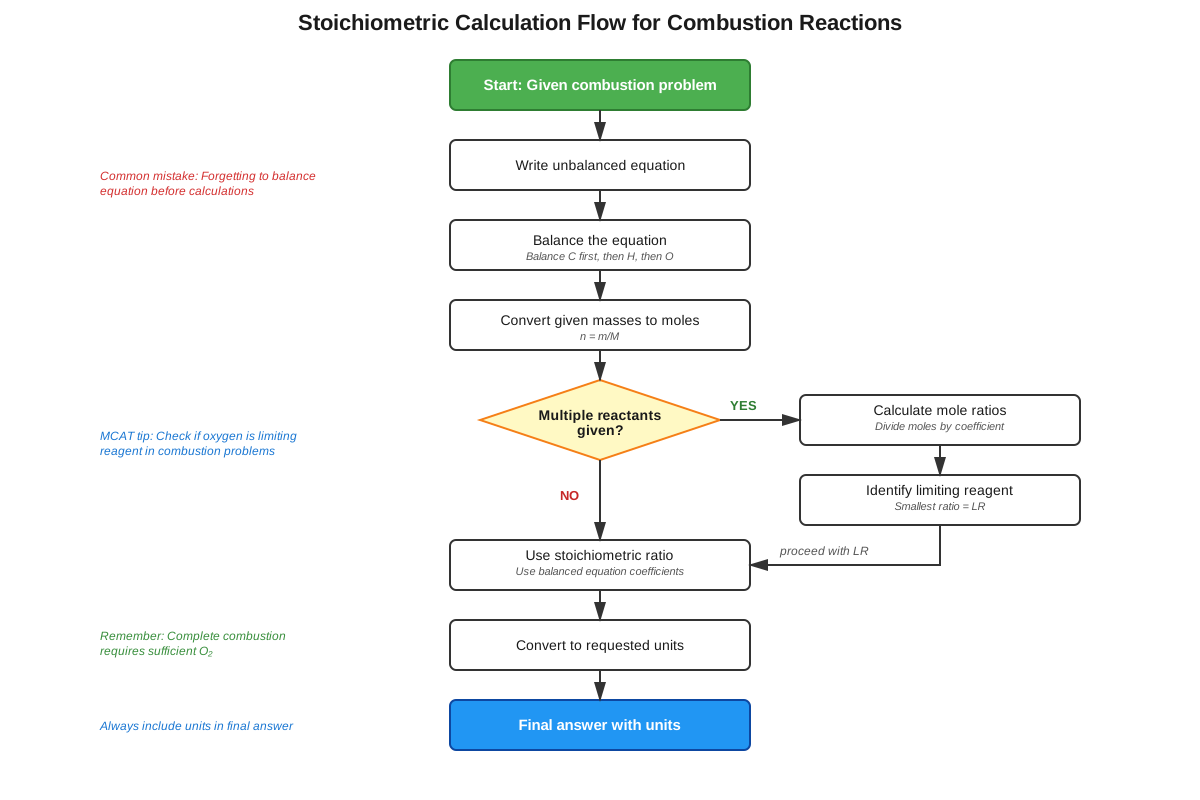
Limiting reagent determination: When given quantities of both fuel and oxygen, identify which reactant will be completely consumed first, thereby limiting product formation. Calculate moles of each reactant, divide by their stoichiometric coefficients, and the smallest value indicates the limiting reagent.
Theoretical yield calculation: Using the limiting reagent, calculate the maximum amount of product that can form based on stoichiometric ratios from the balanced equation.
Percent yield determination: Compare actual experimental yield to theoretical yield to assess reaction efficiency.
| Calculation Type | Formula | Application |
|---|---|---|
| Moles from mass | n = m/M | Convert given masses to moles |
| Stoichiometric ratio | n₁/a₁ = n₂/a₂ | Relate moles of different substances |
| Theoretical yield | n(product) = n(limiting) × (coefficient ratio) | Calculate maximum product |
| Percent yield | (actual/theoretical) × 100% | Assess reaction efficiency |
Thermodynamics of Combustion
Combustion reactions are highly exothermic, releasing substantial energy as heat. The enthalpy of combustion (ΔH°comb) represents the heat released when one mole of substance undergoes complete combustion under standard conditions. This value is always negative, reflecting energy release.
The energy released during combustion originates from the difference between bond energies in reactants and products. Breaking bonds in fuel and oxygen requires energy input (endothermic), while forming bonds in CO₂ and H₂O releases energy (exothermic). Since the products of combustion have stronger, more stable bonds than the reactants, the net process releases energy.
Combustion enthalpy can be calculated using Hess's Law and standard enthalpies of formation:
ΔH°comb = Σ(ΔH°f products) - Σ(ΔH°f reactants)For hydrocarbons, combustion enthalpy generally increases with molecular size because larger molecules contain more C-H and C-C bonds that release energy upon oxidation. This principle explains why longer-chain hydrocarbons serve as more energy-dense fuels.
Products of Combustion
The products of combustion depend critically on oxygen availability and the elemental composition of the fuel:
Complete combustion products:
- Carbon → CO₂ (carbon dioxide)
- Hydrogen → H₂O (water)
- Sulfur → SO₂ (sulfur dioxide)
- Nitrogen → N₂ (nitrogen gas, though some NOₓ may form at high temperatures)
Incomplete combustion products:
- Carbon → CO (carbon monoxide) or C (soot/carbon particles)
- Hydrogen → H₂O (water still forms preferentially)
- Partially oxidized organic compounds
The formation of carbon monoxide during incomplete combustion has significant toxicological implications. CO binds hemoglobin with approximately 200 times greater affinity than oxygen, preventing oxygen transport and causing tissue hypoxia—a critical concept connecting combustion reactions General Chemistry to medical practice.
Combustion of Different Compound Classes
While hydrocarbon combustion is most commonly tested, the MCAT may present combustion of other organic compounds:
Alcohols (containing -OH groups): Combust to produce CO₂ and H₂O, with the oxygen in the alcohol reducing the amount of O₂ needed. Example: C₂H₅OH + 3O₂ → 2CO₂ + 3H₂O
Carbohydrates (general formula CₙH₂ₘOₘ): Also combust to CO₂ and H₂O. Glucose combustion (C₆H₁₂O₆ + 6O₂ → 6CO₂ + 6H₂O) parallels cellular respiration, making this particularly high-yield for the MCAT.
Compounds containing nitrogen: Produce N₂ as the primary nitrogen-containing product, though nitrogen oxides (NOₓ) may form under high-temperature conditions.
Concept Relationships
The concepts within combustion reactions form an interconnected network that builds upon fundamental chemical principles. Combustion reactions fundamentally represent a specific application of stoichiometry, requiring balanced equations to establish molar relationships between reactants and products. This stoichiometric foundation → enables quantitative calculations → which determine limiting reagents, theoretical yields, and percent yields.
The classification of combustion (complete vs. incomplete) → depends on oxygen availability → which determines product distribution → affecting both energy release and environmental impact. Complete combustion → produces maximum energy and simple products (CO₂, H₂O) → while incomplete combustion → yields less energy and produces toxic CO or soot → illustrating how reaction conditions fundamentally alter outcomes.
Thermodynamically, combustion reactions → exemplify exothermic processes → connecting to enthalpy concepts → and demonstrating Hess's Law applications. The energy released → can be calculated from bond energies or formation enthalpies → providing quantitative measures of fuel efficiency → relevant to both industrial applications and biological metabolism.
Combustion connects to prerequisite topics through multiple pathways. Balancing equations (prerequisite) → provides the foundation for writing combustion equations → which then enables stoichiometric calculations. Understanding oxidation states (prerequisite) → reveals combustion as a redox process → where carbon is oxidized from negative or zero oxidation states → to +4 in CO₂. The mole concept (prerequisite) → allows conversion between mass and moles → essential for all combustion calculations.
Looking forward, combustion reactions → connect to thermochemistry → through calorimetry experiments measuring heat release. They also → relate to kinetics → as combustion rate depends on temperature, concentration, and activation energy. Most significantly for the MCAT, combustion → parallels cellular respiration → where glucose undergoes controlled oxidation → producing the same products (CO₂ and H₂O) → but capturing energy in ATP rather than releasing it as heat. This connection between combustion reactions MCAT content and biochemistry makes the topic particularly high-yield.
High-Yield Facts
⭐ Complete combustion of hydrocarbons always produces only CO₂ and H₂O as products; any other products indicate incomplete combustion.
⭐ The general formula for complete hydrocarbon combustion is: CₓHᵧ + (x + y/4)O₂ → xCO₂ + (y/2)H₂O
⭐ All combustion reactions are exothermic (ΔH < 0), releasing energy as heat and light.
⭐ Carbon monoxide (CO) forms during incomplete combustion when oxygen supply is limited, creating a toxic product that binds hemoglobin.
⭐ Cellular respiration (C₆H₁₂O₆ + 6O₂ → 6CO₂ + 6H₂O) is chemically equivalent to glucose combustion but occurs through controlled enzymatic steps.
- Combustion reactions are always redox reactions where the fuel is oxidized and oxygen is reduced.
- When balancing combustion equations, balance elements in this order: carbon, hydrogen, then oxygen.
- Incomplete combustion releases less energy than complete combustion because products retain more chemical potential energy.
- The enthalpy of combustion increases with molecular size for hydrocarbons due to more C-H and C-C bonds.
- Nitrogen in organic compounds typically forms N₂ during combustion, though NOₓ pollutants can form at high temperatures.
- Oxygen present in the fuel molecule (as in alcohols or carbohydrates) reduces the amount of O₂ gas needed for combustion.
- Combustion in a bomb calorimeter occurs at constant volume, while combustion in open air occurs at constant pressure.
- The stoichiometric ratio of O₂ to hydrocarbon increases with the hydrogen-to-carbon ratio in the fuel.
Quick check — test yourself on Combustion reactions so far.
Try Flashcards →Common Misconceptions
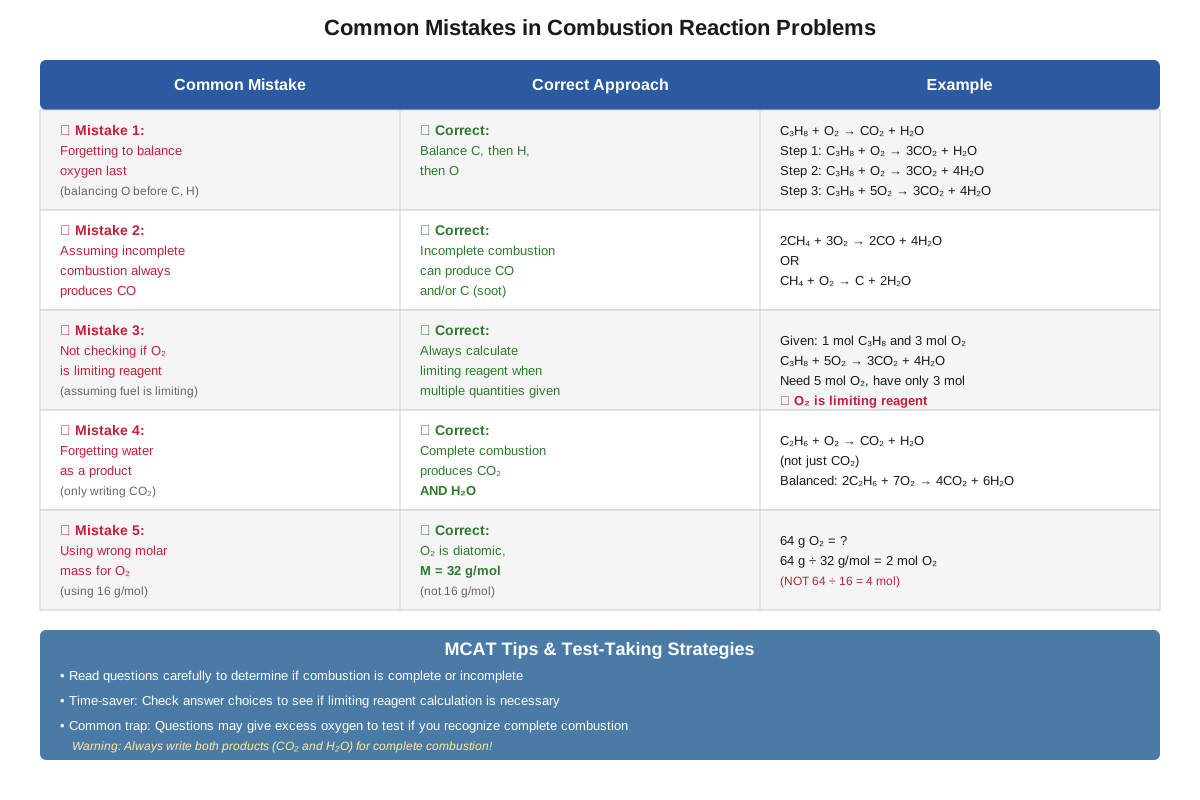
Misconception: All combustion reactions produce only CO₂ and H₂O.
Correction: Only complete combustion of hydrocarbons produces exclusively CO₂ and H₂O. Incomplete combustion produces CO, C (soot), or other partially oxidized products. Additionally, compounds containing elements like sulfur or nitrogen produce SO₂ or N₂ respectively.
Misconception: Combustion and cellular respiration are completely different processes.
Correction: Cellular respiration is essentially controlled combustion. Both processes oxidize glucose to CO₂ and H₂O with the same overall stoichiometry (C₆H₁₂O₆ + 6O₂ → 6CO₂ + 6H₂O). The key difference is that respiration captures energy in ATP through multiple enzymatic steps, while combustion releases energy rapidly as heat.
Misconception: The coefficient of O₂ in a balanced combustion equation can be determined before balancing carbon and hydrogen.
Correction: Oxygen must be balanced last because oxygen atoms appear in multiple products (CO₂ and H₂O). Balancing carbon and hydrogen first establishes how many oxygen atoms are needed in products, which then determines the O₂ coefficient.
Misconception: Incomplete combustion occurs only when there is no oxygen present.
Correction: Incomplete combustion occurs when oxygen is limited or insufficient, not absent. Even with some oxygen present, if the O₂:fuel ratio is below the stoichiometric requirement for complete combustion, incomplete combustion will occur, producing CO or soot alongside CO₂.
Misconception: All combustion reactions occur rapidly and explosively.
Correction: While many combustion reactions are rapid, the rate depends on factors including temperature, concentration, surface area, and activation energy. Some combustion reactions (like rusting of iron, which is slow oxidation) occur very slowly. The term "combustion" typically refers to rapid oxidation with visible flame, but the distinction is based on rate, not mechanism.
Misconception: The products of combustion always have lower energy than the reactants.
Correction: While combustion releases energy (exothermic), this doesn't mean products have "lower energy" in absolute terms. Rather, products have stronger, more stable bonds, meaning they have lower potential energy. The energy difference is released as heat. This is a subtle but important distinction for understanding thermodynamics.
Misconception: Fractional coefficients in balanced equations are incorrect and must always be converted to whole numbers.
Correction: Fractional coefficients are mathematically valid and often appear in thermochemical equations representing combustion of one mole of substance. However, for stoichiometric calculations, whole number coefficients are typically preferred. Both representations are correct; the choice depends on context.
Worked Examples
Example 1: Complete Combustion Stoichiometry
Problem: Octane (C₈H₁₈), a component of gasoline, undergoes complete combustion. If 57.0 g of octane burns in excess oxygen, calculate: (a) the balanced equation, (b) moles of CO₂ produced, and (c) mass of H₂O formed.
Solution:
(a) Balancing the equation:
Step 1: Write the unbalanced equation
C₈H₁₈ + O₂ → CO₂ + H₂OStep 2: Balance carbon (8 carbons in octane)
C₈H₁₈ + O₂ → 8CO₂ + H₂OStep 3: Balance hydrogen (18 hydrogens in octane)
C₈H₁₈ + O₂ → 8CO₂ + 9H₂OStep 4: Balance oxygen (16 O in CO₂ + 9 O in H₂O = 25 O needed, so 12.5 O₂)
C₈H₁₈ + 12.5O₂ → 8CO₂ + 9H₂OStep 5: Multiply by 2 to eliminate fraction
2C₈H₁₈ + 25O₂ → 16CO₂ + 18H₂O(b) Calculating moles of CO₂:
Molar mass of C₈H₁₈ = (8 × 12.01) + (18 × 1.008) = 114.2 g/mol
Moles of octane = 57.0 g ÷ 114.2 g/mol = 0.499 mol ≈ 0.50 mol
From the balanced equation: 2 mol C₈H₁₈ produces 16 mol CO₂
Ratio: 16/2 = 8 mol CO₂ per mol C₈H₁₈
Moles of CO₂ = 0.50 mol C₈H₁₈ × (16 mol CO₂/2 mol C₈H₁₈) = 4.0 mol CO₂
(c) Calculating mass of H₂O:
From the balanced equation: 2 mol C₈H₁₈ produces 18 mol H₂O
Ratio: 18/2 = 9 mol H₂O per mol C₈H₁₈
Moles of H₂O = 0.50 mol C₈H₁₈ × (18 mol H₂O/2 mol C₈H₁₈) = 4.5 mol H₂O
Molar mass of H₂O = (2 × 1.008) + 16.00 = 18.02 g/mol
Mass of H₂O = 4.5 mol × 18.02 g/mol = 81 g H₂O
Key Concepts Applied: This problem demonstrates balancing combustion equations, mole-to-mole conversions using stoichiometric ratios, and mass-to-mole-to-mass calculations—all essential skills for combustion reactions MCAT questions.
Example 2: Limiting Reagent in Combustion
Problem: Methanol (CH₃OH) is burned in air. If 16.0 g of methanol is mixed with 16.0 g of oxygen gas, determine: (a) the limiting reagent, (b) the theoretical yield of CO₂ in grams, and (c) the mass of excess reagent remaining.
Solution:
(a) Determining the limiting reagent:
Step 1: Write and balance the equation
2CH₃OH + 3O₂ → 2CO₂ + 4H₂OStep 2: Calculate moles of each reactant
Molar mass of CH₃OH = 12.01 + (4 × 1.008) + 16.00 = 32.04 g/mol
Moles of CH₃OH = 16.0 g ÷ 32.04 g/mol = 0.499 mol
Molar mass of O₂ = 2 × 16.00 = 32.00 g/mol
Moles of O₂ = 16.0 g ÷ 32.00 g/mol = 0.500 mol
Step 3: Determine limiting reagent by comparing mole ratios
For CH₃OH: 0.499 mol ÷ 2 = 0.250
For O₂: 0.500 mol ÷ 3 = 0.167
Since 0.167 < 0.250, O₂ is the limiting reagent.
(b) Calculating theoretical yield of CO₂:
From balanced equation: 3 mol O₂ produces 2 mol CO₂
Moles of CO₂ = 0.500 mol O₂ × (2 mol CO₂/3 mol O₂) = 0.333 mol CO₂
Molar mass of CO₂ = 12.01 + (2 × 16.00) = 44.01 g/mol
Mass of CO₂ = 0.333 mol × 44.01 g/mol = 14.7 g CO₂
(c) Calculating excess reagent remaining:
Moles of CH₃OH consumed = 0.500 mol O₂ × (2 mol CH₃OH/3 mol O₂) = 0.333 mol CH₃OH
Moles of CH₃OH remaining = 0.499 mol - 0.333 mol = 0.166 mol
Mass of CH₃OH remaining = 0.166 mol × 32.04 g/mol = 5.3 g CH₃OH
Key Concepts Applied: This problem illustrates limiting reagent determination, a critical skill in Stoichiometry and Reactions. The systematic approach—converting to moles, comparing ratios, and using the limiting reagent for product calculations—represents the standard method for solving combustion stoichiometry problems on the MCAT.
Exam Strategy
When approaching combustion reactions MCAT questions, employ a systematic strategy that maximizes accuracy and efficiency:
Step 1: Identify the reaction type immediately. Look for trigger words like "burns," "combustion," "reacts with oxygen," or "oxidation." These signal that you're dealing with a combustion reaction and should immediately think about products (CO₂ and H₂O for complete combustion).
Step 2: Determine if combustion is complete or incomplete. The question will usually specify "complete combustion" or provide clues like "excess oxygen" (complete) or "limited oxygen" (incomplete). If incomplete, expect CO or C as products. This distinction is critical because it changes both products and energy calculations.
Step 3: Write and balance the equation systematically. Always balance in the order: carbon → hydrogen → oxygen. This sequence prevents errors and saves time. If the question provides the balanced equation, verify it quickly by checking each element—MCAT questions occasionally contain intentional errors to test your knowledge.
Step 4: Identify what the question is actually asking. Combustion questions often embed the actual question within lengthy stems. Common question types include:
- Stoichiometric calculations (mass, moles, volume)
- Limiting reagent identification
- Theoretical vs. actual yield
- Energy calculations (ΔH, heat released)
- Environmental impact (CO₂ production, pollution)
Trigger words and phrases to watch for:
- "Complete combustion" → only CO₂ and H₂O products
- "Insufficient oxygen" or "limited air" → incomplete combustion, CO formation
- "Excess oxygen" → fuel is limiting reagent
- "Theoretical yield" → calculate from limiting reagent
- "Percent yield" → (actual/theoretical) × 100%
- "Heat released" or "enthalpy of combustion" → thermodynamic calculation
Process-of-elimination strategies:
For product identification questions, eliminate answers that:
- Include products impossible for complete combustion (CO, C, H₂)
- Violate conservation of mass or atoms
- Show incorrect stoichiometric ratios
For stoichiometry calculations, eliminate answers that:
- Exceed the theoretical maximum (if calculating yield)
- Ignore the limiting reagent
- Use incorrect molar masses
- Fail to convert between mass and moles
Time allocation advice:
Discrete combustion questions typically require 60-90 seconds. Allocate time as follows:
- 15-20 seconds: Read and identify question type
- 20-30 seconds: Write/balance equation if needed
- 20-30 seconds: Perform calculations
- 10-15 seconds: Verify answer and check units
Passage-based combustion questions may require 90-120 seconds, with additional time for extracting relevant information from the passage. If a calculation becomes complex, consider whether estimation or dimensional analysis might quickly eliminate wrong answers, saving time for other questions.
Exam Tip: If you encounter a combustion problem with complex stoichiometry, check whether the answer choices differ by orders of magnitude. If so, estimation using rounded numbers may be sufficient, saving valuable time.
Memory Techniques
Mnemonic for balancing combustion equations: "CHO"
Balance in order: Carbon, Hydrogen, Oxygen
This sequence prevents the need to rebalance earlier elements.
Mnemonic for complete combustion products: "See Water"
C → CO₂ (carbon dioxide)
Water → H₂O
This reminds you that complete combustion of hydrocarbons produces only these two products.
Acronym for incomplete combustion products: "COPS"
Carbon monoxide (CO)
Organic compounds (partially oxidized)
Particulates (soot, carbon)
Smoke
This helps remember what forms when oxygen is limited.
Visualization strategy for combustion energy:
Picture a hydrocarbon molecule as a compressed spring (high potential energy). When combustion occurs, the spring releases (energy out), and the products (CO₂ and H₂O) are relaxed springs (low potential energy, stable). This visual reinforces that combustion is exothermic and products are more stable.
Memory aid for cellular respiration connection:
"Respiration is combustion in slow motion"
This phrase helps remember that cellular respiration and glucose combustion have identical stoichiometry (C₆H₁₂O₆ + 6O₂ → 6CO₂ + 6H₂O) but different mechanisms and energy capture methods.
Rhyme for limiting reagent:
"Divide by coefficient, smallest one's deficient"
This reminds you to divide moles by stoichiometric coefficients when determining the limiting reagent—the smallest quotient indicates the limiting reactant.
Acronym for combustion calculation steps: "MOLES"
Molar mass calculation
Obtain moles from mass
Limiting reagent determination
Equate using stoichiometric ratios
Solve for desired quantity
This provides a systematic approach to combustion stoichiometry problems.
Summary
Combustion reactions represent a fundamental class of exothermic oxidation-reduction reactions where a fuel reacts with oxygen to produce heat, light, and oxidized products. For the MCAT, mastery of combustion requires understanding both complete combustion (producing only CO₂ and H₂O from hydrocarbons) and incomplete combustion (producing CO, C, or partially oxidized products when oxygen is limited). The ability to write and balance combustion equations systematically—balancing carbon, then hydrogen, then oxygen—forms the foundation for all stoichiometric calculations involving these reactions. Students must be proficient in determining limiting reagents, calculating theoretical yields, and connecting combustion to thermodynamic principles, particularly the exothermic nature of these reactions and their negative enthalpy changes. The parallel between combustion and cellular respiration provides a critical bridge between General Chemistry and biochemistry, as both processes oxidize organic compounds to CO₂ and H₂O with identical stoichiometry but different mechanisms. Understanding combustion also requires recognizing its environmental and toxicological implications, from CO₂ as a greenhouse gas to CO as a toxic product that binds hemoglobin. Success on MCAT combustion questions demands integrating multiple concepts—stoichiometry, thermodynamics, redox chemistry, and gas laws—while maintaining accuracy in calculations and attention to detail in balancing equations.
Key Takeaways
- Complete combustion of hydrocarbons produces only CO₂ and H₂O; incomplete combustion produces CO, C (soot), or partially oxidized products when oxygen is limited
- All combustion reactions are exothermic (ΔH < 0), releasing energy through formation of stable C=O and O-H bonds in products
- Balance combustion equations systematically: carbon first, hydrogen second, oxygen last to avoid errors and save time
- Cellular respiration (C₆H₁₂O₆ + 6O₂ → 6CO₂ + 6H₂O) is chemically equivalent to glucose combustion, connecting chemistry to biochemistry
- Limiting reagent determination requires dividing moles by stoichiometric coefficients; the smallest quotient identifies the limiting reactant
- Carbon monoxide from incomplete combustion is toxic because it binds hemoglobin with 200× greater affinity than oxygen, causing tissue hypoxia
- Combustion stoichiometry integrates multiple concepts: mole conversions, balanced equations, limiting reagents, and theoretical yield calculations
Related Topics
Thermochemistry and Calorimetry: Combustion reactions serve as the basis for calorimetry experiments, where heat released during combustion is measured to determine enthalpy changes and food energy content. Mastering combustion enables understanding of bomb calorimetry and Hess's Law applications.
Oxidation-Reduction Reactions: Combustion represents a specific type of redox reaction where carbon is oxidized and oxygen is reduced. Understanding combustion deepens comprehension of electron transfer, oxidation states, and redox stoichiometry.
Gas Laws and Stoichiometry: When combustion products are gases, gas law calculations become relevant for determining volumes, pressures, and densities. This connection is particularly important for environmental chemistry questions involving combustion emissions.
Cellular Respiration and Metabolism: The chemical equivalence between glucose combustion and cellular respiration makes combustion essential background for understanding biochemical energy production, ATP synthesis, and metabolic pathways tested in the Biological and Biochemical Foundations section.
Environmental Chemistry: Combustion of fossil fuels produces greenhouse gases (CO₂) and pollutants (CO, NOₓ, SO₂), connecting chemistry to environmental science and public health topics that may appear in interdisciplinary MCAT passages.
Practice CTA
Now that you've mastered the core concepts of combustion reactions, it's time to solidify your understanding through active practice. Attempt the practice questions and flashcards associated with this topic to test your ability to balance equations, perform stoichiometric calculations, and apply combustion principles to MCAT-style scenarios. Remember, the difference between passive reading and true mastery lies in deliberate practice. Challenge yourself with timed questions to simulate exam conditions, and review any mistakes carefully to identify gaps in understanding. Each practice problem you solve strengthens the neural pathways that will serve you on test day. You've built a strong foundation—now transform that knowledge into the problem-solving skills that will earn you points on the MCAT!
Sign up free to keep reading
Create a free AnvayaPrep account to finish this MCAT guide on Combustion reactions — plus flashcards and practice questions.