Overview
Calorimetry is the quantitative measurement of heat transfer during physical and chemical processes, forming a cornerstone of Thermodynamics in General Chemistry. This experimental technique allows scientists and clinicians to determine the energy changes associated with reactions, phase transitions, and temperature changes by measuring heat flow into or out of a system. On the MCAT, calorimetry problems test your ability to apply conservation of energy principles, manipulate heat capacity equations, and interpret experimental data—skills that appear across multiple sections of the exam, particularly in Chemical and Physical Foundations of Biological Systems.
Understanding calorimetry is essential for MCAT success because it bridges theoretical thermodynamics with practical applications. The exam frequently presents calorimetry in the context of bomb calorimeters measuring combustion reactions, coffee-cup calorimeters determining enthalpy changes of aqueous reactions, or biological systems regulating temperature through metabolic processes. These questions require not just memorization of formulas, but deep conceptual understanding of heat transfer, system boundaries, and energy conservation. Calorimetry problems often appear as calculation-heavy discrete questions or embedded within passages describing experimental procedures.
Within the broader landscape of General Chemistry, calorimetry serves as the experimental foundation for understanding enthalpy, internal energy, and the First Law of Thermodynamics. It connects directly to concepts like specific heat capacity, heat of fusion and vaporization, Hess's Law, and bond energies. Mastering calorimetry enables students to tackle more advanced thermodynamic concepts while developing the quantitative reasoning skills that distinguish high-scoring MCAT candidates from average performers.
Learning Objectives
- [ ] Define Calorimetry using accurate General Chemistry terminology
- [ ] Explain why Calorimetry matters for the MCAT
- [ ] Apply Calorimetry to exam-style questions
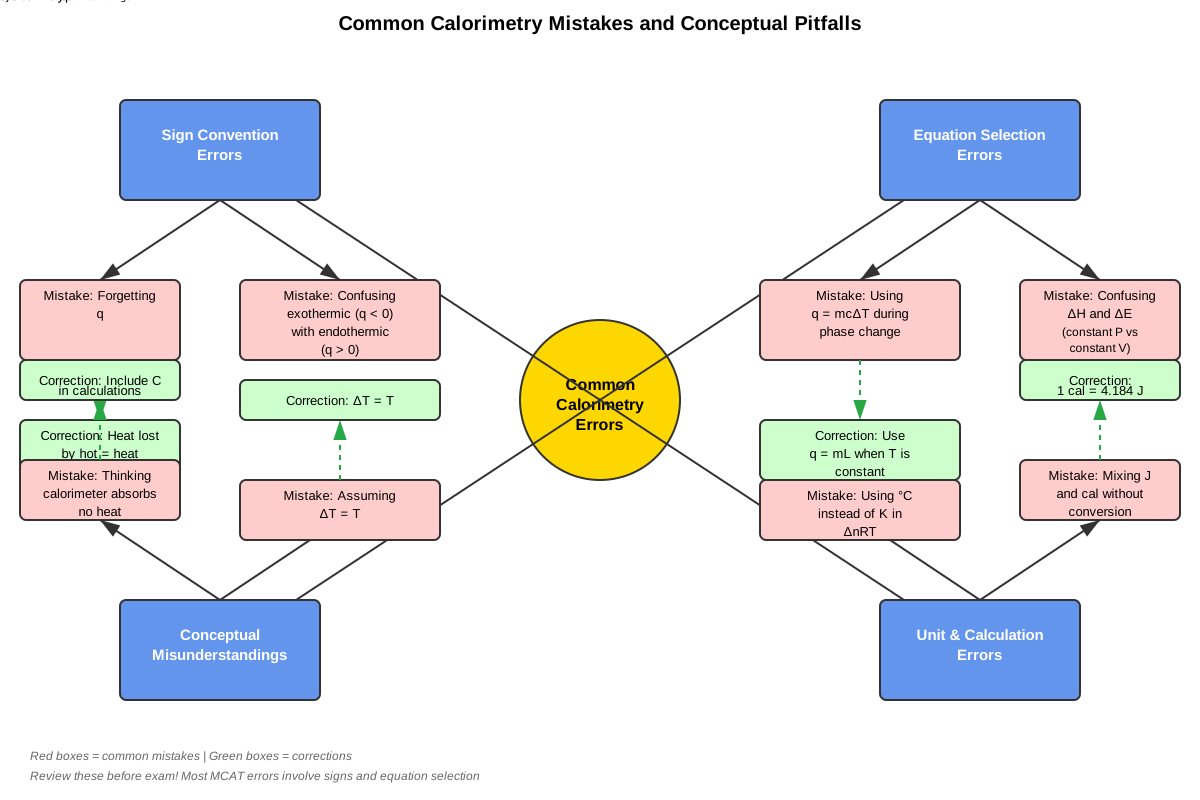
- [ ] Identify common mistakes related to Calorimetry
- [ ] Connect Calorimetry to related General Chemistry concepts
- [ ] Calculate heat transfer using specific heat capacity, mass, and temperature change
- [ ] Distinguish between constant-pressure and constant-volume calorimetry and their thermodynamic implications
- [ ] Interpret calorimetry experimental data to determine enthalpy changes and heat capacities
Prerequisites
- Basic algebra and unit conversions: Essential for manipulating calorimetry equations and converting between energy units (joules, calories, kilojoules)
- Temperature scales (Celsius, Kelvin): Required because calorimetry calculations use temperature differences, and understanding when absolute temperature matters
- Conservation of energy: The fundamental principle underlying all calorimetry—heat lost by one substance equals heat gained by another in an isolated system
- States of matter and phase transitions: Necessary to understand when to apply latent heat versus sensible heat calculations
- Basic stoichiometry: Needed to relate molar quantities to heat changes in chemical reactions
Why This Topic Matters
Calorimetry MCAT questions appear with moderate frequency across the Chemical and Physical Foundations section, typically comprising 2-4 questions per exam. These questions assess both conceptual understanding and quantitative problem-solving abilities, making them high-yield for score improvement. The MCAT particularly favors calorimetry problems that integrate multiple concepts—for example, combining heat transfer calculations with phase changes, or using calorimetry data to determine reaction stoichiometry.
In clinical and research contexts, calorimetry has profound real-world significance. Indirect calorimetry measures metabolic rate in patients by analyzing oxygen consumption and carbon dioxide production, guiding nutritional support in intensive care units. Differential scanning calorimetry characterizes protein stability and drug formulations in pharmaceutical development. Bomb calorimetry determines the caloric content of foods, directly connecting to nutritional science and obesity research. Understanding these applications helps contextualize MCAT passages and provides material for the Psychological, Social, and Biological Foundations section when discussing metabolism and nutrition.
Common MCAT passage formats include experimental descriptions where students must interpret calorimetry data, calculate unknown quantities from given information, or identify sources of experimental error. Discrete questions often present straightforward calculations but with conceptual twists—such as asking what happens when the calorimeter itself absorbs heat, or requiring students to recognize that temperature change depends on heat capacity, not just heat transferred. The exam also tests whether students understand the sign conventions for heat flow (positive for endothermic, negative for exothermic from the system's perspective).
Core Concepts
Fundamental Definition and Principles
Calorimetry is the experimental science of measuring heat changes during physical or chemical processes. The technique relies on the principle of energy conservation: in an isolated system, the total energy remains constant, so heat lost by one component must equal heat gained by another. A calorimeter is the insulated device used to measure these heat changes by monitoring temperature changes in a known quantity of material, typically water.
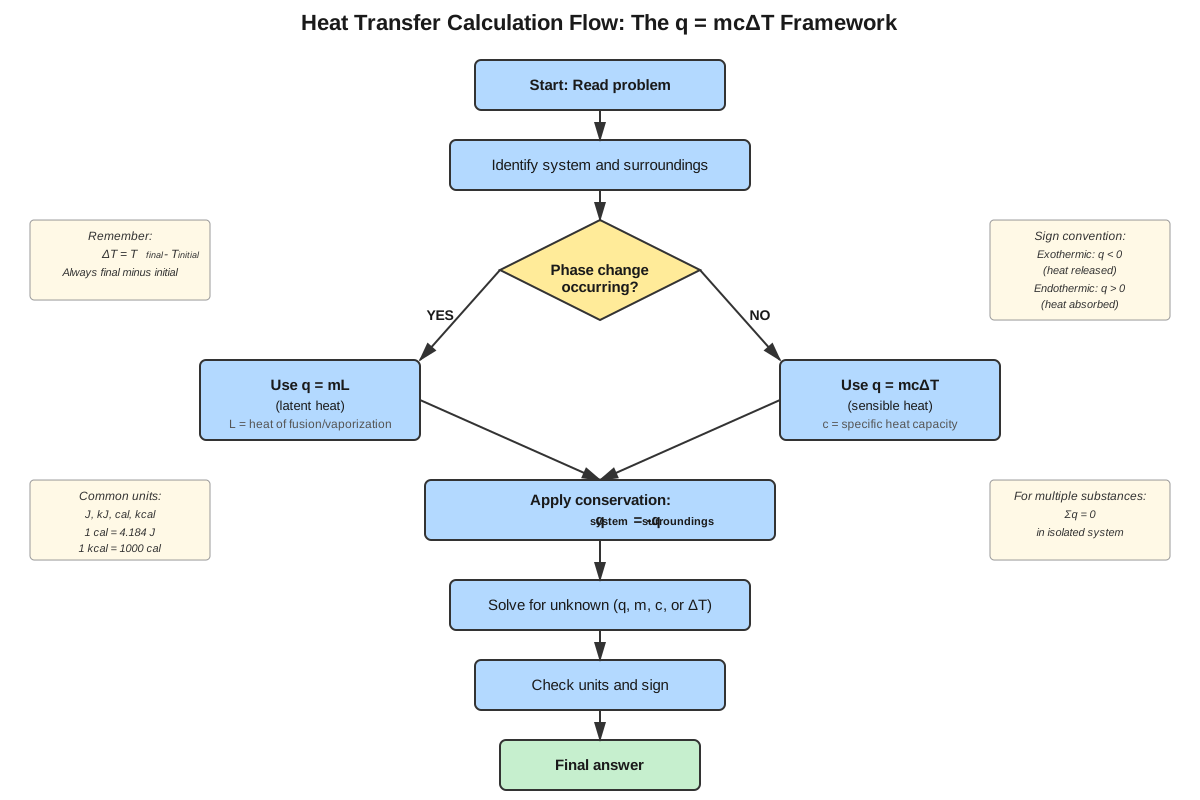
The fundamental equation governing calorimetry is:
q = mcΔTWhere:
- q = heat transferred (joules or calories)
- m = mass of substance (grams or kilograms)
- c = specific heat capacity (J/g°C or cal/g°C)
- ΔT = temperature change (T_final - T_initial)
This equation applies to processes where temperature changes without phase transitions. The specific heat capacity represents the amount of heat required to raise one gram of a substance by one degree Celsius. Water's specific heat capacity (4.184 J/g°C or 1 cal/g°C) is exceptionally high, making it ideal for calorimetry applications.
Types of Calorimeters
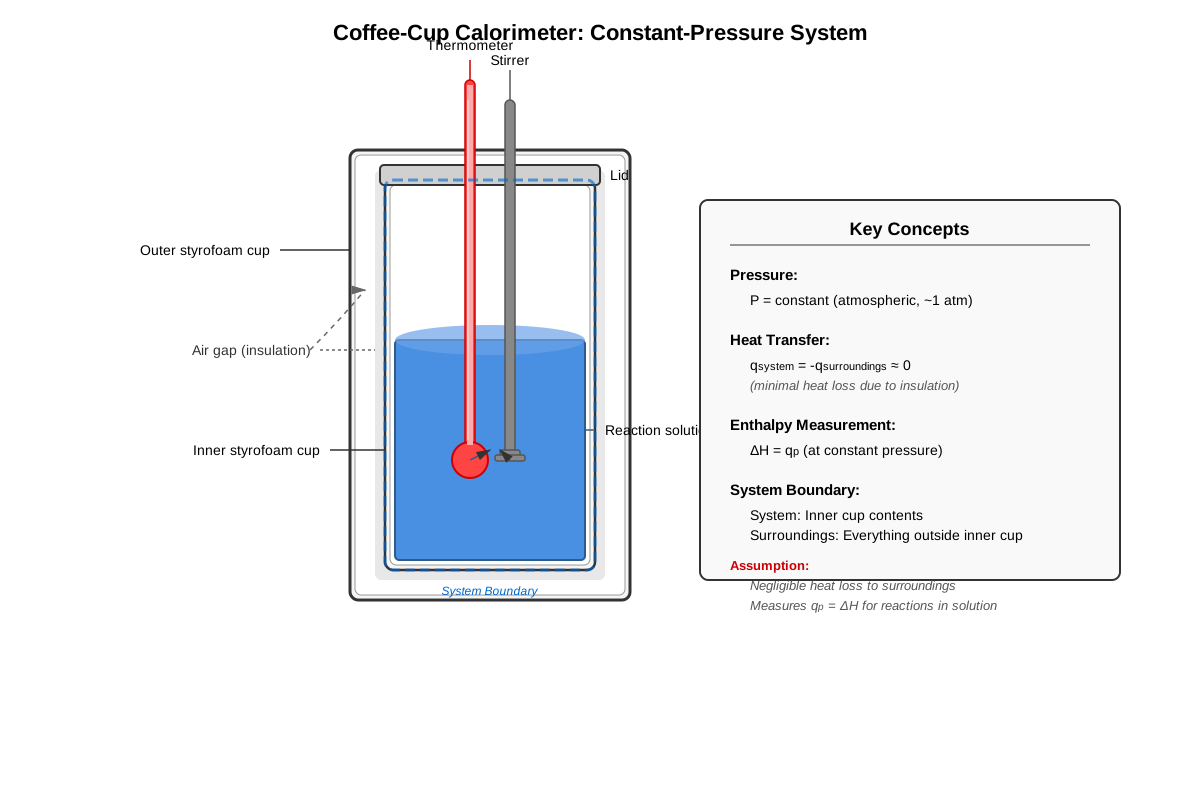
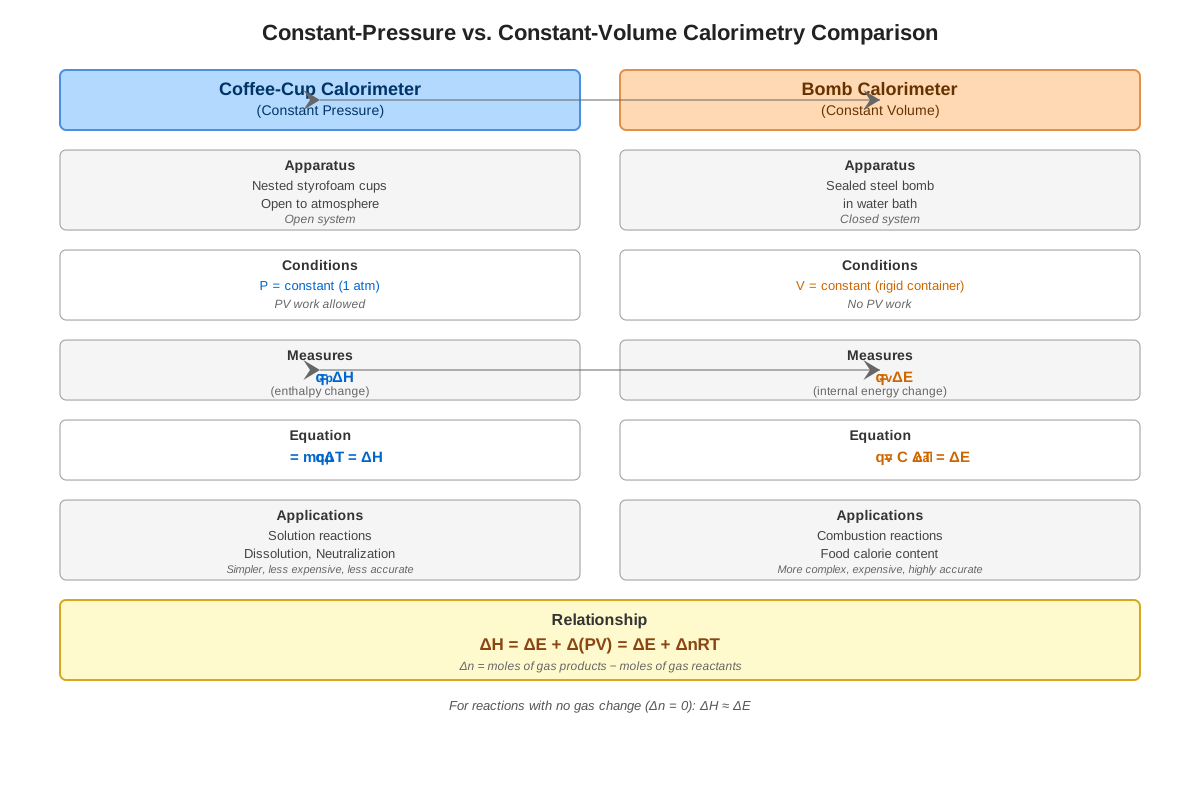
Coffee-Cup Calorimetry (Constant-Pressure Calorimetry) represents the simpler form of calorimetry, typically using nested Styrofoam cups to create an insulated system open to atmospheric pressure. This setup measures enthalpy changes (ΔH) for reactions occurring in aqueous solution. Because the system maintains constant pressure (atmospheric), the heat measured equals the enthalpy change of the reaction:
q_p = ΔHIn coffee-cup calorimetry, the heat released or absorbed by a reaction is calculated by measuring the temperature change of the solution, assuming the solution has the same density and specific heat as water. The total heat capacity of the calorimeter itself is often negligible or included as a calorimeter constant.
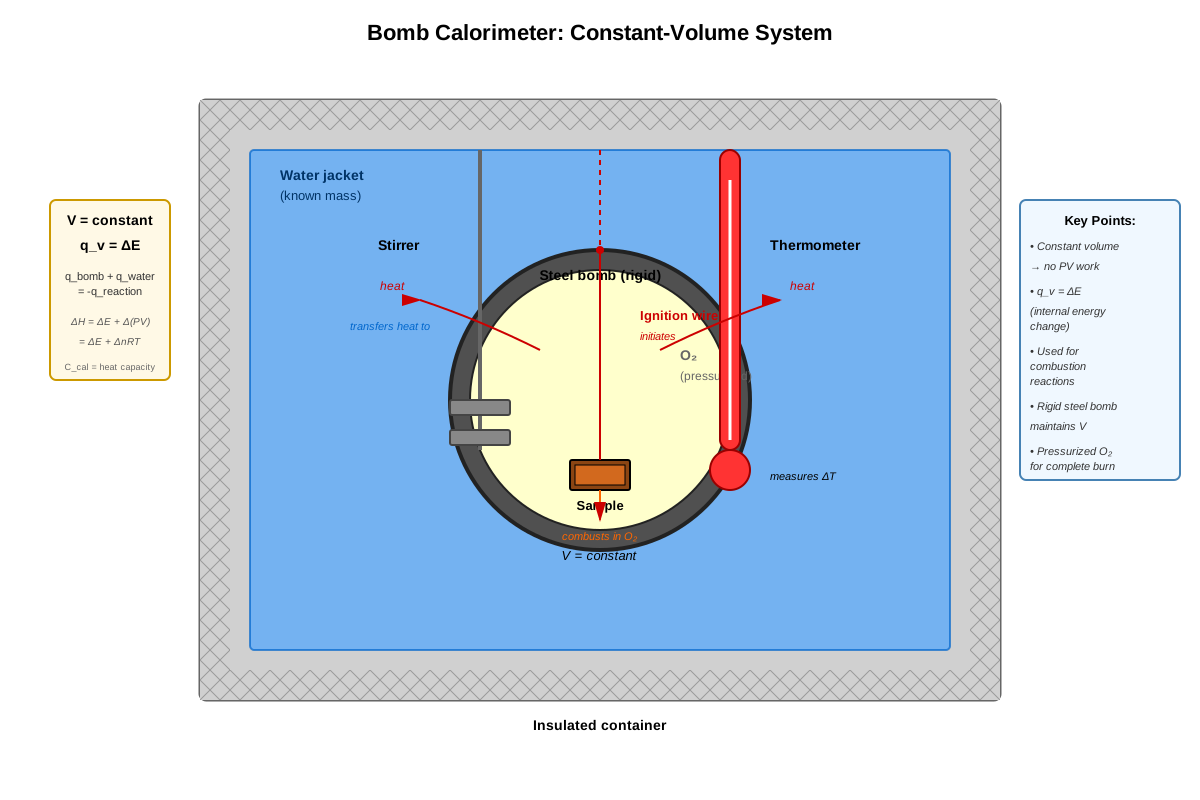
Bomb Calorimetry (Constant-Volume Calorimetry) uses a sealed, rigid metal container (the "bomb") submerged in a water bath. This design measures internal energy changes (ΔE) because the volume remains constant. Bomb calorimeters are primarily used for combustion reactions, where a sample burns in pure oxygen under high pressure. The heat released raises the temperature of the bomb and surrounding water:
q_v = ΔEThe relationship between ΔH and ΔE involves the work term from the First Law of Thermodynamics:
ΔH = ΔE + PΔV = ΔE + ΔnRTFor condensed phases or reactions with no change in moles of gas (Δn = 0), ΔH ≈ ΔE. For combustion reactions involving gases, this correction becomes significant.
Heat Transfer Calculations
The core of calorimetry problem-solving involves applying conservation of energy. In an isolated system:
q_lost + q_gained = 0Or equivalently:
-q_substance1 = q_substance2For problems involving mixing substances at different temperatures, the heat lost by the hotter substance equals the heat gained by the cooler substance plus any heat absorbed by the calorimeter:
m_hot × c_hot × (T_final - T_hot,initial) = -[m_cold × c_cold × (T_final - T_cold,initial) + C_cal × (T_final - T_cold,initial)]Where C_cal is the heat capacity of the calorimeter (in J/°C), often determined through calibration experiments.
Phase Changes and Latent Heat
When substances undergo phase transitions, temperature remains constant while heat is absorbed or released. These processes require latent heat calculations:
q = mLWhere L represents either:
- Heat of fusion (ΔH_fus): energy required to melt one gram of solid
- Heat of vaporization (ΔH_vap): energy required to vaporize one gram of liquid
For problems involving both temperature changes and phase transitions, calculate heat for each step separately and sum:
q_total = q_heating1 + q_phase_change + q_heating2For example, heating ice from -10°C to steam at 110°C requires five distinct calculations: heating ice, melting ice, heating water, vaporizing water, and heating steam.
Calorimeter Constant and Heat Capacity
The calorimeter constant (C_cal) represents the heat capacity of the calorimeter apparatus itself—the amount of heat required to raise the calorimeter's temperature by 1°C. This value is determined experimentally by performing a reaction with known enthalpy change and measuring the temperature change:
C_cal = \frac{q_{known}}{ΔT} - m_{solution} × c_{solution}Once determined, the calorimeter constant is used in subsequent experiments to account for heat absorbed by the apparatus. Neglecting the calorimeter constant leads to systematic underestimation of reaction enthalpies.
Sign Conventions and System Perspective
Understanding sign conventions is critical for MCAT success. From the system's perspective:
- Exothermic reactions: release heat to surroundings, q < 0, ΔH < 0
- Endothermic reactions: absorb heat from surroundings, q > 0, ΔH > 0
From the surroundings' perspective (the calorimeter and water), signs reverse:
- Exothermic reactions cause temperature increase in surroundings (q_surroundings > 0)
- Endothermic reactions cause temperature decrease in surroundings (q_surroundings < 0)
The MCAT often tests whether students correctly apply these perspectives when interpreting experimental data.
Molar Heat Capacity and Enthalpy of Reaction
Molar heat capacity (C_m) expresses heat capacity per mole rather than per gram:
q = nC_mΔTWhere n = number of moles. This formulation connects directly to thermodynamic tables that list molar quantities.
The enthalpy of reaction (ΔH_rxn) can be determined from calorimetry data:
ΔH_{rxn} = \frac{q_{rxn}}{n_{limiting}}Where n_limiting is the number of moles of limiting reactant. This calculation requires careful attention to stoichiometry and proper sign assignment based on whether heat was released or absorbed.
Concept Relationships
Calorimetry serves as the experimental bridge connecting abstract thermodynamic concepts to measurable quantities. The relationship map flows as follows:
Conservation of Energy → Calorimetry Principle → Heat Transfer Equations → Enthalpy and Internal Energy Determination
Within calorimetry itself, the type of calorimeter determines which thermodynamic quantity is measured: Coffee-Cup Calorimeter → Constant Pressure → Measures ΔH, while Bomb Calorimeter → Constant Volume → Measures ΔE.
The specific heat capacity concept connects to molecular structure and bonding: substances with more degrees of freedom (rotational, vibrational) generally have higher heat capacities. This links calorimetry to kinetic molecular theory and statistical mechanics.
Calorimetry data feeds into Hess's Law calculations, where measured enthalpy changes for individual reactions combine to determine enthalpies for reactions that cannot be measured directly. This connection extends to bond energy calculations and formation reactions.
The phase change component of calorimetry connects to intermolecular forces: stronger intermolecular attractions require more energy to overcome, resulting in higher heats of fusion and vaporization. This relationship bridges to vapor pressure, phase diagrams, and colligative properties.
Temperature changes measured in calorimetry relate to reaction kinetics through the Arrhenius equation, where temperature affects reaction rates. Additionally, calorimetry connects to equilibrium thermodynamics through the van't Hoff equation, which relates temperature dependence of equilibrium constants to enthalpy changes.
Quick check — test yourself on Calorimetry so far.
Try Flashcards →High-Yield Facts
⭐ The heat lost by one substance equals the heat gained by another in an isolated system: -q_lost = q_gained (foundation of all calorimetry calculations)
⭐ Coffee-cup calorimeters measure ΔH at constant pressure; bomb calorimeters measure ΔE at constant volume
⭐ Water's specific heat capacity is 4.184 J/g°C or 1 cal/g°C, the highest of common substances, making it ideal for calorimetry
⭐ For exothermic reactions, the system loses heat (q_system < 0) and surroundings gain heat (temperature increases)
⭐ The equation q = mcΔT applies only when no phase changes occur; phase changes require q = mL
- The calorimeter constant accounts for heat absorbed by the apparatus itself and must be included for accurate measurements
- Temperature change (ΔT) is always final minus initial temperature; the sign indicates direction of heat flow
- Heat of vaporization is always greater than heat of fusion for the same substance because breaking all intermolecular forces requires more energy than partially disrupting them
- In bomb calorimetry, ΔH = ΔE + ΔnRT, where Δn is the change in moles of gas; for condensed phases, ΔH ≈ ΔE
- Specific heat capacity varies by substance: metals have low values (0.1-0.5 J/g°C), water has high value (4.184 J/g°C)
- The final temperature in mixing problems lies between the initial temperatures of the mixed substances, weighted by their heat capacities
- Calorimetry assumes no heat exchange with external environment (adiabatic conditions); real calorimeters approximate this with insulation
Common Misconceptions
Misconception: Heat and temperature are the same thing.
Correction: Heat (q) is energy transferred between objects at different temperatures, measured in joules or calories. Temperature is a measure of average kinetic energy of particles, measured in degrees. A large mass of water at 50°C contains more heat than a small mass at the same temperature.
Misconception: The substance with the larger temperature change absorbed more heat.
Correction: Temperature change depends on both heat absorbed AND heat capacity. A substance with low heat capacity experiences large temperature changes with small heat input. The equation q = mcΔT shows that heat depends on the product of all three variables, not just ΔT.
Misconception: In calorimetry problems, q is always positive.
Correction: The sign of q depends on perspective and process direction. From the system's perspective, exothermic reactions have negative q (heat released), while endothermic reactions have positive q (heat absorbed). Always define your system clearly before assigning signs.
Misconception: The calorimeter constant can be ignored in calculations.
Correction: The calorimeter absorbs heat and undergoes temperature change just like the solution. Ignoring C_cal leads to systematic errors, typically underestimating the magnitude of enthalpy changes by 5-15%. The MCAT specifically tests whether students account for this factor.
Misconception: ΔH and ΔE are always equal.
Correction: ΔH = ΔE + PΔV. They are approximately equal only when volume change is negligible (condensed phases) or when Δn_gas = 0. For combustion reactions in bomb calorimeters, the correction ΔH = ΔE + ΔnRT is often significant and must be applied.
Misconception: Specific heat capacity is the same for all substances.
Correction: Specific heat capacity is an intensive property that varies widely among substances based on molecular structure, bonding, and degrees of freedom. Water's unusually high specific heat (4.184 J/g°C) is exceptional; most substances have much lower values.
Misconception: Heat flows from objects with more heat to objects with less heat.
Correction: Heat flows from higher temperature to lower temperature, regardless of total heat content. A small hot object can transfer heat to a large cold object even though the large object contains more total thermal energy.
Worked Examples
Example 1: Coffee-Cup Calorimetry with Neutralization Reaction
Problem: A student mixes 50.0 mL of 1.0 M HCl at 22.0°C with 50.0 mL of 1.0 M NaOH at 22.0°C in a coffee-cup calorimeter. The final temperature reaches 28.5°C. Assuming the solution has the same density (1.00 g/mL) and specific heat capacity (4.184 J/g°C) as water, and neglecting the heat capacity of the calorimeter, calculate the enthalpy of neutralization per mole of water formed.
Solution:
Step 1: Calculate total mass of solution
- Total volume = 50.0 mL + 50.0 mL = 100.0 mL
- Mass = 100.0 mL × 1.00 g/mL = 100.0 g
Step 2: Calculate temperature change
- ΔT = T_final - T_initial = 28.5°C - 22.0°C = 6.5°C
Step 3: Calculate heat absorbed by solution (surroundings)
- q_solution = mcΔT = (100.0 g)(4.184 J/g°C)(6.5°C) = 2,720 J = 2.72 kJ
Step 4: Determine heat released by reaction (system)
- Since the solution temperature increased, the reaction released heat (exothermic)
- q_reaction = -q_solution = -2.72 kJ
Step 5: Calculate moles of water formed
- HCl + NaOH → NaCl + H₂O (1:1:1:1 stoichiometry)
- Moles HCl = (1.0 M)(0.050 L) = 0.050 mol
- Moles NaOH = (1.0 M)(0.050 L) = 0.050 mol
- Both are limiting (equal amounts), so 0.050 mol H₂O forms
Step 6: Calculate enthalpy per mole
- ΔH_neutralization = q_reaction / n_water = -2.72 kJ / 0.050 mol = -54.4 kJ/mol
Interpretation: The negative sign indicates an exothermic reaction, consistent with the temperature increase observed. This value is close to the literature value of -55.8 kJ/mol for strong acid-strong base neutralization.
Example 2: Multi-Step Heating with Phase Change
Problem: Calculate the total heat required to convert 25.0 g of ice at -15.0°C to steam at 115.0°C. Use the following data:
- Specific heat of ice: 2.09 J/g°C
- Specific heat of water: 4.184 J/g°C
- Specific heat of steam: 2.01 J/g°C
- Heat of fusion of ice: 334 J/g
- Heat of vaporization of water: 2,260 J/g
Solution:
This problem requires five separate calculations:
Step 1: Heat ice from -15.0°C to 0°C
- q₁ = mcΔT = (25.0 g)(2.09 J/g°C)(0°C - (-15.0°C))
- q₁ = (25.0)(2.09)(15.0) = 784 J
Step 2: Melt ice at 0°C
- q₂ = mL_fus = (25.0 g)(334 J/g) = 8,350 J
Step 3: Heat water from 0°C to 100°C
- q₃ = mcΔT = (25.0 g)(4.184 J/g°C)(100°C - 0°C)
- q₃ = (25.0)(4.184)(100) = 10,460 J
Step 4: Vaporize water at 100°C
- q₄ = mL_vap = (25.0 g)(2,260 J/g) = 56,500 J
Step 5: Heat steam from 100°C to 115°C
- q₅ = mcΔT = (25.0 g)(2.01 J/g°C)(115°C - 100°C)
- q₅ = (25.0)(2.01)(15.0) = 754 J
Step 6: Sum all heat quantities
- q_total = q₁ + q₂ + q₃ + q₄ + q₅
- q_total = 784 + 8,350 + 10,460 + 56,500 + 754
- q_total = 76,848 J ≈ 76.8 kJ
Key Insight: The vaporization step (q₄) accounts for approximately 74% of the total heat, demonstrating that phase changes require far more energy than temperature changes. This connects to the strength of intermolecular forces that must be overcome during vaporization.
Exam Strategy
When approaching Calorimetry MCAT questions, begin by identifying the type of problem: Is it a mixing problem, a reaction calorimetry problem, or a phase change problem? This classification determines which equations apply.
Trigger words to watch for include:
- "Isolated system" or "insulated" → signals conservation of energy applies
- "Constant pressure" → coffee-cup calorimeter, measures ΔH
- "Constant volume" or "bomb calorimeter" → measures ΔE
- "Final temperature" → mixing problem requiring q_lost = -q_gained
- "Per mole" → requires dividing total heat by moles of limiting reactant
Systematic approach for calculation problems:
- Write down the known variables (m, c, T_initial, T_final)
- Identify what's being asked (q, ΔT, c, or m)
- Determine if phase changes occur (use q = mL) or not (use q = mcΔT)
- Apply conservation of energy if multiple substances interact
- Check sign conventions: define your system and assign signs accordingly
- Verify units throughout and convert if necessary
Process of elimination strategies:
- Eliminate answers with incorrect signs (exothermic reactions should have negative ΔH from system perspective)
- Eliminate answers with wrong order of magnitude (quick estimation: water's specific heat is ~4, so 100 g with 10°C change ≈ 4,000 J)
- For mixing problems, eliminate final temperatures outside the range of initial temperatures
- If a question asks about heat capacity, eliminate options that don't have units of energy/temperature
Time allocation: Straightforward calorimetry calculations should take 60-90 seconds. If a problem requires more than 2 minutes, you may be overcomplicating it—look for a conceptual shortcut or estimation strategy. Multi-step phase change problems warrant 2-3 minutes due to multiple calculations.
Exam Tip: The MCAT rarely requires complex arithmetic. If your calculation involves difficult numbers, check whether you've set up the problem correctly or whether estimation would suffice for answer selection.
Memory Techniques
Q-MCAT Mnemonic for the calorimetry equation:
- Quantity of heat
- Mass matters
- Capacity (specific heat)
- And
- Temperature change
- (q = mcΔT)
"Coffee Pressure, Bomb Volume" to remember:
- Coffee-cup calorimeter operates at constant Pressure (measures ΔH)
- Bomb calorimeter operates at constant Volume (measures ΔE)
"SOLID-LIQUID-GAS" Phase Change Visualization:
Picture climbing a mountain where:
- Flat sections = temperature changes (use q = mcΔT)
- Steep cliffs = phase changes (use q = mL)
- The cliff from liquid to gas is always taller than solid to liquid (ΔH_vap > ΔH_fus)
Sign Convention Memory Aid: "EXothermic EXits" (heat exits the system, so q is negative)
Heat Capacity Ranking: "Metals are Minimal, Water is Whopping"
- Metals: 0.1-0.5 J/g°C
- Most substances: 1-2 J/g°C
- Water: 4.184 J/g°C (exceptional)
Calorimeter Constant Reminder: "Calorimeter Counts Calories too" (don't forget to include C_cal in calculations)
Summary
Calorimetry is the quantitative measurement of heat transfer, providing the experimental foundation for thermodynamics in General Chemistry. The technique applies conservation of energy—heat lost equals heat gained in isolated systems—to determine enthalpy changes, specific heat capacities, and heats of reaction. Coffee-cup calorimeters measure enthalpy changes at constant pressure for solution reactions, while bomb calorimeters measure internal energy changes at constant volume for combustion reactions. The fundamental equation q = mcΔT governs temperature changes, while q = mL applies to phase transitions. MCAT success requires mastering sign conventions (exothermic reactions release heat, q < 0 from system perspective), accounting for calorimeter heat capacity, and connecting calorimetry data to broader thermodynamic concepts. Problems typically involve either mixing calculations where final temperature is unknown, or reaction calorimetry where enthalpy per mole must be determined from temperature changes. Understanding these principles enables students to tackle both straightforward calculations and complex passage-based questions that integrate calorimetry with stoichiometry, kinetics, and equilibrium.
Key Takeaways
- Calorimetry measures heat transfer using the principle that heat lost equals heat gained in isolated systems (-q_lost = q_gained)
- The equation q = mcΔT applies to temperature changes without phase transitions; q = mL applies to phase changes at constant temperature
- Coffee-cup calorimeters (constant pressure) measure ΔH; bomb calorimeters (constant volume) measure ΔE, with ΔH = ΔE + ΔnRT
- Sign conventions are critical: exothermic reactions have negative q from the system's perspective but cause temperature increases in surroundings
- Water's exceptionally high specific heat capacity (4.184 J/g°C) makes it ideal for calorimetry and explains its role in biological temperature regulation
- The calorimeter constant (C_cal) accounts for heat absorbed by the apparatus and must be included for accurate enthalpy determinations
- Multi-step heating problems require separate calculations for each temperature change and phase transition, then summing all heat quantities
Related Topics
Hess's Law and Enthalpy of Formation: Calorimetry provides the experimental data used in Hess's Law calculations, where measured enthalpy changes combine to determine enthalpies for reactions that cannot be measured directly. Mastering calorimetry enables understanding of standard enthalpy of formation tables.
First Law of Thermodynamics: Calorimetry exemplifies the First Law (ΔE = q + w), demonstrating energy conservation in chemical systems. Understanding calorimetry deepens comprehension of internal energy, work, and heat as distinct forms of energy transfer.
Thermochemistry and Bond Energies: Calorimetry data allows calculation of bond dissociation energies by measuring enthalpy changes for reactions where specific bonds break or form, connecting experimental measurements to molecular structure.
Kinetics and the Arrhenius Equation: Temperature changes measured in calorimetry relate to reaction rates through the temperature dependence of rate constants, bridging thermodynamics and kinetics.
Phase Diagrams and Intermolecular Forces: The heats of fusion and vaporization measured by calorimetry directly reflect the strength of intermolecular forces, connecting to vapor pressure, boiling point elevation, and phase equilibria.
Practice CTA
Now that you've mastered the core concepts of calorimetry, it's time to solidify your understanding through active practice. Work through the accompanying practice questions to test your ability to apply conservation of energy, manipulate calorimetry equations, and interpret experimental data under timed conditions. Use the flashcards to reinforce high-yield facts and ensure rapid recall of key equations and constants. Remember: calorimetry problems reward systematic approaches and careful attention to signs and units—skills that improve dramatically with deliberate practice. Your investment in mastering this topic will pay dividends not only in thermodynamics questions but across all quantitative reasoning on the MCAT. You've got this!
Sign up free to keep reading
Create a free AnvayaPrep account to finish this MCAT guide on Calorimetry — plus flashcards and practice questions.