Overview
Redox reactions (reduction-oxidation reactions) represent one of the most fundamental and ubiquitous chemical processes tested on the MCAT. These reactions involve the transfer of electrons between chemical species, resulting in changes to the oxidation states of atoms involved. Understanding redox reactions is essential not only for General Chemistry but also for biochemistry, organic chemistry, and biological systems passages that appear throughout the MCAT. From cellular respiration and photosynthesis to electrochemical cells and metabolic pathways, redox chemistry underpins countless processes that medical students must comprehend.
The MCAT frequently tests redox reactions within the context of Stoichiometry and Reactions, requiring students to identify oxidizing and reducing agents, balance complex redox equations, calculate oxidation numbers, and predict the spontaneity of electron transfer processes. Questions may appear as discrete items testing fundamental concepts or embedded within passage-based questions involving biological electron transport chains, galvanic cells, or metabolic oxidation of nutrients. The ability to quickly recognize electron transfer, assign oxidation states, and understand the energetics of redox processes is crucial for success on test day.
Mastery of redox reactions General Chemistry concepts provides the foundation for understanding electrochemistry, thermodynamics, and kinetics—all high-yield MCAT topics. Additionally, redox reactions MCAT questions often integrate multiple concepts simultaneously, such as combining stoichiometric calculations with electrochemical cell potentials or linking oxidation states to molecular structure. This interconnected nature makes redox chemistry a particularly important topic that rewards thorough understanding rather than superficial memorization.
Learning Objectives
- [ ] Define Redox reactions using accurate General Chemistry terminology
- [ ] Explain why Redox reactions matters for the MCAT
- [ ] Apply Redox reactions to exam-style questions
- [ ] Identify common mistakes related to Redox reactions
- [ ] Connect Redox reactions to related General Chemistry concepts
- [ ] Assign oxidation numbers to atoms in compounds and ions using systematic rules
- [ ] Balance redox equations using both the half-reaction method and oxidation number method
- [ ] Identify oxidizing agents, reducing agents, and the species being oxidized or reduced in any redox reaction
- [ ] Predict the relative strength of oxidizing and reducing agents using standard reduction potentials
Prerequisites
- Basic atomic structure and electron configuration: Understanding electron shells and valence electrons is essential for comprehending electron transfer processes
- Chemical bonding and Lewis structures: Recognizing how electrons are shared or transferred in bonds helps identify oxidation state changes
- Stoichiometry and balancing equations: Redox equation balancing builds upon fundamental stoichiometric principles
- Acids and bases: Many redox reactions occur in acidic or basic solutions, requiring knowledge of H⁺ and OH⁻ behavior
- Periodic trends: Electronegativity and ionization energy trends help predict which species will gain or lose electrons
Why This Topic Matters
Redox reactions are clinically significant because they govern essential physiological processes. Cellular respiration relies on a series of redox reactions in the electron transport chain to generate ATP, the energy currency of cells. Antioxidants function by undergoing oxidation themselves to prevent oxidative damage to cellular components. Drug metabolism in the liver often involves oxidation reactions catalyzed by cytochrome P450 enzymes. Understanding these processes at the chemical level is fundamental to medical practice and pharmaceutical development.
On the MCAT, redox chemistry appears in approximately 4-6 questions per exam, distributed across both the Chemical and Physical Foundations of Biological Systems section and the Biological and Biochemical Foundations of Living Systems section. Questions may be discrete (testing pure chemistry concepts) or passage-based (integrating redox chemistry with biological systems). Common question formats include identifying oxidation states, balancing redox equations, calculating cell potentials, analyzing electron transport chains, and predicting reaction spontaneity.
This topic frequently appears in MCAT passages involving: metabolic pathways (glycolysis, citric acid cycle, oxidative phosphorylation), photosynthesis (light reactions and electron transport), electrochemical cells and batteries, corrosion and metal reactivity, and biochemical assays that use redox indicators. The interdisciplinary nature of redox chemistry makes it a favorite topic for passage writers who want to test multiple concepts simultaneously.
Core Concepts
Definition and Fundamental Principles
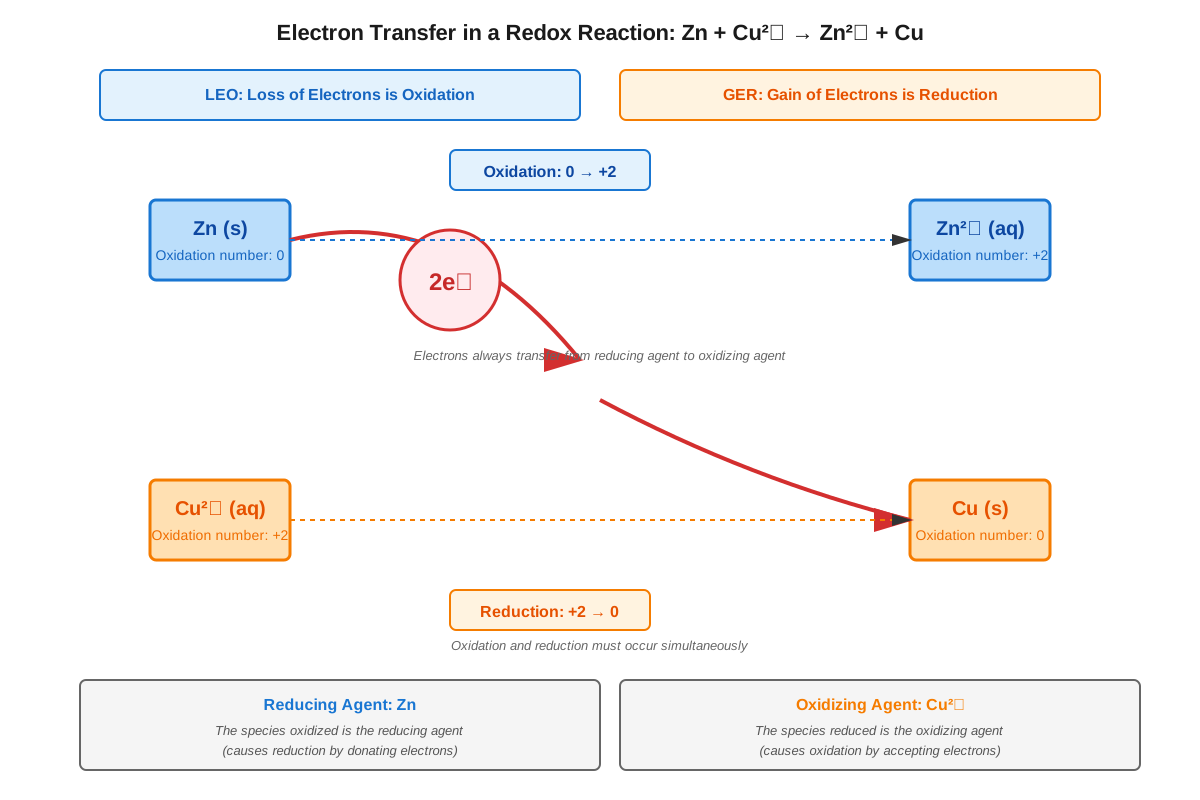
Redox reactions are chemical reactions in which electrons are transferred from one species to another, resulting in changes in oxidation states. The term "redox" combines two complementary processes: reduction (gain of electrons) and oxidation (loss of electrons). These processes always occur together—when one species loses electrons, another must gain them.
A useful mnemonic for remembering these definitions is OIL RIG: Oxidation Is Loss (of electrons), Reduction Is Gain (of electrons). Alternatively, LEO the lion says GER: Lose Electrons Oxidation, Gain Electrons Reduction.
The species that loses electrons (undergoes oxidation) is called the reducing agent or reductant because it causes another species to be reduced. Conversely, the species that gains electrons (undergoes reduction) is called the oxidizing agent or oxidant because it causes another species to be oxidized. This reciprocal relationship is crucial for MCAT questions.
Oxidation Numbers (Oxidation States)
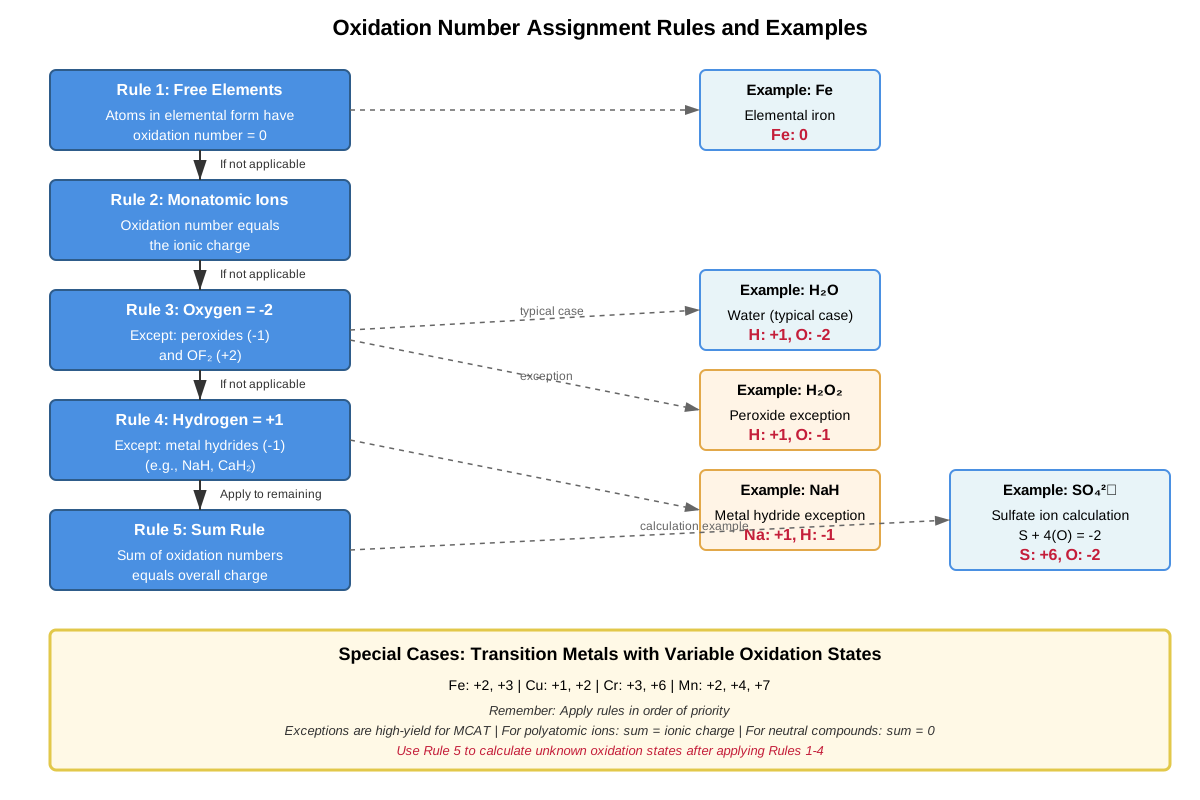
Oxidation numbers are bookkeeping tools that help track electron transfer in redox reactions. They represent the hypothetical charge an atom would have if all bonds were completely ionic. Assigning oxidation numbers correctly is essential for identifying redox reactions and balancing redox equations.
Rules for Assigning Oxidation Numbers:
- The oxidation number of an element in its standard state is 0 (e.g., O₂, N₂, Fe, C)
- The oxidation number of a monatomic ion equals its charge (e.g., Na⁺ = +1, Cl⁻ = -1)
- Oxygen is usually -2 (exceptions: peroxides -1, superoxides -½, OF₂ +2)
- Hydrogen is usually +1 (exception: metal hydrides -1, e.g., NaH)
- Fluorine is always -1 in compounds
- Group 1 metals are always +1; Group 2 metals are always +2
- The sum of oxidation numbers in a neutral compound equals 0
- The sum of oxidation numbers in a polyatomic ion equals the ion's charge
Exam Tip: When multiple rules could apply, follow the priority order listed above. For example, in H₂O₂ (hydrogen peroxide), rule 4 (H = +1) takes precedence over rule 3, making oxygen -1 rather than -2.
Identifying Redox Reactions
Not all chemical reactions are redox reactions. To determine if a reaction involves electron transfer, compare oxidation numbers of all atoms before and after the reaction. If any oxidation numbers change, the reaction is a redox reaction.
Types of reactions and their redox status:
| Reaction Type | Redox? | Example |
|---|---|---|
| Combustion | Yes | CH₄ + 2O₂ → CO₂ + 2H₂O |
| Single displacement | Yes | Zn + CuSO₄ → ZnSO₄ + Cu |
| Synthesis (some) | Yes | 2Na + Cl₂ → 2NaCl |
| Decomposition (some) | Yes | 2H₂O → 2H₂ + O₂ |
| Double displacement | No | AgNO₃ + NaCl → AgCl + NaNO₃ |
| Acid-base neutralization | No | HCl + NaOH → NaCl + H₂O |
Half-Reactions and Electron Transfer
Complex redox reactions can be broken down into two half-reactions: an oxidation half-reaction showing electron loss and a reduction half-reaction showing electron gain. This separation clarifies the electron transfer process and facilitates equation balancing.
For example, in the reaction between zinc metal and copper(II) ions:
- Oxidation half-reaction: Zn → Zn²⁺ + 2e⁻ (zinc loses 2 electrons)
- Reduction half-reaction: Cu²⁺ + 2e⁻ → Cu (copper gains 2 electrons)
- Overall reaction: Zn + Cu²⁺ → Zn²⁺ + Cu
The electrons lost in oxidation must equal the electrons gained in reduction. This principle is fundamental to balancing redox equations.
Balancing Redox Equations
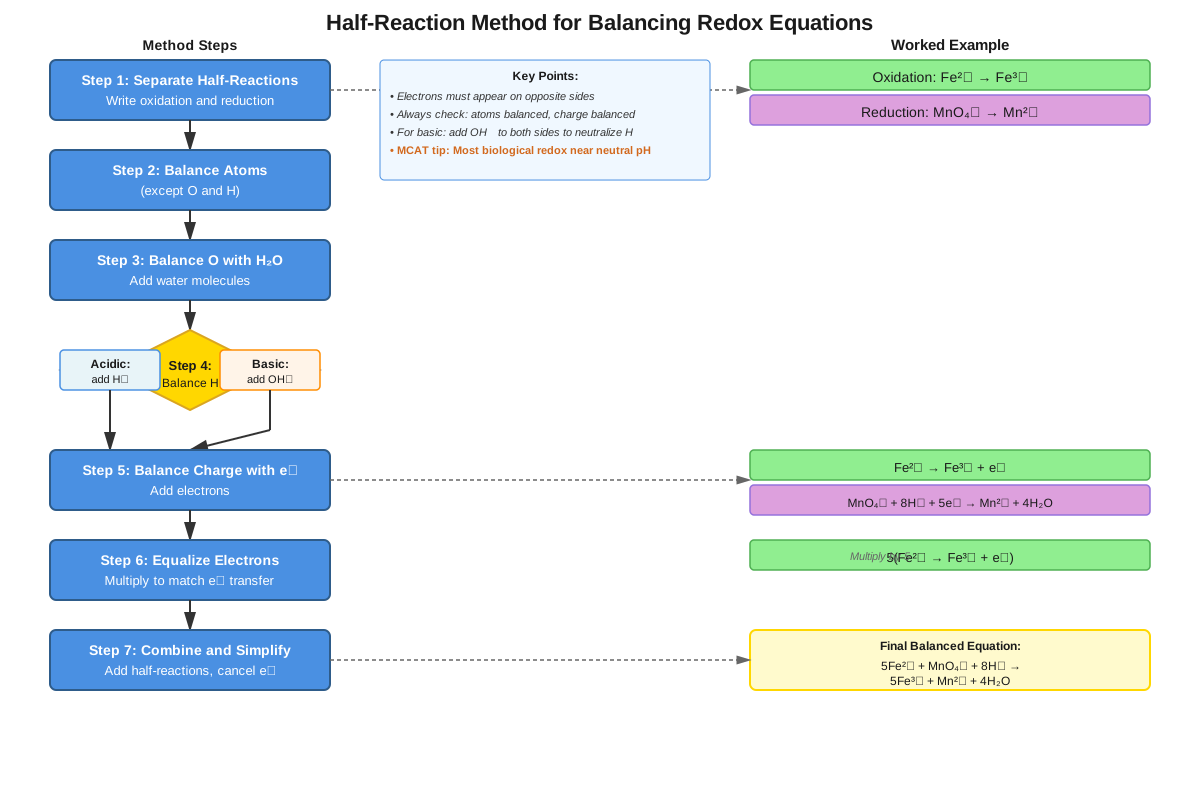
The MCAT may require balancing redox equations, particularly in acidic or basic solutions. The half-reaction method is the most systematic approach:
Steps for balancing in acidic solution:
- Separate the equation into oxidation and reduction half-reactions
- Balance all atoms except O and H
- Balance O by adding H₂O
- Balance H by adding H⁺
- Balance charge by adding electrons
- Multiply half-reactions to equalize electrons transferred
- Add half-reactions and cancel species appearing on both sides
- Verify that atoms and charge are balanced
For basic solutions, complete steps 1-7 as for acidic solutions, then:
- Add OH⁻ to both sides to neutralize H⁺ (forming H₂O)
- Cancel water molecules appearing on both sides
- Verify final balance
Oxidizing and Reducing Agents
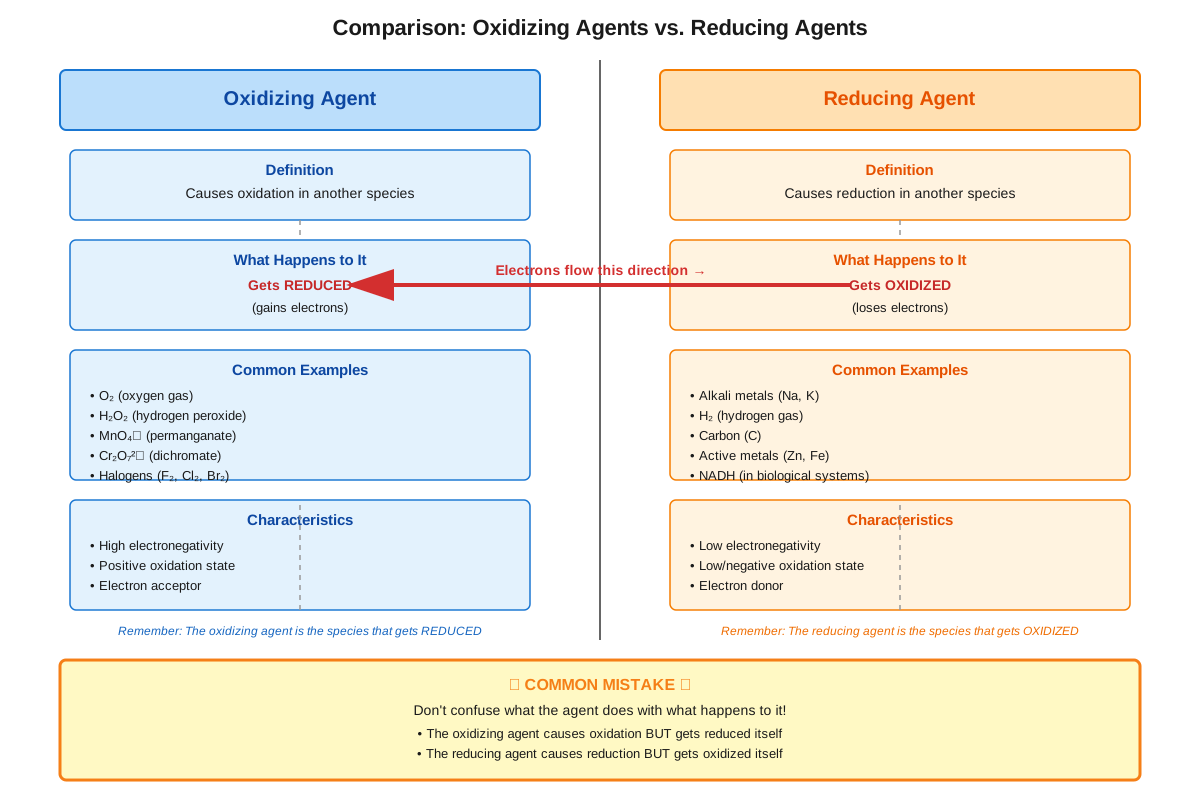
Identifying the oxidizing agent and reducing agent is a common MCAT question type. Remember:
- The oxidizing agent is the species that gets reduced (it accepts electrons)
- The reducing agent is the species that gets oxidized (it donates electrons)
- The oxidizing agent contains the atom whose oxidation number decreases
- The reducing agent contains the atom whose oxidation number increases
Common oxidizing agents (strong electron acceptors):
- O₂, O₃ (ozone)
- Halogens (F₂, Cl₂, Br₂, I₂)
- Permanganate (MnO₄⁻)
- Dichromate (Cr₂O₇²⁻)
- Concentrated acids (HNO₃, H₂SO₄)
- Hydrogen peroxide (H₂O₂)
Common reducing agents (strong electron donors):
- Alkali metals (Li, Na, K)
- Alkaline earth metals (Mg, Ca)
- Hydrogen gas (H₂)
- Carbon monoxide (CO)
- Hydride reagents (NaBH₄, LiAlH₄)
Disproportionation Reactions
Disproportionation is a special type of redox reaction where a single element in one oxidation state is simultaneously oxidized and reduced, forming two different products. A classic example is the decomposition of hydrogen peroxide:
2H₂O₂ → 2H₂O + O₂
In H₂O₂, oxygen has an oxidation state of -1. In the products, oxygen is -2 in H₂O (reduced) and 0 in O₂ (oxidized). The same element undergoes both oxidation and reduction.
Redox in Biological Systems
Biological redox reactions are central to metabolism and energy production. NAD⁺/NADH and FAD/FADH₂ are crucial electron carriers in cellular respiration. When NAD⁺ accepts electrons (and H⁺), it is reduced to NADH:
NAD⁺ + 2e⁻ + H⁺ → NADH
This reduced form then donates electrons to the electron transport chain, where a series of redox reactions ultimately reduces oxygen to water while generating ATP. Understanding these electron transfers is essential for MCAT biochemistry passages.
Concept Relationships
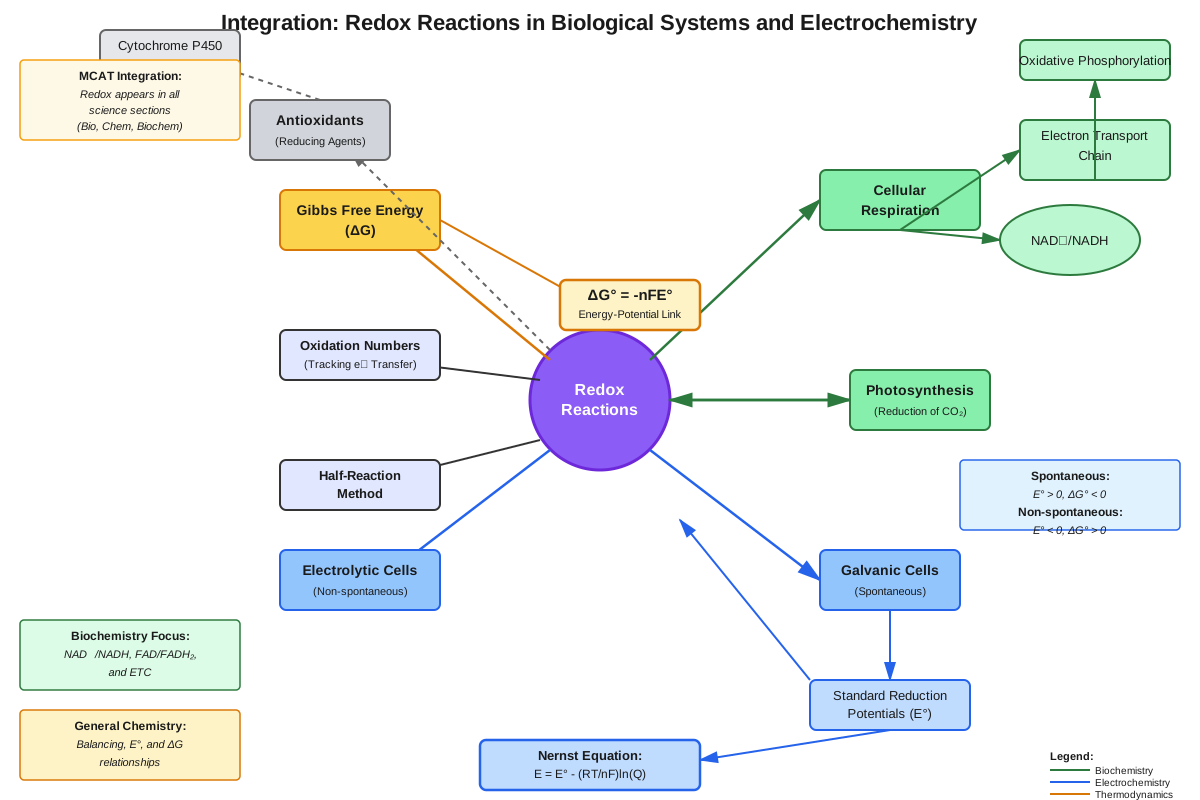
The concepts within redox chemistry are hierarchically organized. Oxidation numbers serve as the foundation, enabling identification of electron transfer in reactions. Once electron transfer is recognized, reactions can be separated into half-reactions, which clarifies the roles of oxidizing agents and reducing agents. The ability to write and balance half-reactions leads to mastery of balancing complex redox equations, which is essential for stoichiometric calculations.
Redox reactions connect to electrochemistry through the relationship between spontaneous electron transfer and electrical potential. The standard reduction potential (E°) quantifies the tendency of a species to gain electrons, directly relating to oxidizing/reducing agent strength. This connection flows as: Redox reactions → Half-reactions → Standard reduction potentials → Cell potential → Gibbs free energy → Spontaneity.
Within Stoichiometry and Reactions, redox chemistry integrates with other reaction types. While acid-base reactions involve proton transfer and redox reactions involve electron transfer, some reactions (like those involving permanganate in acidic solution) combine both aspects. Understanding these distinctions prevents confusion on the MCAT.
Redox concepts also connect to thermodynamics (spontaneity and energy changes), kinetics (reaction rates of electron transfer), and equilibrium (the balance between oxidized and reduced forms). In biological systems, redox reactions link to metabolism (energy extraction from nutrients), photosynthesis (light energy conversion), and cellular respiration (ATP synthesis).
The relationship map: Oxidation numbers → Identify redox reactions → Write half-reactions → Balance equations → Determine oxidizing/reducing agents → Predict reaction spontaneity → Apply to electrochemistry and biochemistry.
Quick check — test yourself on Redox reactions so far.
Try Flashcards →High-Yield Facts
⭐ Oxidation is loss of electrons; reduction is gain of electrons (OIL RIG)
⭐ The oxidizing agent gets reduced; the reducing agent gets oxidized
⭐ In compounds, oxygen is usually -2 and hydrogen is usually +1
⭐ The sum of oxidation numbers in a neutral compound equals zero; in a polyatomic ion, it equals the ion's charge
⭐ Electrons lost in oxidation must equal electrons gained in reduction
- Fluorine always has an oxidation number of -1 in compounds
- Group 1 metals are always +1; Group 2 metals are always +2 in compounds
- The oxidation number of an element in its standard state is always 0
- In peroxides (like H₂O₂), oxygen has an oxidation number of -1
- Disproportionation reactions involve the same element being both oxidized and reduced
- NAD⁺ and FAD are biological oxidizing agents that accept electrons during metabolism
- Strong oxidizing agents are easily reduced; strong reducing agents are easily oxidized
- Balancing redox equations in basic solution requires adding OH⁻ to neutralize H⁺
- Combustion reactions are always redox reactions involving oxygen as the oxidizing agent
- The species containing the atom with increasing oxidation number is the reducing agent
Common Misconceptions
Misconception: Oxidation always involves oxygen.
Correction: While many oxidation reactions do involve oxygen, oxidation is defined as the loss of electrons, which can occur without oxygen present. For example, when sodium reacts with chlorine (2Na + Cl₂ → 2NaCl), sodium is oxidized despite no oxygen involvement.
Misconception: The oxidizing agent is the species that gets oxidized.
Correction: The oxidizing agent is the species that gets reduced (gains electrons) while causing another species to be oxidized. It's called an "oxidizing" agent because it oxidizes other species, not because it itself is oxidized.
Misconception: Oxidation number and ionic charge are the same thing.
Correction: Oxidation numbers are hypothetical charges assuming complete ionic bonding, while actual ionic charges represent real electron distribution. In covalent compounds like CO₂, carbon has an oxidation number of +4, but it doesn't actually carry a +4 charge.
Misconception: In all compounds, hydrogen is +1 and oxygen is -2.
Correction: While these are the most common oxidation states, exceptions exist. Hydrogen is -1 in metal hydrides (NaH, CaH₂), and oxygen is -1 in peroxides (H₂O₂, Na₂O₂) and -½ in superoxides (KO₂).
Misconception: If a reaction involves ions, it must be a redox reaction.
Correction: Many ionic reactions, particularly double displacement and acid-base neutralization reactions, involve no change in oxidation numbers. For example, AgNO₃ + NaCl → AgCl + NaNO₃ is not a redox reaction despite involving ions.
Misconception: The number of electrons in a half-reaction must equal the oxidation number change.
Correction: While related, these aren't always equal. The number of electrons transferred equals the change in oxidation number multiplied by the number of atoms undergoing that change. For example, in Fe₂O₃ → 2Fe, each Fe changes by 3, but 2 atoms change, so 6 electrons total are transferred.
Misconception: Balancing redox equations is the same as balancing regular equations.
Correction: Redox equations require balancing both atoms and charge. Simply balancing atoms may result in unbalanced charge, leading to an incorrect equation. The half-reaction method systematically addresses both requirements.
Worked Examples
Example 1: Identifying Oxidation States and Redox Agents
Question: In the reaction 2Fe²⁺ + Cl₂ → 2Fe³⁺ + 2Cl⁻, identify the species oxidized, the species reduced, the oxidizing agent, and the reducing agent.
Solution:
Step 1: Assign oxidation numbers to all species.
- Fe²⁺: oxidation number = +2 (equals ionic charge)
- Cl₂: oxidation number = 0 (element in standard state)
- Fe³⁺: oxidation number = +3 (equals ionic charge)
- Cl⁻: oxidation number = -1 (equals ionic charge)
Step 2: Identify changes in oxidation numbers.
- Fe: +2 → +3 (increase of 1, oxidation)
- Cl: 0 → -1 (decrease of 1, reduction)
Step 3: Identify the species oxidized and reduced.
- Species oxidized: Fe²⁺ (its oxidation number increases)
- Species reduced: Cl₂ (its oxidation number decreases)
Step 4: Identify the oxidizing and reducing agents.
- Oxidizing agent: Cl₂ (it causes Fe²⁺ to be oxidized; Cl₂ itself is reduced)
- Reducing agent: Fe²⁺ (it causes Cl₂ to be reduced; Fe²⁺ itself is oxidized)
Key Concept: The species that undergoes oxidation is the reducing agent, and the species that undergoes reduction is the oxidizing agent. This reciprocal relationship is frequently tested on the MCAT.
Example 2: Balancing a Redox Equation in Acidic Solution
Question: Balance the following redox equation occurring in acidic solution:
MnO₄⁻ + Fe²⁺ → Mn²⁺ + Fe³⁺
Solution:
Step 1: Write the oxidation and reduction half-reactions.
- Oxidation: Fe²⁺ → Fe³⁺
- Reduction: MnO₄⁻ → Mn²⁺
Step 2: Balance atoms other than O and H.
- Oxidation: Fe²⁺ → Fe³⁺ (already balanced)
- Reduction: MnO₄⁻ → Mn²⁺ (already balanced)
Step 3: Balance oxygen by adding H₂O.
- Oxidation: Fe²⁺ → Fe³⁺ (no oxygen)
- Reduction: MnO₄⁻ → Mn²⁺ + 4H₂O (4 oxygen on left, add 4 H₂O on right)
Step 4: Balance hydrogen by adding H⁺.
- Oxidation: Fe²⁺ → Fe³⁺ (no hydrogen)
- Reduction: MnO₄⁻ + 8H⁺ → Mn²⁺ + 4H₂O (8 H on right, add 8 H⁺ on left)
Step 5: Balance charge by adding electrons.
- Oxidation: Fe²⁺ → Fe³⁺ + e⁻ (left: +2, right: +3, add 1e⁻ to right)
- Reduction: MnO₄⁻ + 8H⁺ + 5e⁻ → Mn²⁺ + 4H₂O (left: -1+8=-7+5e⁻, right: +2, need 5e⁻)
Step 6: Multiply to equalize electrons (5 electrons needed).
- Oxidation: 5Fe²⁺ → 5Fe³⁺ + 5e⁻
- Reduction: MnO₄⁻ + 8H⁺ + 5e⁻ → Mn²⁺ + 4H₂O
Step 7: Add half-reactions and cancel electrons.
MnO₄⁻ + 8H⁺ + 5Fe²⁺ → Mn²⁺ + 4H₂O + 5Fe³⁺
Step 8: Verify balance.
- Atoms: Mn: 1=1 ✓, O: 4=4 ✓, H: 8=8 ✓, Fe: 5=5 ✓
- Charge: Left: -1+8+10=+17, Right: +2+15=+17 ✓
Final Answer: MnO₄⁻ + 8H⁺ + 5Fe²⁺ → Mn²⁺ + 4H₂O + 5Fe³⁺
Key Concept: The half-reaction method systematically balances both atoms and charge. Always verify your final answer by checking that both atoms and total charge balance.
Exam Strategy
When approaching redox reactions MCAT questions, begin by quickly scanning for keywords that signal redox chemistry: "oxidation," "reduction," "electron transfer," "oxidizing agent," "reducing agent," or mentions of oxidation numbers. These trigger words indicate the question type and guide your approach.
For questions asking you to identify oxidation states, work systematically through the rules in order of priority. Start with elements in their standard state (always 0), then monatomic ions (equal to charge), then apply the rules for oxygen, hydrogen, and other elements. If you're unsure, use the rule that the sum of oxidation numbers must equal the overall charge.
Time-Saving Tip: On the MCAT, you rarely need to fully balance complex redox equations. More commonly, you'll identify which species is oxidized/reduced or determine the number of electrons transferred. Focus on these high-yield skills rather than memorizing every balancing step.
When identifying oxidizing and reducing agents, remember the reciprocal relationship: the oxidizing agent is reduced, and the reducing agent is oxidized. If you forget which is which, think about the function: an oxidizing agent oxidizes other species (so it must accept electrons and be reduced itself).
For process-of-elimination, watch for answer choices that confuse oxidation with reduction or that incorrectly identify agents. Common wrong answers include stating that the oxidizing agent is oxidized or that an increase in oxidation number represents reduction.
In passage-based questions, redox chemistry often appears in biological contexts (electron transport chains, metabolic pathways) or electrochemistry contexts (batteries, corrosion). Quickly identify the electron flow direction and the species gaining/losing electrons. Don't get bogged down in complex biochemical details—focus on the fundamental electron transfer.
Allocate approximately 1-1.5 minutes for discrete redox questions and 1.5-2 minutes for passage-based questions involving redox chemistry. If a question requires extensive equation balancing, consider flagging it and returning if time permits, as these can be time-consuming.
Memory Techniques
OIL RIG: Oxidation Is Loss, Reduction Is Gain (of electrons)
LEO the lion says GER: Lose Electrons Oxidation, Gain Electrons Reduction
For remembering oxidation number rules, use "FOHG":
- Fluorine is always -1
- Oxygen is usually -2
- Hydrogen is usually +1
- Group 1 is +1, Group 2 is +2
"An OX and a RED CAT": In electrochemical cells, ANode is OXidation, REDuction occurs at the CAThode
For oxidizing/reducing agents: "The agent does the opposite" - the oxidizing agent gets reduced, the reducing agent gets oxidized
Visualization for electron transfer: Picture electrons as physical objects moving from the reducing agent (electron donor) to the oxidizing agent (electron acceptor). The reducing agent becomes more positive (oxidized), while the oxidizing agent becomes more negative (reduced).
For balancing in acidic vs. basic solution: "Acid adds H⁺, Base adds OH⁻" - remember that acidic solutions use H⁺ to balance hydrogen, while basic solutions require an extra step of adding OH⁻.
Common oxidizing agents mnemonic "CHOP":
- Chlorine (and other halogens)
- Hydrogen peroxide
- Oxygen
- Permanganate
Summary
Redox reactions involve the transfer of electrons between chemical species, with oxidation representing electron loss and reduction representing electron gain. These complementary processes always occur together, with the reducing agent donating electrons (becoming oxidized) and the oxidizing agent accepting electrons (becoming reduced). Mastery of oxidation number assignment is fundamental to identifying redox reactions and determining which species undergo oxidation or reduction. The systematic half-reaction method enables balancing of complex redox equations by separately addressing oxidation and reduction processes, then combining them while ensuring electron balance. Understanding common oxidizing agents (like oxygen, halogens, and permanganate) and reducing agents (like metals and hydride reagents) helps predict reaction outcomes. On the MCAT, redox chemistry appears in both pure chemistry contexts and biological applications, particularly in metabolism and electron transport chains. Success requires recognizing the reciprocal relationship between oxidizing/reducing agents and the species they affect, quickly assigning oxidation numbers using systematic rules, and connecting redox principles to electrochemistry and biochemistry concepts.
Key Takeaways
- Redox reactions involve electron transfer: oxidation is electron loss (OIL), reduction is electron gain (RIG)
- Oxidation numbers are assigned using systematic rules, with oxygen typically -2 and hydrogen typically +1
- The oxidizing agent gets reduced (accepts electrons); the reducing agent gets oxidized (donates electrons)
- Balancing redox equations requires balancing both atoms and charge using the half-reaction method
- Electrons lost in oxidation must equal electrons gained in reduction
- Redox chemistry is essential for understanding metabolism, electron transport chains, and electrochemical cells on the MCAT
- Common MCAT questions focus on identifying oxidation states, determining oxidizing/reducing agents, and recognizing electron transfer in biological systems
Related Topics
Electrochemistry: Redox reactions form the foundation of electrochemical cells, where spontaneous electron transfer generates electrical current (galvanic cells) or electrical current drives non-spontaneous reactions (electrolytic cells). Understanding standard reduction potentials and cell potential calculations builds directly on redox principles.
Thermodynamics and Gibbs Free Energy: The spontaneity of redox reactions relates to Gibbs free energy changes, connecting electron transfer to energy considerations. The relationship ΔG° = -nFE° links electrochemistry to thermodynamics.
Metabolism and Cellular Respiration: Biological redox reactions in glycolysis, the citric acid cycle, and the electron transport chain extract energy from nutrients. NAD⁺/NADH and FAD/FADH₂ serve as electron carriers in these pathways.
Photosynthesis: Light reactions involve redox processes where water is oxidized to oxygen and NADP⁺ is reduced to NADPH, demonstrating biological electron transfer driven by light energy.
Organic Chemistry Reactions: Many organic transformations involve oxidation (adding oxygen or removing hydrogen) or reduction (adding hydrogen or removing oxygen), though the mechanisms differ from inorganic redox reactions.
Practice CTA
Now that you've mastered the core concepts of redox reactions, it's time to reinforce your understanding through active practice. Attempt the practice questions and flashcards associated with this topic to test your ability to assign oxidation numbers, identify oxidizing and reducing agents, and balance redox equations under timed conditions. Remember, the MCAT rewards not just knowledge but also the ability to apply concepts quickly and accurately under pressure. Each practice question you complete strengthens your pattern recognition and builds the confidence you need for test day. You've built a solid foundation—now prove it to yourself through deliberate practice!
Sign up free to keep reading
Create a free AnvayaPrep account to finish this MCAT guide on Redox reactions — plus flashcards and practice questions.