Overview
Free energy and equilibrium represent one of the most fundamental and high-yield relationships in General Chemistry, bridging the concepts of thermodynamics with chemical reactivity. Understanding how Gibbs free energy (ΔG) relates to the equilibrium constant (K) is essential for predicting whether reactions will proceed spontaneously and determining the composition of reaction mixtures at equilibrium. This topic synthesizes multiple thermodynamic principles—including enthalpy, entropy, and temperature effects—into a unified framework that explains chemical behavior.
For the MCAT, this topic appears frequently across both the Chemical and Physical Foundations of Biological Systems section and occasionally in passages involving biochemical pathways. Questions may ask students to calculate free energy changes, predict reaction spontaneity, interpret equilibrium constants, or analyze how changing conditions affects both thermodynamic favorability and equilibrium position. The relationship between ΔG° and K, expressed through the equation ΔG° = -RT ln K, is particularly high-yield and appears in various forms throughout the exam.
This topic serves as a conceptual bridge connecting thermodynamics to kinetics, electrochemistry, and biochemical energetics. Mastery of free energy and equilibrium enables students to understand coupled reactions in metabolism, predict the direction of electron flow in electrochemical cells, and analyze how enzymes affect reaction pathways without changing equilibrium positions. The principles learned here form the foundation for understanding Le Châtelier's principle, reaction quotients, and the thermodynamic basis of biological processes such as ATP hydrolysis and membrane transport.
Learning Objectives
- [ ] Define free energy and equilibrium using accurate General Chemistry terminology
- [ ] Explain why free energy and equilibrium matters for the MCAT
- [ ] Apply free energy and equilibrium to exam-style questions
- [ ] Identify common mistakes related to free energy and equilibrium
- [ ] Connect free energy and equilibrium to related General Chemistry concepts
- [ ] Calculate Gibbs free energy changes using both ΔG = ΔH - TΔS and ΔG = ΔG° + RT ln Q
- [ ] Predict reaction spontaneity and equilibrium position from thermodynamic parameters
- [ ] Interconvert between equilibrium constants and standard free energy changes
Prerequisites
- Basic thermodynamics concepts: Understanding of enthalpy (ΔH), entropy (ΔS), and the first and second laws of thermodynamics provides the foundation for Gibbs free energy calculations
- Equilibrium principles: Familiarity with equilibrium constants (Keq, Ka, Kb, Ksp) and the concept of dynamic equilibrium is necessary to understand the relationship between K and ΔG°
- Logarithmic functions: Comfort with natural logarithms and their properties is essential for manipulating the equations connecting free energy and equilibrium
- Gas laws and the ideal gas constant: Knowledge of R (8.314 J/mol·K or 0.0821 L·atm/mol·K) and temperature conversions to Kelvin is required for quantitative calculations
- Reaction quotient (Q): Understanding how Q compares to K to predict reaction direction connects directly to the non-standard free energy equation
Why This Topic Matters
Clinical and Real-World Significance
The relationship between free energy and equilibrium governs virtually every biochemical process in living systems. ATP hydrolysis, the "energy currency" of cells, has a large negative ΔG° that drives countless otherwise unfavorable reactions through coupling mechanisms. Drug binding to receptors, protein folding, and membrane transport all depend on free energy changes that determine equilibrium positions. Understanding these principles allows medical professionals to comprehend how metabolic disorders arise when energy balance is disrupted and how pharmaceutical interventions can shift equilibrium positions to therapeutic advantage.
Exam Statistics and Question Types
Free energy and equilibrium concepts appear in approximately 3-5 questions per MCAT exam, making this a high-yield topic. Questions typically fall into several categories: (1) direct calculation problems requiring use of ΔG = ΔH - TΔS or ΔG° = -RT ln K; (2) conceptual questions about spontaneity and equilibrium position; (3) passage-based questions involving coupled reactions or biochemical pathways; and (4) questions requiring interpretation of thermodynamic data tables. The MCAT frequently tests the distinction between ΔG and ΔG°, the relationship between reaction quotient Q and spontaneity, and the effect of temperature on equilibrium.
Common Exam Passage Contexts
This topic commonly appears in passages describing: enzyme-catalyzed reactions and metabolic pathways (especially glycolysis and the citric acid cycle); electrochemical cells and battery systems; phase transitions and solubility equilibria; protein-ligand binding studies; and temperature-dependent reaction systems. Passages often provide thermodynamic data in tables and ask students to make predictions about reaction behavior under various conditions. Understanding the conceptual relationship between free energy and equilibrium enables rapid analysis of these complex scenarios.
Core Concepts
Gibbs Free Energy: Definition and Significance
Gibbs free energy (G) represents the amount of energy in a system available to do useful work at constant temperature and pressure. The change in Gibbs free energy (ΔG) for a process determines whether that process will occur spontaneously. The fundamental equation relating free energy to other thermodynamic quantities is:
ΔG = ΔH - TΔSwhere ΔH is the enthalpy change, T is the absolute temperature in Kelvin, and ΔS is the entropy change. This equation reveals that spontaneity depends on the balance between enthalpy (energy content) and entropy (disorder), weighted by temperature.
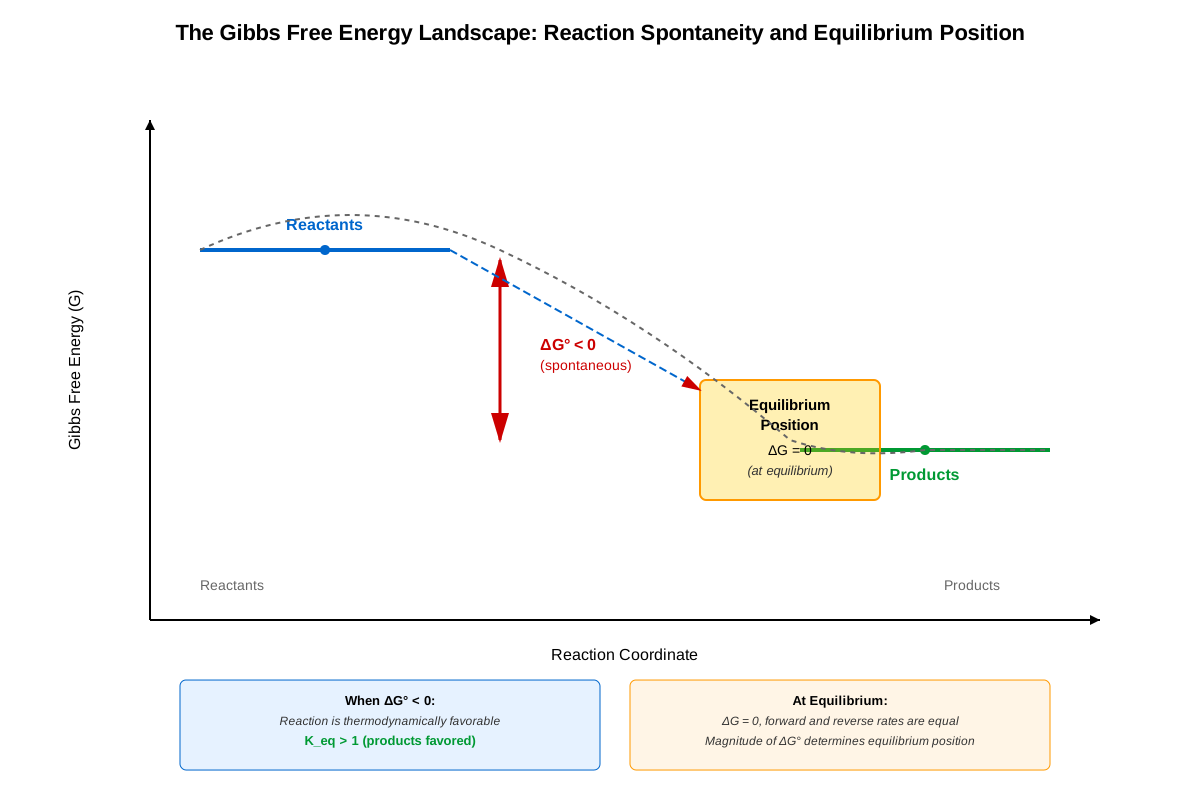
A process is spontaneous when ΔG < 0 (exergonic), non-spontaneous when ΔG > 0 (endergonic), and at equilibrium when ΔG = 0. Importantly, spontaneity indicates thermodynamic favorability but says nothing about reaction rate—kinetics and thermodynamics are independent considerations.
Standard Free Energy Change (ΔG°)
The standard free energy change (ΔG°) represents the free energy change when all reactants and products are in their standard states (1 M concentration for solutions, 1 atm pressure for gases, pure substances for solids and liquids) at a specified temperature (usually 25°C or 298 K). The standard biochemical free energy change (ΔG°') uses pH 7 as the standard state for H⁺ concentration, which is more relevant for biological systems.
ΔG° can be calculated from standard enthalpies and entropies of formation:
ΔG° = ΔH° - TΔS°Alternatively, ΔG° can be calculated from standard free energies of formation (ΔG°f):
ΔG° = Σ(ΔG°f products) - Σ(ΔG°f reactants)The Relationship Between ΔG° and Equilibrium Constant
The most critical equation connecting thermodynamics and equilibrium is:
ΔG° = -RT ln Kwhere R is the gas constant (8.314 J/mol·K), T is temperature in Kelvin, and K is the equilibrium constant. This equation can also be written as:
K = e^(-ΔG°/RT)This relationship reveals several key insights:
| ΔG° Value | K Value | Equilibrium Position | Interpretation |
|---|---|---|---|
| ΔG° < 0 (negative) | K > 1 | Favors products | Reaction proceeds forward under standard conditions |
| ΔG° = 0 | K = 1 | Equal products and reactants | No net driving force |
| ΔG° > 0 (positive) | K < 1 | Favors reactants | Reaction proceeds in reverse under standard conditions |
The magnitude of ΔG° indicates how far the equilibrium lies toward products or reactants. A ΔG° of -17.1 kJ/mol at 298 K corresponds to K ≈ 1000, while ΔG° of +17.1 kJ/mol corresponds to K ≈ 0.001.
Non-Standard Conditions and the Reaction Quotient
Under non-standard conditions, the free energy change is given by:
ΔG = ΔG° + RT ln Qwhere Q is the reaction quotient, calculated the same way as K but using actual concentrations rather than equilibrium concentrations. This equation is fundamental for predicting reaction direction:
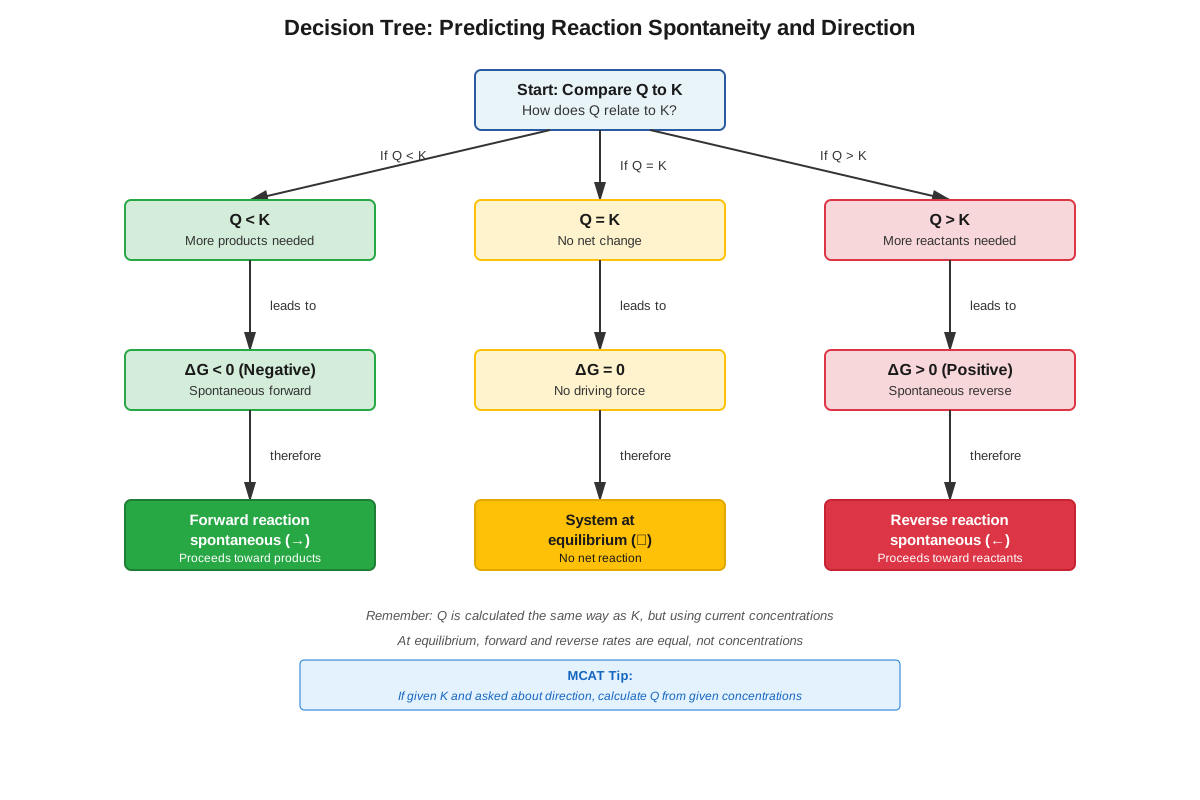
- When Q < K: ΔG < 0, reaction proceeds forward (toward products)
- When Q = K: ΔG = 0, system is at equilibrium
- When Q > K: ΔG > 0, reaction proceeds in reverse (toward reactants)
At equilibrium, Q = K and ΔG = 0, which confirms the relationship ΔG° = -RT ln K.
Temperature Dependence of Equilibrium
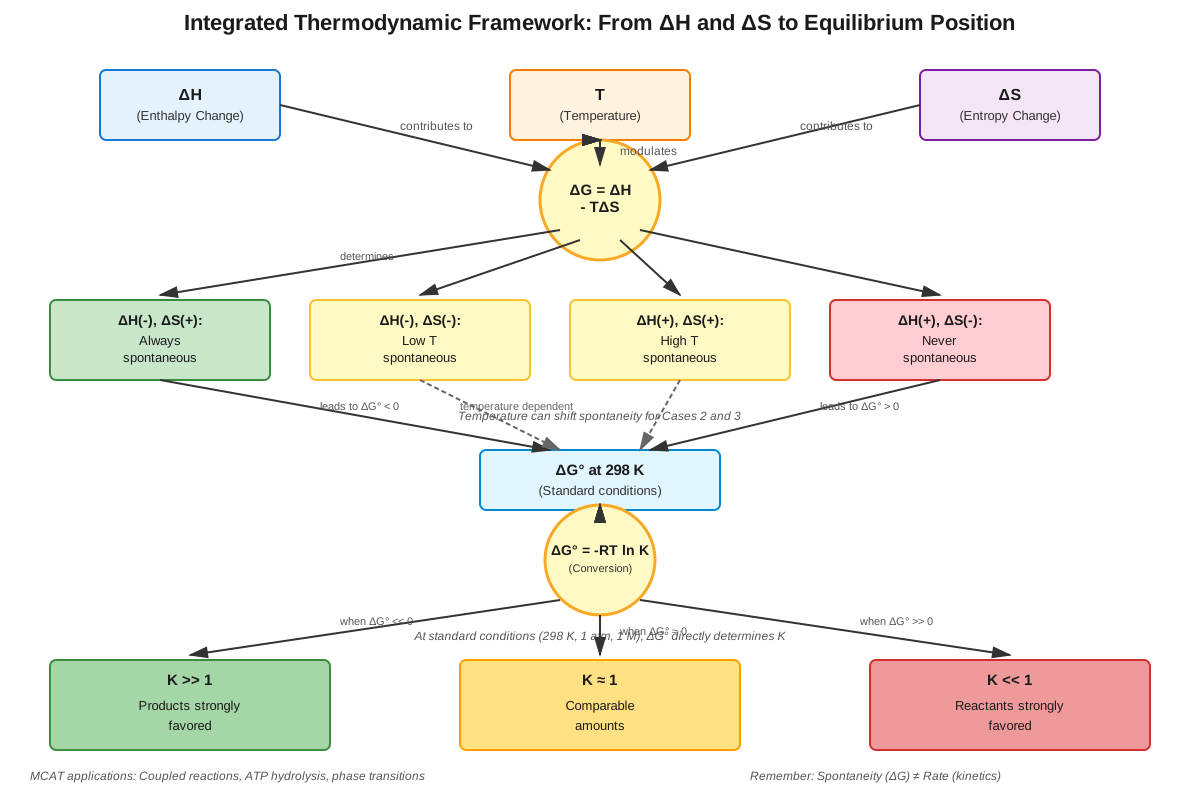
Temperature affects equilibrium position through its influence on ΔG. Using ΔG° = ΔH° - TΔS°, we can predict how temperature changes affect spontaneity:
| ΔH° | ΔS° | Low Temperature | High Temperature |
|---|---|---|---|
| - (exothermic) | + (entropy increases) | Spontaneous (ΔG° < 0) | Spontaneous (ΔG° < 0) |
| - (exothermic) | - (entropy decreases) | Spontaneous (ΔG° < 0) | May become non-spontaneous |
| + (endothermic) | + (entropy increases) | May be non-spontaneous | Spontaneous (ΔG° < 0) |
| + (endothermic) | - (entropy decreases) | Non-spontaneous (ΔG° > 0) | Non-spontaneous (ΔG° > 0) |
The van't Hoff equation relates the temperature dependence of the equilibrium constant to enthalpy:
ln(K₂/K₁) = -(ΔH°/R)(1/T₂ - 1/T₁)For exothermic reactions (ΔH° < 0), increasing temperature decreases K, shifting equilibrium toward reactants. For endothermic reactions (ΔH° > 0), increasing temperature increases K, shifting equilibrium toward products.
Coupled Reactions and Free Energy
Biological systems frequently couple thermodynamically unfavorable reactions (ΔG° > 0) with favorable ones (ΔG° < 0) to drive necessary processes. The classic example is ATP hydrolysis:
ATP + H₂O → ADP + Pi ΔG°' ≈ -30.5 kJ/molThis highly favorable reaction can be coupled to endergonic processes. For coupled reactions, the overall ΔG° is the sum of individual ΔG° values:
ΔG°total = ΔG°₁ + ΔG°₂If ΔG°total < 0, the coupled process is thermodynamically favorable. This principle underlies metabolic pathways, active transport, and biosynthetic reactions.
Concept Relationships
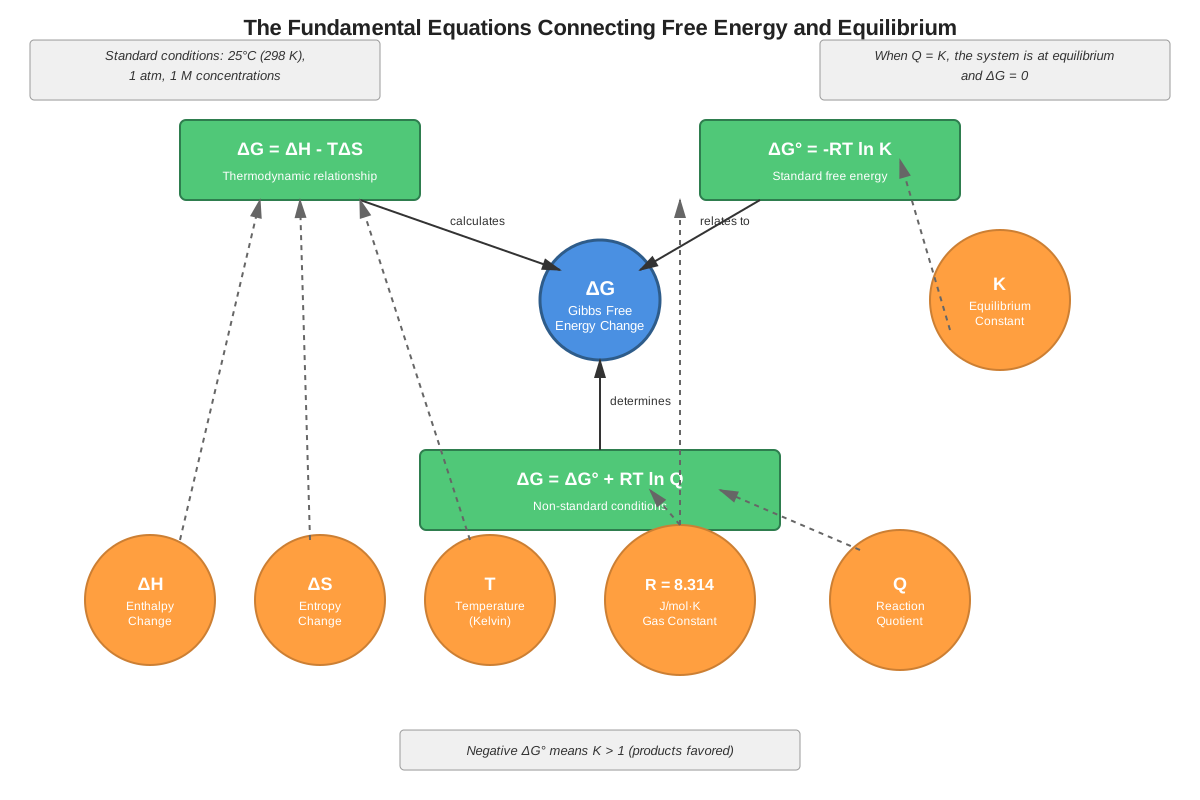
The relationship between free energy and equilibrium serves as a central hub connecting multiple thermodynamic concepts. Enthalpy (ΔH) and entropy (ΔS) combine through the Gibbs equation (ΔG = ΔH - TΔS) to determine free energy changes, which in turn predict spontaneity. The standard free energy change (ΔG°) connects directly to the equilibrium constant (K) through ΔG° = -RT ln K, establishing that thermodynamic favorability determines equilibrium position.
The reaction quotient (Q) extends this relationship to non-standard conditions through ΔG = ΔG° + RT ln Q, creating a framework for predicting reaction direction at any point. When Q < K, the system has not yet reached equilibrium and ΔG < 0, driving the reaction forward. As the reaction proceeds, Q increases until Q = K, at which point ΔG = 0 and equilibrium is established.
Temperature acts as a critical variable affecting both the magnitude of ΔG (through the TΔS term) and the value of K (through the van't Hoff equation). This connects to Le Châtelier's principle, where temperature changes shift equilibrium position in predictable ways based on reaction enthalpy.
These concepts extend to related topics: electrochemistry (where ΔG° = -nFE°cell connects free energy to cell potential), solubility equilibria (where ΔG° relates to Ksp), acid-base chemistry (where ΔG° relates to Ka and Kb), and biochemical energetics (where coupled reactions and ATP hydrolysis drive metabolism). Understanding free energy and equilibrium provides the thermodynamic foundation for analyzing all chemical processes.
Quick check — test yourself on Free energy and equilibrium so far.
Try Flashcards →High-Yield Facts
⭐ ΔG° = -RT ln K is the fundamental equation relating standard free energy to equilibrium constant; at 298 K, this simplifies to ΔG° (kJ/mol) ≈ -5.7 log K
⭐ ΔG = 0 at equilibrium for any system; this is the defining characteristic of equilibrium and means no net driving force exists
⭐ ΔG = ΔG° + RT ln Q determines reaction direction under non-standard conditions; when Q < K, ΔG < 0 and the reaction proceeds forward
⭐ K > 1 means ΔG° < 0, indicating products are favored at equilibrium; K < 1 means ΔG° > 0, indicating reactants are favored
⭐ Temperature affects equilibrium position through ΔG° = ΔH° - TΔS°; increasing temperature favors the endothermic direction
- A negative ΔG indicates a spontaneous process, but spontaneity does not imply rapid kinetics
- Standard state conditions are 1 M concentration, 1 atm pressure, and 298 K (though temperature can vary)
- The magnitude of ΔG° indicates how far equilibrium lies toward products or reactants; |ΔG°| > 20 kJ/mol indicates strong favorability
- Catalysts (including enzymes) do not change ΔG° or K; they only affect the rate of reaching equilibrium
- For coupled reactions, ΔG° values are additive, allowing unfavorable reactions to be driven by favorable ones
- The relationship between ΔG° and K is logarithmic, meaning small changes in ΔG° correspond to large changes in K
- At physiological temperature (310 K), RT ≈ 2.58 kJ/mol, a useful value for quick calculations
Common Misconceptions
Misconception: A negative ΔG° means the reaction goes to completion.
Correction: A negative ΔG° means products are favored at equilibrium (K > 1), but both reactants and products will be present at equilibrium. Only extremely negative ΔG° values (typically < -30 kJ/mol) result in near-complete conversion to products.
Misconception: ΔG and ΔG° are interchangeable terms.
Correction: ΔG° is the free energy change under standard conditions and relates to K through ΔG° = -RT ln K. ΔG is the free energy change under actual conditions and determines spontaneity at that moment. ΔG depends on Q (the current concentrations), while ΔG° is a constant for a given reaction at a given temperature.
Misconception: If ΔG° is positive, the reaction cannot occur.
Correction: A positive ΔG° means the reaction is non-spontaneous under standard conditions and K < 1, but the reaction can still proceed forward if coupled to a favorable reaction or if Q is very small (making ΔG = ΔG° + RT ln Q negative). Many biological reactions have positive ΔG° but are driven by coupling to ATP hydrolysis.
Misconception: Catalysts change the equilibrium constant or ΔG°.
Correction: Catalysts (including enzymes) only affect reaction rate by lowering activation energy. They do not change thermodynamic parameters like ΔG°, ΔH°, ΔS°, or K. A catalyst helps a system reach equilibrium faster but does not change the equilibrium position.
Misconception: Increasing temperature always favors product formation.
Correction: Temperature effects depend on the sign of ΔH°. For exothermic reactions (ΔH° < 0), increasing temperature decreases K and shifts equilibrium toward reactants. For endothermic reactions (ΔH° > 0), increasing temperature increases K and shifts equilibrium toward products. This follows from Le Châtelier's principle and the van't Hoff equation.
Misconception: When ΔG = 0, no reaction is occurring.
Correction: When ΔG = 0, the system is at equilibrium, meaning the forward and reverse reactions occur at equal rates (dynamic equilibrium). Reactions continue to occur, but there is no net change in concentrations. This is fundamentally different from a static system where no reactions occur.
Worked Examples
Example 1: Calculating ΔG° from Equilibrium Constant
Problem: At 298 K, the equilibrium constant for the reaction A ⇌ B is K = 2.5 × 10³. Calculate ΔG° for this reaction and determine whether products or reactants are favored at equilibrium.
Solution:
Step 1: Identify the relevant equation and given values.
- Use ΔG° = -RT ln K
- R = 8.314 J/mol·K
- T = 298 K
- K = 2.5 × 10³ = 2500
Step 2: Calculate ln K.
- ln(2500) = ln(2.5 × 10³) = ln(2.5) + ln(10³)
- ln(2.5) ≈ 0.916
- ln(10³) = 3 ln(10) ≈ 3(2.303) = 6.909
- ln(2500) ≈ 0.916 + 6.909 = 7.825
Step 3: Calculate ΔG°.
- ΔG° = -(8.314 J/mol·K)(298 K)(7.825)
- ΔG° = -(8.314)(298)(7.825) J/mol
- ΔG° ≈ -19,400 J/mol = -19.4 kJ/mol
Step 4: Interpret the result.
Since ΔG° is negative and K > 1, products are strongly favored at equilibrium. At equilibrium, the concentration of B will be approximately 2500 times greater than the concentration of A.
Connection to learning objectives: This problem demonstrates the direct application of the ΔG° = -RT ln K relationship and shows how to interpret thermodynamic favorability from equilibrium constants.
Example 2: Predicting Reaction Direction Using Q and ΔG
Problem: Consider the reaction N₂(g) + 3H₂(g) ⇌ 2NH₃(g) with ΔG° = -33.0 kJ/mol at 298 K. If a reaction mixture contains [N₂] = 0.50 M, [H₂] = 0.75 M, and [NH₃] = 0.20 M, determine whether the reaction will proceed forward, reverse, or is at equilibrium.
Solution:
Step 1: Calculate the reaction quotient Q.
- Q = [NH₃]²/([N₂][H₂]³)
- Q = (0.20)²/[(0.50)(0.75)³]
- Q = 0.040/(0.50 × 0.422)
- Q = 0.040/0.211 ≈ 0.19
Step 2: Calculate the equilibrium constant K from ΔG°.
- ΔG° = -RT ln K
- -33,000 J/mol = -(8.314 J/mol·K)(298 K) ln K
- ln K = 33,000/(8.314 × 298) = 33,000/2478 ≈ 13.3
- K = e^13.3 ≈ 6.0 × 10⁵
Step 3: Compare Q to K.
- Q = 0.19
- K = 6.0 × 10⁵
- Q << K
Step 4: Calculate ΔG to confirm.
- ΔG = ΔG° + RT ln Q
- ΔG = -33,000 + (8.314)(298) ln(0.19)
- ln(0.19) ≈ -1.66
- ΔG = -33,000 + (2478)(-1.66)
- ΔG = -33,000 - 4113 = -37,113 J/mol ≈ -37.1 kJ/mol
Step 5: Interpret the result.
Since Q < K and ΔG < 0, the reaction will proceed forward (toward products). The system has not yet reached equilibrium, and more NH₃ will form as N₂ and H₂ are consumed.
Connection to learning objectives: This problem integrates multiple concepts—calculating Q, relating ΔG° to K, using the non-standard free energy equation, and predicting reaction direction—demonstrating comprehensive mastery of free energy and equilibrium relationships.
Exam Strategy
Approaching MCAT Questions
When encountering free energy and equilibrium questions on the MCAT, first identify whether the question asks about standard conditions (ΔG°, K) or non-standard conditions (ΔG, Q). This distinction is critical because different equations apply. Look for explicit mention of "standard conditions," "1 M concentrations," or "equilibrium constant" to signal ΔG° problems.
For calculation questions, quickly assess whether you need to use ΔG = ΔH - TΔS, ΔG° = -RT ln K, or ΔG = ΔG° + RT ln Q. The MCAT rarely requires complex logarithm calculations; instead, it often provides values or asks for qualitative predictions. Memorize that at 298 K, RT ≈ 2.5 kJ/mol for quick estimation.
Trigger Words and Phrases
Watch for these key phrases that signal specific concepts:
- "Spontaneous" or "thermodynamically favorable" → ΔG < 0
- "At equilibrium" → ΔG = 0, Q = K
- "Standard conditions" → Use ΔG°, not ΔG
- "Products are favored" → K > 1, ΔG° < 0
- "Coupled reaction" → Add ΔG° values
- "Temperature increases" → Consider sign of ΔH° to predict equilibrium shift
- "Enzyme added" or "catalyst" → No change in ΔG° or K, only rate
Process of Elimination Tips
When facing multiple-choice questions about free energy and equilibrium:
- Eliminate options that confuse ΔG with ΔG° or that claim catalysts change equilibrium position
- For sign questions (positive/negative ΔG), eliminate answers inconsistent with the relationship between K and ΔG° (K > 1 requires ΔG° < 0)
- For temperature-dependent questions, eliminate answers that don't account for the sign of ΔH°
- Check units carefully—ΔG is typically in kJ/mol while R is often in J/mol·K, requiring conversion
- For coupled reactions, eliminate answers that don't properly add ΔG° values
Time Allocation
Most free energy and equilibrium questions can be answered in 60-90 seconds. If a calculation appears complex, look for shortcuts: Can you determine the answer qualitatively without calculating exact values? Does the magnitude of K clearly indicate strong product or reactant favorability? The MCAT rewards conceptual understanding over computational precision, so prioritize understanding relationships over exact calculations when time is limited.
Memory Techniques
Mnemonics
"Negative Goes" - Remember that negative ΔG means the reaction "goes" (proceeds spontaneously forward).
"K is King" - When K > 1, products are "King" (favored); when K < 1, reactants rule.
"HASTE makes waste" - For ΔG = ΔH - TΔS:
- Heat (enthalpy)
- And
- Spontaneity
- Temperature
- Entropy
"Standard Starts with S, So does State" - ΔG° refers to Standard State conditions (1 M, 1 atm, 298 K).
Visualization Strategies
Visualize the free energy-reaction coordinate diagram: At equilibrium, the system sits at the lowest point of the free energy curve. If Q < K, the system is "uphill" from equilibrium on the reactant side and will "roll down" toward products (ΔG < 0). If Q > K, the system is "uphill" on the product side and will "roll back" toward reactants (ΔG > 0).
For temperature effects, picture a balance scale with ΔH on one side and TΔS on the other. As temperature increases, the TΔS side gets heavier. For exothermic reactions (negative ΔH), this tips the balance toward positive ΔG at high temperatures. For endothermic reactions (positive ΔH), increasing temperature helps overcome the unfavorable enthalpy, making ΔG more negative.
Acronyms
KEGS - The four key variables in free energy and equilibrium:
- K - Equilibrium constant
- E - Energy (Gibbs free energy)
- G - ΔG and ΔG°
- S - Spontaneity
Summary
Free energy and equilibrium represent the thermodynamic foundation for predicting chemical behavior. The Gibbs free energy change (ΔG) determines whether a process is spontaneous (ΔG < 0), at equilibrium (ΔG = 0), or non-spontaneous (ΔG > 0). The standard free energy change (ΔG°) relates directly to the equilibrium constant through ΔG° = -RT ln K, establishing that thermodynamic favorability determines equilibrium position. Under non-standard conditions, ΔG = ΔG° + RT ln Q predicts reaction direction by comparing the reaction quotient (Q) to the equilibrium constant (K). Temperature affects both spontaneity and equilibrium position through the relationship ΔG = ΔH - TΔS, with the balance between enthalpy and entropy determining thermodynamic favorability. These principles enable prediction of reaction behavior, analysis of coupled reactions in biological systems, and understanding of how changing conditions affects chemical processes—all critical skills for MCAT success.
Key Takeaways
- ΔG° = -RT ln K is the fundamental equation connecting thermodynamics to equilibrium; negative ΔG° means K > 1 and products are favored
- ΔG = 0 defines equilibrium, while ΔG < 0 indicates spontaneity and ΔG > 0 indicates non-spontaneity under the given conditions
- ΔG = ΔG° + RT ln Q determines reaction direction by comparing actual conditions (Q) to equilibrium (K)
- Temperature affects equilibrium through ΔG = ΔH - TΔS; increasing temperature favors the endothermic direction
- Catalysts do not change ΔG°, K, or equilibrium position—they only affect the rate of reaching equilibrium
- Coupled reactions allow thermodynamically unfavorable processes to occur by pairing them with favorable reactions (ΔG°total = ΔG°₁ + ΔG°₂)
- Distinguish between ΔG and ΔG°—ΔG° is constant for a reaction at a given temperature, while ΔG varies with conditions and determines spontaneity at that moment
Related Topics
Electrochemistry and Cell Potentials: The relationship ΔG° = -nFE°cell connects free energy to electrochemical cell potentials, extending thermodynamic principles to redox reactions and batteries. Mastering free energy and equilibrium provides the foundation for understanding spontaneous electron transfer.
Acid-Base Equilibria: The equilibrium constants Ka and Kb relate to ΔG° through the same fundamental equation, allowing thermodynamic analysis of proton transfer reactions. Understanding free energy principles enables prediction of acid-base reaction favorability.
Solubility Equilibria: The solubility product constant (Ksp) represents an equilibrium constant that relates to ΔG° for dissolution processes. Free energy principles explain why some salts dissolve spontaneously while others precipitate.
Chemical Kinetics: While thermodynamics (ΔG) determines whether a reaction can occur, kinetics determines how fast it occurs. Understanding that these are independent considerations is crucial for analyzing reaction mechanisms and catalysis.
Biochemical Energetics: Metabolic pathways rely on coupled reactions and ATP hydrolysis to drive unfavorable processes. The principles of free energy and equilibrium underlie all of biochemistry, from glycolysis to oxidative phosphorylation.
Practice CTA
Now that you've mastered the core concepts of free energy and equilibrium, it's time to solidify your understanding through active practice. Work through the practice questions to test your ability to apply these principles to MCAT-style problems, and use the flashcards to reinforce high-yield facts and equations. Remember, thermodynamics is one of the most predictable and high-yield topics on the MCAT—investing time here will pay dividends on test day. Focus on understanding the relationships between concepts rather than memorizing isolated facts, and you'll be able to tackle any free energy or equilibrium question with confidence!
Sign up free to keep reading
Create a free AnvayaPrep account to finish this MCAT guide on Free energy and equilibrium — plus flashcards and practice questions.