Overview
The Second law of thermodynamics stands as one of the most fundamental principles governing energy transformations in the universe, and it holds critical importance for MCAT success in General Chemistry. This law introduces the concept of entropy—a measure of disorder or randomness in a system—and establishes that spontaneous processes in isolated systems always proceed in the direction of increasing total entropy. Unlike the first law, which focuses on energy conservation, the second law addresses the quality and directionality of energy transformations, explaining why certain processes occur naturally while their reverse processes do not.
For MCAT preparation, understanding the Second law of thermodynamics provides the foundation for predicting reaction spontaneity, interpreting Gibbs free energy calculations, and analyzing biological processes such as ATP hydrolysis, protein folding, and cellular respiration. The second law explains why living organisms must constantly consume energy to maintain their highly ordered state and why heat always flows from hot to cold objects without external intervention. This principle bridges multiple MCAT disciplines, appearing not only in General Chemistry questions but also in biochemistry passages discussing metabolic pathways and physics problems involving heat engines.
The second law's relationship to other thermodynamics concepts creates an interconnected framework essential for MCAT mastery. It works in tandem with the first law (energy conservation) to establish the complete thermodynamic picture, directly determines the sign of Gibbs free energy changes that predict spontaneity, and explains why enthalpy and entropy compete to drive chemical reactions. Students who thoroughly understand the second law gain powerful predictive abilities for analyzing complex systems and can confidently approach passage-based questions that require integrating multiple thermodynamic principles.
Learning Objectives
- [ ] Define Second law of thermodynamics using accurate General Chemistry terminology
- [ ] Explain why Second law of thermodynamics matters for the MCAT
- [ ] Apply Second law of thermodynamics to exam-style questions
- [ ] Identify common mistakes related to Second law of thermodynamics
- [ ] Connect Second law of thermodynamics to related General Chemistry concepts
- [ ] Calculate entropy changes for systems and surroundings in various processes
- [ ] Predict spontaneity of processes using entropy considerations alone
- [ ] Distinguish between reversible and irreversible processes using second law principles
- [ ] Analyze coupled biological processes through the lens of entropy changes
Prerequisites
- First law of thermodynamics: Understanding energy conservation is essential because the second law builds upon it to address energy quality and directionality
- System vs. surroundings definitions: Distinguishing between system, surroundings, and universe is critical for properly applying entropy calculations
- State functions: Recognizing entropy as a state function helps understand why entropy changes depend only on initial and final states
- Heat and temperature concepts: Entropy changes are calculated using heat transfer and temperature, making these foundational concepts necessary
- Basic probability and statistics: Entropy relates to the number of microstates, requiring basic understanding of probability concepts
Why This Topic Matters
Clinical and Real-World Significance
The second law of thermodynamics governs every biological process occurring in living organisms. Cellular metabolism, protein synthesis, DNA replication, and active transport all represent local decreases in entropy that must be coupled with larger entropy increases elsewhere. When cells synthesize complex proteins from amino acids, they create highly ordered structures (decreasing entropy), but this process is only possible because it's coupled with ATP hydrolysis and heat release that increase the total entropy of the universe. Understanding this principle explains why organisms must continuously consume energy-rich nutrients—not just to obtain energy (first law) but to drive processes that would otherwise be thermodynamically unfavorable.
Medical applications include understanding drug dissolution, membrane transport mechanisms, and the thermodynamic basis of diseases. For example, protein misfolding diseases like Alzheimer's and Creutzfeldt-Jakob disease involve proteins adopting more thermodynamically stable (higher entropy) but functionally incorrect conformations. The second law also explains why maintaining body temperature requires constant metabolic activity and why hypothermia can be life-threatening—the body's organized state requires continuous energy input to prevent entropy increase.
MCAT Exam Statistics and Question Types
The Second law of thermodynamics MCAT questions appear with moderate frequency across Chemical and Physical Foundations sections, typically comprising 2-4 questions per exam. These questions most commonly appear in three formats: discrete questions testing conceptual understanding of entropy and spontaneity (30%), passage-based questions integrating thermodynamics with biochemical pathways (50%), and calculation problems involving entropy changes and Gibbs free energy (20%).
Exam passages frequently embed second law concepts within biochemistry contexts, such as analyzing the thermodynamics of glycolysis, explaining why coupled reactions are necessary for biosynthesis, or interpreting experimental data about protein folding. Questions often require students to identify which thermodynamic quantity (ΔH, ΔS, or ΔG) determines spontaneity under specific conditions, calculate total entropy changes for the universe, or predict how temperature affects reaction favorability. The MCAT particularly favors questions that test conceptual understanding over pure calculation, emphasizing qualitative reasoning about entropy changes.
Core Concepts
Definition and Statement of the Second Law
The Second law of thermodynamics can be stated in multiple equivalent ways, each highlighting different aspects of this fundamental principle. The most general statement declares that the total entropy of an isolated system (or the universe) always increases for spontaneous processes and remains constant only for reversible processes. Mathematically, this is expressed as:
ΔS_universe ≥ 0where the equality holds only for perfectly reversible processes, and the inequality applies to all real, irreversible processes. This means that for any spontaneous change, ΔS_universe > 0.
An alternative formulation states that heat cannot spontaneously flow from a colder body to a hotter body without external work being performed. This version emphasizes the directionality of natural processes and explains why certain transformations occur spontaneously while their reverse processes do not. Yet another statement declares that no heat engine can be 100% efficient—some energy must always be dissipated as waste heat, increasing the entropy of the surroundings.
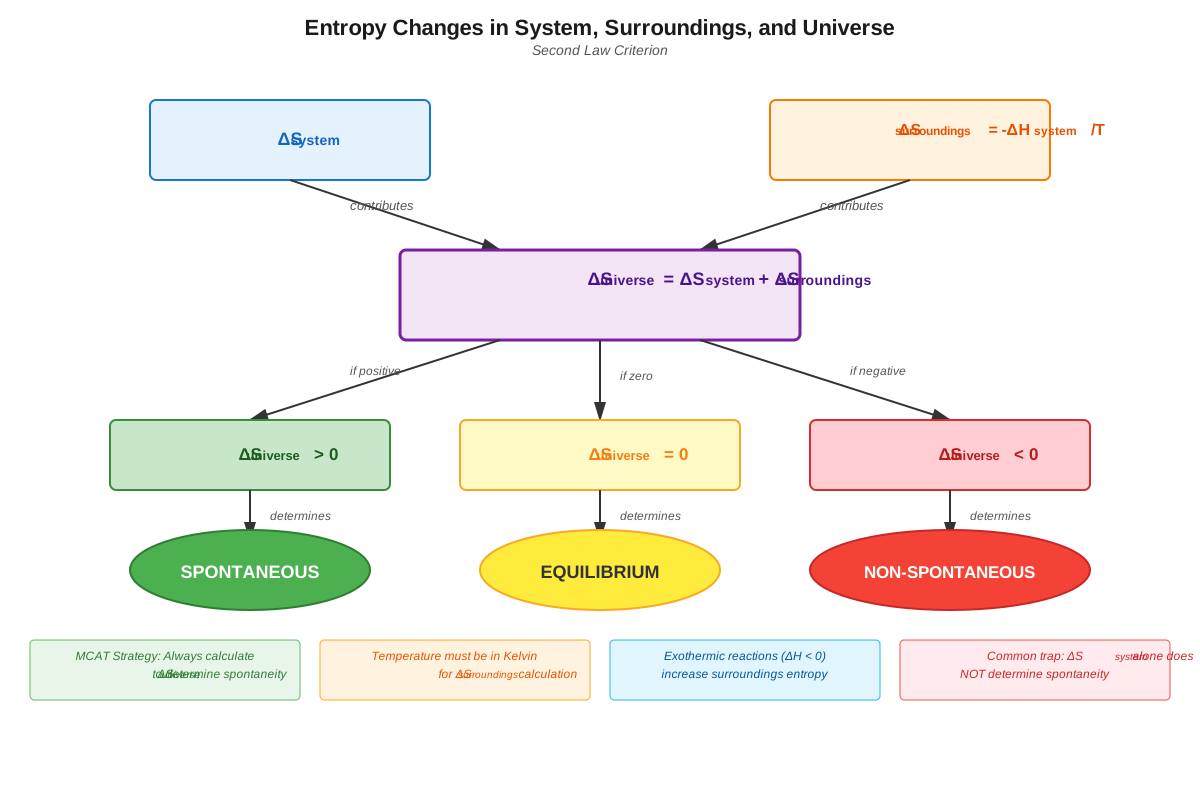
For MCAT purposes, the most useful formulation focuses on entropy: spontaneous processes increase the total entropy of the universe. This version directly connects to Gibbs free energy calculations and biological applications. The universe is divided into system (the part we're studying) and surroundings (everything else), so:
ΔS_universe = ΔS_system + ΔS_surroundingsA process is spontaneous when ΔS_universe > 0, even if ΔS_system is negative, provided that ΔS_surroundings is sufficiently positive to make the total positive.
Entropy: The Measure of Disorder
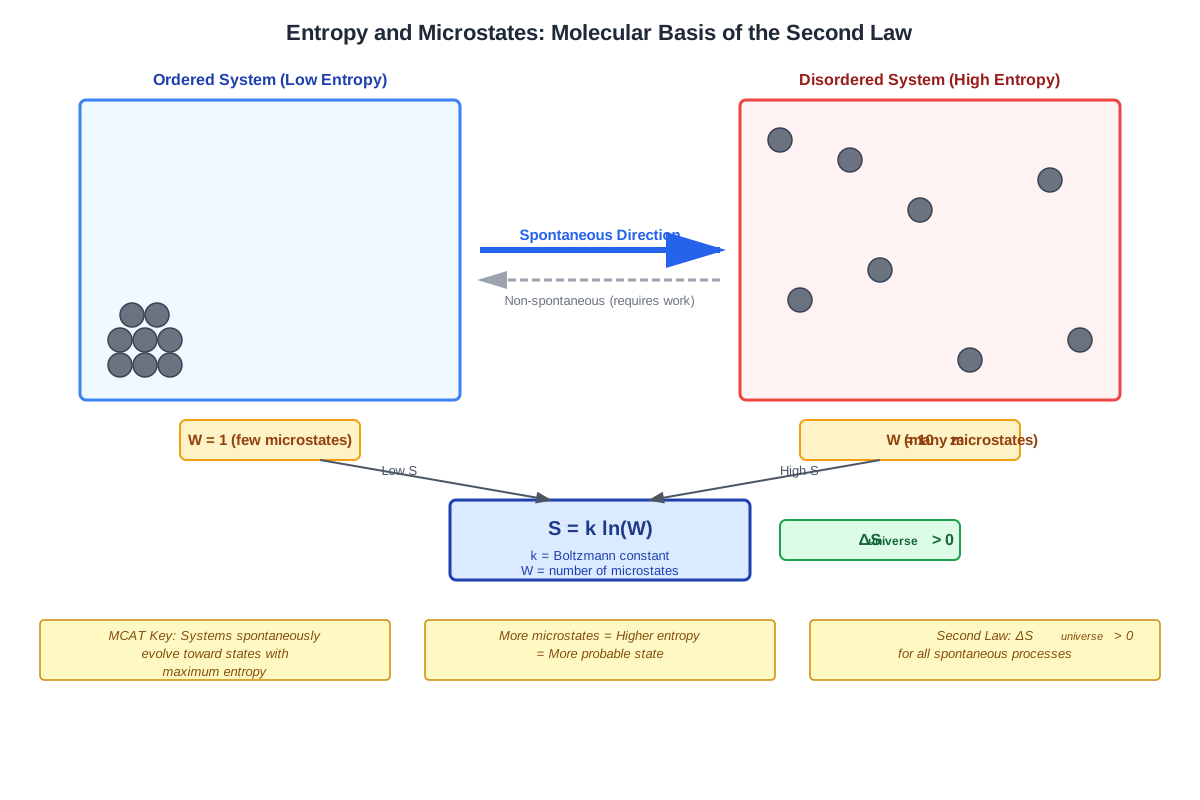
Entropy (S) quantifies the degree of disorder, randomness, or number of possible microstates in a system. At the molecular level, entropy relates to the number of ways particles can be arranged while maintaining the same macroscopic properties. A system with high entropy has many possible arrangements (high disorder), while low entropy indicates few arrangements (high order).
The statistical definition of entropy, given by Boltzmann's equation, is:
S = k_B ln(W)where k_B is Boltzmann's constant and W represents the number of microstates. This equation reveals that entropy increases logarithmically with the number of possible arrangements. For the MCAT, the key insight is that processes naturally proceed toward states with more possible arrangements—greater disorder.
Entropy is a state function, meaning its change depends only on initial and final states, not the path taken. The change in entropy for a reversible process is calculated as:
ΔS = q_rev / Twhere q_rev is the heat transferred reversibly and T is the absolute temperature in Kelvin. This equation shows that entropy change is directly proportional to heat absorbed and inversely proportional to temperature—adding heat at low temperature produces a larger entropy increase than adding the same heat at high temperature.
Factors Affecting Entropy
Several factors systematically affect entropy changes, and recognizing these patterns enables quick qualitative predictions:
Phase transitions: Entropy increases in the order solid < liquid < gas. When substances melt, vaporize, or sublime, entropy increases significantly because particles gain freedom of movement. Conversely, condensation, freezing, and deposition decrease entropy.
Temperature changes: Heating a substance increases its entropy because particles move faster and occupy more energy states. The relationship is not linear—entropy increases more slowly at higher temperatures (ΔS = q/T shows inverse temperature dependence).
Volume changes: For gases, expanding into a larger volume increases entropy because particles have more spatial arrangements available. Compression decreases entropy. This explains why gases spontaneously expand to fill containers.
Mixing and dissolution: Mixing different substances or dissolving solutes increases entropy because particles become more randomly distributed. Separating mixtures decreases entropy and requires energy input.
Number of particles: Reactions that produce more gas molecules from fewer molecules increase entropy. For example, decomposition reactions typically increase entropy, while synthesis reactions often decrease it.
Molecular complexity: More complex molecules generally have higher entropy than simpler ones at the same temperature because they have more vibrational and rotational modes available.
Entropy Changes in Systems and Surroundings
Analyzing spontaneity requires calculating entropy changes for both system and surroundings. For the system, entropy change depends on the specific process:
For phase transitions at constant temperature:
ΔS_system = ΔH_transition / TFor temperature changes at constant pressure:
ΔS_system = nC_p ln(T_final / T_initial)For ideal gas expansion:
ΔS_system = nR ln(V_final / V_initial)For the surroundings, entropy change relates to heat flow. When the system releases heat (exothermic process), the surroundings absorb that heat, increasing their entropy:
ΔS_surroundings = -q_system / T = -ΔH_system / T(at constant pressure, where q = ΔH)
The negative sign appears because heat lost by the system is gained by the surroundings. This relationship is crucial: exothermic processes (negative ΔH) increase surroundings entropy (positive ΔS_surroundings), while endothermic processes decrease it.
Spontaneity and the Second Law
A process is spontaneous if it occurs without continuous external intervention once initiated. Spontaneity does not imply speed—diamond converting to graphite is spontaneous but extremely slow. The second law provides the criterion for spontaneity:
A process is spontaneous if and only if ΔS_universe > 0
This leads to four possible scenarios:
| ΔS_system | ΔS_surroundings | ΔS_universe | Spontaneity | ||||
|---|---|---|---|---|---|---|---|
| Positive | Positive | Positive | Always spontaneous | ||||
| Positive | Negative | Depends on magnitudes | Spontaneous if \ | ΔS_system\ | > \ | ΔS_surroundings\ | |
| Negative | Positive | Depends on magnitudes | Spontaneous if \ | ΔS_surroundings\ | > \ | ΔS_system\ | |
| Negative | Negative | Negative | Never spontaneous |
Temperature plays a critical role in determining spontaneity when system and surroundings entropy changes oppose each other. Since ΔS_surroundings = -ΔH/T, temperature affects the magnitude of surroundings entropy change. This temperature dependence leads directly to the Gibbs free energy concept.
Reversible vs. Irreversible Processes
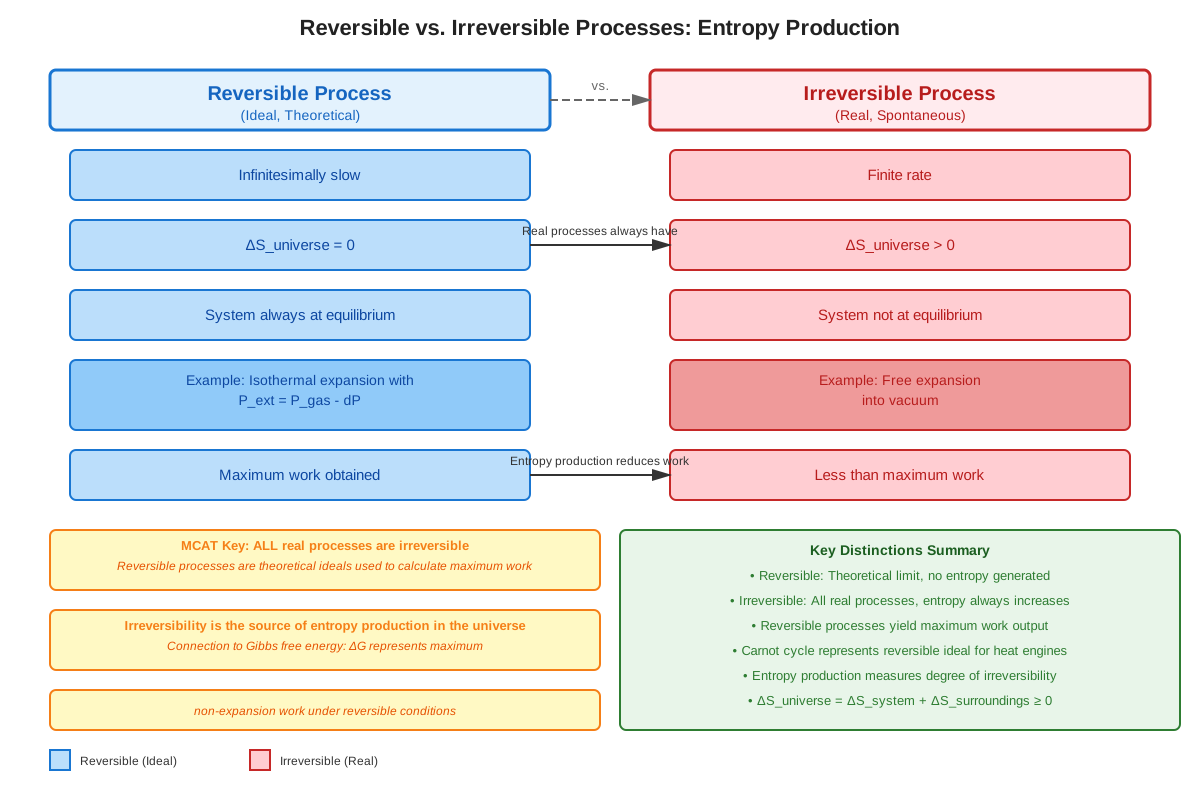
Reversible processes are idealized transformations that occur infinitely slowly through a series of equilibrium states. The system remains in equilibrium with its surroundings throughout, and the process can be reversed by an infinitesimal change in conditions. For reversible processes, ΔS_universe = 0—no net entropy is created.
Irreversible processes are all real processes that occur at finite rates. They generate entropy, making ΔS_universe > 0. Examples include:
- Heat flowing across a finite temperature difference
- Gas expanding into a vacuum (free expansion)
- Friction converting mechanical energy to heat
- Mixing of different substances
- Chemical reactions proceeding at measurable rates
The distinction matters for calculations: maximum work is obtained from reversible processes, while irreversible processes produce less work and more waste heat. Biological systems operate irreversibly but often approach reversibility to maximize efficiency—ATP hydrolysis in cells is carefully controlled to extract maximum useful work.
Connection to Gibbs Free Energy
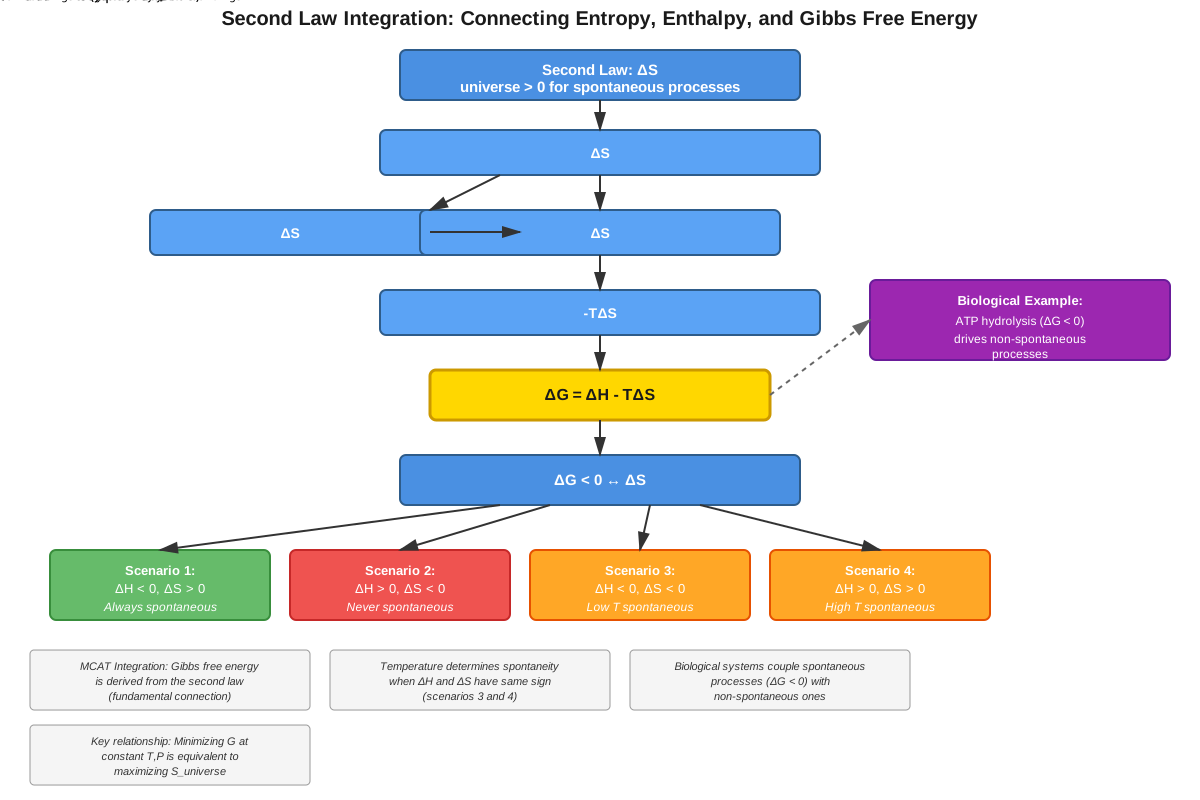
The second law's requirement that ΔS_universe > 0 for spontaneous processes connects directly to Gibbs free energy (ΔG). Substituting ΔS_surroundings = -ΔH/T into the universe entropy equation and rearranging yields:
ΔG = ΔH - TΔSwhere ΔG < 0 indicates spontaneity (equivalent to ΔS_universe > 0). This equation elegantly combines the second law with enthalpy considerations, showing that spontaneity results from competition between enthalpy (ΔH) and entropy (TΔS) terms.
The temperature coefficient (T) in front of ΔS explains why some reactions become spontaneous only at certain temperatures. Endothermic reactions with positive ΔS (like ice melting) become spontaneous above a critical temperature where TΔS exceeds ΔH. Exothermic reactions with negative ΔS (like gas condensation) become spontaneous below a critical temperature.
Concept Relationships
The Second law of thermodynamics forms the conceptual bridge between energy conservation (first law) and reaction spontaneity (Gibbs free energy). The first law establishes that energy cannot be created or destroyed, but provides no information about which direction processes will proceed. The second law adds the critical constraint that spontaneous processes must increase universal entropy, thereby determining directionality.
Within the second law framework, entropy serves as the central concept from which all other relationships flow. Entropy changes in the system depend on the specific process type (phase transition, temperature change, volume change, or chemical reaction), while entropy changes in the surroundings depend primarily on heat flow and temperature. These two entropy changes combine to determine universal entropy change, which directly predicts spontaneity.
The relationship map flows as follows:
Second Law Principle → Entropy as disorder measure → System entropy changes (calculated from process specifics) + Surroundings entropy changes (calculated from heat flow) → Universal entropy change → Spontaneity determination → Gibbs free energy (mathematical reformulation for convenience)
Temperature acts as a critical modulator throughout this framework, affecting both the magnitude of entropy changes (ΔS = q/T) and the relative importance of enthalpy versus entropy in determining spontaneity (ΔG = ΔH - TΔS). This temperature dependence explains phase transitions, temperature-dependent reaction favorability, and the coupling of unfavorable reactions to favorable ones in biological systems.
The second law connects backward to prerequisite concepts including heat, temperature, and state functions, while connecting forward to advanced topics like chemical equilibrium (where ΔG = 0), electrochemistry (where ΔG relates to cell potential), and biochemical energetics (where ATP hydrolysis drives unfavorable processes). Understanding these connections enables students to see thermodynamics as an integrated framework rather than isolated equations.
Quick check — test yourself on Second law of thermodynamics so far.
Try Flashcards →High-Yield Facts
⭐ The second law states that the total entropy of the universe always increases for spontaneous processes: ΔS_universe > 0 for spontaneity
⭐ Entropy is a state function measuring disorder or number of microstates: changes depend only on initial and final states, not path
⭐ For spontaneity, ΔS_universe = ΔS_system + ΔS_surroundings must be positive: both components must be calculated separately
⭐ Surroundings entropy change equals -ΔH_system/T: exothermic processes increase surroundings entropy; endothermic processes decrease it
⭐ Entropy increases in the order solid < liquid < gas: phase transitions to more disordered states increase entropy
- Entropy change for reversible heat transfer is ΔS = q_rev/T: adding heat at lower temperature produces larger entropy increase
- Processes that increase the number of gas molecules increase system entropy: decomposition reactions typically have positive ΔS
- Mixing and dissolution processes increase entropy: separating mixtures requires energy input and decreases entropy
- All real processes are irreversible and generate entropy: only idealized reversible processes have ΔS_universe = 0
- Temperature affects spontaneity through the TΔS term in ΔG = ΔH - TΔS: high temperature favors entropy-driven processes
- Living organisms maintain low entropy locally by increasing surroundings entropy more: metabolism couples favorable and unfavorable processes
- Heat engines cannot be 100% efficient due to the second law: some energy must be dissipated as waste heat
Common Misconceptions
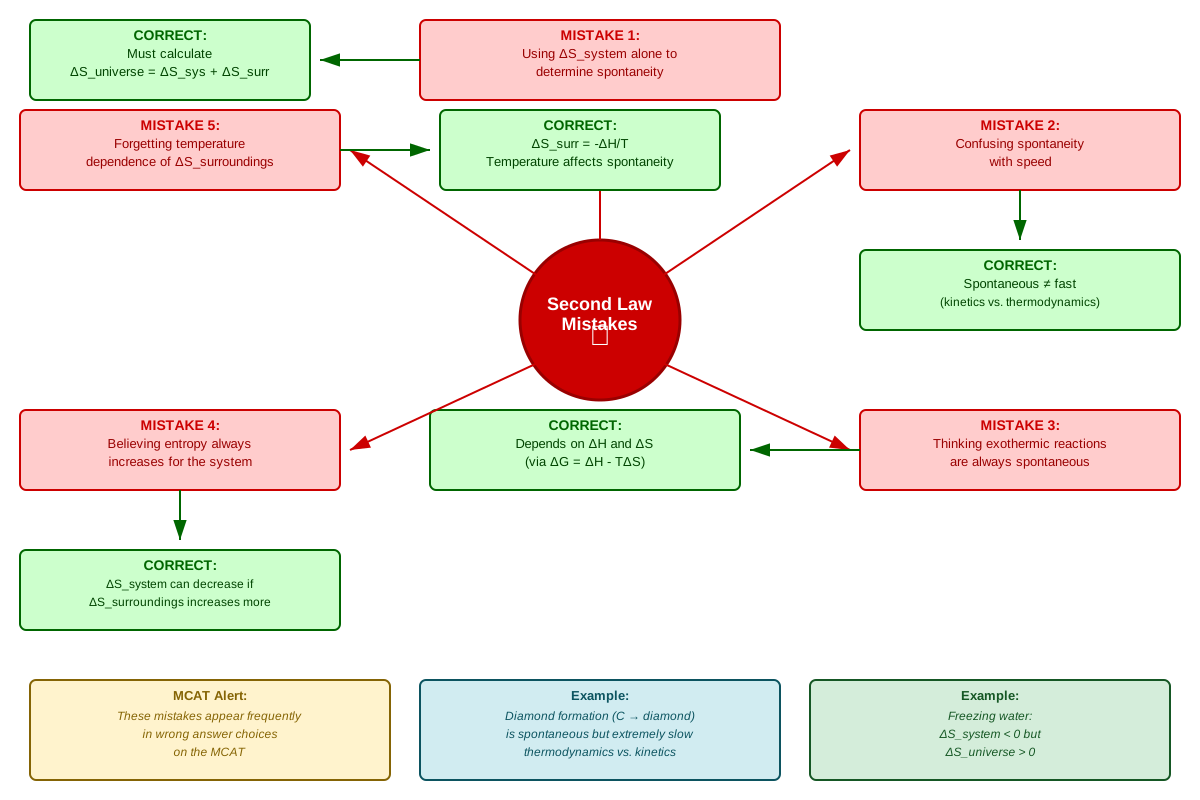
Misconception: Entropy always increases in every system during spontaneous processes.
Correction: Entropy of the universe (system + surroundings) must increase, but system entropy can decrease if surroundings entropy increases more. Freezing water decreases system entropy but increases surroundings entropy through heat release, making the total change positive.
Misconception: Spontaneous processes occur quickly.
Correction: Spontaneity indicates thermodynamic favorability, not kinetic speed. Diamond converting to graphite is spontaneous (ΔG < 0) but occurs immeasurably slowly at room temperature due to high activation energy. Spontaneity and rate are independent concepts.
Misconception: Negative ΔS_system means a process cannot be spontaneous.
Correction: Processes with negative ΔS_system can be spontaneous if they are sufficiently exothermic to make ΔS_surroundings large and positive. Freezing, condensation, and many synthesis reactions have negative ΔS_system but are spontaneous under appropriate conditions because ΔS_surroundings > |ΔS_system|.
Misconception: The second law applies only to isolated systems.
Correction: The second law applies to the universe (system + surroundings), which is isolated. For non-isolated systems, we must account for entropy changes in both system and surroundings. Living organisms appear to violate the second law locally but actually obey it when surroundings are included.
Misconception: Entropy and enthalpy are the same thing.
Correction: Enthalpy (ΔH) measures heat content and bond energies, while entropy (ΔS) measures disorder and number of microstates. They are independent thermodynamic quantities that compete in determining spontaneity through ΔG = ΔH - TΔS. A reaction can be exothermic (negative ΔH) with decreasing entropy (negative ΔS) or vice versa.
Misconception: Reversible processes are common in nature.
Correction: All real processes are irreversible and generate entropy. Reversible processes are idealized limits approached infinitely slowly through equilibrium states. They serve as theoretical benchmarks for maximum efficiency but never occur in practice.
Misconception: Adding heat always increases entropy by the same amount regardless of temperature.
Correction: Entropy change equals q/T, so adding the same heat at lower temperature produces a larger entropy increase. This explains why exothermic reactions are more spontaneous at low temperature—the heat released creates more entropy in cold surroundings.
Worked Examples
Example 1: Calculating Universal Entropy Change
Problem: Consider the freezing of 1 mole of water at 0°C (273 K). The enthalpy of fusion is 6.01 kJ/mol. Calculate ΔS_system, ΔS_surroundings, and ΔS_universe. Is this process spontaneous at 0°C?
Solution:
Step 1: Calculate ΔS_system for the phase transition.
For a phase transition at constant temperature:
ΔS_system = ΔH_fusion / TSince we're freezing (reverse of fusion), ΔH = -6.01 kJ/mol = -6010 J/mol
ΔS_system = -6010 J/mol / 273 K = -22.0 J/(mol·K)The negative value makes sense—liquid water has higher entropy than ice, so freezing decreases system entropy.
Step 2: Calculate ΔS_surroundings.
When the system releases heat (exothermic), the surroundings absorb it:
ΔS_surroundings = -ΔH_system / T = -(-6010 J/mol) / 273 K = +22.0 J/(mol·K)The surroundings gain entropy as they absorb the heat of fusion.
Step 3: Calculate ΔS_universe.
ΔS_universe = ΔS_system + ΔS_surroundings = -22.0 + 22.0 = 0 J/(mol·K)Step 4: Interpret the result.
ΔS_universe = 0 indicates this is a reversible process at equilibrium. At exactly 0°C, water and ice coexist in equilibrium—neither freezing nor melting is spontaneous. Below 0°C, freezing becomes spontaneous (ΔS_universe > 0), while above 0°C, melting is spontaneous.
Key Insight: At phase transition temperatures, ΔS_system and ΔS_surroundings exactly cancel, creating equilibrium. This example demonstrates why phase transitions occur at specific temperatures and illustrates the balance between system and surroundings entropy changes.
Example 2: Predicting Temperature-Dependent Spontaneity
Problem: A reaction has ΔH° = +50 kJ/mol and ΔS° = +150 J/(mol·K). At what temperature does this reaction become spontaneous? Explain the thermodynamic reasoning.
Solution:
Step 1: Identify the spontaneity criterion.
A reaction is spontaneous when ΔG < 0. Using the Gibbs free energy equation:
ΔG = ΔH - TΔSFor spontaneity: ΔH - TΔS < 0
Step 2: Analyze the signs.
- ΔH = +50 kJ/mol (positive, endothermic—disfavors spontaneity)
- ΔS = +150 J/(mol·K) = +0.150 kJ/(mol·K) (positive, increasing disorder—favors spontaneity)
This is an entropy-driven reaction. At low temperature, the ΔH term dominates and ΔG is positive (non-spontaneous). At high temperature, the TΔS term dominates and ΔG becomes negative (spontaneous).
Step 3: Find the crossover temperature.
At the transition point, ΔG = 0:
0 = ΔH - TΔS
TΔS = ΔH
T = ΔH / ΔS = 50 kJ/mol / 0.150 kJ/(mol·K) = 333 K (60°C)
Step 4: Interpret the result.
- Below 333 K: ΔG > 0, reaction is non-spontaneous
- At 333 K: ΔG = 0, reaction is at equilibrium
- Above 333 K: ΔG < 0, reaction is spontaneous
Thermodynamic Reasoning: This endothermic reaction requires energy input (positive ΔH), which decreases surroundings entropy. However, the reaction increases system entropy significantly (positive ΔS). At low temperature, the entropy increase doesn't compensate for the unfavorable enthalpy. As temperature rises, the TΔS term grows larger, eventually overcoming the positive ΔH. Above 333 K, the entropy benefit outweighs the enthalpy cost, making ΔS_universe positive and the reaction spontaneous.
Real-World Connection: This pattern explains why calcium carbonate (limestone) decomposes to calcium oxide and carbon dioxide only at high temperatures—the decomposition is endothermic but increases entropy by producing gas molecules. This principle is used industrially in cement production.
Exam Strategy
Approaching Second Law Questions
When encountering Second law of thermodynamics MCAT questions, first identify whether the question asks about spontaneity, entropy changes, or the relationship between thermodynamic quantities. Read carefully to determine whether the question concerns the system, surroundings, or universe—this distinction is critical and frequently tested.
For spontaneity questions, immediately recall that ΔS_universe > 0 is the criterion, which translates to ΔG < 0 at constant temperature and pressure. If given ΔH and ΔS values, quickly assess their signs to determine temperature dependence:
- Both favorable (ΔH < 0, ΔS > 0): spontaneous at all temperatures
- Both unfavorable (ΔH > 0, ΔS < 0): non-spontaneous at all temperatures
- Mixed signs: temperature-dependent, requiring calculation or qualitative reasoning
Trigger Words and Phrases
Watch for these key phrases that signal second law concepts:
- "Spontaneous process": Immediately think ΔS_universe > 0 or ΔG < 0
- "Disorder" or "randomness": Direct references to entropy
- "Heat flow": Consider entropy changes in both system and surroundings
- "Reversible": Indicates ΔS_universe = 0, maximum work, infinitely slow process
- "Isolated system": Only system entropy matters; no surroundings interaction
- "At equilibrium": ΔG = 0, ΔS_universe = 0
- "Phase transition": Use ΔS = ΔH/T at transition temperature
- "Coupled reaction": Unfavorable process driven by favorable one; total ΔG must be negative
Process of Elimination Tips
When evaluating answer choices:
- Eliminate options that violate the second law: Any answer suggesting ΔS_universe < 0 for a spontaneous process is automatically wrong
- Check sign consistency: If a process is described as exothermic and spontaneous at all temperatures, ΔS_system must be positive (both factors favorable)
- Verify temperature logic: For temperature-dependent spontaneity, ensure the answer correctly identifies which temperature range favors the process based on ΔH and ΔS signs
- Watch for system vs. universe confusion: Answers that claim system entropy must increase for spontaneity are incorrect—only universe entropy must increase
- Identify irrelevant information: Questions often provide extra data; focus on what's needed for the specific calculation or concept being tested
Time Allocation
For discrete second law questions, allocate 60-90 seconds. These typically require quick conceptual reasoning rather than lengthy calculations. For passage-based questions integrating thermodynamics with other concepts, allocate 90-120 seconds, as you'll need to extract relevant information from the passage and apply multiple concepts.
If a calculation is required, set up the equation first, then check if the question asks for a numerical answer or just the sign/trend. Many MCAT questions can be answered qualitatively without completing calculations, saving valuable time. For example, if asked whether ΔS_universe is positive, you might determine this from signs alone without calculating exact values.
Memory Techniques
Mnemonics for Entropy Trends
"Gases Go Up": Entropy increases as substances transition from solid → liquid → gas. The more "up" in phase, the higher the entropy.
"Hot Stuff Spreads Out": Heating increases entropy because particles spread out over more energy states and move more randomly.
"More Molecules, More Mess": Reactions producing more gas molecules increase entropy (more particles = more disorder).
"Mix Makes Mess": Mixing and dissolution always increase entropy—separating requires work.
Visualization Strategy for Spontaneity
Create a mental 2×2 grid for spontaneity based on ΔH and ΔS signs:
                ΔS > 0              ΔS < 0
ΔH < 0    Always spontaneous    Low T spontaneous
          (Favorable both)      (Enthalpy-driven)

ΔH > 0    High T spontaneous    Never spontaneous
          (Entropy-driven)      (Unfavorable both)
Visualize this grid during the exam to quickly categorize reactions. The diagonal from top-left to bottom-right represents clear-cut cases, while the other diagonal represents temperature-dependent cases.
Acronym for Second Law Applications
SPUME - Second law Predicts Universal entropy Must increase for spontaneous processes:
- Spontaneous processes
- Produce entropy
- Universe total
- Must be
- Elevated (positive)
Conceptual Anchor
Remember this central principle: "Nature prefers disorder, but energy matters too." The second law says systems naturally move toward higher entropy (disorder), but enthalpy changes (energy release/absorption) also influence spontaneity. The competition between these factors, modulated by temperature, determines what actually happens.
Summary
The Second law of thermodynamics establishes that spontaneous processes increase the total entropy of the universe, providing the fundamental criterion for determining reaction directionality and spontaneity. Entropy, a state function measuring disorder or number of microstates, increases for processes involving phase transitions to less ordered states, temperature increases, volume expansion, mixing, and reactions producing more gas molecules. Spontaneity requires ΔS_universe = ΔS_system + ΔS_surroundings > 0, where system entropy depends on the specific process and surroundings entropy equals -ΔH_system/T. This framework connects directly to Gibbs free energy through ΔG = ΔH - TΔS, revealing that spontaneity results from competition between enthalpy and entropy factors, with temperature determining their relative importance. For MCAT success, students must recognize that system entropy can decrease during spontaneous processes if surroundings entropy increases more, understand that spontaneity indicates thermodynamic favorability rather than kinetic speed, and apply these principles to biological systems where unfavorable processes are coupled to favorable ones to maintain life's organized state against the universal tendency toward disorder.
Key Takeaways
- The second law states that ΔS_universe > 0 for all spontaneous processes, providing the fundamental criterion for spontaneity
- Entropy measures disorder and increases for phase transitions to less ordered states (solid → liquid → gas), heating, expansion, mixing, and reactions producing more particles
- Spontaneity requires positive total entropy change (system + surroundings), even if system entropy decreases, as long as surroundings entropy increases more
- Surroundings entropy change equals -ΔH/T, making exothermic processes increase surroundings entropy and endothermic processes decrease it
- Temperature determines spontaneity for reactions with competing enthalpy and entropy factors through ΔG = ΔH - TΔS
- Living organisms maintain local order by coupling unfavorable processes to favorable ones, ensuring total entropy increases
- All real processes are irreversible and generate entropy; reversible processes are idealized limits with ΔS_universe = 0
Related Topics
Gibbs Free Energy and Spontaneity: Building directly on the second law, this topic reformulates entropy considerations into the more convenient ΔG function, enabling quantitative predictions of spontaneity and equilibrium constants. Mastering the second law provides the conceptual foundation for understanding why ΔG < 0 indicates spontaneity.
Chemical Equilibrium: At equilibrium, ΔG = 0 and ΔS_universe = 0, representing the balance point where forward and reverse processes occur at equal rates. The second law explains why systems naturally approach equilibrium and why disturbing equilibrium causes spontaneous shifts.
Thermochemistry and Hess's Law: Understanding enthalpy changes (ΔH) is essential for calculating surroundings entropy changes (ΔS_surroundings = -ΔH/T), connecting calorimetry and bond energies to spontaneity predictions.
Electrochemistry: The relationship ΔG = -nFE° connects thermodynamic spontaneity to cell potentials, with the second law underlying why positive cell potentials indicate spontaneous redox reactions.
Biochemical Energetics: ATP hydrolysis, metabolic pathways, and coupled reactions all exemplify second law principles in biological contexts, showing how organisms maintain order while increasing universal entropy.
Practice CTA
Now that you've mastered the conceptual framework of the second law of thermodynamics, it's time to solidify your understanding through active practice. Work through the practice questions to test your ability to apply entropy concepts to diverse scenarios, from calculating entropy changes to predicting spontaneity under various conditions. Use the flashcards to reinforce high-yield facts and ensure rapid recall during the exam. Remember, thermodynamics questions reward deep conceptual understanding over memorization—focus on truly grasping why entropy governs spontaneity, and you'll confidently tackle any second law question the MCAT presents. Your investment in mastering this fundamental principle will pay dividends across chemistry, physics, and biochemistry sections!
Sign up free to keep reading
Create a free AnvayaPrep account to finish this MCAT guide on Second law of thermodynamics — plus flashcards and practice questions.