Overview
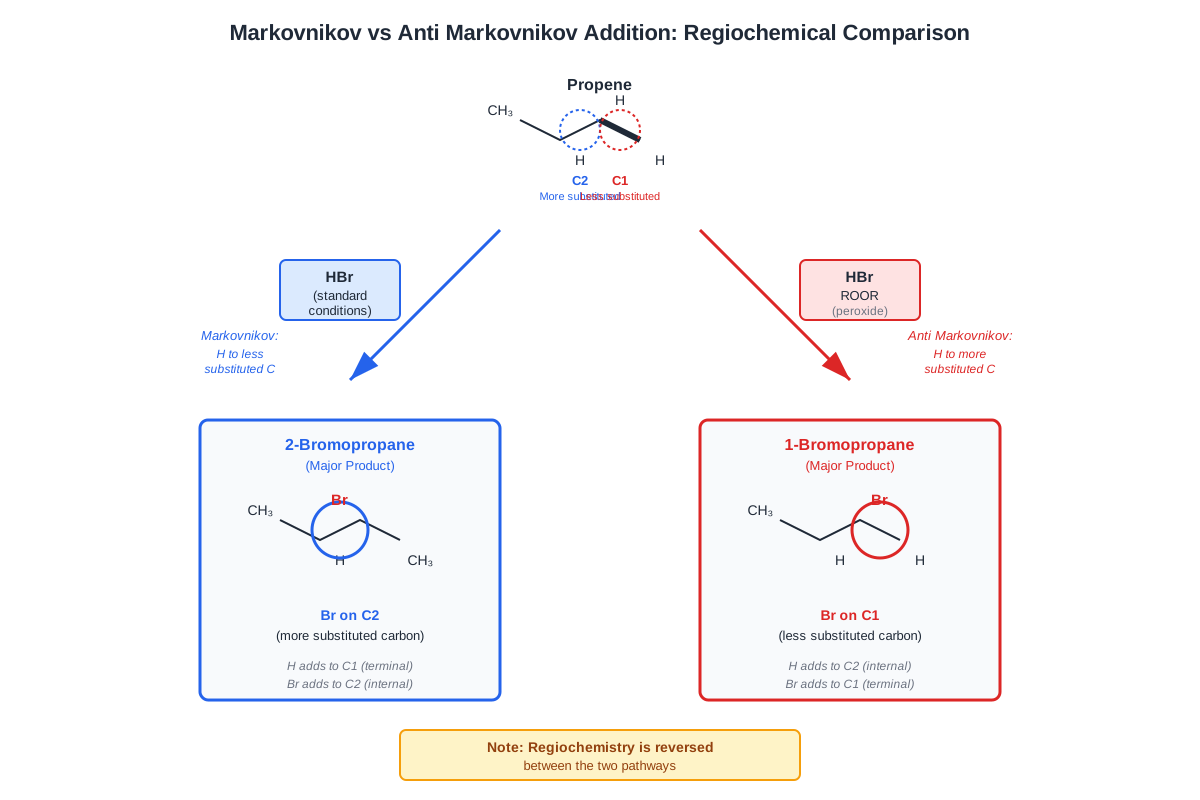
Anti Markovnikov addition represents a critical exception to the standard regioselectivity observed in alkene addition reactions. While Markovnikov's rule predicts that in the addition of HX to an alkene, the hydrogen atom bonds to the carbon with more hydrogen substituents (and the halogen bonds to the more substituted carbon), Anti Markovnikov addition produces the opposite regiochemical outcome. This reversal occurs through specific reaction conditions and mechanisms, most notably hydroboration-oxidation and radical-mediated additions, which proceed through different intermediates than typical carbocation-based additions.
Understanding Anti Markovnikov addition is essential for MCAT success because it tests students' ability to predict reaction products based on mechanism rather than memorization alone. The MCAT frequently presents alkene addition reactions in both discrete questions and passage-based contexts, requiring students to distinguish between conditions that favor Markovnikov versus Anti Markovnikov selectivity. This topic bridges fundamental concepts in Organic Chemistry including carbocation stability, radical chemistry, and the relationship between reaction mechanism and product distribution.
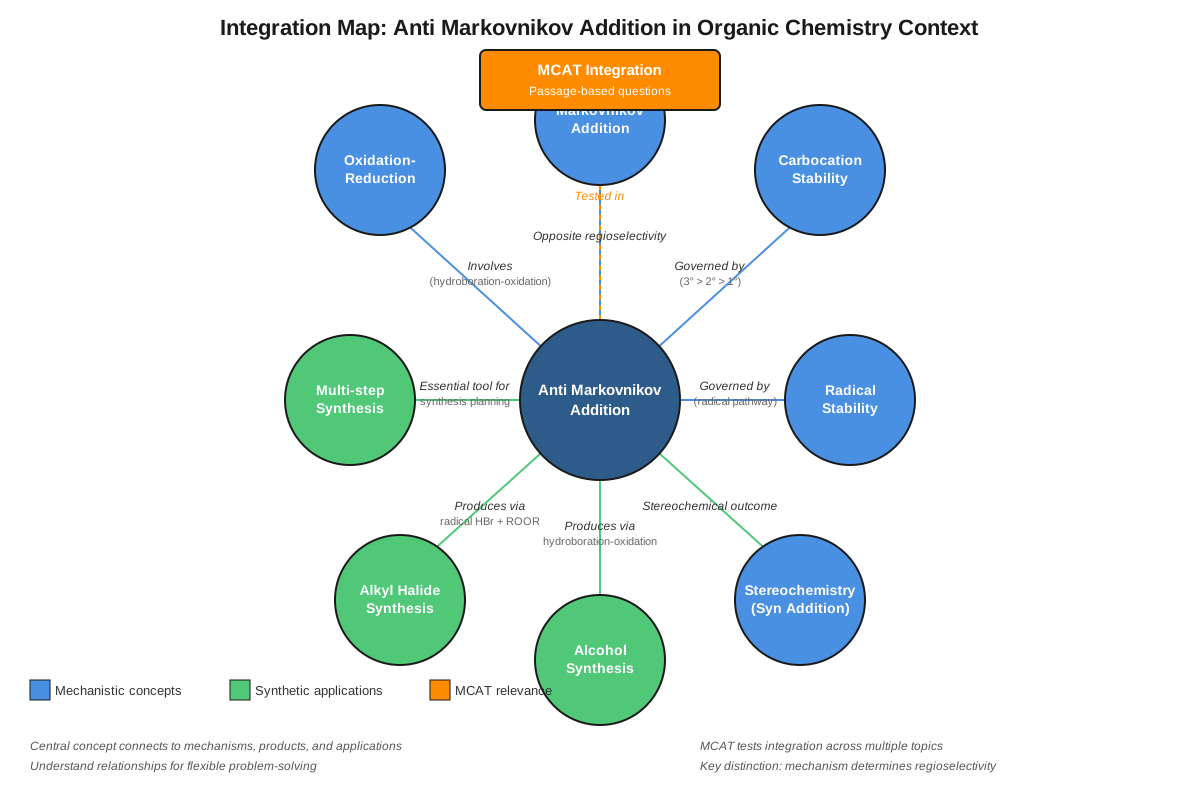
Within the broader context of Addition Reactions, Anti Markovnikov pathways demonstrate how reaction conditions and mechanisms fundamentally alter regioselectivity. This concept connects to stereochemistry (syn versus anti addition), oxidation-reduction reactions, and the practical synthesis of alcohols and alkyl halides. Mastery of this topic enables students to approach complex synthesis problems systematically and to predict products in multi-step reaction sequences—skills that appear regularly on the MCAT Organic Chemistry section.
Learning Objectives
- [ ] Define Anti Markovnikov addition using accurate Organic Chemistry terminology
- [ ] Explain why Anti Markovnikov addition matters for the MCAT
- [ ] Apply Anti Markovnikov addition to exam-style questions
- [ ] Identify common mistakes related to Anti Markovnikov addition
- [ ] Connect Anti Markovnikov addition to related Organic Chemistry concepts
- [ ] Distinguish between reaction conditions that produce Markovnikov versus Anti Markovnikov products
- [ ] Predict the regiochemical and stereochemical outcomes of hydroboration-oxidation reactions
- [ ] Explain the mechanistic basis for Anti Markovnikov selectivity in radical additions
Prerequisites
- Alkene structure and nomenclature: Understanding C=C double bonds is essential because these are the substrates for all addition reactions discussed in this topic
- Markovnikov's rule and carbocation stability: Anti Markovnikov addition is defined in contrast to normal Markovnikov selectivity, requiring knowledge of the standard rule
- Basic reaction mechanisms: Familiarity with curved arrow notation and elementary steps enables understanding of how different mechanisms produce different products
- Oxidation and reduction concepts: Hydroboration-oxidation involves both processes, and recognizing oxidation states helps track chemical transformations
- Radical chemistry fundamentals: The peroxide effect relies on radical intermediates, making basic radical stability and reactivity essential background
Why This Topic Matters
Clinical and Real-World Significance: Anti Markovnikov addition reactions are fundamental tools in pharmaceutical synthesis. Hydroboration-oxidation provides a reliable method for converting alkenes to primary alcohols, which serve as building blocks for numerous drug molecules. The ability to control regioselectivity allows chemists to synthesize specific isomers with desired biological activity. For example, many beta-blockers and bronchodilators contain alcohol groups positioned through Anti Markovnikov-selective reactions.
MCAT Exam Statistics: Anti Markovnikov addition appears in approximately 2-4 questions per MCAT administration, typically within the Chemical and Physical Foundations of Biological Systems section. Questions may be discrete (testing direct knowledge of reaction conditions and products) or embedded in passages describing synthetic schemes or biochemical pathways. The topic frequently appears alongside other alkene reactions, requiring students to differentiate between multiple addition pathways.
Common Exam Presentations: The MCAT tests this concept through several question formats: (1) predicting products given specific reagents (e.g., "What is the major product when 1-methylcyclohexene is treated with BH₃·THF followed by H₂O₂/NaOH?"), (2) identifying reagents needed to produce a specific product, (3) comparing Markovnikov and Anti Markovnikov products to test mechanistic understanding, and (4) passage-based questions where synthetic schemes require recognition of hydroboration-oxidation or radical additions. Questions often include distractors representing Markovnikov products or incorrect stereochemistry.
Core Concepts
Definition and Fundamental Principle
Anti Markovnikov addition refers to the addition of a reagent across a carbon-carbon double bond where the more electronegative or less substituted group bonds to the more substituted carbon atom—the opposite regioselectivity predicted by Markovnikov's rule. In the context of adding HX across an alkene, Anti Markovnikov addition places the hydrogen on the more substituted carbon and the X group on the less substituted carbon.
The key to understanding this reversal lies in recognizing that different reaction mechanisms produce different intermediates. While Markovnikov addition proceeds through carbocation intermediates (which form preferentially at more substituted positions due to stability), Anti Markovnikov addition proceeds through either radical intermediates or concerted mechanisms that avoid carbocation formation entirely.
Hydroboration-Oxidation: The Primary Anti Markovnikov Pathway
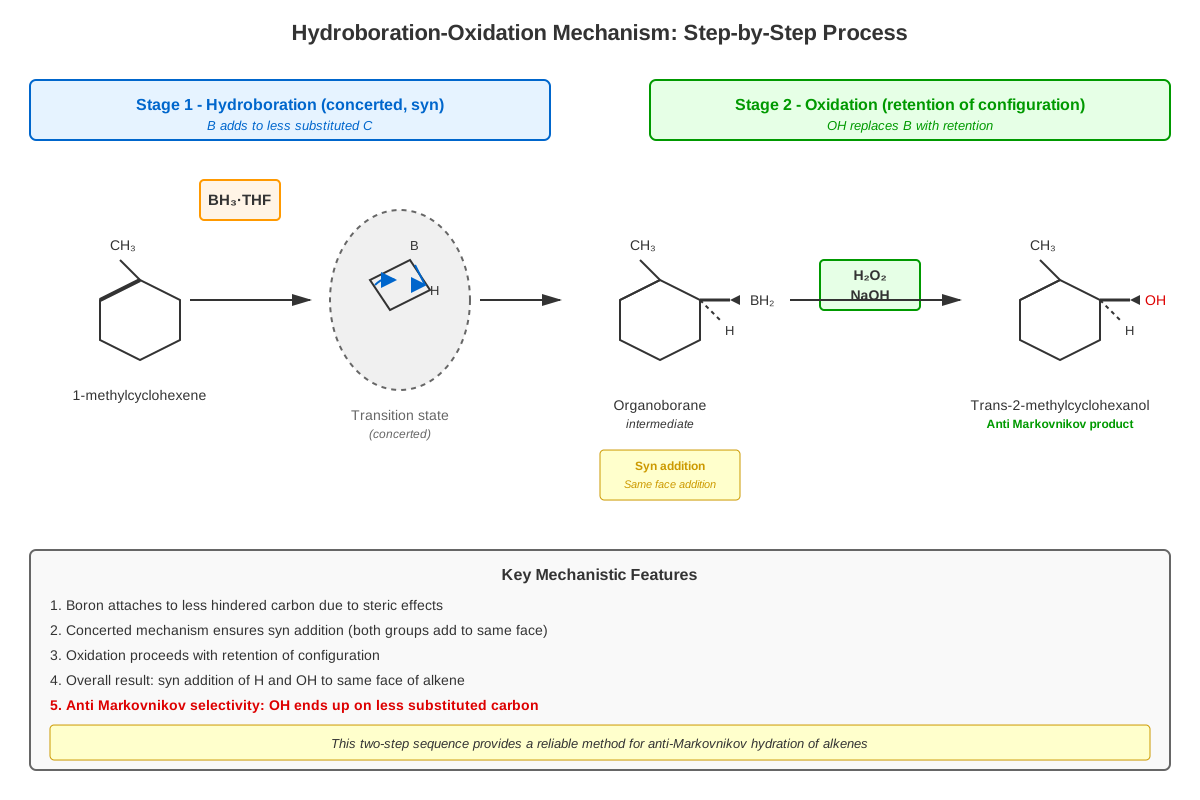
Hydroboration-oxidation represents the most important Anti Markovnikov addition for MCAT preparation. This two-step process converts alkenes to alcohols with Anti Markovnikov regioselectivity and syn stereochemistry.
Step 1: Hydroboration
The alkene reacts with borane (BH₃) or a borane complex such as BH₃·THF (tetrahydrofuran). Borane adds across the double bond in a single concerted step through a four-membered cyclic transition state. The boron atom, being electron-deficient, acts as an electrophile and bonds to the less substituted carbon (the carbon with more hydrogen atoms), while hydrogen bonds to the more substituted carbon. This occurs because:
- Boron seeks the position of highest electron density (the less substituted carbon has higher π-electron density)
- Steric factors favor boron bonding to the less hindered carbon
- The transition state has partial positive charge development at the more substituted position, which is stabilized by alkyl groups
The reaction proceeds with syn addition—both the boron and hydrogen add to the same face of the alkene. One BH₃ molecule can add to three alkene molecules sequentially, forming trialkylborane (R₃B).
Step 2: Oxidation
Treatment with hydrogen peroxide (H₂O₂) in basic conditions (NaOH) oxidizes the carbon-boron bond to a carbon-oxygen bond while maintaining the stereochemistry. The mechanism involves nucleophilic attack by hydroperoxide anion (HOO⁻) on boron, followed by migration of the alkyl group from boron to oxygen with retention of configuration. The result is an alcohol where the OH group occupies the position where boron was attached—the less substituted carbon.
Overall Result: The net transformation adds H and OH across the alkene with Anti Markovnikov regioselectivity (OH on the less substituted carbon) and syn stereochemistry (both groups add to the same face).
The Peroxide Effect: Radical-Mediated Anti Markovnikov Addition
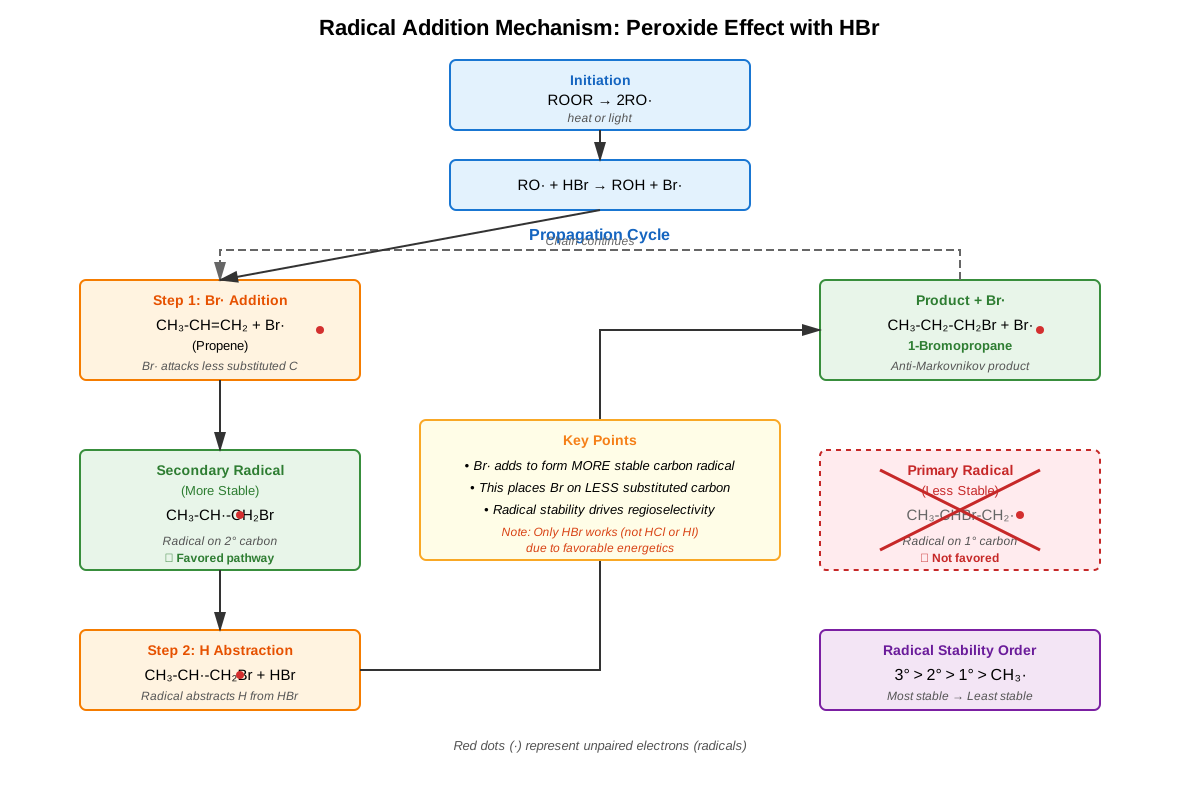
The peroxide effect (also called the Kharasch effect) describes the Anti Markovnikov addition of HBr to alkenes in the presence of peroxides (ROOR) or light. This represents the only common hydrogen halide addition that can be reversed to Anti Markovnikov selectivity through radical conditions.
Mechanism:
- Initiation: Peroxide undergoes homolytic cleavage to form alkoxy radicals (RO·), which abstract hydrogen from HBr to form bromine radicals (Br·)
- Propagation Step 1: The bromine radical adds to the alkene, forming a carbon radical at the more substituted position (because radical stability follows the same order as carbocation stability: 3° > 2° > 1°)
- Propagation Step 2: The carbon radical abstracts hydrogen from another HBr molecule, forming the product and regenerating Br· to continue the chain
Key Point: The regioselectivity is determined in the first propagation step. The bromine radical adds to the less substituted carbon because this produces the more stable carbon radical at the more substituted position. The subsequent hydrogen abstraction then places hydrogen at the more substituted carbon—Anti Markovnikov selectivity.
Important Limitation: This effect works reliably only with HBr. HCl is too unreactive (the H-Cl bond is too strong to be abstracted efficiently), and HI is too reactive (it adds rapidly through the ionic mechanism before radical pathways can compete).
Comparison Table: Markovnikov vs. Anti Markovnikov
| Feature | Markovnikov Addition | Anti Markovnikov Addition |
|---|---|---|
| Mechanism | Ionic (carbocation intermediate) | Concerted (hydroboration) or radical (peroxide effect) |
| Regioselectivity | H to less substituted C, X to more substituted C | H to more substituted C, X to less substituted C |
| Typical Reagents | HX (HCl, HBr, HI), H₂O/H⁺, ROH/H⁺ | BH₃ then H₂O₂/OH⁻; HBr/ROOR |
| Stereochemistry | Mixture (carbocation can be attacked from either face) | Syn (hydroboration); mixture (radical) |
| Rate-determining step | Carbocation formation | Concerted addition (hydroboration); radical addition (peroxide) |
| Intermediate stability | More substituted carbocation preferred | More substituted radical preferred (peroxide effect) |
Mechanistic Rationale for Regioselectivity
Understanding why these reactions produce Anti Markovnikov products requires analyzing the transition states and intermediates:
Hydroboration: The concerted mechanism avoids carbocation formation. In the four-membered transition state, partial positive charge develops at the carbon that will ultimately bond to boron. This partial positive charge is better stabilized at the more substituted position, so the transition state leading to boron attachment at the less substituted carbon is lower in energy. Additionally, steric effects favor the bulky boron atom bonding to the less hindered carbon.
Radical Addition: Radicals, like carbocations, are stabilized by alkyl substitution through hyperconjugation and inductive effects. When a bromine radical adds to an alkene, it adds to the less substituted carbon to generate the more stable (more substituted) carbon radical. This radical then abstracts hydrogen, placing H at the more substituted position.
Stereochemical Considerations
Hydroboration-oxidation produces syn addition products. When the alkene is cyclic or has defined geometry, both the boron and hydrogen add to the same face of the double bond. The subsequent oxidation maintains this stereochemistry, resulting in a syn relationship between the hydrogen and hydroxyl group in the product. This stereochemical outcome can be crucial for predicting products in complex molecules.
Radical additions generally produce mixtures of stereoisomers because the carbon radical intermediate can be attacked from either face before abstracting hydrogen. However, the regioselectivity remains Anti Markovnikov.
Concept Relationships
The concepts within Anti Markovnikov addition are interconnected through mechanistic principles. Reaction mechanism determines regioselectivity: concerted mechanisms (hydroboration) and radical mechanisms (peroxide effect) both avoid carbocation intermediates, leading to Anti Markovnikov products through different pathways. Intermediate stability (radical stability in the peroxide effect) influences where the reactive species forms, which in turn determines where the final groups attach.
Anti Markovnikov addition connects to prerequisite knowledge of Markovnikov's rule by providing the contrasting case—understanding both rules together enables prediction of products based on reaction conditions. The topic links to carbocation stability because recognizing when carbocations do NOT form is as important as knowing when they do. Alkene structure influences reactivity: more substituted alkenes show greater differences between Markovnikov and Anti Markovnikov products.
Looking forward, Anti Markovnikov addition connects to alcohol synthesis (hydroboration-oxidation is a key method for preparing primary alcohols from terminal alkenes), stereochemistry (syn addition in hydroboration), and radical chemistry (the peroxide effect exemplifies radical chain mechanisms). The concept also relates to oxidation-reduction because hydroboration-oxidation involves both processes in sequence.
Relationship Map:
Alkene structure → Reaction conditions (ionic vs. radical vs. concerted) → Mechanism type → Intermediate formed (carbocation vs. radical vs. none) → Regioselectivity (Markovnikov vs. Anti Markovnikov) → Product identity and stereochemistry
Quick check — test yourself on Anti Markovnikov addition so far.
Try Flashcards →High-Yield Facts
⭐ Hydroboration-oxidation (BH₃·THF followed by H₂O₂/NaOH) converts alkenes to alcohols with Anti Markovnikov regioselectivity and syn stereochemistry
⭐ The peroxide effect causes HBr (and only HBr reliably) to add to alkenes with Anti Markovnikov selectivity when peroxides (ROOR) or light are present
⭐ In hydroboration, boron bonds to the less substituted carbon of the alkene, and subsequent oxidation replaces boron with OH while maintaining stereochemistry
⭐ Anti Markovnikov addition places the more electronegative group (OH, Br) on the less substituted carbon—opposite to Markovnikov's rule
⭐ The peroxide effect works through a radical chain mechanism where Br· adds to the less substituted carbon to form the more stable carbon radical
- Hydroboration proceeds through a four-membered cyclic transition state with concerted bond formation
- One BH₃ molecule can react with three alkene molecules to form trialkylborane (R₃B)
- The stereochemistry of hydroboration-oxidation is syn addition—both H and OH add to the same face of the alkene
- HCl and HI do not reliably undergo Anti Markovnikov addition even with peroxides present
- The regioselectivity in radical HBr addition is determined by radical stability: more substituted radicals are more stable
- Steric effects contribute to hydroboration regioselectivity by favoring boron attachment to the less hindered carbon
Common Misconceptions
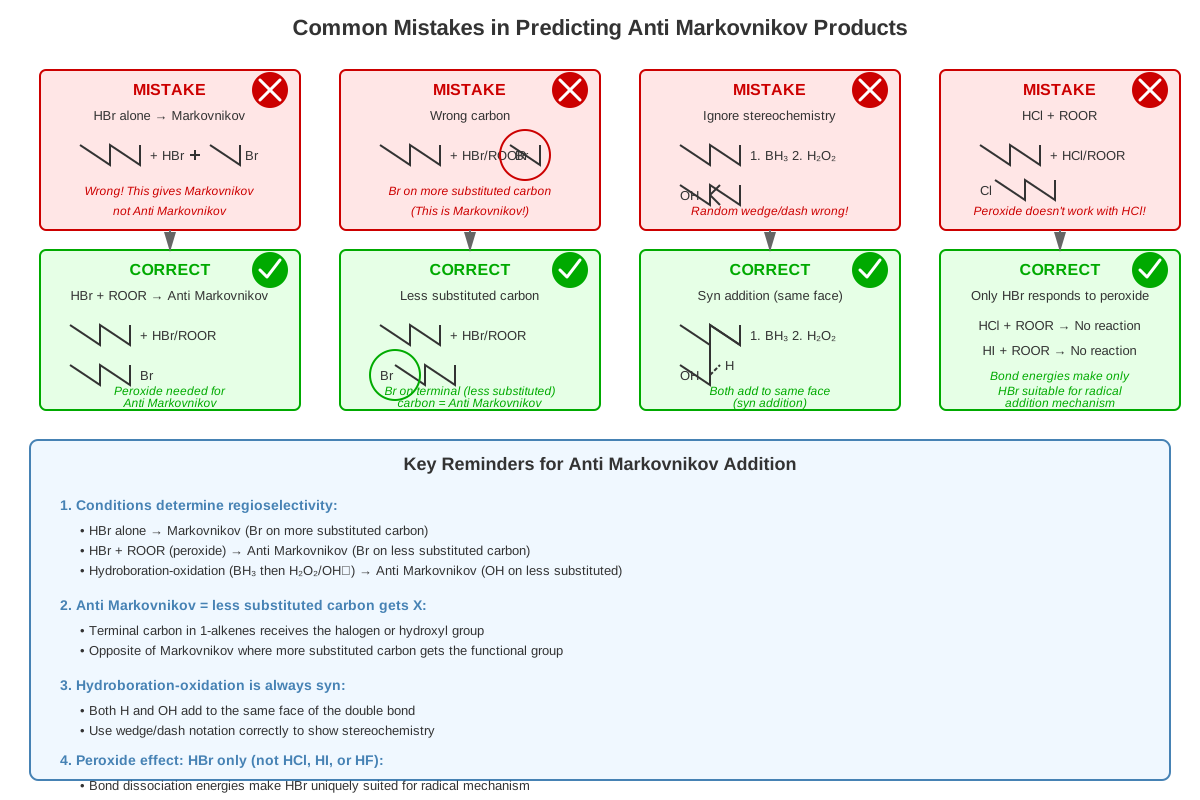
Misconception: All hydrogen halides (HCl, HBr, HI) undergo Anti Markovnikov addition in the presence of peroxides.
Correction: Only HBr reliably shows the peroxide effect. HCl has too strong an H-Cl bond for efficient radical abstraction, and HI reacts too quickly through the ionic mechanism for the radical pathway to compete effectively.
Misconception: Hydroboration-oxidation produces a mixture of stereoisomers because the oxidation step can occur from either face.
Correction: Hydroboration-oxidation produces syn addition products with defined stereochemistry. The oxidation step maintains the stereochemistry established during hydroboration because the alkyl group migrates from boron to oxygen with retention of configuration.
Misconception: Anti Markovnikov addition means the hydrogen always goes to the more substituted carbon in any addition reaction.
Correction: Anti Markovnikov addition specifically refers to reactions where the regioselectivity is opposite to Markovnikov's rule. The term is meaningful only in the context of reactions where Markovnikov selectivity would normally be expected. Not all addition reactions follow Markovnikov's rule in the first place.
Misconception: The peroxide effect works because peroxides stabilize carbocations at different positions.
Correction: The peroxide effect works through a radical mechanism, not a carbocation mechanism. Peroxides initiate radical chain reactions by forming radicals upon homolytic cleavage. The regioselectivity arises from radical stability, not carbocation stability.
Misconception: In hydroboration, the OH group ends up on the more substituted carbon because that's where the hydrogen was initially added.
Correction: In hydroboration, boron (not hydrogen) adds to the less substituted carbon, and the subsequent oxidation replaces boron with OH. The OH group therefore ends up on the less substituted carbon. The hydrogen that adds during hydroboration remains on the more substituted carbon throughout the reaction.
Misconception: Anti Markovnikov products are always less stable than Markovnikov products.
Correction: While Markovnikov products often represent the more thermodynamically stable constitutional isomer (due to more substituted functional groups), Anti Markovnikov selectivity is kinetically controlled by the reaction mechanism. The products are stable compounds; the difference lies in which isomer forms, not in product stability.
Worked Examples
Example 1: Predicting Hydroboration-Oxidation Products
Question: What is the major product when 2-methylbut-1-ene is treated with (1) BH₃·THF, then (2) H₂O₂, NaOH?
Solution:
Step 1: Identify the alkene structure. 2-Methylbut-1-ene has the structure:
    CH₃
    |
CH₃-CH-CH=CH₂
The double bond is between C1 and C2, with C1 being the terminal (less substituted) carbon and C2 being the internal (more substituted) carbon bearing the methyl branch.
Step 2: Apply hydroboration mechanism. During hydroboration, boron adds to the less substituted carbon (C1, the terminal position), and hydrogen adds to the more substituted carbon (C2). This occurs through a concerted syn addition.
Step 3: Apply oxidation. The oxidation step replaces the C-B bond with a C-O bond (specifically C-OH) while maintaining stereochemistry. Since boron was on C1, the OH group will be on C1.
Step 4: Draw the product:
    CH₃
    |
CH₃-CH-CH₂-CH₂OH
The product is 2-methylbutan-1-ol, a primary alcohol. This is the Anti Markovnikov product—the OH is on the less substituted carbon. If this reaction had followed Markovnikov's rule (as in acid-catalyzed hydration), the OH would be on C2, producing 2-methylbutan-2-ol, a tertiary alcohol.
Key Learning Point: Hydroboration-oxidation reliably produces primary alcohols from terminal alkenes and secondary alcohols from internal alkenes, always placing the OH on the less substituted carbon of the original double bond.
Example 2: Comparing Reaction Conditions
Question: An alkene with the structure CH₃CH₂CH=CH₂ (but-1-ene) is subjected to two different reaction conditions:
- Reaction A: H₂O, H₂SO₄ (acid-catalyzed hydration)
- Reaction B: (1) BH₃·THF, (2) H₂O₂, NaOH
Draw the major product of each reaction and explain the difference.
Solution:
Reaction A Analysis: Acid-catalyzed hydration follows Markovnikov's rule. The mechanism involves:
- Protonation of the alkene to form a carbocation
- The carbocation forms at the more substituted position (C2) because secondary carbocations are more stable than primary
- Water attacks the carbocation
- Deprotonation yields the alcohol
Product A: CH₃CH₂CH(OH)CH₃ (butan-2-ol, a secondary alcohol)
The OH is on C2, the more substituted carbon—Markovnikov product.
Reaction B Analysis: Hydroboration-oxidation follows Anti Markovnikov selectivity:
- BH₃ adds to the less substituted carbon (C1, the terminal position)
- Oxidation replaces B with OH at the same position
- The result is syn addition with Anti Markovnikov regioselectivity
Product B: CH₃CH₂CH₂CH₂OH (butan-1-ol, a primary alcohol)
The OH is on C1, the less substituted carbon—Anti Markovnikov product.
Comparison: Both reactions add H and OH across the double bond, but the regioselectivity is opposite. Reaction A produces a secondary alcohol (Markovnikov), while Reaction B produces a primary alcohol (Anti Markovnikov). This difference arises from the mechanisms: carbocation intermediate versus concerted addition.
MCAT Application: Questions often present two reaction pathways and ask students to identify which produces which product, or to select reagents that would produce a specific target molecule. Recognizing that acid-catalyzed hydration and hydroboration-oxidation are complementary methods for alcohol synthesis is high-yield knowledge.
Exam Strategy
Approaching MCAT Questions on Anti Markovnikov Addition:
- Identify the reaction type immediately: Look for key reagents. BH₃ (or B₂H₆) followed by H₂O₂/base always signals hydroboration-oxidation. HBr with peroxides (ROOR) or light indicates the peroxide effect. These are the two main Anti Markovnikov pathways for the MCAT.
- Draw the alkene structure carefully: Identify which carbon is more substituted and which is less substituted. This determines where groups will attach. Many students make errors by misidentifying substitution patterns.
- Apply the regioselectivity rule: For Anti Markovnikov addition, the more electronegative group (OH in hydroboration-oxidation, Br in the peroxide effect) goes to the LESS substituted carbon. Create a mental checklist: "Less substituted carbon gets OH/Br."
Trigger Words and Phrases:
- "BH₃" or "borane" followed by "H₂O₂" or "peroxide" → hydroboration-oxidation → Anti Markovnikov alcohol
- "HBr" with "peroxides" or "ROOR" or "light" → radical addition → Anti Markovnikov alkyl bromide
- "Syn addition" → likely hydroboration-oxidation
- "Primary alcohol from terminal alkene" → hydroboration-oxidation is the method
Process of Elimination Tips:
- If a question asks for the product of BH₃/H₂O₂ treatment and one answer choice shows a tertiary alcohol while another shows a primary alcohol, eliminate the tertiary alcohol—hydroboration-oxidation produces primary alcohols from terminal alkenes
- If answer choices differ in stereochemistry, remember that hydroboration-oxidation gives syn addition, not anti
- When comparing HCl, HBr, and HI with peroxides, only HBr reliably gives Anti Markovnikov products—eliminate choices suggesting HCl or HI undergo the peroxide effect
- If a question describes a radical mechanism but shows Markovnikov products, this is incorrect—radical additions of HBr are Anti Markovnikov
Time Allocation: These questions typically require 60-90 seconds. Spend 20 seconds identifying the reaction type and drawing the structure, 30 seconds applying regioselectivity rules, and 20 seconds checking your answer against the choices. Don't waste time drawing complete mechanisms unless specifically asked—focus on predicting products.
Exam Tip: If you forget which way hydroboration-oxidation goes, remember that it's the "opposite" of what you'd expect from Markovnikov's rule. The method was developed specifically to access Anti Markovnikov products, so it must place OH on the less substituted carbon.
Memory Techniques
Mnemonic for Hydroboration-Oxidation: "Boron Bonds to the Bigger side (less substituted = more H atoms = bigger H count)"
Mnemonic for Peroxide Effect: "Peroxides Produce Peculiar Placement" (peculiar = Anti Markovnikov)
Acronym for HBr Specificity: "Only Br Reacts" (OBR) with peroxides to give reliable Anti Markovnikov addition
Visualization Strategy: Picture the alkene as a seesaw. The more substituted side is "heavier" with alkyl groups. In Markovnikov addition, the "heavy" group (X) goes to the heavy side. In Anti Markovnikov addition, the heavy group goes to the "light" side (less substituted carbon). This visual helps remember the opposite selectivity.
Stereochemistry Memory Aid: "Synchronized swimmers move together" → In hydroboration, H and B add together (syn) to the same face, and this relationship is maintained through oxidation.
Mechanism Memory: For the peroxide effect, remember "Br Radical Adds to Less substituted carbon to make More stable radical" (BRALM). This captures the key mechanistic step determining regioselectivity.
Summary
Anti Markovnikov addition represents a crucial exception to standard alkene addition regioselectivity, producing products where the more electronegative group bonds to the less substituted carbon of the original double bond. The two primary pathways—hydroboration-oxidation and the peroxide effect with HBr—achieve this selectivity through mechanisms that avoid carbocation intermediates. Hydroboration-oxidation proceeds through a concerted addition of BH₃ followed by oxidative replacement of boron with hydroxyl, yielding alcohols with Anti Markovnikov regioselectivity and syn stereochemistry. The peroxide effect operates through a radical chain mechanism where bromine radical adds to form the most stable carbon radical, resulting in Anti Markovnikov placement of bromine. Understanding these mechanisms enables prediction of products based on reaction conditions rather than memorization. For MCAT success, students must recognize the key reagents (BH₃ then H₂O₂/OH⁻ for hydroboration-oxidation; HBr with ROOR for peroxide effect), apply regioselectivity rules correctly, and distinguish these pathways from Markovnikov additions. This knowledge integrates with broader organic chemistry concepts including radical chemistry, stereochemistry, and synthetic strategy.
Key Takeaways
- Anti Markovnikov addition places the more electronegative group (OH, Br) on the less substituted carbon of an alkene—opposite to Markovnikov's rule
- Hydroboration-oxidation (BH₃·THF then H₂O₂/NaOH) is the primary method for Anti Markovnikov alcohol synthesis, producing syn addition products
- The peroxide effect causes HBr (specifically, not HCl or HI) to add with Anti Markovnikov selectivity through a radical chain mechanism
- Mechanism determines regioselectivity: concerted and radical mechanisms avoid carbocations and produce Anti Markovnikov products
- Recognizing reagents is key for MCAT questions: BH₃ followed by oxidation signals hydroboration-oxidation; HBr with peroxides signals radical addition
- Hydroboration places boron on the less substituted carbon due to both electronic factors (partial positive charge stabilization) and steric factors
- The stereochemistry of hydroboration-oxidation is syn addition, maintained throughout both steps of the reaction sequence
Related Topics
Markovnikov Addition Reactions: Understanding standard Markovnikov selectivity in HX additions, acid-catalyzed hydration, and halogenation provides the foundation for recognizing when and why Anti Markovnikov pathways differ. Mastering both rules together enables comprehensive prediction of addition reaction products.
Carbocation Rearrangements: While Anti Markovnikov additions avoid carbocations, understanding carbocation chemistry helps explain why alternative mechanisms evolved and why regioselectivity differs between ionic and non-ionic pathways.
Radical Chain Mechanisms: The peroxide effect exemplifies radical chain reactions with initiation, propagation, and termination steps. Deeper study of radical chemistry illuminates why only HBr undergoes reliable Anti Markovnikov addition with peroxides.
Stereochemistry of Addition Reactions: Hydroboration-oxidation produces syn addition, while other additions may be anti or produce mixtures. Systematic study of stereochemical outcomes across different addition reactions builds three-dimensional thinking skills.
Alcohol Synthesis Methods: Hydroboration-oxidation is one of several methods for preparing alcohols from alkenes. Comparing this method with acid-catalyzed hydration, oxymercuration-demercuration, and others provides a complete toolkit for synthetic planning.
Practice CTA
Now that you've mastered the core concepts of Anti Markovnikov addition, it's time to solidify your understanding through active practice. Attempt the practice questions to test your ability to predict products, identify reagents, and distinguish between Markovnikov and Anti Markovnikov pathways under exam conditions. Use the flashcards to reinforce high-yield facts and reagent recognition. Remember: understanding the mechanism is more powerful than memorizing products. When you can explain why boron bonds to the less substituted carbon or why the peroxide effect works only with HBr, you've achieved true mastery. This depth of understanding will serve you not only on discrete questions but also in complex passage-based scenarios where Anti Markovnikov addition appears as part of multi-step syntheses. You've got this—apply what you've learned and watch your confidence grow!
Sign up free to keep reading
Create a free AnvayaPrep account to finish this MCAT guide on Anti Markovnikov addition — plus flashcards and practice questions.