Overview
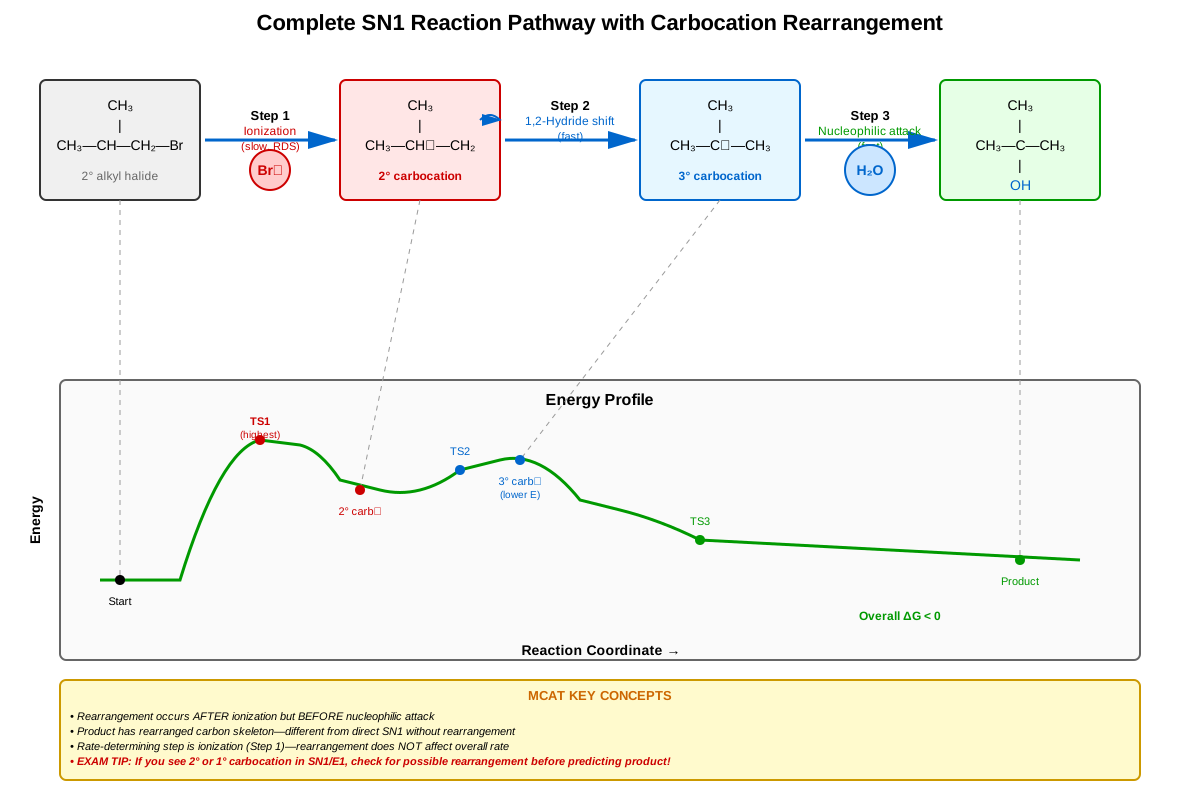
Carbocation rearrangements represent a critical mechanistic phenomenon in Organic Chemistry that frequently determines the outcome of substitution and elimination reactions. When carbocations form as reactive intermediates during chemical transformations, they may undergo structural reorganization through the migration of adjacent atoms or groups to achieve greater thermodynamic stability. This process fundamentally alters the carbon skeleton of molecules, leading to products that differ from those predicted by simple mechanistic analysis. Understanding these rearrangements is essential for predicting reaction outcomes in SN1 and E1 mechanisms, where carbocation intermediates are obligatory.
For the MCAT, carbocation rearrangements appear regularly in the Chemical and Physical Foundations of Biological Systems section, particularly in discrete questions and passage-based problems involving reaction mechanisms. The exam tests whether students can recognize conditions that favor rearrangement, predict the most stable carbocation product, and trace the structural changes that occur during migration. These concepts integrate seamlessly with broader themes in Organic Chemistry MCAT preparation, including reaction mechanisms, stereochemistry, and structure-reactivity relationships.
Mastery of carbocation rearrangements Organic Chemistry principles provides the foundation for understanding more complex transformations in biological systems, including terpene biosynthesis, steroid rearrangements, and certain enzymatic mechanisms. The topic bridges fundamental concepts of carbocation stability with practical applications in predicting reaction pathways—a skill that distinguishes high-scoring students from those who merely memorize reaction products without understanding the underlying mechanistic logic.
Learning Objectives
- [ ] Define carbocation rearrangements using accurate Organic Chemistry terminology
- [ ] Explain why carbocation rearrangements matter for the MCAT
- [ ] Apply carbocation rearrangements to exam-style questions
- [ ] Identify common mistakes related to carbocation rearrangements
- [ ] Connect carbocation rearrangements to related Organic Chemistry concepts
- [ ] Predict when a carbocation will undergo rearrangement based on structural features
- [ ] Distinguish between 1,2-hydride shifts and 1,2-alkyl shifts in carbocation intermediates
- [ ] Trace the complete mechanistic pathway from starting material through rearranged product
Prerequisites
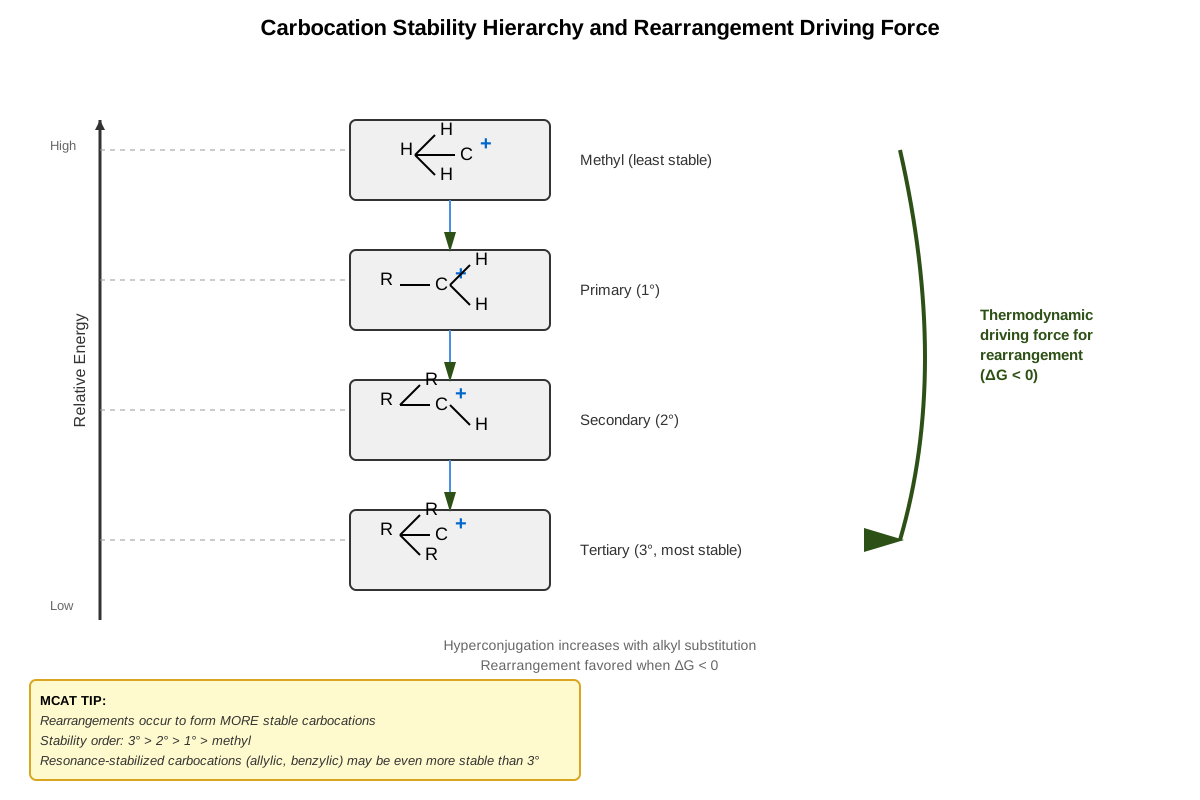
- Carbocation stability trends: Understanding that tertiary > secondary > primary > methyl carbocations follows from hyperconjugation and inductive effects, which determines the thermodynamic driving force for rearrangement
- SN1 and E1 mechanisms: These unimolecular reactions proceed through carbocation intermediates, creating the conditions necessary for rearrangement to occur
- Resonance stabilization: Recognizing allylic and benzylic carbocations helps predict when rearrangement is unnecessary because the intermediate is already highly stabilized
- Basic reaction coordinate diagrams: Interpreting energy profiles allows visualization of how rearrangement lowers the overall energy of the carbocation intermediate
- Stereochemistry fundamentals: Understanding three-dimensional molecular structure is essential for tracking which groups migrate and predicting stereochemical outcomes
Why This Topic Matters
Carbocation rearrangements have profound clinical and industrial relevance. In biological systems, carbocation-like intermediates participate in the biosynthesis of cholesterol, steroid hormones, and terpenes—pathways that are targets for pharmaceutical intervention. The drug industry must account for potential rearrangements when designing synthetic routes to complex molecules, as unexpected skeletal reorganizations can lead to unwanted byproducts or reduced yields.
On the MCAT, carbocation rearrangements appear in approximately 2-4 questions per exam administration, according to analysis of released materials. These questions typically present as discrete items testing mechanism prediction or as passage-based problems embedded in synthetic chemistry or biochemical contexts. The exam frequently tests this concept by showing a starting material and asking students to identify the major product after treatment with conditions that generate carbocations (strong acids, polar protic solvents, good leaving groups). Alternatively, passages may describe unexpected products in a reaction sequence and ask students to explain the structural changes through mechanistic reasoning.
Common exam presentations include: (1) predicting products of alcohol dehydration reactions where rearrangement occurs, (2) explaining why certain SN1 reactions yield unexpected constitutional isomers, (3) identifying which carbocation intermediate is most likely to rearrange, and (4) selecting the correct mechanism that accounts for observed skeletal changes. The MCAT particularly favors questions that require students to integrate multiple concepts—for example, recognizing that a secondary carbocation will rearrange to a tertiary carbocation before undergoing nucleophilic attack or elimination.
Core Concepts
Definition and Fundamental Mechanism
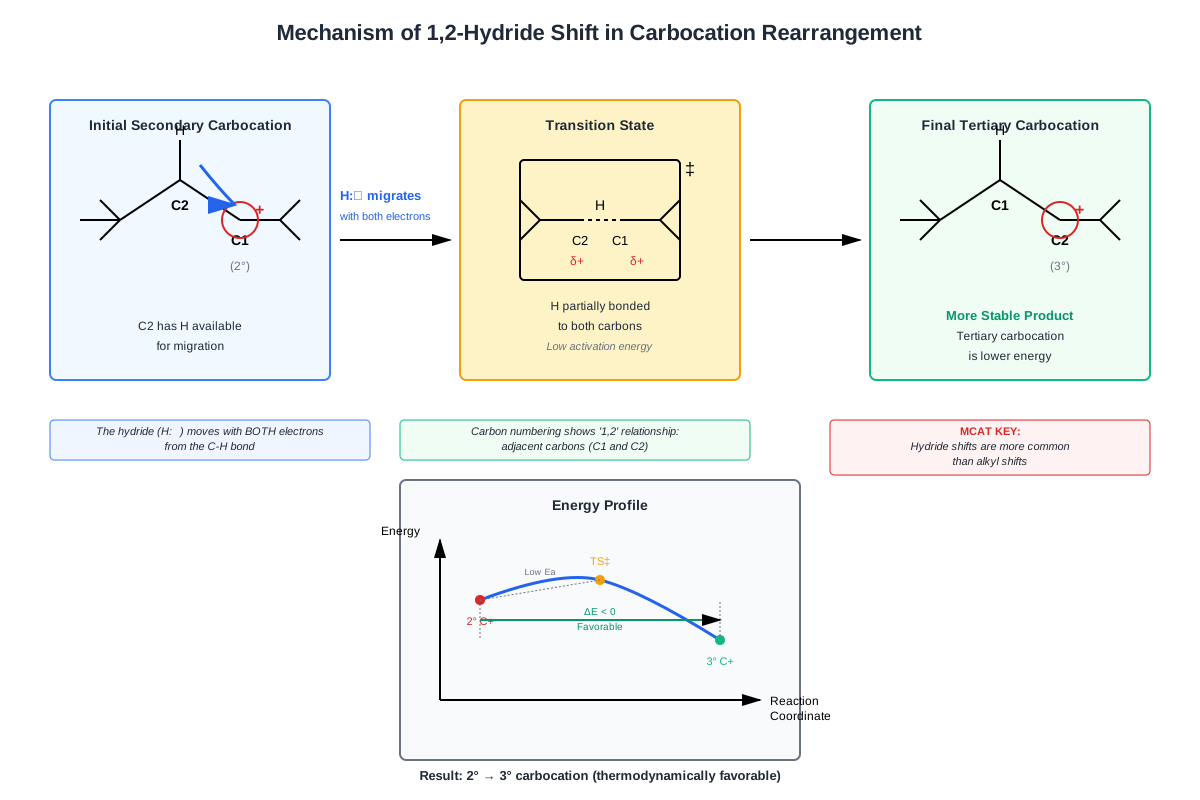
A carbocation rearrangement is a structural reorganization in which a carbocation intermediate undergoes intramolecular migration of an atom or group from an adjacent carbon to the positively charged carbon center. This process occurs when the rearranged carbocation is more stable than the initially formed carbocation. The migration is concerted—the migrating group moves with its bonding electrons while simultaneously forming a new bond to the electron-deficient carbon, ensuring that no free radicals or other high-energy intermediates form during the transition.
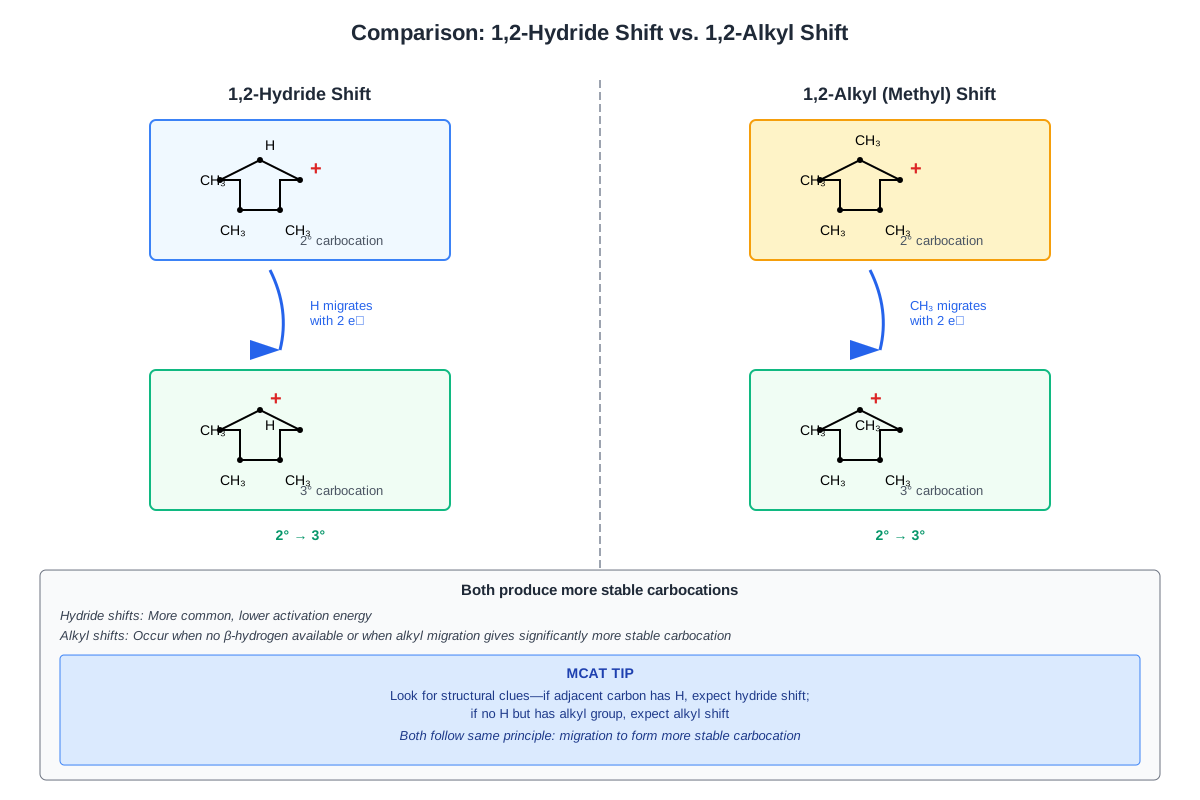
The two most common types of carbocation rearrangements are 1,2-hydride shifts and 1,2-alkyl shifts. In a 1,2-hydride shift, a hydrogen atom with its bonding pair of electrons migrates from an adjacent carbon (the β-carbon) to the carbocation center (the α-carbon). In a 1,2-alkyl shift, an alkyl group (methyl, ethyl, etc.) migrates in the same manner. Both processes convert the original carbocation into a new carbocation with a different carbon skeleton or charge location.
Thermodynamic Driving Force
The fundamental principle governing carbocation rearrangements is the stability hierarchy of carbocations: tertiary (3°) > secondary (2°) > primary (1°) > methyl. This stability order arises from hyperconjugation (overlap of adjacent C-H or C-C σ bonds with the empty p orbital of the carbocation) and inductive effects (electron donation from alkyl groups). Rearrangements occur spontaneously when they convert a less stable carbocation into a more stable one, lowering the overall energy of the intermediate.
For example, a secondary carbocation adjacent to a tertiary carbon will readily undergo rearrangement because the 1,2-shift produces a tertiary carbocation. However, a tertiary carbocation will not rearrange to form a secondary carbocation because this would be thermodynamically unfavorable. The energy difference between carbocation types provides the driving force—typically 10-15 kcal/mol between secondary and tertiary carbocations.
1,2-Hydride Shifts
A 1,2-hydride shift involves the migration of a hydrogen atom from the β-carbon to the α-carbon (the carbocation center). This is the most common type of rearrangement because hydrogen atoms are small and can migrate easily. The mechanism involves the simultaneous breaking of the C-H bond on the β-carbon and formation of a new C-H bond on the α-carbon, with the hydride (H with its bonding electrons) acting as the migrating species.
Consider the dehydration of 3-methyl-2-butanol in acidic conditions. Protonation of the hydroxyl group followed by loss of water generates a secondary carbocation at C-2. However, C-3 is a tertiary carbon bearing a hydrogen atom. A 1,2-hydride shift from C-3 to C-2 converts the secondary carbocation into a tertiary carbocation at C-3, which is significantly more stable. Subsequent elimination produces 2-methyl-2-butene as the major product rather than the expected 3-methyl-2-butene.
1,2-Alkyl Shifts
A 1,2-alkyl shift involves the migration of an entire alkyl group (methyl, ethyl, or larger) from the β-carbon to the carbocation center. These shifts are less common than hydride shifts because the migrating group is larger, creating greater steric demands during the transition state. However, when the stability gain is substantial, alkyl shifts occur readily.
1,2-Methyl shifts are the most frequently observed alkyl rearrangements. For instance, treatment of neopentyl bromide ((CH₃)₃CCH₂Br) under SN1 conditions initially forms a primary carbocation. A 1,2-methyl shift from the adjacent quaternary carbon to the primary carbocation center generates a tertiary carbocation, which then undergoes nucleophilic substitution. This explains why neopentyl systems give rearranged products despite starting from primary substrates.
Ring Expansion and Contraction
Carbocation rearrangements can also involve ring expansion or ring contraction when the carbocation is part of a cyclic system. These rearrangements occur when migration of a ring carbon creates a more stable carbocation, often by relieving ring strain or forming a larger, less strained ring.
A classic example is the conversion of cyclobutylmethyl carbocation to cyclopentyl carbocation through ring expansion. The four-membered ring has significant angle strain (ideal tetrahedral angle 109.5° compressed to ~90°). When a carbocation forms on the methyl substituent, one of the ring carbons can migrate, expanding the four-membered ring to a five-membered ring while simultaneously moving the positive charge onto the ring. The cyclopentyl carbocation is more stable both because it's secondary (compared to primary on the methyl group) and because the five-membered ring has less angle strain.
Competing Pathways
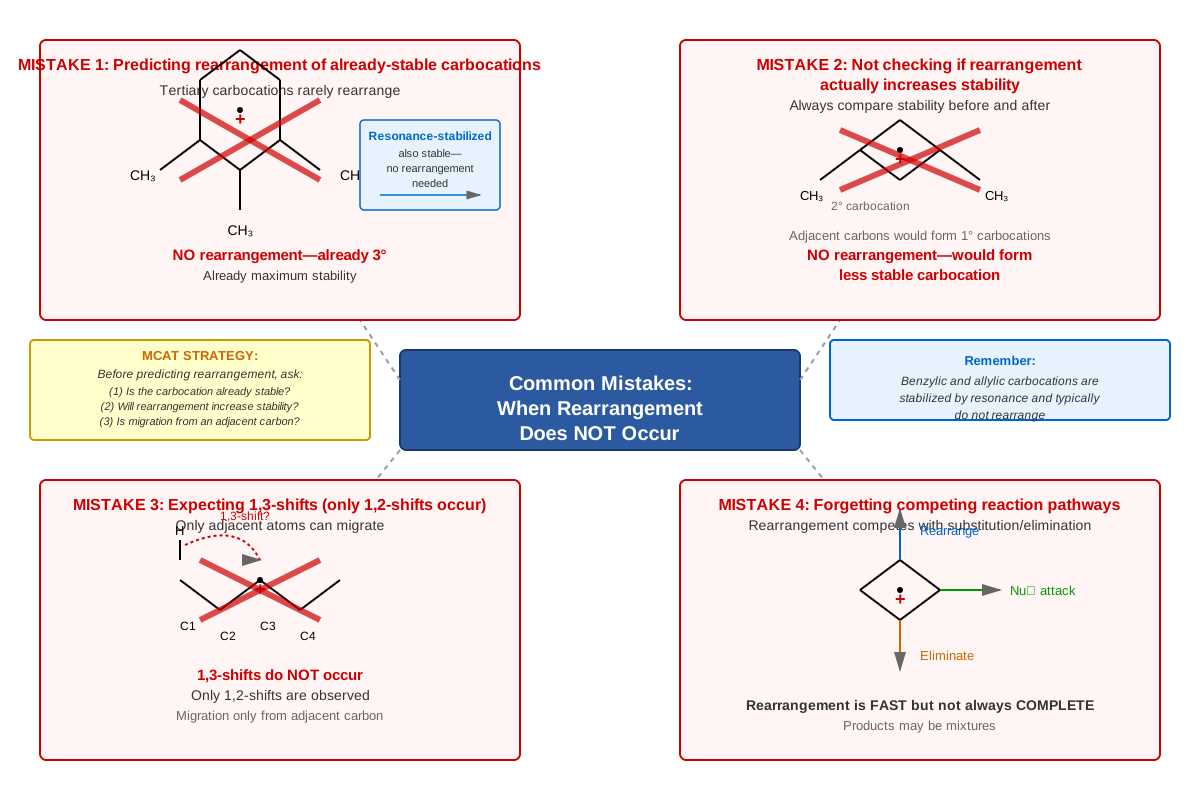
In reactions involving carbocation intermediates, rearrangement competes with other processes: nucleophilic attack (in SN1), elimination (in E1), and further rearrangements. The relative rates of these competing pathways determine the product distribution. Rearrangement is typically very fast—occurring on the timescale of 10⁻¹¹ to 10⁻⁹ seconds—but nucleophilic attack and elimination can be competitive, especially with good nucleophiles or strong bases.
The solvent plays a crucial role in determining whether rearrangement occurs before trapping. In highly polar protic solvents that stabilize carbocations (like water or alcohols), the carbocation lifetime is extended, allowing time for rearrangement. In less polar solvents or in the presence of excellent nucleophiles, the carbocation may be trapped before rearrangement can occur.
Recognition Patterns for MCAT Questions
Several structural features signal potential carbocation rearrangement:
| Structural Feature | Rearrangement Likelihood | Reason |
|---|---|---|
| 2° carbocation adjacent to 3° carbon | Very high | 1,2-shift produces much more stable 3° carbocation |
| 1° carbocation adjacent to 2° or 3° carbon | Very high | Any shift improves stability significantly |
| 3° carbocation with no adjacent quaternary carbon | Low | Already maximally stable |
| Carbocation adjacent to quaternary carbon | High | Methyl shift can produce 3° carbocation |
| Carbocation in strained ring | Moderate to high | Ring expansion relieves strain |
| Benzylic or allylic carbocation | Low | Already resonance-stabilized |
Concept Relationships
Carbocation rearrangements connect intimately with carbocation stability principles—the stability hierarchy provides the thermodynamic rationale for why rearrangements occur. Without understanding that tertiary carbocations are more stable than secondary carbocations, predicting rearrangement becomes impossible.
The relationship flows as follows: Leaving group departure → Carbocation formation → Stability assessment → Rearrangement (if favorable) → Nucleophilic attack or elimination → Product formation. Each step depends on the previous one, and rearrangement inserts itself between carbocation formation and product-forming steps when thermodynamically favorable.
Carbocation rearrangements directly impact substitution and elimination reaction outcomes. In SN1 mechanisms, rearrangement changes which carbon bears the positive charge, altering where the nucleophile attacks. In E1 mechanisms, rearrangement changes which β-hydrogens are available for elimination, affecting regiochemistry and sometimes stereochemistry of the alkene product.
The concept also connects to reaction kinetics. Because rearrangement is typically faster than nucleophilic attack in SN1 reactions, the rearranged carbocation often becomes the predominant intermediate, making the rearranged product the major product. This explains why reaction rates don't always correlate with product distributions—a fast-forming carbocation may rearrange to give a different product than initially expected.
Understanding carbocation rearrangements enhances comprehension of stereochemistry in substitution reactions. When rearrangement occurs, the stereochemical outcome at the original carbocation center becomes irrelevant because the positive charge has moved to a different carbon. This explains why some SN1 reactions show complete loss of stereochemical information beyond simple racemization.
Quick check — test yourself on Carbocation rearrangements so far.
Try Flashcards →High-Yield Facts
⭐ Carbocation rearrangements occur when a less stable carbocation can convert to a more stable carbocation through 1,2-migration of H or alkyl groups
⭐ The stability order (3° > 2° > 1° > methyl) determines the direction of rearrangement—always toward greater stability
⭐ 1,2-Hydride shifts are more common than 1,2-alkyl shifts because hydrogen is smaller and migrates more easily
⭐ Rearrangement competes with nucleophilic attack and elimination; in polar protic solvents, rearrangement often wins
⭐ Neopentyl systems (primary carbocations adjacent to quaternary carbons) always rearrange via 1,2-methyl shift to form tertiary carbocations
- Rearrangements are concerted processes—the migrating group moves with its bonding electrons in a single step
- Ring expansion from four-membered to five-membered rings is favorable due to relief of angle strain
- Benzylic and allylic carbocations rarely rearrange because they are already stabilized by resonance
- Multiple sequential rearrangements can occur if each step increases stability
- The migrating group moves with retention of configuration at the migrating carbon
- Carbocation rearrangements are essentially instantaneous compared to other reaction steps (10⁻¹¹ seconds)
- Wagner-Meerwein rearrangement is the classical name for carbocation rearrangements in bicyclic systems
Common Misconceptions
Misconception: All carbocations undergo rearrangement.
Correction: Only carbocations that can rearrange to form more stable carbocations will do so. Tertiary carbocations with no adjacent quaternary carbons typically do not rearrange because they are already at maximum stability. Resonance-stabilized carbocations (allylic, benzylic) also resist rearrangement.
Misconception: Rearrangement occurs after nucleophilic attack or elimination.
Correction: Rearrangement occurs immediately after carbocation formation and before any other reaction. The rearranged carbocation is the species that undergoes nucleophilic attack or elimination, not the originally formed carbocation.
Misconception: 1,2-Shifts can only involve hydrogen or methyl groups.
Correction: While 1,2-hydride and 1,2-methyl shifts are most common, larger alkyl groups (ethyl, propyl, even phenyl) can migrate if the stability gain justifies the higher activation energy required for moving a bulkier group.
Misconception: Rearrangement changes the stereochemistry at the migrating group.
Correction: The migrating group retains its configuration during the shift. If a chiral center migrates, it maintains its stereochemical configuration in the product. However, the carbon that originally bore the positive charge loses all stereochemical information.
Misconception: SN2 reactions can involve carbocation rearrangements.
Correction: SN2 reactions proceed through a concerted mechanism with no carbocation intermediate, so rearrangement cannot occur. Only reactions that proceed through carbocation intermediates (SN1, E1, and some addition reactions) can exhibit rearrangement.
Misconception: Rearrangement always produces a single product.
Correction: Multiple rearrangement pathways may be possible, and the carbocation may be trapped by nucleophile or undergo elimination before complete rearrangement, leading to product mixtures. Additionally, the rearranged carbocation may have multiple sites for nucleophilic attack or elimination.
Worked Examples
Example 1: Predicting Rearrangement in Alcohol Dehydration
Problem: Predict the major product when 3,3-dimethyl-2-butanol is treated with concentrated H₂SO₄ and heat.
Solution:
Step 1: Identify the reaction type. Concentrated sulfuric acid with heat indicates an E1 dehydration mechanism, which proceeds through a carbocation intermediate.
Step 2: Protonate the hydroxyl group. The -OH group is a poor leaving group, but protonation converts it to -OH₂⁺, an excellent leaving group.
Step 3: Loss of water forms a carbocation. Departure of H₂O from C-2 generates a secondary carbocation at C-2: (CH₃)₃C-CH⁺-CH₃
Step 4: Assess rearrangement potential. The secondary carbocation at C-2 is adjacent to C-3, which is a tertiary carbon (quaternary if we count the carbocation carbon). A 1,2-methyl shift from C-3 to C-2 would generate a tertiary carbocation at C-3.
Step 5: Execute the rearrangement. A methyl group migrates from C-3 to C-2, producing (CH₃)₂C⁺-C(CH₃)₂-H, a tertiary carbocation.
Step 6: Elimination forms the alkene. A β-hydrogen is removed by base (HSO₄⁻ or H₂O), forming a double bond. The most substituted alkene (Zaitsev product) is 2,3-dimethyl-2-butene.
Answer: The major product is 2,3-dimethyl-2-butene, not 3,3-dimethyl-1-butene, because carbocation rearrangement precedes elimination.
Connection to learning objectives: This example demonstrates application of carbocation rearrangement principles to predict reaction outcomes, directly addressing the objective of applying concepts to exam-style questions.
Example 2: Identifying Rearrangement in SN1 Substitution
Problem: When 2-chloro-3-methylbutane reacts with water in a polar protic solvent, two alcohol products are formed. Explain the formation of both products using mechanistic reasoning.
Solution:
Step 1: Recognize the SN1 mechanism. A secondary alkyl halide in a polar protic solvent with a weak nucleophile (water) proceeds via SN1.
Step 2: Ionization forms a carbocation. Loss of Cl⁻ from C-2 generates a secondary carbocation: CH₃-CH⁺-CH(CH₃)-CH₃
Step 3: Consider competing pathways. The secondary carbocation can either (a) undergo nucleophilic attack by water immediately, or (b) rearrange to a more stable carbocation.
Step 4: Analyze rearrangement possibility. C-3 is a tertiary carbon adjacent to the secondary carbocation. A 1,2-hydride shift from C-3 to C-2 would produce a tertiary carbocation at C-3.
Step 5: Both pathways occur. Some carbocation molecules are trapped by water before rearrangement, giving 3-methyl-2-butanol. Other molecules undergo 1,2-hydride shift to form a tertiary carbocation at C-3, which is then trapped by water to give 2-methyl-2-butanol.
Step 6: Predict major product. The rearranged product (2-methyl-2-butanol) is typically major because the tertiary carbocation is more stable and longer-lived, making it more likely to be trapped. However, both products form because rearrangement and nucleophilic attack have comparable rates.
Answer: Two products form—3-methyl-2-butanol (unrearranged) and 2-methyl-2-butanol (rearranged)—with the rearranged product predominating.
Connection to learning objectives: This example illustrates how carbocation rearrangements affect substitution reactions and demonstrates the importance of recognizing competing pathways, addressing multiple learning objectives including application and connection to related concepts.
Exam Strategy
When approaching MCAT questions on carbocation rearrangements, follow this systematic process:
Step 1: Identify the mechanism. Look for trigger words indicating carbocation formation: "strong acid," "polar protic solvent," "good leaving group with weak nucleophile," or "E1/SN1 conditions." If the mechanism is SN2 or E2, rearrangement cannot occur.
Step 2: Draw the initial carbocation. After identifying where the leaving group departs, draw the carbocation structure explicitly, including all substituents on adjacent carbons.
Step 3: Assess stability and rearrangement potential. Ask: "Is this carbocation primary or secondary with an adjacent tertiary or quaternary carbon?" If yes, rearrangement is highly likely. Check for possible 1,2-hydride or 1,2-alkyl shifts.
Step 4: Draw the rearranged carbocation. If rearrangement is favorable, draw the new carbocation structure after the shift. Verify that it is more stable than the original.
Step 5: Predict the product. From the rearranged carbocation (or original if no rearrangement), determine where nucleophilic attack or elimination will occur.
Trigger words to watch for: "unexpected product," "skeletal rearrangement," "Wagner-Meerwein," "1,2-shift," "neopentyl," "ring expansion." These phrases signal that rearrangement is central to the question.
Process-of-elimination tips:
- Eliminate answer choices showing products from unrearranged carbocations when rearrangement is clearly favorable
- Eliminate choices showing rearrangement when the original carbocation is already tertiary or resonance-stabilized
- Eliminate choices showing impossible rearrangements (e.g., 1,3-shifts or rearrangements that decrease stability)
Time allocation: Spend 15-20 seconds drawing the carbocation intermediate and assessing rearrangement potential. This upfront investment prevents choosing wrong answers based on incomplete mechanistic analysis. For passage-based questions, if the passage describes an unexpected product, immediately consider carbocation rearrangement as the explanation.
Exam Tip: If a question shows a starting material with a secondary alcohol or alkyl halide adjacent to a tertiary carbon, assume rearrangement will occur unless the question specifically asks about the unrearranged pathway.
Memory Techniques
Mnemonic for stability order: "Terrific Students Pass MCAT" = Tertiary, Secondary, Primary, Methyl (decreasing carbocation stability)
Mnemonic for rearrangement direction: "Uphill Never Happens" = Rearrangement goes Up in stability, Never down; Hydride shifts are most common
Visualization strategy: Picture carbocations as "stability seekers" that will take any opportunity to become more stable. Imagine the positive charge as a hot potato that wants to move to the most substituted carbon available through the shortest path (1,2-shift).
Acronym for rearrangement conditions: "PAWS" = Polar protic solvent, Adjacent tertiary carbon, Weak nucleophile, Stable carbocation forms → rearrangement likely
Memory aid for neopentyl systems: "Neopentyl Always Rearranges" (NAR). Any time you see a primary carbon attached to a quaternary carbon (neopentyl pattern), expect 1,2-methyl shift to tertiary carbocation.
Pattern recognition: Draw a mental "stability ladder" with methyl at the bottom, primary on the next rung, secondary above that, and tertiary at the top. Rearrangements always climb the ladder, never descend.
Summary
Carbocation rearrangements are intramolecular structural reorganizations that occur when carbocation intermediates can achieve greater stability through 1,2-migration of hydrogen atoms or alkyl groups. These rearrangements follow the fundamental principle that tertiary carbocations are more stable than secondary, which are more stable than primary carbocations. The process is concerted, extremely fast, and occurs before nucleophilic attack or elimination in SN1 and E1 mechanisms. Recognition of structural features that favor rearrangement—particularly secondary carbocations adjacent to tertiary carbons—is essential for predicting reaction outcomes on the MCAT. Both 1,2-hydride shifts and 1,2-alkyl shifts occur, with hydride shifts being more common due to the smaller size of hydrogen. Ring expansion and contraction represent special cases where carbocation rearrangement relieves ring strain or creates more stable ring systems. Mastery of carbocation rearrangements requires integrating knowledge of carbocation stability, reaction mechanisms, and structural analysis to predict when rearrangement will occur and what products will form.
Key Takeaways
- Carbocation rearrangements convert less stable carbocations into more stable ones through 1,2-migration of H or alkyl groups
- The stability hierarchy (3° > 2° > 1° > methyl) determines both whether rearrangement occurs and its direction
- 1,2-Hydride shifts are more common than alkyl shifts, but both occur when thermodynamically favorable
- Rearrangement happens immediately after carbocation formation and before nucleophilic attack or elimination
- Structural red flags for rearrangement include secondary carbocations adjacent to tertiary carbons and neopentyl systems
- Resonance-stabilized carbocations (allylic, benzylic) and tertiary carbocations with no adjacent quaternary carbons rarely rearrange
- Understanding carbocation rearrangements is essential for predicting products in SN1, E1, and acid-catalyzed reactions on the MCAT
Related Topics
Carbocation stability and hyperconjugation: Deepening understanding of why tertiary carbocations are more stable provides the theoretical foundation for predicting rearrangement thermodynamics. This topic explores molecular orbital interactions that stabilize positive charges.
SN1 reaction mechanisms: Carbocation rearrangements directly impact SN1 reaction outcomes. Mastering rearrangements enables accurate prediction of substitution products in unimolecular nucleophilic substitution reactions.
E1 elimination mechanisms: Similar to SN1, E1 reactions proceed through carbocation intermediates. Understanding rearrangements is crucial for predicting alkene regiochemistry and stereochemistry in elimination reactions.
Wagner-Meerwein rearrangements: This advanced topic covers carbocation rearrangements in bicyclic and polycyclic systems, including pinacol-pinacolone rearrangements and terpene biosynthesis—concepts that occasionally appear in upper-level MCAT passages.
Reaction coordinate diagrams: Visualizing the energy profile of carbocation formation, rearrangement, and product formation helps solidify understanding of why rearrangement occurs and how it affects reaction kinetics.
Practice CTA
Now that you've mastered the core concepts of carbocation rearrangements, it's time to solidify your understanding through active practice. Attempt the practice questions and work through the flashcards to reinforce the patterns and principles you've learned. Remember, the MCAT rewards not just knowledge but the ability to apply mechanistic reasoning under time pressure. Each practice problem you solve builds the pattern recognition skills that will help you quickly identify rearrangement scenarios on test day. You've built a strong foundation—now strengthen it through deliberate practice!
Sign up free to keep reading
Create a free AnvayaPrep account to finish this MCAT guide on Carbocation rearrangements — plus flashcards and practice questions.