Overview
The Markovnikov rule is a fundamental principle in Organic Chemistry that predicts the regiochemistry of addition reactions involving unsymmetrical alkenes and polar reagents. Named after Russian chemist Vladimir Markovnikov, this rule states that when a protic acid (HX) adds to an asymmetric alkene, the hydrogen atom bonds to the carbon with the greater number of hydrogen atoms already attached, while the halogen or other electronegative group bonds to the more substituted carbon. This seemingly simple rule has profound mechanistic implications and serves as a cornerstone for understanding electrophilic addition reactions, carbocation stability, and product prediction in organic synthesis.
For the MCAT, the Markovnikov rule represents a high-yield concept that bridges multiple areas of organic chemistry. Test-makers frequently use this principle to assess students' understanding of reaction mechanisms, carbocation intermediates, and the ability to predict major versus minor products. Questions may appear as discrete items asking for product identification, or embedded within passage-based questions involving synthetic pathways, pharmaceutical development, or biochemical transformations. The rule's predictive power makes it an essential tool for rapidly analyzing complex reaction schemes under time pressure.
The Markovnikov rule connects intimately with broader concepts in Organic Chemistry MCAT curriculum, including carbocation stability (influenced by hyperconjugation and inductive effects), stereochemistry of addition reactions, and the contrast with anti-Markovnikov additions (such as hydroboration-oxidation). Understanding this rule provides the foundation for predicting outcomes in electrophilic additions, acid-catalyzed hydrations, and halogenation reactions—all frequently tested reaction types. Mastery of the Markovnikov rule enables students to approach complex synthesis problems systematically and confidently predict reaction products, a critical skill for achieving competitive scores on the MCAT.
Learning Objectives
- [ ] Define Markovnikov rule using accurate Organic Chemistry terminology
- [ ] Explain why Markovnikov rule matters for the MCAT
- [ ] Apply Markovnikov rule to exam-style questions involving multiple reaction types
- [ ] Identify common mistakes related to Markovnikov rule application
- [ ] Connect Markovnikov rule to related Organic Chemistry concepts including carbocation stability
- [ ] Predict major and minor products of addition reactions using mechanistic reasoning
- [ ] Distinguish between Markovnikov and anti-Markovnikov addition pathways
- [ ] Analyze the role of carbocation intermediates in determining regioselectivity
Prerequisites
- Alkene structure and nomenclature: Understanding carbon-carbon double bonds is essential because the Markovnikov rule specifically applies to alkene addition reactions
- Carbocation stability trends: Knowledge of primary, secondary, and tertiary carbocation relative stabilities explains why the Markovnikov rule works mechanistically
- Acid-base chemistry: Familiarity with proton transfer and electrophile-nucleophile interactions is necessary to understand the mechanistic steps of electrophilic addition
- Resonance and inductive effects: These electronic effects influence carbocation stability and therefore product distribution
- Basic reaction mechanisms: Ability to draw curved arrows and track electron movement is required to visualize how additions occur
Why This Topic Matters
The Markovnikov rule appears with remarkable frequency on the MCAT, typically in 2-4 questions per exam either directly or as part of larger synthesis problems. The Chemical and Physical Foundations of Biological Systems section regularly tests students' ability to predict products of addition reactions, making this a high-yield topic for score improvement. Questions often present unfamiliar reagents or complex molecules, requiring students to apply the underlying principle rather than memorize specific reactions.
Clinically and practically, the Markovnikov rule has significant implications for pharmaceutical synthesis and drug metabolism. Many biologically active compounds contain specific regioisomers that result from Markovnikov additions during synthesis. For example, the production of certain anesthetics, antihistamines, and cardiovascular drugs relies on regioselective additions to alkenes. Understanding which isomer forms preferentially can mean the difference between an effective medication and an inactive or even harmful compound. The liver's cytochrome P450 enzymes also catalyze additions to double bonds in drug molecules, and predicting these metabolic transformations requires knowledge of regioselectivity principles.
On the MCAT, this topic commonly appears in several formats: discrete questions showing an alkene and reagent with answer choices depicting different regioisomers; passage-based questions describing synthetic routes to pharmaceutical compounds; and questions requiring students to work backward from a product to identify the starting alkene. The AAMC particularly favors questions that test conceptual understanding over rote memorization, such as asking why a particular product forms or how changing substituents would affect product distribution.
Core Concepts
The Markovnikov Rule Definition
The Markovnikov rule formally states: In the addition of HX (where X is a halogen or other electronegative group) to an unsymmetrical alkene, the hydrogen atom adds to the carbon of the double bond that already has the greater number of hydrogen atoms attached, while the X group adds to the more substituted carbon. A more mechanistically accurate modern statement is: the electrophile (H⁺) adds to the less substituted carbon of the double bond to generate the more stable carbocation intermediate, which then captures the nucleophile.
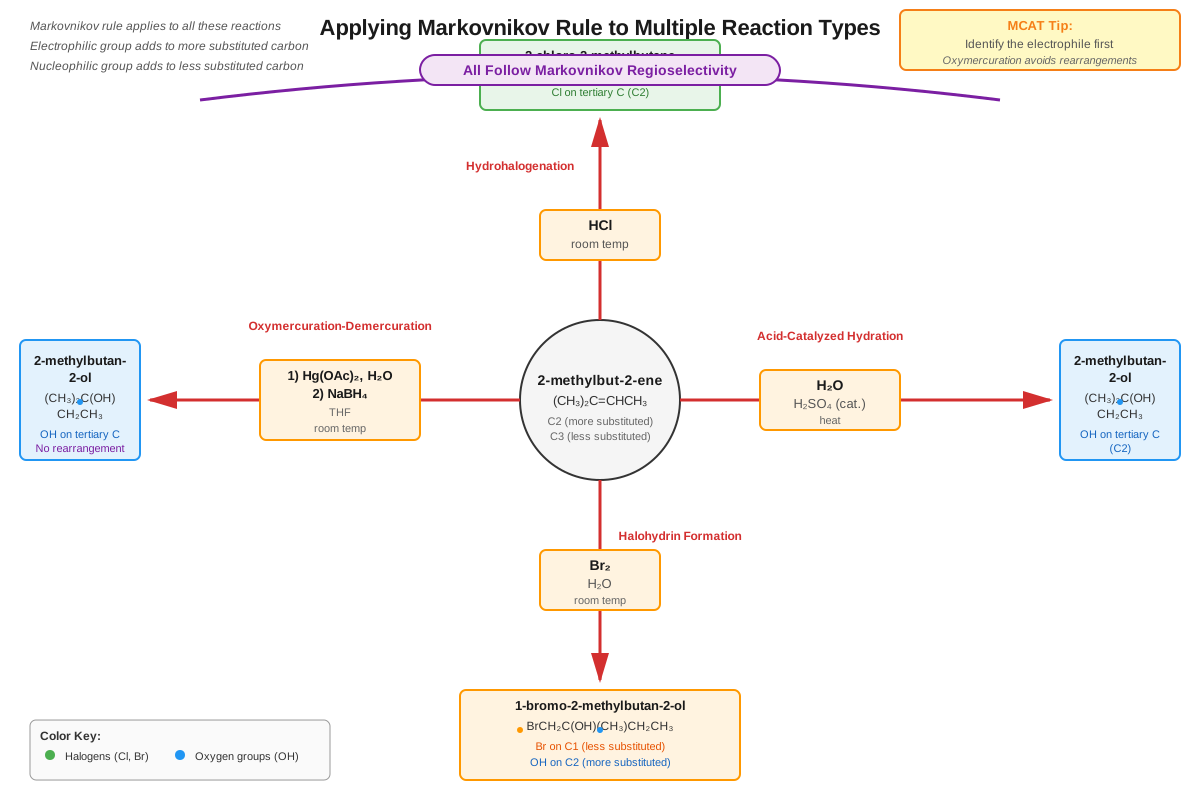
This rule applies to various addition reactions including:
- Hydrohalogenation (HCl, HBr, HI)
- Acid-catalyzed hydration (H₂O/H⁺)
- Addition of hydrogen halides to conjugated dienes
- Oxymercuration reactions (before reduction)
Mechanistic Basis
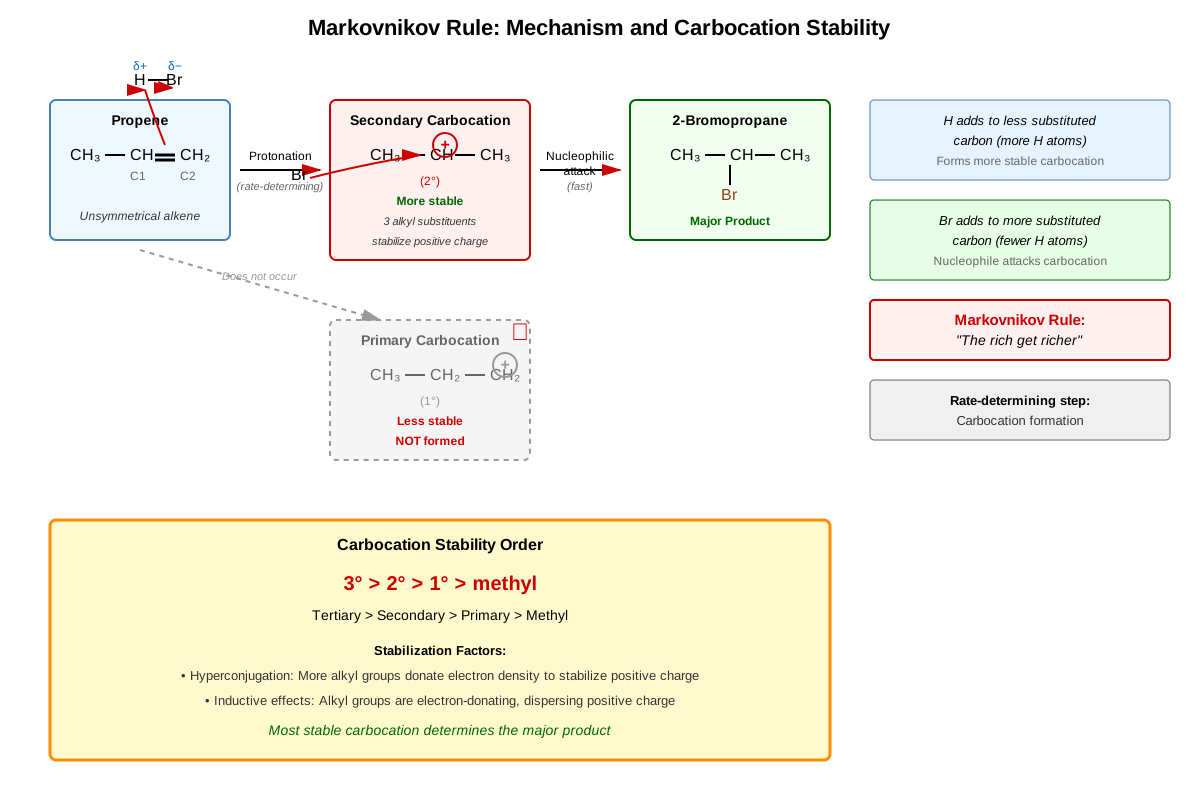
The Markovnikov rule is not arbitrary but derives directly from carbocation stability principles. The mechanism proceeds through two distinct steps:
- Electrophilic attack: The π electrons of the alkene attack the electrophilic hydrogen of HX, forming a new C-H bond. This step generates a carbocation intermediate at the carbon that did not receive the hydrogen.
- Nucleophilic capture: The halide ion (X⁻) or other nucleophile rapidly attacks the positively charged carbocation, forming the second new bond.
The regioselectivity arises because the reaction proceeds through the more stable carbocation intermediate. Since tertiary carbocations are more stable than secondary, which are more stable than primary (3° > 2° > 1°), the hydrogen adds to the less substituted carbon, creating the more substituted (and therefore more stable) carbocation. This intermediate then determines the final product structure.
Carbocation Stability and Hyperconjugation
Understanding why certain carbocations are more stable is crucial for applying the Markovnikov rule correctly. Carbocation stability increases with substitution due to two primary factors:
Hyperconjugation: Adjacent C-H and C-C σ bonds can donate electron density into the empty p orbital of the carbocation through orbital overlap. More alkyl substituents provide more opportunities for hyperconjugation, stabilizing the positive charge.
Inductive effects: Alkyl groups are electron-donating relative to hydrogen, so they help stabilize the adjacent positive charge through σ bonds.
| Carbocation Type | Number of Alkyl Groups | Relative Stability | Example |
|---|---|---|---|
| Methyl | 0 | Least stable (rarely forms) | CH₃⁺ |
| Primary (1°) | 1 | Unstable | CH₃CH₂⁺ |
| Secondary (2°) | 2 | Moderate | (CH₃)₂CH⁺ |
| Tertiary (3°) | 3 | Most stable | (CH₃)₃C⁺ |
Resonance stabilization can override alkyl substitution effects. An allylic or benzylic carbocation (even if primary) may be more stable than a non-resonance-stabilized secondary carbocation due to charge delocalization.
Application to Specific Reactions
Hydrohalogenation: When HBr adds to propene (CH₃CH=CH₂), the hydrogen adds to the terminal carbon (which has two hydrogens), generating a secondary carbocation at the middle carbon. Bromide then attacks this carbocation, producing 2-bromopropane as the major product rather than 1-bromopropane.
Acid-catalyzed hydration: Adding water to an alkene in the presence of acid (H₂SO₄ or H₃PO₄) follows Markovnikov regioselectivity. For 2-methylpropene, the hydrogen adds to the less substituted carbon, forming a tertiary carbocation that is then attacked by water, ultimately yielding tert-butanol after deprotonation.
Hydration via oxymercuration-demercuration: This two-step process provides Markovnikov addition of water without carbocation rearrangements. The mercurinium ion intermediate directs water to the more substituted carbon, achieving Markovnikov regioselectivity through a different mechanism.
Anti-Markovnikov Addition
Understanding the Markovnikov rule requires recognizing when it does NOT apply. Anti-Markovnikov addition occurs when the regiochemistry is reversed, with the hydrogen adding to the more substituted carbon. The most important anti-Markovnikov reaction for the MCAT is hydroboration-oxidation:
In hydroboration (using BH₃ or B₂H₆), the boron adds to the less substituted carbon through a concerted four-membered transition state, without forming a carbocation intermediate. Subsequent oxidation with H₂O₂/OH⁻ replaces boron with a hydroxyl group, resulting in the alcohol at the less substituted position.
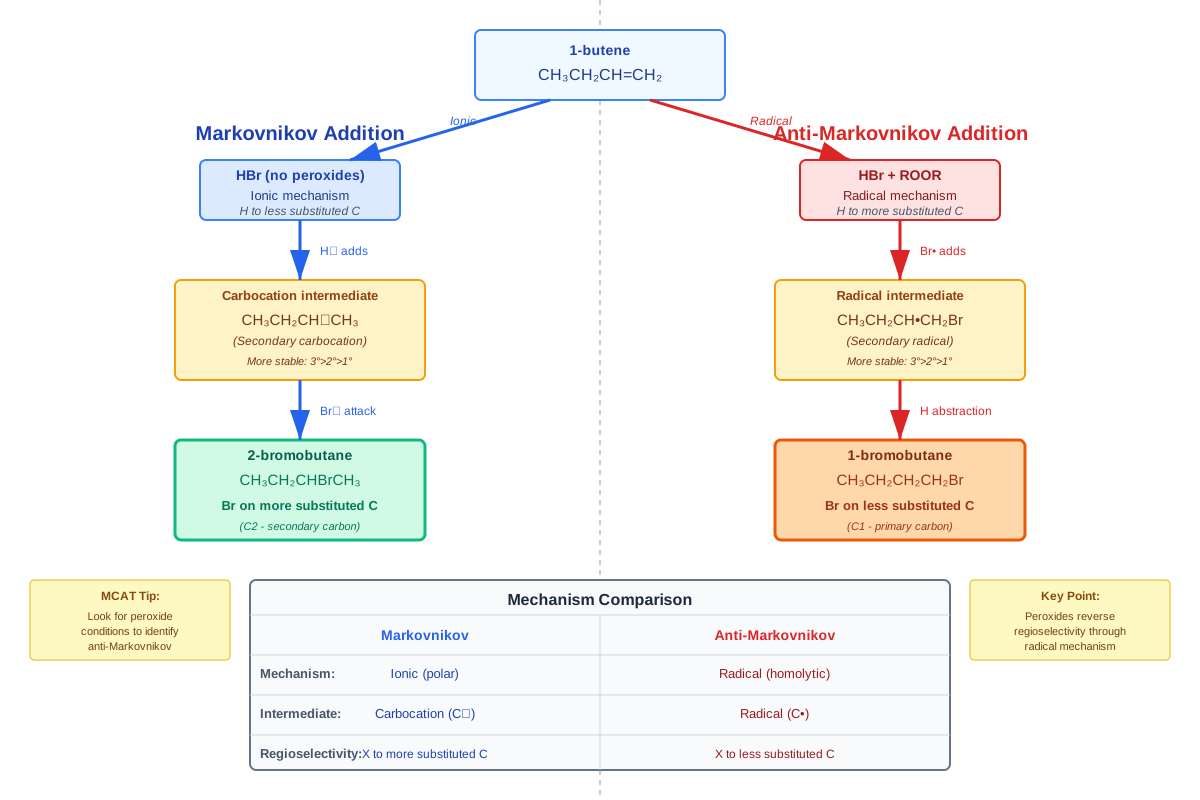
Another anti-Markovnikov pathway involves radical mechanisms. When HBr adds to an alkene in the presence of peroxides (ROOR), the reaction proceeds through radical intermediates rather than carbocations. Since radical stability follows the same trend as carbocation stability (3° > 2° > 1°), but the mechanism differs, the bromine ends up on the less substituted carbon—opposite to the ionic Markovnikov addition.
Stereochemistry Considerations
While the Markovnikov rule predicts regioselectivity (which carbon gets which group), it does not directly address stereochemistry. However, understanding both aspects is crucial:
- Hydrohalogenation produces a mixture of stereoisomers if a new stereocenter forms, because the planar carbocation intermediate can be attacked from either face
- Hydroboration-oxidation proceeds with syn addition (both groups add from the same face) due to the concerted mechanism
- Bromination with Br₂ proceeds through a bromonium ion, resulting in anti addition (groups add from opposite faces)
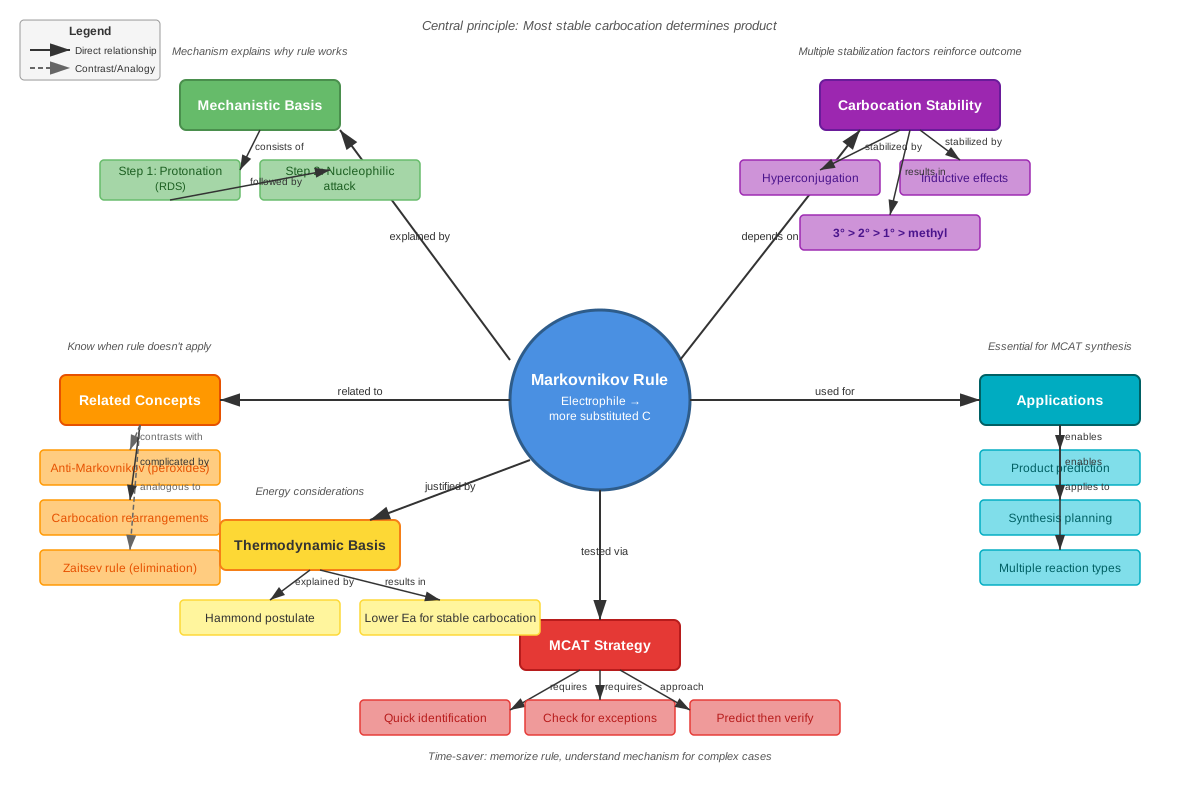
Concept Relationships
The Markovnikov rule sits at the intersection of multiple fundamental organic chemistry concepts, creating a web of interconnected principles. Carbocation stability serves as the mechanistic foundation → which determines regioselectivity in addition reactions → which allows prediction of major and minor products → which connects to reaction kinetics (the more stable carbocation forms faster through a lower-energy transition state).
The rule connects backward to prerequisite knowledge: Alkene structure provides the substrate → acid-base chemistry explains the initial protonation step → resonance and inductive effects rationalize carbocation stability differences → mechanism drawing skills allow visualization of the electron flow.
Forward connections extend to more advanced topics: Understanding Markovnikov additions enables comprehension of carbocation rearrangements (hydride and methyl shifts to form more stable carbocations) → elimination reactions (E1 mechanisms also proceed through carbocations) → synthesis planning (choosing reagents to achieve desired regioselectivity) → biochemical transformations (enzyme-catalyzed additions in metabolic pathways).
The contrast between Markovnikov and anti-Markovnikov pathways illustrates how mechanism determines outcome: ionic mechanisms (carbocation intermediates) → Markovnikov products, while concerted mechanisms (hydroboration) or radical mechanisms (HBr/peroxides) → anti-Markovnikov products. This relationship emphasizes that understanding mechanisms, not just memorizing rules, enables prediction of unfamiliar reactions.
Quick check — test yourself on Markovnikov rule so far.
Try Flashcards →High-Yield Facts
⭐ The Markovnikov rule states that in HX addition to alkenes, hydrogen adds to the carbon with more hydrogens already attached, while X adds to the more substituted carbon
⭐ The mechanistic basis is formation of the more stable carbocation intermediate: 3° > 2° > 1° > methyl
⭐ Hydrohalogenation (HCl, HBr, HI) and acid-catalyzed hydration (H₂O/H⁺) follow Markovnikov regioselectivity
⭐ Hydroboration-oxidation produces anti-Markovnikov products (alcohol on less substituted carbon)
⭐ HBr with peroxides (ROOR) gives anti-Markovnikov products through a radical mechanism
- Carbocation stability is enhanced by hyperconjugation from adjacent C-H and C-C bonds
- Resonance-stabilized carbocations (allylic, benzylic) can be more stable than higher-substituted non-resonance carbocations
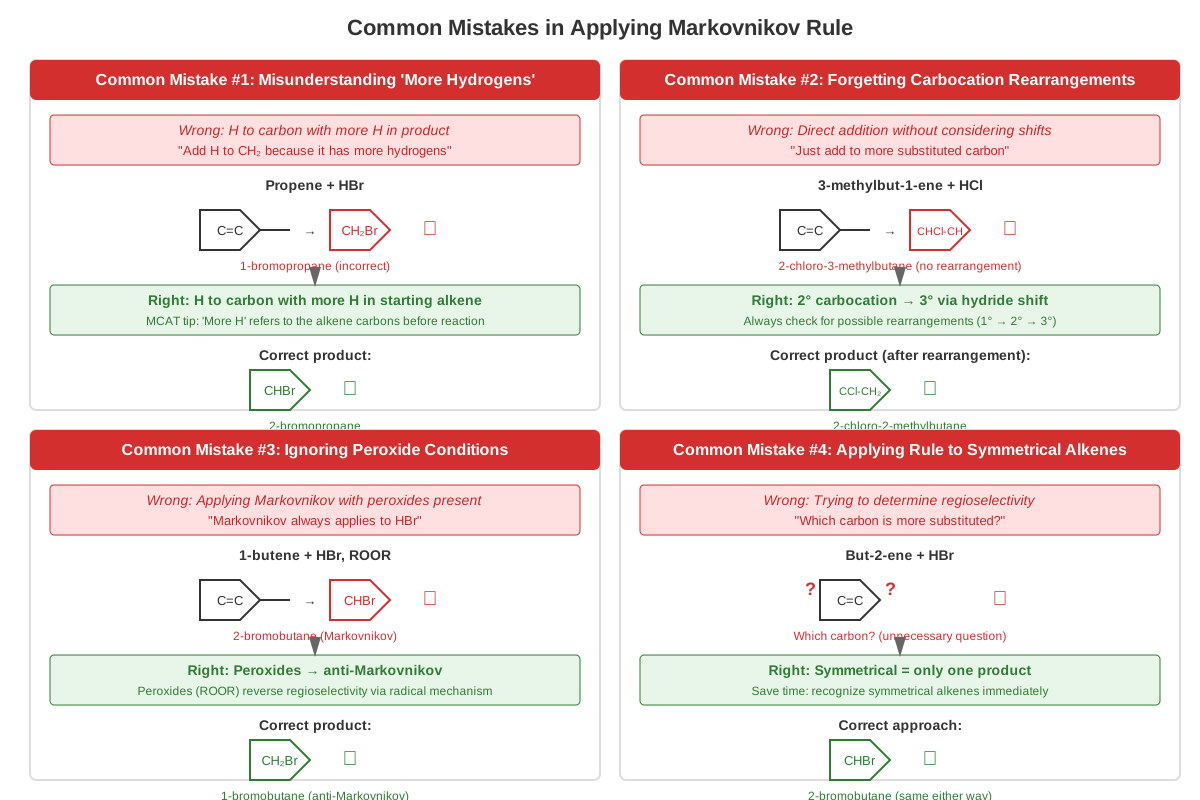
- The Markovnikov rule applies to unsymmetrical alkenes; symmetrical alkenes give only one product regardless
- Carbocation rearrangements (hydride or methyl shifts) can occur if a more stable carbocation can form
- Oxymercuration-demercuration gives Markovnikov hydration without carbocation rearrangements
- The rate-determining step in Markovnikov additions is typically carbocation formation
- Markovnikov additions through carbocation intermediates can produce racemic mixtures if a new stereocenter forms
- The rule does not apply to additions that proceed through cyclic intermediates (bromonium ions, mercurinium ions) or concerted mechanisms
Common Misconceptions
Misconception: The Markovnikov rule means "the rich get richer"—the carbon with more substituents gets more substituents.
Correction: While this mnemonic can help, it's mechanistically backwards. The hydrogen (not the halogen) adds first, going to the less substituted carbon to create the more stable carbocation. The halogen then adds to this carbocation (the more substituted carbon). Understanding the mechanism prevents errors.
Misconception: The Markovnikov rule applies to all addition reactions.
Correction: The rule specifically applies to additions proceeding through carbocation intermediates. Concerted mechanisms (hydroboration), radical mechanisms (HBr/peroxides), and additions through cyclic intermediates (Br₂ → bromonium ion) may show different regioselectivity or no preference.
Misconception: A primary carbocation is always less stable than a secondary carbocation.
Correction: Resonance stabilization can override substitution effects. A resonance-stabilized primary allylic or benzylic carbocation (where the positive charge is delocalized) is more stable than a non-resonance-stabilized secondary carbocation. Always consider both substitution and resonance.
Misconception: Markovnikov addition always produces a single stereoisomer.
Correction: The Markovnikov rule predicts regioselectivity (which carbon gets which group), not stereoselectivity. If a new stereocenter forms, the planar carbocation intermediate can be attacked from either face, typically producing a racemic mixture of enantiomers.
Misconception: The Markovnikov rule is just a memorization shortcut with no theoretical basis.
Correction: The rule is a direct consequence of thermodynamic and kinetic principles. Reactions proceed through lower-energy transition states leading to more stable intermediates. Understanding this mechanistic foundation allows application to unfamiliar reactions and prevents memorization errors.
Misconception: Anti-Markovnikov addition means the opposite groups add (X adds where H should go).
Correction: Anti-Markovnikov specifically means the hydrogen adds to the more substituted carbon (opposite of Markovnikov). The term describes the regioselectivity pattern, not a reversal of which groups are adding. In hydroboration-oxidation, the OH ends up on the less substituted carbon.
Worked Examples
Example 1: Predicting Hydrohalogenation Products
Question: What is the major product when HBr adds to 2-methylbut-2-ene?
Solution:
Step 1: Draw the structure of 2-methylbut-2-ene:
    CH₃
     |
CH₃-C=CH-CH₃
Step 2: Identify the two carbons of the double bond and their substitution:
- Left carbon: bonded to two CH₃ groups (trisubstituted)
- Right carbon: bonded to one CH₃ and one H (disubstituted)
Step 3: Apply the Markovnikov rule mechanistically. The H⁺ from HBr will add to the carbon that will generate the more stable carbocation. If H⁺ adds to the right carbon (less substituted), it creates a tertiary carbocation on the left carbon. If H⁺ adds to the left carbon, it creates a secondary carbocation on the right carbon.
Step 4: Since tertiary carbocations are more stable than secondary, the H⁺ adds to the right carbon (which already has one H), and the carbocation forms on the left (trisubstituted) carbon.
Step 5: The Br⁻ nucleophile attacks the tertiary carbocation:
    CH₃
     |
CH₃-C-CH-CH₃
    |  |
Br HAnswer: 2-bromo-2-methylbutane is the major product. This connects to Learning Objective 3 (applying the rule to exam questions) and demonstrates how mechanistic reasoning leads to correct product prediction.
Example 2: Comparing Markovnikov and Anti-Markovnikov Pathways
Question: An alkene with molecular formula C₅H₁₀ undergoes two different reactions:
- Reaction A: Treatment with H₂O/H₂SO₄ produces 2-methylbutan-2-ol as the major product
- Reaction B: Treatment with 1) BH₃/THF, 2) H₂O₂/OH⁻ produces 3-methylbutan-1-ol
Identify the starting alkene and explain the different products.
Solution:
Step 1: Analyze the products to work backward. Both products have 5 carbons and one OH group, suggesting they came from the same alkene with different regioselectivity.
Step 2: For 2-methylbutan-2-ol, the OH is on a tertiary carbon:
    CH₃
     |
CH₃-C-CH₂-CH₃
    |
    OH
This is the Markovnikov product from acid-catalyzed hydration, meaning the carbocation formed at this tertiary position.
Step 3: For 3-methylbutan-1-ol, the OH is on a primary carbon:
    CH₃
     |
CH₃-CH-CH₂-CH₂-OH
This is the anti-Markovnikov product from hydroboration-oxidation.
Step 4: The starting alkene must have the double bond positioned such that Markovnikov addition puts OH on the tertiary carbon and anti-Markovnikov addition puts OH on the primary carbon. This alkene is 3-methylbut-1-ene:
    CH₃
     |
CH₃-CH-CH=CH₂
Step 5: Verify:
- Reaction A: H⁺ adds to the terminal carbon (which has 2 H's), creating a tertiary carbocation at C-2. Water attacks, giving 2-methylbutan-2-ol. ✓
- Reaction B: BH₃ adds with boron to the more substituted carbon (C-2) and H to the less substituted carbon (C-1) via concerted mechanism. Oxidation replaces B with OH, giving 3-methylbutan-1-ol. ✓
Answer: The starting alkene is 3-methylbut-1-ene. Reaction A follows Markovnikov regioselectivity through a carbocation intermediate, while Reaction B follows anti-Markovnikov regioselectivity through a concerted hydroboration mechanism. This example addresses Learning Objectives 3, 4, and 5 by demonstrating application, avoiding the common mistake of confusing the two pathways, and connecting to related concepts.
Exam Strategy
When approaching MCAT questions on the Markovnikov rule, employ this systematic strategy:
Step 1: Identify the reaction type. Look for trigger words: "HBr," "HCl," "acid-catalyzed hydration," "H₂O/H⁺" signal Markovnikov; "hydroboration," "BH₃," "peroxides" signal anti-Markovnikov. If the mechanism isn't specified, assume ionic (Markovnikov) unless peroxides or borane are mentioned.
Step 2: Locate the double bond and assess symmetry. If the alkene is symmetrical (like but-2-ene), both carbons are equivalent—the Markovnikov rule doesn't apply because only one product can form. Focus on unsymmetrical alkenes.
Step 3: Determine substitution of each carbon in the double bond. Count alkyl groups (not hydrogens) attached to each carbon: 0 = unsubstituted, 1 = monosubstituted, 2 = disubstituted, 3 = trisubstituted.
Step 4: Apply mechanistic reasoning. For Markovnikov: H⁺ adds to the less substituted carbon → more stable carbocation forms on the more substituted carbon → nucleophile attacks carbocation. For anti-Markovnikov: reverse the positions.
Step 5: Check for rearrangements. If a hydride or methyl shift could produce a more stable carbocation, the rearranged product may be major. This is especially important for questions showing unexpected products.
Process of elimination tips:
- Eliminate any answer showing addition to the wrong carbon if you've correctly identified Markovnikov vs. anti-Markovnikov
- Eliminate products with incorrect molecular formulas (addition reactions add atoms, not remove them)
- Eliminate products showing syn addition for reactions that proceed anti (or vice versa)
- If two answers differ only in stereochemistry and the question asks for "the product," choose the answer indicating a mixture or racemic product for carbocation-mediated reactions
Time allocation: Discrete Markovnikov questions should take 45-60 seconds. If a question requires drawing the mechanism, allocate 90 seconds. For passage-based questions, spend 30 seconds identifying the reaction type, then 45 seconds applying the rule.
Exam Tip: If you're unsure whether a reaction follows Markovnikov or anti-Markovnikov regioselectivity, ask: "Does this reaction form a carbocation intermediate?" If yes → Markovnikov. If no (concerted or radical) → possibly anti-Markovnikov.
Memory Techniques
Mnemonic for Markovnikov Rule: "He who Has, Holds" — The carbon that Has more Hydrogens Holds onto the incoming Hydrogen. This reminds you that hydrogen adds to the carbon already bearing more hydrogens.
Mnemonic for Carbocation Stability: "Terry Sells Poor Merchandise" — Tertiary > Secondary > Primary > Methyl. The order of stability from most to least stable.
Visualization Strategy: Picture the carbocation as a "positive charge seeking stability." More alkyl groups = more electron donation = happier carbocation. Visualize alkyl groups as "support beams" holding up the positive charge—more beams (substituents) = more stable structure.
Acronym for Anti-Markovnikov Conditions: "HPR" — Hydroboration, Peroxides, Radicals. These three conditions lead to anti-Markovnikov addition. If you see any of these, expect reversed regioselectivity.
Mechanistic Memory Aid: Draw a simple two-step mechanism for every Markovnikov problem:
- Arrow from π bond to H⁺ → carbocation forms on more substituted carbon
- Arrow from nucleophile to carbocation → product forms
Repeatedly drawing this pattern builds muscle memory for exam day.
Rhyme for Regioselectivity: "More substituted gets the group, less substituted gets the H—that's the Markovnikov loop!" While cheesy, rhymes enhance memory retention through phonological encoding.
Summary
The Markovnikov rule is a cornerstone principle in organic chemistry that predicts the regioselectivity of electrophilic addition reactions to unsymmetrical alkenes. The rule states that when HX adds to an alkene, the hydrogen adds to the less substituted carbon of the double bond, while the electronegative group (X) adds to the more substituted carbon. This regioselectivity arises from the reaction mechanism: the addition proceeds through the more stable carbocation intermediate, which forms at the more substituted position due to hyperconjugation and inductive stabilization from adjacent alkyl groups. The rule applies to hydrohalogenation reactions (HCl, HBr, HI) and acid-catalyzed hydrations (H₂O/H⁺), but not to reactions proceeding through different mechanisms such as hydroboration-oxidation or radical additions with peroxides, which produce anti-Markovnikov products. For MCAT success, students must understand both the rule itself and its mechanistic foundation, enabling prediction of products for familiar and unfamiliar reactions, recognition of when the rule does not apply, and connection to broader concepts including carbocation stability, reaction mechanisms, and stereochemistry.
Key Takeaways
- The Markovnikov rule predicts that in HX addition to alkenes, H adds to the less substituted carbon and X adds to the more substituted carbon, based on formation of the more stable carbocation intermediate
- Carbocation stability follows the order: tertiary > secondary > primary > methyl, due to hyperconjugation and inductive effects from alkyl substituents
- Markovnikov regioselectivity applies to hydrohalogenation (HX) and acid-catalyzed hydration (H₂O/H⁺), while anti-Markovnikov products result from hydroboration-oxidation or HBr with peroxides
- Understanding the mechanistic basis (carbocation formation) is essential for applying the rule correctly and predicting products in unfamiliar reactions
- Resonance stabilization can override substitution effects—a resonance-stabilized primary carbocation may be more stable than a non-resonance-stabilized secondary carbocation
- The Markovnikov rule predicts regioselectivity (which carbon gets which group) but not stereoselectivity; carbocation intermediates typically lead to racemic mixtures when new stereocenters form
- Recognizing trigger words (HBr, H₂O/H⁺ for Markovnikov; BH₃, peroxides for anti-Markovnikov) enables rapid question analysis on the MCAT
Related Topics
Carbocation Rearrangements: After mastering the Markovnikov rule, study hydride and methyl shifts that occur when a more stable carbocation can form adjacent to the initial carbocation. These rearrangements explain unexpected products in addition reactions.
Elimination Reactions (E1 and E2): E1 eliminations proceed through carbocation intermediates similar to Markovnikov additions. Understanding carbocation stability helps predict major elimination products via Zaitsev's rule.
Electrophilic Aromatic Substitution: The principles of carbocation stability and regioselectivity extend to aromatic systems, where substituents direct incoming electrophiles to specific positions based on intermediate stability.
Stereochemistry of Addition Reactions: Building on Markovnikov regioselectivity, explore how different mechanisms (syn vs. anti addition) determine three-dimensional product structures, crucial for understanding reactions like hydroboration-oxidation and halogenation.
Radical Reactions: The anti-Markovnikov addition of HBr with peroxides introduces radical mechanisms, which follow different stability rules and selectivity patterns compared to ionic mechanisms.
Practice CTA
Now that you've mastered the Markovnikov rule, it's time to solidify your understanding through active practice. Challenge yourself with the practice questions and flashcards designed specifically for this topic. Focus on questions that require you to predict products, explain regioselectivity, and distinguish between Markovnikov and anti-Markovnikov pathways. Remember: understanding the mechanism is more powerful than memorizing individual reactions. Each practice problem you work through builds the pattern recognition and mechanistic reasoning skills that will serve you on test day. You've got this—apply what you've learned and watch your confidence soar!
Sign up free to keep reading
Create a free AnvayaPrep account to finish this MCAT guide on Markovnikov rule — plus flashcards and practice questions.