Overview
Alcohol oxidation is a fundamental transformation in Organic Chemistry that involves the conversion of alcohols to carbonyl-containing compounds through the loss of hydrogen atoms. This reaction represents one of the most important functional group interconversions tested on the MCAT, as it bridges the chemistry of alcohols with aldehydes, ketones, and carboxylic acids. Understanding alcohol oxidation requires mastery of oxidation state changes, reagent selectivity, and the ability to predict products based on alcohol classification.
The MCAT frequently tests alcohol oxidation within the context of Alcohols and Ethers chemistry, often embedding questions within biochemical passages involving metabolic pathways (such as ethanol metabolism in the liver) or synthetic organic chemistry scenarios. Students must recognize that not all alcohols oxidize in the same manner—primary, secondary, and tertiary alcohols each follow distinct oxidation pathways that yield different products. The ability to quickly classify an alcohol and predict its oxidation product is a high-yield skill that appears in both discrete questions and passage-based items.
Alcohol oxidation MCAT questions typically assess three key competencies: identifying the appropriate oxidizing agent for a desired transformation, predicting the correct product based on alcohol structure, and recognizing when oxidation cannot occur. This topic connects intimately with other Organic Chemistry concepts including nomenclature, stereochemistry, spectroscopy (particularly IR and NMR analysis of carbonyl products), and reaction mechanisms. Mastery of alcohol oxidation provides the foundation for understanding more complex transformations in both laboratory synthesis and biological systems, making it an essential component of MCAT preparation.
Learning Objectives
- [ ] Define Alcohol oxidation using accurate Organic Chemistry terminology
- [ ] Explain why Alcohol oxidation matters for the MCAT
- [ ] Apply Alcohol oxidation to exam-style questions
- [ ] Identify common mistakes related to Alcohol oxidation
- [ ] Connect Alcohol oxidation to related Organic Chemistry concepts
- [ ] Distinguish between the oxidation products of primary, secondary, and tertiary alcohols
- [ ] Select appropriate oxidizing reagents (PCC, Jones reagent, KMnO₄) based on desired product
- [ ] Predict when an alcohol is resistant to oxidation and explain the structural basis for this resistance
Prerequisites
- Functional group identification: Recognition of alcohols (primary, secondary, tertiary) is essential for predicting oxidation outcomes
- Oxidation states and redox chemistry: Understanding electron loss/gain allows tracking of oxidation level changes during alcohol transformations
- Carbonyl chemistry basics: Familiarity with aldehydes, ketones, and carboxylic acids enables recognition of oxidation products
- Basic organic nomenclature: Proper naming of reactants and products facilitates communication and problem-solving
- Electron-pushing mechanisms: Understanding how electrons move during bond breaking/forming clarifies the oxidation process
Why This Topic Matters
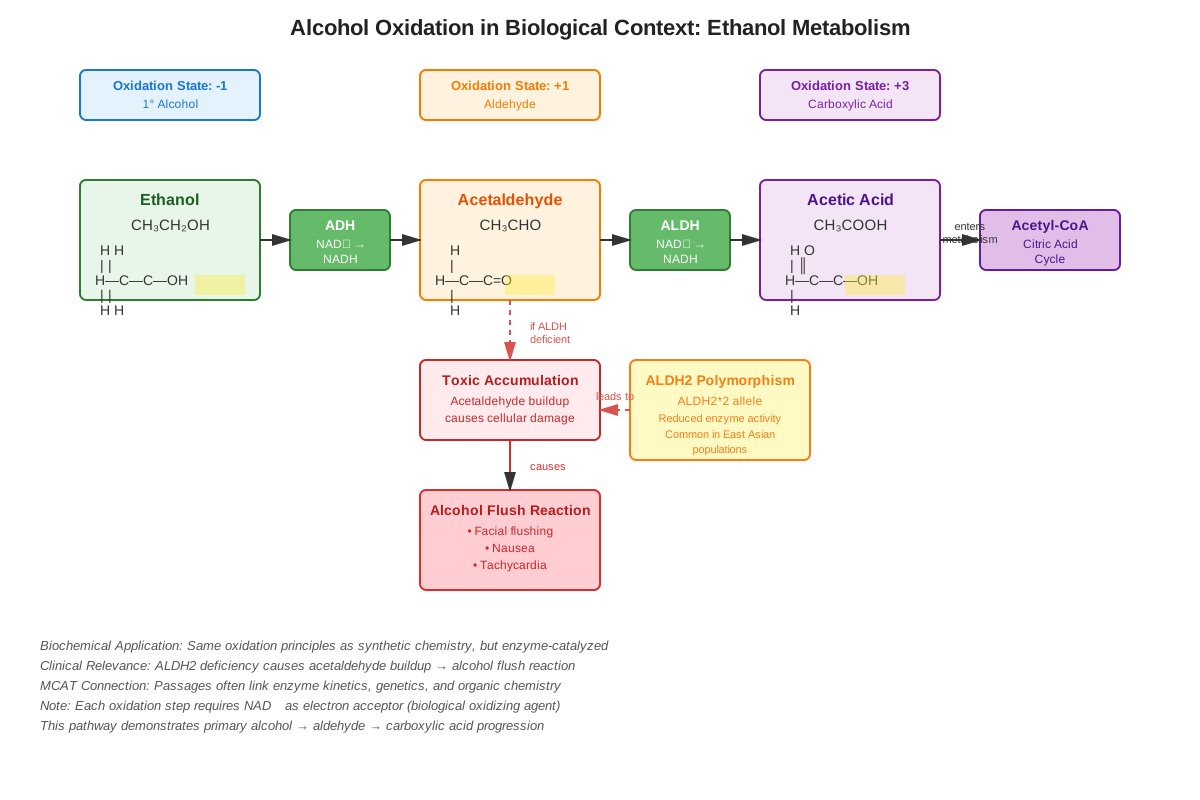
Alcohol oxidation holds significant clinical and biochemical relevance that extends far beyond synthetic organic chemistry. The human body constantly performs alcohol oxidation reactions through enzyme-catalyzed processes. The most clinically relevant example is ethanol metabolism: alcohol dehydrogenase (ADH) oxidizes ethanol to acetaldehyde, which is subsequently oxidized by aldehyde dehydrogenase (ALDH) to acetic acid. Genetic variations in ALDH activity explain alcohol flush reactions common in certain populations, and this biochemical pathway is frequently featured in MCAT passages connecting organic chemistry to physiology.
From an exam statistics perspective, alcohol oxidation appears in approximately 3-5% of MCAT Organic Chemistry questions, with representation across both the Chemical and Physical Foundations section and occasionally in Biological and Biochemical Foundations when integrated with metabolism. Questions typically present in three formats: (1) discrete questions asking for product prediction given a specific reagent, (2) passage-based questions embedded in synthetic schemes requiring multi-step analysis, and (3) biochemical passages describing enzymatic oxidations where students must apply organic chemistry principles to biological systems.
The MCAT commonly tests alcohol oxidation through synthesis problems where students must select appropriate reagents to achieve specific transformations, spectroscopy questions where oxidation products must be identified from IR or NMR data, and metabolic pathway questions where enzymatic oxidations parallel chemical oxidations. Understanding the selectivity of different oxidizing agents—particularly the distinction between reagents that stop at the aldehyde stage versus those that continue to carboxylic acids—is a frequent point of discrimination between high-scoring and average-scoring test-takers.
Core Concepts
Classification of Alcohols and Oxidation Potential
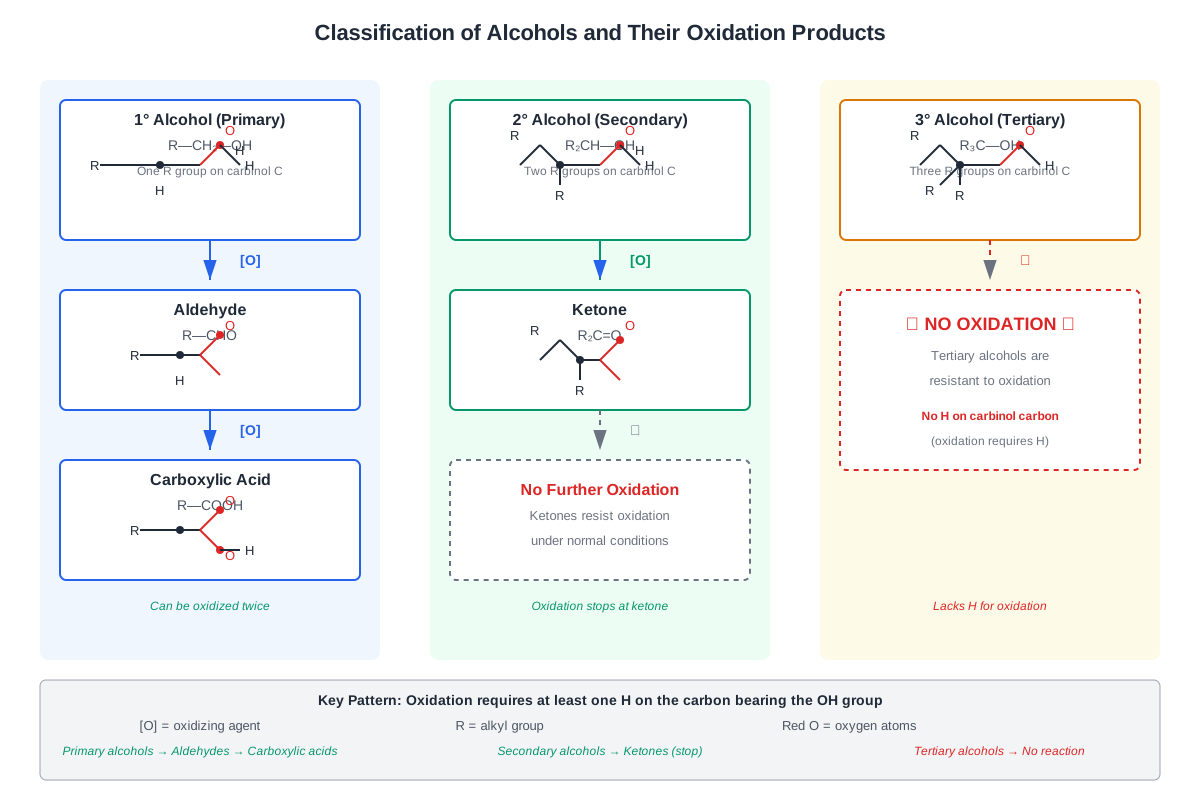
The oxidation behavior of an alcohol is fundamentally determined by its classification. Primary alcohols (1°) have the hydroxyl group attached to a carbon bearing one alkyl substituent and two hydrogens. Secondary alcohols (2°) have the hydroxyl group on a carbon with two alkyl substituents and one hydrogen. Tertiary alcohols (3°) have the hydroxyl group on a carbon bearing three alkyl substituents and no hydrogens.
The critical structural feature determining oxidation potential is the presence of at least one hydrogen atom on the carbon bearing the hydroxyl group (the α-carbon). Primary and secondary alcohols possess this hydrogen and can undergo oxidation, while tertiary alcohols lack this hydrogen and are generally resistant to oxidation under normal conditions. When tertiary alcohols are exposed to strong oxidizing conditions, they typically undergo elimination or carbon-carbon bond cleavage rather than simple oxidation.
Oxidation Products by Alcohol Type
| Alcohol Type | Initial Product | Further Oxidation Product | Key Structural Feature |
|---|---|---|---|
| Primary (1°) | Aldehyde (RCHO) | Carboxylic acid (RCOOH) | Two H atoms on α-carbon |
| Secondary (2°) | Ketone (R₂CO) | No further oxidation | One H atom on α-carbon |
| Tertiary (3°) | No oxidation | No oxidation | No H atoms on α-carbon |
Primary alcohol oxidation proceeds through two stages. The first oxidation removes two hydrogen atoms (one from the α-carbon and one from the oxygen) to form an aldehyde. Under mild conditions or with selective reagents, the reaction can be stopped at this stage. However, aldehydes are themselves susceptible to further oxidation, and under aqueous conditions or with strong oxidizing agents, they oxidize to carboxylic acids. This two-stage process can be represented as:
RCH₂OH → RCHO → RCOOH
Secondary alcohol oxidation produces ketones, which represent a stable endpoint because ketones lack the α-hydrogen necessary for further oxidation without breaking carbon-carbon bonds. The oxidation removes one hydrogen from the α-carbon and one from the oxygen:
R₂CHOH → R₂CO
Common Oxidizing Reagents and Their Selectivity
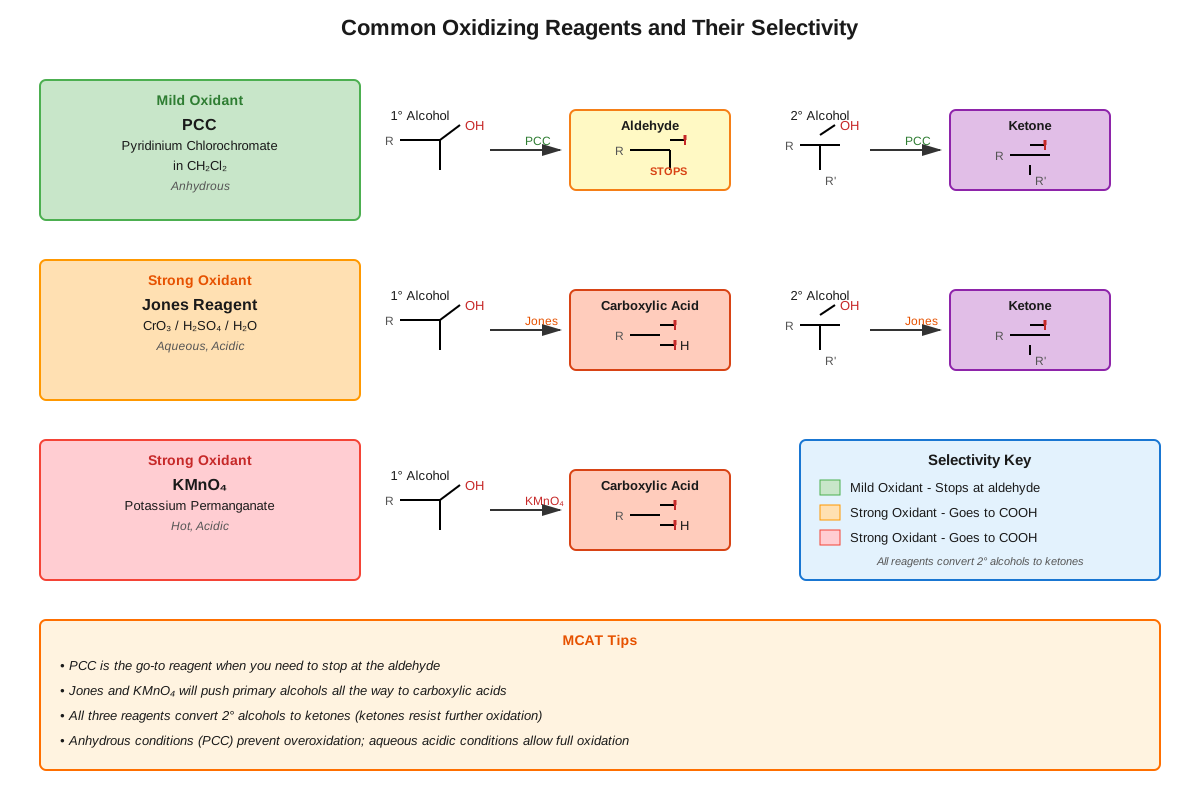
Understanding reagent selectivity is crucial for predicting products and solving synthesis problems. The major oxidizing agents tested on the MCAT include:
Pyridinium chlorochromate (PCC) is a mild, selective oxidizing agent that oxidizes primary alcohols to aldehydes without further oxidation to carboxylic acids. PCC is used in anhydrous conditions (typically in dichloromethane), which prevents the aldehyde from hydrating and undergoing further oxidation. This reagent also oxidizes secondary alcohols to ketones. PCC is the reagent of choice when an aldehyde is the desired product.
Jones reagent (chromic acid, H₂CrO₄, prepared from CrO₃ in aqueous H₂SO₄) is a strong oxidizing agent used in aqueous acidic conditions. It oxidizes primary alcohols all the way to carboxylic acids and secondary alcohols to ketones. The aqueous conditions allow aldehydes to hydrate and undergo further oxidation, making it impossible to stop at the aldehyde stage with this reagent.
Potassium permanganate (KMnO₄) is another strong oxidizing agent that, under acidic or neutral conditions, oxidizes primary alcohols to carboxylic acids and secondary alcohols to ketones. Under basic conditions, it can also cleave carbon-carbon double bonds, making it a versatile but non-selective reagent.
Sodium or potassium dichromate (Na₂Cr₂O₇ or K₂Cr₂O₇) in aqueous acid behaves similarly to Jones reagent, oxidizing primary alcohols to carboxylic acids and secondary alcohols to ketones.
Mechanism of Alcohol Oxidation
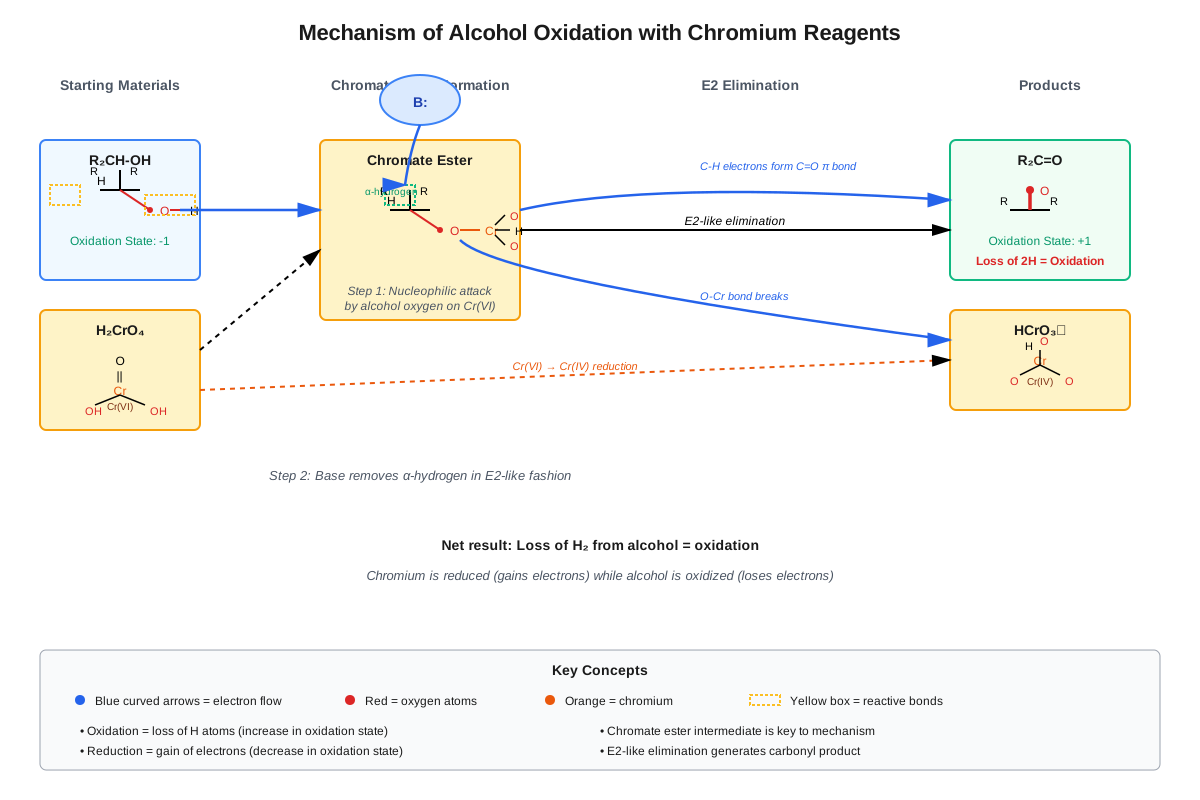
While detailed mechanisms are less frequently tested on the MCAT, understanding the general mechanistic principles aids in predicting products and understanding reactivity patterns. Chromium-based oxidations proceed through a chromate ester intermediate. The alcohol oxygen attacks the chromium center, forming an ester linkage. A base then abstracts the α-hydrogen, and electrons flow to break the C-H bond, with simultaneous reduction of chromium and formation of the carbonyl group.
The key mechanistic insight is that oxidation requires removal of the α-hydrogen, explaining why tertiary alcohols cannot be oxidized—they lack this critical hydrogen atom. The mechanism also clarifies why the reaction is classified as an oxidation: the carbon bearing the hydroxyl group loses hydrogen (becomes less electron-rich) and forms a double bond to oxygen (a more electronegative element).
Oxidation State Analysis
Tracking oxidation states provides a formal method for confirming that oxidation has occurred. In an alcohol, the carbon bearing the OH group has one bond to oxygen. In an aldehyde or ketone, this carbon has two bonds to oxygen (the C=O double bond counts as two bonds). In a carboxylic acid, the carbon has three bonds to oxygen (two from the C=O and one from the C-OH).
Each additional bond to oxygen (or loss of bond to hydrogen) represents an increase in oxidation state:
- Alcohol (R-CH₂-OH): one C-O bond
- Aldehyde (R-CHO): two C-O bonds (oxidation state increased by 1)
- Carboxylic acid (R-COOH): three C-O bonds (oxidation state increased by 2 from alcohol)
Special Cases and Exceptions
Benzylic and allylic alcohols often oxidize more readily than simple aliphatic alcohols due to resonance stabilization of intermediates. However, the same classification rules apply—primary benzylic alcohols oxidize to benzaldehydes (and potentially benzoic acids), while secondary benzylic alcohols oxidize to ketones.
Methanol (CH₃OH) represents a special case of primary alcohol oxidation, yielding formaldehyde (HCHO) and potentially formic acid (HCOOH) under strong oxidizing conditions.
Diols (compounds with two hydroxyl groups) can undergo oxidation at one or both positions depending on conditions and stoichiometry. Vicinal diols (1,2-diols) can be cleaved by periodic acid (HIO₄) or lead tetraacetate, breaking the C-C bond—a reaction distinct from simple oxidation.
Concept Relationships
The concepts within alcohol oxidation form a logical hierarchy based on structure-reactivity relationships. Alcohol classification (primary, secondary, tertiary) serves as the foundation, determining oxidation potential (can oxidize vs. cannot oxidize). For oxidizable alcohols, the classification then determines the product identity (aldehyde/carboxylic acid for primary, ketone for secondary). The choice of oxidizing reagent controls whether primary alcohols stop at the aldehyde stage or proceed to carboxylic acids, creating a decision tree: Primary alcohol → [PCC] → Aldehyde OR Primary alcohol → [Jones/KMnO₄] → Carboxylic acid.
This topic connects backward to prerequisite knowledge of functional group identification and nomenclature, as students must first recognize and classify alcohols before predicting their reactivity. It connects forward to carbonyl chemistry, as the products of alcohol oxidation (aldehydes, ketones, carboxylic acids) undergo their own characteristic reactions including nucleophilic additions, reductions, and condensations.
Laterally, alcohol oxidation relates to reduction reactions as the reverse process—aldehydes and ketones can be reduced back to alcohols using reagents like NaBH₄ or LiAlH₄, creating a bidirectional relationship. The topic also connects to spectroscopy, as oxidation products show characteristic IR absorptions (aldehyde C=O at 1730 cm⁻¹, ketone C=O at 1715 cm⁻¹, carboxylic acid C=O at 1710 cm⁻¹ plus broad O-H at 2500-3300 cm⁻¹) and distinct NMR signals (aldehyde proton at 9-10 ppm, carboxylic acid proton at 10-12 ppm).
In biochemical contexts, alcohol oxidation connects to metabolic pathways including ethanol metabolism, fatty acid oxidation (where β-hydroxy groups are oxidized to ketones), and the citric acid cycle (where isocitrate, containing a secondary alcohol, is oxidized to α-ketoglutarate). Understanding chemical oxidation mechanisms illuminates how enzymatic oxidations (using NAD⁺ or FAD as oxidizing agents) accomplish similar transformations under physiological conditions.
Quick check — test yourself on Alcohol oxidation so far.
Try Flashcards →High-Yield Facts
⭐ Primary alcohols oxidize to aldehydes with PCC and to carboxylic acids with Jones reagent, KMnO₄, or Na₂Cr₂O₇ in aqueous acid
⭐ Secondary alcohols oxidize to ketones with any standard oxidizing agent (PCC, Jones, KMnO₄, dichromate)
⭐ Tertiary alcohols do not undergo oxidation under normal conditions because they lack an α-hydrogen
⭐ PCC is the only common reagent that stops primary alcohol oxidation at the aldehyde stage
⭐ Oxidation requires at least one hydrogen on the carbon bearing the hydroxyl group
- Jones reagent is prepared from CrO₃ in aqueous H₂SO₄ and always oxidizes primary alcohols to carboxylic acids
- The oxidation state of carbon increases with each additional bond to oxygen and decreases with each additional bond to hydrogen
- Aldehydes are more easily oxidized than ketones because they retain an α-hydrogen on the carbonyl carbon
- Chromium-based oxidizing agents change color during reaction: Cr(VI) is orange, Cr(III) is green, providing a visual indicator
- Enzymatic alcohol oxidations in biochemistry use NAD⁺ or FAD as oxidizing agents rather than chromium reagents
- Methanol oxidation produces formaldehyde (toxic) and formic acid, explaining methanol's toxicity
- Benzylic alcohols oxidize readily due to resonance stabilization of intermediates
Common Misconceptions
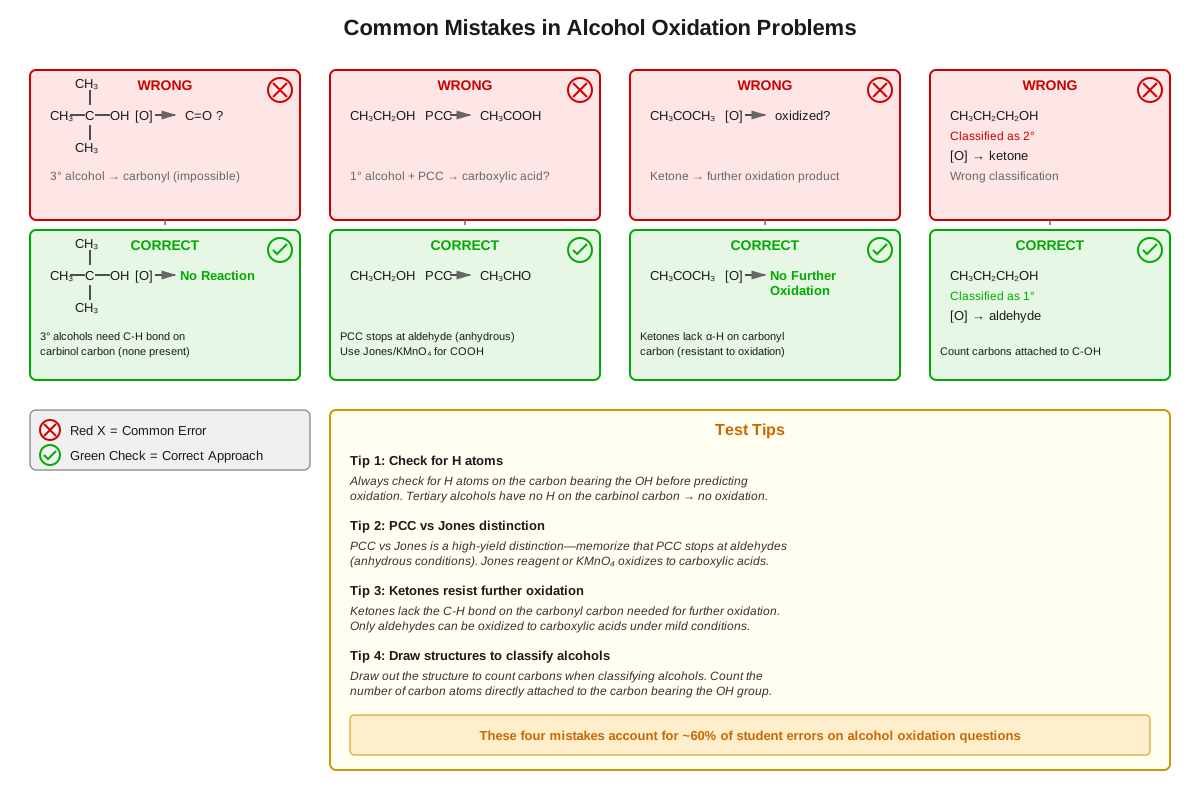
Misconception: All alcohols can be oxidized to some product.
Correction: Tertiary alcohols cannot be oxidized under normal conditions because they lack the α-hydrogen required for the oxidation mechanism. Attempting to oxidize tertiary alcohols with strong oxidizing agents typically results in elimination reactions or no reaction.
Misconception: PCC can oxidize primary alcohols to carboxylic acids if excess reagent is used.
Correction: PCC operates in anhydrous conditions (typically CH₂Cl₂), which prevents the aldehyde product from hydrating. Without hydration, the aldehyde cannot undergo further oxidation to the carboxylic acid, regardless of reagent excess. The anhydrous conditions are the key factor, not the amount of PCC.
Misconception: Secondary alcohols can be oxidized to carboxylic acids.
Correction: Secondary alcohols oxidize only to ketones, which represent a stable endpoint. Further oxidation would require breaking a C-C bond, which does not occur under standard oxidizing conditions. Only primary alcohols can be oxidized to carboxylic acids through the aldehyde intermediate.
Misconception: Ketones and aldehydes have the same reactivity toward oxidizing agents.
Correction: Aldehydes are much more easily oxidized than ketones because aldehydes retain a hydrogen on the carbonyl carbon, allowing further oxidation to carboxylic acids. Ketones lack this hydrogen and resist oxidation without C-C bond cleavage.
Misconception: The same oxidizing agent always produces the same product regardless of alcohol type.
Correction: The product depends on both the reagent AND the alcohol classification. For example, Jones reagent oxidizes primary alcohols to carboxylic acids but oxidizes secondary alcohols only to ketones. The alcohol structure determines the possible oxidation pathway.
Misconception: Oxidation always involves adding oxygen atoms to a molecule.
Correction: While oxidation can involve adding oxygen, it is more accurately defined as loss of electrons, loss of hydrogen, or increase in bonds to more electronegative atoms. Alcohol oxidation primarily involves removing hydrogen atoms (one from carbon, one from oxygen) rather than adding oxygen.
Worked Examples
Example 1: Reagent Selection for Multi-Step Synthesis
Problem: A chemist needs to convert 1-butanol (CH₃CH₂CH₂CH₂OH) to butanoic acid (CH₃CH₂CH₂COOH). Which of the following reagents would accomplish this transformation in a single step?
A) PCC in CH₂Cl₂
B) NaBH₄ in ethanol
C) Jones reagent (CrO₃/H₂SO₄/H₂O)
D) LiAlH₄ in ether
Solution:
First, identify the starting material and product. 1-butanol is a primary alcohol (the OH is on a terminal carbon with two hydrogens). Butanoic acid is a carboxylic acid. This transformation represents oxidation of a primary alcohol to a carboxylic acid.
Analyze each option:
Option A (PCC): PCC is a mild oxidizing agent used in anhydrous conditions. It would oxidize 1-butanol to butanal (an aldehyde) but would stop there. PCC cannot produce the carboxylic acid. Eliminate.
Option B (NaBH₄): This is a reducing agent, not an oxidizing agent. It would not oxidize the alcohol; instead, it reduces carbonyl compounds. This is the opposite direction. Eliminate.
Option C (Jones reagent): Jones reagent is a strong oxidizing agent used in aqueous acidic conditions. It oxidizes primary alcohols all the way to carboxylic acids in a single step. The aqueous conditions allow the intermediate aldehyde to hydrate and undergo further oxidation. This matches our target transformation. This is the correct answer.
Option D (LiAlH₄): Like NaBH₄, this is a reducing agent (actually stronger than NaBH₄). It would not oxidize the alcohol. Eliminate.
Answer: C
Key Takeaway: This problem tests reagent selectivity. Remember that PCC stops at aldehydes (anhydrous conditions), while Jones reagent, KMnO₄, and dichromate in aqueous acid proceed to carboxylic acids. The presence of water is crucial for the second oxidation step.
Example 2: Product Prediction with Multiple Alcohols
Problem: Consider the following compound: 3-methyl-2-butanol (CH₃CH(OH)CH(CH₃)₂). When treated with excess Jones reagent, what is the major product?
A) 3-methylbutanal
B) 3-methyl-2-butanone
C) 3-methylbutanoic acid
D) No reaction occurs
Solution:
First, classify the alcohol. Draw the structure to visualize:
    CH₃
    |
CH₃-CH-CH-CH₃
       |
       OH
The hydroxyl group is on carbon 2, which is bonded to two other carbons (carbon 1 and carbon 3) and one hydrogen. This is a secondary alcohol.
Recall the oxidation behavior: secondary alcohols oxidize to ketones and cannot be oxidized further without breaking C-C bonds.
Analyze the options:
Option A (3-methylbutanal): This is an aldehyde, which would come from oxidation of a primary alcohol. Our starting material is secondary. Eliminate.
Option B (3-methyl-2-butanone): This is a ketone, the expected product from oxidizing a secondary alcohol. The ketone forms at carbon 2 (where the OH was), maintaining the same carbon skeleton. This is correct.
Option C (3-methylbutanoic acid): This is a carboxylic acid, which would require oxidation of a primary alcohol through an aldehyde intermediate. Secondary alcohols cannot form carboxylic acids. Eliminate.
Option D (No reaction): Secondary alcohols do undergo oxidation (unlike tertiary alcohols). Eliminate.
Answer: B
Key Takeaway: Always classify the alcohol first (primary, secondary, or tertiary) before predicting the product. Secondary alcohols always give ketones, regardless of the oxidizing agent used. The "excess" Jones reagent is a distractor—even excess reagent cannot oxidize a ketone further under these conditions.
Exam Strategy
When approaching MCAT questions on alcohol oxidation, employ a systematic three-step strategy:
Step 1: Classify the alcohol (primary, secondary, or tertiary). This single determination narrows the possible products dramatically. Count the carbons attached to the carbon bearing the OH group. If you see three carbons attached, it's tertiary and won't oxidize—immediately look for "no reaction" or elimination products.
Step 2: Identify the reagent and its selectivity. The key distinction is between PCC (stops at aldehyde for primary alcohols) and aqueous oxidizing agents like Jones reagent, KMnO₄, or dichromate (proceed to carboxylic acid for primary alcohols). If the question involves a primary alcohol, the reagent determines whether you stop at the aldehyde or proceed to the carboxylic acid.
Step 3: Verify the product structure. Ensure the carbon skeleton remains intact (oxidation doesn't rearrange or remove carbons under normal conditions) and that the functional group matches your prediction. Common wrong answers include products with rearranged skeletons or incorrect functional groups.
Trigger words to watch for:
- "Mild oxidizing conditions" or "anhydrous" → suggests PCC, expect aldehyde from primary alcohol
- "Aqueous acidic conditions" or "excess oxidizing agent" → suggests complete oxidation to carboxylic acid
- "No further oxidation occurs" → indicates ketone formation from secondary alcohol
- "Resistant to oxidation" → signals tertiary alcohol
Process-of-elimination tips:
- Eliminate any answer showing a tertiary alcohol being oxidized to a carbonyl
- Eliminate carboxylic acids if the starting material is a secondary alcohol
- Eliminate aldehydes if the reagent is Jones reagent, KMnO₄, or aqueous dichromate
- Eliminate reducing agents (NaBH₄, LiAlH₄) when the question asks about oxidation
Time allocation: Alcohol oxidation questions are typically straightforward if you know the classification system. Spend 30-45 seconds classifying the alcohol and identifying the reagent, then 15-30 seconds selecting and verifying the answer. If a question takes longer than 90 seconds, you may be overcomplicating it—return to the basic classification and reagent selectivity principles.
Exam Tip: If a passage describes a multi-step synthesis, track the oxidation state of key carbons through each step. This helps prevent errors when multiple transformations occur sequentially.
Memory Techniques
Mnemonic for oxidation products: "Primary Alcohols → Aldehydes → Acids; Secondary → Stop at ketone; Tertiary → Too stubborn (no reaction)"
PCC selectivity mnemonic: "PCC Prevents Progression to acid" (the three P's remind you that PCC stops at the aldehyde)
Reagent strength visualization: Picture a ladder of oxidation:
Primary alcohol (bottom rung)
    ↓ [PCC stops here]
Aldehyde (middle rung)
    ↓ [Jones/KMnO₄ continue]
Carboxylic acid (top rung)
Secondary alcohols start on a different ladder that only has two rungs (alcohol → ketone), with no higher rung available.
Hydrogen counting trick: Hold up fingers to represent hydrogens on the α-carbon:
- Two fingers (primary) → can lose hydrogen twice → two oxidation steps possible
- One finger (secondary) → can lose hydrogen once → one oxidation step possible
- Closed fist (tertiary) → no hydrogen to lose → no oxidation
Acronym for common oxidizing agents: "PJDK" = PCC, Jones, Dichromate, KMnO₄. Remember that only P (PCC) is selective for aldehydes; J, D, and K all go to carboxylic acids with primary alcohols.
Summary
Alcohol oxidation represents a fundamental functional group transformation where alcohols are converted to carbonyl compounds through loss of hydrogen atoms. The oxidation pathway and products are determined by alcohol classification: primary alcohols oxidize to aldehydes and potentially carboxylic acids, secondary alcohols oxidize to ketones, and tertiary alcohols resist oxidation due to the absence of an α-hydrogen. Reagent selectivity is crucial—PCC in anhydrous conditions stops primary alcohol oxidation at the aldehyde stage, while Jones reagent, potassium permanganate, and dichromate in aqueous conditions oxidize primary alcohols completely to carboxylic acids. Understanding these structure-reactivity relationships enables prediction of products in both synthetic and biochemical contexts, making alcohol oxidation an essential topic for MCAT success.
Key Takeaways
- Alcohol classification (primary, secondary, tertiary) determines oxidation products and is the first step in any problem
- Primary alcohols yield aldehydes with PCC or carboxylic acids with Jones reagent/KMnO₄/dichromate
- Secondary alcohols yield ketones with any oxidizing agent and cannot be oxidized further
- Tertiary alcohols do not undergo oxidation because they lack the required α-hydrogen
- PCC is the only common reagent that stops at the aldehyde stage due to anhydrous reaction conditions
- Oxidation increases the number of bonds between carbon and oxygen (or decreases bonds to hydrogen)
- Enzymatic oxidations in metabolism (using NAD⁺/FAD) follow the same structural principles as chemical oxidations
Related Topics
Reduction of Carbonyl Compounds: The reverse of alcohol oxidation, where aldehydes and ketones are reduced to alcohols using NaBH₄ or LiAlH₄. Mastering oxidation provides the foundation for understanding these complementary transformations.
Carbonyl Chemistry and Nucleophilic Addition: The aldehyde and ketone products of alcohol oxidation undergo characteristic reactions with nucleophiles. Understanding how to form these compounds through oxidation is prerequisite to studying their reactivity.
Spectroscopic Analysis (IR and NMR): Oxidation products show distinctive spectroscopic signatures. IR spectroscopy reveals carbonyl stretches, while NMR shows characteristic chemical shifts for aldehyde and carboxylic acid protons.
Biochemical Oxidation-Reduction: Enzymatic alcohol oxidations using NAD⁺ and FAD as oxidizing agents parallel chemical oxidations. This connection bridges organic chemistry and biochemistry for integrated MCAT passages.
Elimination Reactions: When tertiary alcohols are treated with strong oxidizing agents or acids, they undergo elimination rather than oxidation, forming alkenes through E1 or E2 mechanisms.
Practice CTA
Now that you've mastered the core concepts of alcohol oxidation, it's time to solidify your understanding through active practice. Work through the practice questions to test your ability to classify alcohols, select appropriate reagents, and predict products under various conditions. Use the flashcards to reinforce high-yield facts and reagent selectivity patterns. Remember, the difference between knowing these concepts passively and applying them rapidly under exam conditions comes from deliberate practice. Challenge yourself with increasingly complex problems, and don't hesitate to return to this guide when you encounter difficulties. Your investment in mastering alcohol oxidation will pay dividends not only in discrete organic chemistry questions but also in passage-based items integrating synthesis, spectroscopy, and biochemistry. You've got this!
Sign up free to keep reading
Create a free AnvayaPrep account to finish this MCAT guide on Alcohol oxidation — plus flashcards and practice questions.