Overview
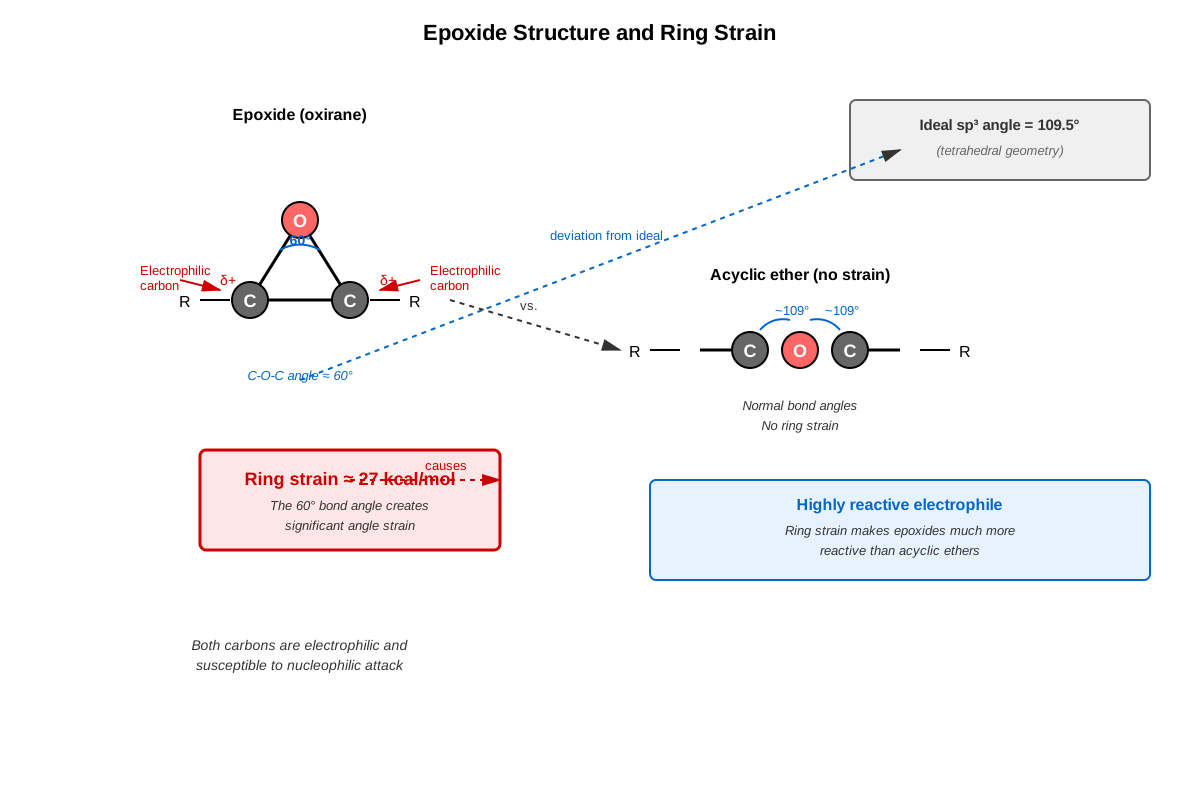
Epoxide opening is a fundamental reaction mechanism in Organic Chemistry that involves the cleavage of the three-membered cyclic ether ring structure known as an epoxide. This reaction is particularly important within the broader study of Alcohols and Ethers because it represents one of the most versatile methods for introducing two functional groups simultaneously onto adjacent carbon atoms. The ring strain inherent in the three-membered epoxide ring (approximately 27 kcal/mol) makes these compounds highly reactive electrophiles, susceptible to nucleophilic attack under both acidic and basic conditions. Understanding the stereochemical and regiochemical outcomes of epoxide opening reactions is essential for predicting product formation in complex organic synthesis scenarios.
For the MCAT, epoxide opening represents a medium-difficulty topic that tests students' ability to integrate multiple concepts: nucleophilic substitution mechanisms, stereochemistry, acid-base chemistry, and regioselectivity. The MCAT frequently presents epoxide opening in the context of biological molecules, pharmaceutical synthesis, or multi-step reaction sequences where students must predict products and understand mechanistic pathways. This topic bridges fundamental reaction mechanisms with practical applications in biochemistry, as epoxides appear in steroid metabolism, drug metabolism (particularly through cytochrome P450 enzymes), and as intermediates in the biosynthesis of various natural products.
The significance of epoxide opening Organic Chemistry extends beyond isolated reactions to encompass broader principles of reactivity, selectivity, and three-dimensional molecular structure. Mastery of this topic enables students to approach MCAT passages involving ether chemistry, alcohol synthesis, and stereochemical transformations with confidence. The mechanistic understanding developed through studying epoxide opening also reinforces concepts applicable to other ring-opening reactions and nucleophilic substitution processes throughout organic chemistry.
Learning Objectives
- [ ] Define epoxide opening using accurate Organic Chemistry terminology
- [ ] Explain why epoxide opening matters for the MCAT
- [ ] Apply epoxide opening to exam-style questions
- [ ] Identify common mistakes related to epoxide opening
- [ ] Connect epoxide opening to related Organic Chemistry concepts
- [ ] Predict the regiochemical outcome of epoxide opening under acidic versus basic conditions
- [ ] Determine the stereochemical configuration of products formed from epoxide opening reactions
- [ ] Analyze the role of ring strain and nucleophile strength in epoxide reactivity
- [ ] Evaluate multi-step synthesis pathways that incorporate epoxide formation and opening
Prerequisites
- Nucleophilic substitution mechanisms (SN1 and SN2): Essential for understanding the mechanistic pathways by which nucleophiles attack epoxide carbons and the factors governing reaction rates and stereochemistry
- Stereochemistry and chirality: Required to predict the three-dimensional arrangement of products, particularly the inversion of configuration that occurs during epoxide opening
- Acid-base chemistry: Necessary to understand how protonation affects epoxide reactivity and regioselectivity, and how pH conditions determine reaction pathways
- Alcohol and ether nomenclature and properties: Provides the foundational knowledge of functional groups involved in both the starting materials and products of epoxide reactions
- Ring strain concepts: Critical for understanding why three-membered rings are particularly reactive and how this strain drives the thermodynamics of ring-opening reactions
- Carbocation stability: Important for predicting regioselectivity in acid-catalyzed epoxide opening where partial carbocation character develops
Why This Topic Matters
Epoxide opening has significant clinical and real-world relevance that extends well beyond academic organic chemistry. In biological systems, epoxides are formed as reactive intermediates during the metabolism of various drugs and environmental toxins by cytochrome P450 enzymes. These epoxide intermediates can react with cellular nucleophiles such as DNA, proteins, and glutathione, leading to either detoxification or, in some cases, carcinogenic effects. For example, benzo[a]pyrene, a component of cigarette smoke, is metabolized to a highly reactive epoxide that can damage DNA and contribute to lung cancer development. Understanding epoxide opening mechanisms is therefore crucial for comprehending drug metabolism, toxicology, and chemical carcinogenesis.
On the MCAT, epoxide opening MCAT questions appear with moderate frequency, typically 1-3 questions per exam either as discrete items or embedded within passage-based questions. These questions most commonly appear in the Chemical and Physical Foundations of Biological Systems section, though they may also appear in passages discussing drug metabolism or biochemical pathways in the Biological and Biochemical Foundations of Living Systems section. The MCAT tests epoxide opening through several question formats: predicting products of reactions under specified conditions, identifying the correct mechanism among multiple choices, determining stereochemical outcomes, and analyzing multi-step synthesis sequences where epoxide opening is one component.
Common ways this topic appears in MCAT passages include: pharmaceutical synthesis schemes where epoxides serve as intermediates in drug production; biochemical passages discussing steroid hormone biosynthesis (which involves epoxide intermediates); toxicology passages explaining how environmental pollutants are metabolized; and organic synthesis passages requiring students to propose or analyze multi-step reaction sequences. The MCAT particularly favors questions that test the distinction between acid-catalyzed and base-catalyzed epoxide opening, as this requires integration of multiple concepts including regioselectivity, mechanism, and the effects of reaction conditions.
Core Concepts
Structure and Reactivity of Epoxides
Epoxides (also called oxiranes) are three-membered cyclic ethers with the general structure of an oxygen atom bonded to two adjacent carbon atoms, forming a highly strained ring. The ring strain in epoxides arises from two sources: angle strain (the C-O-C bond angle is compressed to approximately 60° rather than the preferred tetrahedral angle of 109.5°) and torsional strain (all bonds are eclipsed). This cumulative strain energy of approximately 27 kcal/mol makes epoxides significantly more reactive than their acyclic ether counterparts, which are generally quite unreactive under normal conditions.
The electrophilic nature of epoxides stems from the polarization of the C-O bonds and the accessibility of the carbon atoms to nucleophilic attack. Unlike typical ethers where the oxygen lone pairs are the most reactive site, in epoxides the carbon atoms serve as the primary electrophilic centers. The oxygen atom, while still basic, primarily serves to activate the adjacent carbons toward nucleophilic attack and to act as a leaving group during ring opening.
Mechanism of Base-Catalyzed Epoxide Opening
Under basic or neutral conditions, epoxide opening proceeds through an SN2-like mechanism where a nucleophile directly attacks one of the epoxide carbons. The mechanism follows these steps:
- The nucleophile (Nu⁻ or a neutral nucleophile with lone pairs) approaches the epoxide carbon from the backside, opposite to the C-O bond
- As the nucleophile forms a bond with the carbon, the C-O bond breaks simultaneously
- The oxygen atom becomes negatively charged (alkoxide ion) as the ring opens
- In aqueous or protic conditions, the alkoxide is protonated to form an alcohol
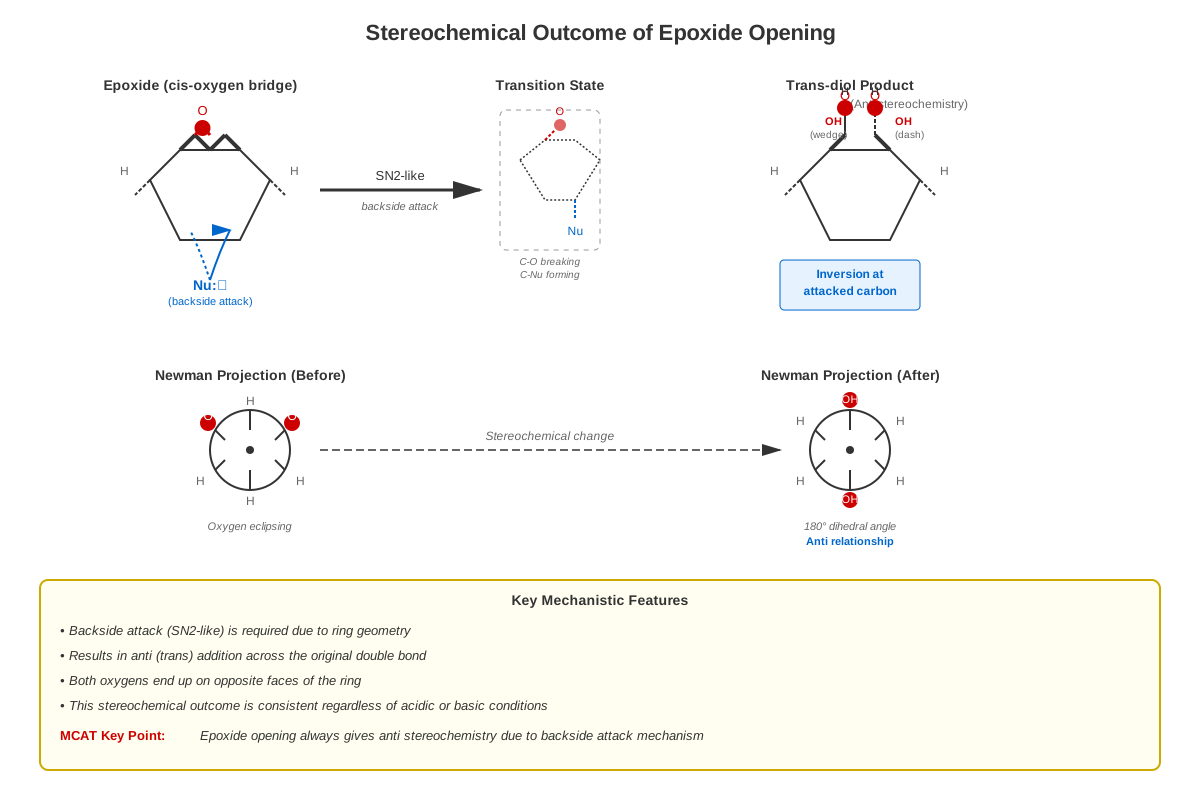
The stereochemical outcome of base-catalyzed epoxide opening is inversion of configuration at the carbon being attacked, consistent with SN2 mechanism characteristics. If the epoxide is derived from a trans-alkene, the product will have two substituents in a trans relationship (anti addition overall). The reaction proceeds with backside attack, meaning the nucleophile approaches from the side opposite the epoxide oxygen.
Regioselectivity in Base-Catalyzed Epoxide Opening
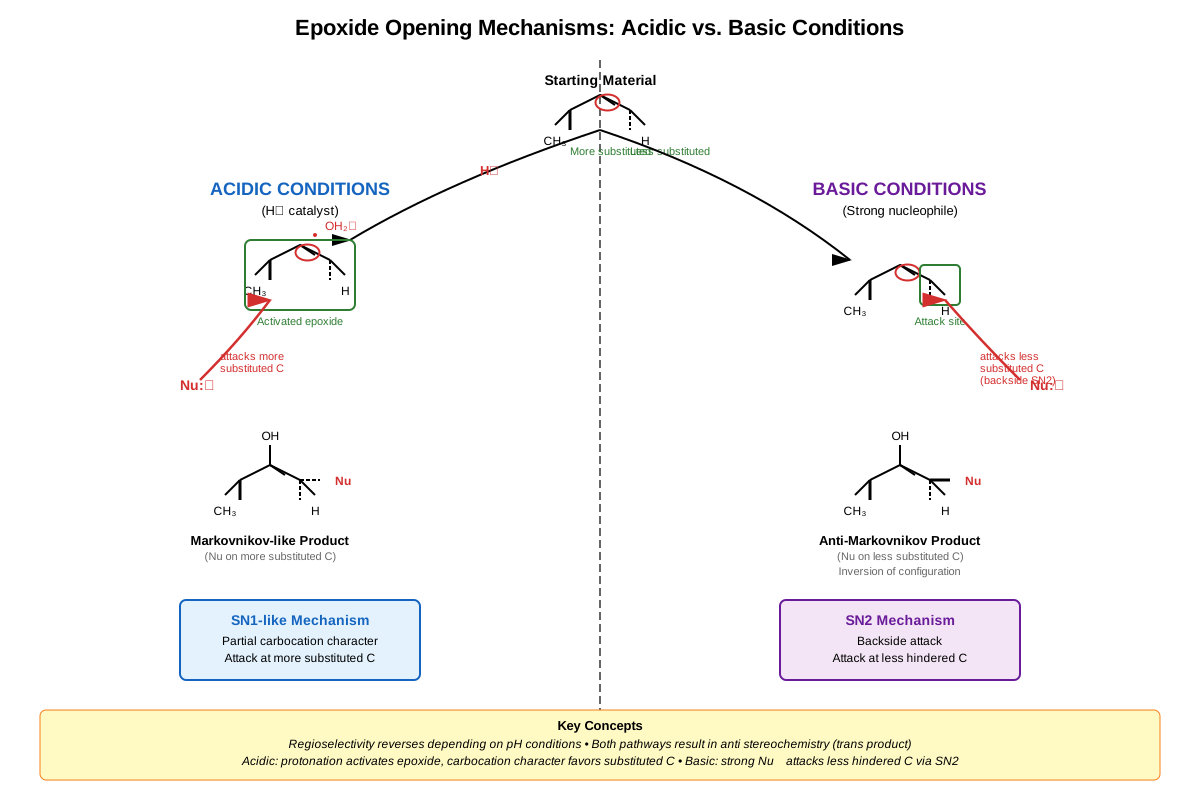
When an unsymmetrical epoxide undergoes base-catalyzed opening, the nucleophile preferentially attacks the less substituted (less hindered) carbon. This regioselectivity arises from steric factors—the SN2-like mechanism requires backside approach, which is more accessible at the less substituted position. For example, in the opening of 2-methyloxirane (propylene oxide), nucleophiles attack predominantly at the terminal (primary) carbon rather than the secondary carbon bearing the methyl group.
The preference for attack at the less substituted carbon can be understood through transition state analysis: the developing negative charge on oxygen and the incoming nucleophile create significant steric crowding in the transition state. This crowding is minimized when attack occurs at the less substituted position.
Mechanism of Acid-Catalyzed Epoxide Opening
Under acidic conditions, the mechanism of epoxide opening changes significantly, proceeding through an SN2-like mechanism with SN1 character. The steps are:
- The epoxide oxygen is protonated by the acid catalyst, forming a protonated epoxide
- Protonation increases the electrophilicity of the carbon atoms and converts oxygen into a better leaving group
- The nucleophile attacks one of the carbons; the C-O bond breaks either simultaneously (SN2-like) or with some carbocation character (SN1-like)
- The extent of carbocation character depends on the substitution pattern of the epoxide carbons
The stereochemical outcome is typically inversion of configuration, though with highly substituted epoxides where significant carbocation character develops, some racemization may occur. The reaction still generally proceeds with backside attack, but the transition state has more carbocation character than in base-catalyzed opening.
Regioselectivity in Acid-Catalyzed Epoxide Opening
In acid-catalyzed epoxide opening of unsymmetrical epoxides, the nucleophile preferentially attacks the more substituted (more hindered) carbon. This reversal of regioselectivity compared to base-catalyzed conditions occurs because the protonated epoxide develops partial carbocation character during ring opening. Since more substituted carbocations are more stable (due to hyperconjugation and inductive effects), the transition state leading to attack at the more substituted position is lower in energy.
This regioselectivity pattern is particularly important for MCAT questions, as it represents a key distinction between acidic and basic conditions. For example, in the acid-catalyzed opening of 2-methyloxirane, nucleophiles attack predominantly at the secondary carbon (bearing the methyl group) rather than the primary carbon.
Common Nucleophiles in Epoxide Opening
Various nucleophiles can open epoxide rings, and the choice of nucleophile determines the functional groups present in the product:
| Nucleophile | Conditions | Product Functional Groups | Example Product |
|---|---|---|---|
| H₂O | Acidic | Two hydroxyl groups (diol) | 1,2-ethanediol |
| OH⁻ | Basic | Two hydroxyl groups (diol) | 1,2-ethanediol |
| ROH (alcohols) | Acidic | Hydroxyl and ether | 2-methoxyethanol |
| RO⁻ (alkoxides) | Basic | Hydroxyl and ether | 2-methoxyethanol |
| NH₃ or RNH₂ | Basic or neutral | Amino alcohol | 2-aminoethanol |
| CN⁻ | Basic | Cyanohydrin | 3-hydroxypropanenitrile |
| Grignard (RMgX) | Basic | Alcohol with C-C bond | Various alcohols |
| LiAlH₄ | Basic | Alcohol (reduction) | Ethanol from ethylene oxide |
Stereochemical Outcomes
The stereochemistry of epoxide opening is highly predictable and represents a high-yield MCAT concept. Key principles include:
- Anti-stereochemistry overall: When an alkene is converted to an epoxide and then opened, the overall addition pattern is anti (opposite sides of the original double bond)
- Inversion at the attacked carbon: The SN2-like nature of both acid- and base-catalyzed opening results in inversion of configuration at the carbon undergoing nucleophilic attack
- Trans-diaxial opening in cyclic systems: When cyclic epoxides open, the nucleophile and the oxygen (which becomes OH after protonation) end up in trans-diaxial positions
- Retention of configuration at the non-attacked carbon: The carbon not being attacked maintains its stereochemical configuration
Epoxide Formation and Opening in Synthesis
Epoxides are typically formed through two main routes that students should recognize:
- Alkene epoxidation: Treatment of alkenes with peroxyacids (RCO₃H) such as m-CPBA (meta-chloroperoxybenzoic acid) produces epoxides with syn-stereochemistry (both oxygens add to the same face)
- Halohydrin cyclization: Treatment of halohydrins (compounds with a halogen and hydroxyl on adjacent carbons) with base causes intramolecular SN2 displacement, forming the epoxide
The combination of epoxide formation followed by opening allows for the net addition of two functional groups across a double bond with control over stereochemistry and regiochemistry, making this sequence valuable in organic synthesis.
Concept Relationships
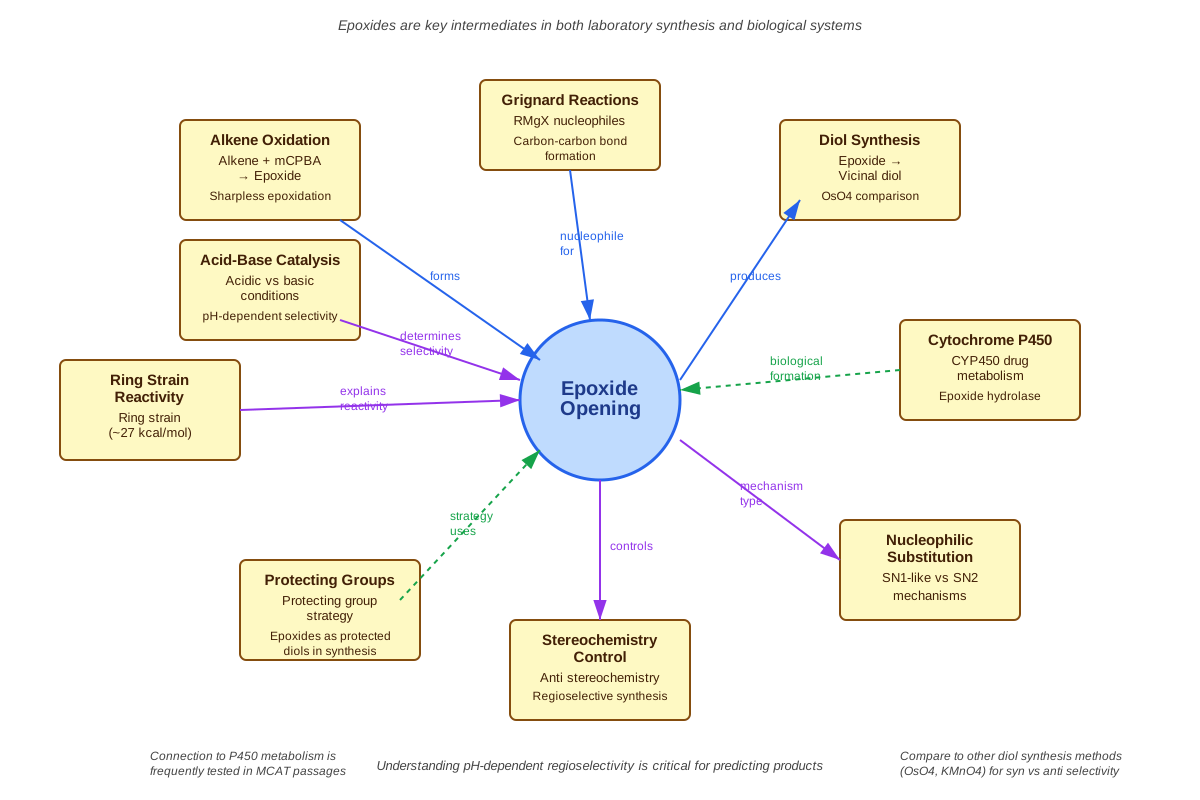
The concepts within epoxide opening are interconnected through mechanistic and structural principles. Ring strain in the epoxide structure → drives the high reactivity toward nucleophiles → which determines the mechanism (SN2-like) → which in turn governs the stereochemical outcome (inversion). The reaction conditions (acidic vs. basic) → affect the protonation state of the epoxide → which influences the regioselectivity (less substituted in base, more substituted in acid) → ultimately determining the product structure.
Epoxide opening connects to prerequisite topics in several ways: The SN2-like mechanism draws directly on nucleophilic substitution principles, including backside attack and inversion of configuration. The regioselectivity under acidic conditions relates to carbocation stability concepts, as the transition state develops partial positive charge at the carbon being attacked. The overall transformation produces alcohols, connecting this topic to alcohol chemistry, hydrogen bonding, and subsequent reactions of hydroxyl groups. The stereochemical outcomes require understanding of chirality and stereoisomerism, including the ability to assign R/S configurations and predict three-dimensional structures.
Looking forward, epoxide opening connects to more advanced topics: The diol products can undergo oxidative cleavage with periodate or lead tetraacetate, linking to carbonyl chemistry. The amino alcohol products from ammonia or amine nucleophiles are relevant to amino acid and protein chemistry. The epoxide opening mechanism serves as a model for understanding other ring-opening reactions such as lactone and lactam hydrolysis. In biochemistry, epoxide intermediates in steroid biosynthesis and drug metabolism represent direct applications of these principles.
The relationship map can be summarized as: Alkene → epoxidation → epoxide → (conditions determine pathway) → acid-catalyzed opening (attack at more substituted carbon) OR base-catalyzed opening (attack at less substituted carbon) → diol or substituted alcohol products → further transformations in synthesis or metabolism.
Quick check — test yourself on Epoxide opening so far.
Try Flashcards →High-Yield Facts
⭐ Epoxides are three-membered cyclic ethers with approximately 27 kcal/mol of ring strain, making them much more reactive than acyclic ethers
⭐ Under basic conditions, nucleophiles attack the less substituted (less hindered) carbon of unsymmetrical epoxides
⭐ Under acidic conditions, nucleophiles attack the more substituted carbon of unsymmetrical epoxides due to partial carbocation character in the transition state
⭐ Epoxide opening proceeds with inversion of configuration at the carbon being attacked, consistent with SN2 mechanism
⭐ The overall stereochemistry of alkene epoxidation followed by epoxide opening is anti-addition across the original double bond
- Water can open epoxides under either acidic or basic conditions to produce 1,2-diols (vicinal diols)
- Grignard reagents open epoxides to form alcohols with new carbon-carbon bonds, attacking at the less hindered position
- Acid-catalyzed epoxide opening requires protonation of the oxygen first, converting it into a better leaving group
- In cyclic systems, epoxide opening occurs with trans-diaxial geometry, placing the nucleophile and leaving group in axial positions on opposite faces
- LiAlH₄ reduces epoxides to alcohols by delivering hydride to the less substituted carbon
- The rate of epoxide opening increases with increasing ring strain and with stronger nucleophiles
- Epoxides derived from trans-alkenes produce products with substituents in trans relationship after opening
Common Misconceptions
Misconception: Epoxides are unreactive like other ethers and require harsh conditions to undergo reactions.
Correction: Epoxides are highly reactive due to ring strain (approximately 27 kcal/mol) and readily undergo ring-opening reactions under mild acidic or basic conditions, unlike acyclic ethers which are generally unreactive.
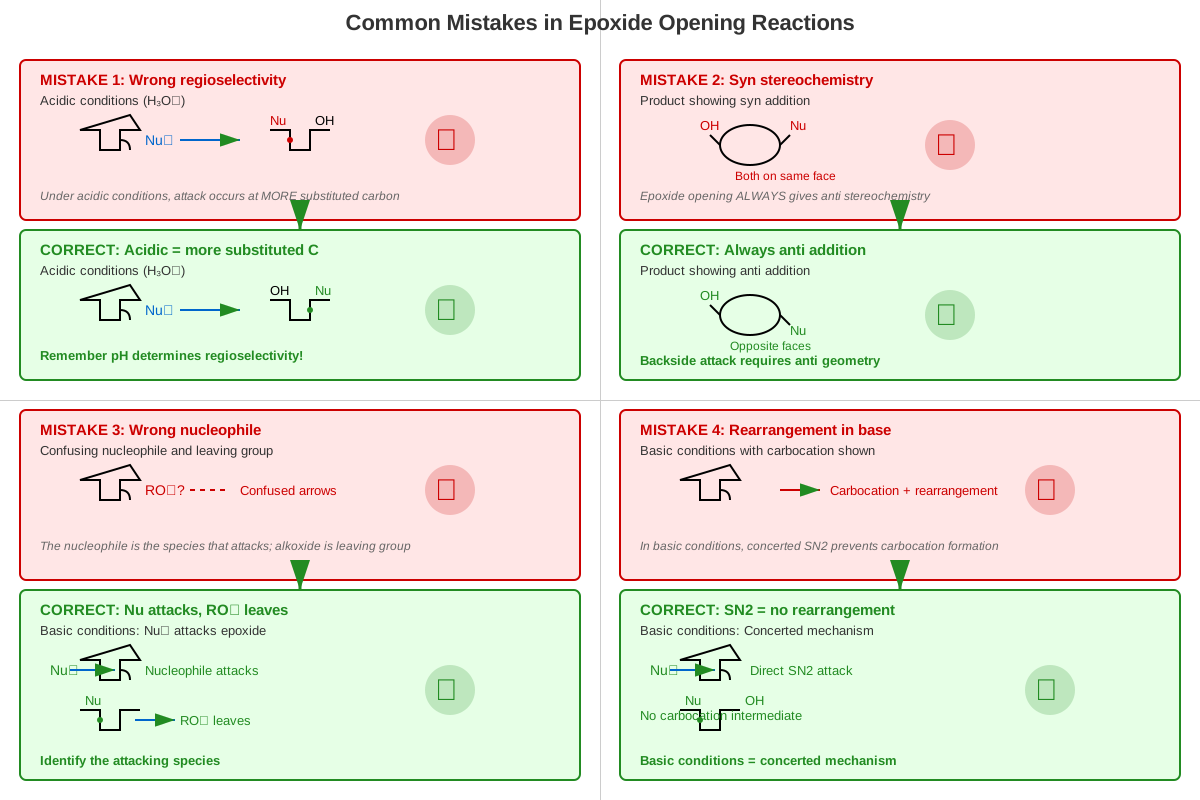
Misconception: Nucleophiles always attack the less substituted carbon of an epoxide regardless of reaction conditions.
Correction: Regioselectivity depends on conditions—under basic conditions, nucleophiles attack the less substituted carbon (steric control), but under acidic conditions, they attack the more substituted carbon (electronic control due to partial carbocation character).
Misconception: Epoxide opening proceeds with retention of configuration at the attacked carbon.
Correction: Epoxide opening proceeds through an SN2-like mechanism with inversion of configuration at the carbon undergoing nucleophilic attack, just like standard SN2 reactions.
Misconception: The oxygen atom in an epoxide is the site of nucleophilic attack.
Correction: The carbon atoms of the epoxide are the electrophilic centers that undergo nucleophilic attack; the oxygen serves to activate these carbons and acts as a leaving group during ring opening.
Misconception: Acid-catalyzed and base-catalyzed epoxide opening produce the same products from unsymmetrical epoxides.
Correction: These conditions produce regioisomeric products—the nucleophile attacks different carbons depending on whether conditions are acidic (more substituted carbon) or basic (less substituted carbon).
Misconception: Epoxide opening under acidic conditions proceeds through a fully formed carbocation intermediate like SN1 reactions.
Correction: While acid-catalyzed opening has SN1 character with partial carbocation development in the transition state, it generally proceeds through a concerted or nearly concerted mechanism rather than forming a discrete carbocation intermediate, especially with less substituted epoxides.
Misconception: The stereochemistry of the starting epoxide doesn't matter for the stereochemistry of the product.
Correction: The stereochemistry of the epoxide directly determines the stereochemistry of the product because the reaction proceeds with inversion at the attacked carbon and retention at the other carbon, making the starting stereochemistry crucial.
Worked Examples
Example 1: Predicting Products of Epoxide Opening Under Different Conditions
Problem: Consider (2R,3R)-2,3-dimethyloxirane. Predict the major product when this epoxide is treated with (a) CH₃OH/H⁺ and (b) CH₃O⁻/CH₃OH.
Solution:
First, analyze the structure: (2R,3R)-2,3-dimethyloxirane is a symmetrical epoxide with methyl groups on both carbons in the R configuration. The epoxide oxygen connects C2 and C3.
(a) CH₃OH/H⁺ (acidic conditions):
Step 1: Under acidic conditions, the epoxide oxygen is protonated first, creating a better leaving group and increasing electrophilicity of both carbons.
Step 2: Since this is a symmetrical epoxide, both carbons are equally substituted (both secondary), so there is no regioselectivity preference based on substitution. Attack can occur at either carbon with equal probability.
Step 3: The nucleophile (CH₃OH) attacks with inversion of configuration. If attack occurs at C2, the configuration at C2 inverts from R to S, while C3 remains R. If attack occurs at C3, the configuration at C3 inverts from R to S, while C2 remains R.
Step 4: After nucleophilic attack, the alkoxide is protonated to give the final product.
Product: A mixture of (2S,3R)-3-methoxy-2-butanol and (2R,3S)-2-methoxy-3-butanol (enantiomeric products formed in equal amounts). Each product has one methoxy group and one hydroxyl group on adjacent carbons with anti-stereochemistry.
(b) CH₃O⁻/CH₃OH (basic conditions):
Step 1: Under basic conditions, the methoxide ion (CH₃O⁻) directly attacks the epoxide without prior protonation.
Step 2: Again, since the epoxide is symmetrical, both carbons are equally accessible and substituted, so attack occurs at either carbon with equal probability.
Step 3: The nucleophile attacks with inversion of configuration, producing the same stereochemical outcome as in acidic conditions.
Step 4: The resulting alkoxide is protonated by the solvent (CH₃OH).
Product: The same mixture of (2S,3R)-3-methoxy-2-butanol and (2R,3S)-2-methoxy-3-butanol.
Key insight: For symmetrical epoxides, acidic and basic conditions give the same products because there is no regioselectivity issue. The difference between acidic and basic conditions only matters for unsymmetrical epoxides.
Example 2: Analyzing Regioselectivity in Unsymmetrical Epoxide Opening
Problem: Methyloxirane (propylene oxide) is treated with sodium cyanide (NaCN) in water at neutral pH, and separately with HCN in acidic solution. Draw the major product of each reaction and explain the regioselectivity.
Solution:
First, identify the structure: Methyloxirane has a methyl group on one carbon (C2, making it secondary) and a hydrogen on the other carbon (C1, making it primary).
Reaction 1: NaCN in water at neutral pH (basic/neutral conditions):
Step 1: Under basic or neutral conditions, the cyanide ion (CN⁻) acts as the nucleophile and attacks the epoxide directly without protonation.
Step 2: The nucleophile preferentially attacks the less substituted carbon (C1, the primary carbon) because this position is less sterically hindered and more accessible for backside attack in the SN2-like mechanism.
Step 3: The C-O bond breaks as CN⁻ attacks, forming an alkoxide at the oxygen.
Step 4: The alkoxide is protonated by water to form the hydroxyl group.
Product: 3-hydroxypropanenitrile (HOCH₂CH₂CN), where the cyano group is attached to the primary carbon and the hydroxyl group is on the secondary carbon.
Reaction 2: HCN in acidic solution (acidic conditions):
Step 1: Under acidic conditions, the epoxide oxygen is protonated first by the acid, forming a protonated epoxide.
Step 2: Protonation increases the electrophilicity of both carbons and allows the C-O bond to break more easily. The transition state develops partial carbocation character.
Step 3: The nucleophile (CN⁻ or HCN acting as nucleophile) preferentially attacks the more substituted carbon (C2, the secondary carbon) because the transition state with partial positive charge at the secondary position is more stable than at the primary position.
Step 4: After attack, the molecule is deprotonated to give the neutral product.
Product: 1-hydroxypropan-2-nitrile (CH₃CH(CN)OH), where the cyano group is attached to the secondary carbon and the hydroxyl group is on the primary carbon.
Key insight: The regioselectivity reverses between basic and acidic conditions. Basic conditions favor attack at the less hindered (primary) carbon, while acidic conditions favor attack at the more substituted (secondary) carbon due to partial carbocation character in the transition state. This is one of the most commonly tested concepts in epoxide opening on the MCAT.
Exam Strategy
When approaching epoxide opening MCAT questions, begin by identifying the reaction conditions—specifically whether the environment is acidic or basic, as this single factor determines regioselectivity. Look for trigger words such as "H⁺," "acidic," "H₂SO₄," or "HCl" indicating acidic conditions, versus "OH⁻," "basic," "NaOH," or "neutral" indicating basic conditions. This distinction should be your first decision point.
For questions asking about product prediction, use this systematic approach: (1) Identify whether the epoxide is symmetrical or unsymmetrical; (2) Determine the reaction conditions; (3) Apply the appropriate regioselectivity rule (less substituted for basic, more substituted for acidic); (4) Apply stereochemical rules (inversion at attacked carbon); (5) Identify the nucleophile to determine what functional group is introduced. This five-step process should take 30-45 seconds and will lead you to the correct answer in most cases.
Process-of-elimination strategies are particularly effective for epoxide questions. If a question shows products with retention of configuration, eliminate it immediately—epoxide opening always involves inversion. If an unsymmetrical epoxide is opened under basic conditions and the answer choice shows attack at the more substituted carbon, eliminate it. If the question involves acidic conditions and shows attack at the less substituted carbon, eliminate it. These "impossible" scenarios can help you quickly narrow down answer choices.
Watch for questions that test the distinction between epoxide opening and other ether reactions. Remember that acyclic ethers are generally unreactive and require harsh conditions (like HI or HBr at high temperatures) to cleave, while epoxides react readily under mild conditions. If a passage discusses ether cleavage under mild conditions, it's almost certainly referring to an epoxide.
Time allocation for epoxide questions should be approximately 60-90 seconds for discrete questions and up to 2 minutes for passage-based questions requiring multiple steps of reasoning. If a question asks you to predict products through multiple steps including epoxide formation and opening, budget extra time but remember that each individual step follows predictable rules. Don't get bogged down trying to visualize complex three-dimensional structures—use wedge-and-dash notation systematically and apply inversion rules mechanically.
For questions involving cyclic epoxides, remember the trans-diaxial opening rule: the nucleophile and the oxygen (which becomes OH) end up in axial positions on opposite faces of the ring. This often appears in questions about steroid chemistry or complex natural products. If you see a cyclohexane ring with an epoxide, immediately think "trans-diaxial opening."
Memory Techniques
Regioselectivity Mnemonic - "BLESS the LESS, ACID the MORE":
- Basic conditions → attack the LESS substituted carbon
- ACIDic conditions → attack the MORE substituted carbon
This simple phrase captures the most commonly tested distinction in epoxide opening and can be recalled quickly during the exam.
Stereochemistry Visualization - "Backside Attack, Frontside Leaves":
Visualize the nucleophile approaching from the back (opposite the epoxide oxygen) while the oxygen leaves from the front. This mental image reinforces the inversion of configuration that occurs during epoxide opening. Imagine the carbon being "flipped inside out" like an umbrella in the wind.
Mechanism Memory - "PAL" for Acidic Opening:
- Protonation of oxygen first
- Attack at more substituted carbon
- Loss of water (or deprotonation) to form product
This acronym helps you remember the sequence of steps in acid-catalyzed epoxide opening.
Nucleophile Product Mnemonic - "Water Makes Diols, Alcohols Make Ethers, Amines Make Amino Alcohols":
This phrase helps you quickly identify the functional groups in products based on the nucleophile used. The pattern is simple: the nucleophile's functional group appears in the product along with a hydroxyl group from the opened epoxide.
Ring Strain Reminder - "Three's a Crowd":
Remember that three-membered rings are highly strained and reactive. When you see a three-membered ring with oxygen (epoxide) or without oxygen (cyclopropane), think "high energy, high reactivity." This helps distinguish epoxides from larger cyclic ethers like tetrahydrofuran (five-membered) or dioxane (six-membered), which are much less reactive.
Summary
Epoxide opening is a fundamental reaction in organic chemistry involving the nucleophilic cleavage of three-membered cyclic ether rings. The high ring strain (approximately 27 kcal/mol) makes epoxides significantly more reactive than acyclic ethers, allowing them to undergo ring-opening reactions under mild conditions. The mechanism and regioselectivity of epoxide opening depend critically on reaction conditions: under basic or neutral conditions, nucleophiles attack the less substituted carbon through an SN2-like mechanism, while under acidic conditions, protonation of the oxygen leads to preferential attack at the more substituted carbon due to partial carbocation character in the transition state. Regardless of conditions, the reaction proceeds with inversion of configuration at the carbon being attacked, consistent with backside nucleophilic attack. The products are typically 1,2-difunctionalized compounds such as diols, ether-alcohols, or amino alcohols, depending on the nucleophile employed. Understanding the interplay between reaction conditions, regioselectivity, and stereochemistry is essential for predicting products and solving MCAT problems involving epoxide chemistry, particularly in the context of organic synthesis, drug metabolism, and biochemical transformations.
Key Takeaways
- Epoxides are highly reactive three-membered cyclic ethers due to approximately 27 kcal/mol of ring strain, making them much more reactive than acyclic ethers
- Regioselectivity in unsymmetrical epoxide opening is condition-dependent: basic conditions favor attack at the less substituted carbon (steric control), while acidic conditions favor attack at the more substituted carbon (electronic control)
- Epoxide opening proceeds with inversion of configuration at the attacked carbon through an SN2-like mechanism, regardless of whether conditions are acidic or basic
- Common nucleophiles include water (producing diols), alcohols (producing ether-alcohols), amines (producing amino alcohols), and cyanide (producing cyanohydrins)
- The overall stereochemistry of alkene epoxidation followed by epoxide opening results in anti-addition across the original double bond
- In cyclic systems, epoxide opening occurs with trans-diaxial geometry, placing the nucleophile and hydroxyl group on opposite faces of the ring
- Acid-catalyzed opening requires initial protonation of the epoxide oxygen, converting it into a better leaving group and allowing partial carbocation character to develop in the transition state
Related Topics
Alkene Reactions and Epoxidation: Understanding how epoxides are formed from alkenes using peroxyacids (like m-CPBA) provides context for epoxide opening and allows students to predict the stereochemistry of the starting epoxide. This topic enables students to work through complete synthetic sequences from alkenes to diols.
Vicinal Diol Cleavage: The diol products from epoxide opening can undergo oxidative cleavage with reagents like periodate (IO₄⁻) or lead tetraacetate, breaking the C-C bond to form carbonyl compounds. Mastering epoxide opening prepares students for understanding these subsequent transformations.
Halohydrin Formation and Cyclization: Halohydrins (compounds with halogen and hydroxyl on adjacent carbons) can cyclize to form epoxides under basic conditions through intramolecular SN2 displacement. This represents an alternative route to epoxide formation and reinforces SN2 mechanism concepts.
Grignard Reactions with Epoxides: Grignard reagents open epoxides to form alcohols with new carbon-carbon bonds, representing an important method for carbon chain extension. Understanding basic epoxide opening prepares students for these more complex organometallic reactions.
Biochemical Applications - Cytochrome P450 Metabolism: Many drugs and toxins are metabolized to epoxide intermediates by cytochrome P450 enzymes, which then undergo enzymatic or non-enzymatic opening. This connects organic chemistry to biochemistry and pharmacology, topics that frequently appear together on the MCAT.
Practice CTA
Now that you've mastered the core concepts of epoxide opening, it's time to solidify your understanding through active practice. Work through the practice questions and flashcards to test your ability to predict products, identify mechanisms, and apply regioselectivity rules under time pressure. Focus particularly on distinguishing between acidic and basic conditions, as this represents the highest-yield distinction for MCAT questions. Remember that organic chemistry mastery comes from repeated application of mechanistic principles—each practice problem strengthens your pattern recognition and speeds up your problem-solving process. You've built a strong foundation; now reinforce it through deliberate practice, and you'll be fully prepared to tackle any epoxide opening question the MCAT presents!
Sign up free to keep reading
Create a free AnvayaPrep account to finish this MCAT guide on Epoxide opening — plus flashcards and practice questions.