Overview
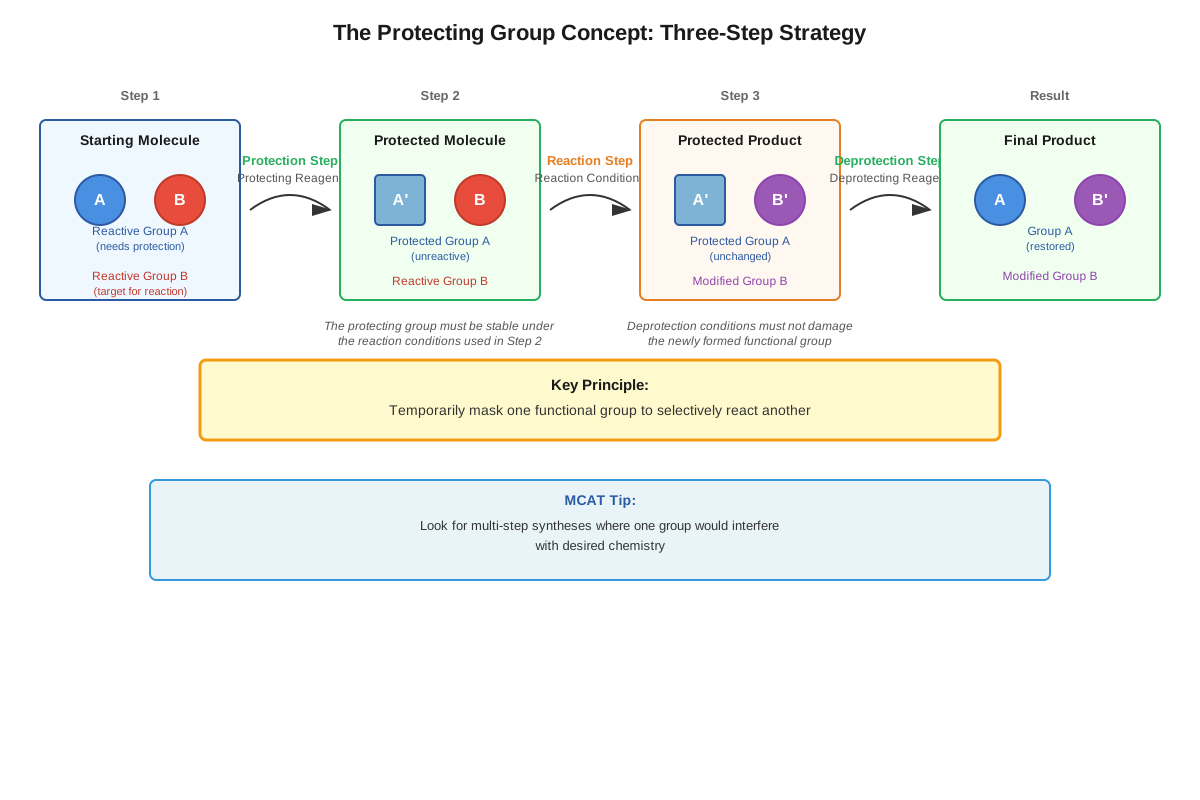
Protecting groups basics represent a fundamental synthetic strategy in Organic Chemistry that allows chemists to selectively modify one functional group while preventing unwanted reactions at another site within the same molecule. This concept is particularly relevant when working with alcohols and ethers, as hydroxyl groups are highly reactive and can interfere with reactions intended for other parts of a molecule. The principle is straightforward: temporarily convert a reactive functional group into an unreactive derivative, perform the desired transformation elsewhere in the molecule, then remove the protecting group to regenerate the original functionality.
For the MCAT, understanding protecting groups basics is essential because it demonstrates sophisticated problem-solving in multi-step synthesis questions and reflects real-world pharmaceutical chemistry applications. The exam frequently tests whether students can recognize when a protecting group is necessary, identify common protecting groups (especially for alcohols), and understand the logic behind protection-deprotection sequences. This topic bridges fundamental reactivity concepts with practical synthetic strategy, making it a medium-yield but conceptually important area.
The relationship between protecting groups and broader Organic Chemistry concepts is significant. Protecting groups rely on understanding relative reactivity of functional groups, selectivity in chemical reactions, and the principle of orthogonal chemistry—where one set of conditions affects one group but not another. This topic connects directly to alcohol chemistry, ether formation, acid-base chemistry, and multi-step synthesis planning, all of which are testable concepts on the MCAT. Mastering protecting groups demonstrates a higher level of chemical reasoning that distinguishes top-scoring students.
Learning Objectives
- [ ] Define protecting groups basics using accurate Organic Chemistry terminology
- [ ] Explain why protecting groups basics matters for the MCAT
- [ ] Apply protecting groups basics to exam-style questions
- [ ] Identify common mistakes related to protecting groups basics
- [ ] Connect protecting groups basics to related Organic Chemistry concepts
- [ ] Predict when a protecting group strategy is necessary in a multi-step synthesis
- [ ] Compare and contrast different protecting groups based on their stability and removal conditions
- [ ] Analyze synthesis schemes to identify protection and deprotection steps
Prerequisites
- Alcohol structure and nomenclature: Understanding hydroxyl group reactivity is essential since alcohols are the most commonly protected functional groups on the MCAT
- Ether formation and properties: Protecting groups often convert alcohols to ethers temporarily, requiring knowledge of ether stability and formation mechanisms
- Acid-base chemistry: Protection and deprotection steps frequently involve acid or base catalysis, making pH considerations critical
- Nucleophilic substitution mechanisms: Many protecting group installations proceed through SN1 or SN2 mechanisms
- Carbonyl chemistry basics: Understanding aldehydes and ketones helps recognize why certain functional groups need protection during carbonyl reactions
Why This Topic Matters
In pharmaceutical and biochemical research, protecting groups are indispensable tools for synthesizing complex molecules with multiple functional groups. For example, the synthesis of many antibiotics, antivirals, and chemotherapy agents requires selective protection of hydroxyl groups to prevent unwanted side reactions during key bond-forming steps. The Nobel Prize-winning synthesis of vitamin B12 by Robert Woodward employed over 100 steps, many involving strategic use of protecting groups. This real-world significance translates directly to MCAT passages that describe drug synthesis or biochemical modifications.
On the MCAT, protecting groups appear in approximately 3-5% of Organic Chemistry questions, typically within Chemical and Physical Foundations of Biological Systems passages. The exam most commonly tests this concept through multi-step synthesis problems where students must identify which functional group needs protection, select an appropriate protecting group, or recognize when a deprotection step should occur. Questions may present a synthesis scheme with a missing reagent and ask students to identify the protecting group being installed or removed.
The MCAT particularly favors questions about silyl ethers (like TBS or TMS groups) and acetals/ketals as alcohol protecting groups because these demonstrate both the concept and practical selectivity. Passages may describe a research scenario where chemists need to selectively modify one hydroxyl group in a diol, requiring students to recognize that protecting one OH group allows selective reaction at the other. Understanding the logic of when and why to use protecting groups—rather than memorizing every possible protecting group—is the key to success on MCAT questions.
Core Concepts
What Are Protecting Groups?
A protecting group is a temporary modification of a functional group that renders it unreactive under specific reaction conditions, allowing selective transformation of other parts of the molecule. The ideal protecting group must meet three criteria: (1) it can be installed easily and in high yield, (2) it remains stable under the conditions used for subsequent reactions, and (3) it can be removed selectively without affecting other functional groups in the molecule. This three-step sequence—protection, reaction, deprotection—forms the foundation of protecting group strategy in Organic Chemistry.
The concept of orthogonal protection is particularly important: different protecting groups should be removable under different conditions, allowing sequential deprotection in molecules with multiple protected sites. For MCAT purposes, understanding the general principle matters more than memorizing every protecting group, though familiarity with common examples is valuable.
Why Protecting Groups Are Necessary
Functional groups like alcohols, amines, and carboxylic acids are highly reactive and can interfere with intended reactions in several ways. An alcohol might act as a nucleophile when you want another group to react, or it might be oxidized when you're trying to perform a reduction elsewhere. Consider a molecule with both an alcohol and an alkene: if you want to perform hydroboration-oxidation on the alkene, the existing alcohol might interfere or undergo unwanted oxidation. By temporarily converting the alcohol to a less reactive ether (a common protecting strategy), the alkene can be selectively transformed.
Chemoselectivity—the preferential reaction of one functional group over another—is the driving principle behind protecting group use. When natural chemoselectivity is insufficient, protecting groups create artificial selectivity by temporarily masking reactive sites.
Common Protecting Groups for Alcohols
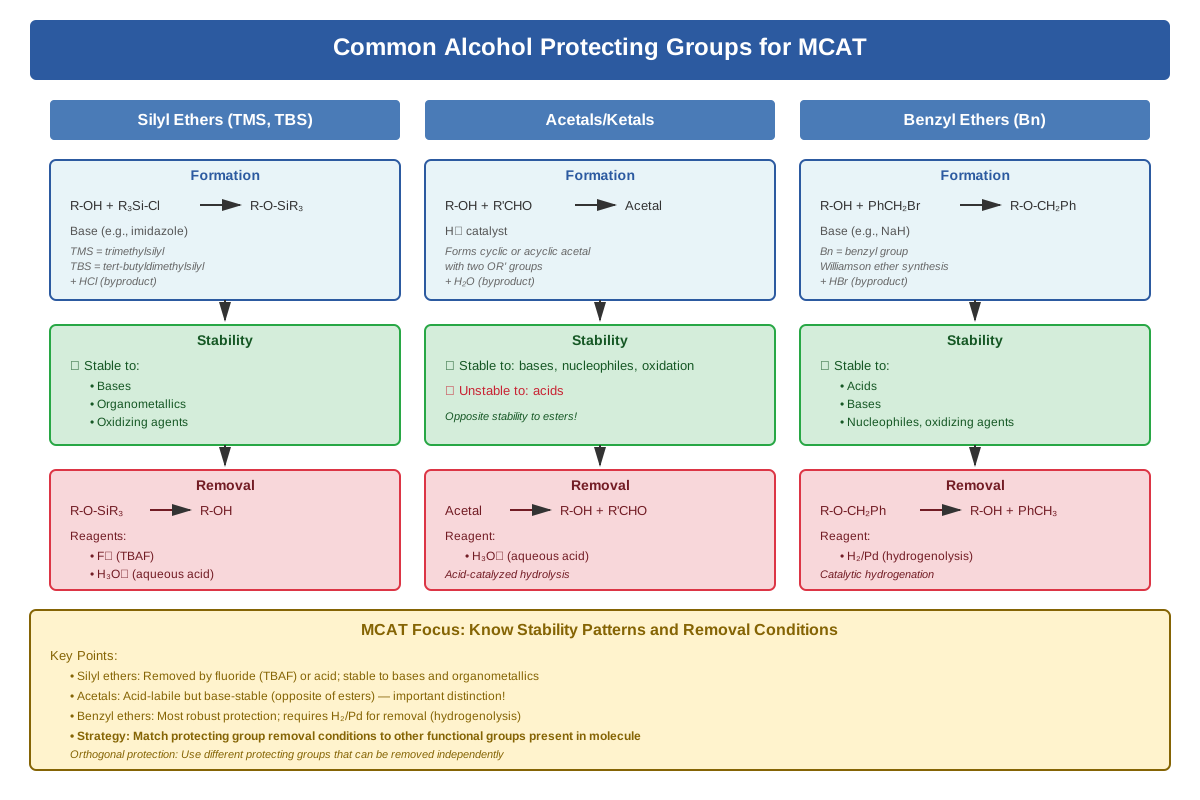
Since alcohols and ethers are central to this MCAT topic, understanding alcohol protecting groups is essential. The table below summarizes the most MCAT-relevant protecting groups:
| Protecting Group | Structure Type | Installation Conditions | Removal Conditions | Stability |
|---|---|---|---|---|
| Silyl ethers (TMS, TBS, TIPS) | R-O-Si(R')₃ | Silyl chloride + base | Fluoride ion (TBAF) or dilute acid | Stable to bases, nucleophiles, oxidizing agents |
| Acetals/Ketals | R-O-C(OR')₂-R" | Alcohol + aldehyde/ketone + acid catalyst | Aqueous acid | Stable to bases, nucleophiles, reducing agents |
| Benzyl ethers | R-O-CH₂-Ph | Benzyl bromide + strong base | Hydrogenolysis (H₂/Pd) | Very stable; resistant to most conditions |
| Methyl ethers | R-O-CH₃ | Methyl iodide + strong base | Strong acid (HI) or strong base | Extremely stable; rarely used as temporary protecting groups |
Silyl Ether Protecting Groups
Silyl ethers are among the most important protecting groups for the MCAT because they illustrate key principles of selectivity and mild deprotection. The most common silyl protecting groups are:
- TMS (trimethylsilyl): -Si(CH₃)₃
- TBS (tert-butyldimethylsilyl): -Si(CH₃)₂C(CH₃)₃
- TIPS (triisopropylsilyl): -Si[CH(CH₃)₂]₃
These groups increase in steric bulk and stability from TMS to TIPS. Installation typically involves treating an alcohol with a silyl chloride (like TBSCl) in the presence of a base such as imidazole or triethylamine. The key advantage of silyl ethers is their selective removal using fluoride ion (typically tetrabutylammonium fluoride, TBAF), which cleaves the Si-O bond through a mechanism involving fluoride's strong affinity for silicon.
The Si-O bond is more labile than a C-O bond, making silyl ethers easier to remove than simple alkyl ethers. This selectivity is crucial: silyl ethers are stable to many organometallic reagents, strong bases, and oxidizing agents, but can be cleanly removed with fluoride without affecting other functional groups.
Acetal and Ketal Protecting Groups
Acetals and ketals protect alcohols (particularly diols) by forming cyclic or acyclic structures with aldehydes or ketones. For example, treating a 1,2-diol with acetone under acid catalysis forms a cyclic ketal (specifically, an acetonide). This protection strategy is particularly useful for vicinal diols (1,2-diols) or 1,3-diols, which form stable five- or six-membered ring acetals.
The mechanism of acetal formation involves:
- Protonation of the carbonyl oxygen
- Nucleophilic attack by the alcohol
- Proton transfer
- Loss of water to form an oxonium ion
- Attack by a second alcohol
- Deprotonation to form the acetal
Acetals are stable to bases, nucleophiles, and reducing agents but are readily cleaved by aqueous acid, which reverses the formation mechanism. This acid lability makes acetals complementary to silyl ethers (which are base-labile but acid-stable), enabling orthogonal protection strategies.
Protection Strategy in Multi-Step Synthesis
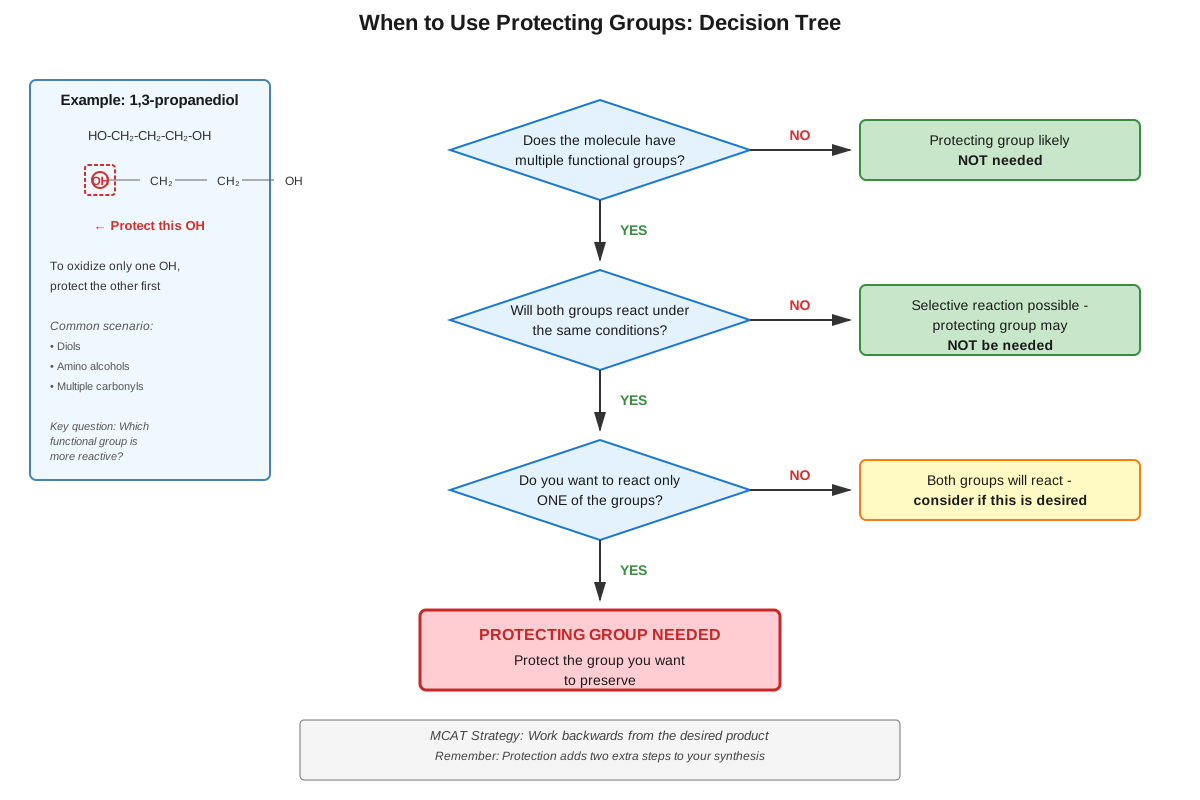
The logic of when to use a protecting group follows a systematic analysis:
- Identify all functional groups in the starting material
- Determine which group needs to react in the next step
- Assess whether other groups will interfere with the desired reaction
- Select a protecting group that is stable under the reaction conditions
- Plan the deprotection step to ensure it won't affect the newly formed functional groups
For MCAT questions, recognizing that a synthesis requires protection often comes from seeing incompatible functional groups or reaction conditions that would affect multiple sites. If a question shows a molecule with two alcohols but only one should be oxidized, protection of one alcohol is necessary.
Selectivity in Protection
Not all functional groups are equally reactive, and protecting groups can exploit these differences. Primary alcohols are generally more reactive than secondary alcohols in protection reactions, allowing selective protection. Steric hindrance also plays a role: bulky protecting groups like TIPS preferentially protect less hindered alcohols.
Chemoselectivity between different functional group classes is also important. For example, alcohols can be selectively protected in the presence of carboxylic acids by choosing appropriate conditions, since carboxylic acids and alcohols have different pKa values and nucleophilicity.
Concept Relationships
The concept of protecting groups sits at the intersection of several fundamental organic chemistry principles. Functional group reactivity determines when protection is necessary—highly reactive groups like alcohols, amines, and thiols are most commonly protected. This connects directly to nucleophilicity and electrophilicity concepts, as protecting groups temporarily mask nucleophilic sites.
The relationship flows as follows: Alcohol reactivity → necessitates → Protecting group installation → enables → Selective transformation → followed by → Deprotection → yields → Target molecule. Each arrow represents a strategic decision point in synthesis planning.
Protecting groups also connect to ether chemistry since many alcohol protecting groups are ethers (silyl ethers, benzyl ethers, methyl ethers). Understanding ether stability and formation mechanisms is prerequisite knowledge that directly applies to protection strategies. The C-O bond in ethers is relatively stable, which is why ethers make good protecting groups—they don't react under most conditions.
Acid-base chemistry underlies both protection and deprotection mechanisms. Acetal formation requires acid catalysis, while silyl ether installation requires base. Deprotection conditions (aqueous acid for acetals, fluoride for silyl ethers) must be carefully chosen to avoid affecting other functional groups, connecting to the concept of selective reactivity.
The broader concept of retrosynthetic analysis—working backward from a target molecule to identify synthetic routes—heavily relies on protecting group strategy. When planning a synthesis, chemists identify disconnections (bonds to form) and then determine which functional groups need protection during each step. This forward-and-backward thinking is exactly what MCAT synthesis questions test.
High-Yield Facts
⭐ Protecting groups temporarily mask reactive functional groups, allowing selective reactions elsewhere in the molecule
⭐ Silyl ethers (TMS, TBS, TIPS) are removed with fluoride ion (TBAF) and are stable to bases and nucleophiles
⭐ Acetals and ketals are stable to bases and nucleophiles but are cleaved by aqueous acid
⭐ The ideal protecting group is easy to install, stable under reaction conditions, and easy to remove selectively
⭐ Primary alcohols are generally more reactive than secondary alcohols, allowing selective protection
- Benzyl ethers are removed by hydrogenolysis (H₂/Pd-C) and are very stable to most other conditions
- Orthogonal protection means different protecting groups can be removed under different conditions
- Protecting groups are most commonly used for alcohols, amines, carbonyls, and carboxylic acids
- The Si-O bond in silyl ethers is more reactive than C-O bonds due to silicon's affinity for fluoride
- Cyclic acetals (like acetonides) are more stable than acyclic acetals due to entropic factors
- Protection-deprotection sequences add steps to a synthesis but enable reactions that would otherwise be impossible
Quick check — test yourself on Protecting groups basics so far.
Try Flashcards →Common Misconceptions
Misconception: Protecting groups permanently modify the molecule and change its final structure.
Correction: Protecting groups are temporary modifications that are removed in a deprotection step, regenerating the original functional group. The final product has the same functional groups as if no protection had occurred—protection simply enables selective reactions during synthesis.
Misconception: Any ether can serve as a protecting group for alcohols.
Correction: Only certain ethers make good protecting groups because they must be removable under mild, selective conditions. Simple alkyl ethers like methyl ethers are too stable and require harsh conditions (strong acid or base) for removal, which would likely destroy other parts of the molecule. Silyl ethers and benzyl ethers are preferred because they can be removed selectively.
Misconception: Silyl ethers are removed with acid, just like acetals.
Correction: Silyl ethers are typically removed with fluoride ion (TBAF), not acid. While dilute acid can remove some silyl ethers, fluoride is the preferred reagent because of silicon's strong affinity for fluorine. This selectivity is crucial—acetals are removed with acid while silyl ethers are removed with fluoride, enabling orthogonal protection strategies.
Misconception: Protecting groups are only necessary when two identical functional groups are present.
Correction: Protecting groups are needed whenever any reactive functional group would interfere with a desired reaction, regardless of whether multiple copies of that group exist. Even a single alcohol might need protection if the planned reaction conditions would oxidize, eliminate, or otherwise transform it unintentionally.
Misconception: The bulkiest protecting group is always the best choice.
Correction: Protecting group selection depends on the specific synthetic context. While bulkier groups like TIPS offer greater stability, they may also hinder desired reactions due to steric effects. The best protecting group balances stability during the reaction sequence with ease of installation and removal. Sometimes a less stable group like TMS is preferred if only brief protection is needed.
Misconception: All protecting groups for the same functional group are removed under the same conditions.
Correction: Different protecting groups for the same functional group are removed under different conditions—this is the principle of orthogonal protection. For example, silyl ethers (fluoride removal), benzyl ethers (hydrogenolysis), and acetals (acid hydrolysis) all protect alcohols but require completely different deprotection conditions, allowing selective removal in complex molecules.
Worked Examples
Example 1: Identifying the Need for Protection
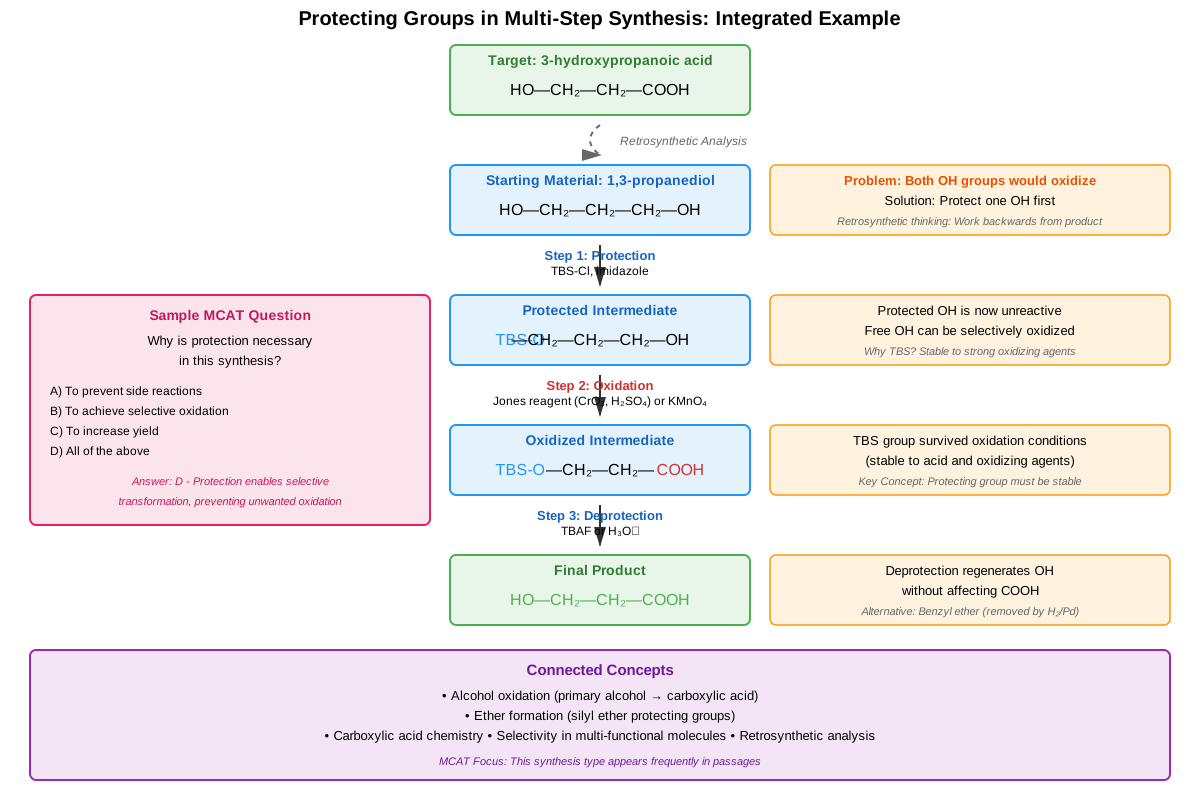
Problem: A chemist wants to synthesize the following transformation: Convert 1,3-propanediol (HO-CH₂-CH₂-CH₂-OH) to 3-hydroxypropanoic acid (HO-CH₂-CH₂-COOH). The planned route involves oxidizing one primary alcohol to a carboxylic acid using Jones reagent (CrO₃/H₂SO₄). Why would this synthesis fail without a protecting group, and what strategy would work?
Solution:
Step 1: Analyze the functional groups. The starting material has two identical primary alcohols. The goal is to oxidize only one to a carboxylic acid while leaving the other as an alcohol.
Step 2: Identify the problem. Jones reagent is a strong oxidizing agent that will oxidize both primary alcohols to carboxylic acids, giving HO₂C-CH₂-CH₂-CO₂H (malonic acid) instead of the desired product. Without protection, there's no selectivity.
Step 3: Design a protection strategy. One alcohol must be protected before oxidation:
- Protect one -OH group (convert to a silyl ether using TBSCl and base)
- Oxidize the remaining free -OH to -COOH using Jones reagent
- Remove the protecting group with TBAF to regenerate the -OH
Step 4: Verify stability. TBS ethers are stable to the acidic, oxidizing conditions of Jones reagent, so the protected alcohol won't be affected during oxidation. Fluoride-mediated deprotection won't affect the carboxylic acid.
Key Learning Point: This example demonstrates the core logic of protecting groups—when two identical functional groups are present but only one should react, protection enables selectivity. This type of reasoning appears frequently in MCAT synthesis questions.
Example 2: Selecting the Appropriate Protecting Group
Problem: A synthesis requires protecting an alcohol through several steps: (1) treatment with a strong base (n-BuLi), (2) reaction with an alkyl halide, and (3) treatment with aqueous acid. Which protecting group would be most appropriate: (A) TBS ether, (B) acetal, (C) benzyl ether, or (D) no protection needed?
Solution:
Step 1: Analyze each reaction condition's compatibility with protecting groups.
Strong base (n-BuLi): This will deprotonate acidic protons and can cleave some protecting groups. Acetals are stable to base. Silyl ethers are stable to base. Benzyl ethers are stable to base. So far, all options work.
Alkyl halide reaction: This is likely an SN2 reaction. All protecting groups remain stable during SN2 reactions.
Aqueous acid: This will hydrolyze acetals back to alcohols. Silyl ethers can be cleaved by strong acid but are relatively stable to dilute acid. Benzyl ethers are stable to acid.
Step 2: Evaluate each option:
- (A) TBS ether: Stable to base and nucleophiles, but the final aqueous acid step might partially cleave it. However, if the acid is dilute, TBS should survive.
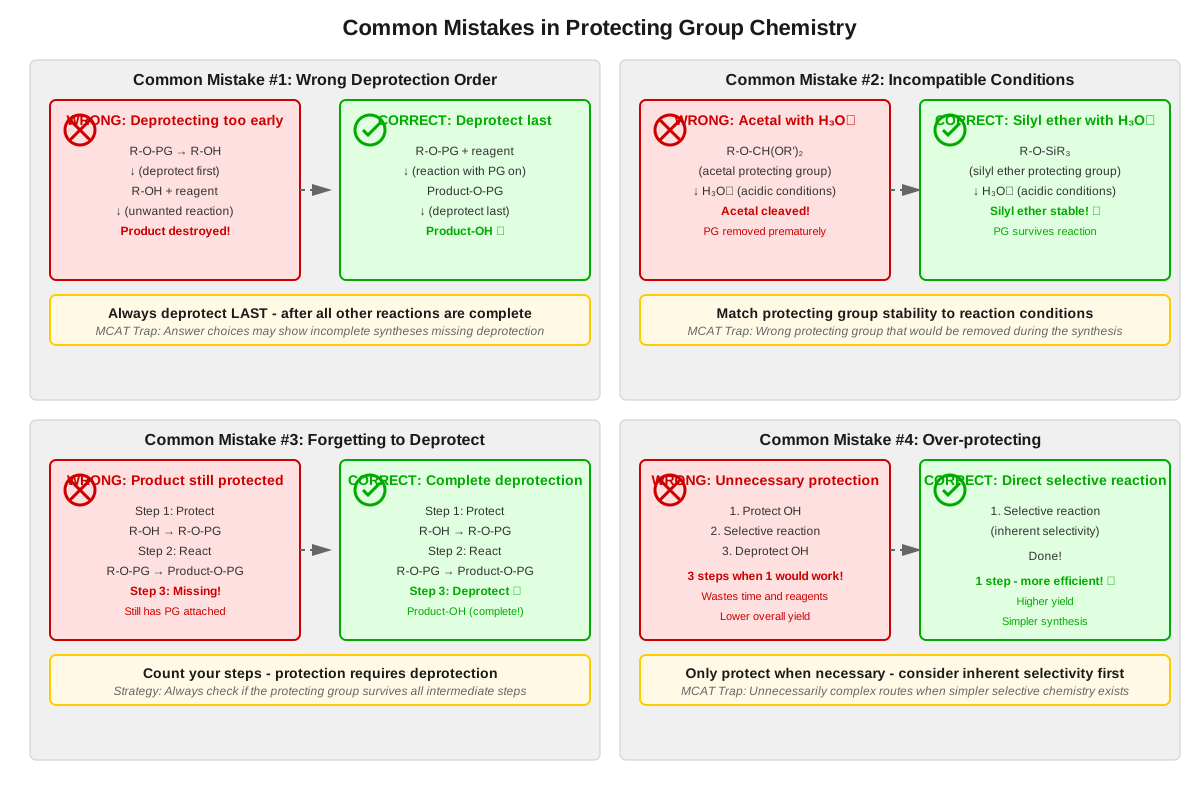
- (B) Acetal: Stable to base and nucleophiles, but will definitely be cleaved by the aqueous acid in step 3, regenerating the alcohol prematurely.
- (C) Benzyl ether: Stable to all three conditions. This is the best choice.
- (D) No protection: The alcohol would be deprotonated by n-BuLi and could act as a nucleophile, interfering with the desired reaction.
Answer: (C) Benzyl ether is most appropriate because it's stable to strong base, nucleophiles, and acid. It would be removed later by hydrogenolysis.
Key Learning Point: Protecting group selection requires analyzing all subsequent reaction conditions. The protecting group must survive every step until intentional deprotection. This multi-step thinking is exactly what the MCAT tests in complex synthesis problems.
Exam Strategy
When approaching MCAT questions on protecting groups basics, follow this systematic strategy:
Step 1: Identify the functional groups in the starting material and product. Look for functional groups that appear in the starting material but not the product (these might have been protected then deprotected) or groups that should remain unchanged through the synthesis.
Step 2: Analyze the reaction conditions in each step. Ask: "Would these conditions affect any functional group that should remain unchanged?" If yes, protection is likely needed. Watch for trigger phrases like "selective oxidation," "without affecting the alcohol," or "protecting the hydroxyl group."
Step 3: Recognize common protecting group patterns. If you see:
- Silyl chloride (TMSCl, TBSCl) + base → silyl ether installation
- Fluoride ion (TBAF) → silyl ether removal
- Aldehyde/ketone + acid catalyst → acetal formation
- Aqueous acid after previous steps → likely acetal deprotection
- H₂/Pd-C → likely benzyl ether removal
Step 4: Use process of elimination. If a question asks which protecting group to use:
- Eliminate options that would be cleaved by the reaction conditions
- Eliminate options that are too difficult to remove
- Choose the protecting group that's stable during the reaction but removable afterward
Time allocation: Protecting group questions typically appear as part of longer synthesis passages. Spend 60-90 seconds identifying whether protection is needed, then 30-45 seconds selecting the appropriate group. Don't get bogged down trying to remember every protecting group—focus on the logic of stability and removal conditions.
Trigger words to watch for:
- "Selective" or "selectively" → suggests protection may be needed
- "Without affecting" → indicates a group that needs protection
- "In the presence of" → lists a functional group that must survive the reaction
- "Orthogonal" → refers to protecting groups removable under different conditions
- "Mild conditions" → suggests a protecting group that's easy to remove
Exam Tip: If you're unsure whether a protecting group is needed, ask yourself: "Would the reaction conditions affect more than one functional group?" If yes, protection is likely necessary. The MCAT rarely asks about obscure protecting groups—focus on silyl ethers and acetals.
Memory Techniques
Mnemonic for Silyl Ether Removal: "Fluoride Frees Silyl" (FFS) - Fluoride removes silyl ethers by attacking silicon.
Mnemonic for Acetal Stability: "Acetals Are Acid-Averse" (AAAA) - Acetals are cleaved by acid but stable to base.
Visualization Strategy: Picture a protecting group as a "molecular shield" that you temporarily place over a reactive site. The shield must:
- Be easy to put on (installation)
- Block attacks during battle (stability)
- Be easy to remove when the battle is over (deprotection)
Acronym for Protecting Group Selection: SIRS
- Stability: Will it survive the reaction conditions?
- Installation: Can it be added easily?
- Removal: Can it be removed selectively?
- Selectivity: Does it protect only the intended group?
Memory Aid for Common Protecting Groups:
- Silyl → Fluoride (SF: Science Fiction)
- Acetal → Acid (AA: Alcoholics Anonymous)
- Benzyl → Hydrogenolysis (BH: Big Hydrogen)
Conceptual Anchor: Think of protecting groups like temporary bandages. You put a bandage on a cut (protection) so you can work with your hands (perform reactions) without irritating the wound (reactive functional group). When the work is done, you remove the bandage (deprotection) to let the skin breathe (restore the functional group).
Summary
Protecting groups are temporary modifications of reactive functional groups that enable selective transformations in multi-step organic synthesis. The strategy involves three phases: installation of the protecting group to mask reactivity, performing the desired reaction on other parts of the molecule, and selective removal of the protecting group to regenerate the original functionality. For the MCAT, the most important protecting groups are silyl ethers (removed with fluoride) and acetals/ketals (removed with aqueous acid), both commonly used for alcohols. The key to mastering this topic is understanding the logic of when protection is necessary—whenever a functional group would interfere with a planned reaction—and how to select an appropriate protecting group based on stability under reaction conditions and ease of selective removal. This concept connects to broader themes of chemoselectivity, functional group reactivity, and synthetic strategy, all of which are testable on the MCAT. Success on exam questions requires recognizing trigger words like "selective" or "without affecting," analyzing multi-step synthesis schemes for incompatible functional groups, and applying the principle that protecting groups must be stable during reactions but removable afterward without affecting newly formed functional groups.
Key Takeaways
- Protecting groups temporarily mask reactive functional groups, enabling selective reactions elsewhere in the molecule, then are removed to regenerate the original group
- Silyl ethers (TMS, TBS, TIPS) are stable to bases and nucleophiles but are removed with fluoride ion (TBAF), making them ideal for protecting alcohols during reactions with strong bases or organometallic reagents
- Acetals and ketals are stable to bases, nucleophiles, and reducing agents but are cleaved by aqueous acid, providing complementary protection to silyl ethers
- The ideal protecting group must be easy to install, stable under all subsequent reaction conditions, and removable selectively without affecting other functional groups
- Protecting group strategy is essential when multiple functional groups are present and only one should react, or when reaction conditions would affect a functional group that must remain unchanged
- Orthogonal protection uses different protecting groups that are removed under different conditions, enabling sequential deprotection in complex molecules
- MCAT questions test the logic of when and why to use protecting groups rather than memorization of every possible protecting group
Related Topics
Alcohol Oxidation and Reduction: Understanding when alcohols need protection during oxidation reactions (like using PCC or Jones reagent) connects directly to protecting group strategy, as unprotected alcohols may undergo unwanted oxidation.
Grignard and Organolithium Reagents: These strong bases and nucleophiles react with acidic protons, including those on alcohols, making alcohol protection essential before using these reagents—a common MCAT synthesis scenario.
Carbonyl Chemistry and Acetal Formation: The mechanism of acetal formation is both a protecting group strategy and a fundamental carbonyl reaction, linking these two important topics.
Ether Synthesis and Reactions: Since many protecting groups are ethers, understanding Williamson ether synthesis and ether stability provides the foundation for protecting group chemistry.
Multi-Step Synthesis and Retrosynthetic Analysis: Protecting groups are essential tools in complex synthesis planning, making this topic a gateway to more advanced synthesis problems on the MCAT.
Practice CTA
Now that you've mastered the fundamentals of protecting groups, it's time to reinforce your understanding through active practice. Work through the practice questions to test your ability to identify when protection is needed, select appropriate protecting groups, and analyze multi-step synthesis schemes. Use the flashcards to memorize high-yield facts about common protecting groups and their removal conditions. Remember, protecting groups represent sophisticated chemical thinking—mastering this topic demonstrates the kind of strategic reasoning that distinguishes top MCAT performers. You've built a strong foundation; now apply it to exam-style problems and watch your confidence grow!
Sign up free to keep reading
Create a free AnvayaPrep account to finish this MCAT guide on Protecting groups basics — plus flashcards and practice questions.