Overview
Oxidation and reduction reactions, collectively known as redox reactions, represent one of the most fundamental and ubiquitous chemical processes tested on the MCAT. These reactions involve the transfer of electrons between chemical species and form the foundation of electrochemistry, metabolism, cellular respiration, and countless other biological and chemical processes. Understanding oxidation-reduction is not merely an academic exercise—it is essential for interpreting experimental passages, solving quantitative problems, and connecting chemical principles to biological systems that appear throughout all sections of the MCAT.
The MCAT tests oxidation and reduction concepts extensively across multiple contexts. In the Chemical and Physical Foundations section, questions may involve calculating oxidation states, balancing redox equations, or analyzing electrochemical cells. In the Biological and Biochemical Foundations section, redox chemistry appears in metabolic pathways (glycolysis, citric acid cycle, electron transport chain), where electron carriers like NAD+ and FAD serve as oxidizing agents. Even in passage-based questions, the ability to quickly identify which species are oxidized or reduced can unlock the logic behind experimental designs and results.
Mastery of oxidation and reduction in General Chemistry provides the conceptual framework for understanding galvanic and electrolytic cells, standard reduction potentials, the Nernst equation, and spontaneity of reactions—all high-yield topics that integrate thermodynamics, kinetics, and equilibrium. This topic serves as a bridge between fundamental atomic structure and complex biological energy transformations, making it one of the highest-yield subjects for MCAT preparation.
Learning Objectives
- [ ] Define oxidation and reduction using accurate General Chemistry terminology
- [ ] Explain why oxidation and reduction matters for the MCAT
- [ ] Apply oxidation and reduction to exam-style questions
- [ ] Identify common mistakes related to oxidation and reduction
- [ ] Connect oxidation and reduction to related General Chemistry concepts
- [ ] Assign oxidation states to atoms in compounds and ions using systematic rules
- [ ] Balance redox reactions in both acidic and basic solutions using the half-reaction method
- [ ] Identify oxidizing agents and reducing agents in chemical equations
- [ ] Predict the spontaneity of redox reactions using reduction potential values
Prerequisites
- Atomic structure and electron configuration: Understanding electron shells and valence electrons is essential because redox reactions fundamentally involve electron transfer between atoms
- Chemical bonding and electronegativity: Electronegativity differences determine how electrons are assigned in oxidation state calculations and predict which species will gain or lose electrons
- Stoichiometry and balancing equations: Balancing redox reactions requires proficiency with stoichiometric coefficients and conservation of mass and charge
- Thermodynamics basics: Concepts of spontaneity, free energy, and equilibrium connect directly to predicting whether redox reactions will proceed forward
Why This Topic Matters
Clinical and Real-World Significance
Oxidation-reduction reactions are central to life itself. Cellular respiration—the process by which cells extract energy from glucose—is fundamentally a series of redox reactions where glucose is oxidized and oxygen is reduced. The electron transport chain in mitochondria uses a cascade of redox reactions to generate the proton gradient that drives ATP synthesis. Antioxidants like vitamin C and glutathione protect cells by being preferentially oxidized, preventing damage to cellular components. Understanding redox chemistry is essential for comprehending drug metabolism (particularly Phase I reactions involving cytochrome P450 enzymes), oxidative stress in disease states, and the mechanism of action of numerous pharmaceuticals.
Exam Statistics and Question Types
Oxidation and reduction concepts appear in approximately 8-12% of Chemical and Physical Foundations questions and 5-8% of Biological and Biochemical Foundations questions on the MCAT. Questions may be discrete (asking you to assign oxidation states or identify oxidizing agents) or passage-based (requiring you to analyze electrochemical cells, interpret reduction potentials, or understand redox reactions in metabolic pathways). The MCAT frequently tests this topic through:
- Calculation of oxidation states in complex molecules
- Identification of oxidizing and reducing agents
- Balancing redox equations
- Analysis of galvanic and electrolytic cells
- Interpretation of standard reduction potential tables
- Application to biological electron carriers (NAD+/NADH, FAD/FADH₂)
- Integration with thermodynamics to predict reaction spontaneity
Common Passage Contexts
MCAT passages involving oxidation and reduction often present experimental scenarios such as: novel battery designs, corrosion prevention methods, biosensors using redox-active molecules, metabolic pathway disruptions, spectrophotometric assays measuring oxidation states, or electrochemical detection methods. Recognizing redox chemistry in these contexts allows rapid passage comprehension and efficient question answering.
Core Concepts
Fundamental Definitions
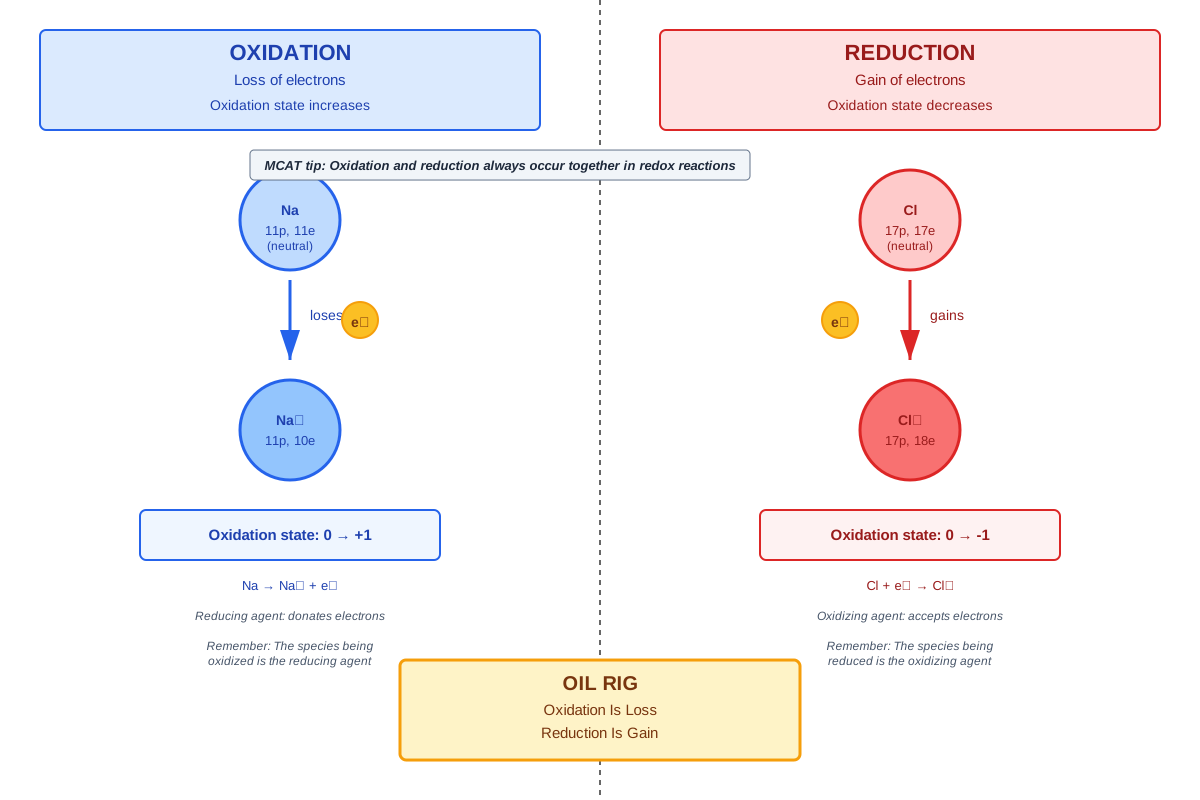
Oxidation is defined as the loss of electrons by a chemical species, resulting in an increase in oxidation state. The mnemonic "OIL" (Oxidation Is Loss) helps remember this definition. When a species is oxidized, it becomes more positively charged (or less negatively charged) as electrons are removed.
Reduction is defined as the gain of electrons by a chemical species, resulting in a decrease in oxidation state. The mnemonic "RIG" (Reduction Is Gain) complements the oxidation definition. When a species is reduced, it becomes more negatively charged (or less positively charged) as electrons are added.
These processes always occur together—electrons lost by one species must be gained by another. This is why we refer to redox reactions as coupled processes. The complete mnemonic "OIL RIG" or "LEO the lion says GER" (Loss of Electrons is Oxidation; Gain of Electrons is Reduction) helps students remember both processes simultaneously.
Oxidation States (Oxidation Numbers)
Oxidation states are bookkeeping numbers assigned to atoms in molecules or ions that represent the hypothetical charge an atom would have if all bonds were completely ionic. These numbers allow us to track electron transfer in redox reactions, even when actual ionic charges don't exist.
Rules for Assigning Oxidation States
- The oxidation state of an atom in its elemental form is always 0 (e.g., O₂, N₂, Fe, Na)
- The oxidation state of a monatomic ion equals its charge (e.g., Na⁺ = +1, Cl⁻ = -1, Fe³⁺ = +3)
- Oxygen is usually -2 (exceptions: peroxides like H₂O₂ where O = -1, and OF₂ where O = +2)
- Hydrogen is usually +1 when bonded to nonmetals and -1 when bonded to metals (metal hydrides)
- Alkali metals (Group 1) are always +1 in compounds
- Alkaline earth metals (Group 2) are always +2 in compounds
- Fluorine is always -1 in compounds
- The sum of oxidation states in a neutral molecule equals 0
- The sum of oxidation states in a polyatomic ion equals the ion's charge
Example Calculations
For H₂SO₄:
- H = +1 (rule 4)
- O = -2 (rule 3)
- Let S = x
- 2(+1) + x + 4(-2) = 0
- 2 + x - 8 = 0
- x = +6
For Cr₂O₇²⁻:
- O = -2 (rule 3)
- Let Cr = x
- 2x + 7(-2) = -2
- 2x - 14 = -2
- 2x = 12
- x = +6
Oxidizing and Reducing Agents
An oxidizing agent (or oxidant) is a species that causes another species to be oxidized by accepting electrons from it. Paradoxically, the oxidizing agent itself is reduced in the process. Strong oxidizing agents have a high affinity for electrons and are easily reduced.
A reducing agent (or reductant) is a species that causes another species to be reduced by donating electrons to it. The reducing agent itself is oxidized in the process. Strong reducing agents readily give up electrons and are easily oxidized.
| Agent Type | What It Does | What Happens to It | Electron Movement |
|---|---|---|---|
| Oxidizing Agent | Oxidizes other species | Gets reduced | Accepts electrons |
| Reducing Agent | Reduces other species | Gets oxidized | Donates electrons |
Common strong oxidizing agents include: O₂, F₂, Cl₂, permanganate (MnO₄⁻), dichromate (Cr₂O₇²⁻), concentrated H₂SO₄, and HNO₃.
Common strong reducing agents include: alkali metals (Li, Na, K), alkaline earth metals (Mg, Ca), H₂, and carbon.
Half-Reactions
Half-reactions separate the oxidation and reduction processes into two distinct equations, each showing either electron loss or electron gain. This method is particularly useful for balancing complex redox equations.
An oxidation half-reaction shows the loss of electrons:
Zn → Zn²⁺ + 2e⁻A reduction half-reaction shows the gain of electrons:
Cu²⁺ + 2e⁻ → CuWhen combined (ensuring electrons cancel), these give the overall redox reaction:
Zn + Cu²⁺ → Zn²⁺ + CuBalancing Redox Reactions
The half-reaction method is the most systematic approach for balancing redox equations, especially in acidic or basic solutions.
Steps for Acidic Solution
- Separate the equation into oxidation and reduction half-reactions
- Balance all atoms except O and H in each half-reaction
- Balance O by adding H₂O molecules
- Balance H by adding H⁺ ions
- Balance charge by adding electrons
- Multiply half-reactions by appropriate factors so electrons cancel
- Add the half-reactions together
- Simplify by canceling species that appear on both sides
Steps for Basic Solution
Follow steps 1-7 for acidic solution, then:
- Add OH⁻ ions to both sides equal to the number of H⁺ ions
- Combine H⁺ and OH⁻ to form H₂O
- Cancel water molecules appearing on both sides
Disproportionation Reactions
Disproportionation is a special type of redox reaction where the same element in a single species is simultaneously oxidized and reduced, forming two different products. A classic example is the decomposition of hydrogen peroxide:
2 H₂O₂ → 2 H₂O + O₂In H₂O₂, oxygen has an oxidation state of -1. In the products, oxygen is -2 in H₂O (reduced) and 0 in O₂ (oxidized).
Biological Redox Reactions
In biological systems, NAD⁺ (nicotinamide adenine dinucleotide) and FAD (flavin adenine dinucleotide) serve as crucial electron carriers. NAD⁺ is reduced to NADH by accepting two electrons and one proton:
NAD⁺ + 2e⁻ + H⁺ → NADHFAD is reduced to FADH₂ by accepting two electrons and two protons:
FAD + 2e⁻ + 2H⁺ → FADH₂These reduced forms (NADH and FADH₂) act as reducing agents in cellular metabolism, particularly in the electron transport chain where they donate electrons to generate ATP. Understanding these biological oxidizing and reducing agents is essential for MCAT biochemistry questions.
Concept Relationships
The concepts within oxidation and reduction form a hierarchical and interconnected framework. Oxidation states serve as the foundational tool → enabling identification of which atoms are oxidized or reduced → which allows determination of oxidizing and reducing agents → which can be separated into half-reactions → which are used to balance complex redox equations → which connect to electrochemical cells where half-reactions occur at separate electrodes.
This topic connects backward to prerequisite knowledge: electron configuration determines how readily atoms lose or gain electrons (oxidation or reduction tendency), electronegativity predicts which atoms will be assigned higher or lower oxidation states in covalent compounds, and thermodynamics determines whether redox reactions are spontaneous based on free energy changes.
Forward connections include: galvanic cells (spontaneous redox reactions generating electrical energy), electrolytic cells (non-spontaneous redox reactions driven by external electrical energy), standard reduction potentials (quantifying the tendency of species to be reduced), the Nernst equation (relating cell potential to concentration), corrosion (unwanted oxidation of metals), and biological metabolism (where controlled redox reactions extract energy from nutrients).
The relationship map: Electron Transfer → Oxidation States → Identifying Redox Reactions → Half-Reactions → Balancing Equations → Electrochemical Cells → Reduction Potentials → Spontaneity Predictions → Biological Applications
High-Yield Facts
⭐ Oxidation is loss of electrons (OIL); reduction is gain of electrons (RIG)—this is the most fundamental concept and appears in virtually every redox question
⭐ The oxidizing agent is reduced; the reducing agent is oxidized—students must identify these correctly to analyze reaction mechanisms
⭐ Oxidation state rules: elements = 0, monatomic ions = charge, O = -2 (usually), H = +1 (usually), Group 1 = +1, Group 2 = +2
⭐ In half-reactions, electrons appear as products in oxidation and as reactants in reduction—this determines which half-reaction is which
⭐ NAD⁺ and FAD are biological oxidizing agents; NADH and FADH₂ are biological reducing agents—critical for metabolism questions
- The sum of oxidation states in a neutral compound equals zero; in a polyatomic ion, it equals the ion's charge
- Disproportionation reactions involve the same element being simultaneously oxidized and reduced
- In acidic solution, balance redox equations using H⁺ and H₂O; in basic solution, use OH⁻ and H₂O
- Transition metals commonly exhibit multiple oxidation states (Fe²⁺/Fe³⁺, Mn²⁺/Mn⁴⁺/Mn⁷⁺)
- Oxygen in peroxides (H₂O₂, Na₂O₂) has an oxidation state of -1, not -2
- Fluorine is always -1 in compounds; it is the most electronegative element and never positive
- The species with the higher (more positive) oxidation state is more oxidized; lower (more negative) is more reduced
Quick check — test yourself on Oxidation and reduction so far.
Try Flashcards →Common Misconceptions
Misconception: Oxidation always involves oxygen, and reduction always involves hydrogen.
Correction: While historically these terms derived from reactions with oxygen and hydrogen, oxidation and reduction are defined solely by electron transfer. Oxidation is loss of electrons (regardless of whether oxygen is involved), and reduction is gain of electrons (regardless of whether hydrogen is involved). For example, 2Na + Cl₂ → 2NaCl is a redox reaction with no oxygen or hydrogen present.
Misconception: The oxidizing agent is the species that gets oxidized.
Correction: The oxidizing agent is the species that causes oxidation in another species and is itself reduced in the process. Similarly, the reducing agent causes reduction in another species and is itself oxidized. Think of it as: the oxidizing agent "does the oxidizing" to something else while being reduced itself.
Misconception: In a redox reaction, the species with the higher oxidation state is always the oxidizing agent.
Correction: The oxidizing agent is identified by what happens during the reaction, not by initial oxidation states. The oxidizing agent is the species whose oxidation state decreases (gets reduced) during the reaction. For example, in Zn + Cu²⁺ → Zn²⁺ + Cu, Cu²⁺ is the oxidizing agent because copper's oxidation state decreases from +2 to 0.
Misconception: Oxidation states are the same as actual charges on atoms.
Correction: Oxidation states are formal bookkeeping numbers that assume complete ionic bonding, while actual charges reflect real electron distribution. In covalent molecules like H₂O, oxygen has an oxidation state of -2, but it doesn't actually carry a -2 charge. Oxidation states are useful for tracking electron transfer but don't represent actual charge distribution in covalent bonds.
Misconception: All atoms in a molecule must have integer oxidation states.
Correction: While most oxidation states are integers, some molecules have fractional oxidation states when averaged across equivalent atoms. For example, in Fe₃O₄ (magnetite), the average oxidation state of iron is +8/3. However, this represents a mixture of Fe²⁺ and Fe³⁺ ions. For MCAT purposes, focus on integer oxidation states for individual atoms.
Misconception: Balancing redox equations only requires balancing atoms, not charge.
Correction: Redox equations must be balanced for both mass (atoms) and charge. After balancing atoms using H₂O and H⁺ (or OH⁻), you must add electrons to balance the charge in each half-reaction. The number of electrons lost in oxidation must equal the number gained in reduction when half-reactions are combined.
Misconception: NADH is an oxidizing agent because it participates in oxidation-reduction reactions.
Correction: NADH is a reducing agent because it donates electrons (becoming oxidized to NAD⁺). NAD⁺ is the oxidizing agent because it accepts electrons (becoming reduced to NADH). This distinction is crucial for understanding metabolic pathways where NADH serves as an electron donor.
Worked Examples
Example 1: Assigning Oxidation States and Identifying Redox Changes
Question: In the reaction below, identify which element is oxidized, which is reduced, and identify the oxidizing and reducing agents.
2 KMnO₄ + 16 HCl → 2 MnCl₂ + 5 Cl₂ + 2 KCl + 8 H₂OSolution:
Step 1: Assign oxidation states to all elements in reactants and products.
Reactants:
- K in KMnO₄: +1 (Group 1 metal)
- O in KMnO₄: -2 (standard rule)
- Mn in KMnO₄: +1 + x + 4(-2) = 0 → x = +7
- H in HCl: +1
- Cl in HCl: -1
Products:
- Mn in MnCl₂: +2 (since Cl is -1, and the compound is neutral: x + 2(-1) = 0)
- Cl in Cl₂: 0 (elemental form)
- K in KCl: +1
- Cl in KCl: -1
- H in H₂O: +1
- O in H₂O: -2
Step 2: Identify changes in oxidation states.
- Mn: +7 → +2 (decrease of 5, reduced)
- Cl: -1 → 0 (increase of 1, oxidized)
Note that not all chlorine is oxidized; some remains as Cl⁻ in KCl and MnCl₂.
Step 3: Identify agents.
- Oxidizing agent: KMnO₄ (contains Mn⁷⁺ which is reduced to Mn²⁺)
- Reducing agent: HCl (contains Cl⁻ which is oxidized to Cl₂)
Answer: Manganese is reduced (from +7 to +2), chlorine is oxidized (from -1 to 0), KMnO₄ is the oxidizing agent, and HCl is the reducing agent.
Connection to Learning Objectives: This example demonstrates the systematic application of oxidation state rules, identification of oxidation and reduction processes, and determination of oxidizing and reducing agents—all essential skills for MCAT questions.
Example 2: Balancing a Redox Reaction in Acidic Solution
Question: Balance the following redox reaction occurring in acidic solution:
MnO₄⁻ + Fe²⁺ → Mn²⁺ + Fe³⁺Solution:
Step 1: Write separate half-reactions.
Oxidation: Fe²⁺ → Fe³⁺
Reduction: MnO₄⁻ → Mn²⁺
Step 2: Balance atoms other than O and H.
Both half-reactions already have balanced metal atoms.
Step 3: Balance oxygen by adding H₂O.
Oxidation: Fe²⁺ → Fe³⁺ (no oxygen)
Reduction: MnO₄⁻ → Mn²⁺ + 4 H₂O
Step 4: Balance hydrogen by adding H⁺.
Oxidation: Fe²⁺ → Fe³⁺ (no hydrogen)
Reduction: MnO₄⁻ + 8 H⁺ → Mn²⁺ + 4 H₂O
Step 5: Balance charge by adding electrons.
Oxidation: Fe²⁺ → Fe³⁺ + e⁻ (left side: +2, right side: +3 + (-1) = +2 ✓)
Reduction: MnO₄⁻ + 8 H⁺ + 5e⁻ → Mn²⁺ + 4 H₂O (left side: -1 + 8 + (-5) = +2, right side: +2 ✓)
Step 6: Multiply to make electrons equal.
Multiply oxidation half-reaction by 5:
5 Fe²⁺ → 5 Fe³⁺ + 5e⁻
Keep reduction half-reaction as is:
MnO₄⁻ + 8 H⁺ + 5e⁻ → Mn²⁺ + 4 H₂O
Step 7: Add half-reactions and cancel electrons.
MnO₄⁻ + 8 H⁺ + 5 Fe²⁺ → Mn²⁺ + 4 H₂O + 5 Fe³⁺Step 8: Verify mass and charge balance.
Atoms: Mn (1=1), O (4=4), H (8=8), Fe (5=5) ✓
Charge: Left = -1 + 8 + 10 = +17; Right = +2 + 0 + 15 = +17 ✓
Answer: The balanced equation is:
MnO₄⁻ + 8 H⁺ + 5 Fe²⁺ → Mn²⁺ + 4 H₂O + 5 Fe³⁺Connection to Learning Objectives: This example demonstrates the systematic half-reaction method for balancing redox equations, a high-yield skill that appears frequently on the MCAT in both discrete questions and passage-based problems involving electrochemical cells.
Exam Strategy
Approaching MCAT Redox Questions
Step 1: Quickly scan for trigger words: "oxidized," "reduced," "oxidizing agent," "reducing agent," "electron transfer," "oxidation state," or mentions of electrochemical cells. These signal that redox concepts are being tested.
Step 2: If asked to identify oxidation or reduction, immediately assign oxidation states to the relevant atoms in reactants and products. Focus only on atoms that change—don't waste time on spectator atoms.
Step 3: Remember the counterintuitive relationship: the oxidizing agent gets reduced, and the reducing agent gets oxidized. If a question asks for the oxidizing agent, look for the species whose oxidation state decreases.
Step 4: For balancing equations, use the half-reaction method systematically. Don't try to balance by inspection for complex redox reactions—it wastes time and increases error risk.
Step 5: In passage-based questions, look for redox reactions in biological contexts (metabolism, electron transport chain) or electrochemical contexts (batteries, corrosion, electrolysis). Recognizing the redox nature of the system helps predict experimental outcomes.
Trigger Words and Phrases
- "Oxidation state" or "oxidation number" → assign oxidation states using systematic rules
- "Electron transfer" → identify which species loses and gains electrons
- "Oxidizing agent" or "oxidant" → find the species that gets reduced
- "Reducing agent" or "reductant" → find the species that gets oxidized
- "Half-reaction" or "half-cell" → separate oxidation and reduction processes
- "Acidic solution" or "basic solution" → use appropriate balancing method
- "NAD+," "NADH," "FAD," "FADH₂" → biological redox reactions
- "Disproportionation" → same element both oxidized and reduced
Process of Elimination Tips
- If a question asks which species is oxidized, eliminate any answer choice showing a decrease in oxidation state (that would be reduction)
- If asked for the oxidizing agent, eliminate any species whose oxidation state increases (that would be the reducing agent)
- For balancing questions, eliminate answer choices that don't conserve charge or mass
- In biological contexts, remember NAD+ and FAD are oxidizing agents; eliminate choices that reverse this relationship
- If a question involves transition metals, expect multiple oxidation states; eliminate choices that assign impossible oxidation states
Time Allocation
For discrete questions on oxidation states or identifying agents: aim for 45-60 seconds. These should be quick applications of rules.
For balancing redox equations: allocate 90-120 seconds. Use the systematic half-reaction method rather than trial-and-error.
For passage-based questions: spend 30-45 seconds identifying the redox nature of the system during passage reading, then 60-90 seconds per question applying redox concepts to specific scenarios.
Memory Techniques
Mnemonics
OIL RIG: Oxidation Is Loss (of electrons); Reduction Is Gain (of electrons)
LEO the lion says GER: Loss of Electrons is Oxidation; Gain of Electrons is Reduction
AN OX and a RED CAT: ANode is OXidation; REDuction at CAThode (useful for electrochemical cells)
For oxidation state rules, remember "HOFBRINCL" (pronounced "Hof-brinkle"):
- Hydrogen: +1 (usually)
- Oxygen: -2 (usually)
- Fluorine: -1 (always)
- Barium (Group 2): +2
- Rubidium (Group 1): +1
- Ion: oxidation state = charge
- Neutral: sum of oxidation states = 0
- Charge: sum of oxidation states = charge
- Lone element: oxidation state = 0
Visualization Strategy
Visualize electrons as physical objects being transferred between species. Picture the reducing agent as a "donor" handing electrons to the oxidizing agent as a "receiver." The donor (reducing agent) becomes more positive (oxidized) after giving away negative electrons, while the receiver (oxidizing agent) becomes more negative (reduced) after accepting electrons.
For biological redox reactions, visualize NAD+ as an empty electron carrier (like an empty truck) that becomes "loaded" with electrons to form NADH. NADH then delivers these electrons to the electron transport chain, becoming "empty" (NAD+) again.
Acronym for Common Oxidizing Agents
"FOPCH" (pronounced "fop-ch"):
- Fluorine (F₂)
- Oxygen (O₂)
- Permanganate (MnO₄⁻)
- Chromate/Dichromate (CrO₄²⁻/Cr₂O₇²⁻)
- Halogen acids (HNO₃, H₂SO₄)
Summary
Oxidation and reduction reactions involve the transfer of electrons between chemical species and represent one of the most fundamental and high-yield topics for the MCAT. Oxidation is defined as the loss of electrons (increasing oxidation state), while reduction is the gain of electrons (decreasing oxidation state). These processes always occur together in redox reactions. The oxidizing agent causes oxidation in another species while being reduced itself; conversely, the reducing agent causes reduction while being oxidized. Systematic assignment of oxidation states using established rules allows identification of which atoms are oxidized or reduced. The half-reaction method provides a reliable approach for balancing complex redox equations in both acidic and basic solutions. In biological systems, electron carriers like NAD+/NADH and FAD/FADH₂ serve as crucial oxidizing and reducing agents in metabolic pathways. Mastery of these concepts enables students to analyze electrochemical cells, predict reaction spontaneity, and understand the chemical basis of cellular energy metabolism—all essential for MCAT success.
Key Takeaways
- Oxidation is loss of electrons (OIL); reduction is gain of electrons (RIG)—this fundamental definition underlies all redox chemistry
- The oxidizing agent is reduced; the reducing agent is oxidized—understanding this counterintuitive relationship is essential for identifying agents correctly
- Oxidation states are assigned using systematic rules and allow tracking of electron transfer even in covalent compounds
- Half-reactions separate oxidation and reduction processes and provide the most reliable method for balancing complex redox equations
- NAD+ and FAD are biological oxidizing agents; NADH and FADH₂ are reducing agents—critical for understanding metabolism
- Redox reactions connect to electrochemistry, thermodynamics, and biochemistry—making this a high-yield integrative topic
- Practice assigning oxidation states quickly and accurately—this skill appears in multiple question types and is essential for time management
Related Topics
Electrochemical Cells (Galvanic and Electrolytic): Understanding oxidation and reduction is prerequisite for analyzing how redox reactions generate electrical energy in galvanic cells or how electrical energy drives non-spontaneous redox reactions in electrolytic cells. The half-reactions learned here occur at separate electrodes in these cells.
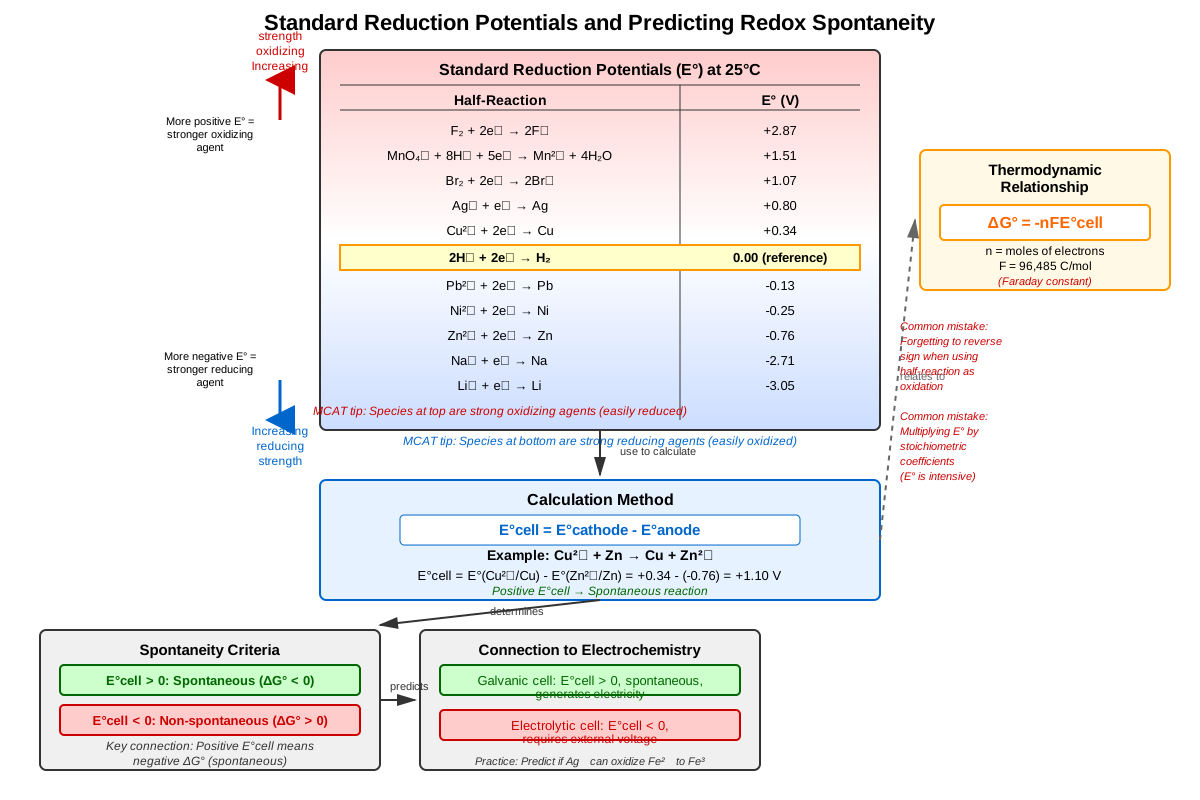
Standard Reduction Potentials: This topic builds directly on redox concepts by quantifying the tendency of species to be reduced. Mastering oxidation and reduction enables prediction of reaction spontaneity using reduction potential tables.
The Nernst Equation: This advanced electrochemistry topic relates cell potential to concentration and requires solid understanding of redox reactions and half-reactions to apply correctly.
Cellular Respiration and Metabolism: The biological application of redox chemistry, where glucose oxidation and oxygen reduction drive ATP synthesis through coupled redox reactions involving NAD+, FAD, and the electron transport chain.
Thermodynamics and Free Energy: Redox reactions connect to Gibbs free energy calculations, allowing prediction of spontaneity and equilibrium positions for electron transfer reactions.
Practice CTA
Now that you've mastered the core concepts of oxidation and reduction, it's time to reinforce your understanding through active practice. Attempt the practice questions and flashcards associated with this topic to test your ability to assign oxidation states quickly, identify oxidizing and reducing agents accurately, and balance redox equations systematically. Remember, the MCAT rewards not just conceptual understanding but also rapid, accurate application under time pressure. Each practice question you complete builds the pattern recognition and problem-solving speed essential for test day success. You've built a strong foundation—now strengthen it through deliberate practice!
Sign up free to keep reading
Create a free AnvayaPrep account to finish this MCAT guide on Oxidation and reduction — plus flashcards and practice questions.