Overview
Potassium permanganate (KMnO4) is one of the most important and frequently tested oxidizing agents in Organic Chemistry for the MCAT. This purple-colored compound serves as a powerful oxidant capable of transforming various functional groups through oxidation and reduction reactions. Understanding KMnO4 reactions is essential because the MCAT regularly tests students' ability to predict reaction products, recognize oxidation states, and apply mechanistic reasoning to organic transformations.
The significance of KMnO4 MCAT questions extends beyond simple memorization of reaction outcomes. Students must grasp the underlying principles of oxidation—specifically how KMnO4 selectively oxidizes certain functional groups while leaving others unchanged. This selectivity depends on reaction conditions (temperature, concentration, pH) and the structure of the organic substrate. Mastery of KMnO4 chemistry enables students to predict products in multi-step synthesis problems, a common question type in the Chemical and Physical Foundations section.
Within the broader context of Organic Chemistry, KMnO4 reactions represent a critical application of redox principles to carbon-based molecules. These reactions connect to fundamental concepts including oxidation states of carbon, functional group interconversions, and the relationship between molecular structure and reactivity. KMnO4 chemistry also bridges to biochemistry topics, as oxidation reactions are central to metabolic pathways tested in the Biological and Biochemical Foundations section.
Learning Objectives
- [ ] Define KMnO4 using accurate Organic Chemistry terminology
- [ ] Explain why KMnO4 matters for the MCAT
- [ ] Apply KMnO4 to exam-style questions
- [ ] Identify common mistakes related to KMnO4
- [ ] Connect KMnO4 to related Organic Chemistry concepts
- [ ] Predict the products of KMnO4 oxidation reactions under different conditions (hot/cold, dilute/concentrated)
- [ ] Distinguish between oxidation outcomes for different alkene substitution patterns
- [ ] Analyze multi-step synthesis problems involving KMnO4 as one reagent among several
Prerequisites
- Oxidation states of carbon: Essential for understanding how KMnO4 increases the oxidation level of carbon atoms in organic molecules
- Functional group nomenclature: Required to identify starting materials and predict products (alcohols, aldehydes, ketones, carboxylic acids)
- Alkene structure and stability: Necessary for predicting cleavage patterns when KMnO4 oxidizes carbon-carbon double bonds
- Acid-base chemistry: Relevant because KMnO4 reactions often occur under basic or acidic conditions, affecting product distribution
- Basic redox principles: Fundamental for recognizing that KMnO4 acts as an oxidizing agent while being reduced itself
Why This Topic Matters
KMnO4 Organic Chemistry appears regularly on the MCAT because it tests multiple competencies simultaneously: functional group recognition, reaction prediction, and mechanistic reasoning. Approximately 2-3 questions per exam directly or indirectly involve oxidation reactions, with KMnO4 being one of the most commonly featured reagents. Questions may appear as discrete items asking for product prediction or embedded within passage-based questions about synthesis pathways or metabolic oxidation processes.
In real-world applications, permanganate oxidations have clinical relevance. KMnO4 solutions are used as topical antiseptics and in water treatment to oxidize organic contaminants. Understanding these oxidation reactions provides insight into how biological systems use similar redox chemistry—for example, how cytochrome P450 enzymes oxidize drugs and toxins in the liver. This connection between laboratory chemistry and biological oxidation makes KMnO4 an ideal topic for integrated MCAT questions that span multiple disciplines.
The MCAT frequently presents KMnO4 in passage contexts involving synthetic organic chemistry, pharmaceutical development, or environmental chemistry. Students might encounter a passage describing a multi-step synthesis where KMnO4 serves as one reagent, then face questions about why that specific oxidizing agent was chosen, what byproducts might form, or how reaction conditions affect selectivity. Mastering KMnO4 chemistry therefore provides a competitive advantage on both discrete questions and complex passage-based items.
Core Concepts
Structure and Properties of KMnO4
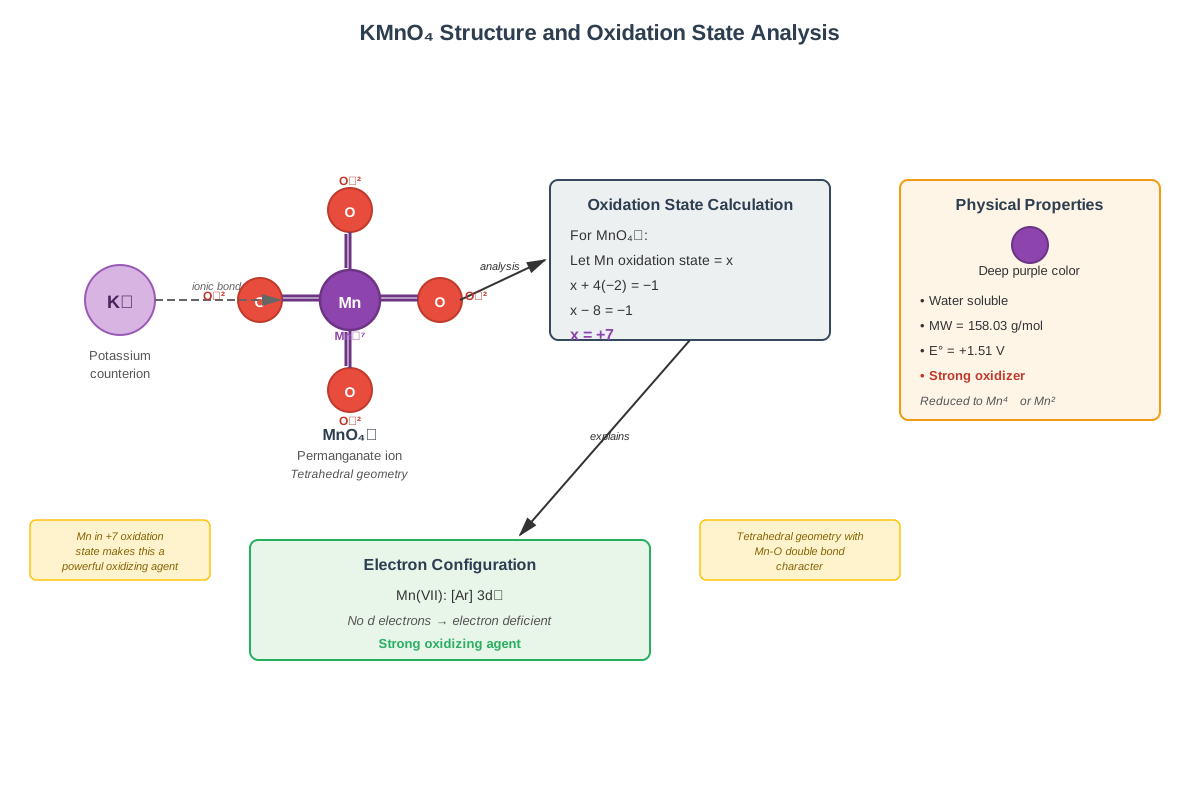
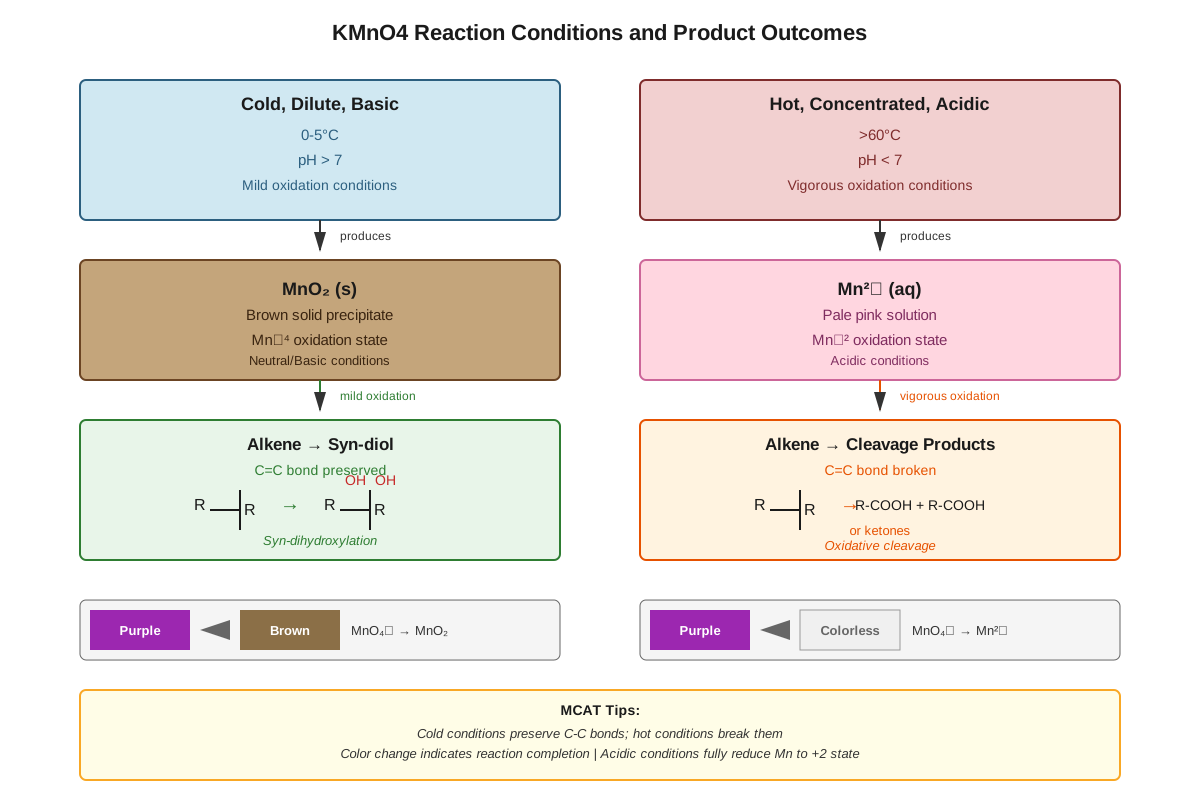
Potassium permanganate consists of potassium cations (K⁺) and permanganate anions (MnO₄⁻). The manganese atom in permanganate exists in the +7 oxidation state, making it highly electron-deficient and thus a powerful oxidizing agent. The deep purple color of KMnO4 solutions serves as a visual indicator of reaction progress—as the permanganate is reduced, the solution changes color depending on conditions (brown MnO₂ precipitate in neutral/basic conditions, or colorless Mn²⁺ in acidic conditions).
The oxidizing power of KMnO4 stems from manganese's ability to accept electrons and decrease its oxidation state. In organic reactions, this electron transfer oxidizes carbon atoms, typically increasing their oxidation state by forming new carbon-oxygen bonds. The specific reduction product of manganese depends on pH: in acidic solution, Mn⁷⁺ reduces to Mn²⁺; in neutral or basic solution, it reduces to Mn⁴⁺ (as MnO₂).
Oxidation of Alkenes
KMnO4 reacts with alkenes through oxidative cleavage of the carbon-carbon double bond. The reaction outcome depends critically on temperature and concentration:
Cold, Dilute KMnO4 (Baeyer Test)
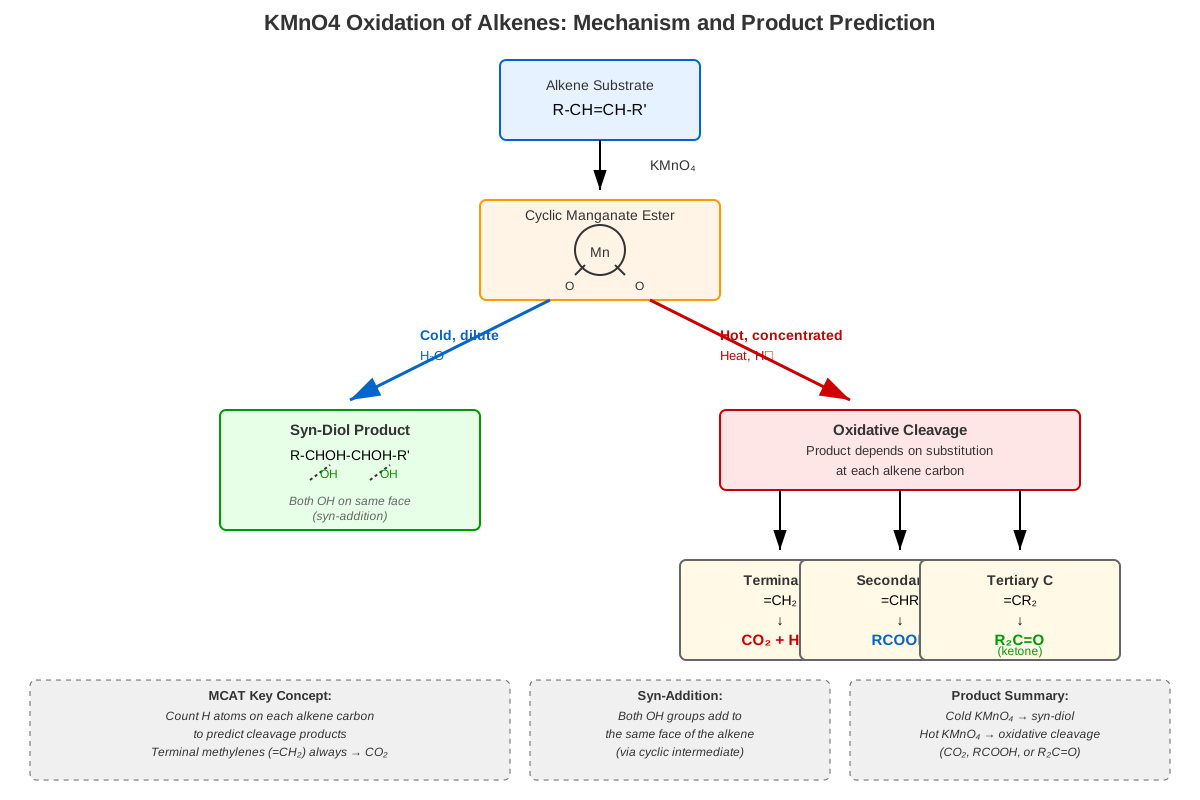
Under mild conditions (cold, dilute, basic solution), KMnO4 converts alkenes to vicinal diols (1,2-diols) through syn addition. This reaction, known as dihydroxylation, adds two hydroxyl groups to the same face of the double bond. The mechanism involves formation of a cyclic manganate ester intermediate, followed by hydrolysis to yield the diol. This reaction serves as a qualitative test for alkenes—the purple permanganate solution decolorizes and forms a brown precipitate of MnO₂.
Hot, Concentrated KMnO4 (Oxidative Cleavage)
Under vigorous conditions (heat, concentrated solution), KMnO4 cleaves the carbon-carbon double bond entirely, oxidizing each carbon to the highest possible oxidation state. The products depend on the substitution pattern of the alkene:
| Alkene Carbon Substitution | Oxidation Product |
|---|---|
| R₂C=CR₂ (tetrasubstituted) | Two ketones |
| R₂C=CHR (trisubstituted) | One ketone + one carboxylic acid |
| R₂C=CH₂ (disubstituted) | One ketone + CO₂ (from formic acid) |
| RHC=CHR (disubstituted, internal) | Two carboxylic acids |
| RHC=CH₂ (monosubstituted, terminal) | One carboxylic acid + CO₂ |
The key principle: carbons with at least one hydrogen attached to the double bond oxidize to carboxylic acids, while fully substituted carbons (no hydrogens) oxidize to ketones. Terminal CH₂ groups oxidize all the way to CO₂ because the intermediate formic acid (HCOOH) is further oxidized.
Oxidation of Alkynes
Alkynes react with KMnO4 similarly to alkenes but require more vigorous conditions due to the greater bond strength of the triple bond. Hot, concentrated KMnO4 cleaves alkynes oxidatively, producing carboxylic acids. Internal alkynes (R-C≡C-R) yield two carboxylic acids, while terminal alkynes (R-C≡C-H) produce one carboxylic acid plus CO₂.
Oxidation of Alkylbenzenes
KMnO4 oxidizes alkyl side chains attached to benzene rings, converting them to carboxylic acid groups. This reaction requires at least one benzylic hydrogen (a hydrogen on the carbon directly attached to the benzene ring). The entire alkyl chain, regardless of length, oxidizes to a single carboxyl group (-COOH) attached to the ring.
For example:
- Toluene (methylbenzene) → Benzoic acid
- Ethylbenzene → Benzoic acid
- Isopropylbenzene (cumene) → Benzoic acid
However, tert-butylbenzene does NOT react because the benzylic carbon lacks any hydrogen atoms. This selectivity makes KMnO4 useful for determining substitution patterns in aromatic compounds.
Oxidation of Alcohols
KMnO4 oxidizes primary and secondary alcohols but cannot oxidize tertiary alcohols (which lack a hydrogen on the carbon bearing the hydroxyl group):
Primary alcohols (RCH₂OH): Oxidize to carboxylic acids (RCOOH) under typical KMnO4 conditions. The reaction proceeds through an aldehyde intermediate, but KMnO4 is strong enough to oxidize the aldehyde further to the carboxylic acid.
Secondary alcohols (R₂CHOH): Oxidize to ketones (R₂C=O). Ketones resist further oxidation because they lack the necessary C-H bond.
Tertiary alcohols (R₃COH): Do not react with KMnO4 under normal conditions because oxidation would require breaking a C-C bond.
Reaction Conditions and Selectivity
Understanding reaction conditions is crucial for predicting KMnO4 outcomes:
- Temperature: Cold conditions favor addition reactions (diol formation), while heat promotes cleavage reactions
- Concentration: Dilute solutions give milder oxidation; concentrated solutions provide more vigorous oxidation
- pH: Basic conditions (typical for KMnO4 reactions) prevent acid-sensitive products from decomposing
- Substrate structure: Substitution patterns determine oxidation products, especially for alkenes and aromatic compounds
Mechanism Considerations
While detailed mechanisms are less emphasized on the MCAT, understanding the general mechanistic principles helps predict products:
- KMnO4 acts as an electrophile, attacking electron-rich double bonds or C-H bonds
- Cyclic intermediates often form (e.g., manganate esters in diol formation)
- The reaction proceeds through multiple electron transfers as Mn⁷⁺ reduces to Mn⁴⁺ or Mn²⁺
- Oxidation increases the number of C-O bonds while decreasing C-H or C-C bonds
Concept Relationships
The chemistry of KMnO4 connects multiple organic chemistry concepts in a hierarchical framework. At the foundation lies redox chemistry—KMnO4 functions as an oxidizing agent because manganese in the +7 state readily accepts electrons. This fundamental principle → leads to → functional group transformations, where specific organic functional groups (alkenes, alcohols, alkynes, alkylbenzenes) undergo predictable oxidation reactions.
The concept of oxidation state of carbon → determines → product identity. Carbons with lower oxidation states (more C-H bonds, fewer C-O bonds) can be oxidized further than carbons already at high oxidation states. This principle → explains → why primary alcohols oxidize to carboxylic acids (two oxidation steps possible) while secondary alcohols stop at ketones (only one oxidation step possible).
Reaction conditions (temperature, concentration) → control → reaction pathway selectivity. Cold, dilute conditions → favor → diol formation from alkenes, while hot, concentrated conditions → drive → oxidative cleavage. This condition-dependence → connects to → broader principles of reaction kinetics and thermodynamics—milder conditions access kinetic products (diols), while vigorous conditions provide energy to reach thermodynamic products (cleaved, fully oxidized fragments).
KMnO4 chemistry → relates to → other oxidizing agents studied for the MCAT. Comparing KMnO4 with chromium-based oxidants (PCC, Jones reagent) or ozone (O₃) → reveals → selectivity patterns and appropriate reagent choices for synthesis problems. KMnO4 → also connects to → biochemical oxidation, as metabolic pathways use similar principles (electron transfer, increasing oxidation state) through enzyme-catalyzed reactions.
Quick check — test yourself on KMnO4 so far.
Try Flashcards →High-Yield Facts
⭐ KMnO4 is a strong oxidizing agent where manganese exists in the +7 oxidation state and readily accepts electrons
⭐ Cold, dilute KMnO4 converts alkenes to vicinal diols through syn dihydroxylation (Baeyer test)
⭐ Hot, concentrated KMnO4 cleaves alkenes oxidatively, producing ketones and/or carboxylic acids depending on substitution
⭐ Alkene carbons with at least one hydrogen oxidize to carboxylic acids; fully substituted carbons oxidize to ketones
⭐ KMnO4 oxidizes alkyl side chains on benzene rings to carboxylic acids, but requires at least one benzylic hydrogen
- Primary alcohols oxidize to carboxylic acids with KMnO4 (through aldehyde intermediates)
- Secondary alcohols oxidize to ketones with KMnO4
- Tertiary alcohols do not react with KMnO4 under normal conditions
- The purple color of KMnO4 disappears during oxidation reactions, forming brown MnO₂ precipitate in basic conditions
- Terminal alkene carbons (=CH₂) oxidize completely to CO₂ because the intermediate formic acid undergoes further oxidation
Common Misconceptions
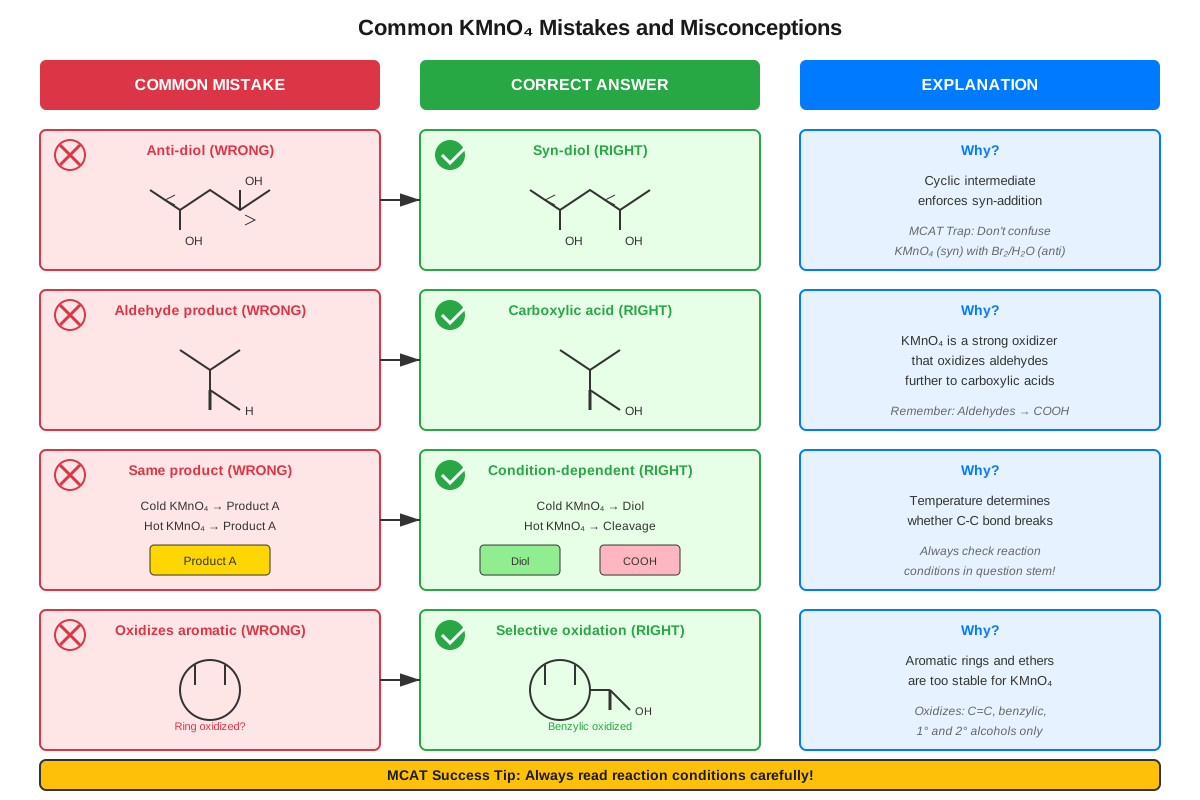
Misconception: KMnO4 always cleaves carbon-carbon double bonds completely
Correction: Under cold, dilute conditions, KMnO4 adds hydroxyl groups to form diols without cleaving the C-C bond. Only hot, concentrated conditions cause oxidative cleavage. Recognizing reaction conditions is essential for predicting products.
Misconception: All carbons in an alkene oxidize to the same product type
Correction: The oxidation product depends on substitution pattern. A carbon with hydrogens attached to the double bond oxidizes to a carboxylic acid, while a fully substituted carbon (no hydrogens) oxidizes only to a ketone. Each carbon of the alkene must be analyzed separately.
Misconception: KMnO4 can oxidize any alcohol to a carboxylic acid
Correction: Only primary alcohols oxidize to carboxylic acids. Secondary alcohols stop at ketones, and tertiary alcohols don't react at all because they lack the necessary C-H bond on the carbon bearing the hydroxyl group.
Misconception: The entire alkyl side chain on benzene remains intact during KMnO4 oxidation
Correction: KMnO4 oxidizes the entire alkyl chain to a single carboxyl group, regardless of chain length. Ethylbenzene, propylbenzene, and butylbenzene all yield benzoic acid. Only the presence of a benzylic hydrogen matters, not the chain length.
Misconception: KMnO4 and ozone (O₃) give identical products when cleaving alkenes
Correction: While both cleave alkenes, they differ in oxidation strength. Ozone followed by oxidative workup (O₃/H₂O₂) gives similar products to hot KMnO4, but ozone with reductive workup (O₃/Zn) stops at aldehydes. KMnO4 is too strong to stop at the aldehyde stage for primary carbons.
Misconception: The brown precipitate formed during KMnO4 reactions is the organic product
Correction: The brown precipitate is manganese dioxide (MnO₂), the reduced form of the manganese oxidizing agent. The organic products remain in solution (or may be extracted). The precipitate indicates that oxidation has occurred but is not the desired product.
Worked Examples
Example 1: Alkene Oxidation Product Prediction
Question: What are the products when 2-methyl-2-butene is treated with hot, concentrated KMnO4?
Structure of starting material: (CH₃)₂C=CH-CH₃
Step 1 - Identify the reaction type: Hot, concentrated KMnO4 indicates oxidative cleavage of the alkene
Step 2 - Analyze each carbon of the double bond separately:
- Left carbon: (CH₃)₂C= (two methyl groups, no hydrogens on the double bond carbon)
- Right carbon: =CH-CH₃ (one hydrogen on the double bond carbon)
Step 3 - Apply oxidation rules:
- Fully substituted carbon (no H) → oxidizes to ketone
- Carbon with hydrogen → oxidizes to carboxylic acid
Step 4 - Draw products:
- Left fragment: (CH₃)₂C=O (acetone)
- Right fragment: CH₃COOH (acetic acid)
Answer: The products are acetone and acetic acid
Connection to learning objectives: This example demonstrates application of KMnO4 chemistry to exam-style questions by requiring analysis of substitution patterns and prediction of oxidation products based on reaction conditions.
Example 2: Multi-Step Synthesis Analysis
Question: A chemist needs to convert toluene (methylbenzene) to benzoic acid, then to benzyl alcohol. Which sequence of reagents accomplishes this transformation?
Step 1 - Analyze the first transformation (toluene → benzoic acid):
- Toluene has a methyl group attached to benzene
- Need to oxidize -CH₃ to -COOH
- KMnO4 oxidizes alkyl side chains to carboxylic acids (requires benzylic H, which is present)
Step 2 - Analyze the second transformation (benzoic acid → benzyl alcohol):
- Need to reduce carboxylic acid to primary alcohol
- This requires a reducing agent, not an oxidizing agent
- Common reducing agent: LiAlH₄ (lithium aluminum hydride)
Step 3 - Verify the logic:
- KMnO4 increases oxidation state: CH₃ → COOH ✓
- LiAlH₄ decreases oxidation state: COOH → CH₂OH ✓
Answer: 1) KMnO4, heat; 2) LiAlH₄
Common trap: Students might think KMnO4 could be used for both steps, but KMnO4 only oxidizes (increases oxidation state), never reduces. The second step requires a reducing agent.
Connection to learning objectives: This example connects KMnO4 to related organic chemistry concepts (reduction reactions, multi-step synthesis) and identifies a common mistake (confusing oxidation and reduction).
Exam Strategy
When approaching KMnO4 MCAT questions, immediately identify the reaction conditions mentioned in the question stem or passage. The distinction between "cold, dilute" and "hot, concentrated" determines whether you're dealing with diol formation or oxidative cleavage. If conditions aren't specified, assume hot, concentrated conditions for cleavage reactions.
Trigger words and phrases to watch for:
- "Baeyer test" or "qualitative test for alkenes" → cold, dilute conditions → diol formation
- "Oxidative cleavage" → hot, concentrated conditions → complete bond breaking
- "Purple solution decolorizes" → indicates oxidation has occurred
- "Brown precipitate forms" → MnO₂ formation, confirms oxidation in basic conditions
Process-of-elimination strategy: When evaluating answer choices for oxidation products:
- Eliminate any answer showing reduction (decrease in oxidation state)
- Eliminate products that violate substitution rules (e.g., carboxylic acid from fully substituted carbon)
- Eliminate products showing incomplete oxidation when conditions are vigorous (e.g., aldehyde instead of carboxylic acid with hot KMnO4)
- Check for CO₂ formation from terminal =CH₂ groups
Time allocation: KMnO4 questions typically require 60-90 seconds. Spend 20 seconds identifying reaction type and conditions, 30 seconds analyzing substrate structure and applying rules, and 20 seconds verifying your answer against choices. If a question involves multi-step synthesis with KMnO4 as one step, allocate up to 2 minutes to trace through the entire sequence.
Red flags in answer choices: Be suspicious of answers showing: (1) aldehydes as final products from primary positions (KMnO4 is too strong to stop there), (2) oxidation of tertiary alcohols, (3) intact alkyl chains on benzene after KMnO4 treatment, or (4) anti addition of hydroxyl groups (KMnO4 gives syn addition).
Memory Techniques
Mnemonic for alkene oxidation products - "HCAK":
- Hydrogen present on alkene carbon → Carboxylic Acid
- No hydrogen (fully substituted) → Ketone
Visualization for alcohol oxidation - "The Staircase":
Picture oxidation as climbing stairs:
- Ground floor: Primary alcohol (RCH₂OH)
- First floor: Aldehyde (RCHO) - KMnO4 doesn't stop here
- Second floor: Carboxylic acid (RCOOH) - KMnO4 stops here
- Separate staircase: Secondary alcohol (R₂CHOH) → Ketone (R₂CO) - only one step possible
- No staircase: Tertiary alcohol (R₃COH) - can't climb (no reaction)
Acronym for reaction conditions - "CHDC":
- Cold → Hydroxylation (diol formation)
- Hot → Destruction (oxidative Cleavage)
Memory aid for benzylic oxidation: "Benzylic hydrogen? Bye-bye chain!" - If there's at least one hydrogen on the carbon attached to benzene, the entire chain oxidizes away to -COOH.
Color change memory device: "Purple Permanganate Produces Brown" - The purple KMnO4 solution produces brown MnO₂ precipitate when oxidation occurs in basic conditions. This visual cue confirms reaction completion.
Summary
Potassium permanganate (KMnO4) serves as a versatile and powerful oxidizing agent in organic chemistry, with reaction outcomes determined by substrate structure and reaction conditions. Under cold, dilute conditions, KMnO4 converts alkenes to vicinal diols through syn dihydroxylation, while hot, concentrated conditions cause oxidative cleavage of carbon-carbon double bonds. The products of cleavage depend on substitution patterns: carbons bearing hydrogens oxidize to carboxylic acids, while fully substituted carbons yield ketones. KMnO4 also oxidizes primary alcohols to carboxylic acids, secondary alcohols to ketones, and alkyl side chains on aromatic rings to carboxylic acids (provided a benzylic hydrogen is present). Tertiary alcohols resist oxidation due to the absence of a C-H bond on the carbon bearing the hydroxyl group. Mastery of KMnO4 chemistry requires understanding oxidation state changes, recognizing how reaction conditions affect selectivity, and applying systematic analysis to predict products—skills directly tested on MCAT organic chemistry questions.
Key Takeaways
- KMnO4 is a strong oxidizing agent (Mn in +7 state) that increases the oxidation state of carbon atoms by forming C-O bonds
- Reaction conditions determine outcomes: cold/dilute gives diols; hot/concentrated causes oxidative cleavage
- Alkene oxidation products follow substitution rules: carbons with H → carboxylic acids; fully substituted → ketones
- Alcohol oxidation depends on class: 1° → carboxylic acids; 2° → ketones; 3° → no reaction
- Benzylic oxidation converts entire alkyl chains to -COOH if at least one benzylic hydrogen is present
- Terminal alkene carbons (=CH₂) oxidize completely to CO₂ via formic acid intermediate
- The purple-to-brown color change (MnO₂ formation) serves as a visual indicator of oxidation
Related Topics
Chromium-based oxidizing agents (PCC, Jones reagent): These provide milder, more selective oxidation than KMnO4, particularly useful for stopping at the aldehyde stage when oxidizing primary alcohols. Mastering KMnO4 provides a foundation for understanding how different oxidizing agents offer varying degrees of oxidation strength.
Ozonolysis (O₃ followed by workup): Another method for cleaving carbon-carbon double bonds, with product outcomes depending on workup conditions (oxidative vs. reductive). Comparing ozonolysis to KMnO4 cleavage helps students select appropriate reagents for synthesis problems.
Reduction reactions (LiAlH₄, NaBH₄): The conceptual opposite of oxidation, these reactions decrease carbon oxidation states. Understanding both oxidation and reduction enables students to design multi-step synthesis pathways.
Functional group interconversions: KMnO4 chemistry exemplifies how functional groups transform systematically based on oxidation state, a central theme in organic chemistry synthesis and retrosynthesis problems.
Practice CTA
Now that you've mastered the core concepts of KMnO4 chemistry, test your understanding with practice questions and flashcards. Focus on predicting products under different reaction conditions, analyzing substitution patterns, and distinguishing KMnO4 from other oxidizing agents. The more you practice applying these principles to varied substrates, the more confident you'll become in tackling MCAT questions on oxidation reactions. Remember: understanding the "why" behind each transformation is more valuable than memorizing isolated facts. You've got this!
Sign up free to keep reading
Create a free AnvayaPrep account to finish this MCAT guide on KMnO4 — plus flashcards and practice questions.