Overview
Oxidizing agents are chemical species that accept electrons from other substances during redox (reduction-oxidation) reactions, causing those substances to be oxidized while the oxidizing agent itself becomes reduced. Understanding oxidizing agents is fundamental to mastering Electrochemistry and General Chemistry concepts tested extensively on the MCAT. These agents play critical roles in biological systems, from cellular respiration to metabolic pathways, making them essential for both the Chemical and Physical Foundations of Biological Systems section and the Biological and Biochemical Foundations of Living Systems section.
The concept of Oxidizing agents MCAT questions frequently appears in passages involving electrochemical cells, redox titrations, metabolic pathways, and biochemical reactions. Students must recognize oxidizing agents by their electron-accepting behavior, predict their relative strengths based on reduction potentials, and apply this knowledge to determine spontaneity of reactions. The ability to identify oxidizing agents quickly and accurately is a high-yield skill that connects to broader topics including thermodynamics, kinetics, and biological energy transfer.
Oxidizing agents General Chemistry principles extend beyond simple electron transfer to encompass cell potentials, Gibbs free energy calculations, and the relationship between molecular structure and oxidizing power. This topic serves as a bridge between fundamental chemical principles and complex biological processes, making it indispensable for achieving a competitive MCAT score. Mastery of oxidizing agents enables students to tackle multistep problems involving coupled reactions, metabolic regulation, and pharmaceutical mechanisms.
Learning Objectives
- [ ] Define Oxidizing agents using accurate General Chemistry terminology
- [ ] Explain why Oxidizing agents matters for the MCAT
- [ ] Apply Oxidizing agents to exam-style questions
- [ ] Identify common mistakes related to Oxidizing agents
- [ ] Connect Oxidizing agents to related General Chemistry concepts
- [ ] Predict the relative strength of oxidizing agents using standard reduction potentials
- [ ] Determine which species acts as the oxidizing agent in complex redox reactions
- [ ] Analyze the relationship between molecular structure and oxidizing ability
Prerequisites
- Oxidation states and oxidation numbers: Essential for tracking electron transfer and identifying which species gains electrons
- Balancing redox reactions: Required to determine stoichiometry and identify oxidizing/reducing agents in equations
- Basic electrochemistry terminology: Understanding of anode, cathode, reduction, and oxidation provides the foundation for agent identification
- Electron configuration: Helps predict which species will readily accept electrons based on stability considerations
- Periodic trends: Electronegativity and electron affinity trends correlate with oxidizing agent strength
Why This Topic Matters
Clinical and Real-World Significance
Oxidizing agents are ubiquitous in biological systems and medical applications. In cellular respiration, oxygen serves as the terminal electron acceptor (oxidizing agent) in the electron transport chain, enabling ATP synthesis. NAD+ and FAD act as oxidizing agents in metabolic pathways, accepting electrons during glycolysis, the citric acid cycle, and beta-oxidation. Clinically, oxidizing agents are used as disinfectants (hydrogen peroxide, bleach), in wound care (potassium permanganate), and as therapeutic agents. Understanding oxidizing agents helps explain drug mechanisms, toxicology (oxidative stress), and disease processes involving reactive oxygen species.
MCAT Exam Statistics
Oxidizing agents appear in approximately 15-20% of General Chemistry questions and feature prominently in biochemistry passages. The MCAT frequently tests this concept through:
- Discrete questions asking students to identify oxidizing agents in given reactions
- Passage-based questions involving electrochemical cells, biological electron transport, or redox titrations
- Data interpretation requiring analysis of reduction potential tables
- Integrated questions connecting redox chemistry to metabolism, pharmacology, or environmental chemistry
Common Exam Appearances
MCAT passages commonly present oxidizing agents in contexts such as: fuel cells and battery technology, corrosion and rust formation, photosynthesis and respiration pathways, bleaching and disinfection mechanisms, analytical chemistry techniques (redox titrations), and pharmaceutical oxidation-reduction reactions. Questions may require students to identify the oxidizing agent from a list, predict reaction spontaneity, calculate cell potentials, or explain biological consequences of altered oxidizing agent availability.
Core Concepts
Definition and Fundamental Properties
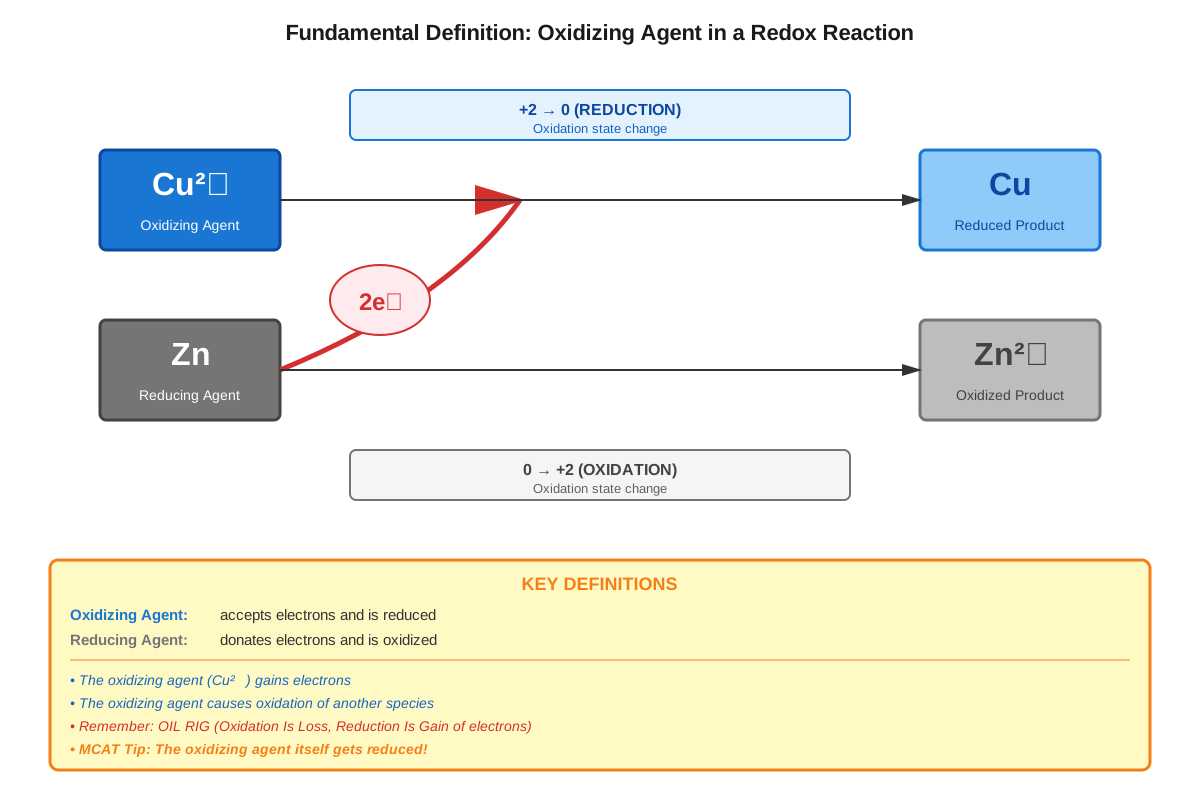
An oxidizing agent (also called an oxidant) is a chemical species that causes oxidation in another substance by accepting electrons from it. During this process, the oxidizing agent itself undergoes reduction (gains electrons and decreases in oxidation state). This reciprocal relationship is fundamental: the oxidizing agent is the species that gets reduced. The strength of an oxidizing agent reflects its electron affinity—stronger oxidizing agents have greater tendencies to accept electrons.
Key characteristics of oxidizing agents include:
- Contains an element in a high oxidation state or capable of achieving a lower oxidation state
- Possesses high electronegativity (typically nonmetals)
- Often contains oxygen, halogens, or transition metals in high oxidation states
- Becomes reduced (gains electrons) during the reaction
- Causes an increase in oxidation state of another species
Identifying Oxidizing Agents in Reactions
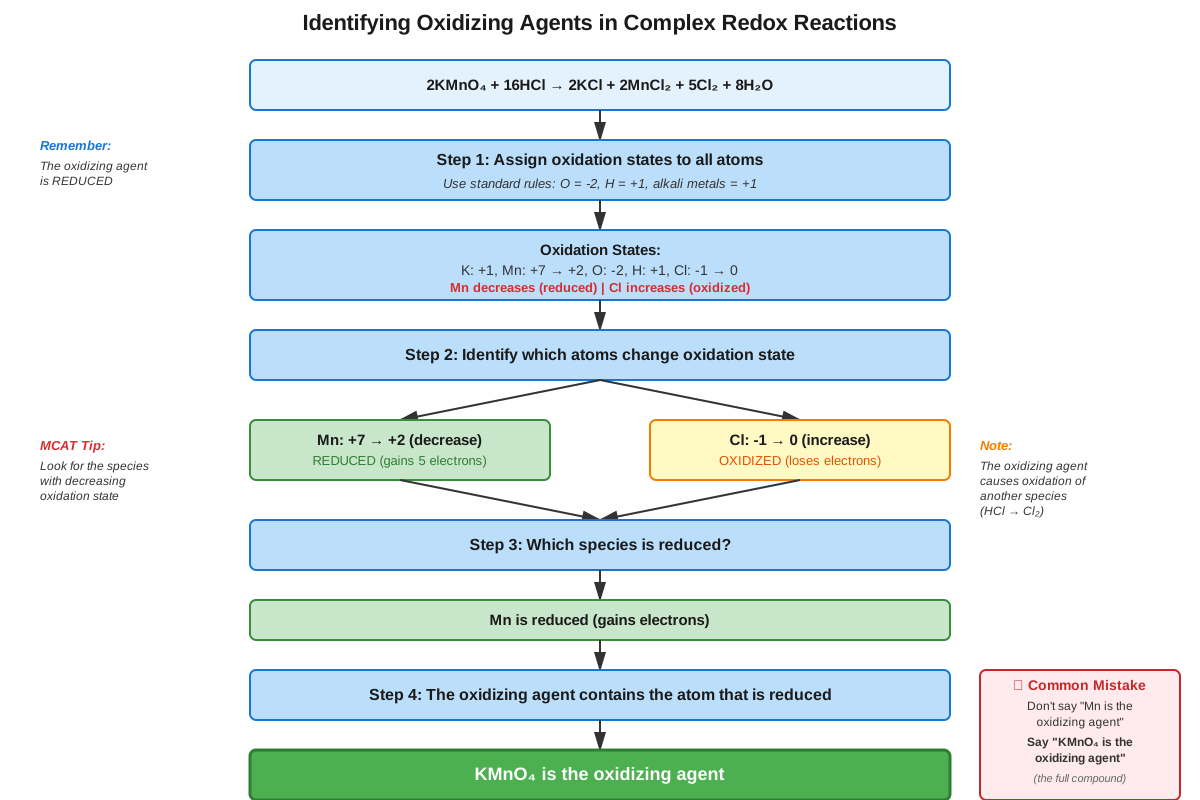
To identify the oxidizing agent in any redox reaction, follow this systematic approach:
- Assign oxidation numbers to all atoms in reactants and products
- Identify which species decreases in oxidation number (gets reduced)
- The species containing the atom that decreases in oxidation number is the oxidizing agent
- Verify that another species increases in oxidation number (gets oxidized)
Example: In the reaction 2Fe²⁺ + Cl₂ → 2Fe³⁺ + 2Cl⁻
- Fe goes from +2 to +3 (oxidized, loses electrons)
- Cl goes from 0 to -1 (reduced, gains electrons)
- Cl₂ is the oxidizing agent because it accepts electrons and is reduced
Common Oxidizing Agents and Their Strengths
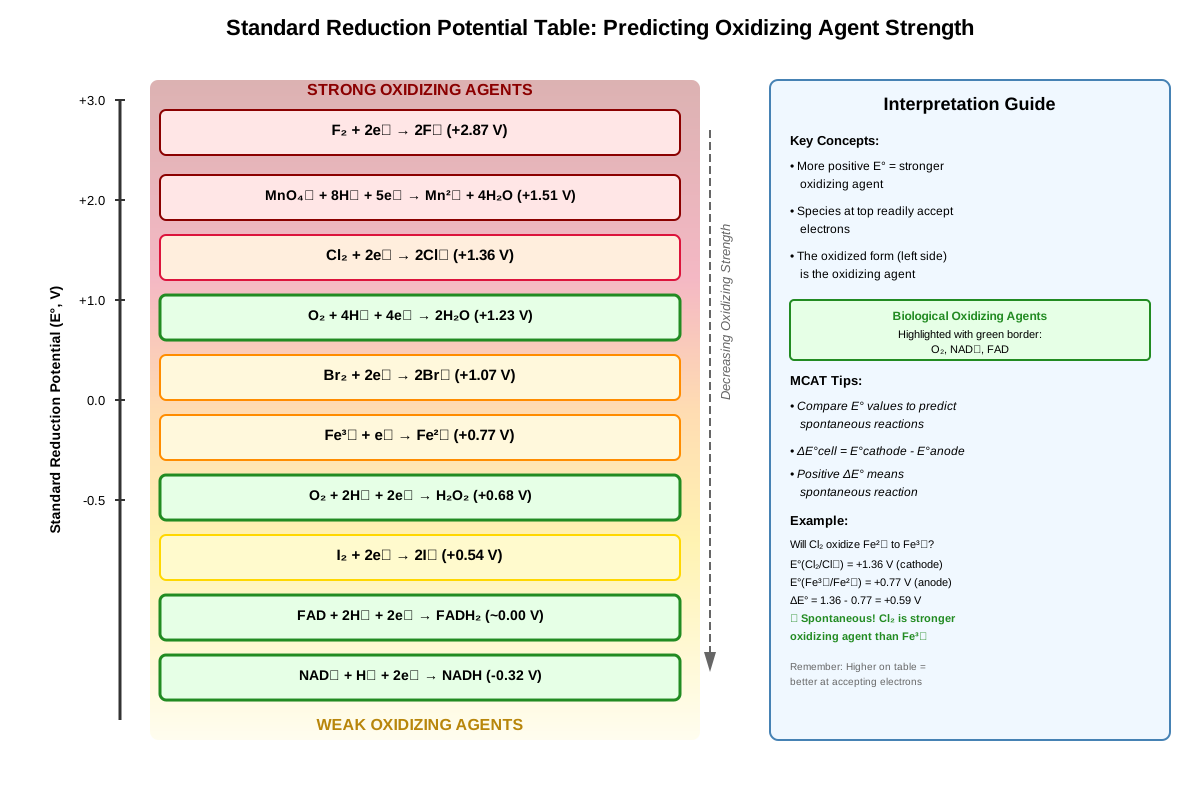
The strength of an oxidizing agent is quantified by its standard reduction potential (E°). Higher (more positive) reduction potentials indicate stronger oxidizing agents. The following table presents common oxidizing agents encountered on the MCAT:
| Oxidizing Agent | Half-Reaction | E° (V) | Strength |
|---|---|---|---|
| F₂ | F₂ + 2e⁻ → 2F⁻ | +2.87 | Strongest |
| H₂O₂ (acidic) | H₂O₂ + 2H⁺ + 2e⁻ → 2H₂O | +1.78 | Very strong |
| MnO₄⁻ (acidic) | MnO₄⁻ + 8H⁺ + 5e⁻ → Mn²⁺ + 4H₂O | +1.51 | Very strong |
| Cl₂ | Cl₂ + 2e⁻ → 2Cl⁻ | +1.36 | Strong |
| O₂ (acidic) | O₂ + 4H⁺ + 4e⁻ → 2H₂O | +1.23 | Strong |
| Br₂ | Br₂ + 2e⁻ → 2Br⁻ | +1.07 | Moderate |
| NO₃⁻ (acidic) | NO₃⁻ + 4H⁺ + 3e⁻ → NO + 2H₂O | +0.96 | Moderate |
| Fe³⁺ | Fe³⁺ + e⁻ → Fe²⁺ | +0.77 | Moderate |
| I₂ | I₂ + 2e⁻ → 2I⁻ | +0.54 | Weak |
Biological Oxidizing Agents
In biochemical systems, several molecules function as critical oxidizing agents:
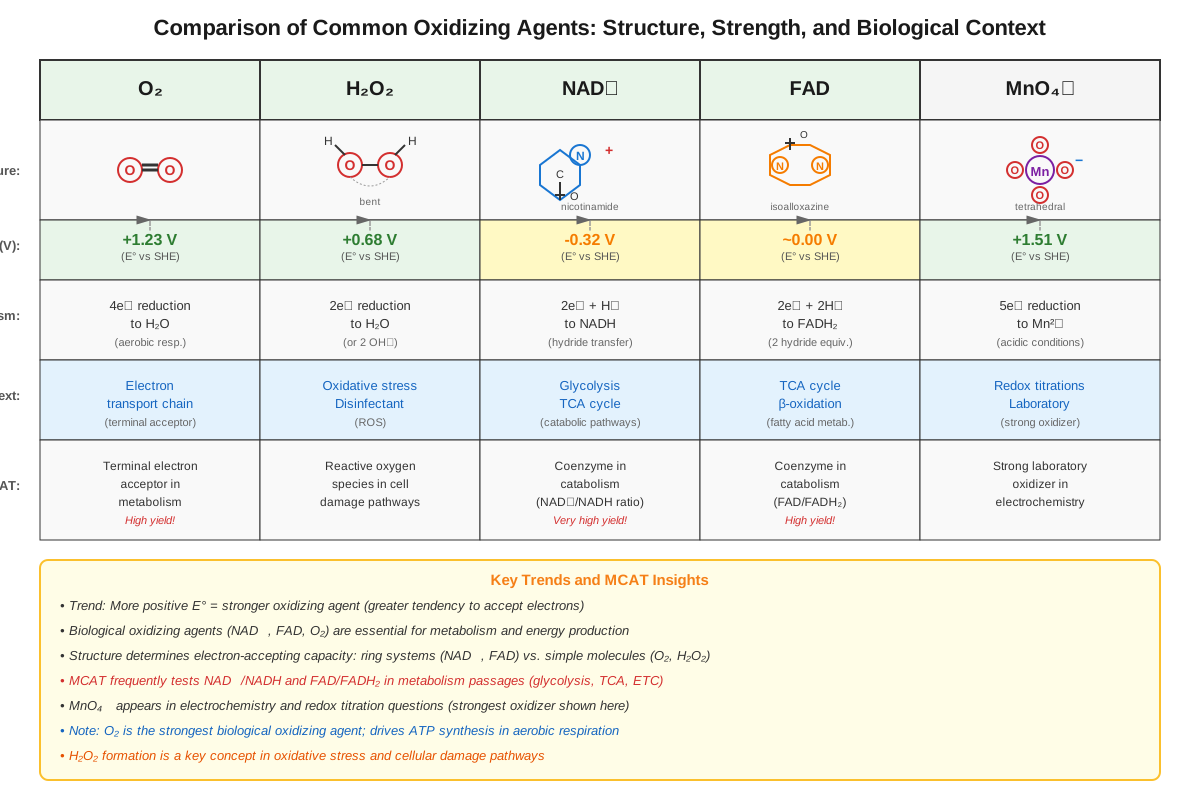
NAD⁺ (Nicotinamide Adenine Dinucleotide): Accepts two electrons and one proton to form NADH. Functions in glycolysis, citric acid cycle, and beta-oxidation. The reduction potential is approximately -0.32 V, making it a relatively weak oxidizing agent suitable for metabolic reactions.
FAD (Flavin Adenine Dinucleotide): Accepts two electrons and two protons to form FADH₂. Used in the citric acid cycle and fatty acid oxidation. Has a reduction potential around 0.0 V, slightly stronger than NAD⁺.
Oxygen (O₂): The terminal electron acceptor in aerobic respiration. Its high reduction potential (+0.82 V for O₂ + 4H⁺ + 4e⁻ → 2H₂O at pH 7) makes it an excellent final oxidizing agent, enabling maximum energy extraction from nutrients.
Cytochromes: Iron-containing proteins in the electron transport chain that alternate between Fe³⁺ (oxidized) and Fe²⁺ (reduced) states, serving as intermediate oxidizing agents.
Relationship Between Structure and Oxidizing Power
Several structural features enhance oxidizing ability:
High oxidation states: Species with elements in high oxidation states (MnO₄⁻, Cr₂O₇²⁻) are strong oxidizing agents because the central atom can readily accept electrons to achieve lower, more stable oxidation states.
Electronegativity: Highly electronegative elements (F, O, Cl) attract electrons strongly, making their compounds effective oxidizing agents.
Stability of reduced form: When the reduced form is particularly stable (F⁻ with complete octet, Cl⁻ with noble gas configuration), the reduction is thermodynamically favorable, enhancing oxidizing power.
Resonance stabilization: Polyatomic ions like MnO₄⁻ and NO₃⁻ benefit from resonance stabilization in their reduced forms, contributing to their oxidizing ability.
Oxidizing Agents in Electrochemical Cells
In galvanic (voltaic) cells, the oxidizing agent is found at the cathode where reduction occurs. Electrons flow from the anode (where oxidation occurs) through the external circuit to the cathode, where the oxidizing agent accepts them. The cell potential (E°cell) is calculated as:
E°cell = E°cathode - E°anode = E°reduction - E°oxidationFor a spontaneous reaction, E°cell must be positive, which occurs when the oxidizing agent at the cathode has a higher reduction potential than the reducing agent at the anode.
In electrolytic cells, an external voltage forces non-spontaneous reactions. The oxidizing agent is still reduced at the cathode, but the process requires energy input.
Factors Affecting Oxidizing Agent Strength
Concentration: Higher concentrations of oxidizing agents shift equilibrium toward reduction (Le Chatelier's principle), effectively increasing oxidizing power. The Nernst equation quantifies this effect:
E = E° - (RT/nF)ln(Q)pH: Many oxidizing agents (MnO₄⁻, Cr₂O₇²⁻, H₂O₂) are stronger in acidic conditions because H⁺ ions participate in the reduction half-reaction. Decreasing pH increases the concentration of H⁺, driving the reduction forward.
Temperature: Higher temperatures generally increase reaction rates but may affect the thermodynamic favorability of reduction. The Nernst equation shows temperature dependence through the RT term.
Solvent effects: Polar solvents stabilize ionic species differently than nonpolar solvents, affecting reduction potentials and oxidizing strength.
Concept Relationships
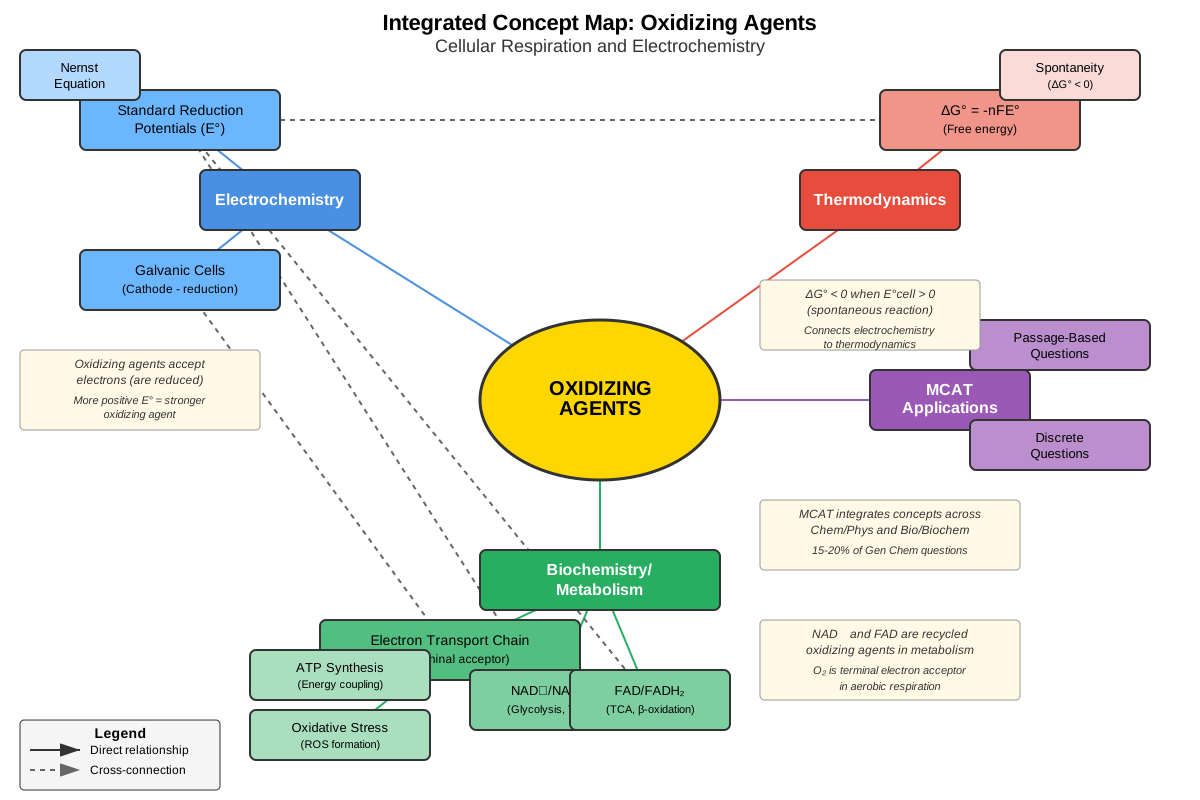
The concept of oxidizing agents is central to understanding redox chemistry and connects to multiple General Chemistry topics. Oxidation states provide the foundation for identifying oxidizing agents → Electron transfer represents the mechanism by which oxidizing agents function → Reduction potentials quantify oxidizing agent strength → Electrochemical cells demonstrate practical applications where oxidizing agents drive current flow → Gibbs free energy relates cell potential to reaction spontaneity (ΔG° = -nFE°) → Thermodynamics explains why certain species preferentially accept electrons.
Within biochemistry, oxidizing agents connect to: Cellular respiration (O₂, NAD⁺, FAD as electron acceptors) → Metabolic pathways (oxidizing agents regulate flux through glycolysis and citric acid cycle) → Electron transport chain (sequential oxidizing agents with increasing reduction potentials) → ATP synthesis (proton gradient generated by electron transfer to oxidizing agents).
The relationship flows: Molecular structure → Electron affinity → Reduction potential → Oxidizing strength → Reaction spontaneity → Biological function. Understanding this progression enables prediction of which species will act as oxidizing agents in unfamiliar reactions and explains why biological systems evolved specific electron carriers.
High-Yield Facts
⭐ The oxidizing agent is the species that gets reduced (gains electrons and decreases in oxidation state)
⭐ Higher (more positive) standard reduction potentials indicate stronger oxidizing agents
⭐ In galvanic cells, the oxidizing agent is always at the cathode where reduction occurs
⭐ Oxygen (O₂) is the terminal electron acceptor in aerobic respiration, serving as the final oxidizing agent
⭐ NAD⁺ and FAD are the primary oxidizing agents in metabolic pathways, accepting electrons during substrate oxidation
- Fluorine (F₂) is the strongest oxidizing agent with E° = +2.87 V
- Permanganate (MnO₄⁻) is a strong oxidizing agent in acidic solution (E° = +1.51 V) but weaker in basic solution
- Hydrogen peroxide (H₂O₂) can act as both an oxidizing agent and a reducing agent depending on reaction conditions
- Halogens decrease in oxidizing strength down the group: F₂ > Cl₂ > Br₂ > I₂
- Transition metals in high oxidation states (Cr₂O₇²⁻, MnO₄⁻) are typically strong oxidizing agents
- The oxidizing agent in a spontaneous redox reaction has a higher reduction potential than the reducing agent
- Acidic conditions generally enhance the oxidizing power of oxyanions (MnO₄⁻, Cr₂O₇²⁻, NO₃⁻)
- In biological systems, the electron transport chain uses progressively stronger oxidizing agents to maximize energy extraction
- Reactive oxygen species (superoxide, hydroxyl radical) are powerful oxidizing agents that can damage cellular components
Quick check — test yourself on Oxidizing agents so far.
Try Flashcards →Common Misconceptions
Misconception: The oxidizing agent is the species that gets oxidized.
Correction: The oxidizing agent is the species that gets reduced (gains electrons). It causes oxidation in another species while being reduced itself. Remember: the oxidizing agent oxidizes others but is itself reduced.
Misconception: Oxidizing agents always contain oxygen.
Correction: While many oxidizing agents contain oxygen (O₂, H₂O₂, MnO₄⁻), the name "oxidizing agent" refers to the function (accepting electrons), not composition. Halogens (F₂, Cl₂, Br₂), metal cations (Fe³⁺, Cu²⁺), and NAD⁺ are all oxidizing agents without oxygen.
Misconception: A stronger oxidizing agent has a more negative reduction potential.
Correction: Stronger oxidizing agents have more positive (higher) reduction potentials. A positive E° indicates a thermodynamically favorable reduction, meaning the species readily accepts electrons. F₂ (+2.87 V) is a much stronger oxidizing agent than I₂ (+0.54 V).
Misconception: The oxidizing agent is always at the anode in electrochemical cells.
Correction: The oxidizing agent is at the cathode where reduction occurs. The anode is where oxidation occurs, so the reducing agent is found there. Remember: "Red Cat" (Reduction at Cathode) and "An Ox" (Anode Oxidation).
Misconception: NAD⁺ and NADH are the same molecule serving different functions.
Correction: NAD⁺ is the oxidized form (oxidizing agent) that accepts electrons to become NADH (reduced form). They are different oxidation states of the same molecule. NAD⁺ functions as an oxidizing agent in catabolic reactions, while NADH functions as a reducing agent in anabolic reactions and the electron transport chain.
Misconception: All oxidizing agents are equally strong in any conditions.
Correction: Oxidizing agent strength depends on conditions including pH, concentration, temperature, and solvent. For example, MnO₄⁻ is much stronger in acidic solution (E° = +1.51 V) than in neutral or basic solution because H⁺ ions participate in the reduction half-reaction.
Misconception: If a species can be oxidized, it cannot be an oxidizing agent.
Correction: Some species can act as either oxidizing or reducing agents depending on what they react with. H₂O₂ is a classic example—it can accept electrons (act as oxidizing agent) from strong reducing agents or donate electrons (act as reducing agent) to strong oxidizing agents.
Worked Examples
Example 1: Identifying the Oxidizing Agent in a Complex Reaction
Question: In the reaction below, identify the oxidizing agent and explain your reasoning:
Cr₂O₇²⁻ + 14H⁺ + 6Fe²⁺ → 2Cr³⁺ + 6Fe³⁺ + 7H₂O
Solution:
Step 1: Assign oxidation numbers to elements that change.
- Chromium in Cr₂O₇²⁻: Each Cr is +6 (since 2x + 7(-2) = -2, so x = +6)
- Chromium in Cr³⁺: +3
- Iron in Fe²⁺: +2
- Iron in Fe³⁺: +3
Step 2: Identify which species is reduced and which is oxidized.
- Chromium: +6 → +3 (decrease in oxidation state = reduction, gains electrons)
- Iron: +2 → +3 (increase in oxidation state = oxidation, loses electrons)
Step 3: Identify the oxidizing agent.
The species that contains the element being reduced is the oxidizing agent. Since chromium is reduced, Cr₂O₇²⁻ (dichromate ion) is the oxidizing agent.
Step 4: Verify the electron transfer.
- Each Cr atom gains 3 electrons: Cr⁶⁺ + 3e⁻ → Cr³⁺
- Two Cr atoms gain 6 electrons total
- Each Fe atom loses 1 electron: Fe²⁺ → Fe³⁺ + e⁻
- Six Fe atoms lose 6 electrons total
- Electrons lost = electrons gained ✓
Connection to Learning Objectives: This example demonstrates how to systematically identify oxidizing agents using oxidation state changes, a critical skill for MCAT success. Dichromate is a common strong oxidizing agent in acidic solution, frequently appearing in exam questions.
Example 2: Predicting Reaction Spontaneity Using Reduction Potentials
Question: Will the following reaction occur spontaneously under standard conditions? If so, identify the oxidizing agent.
Br₂(l) + 2I⁻(aq) → 2Br⁻(aq) + I₂(s)
Given: E°(Br₂/Br⁻) = +1.07 V and E°(I₂/I⁻) = +0.54 V
Solution:
Step 1: Write the half-reactions.
- Reduction: Br₂ + 2e⁻ → 2Br⁻ (E° = +1.07 V)
- Oxidation: 2I⁻ → I₂ + 2e⁻ (E° = -0.54 V when reversed)
Step 2: Calculate the standard cell potential.
E°cell = E°reduction - E°oxidation
E°cell = (+1.07 V) - (+0.54 V) = +0.53 V
Step 3: Determine spontaneity.
Since E°cell is positive (+0.53 V), the reaction is spontaneous under standard conditions. This can also be confirmed using ΔG° = -nFE°cell, which will be negative (spontaneous) when E°cell is positive.
Step 4: Identify the oxidizing agent.
Br₂ is reduced (gains electrons), so Br₂ is the oxidizing agent. This makes sense because Br₂ has a higher reduction potential (+1.07 V) than I₂ (+0.54 V), making it the stronger oxidizing agent.
Step 5: Interpret the result.
Bromine can oxidize iodide ions to iodine because bromine is a stronger oxidizing agent than iodine. This follows the periodic trend: oxidizing strength of halogens decreases down the group (F₂ > Cl₂ > Br₂ > I₂).
Connection to Learning Objectives: This example integrates multiple concepts—reduction potentials, spontaneity prediction, and oxidizing agent identification—demonstrating how these topics interconnect on the MCAT. Understanding that the species with higher reduction potential acts as the oxidizing agent is essential for quickly solving electrochemistry problems.
Exam Strategy
Approaching MCAT Questions on Oxidizing Agents
Step 1: Quickly scan for oxidation state changes
When encountering a redox reaction, immediately assign oxidation numbers to identify which species is reduced. The species containing the atom that decreases in oxidation state is the oxidizing agent.
Step 2: Use reduction potential tables efficiently
If given a table of reduction potentials, remember that species with higher (more positive) E° values are stronger oxidizing agents. The oxidizing agent in a spontaneous reaction will have a higher reduction potential than the reducing agent.
Step 3: Recognize biological contexts
In biochemistry passages, look for NAD⁺, FAD, and O₂ as oxidizing agents. Questions about metabolic pathways often test whether students understand that these molecules accept electrons from substrates.
Trigger Words and Phrases
Watch for these key phrases that signal oxidizing agent questions:
- "Which species is reduced?" (The answer is the oxidizing agent)
- "Electron acceptor" (Synonym for oxidizing agent)
- "Causes oxidation of..." (The species causing oxidation is the oxidizing agent)
- "At the cathode..." (In electrochemical cells, the oxidizing agent is at the cathode)
- "Terminal electron acceptor" (In biological contexts, refers to the final oxidizing agent, usually O₂)
- "Decrease in oxidation state" (Indicates reduction, identifying the oxidizing agent)
Process-of-Elimination Tips
Eliminate species that are oxidized: If a species increases in oxidation state, it cannot be the oxidizing agent—it's the reducing agent.
Eliminate species with very negative reduction potentials: In questions asking for the strongest oxidizing agent, immediately eliminate options with negative or low positive E° values.
In biological passages, eliminate reduced forms: If asked to identify an oxidizing agent in metabolism, eliminate NADH, FADH₂, and reduced cytochromes—only their oxidized forms (NAD⁺, FAD, oxidized cytochromes) can act as oxidizing agents.
Check for pH dependence: If the question specifies acidic or basic conditions, remember that many oxidizing agents (MnO₄⁻, Cr₂O₇²⁻) are stronger in acidic solution.
Time Allocation Advice
For discrete questions on oxidizing agents (typically 60-90 seconds):
- Spend 15-20 seconds assigning oxidation numbers
- Spend 10-15 seconds identifying which species is reduced
- Spend 10-15 seconds selecting the answer
- Spend 20-40 seconds double-checking if time permits
For passage-based questions (typically 90-120 seconds):
- Spend 30-40 seconds extracting relevant information from the passage
- Spend 30-40 seconds applying oxidizing agent concepts
- Spend 20-30 seconds eliminating wrong answers
- Spend 10-20 seconds confirming your choice
Exam Tip: If you're stuck between two answers, ask yourself: "Which species is being reduced (gaining electrons)?" The species being reduced is always the oxidizing agent. This simple question resolves most confusion.
Memory Techniques
Mnemonics for Key Concepts
"OIL RIG": Oxidation Is Loss (of electrons), Reduction Is Gain (of electrons). The oxidizing agent causes oxidation (loss of electrons) in another species while gaining electrons itself.
"LEO the lion says GER": Lose Electrons = Oxidation; Gain Electrons = Reduction. The oxidizing agent gains electrons (GER).
"Red Cat, An Ox": Reduction at Cathode, Anode Oxidation. The oxidizing agent is at the cathode where reduction occurs.
"HOPE": Higher Oxidation states, Positive reduction potentials, Electron acceptors. These three characteristics identify strong oxidizing agents.
Acronym for Common Biological Oxidizing Agents
"NO FAD": NAD⁺, O₂, FAD—the three major oxidizing agents in cellular respiration and metabolism.
Visualization Strategy for Reduction Potentials
Visualize a "reduction potential ladder" with stronger oxidizing agents at the top (more positive E°) and weaker ones at the bottom. Electrons "fall down" the ladder from reducing agents (bottom) to oxidizing agents (top), releasing energy. This mental image helps predict spontaneous reactions: electrons flow from species with lower reduction potential to those with higher reduction potential.
Top of ladder (strong oxidizing agents): F₂ (+2.87 V) → H₂O₂ (+1.78 V) → MnO₄⁻ (+1.51 V) → Cl₂ (+1.36 V) → O₂ (+1.23 V)
Middle of ladder: Br₂ (+1.07 V) → Fe³⁺ (+0.77 V) → I₂ (+0.54 V)
Bottom of ladder (weak oxidizing agents/strong reducing agents): NAD⁺ (-0.32 V) → H₂ (0.00 V)
Memory Palace Technique
Create a mental journey through a cell to remember biological oxidizing agents:
- Cytoplasm (glycolysis): NAD⁺ accepts electrons from glucose
- Mitochondrial matrix (citric acid cycle): NAD⁺ and FAD accept electrons from acetyl-CoA
- Inner mitochondrial membrane (electron transport chain): Cytochromes and other carriers accept electrons sequentially
- Final destination: O₂ accepts electrons at Complex IV, forming water
This spatial organization helps recall which oxidizing agents function in which metabolic locations.
Summary
Oxidizing agents are electron acceptors that undergo reduction while causing oxidation in other species. Understanding oxidizing agents requires mastery of oxidation state changes, reduction potentials, and electrochemical principles. The oxidizing agent in any redox reaction is identified as the species that decreases in oxidation state (gains electrons). Stronger oxidizing agents have more positive standard reduction potentials and are found at the cathode in electrochemical cells. Common strong oxidizing agents include F₂, H₂O₂, MnO₄⁻, Cl₂, and O₂, while biological systems rely on NAD⁺, FAD, and O₂ as critical electron acceptors in metabolism. The strength of oxidizing agents depends on molecular structure, pH, concentration, and temperature. MCAT questions test the ability to identify oxidizing agents, predict reaction spontaneity using reduction potentials, and apply these concepts to biological and electrochemical contexts. Success requires systematic analysis of oxidation state changes, efficient use of reduction potential data, and recognition of common oxidizing agents in various contexts.
Key Takeaways
- The oxidizing agent is the species that gets reduced (gains electrons and decreases in oxidation state) while causing oxidation in another species
- Higher standard reduction potentials (more positive E° values) indicate stronger oxidizing agents
- In electrochemical cells, the oxidizing agent is always located at the cathode where reduction occurs
- Common strong oxidizing agents include F₂, Cl₂, MnO₄⁻, Cr₂O₇²⁻, H₂O₂, and O₂; biological oxidizing agents include NAD⁺, FAD, and O₂
- Oxidizing agent strength increases with higher oxidation states, greater electronegativity, acidic conditions, and higher concentrations
- To identify the oxidizing agent, assign oxidation numbers and find the species that decreases in oxidation state
- Spontaneous redox reactions occur when the oxidizing agent has a higher reduction potential than the reducing agent (E°cell > 0)
Related Topics
Reducing Agents: The complementary concept to oxidizing agents; species that donate electrons and cause reduction. Understanding both agents together provides complete mastery of redox chemistry.
Standard Reduction Potentials: Quantitative measures of oxidizing and reducing strength; essential for predicting reaction spontaneity and calculating cell potentials.
Electrochemical Cells (Galvanic and Electrolytic): Practical applications where oxidizing agents drive current flow; connects redox chemistry to thermodynamics and energy conversion.
Biological Electron Transport: The electron transport chain uses sequential oxidizing agents with increasing reduction potentials to maximize ATP production; bridges general chemistry and biochemistry.
Redox Titrations: Analytical technique using oxidizing agents to determine concentrations; frequently appears in MCAT laboratory-based passages.
Oxidative Stress and Antioxidants: Biological consequences of excessive oxidizing agents (reactive oxygen species) and protective mechanisms; relevant to aging, disease, and pharmacology.
Mastering oxidizing agents provides the foundation for understanding these advanced topics and enables integration of chemical principles with biological systems—a key skill for MCAT success.
Practice CTA
Now that you've thoroughly reviewed oxidizing agents, it's time to solidify your understanding through active practice. Attempt the practice questions and flashcards associated with this topic to reinforce key concepts, identify any remaining gaps in knowledge, and build the pattern recognition skills essential for rapid problem-solving on test day. Remember, mastery comes from application—each practice question you work through strengthens your ability to recognize oxidizing agents in diverse contexts and apply reduction potential principles efficiently. You've built a strong conceptual foundation; now transform that knowledge into high-yield exam performance through deliberate practice!
Sign up free to keep reading
Create a free AnvayaPrep account to finish this MCAT guide on Oxidizing agents — plus flashcards and practice questions.