Overview
Chair conformations represent one of the most important three-dimensional structural concepts in Organic Chemistry, particularly for understanding the behavior of cyclohexane and substituted cyclohexane rings. These conformations describe the lowest-energy, most stable arrangements of six-membered rings, where the molecule adopts a puckered shape resembling a reclining chair. Mastering chair conformations is essential for predicting molecular stability, understanding reaction mechanisms, and solving stereochemistry problems that frequently appear on the MCAT.
The significance of chair conformations extends beyond simple structural representation. These conformations directly influence the physical properties, reactivity, and biological activity of countless organic molecules, including carbohydrates, steroids, and pharmaceutical compounds. On the MCAT, questions involving chair conformations typically test the ability to draw accurate structures, identify axial and equatorial positions, predict conformational stability, and understand how substituent placement affects molecular energy. The topic bridges fundamental concepts in Stereochemistry and Conformation with more advanced applications in reaction mechanisms and biomolecule structure.
Understanding chair conformations provides the foundation for analyzing conformational isomers, predicting product distributions in reactions, and explaining why certain molecular arrangements are favored in biological systems. This knowledge connects directly to broader themes in Organic Chemistry MCAT preparation, including stereoisomerism, ring strain, steric interactions, and the relationship between molecular structure and function. Students who master chair conformations gain a powerful tool for visualizing three-dimensional molecular architecture and predicting chemical behavior.
Learning Objectives
- [ ] Define chair conformations using accurate Organic Chemistry terminology
- [ ] Explain why chair conformations matters for the MCAT
- [ ] Apply chair conformations to exam-style questions
- [ ] Identify common mistakes related to chair conformations
- [ ] Connect chair conformations to related Organic Chemistry concepts
- [ ] Draw accurate chair conformations showing correct bond angles and positions
- [ ] Predict the relative stability of different chair conformations based on substituent positions
- [ ] Perform chair flips and correctly identify the resulting axial and equatorial positions
- [ ] Calculate the energy difference between conformational isomers using A-values
Prerequisites
- Basic molecular geometry and VSEPR theory: Understanding tetrahedral carbon geometry (109.5° bond angles) is essential for recognizing why cyclohexane adopts a puckered rather than planar structure
- Newman projections and conformational analysis: The concepts of staggered and eclipsed conformations provide the foundation for understanding why chair conformations minimize torsional strain
- Stereochemistry fundamentals: Knowledge of cis/trans isomerism and wedge-dash notation enables proper representation of substituent orientation in chair conformations
- Ring strain concepts: Understanding angle strain, torsional strain, and steric strain explains why the chair conformation is the most stable arrangement for six-membered rings
- Alkane nomenclature and structure: Familiarity with cycloalkanes and substituent naming is necessary for identifying and describing substituted cyclohexanes
Why This Topic Matters
Chair conformations appear with moderate frequency on the MCAT, typically in 2-4 questions per exam, either as standalone discrete questions or embedded within passage-based questions in the Chemical and Physical Foundations section. The topic's importance extends beyond its direct testing frequency because it underlies many biochemistry concepts, particularly carbohydrate chemistry, where glucose and other sugars exist predominantly in chair conformations. Understanding these structures is crucial for interpreting experimental data about molecular stability and reactivity.
Clinically, chair conformations have profound implications for drug design and pharmacology. Many pharmaceutical compounds contain cyclohexane rings or similar six-membered structures, and the three-dimensional arrangement of substituents directly affects how these molecules interact with biological targets. For example, the different conformations of substituted cyclohexanes can determine whether a drug molecule fits into an enzyme active site or receptor binding pocket. This real-world relevance makes chair conformations a high-yield topic for medical school preparation.
On the MCAT, chair conformations commonly appear in several contexts: analyzing carbohydrate structures in biochemistry passages, predicting product stability in organic synthesis problems, interpreting NMR or other spectroscopic data that depends on molecular geometry, and solving problems involving conformational equilibria. Questions may present a substituted cyclohexane and ask students to identify the most stable conformation, or they may require drawing the chair flip and determining which substituents change from axial to equatorial positions. The ability to quickly and accurately work with chair conformations can significantly improve performance on these medium-difficulty questions.
Core Concepts
The Chair Conformation Structure
The chair conformation is the most stable three-dimensional arrangement of cyclohexane, characterized by a puckered structure that eliminates both angle strain and torsional strain. In this conformation, all carbon-carbon bond angles are approximately 109.5°, matching the ideal tetrahedral geometry of sp³-hybridized carbons. Additionally, all adjacent C-H bonds are perfectly staggered when viewed in Newman projection, minimizing torsional strain. This combination of optimal geometry makes the chair conformation approximately 25 kJ/mol more stable than the next most stable conformation (the twist-boat).
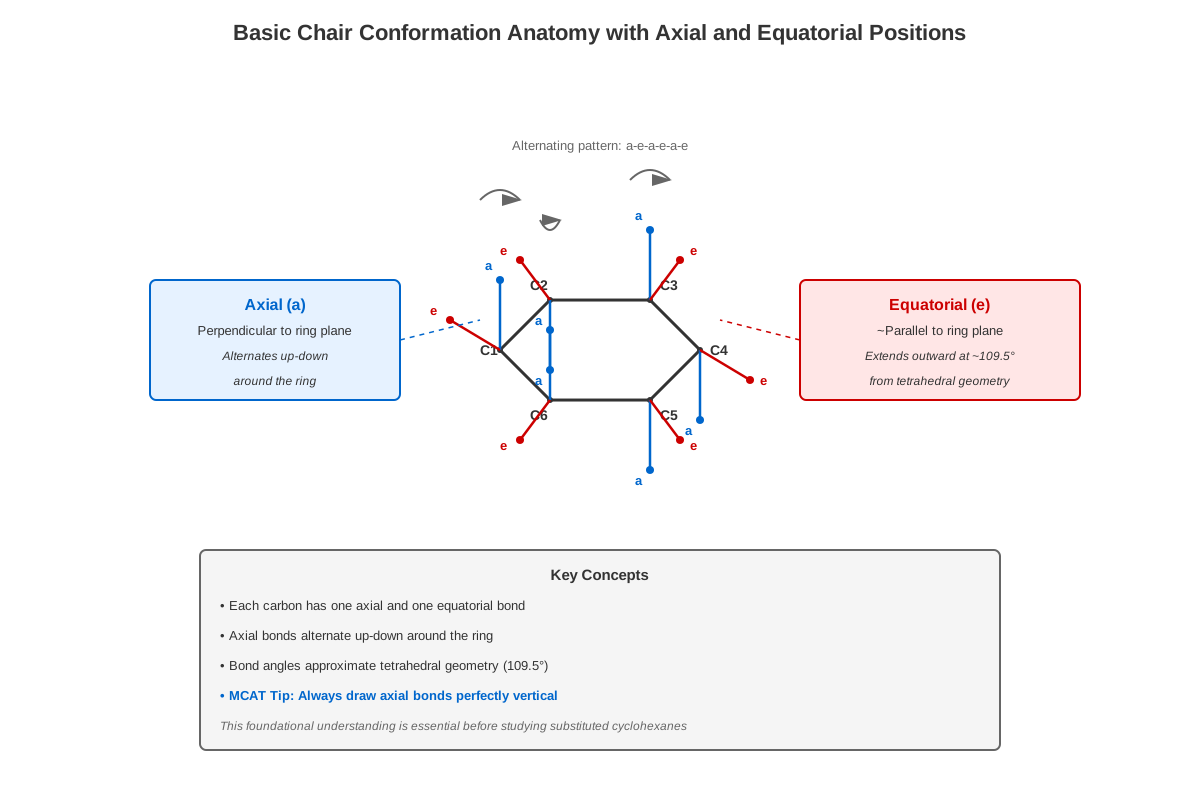
The chair structure features alternating carbon atoms positioned above and below an imaginary plane. Visualizing the chair requires recognizing that carbons 1, 2, 4, and 5 form a plane, while carbon 3 extends below this plane and carbon 6 extends above it (using standard numbering). This arrangement creates the characteristic "chair" shape with a "seat," "back," and "footrest." Each carbon atom in the chair conformation bears two hydrogen atoms (or substituents), positioned in two distinct orientations: axial and equatorial.
Axial and Equatorial Positions
Understanding the distinction between axial and equatorial positions is fundamental to predicting conformational stability. Axial positions are oriented parallel to an imaginary vertical axis running through the center of the ring. These positions alternate up and down around the ring: if carbon 1 has an axial substituent pointing up, carbon 2's axial position points down, carbon 3's points up, and so forth. Axial substituents are more crowded because they point directly toward other axial substituents on the same face of the ring, creating unfavorable steric interactions called 1,3-diaxial interactions.
Equatorial positions are oriented roughly perpendicular to the vertical axis, extending outward from the ring in the plane of the "equator." These positions provide more space for substituents because they point away from the ring structure, minimizing steric interactions. For any given carbon, the axial and equatorial positions are approximately 109.5° apart, maintaining tetrahedral geometry. A crucial pattern to remember: when an axial bond points up, the equatorial bond on that same carbon angles slightly downward, and vice versa.
| Position Type | Orientation | Steric Crowding | Stability Preference |
|---|---|---|---|
| Axial | Parallel to ring axis | High (1,3-diaxial interactions) | Less stable for large groups |
| Equatorial | Perpendicular to ring axis | Low (points away from ring) | More stable for large groups |
Chair Flips and Ring Inversion
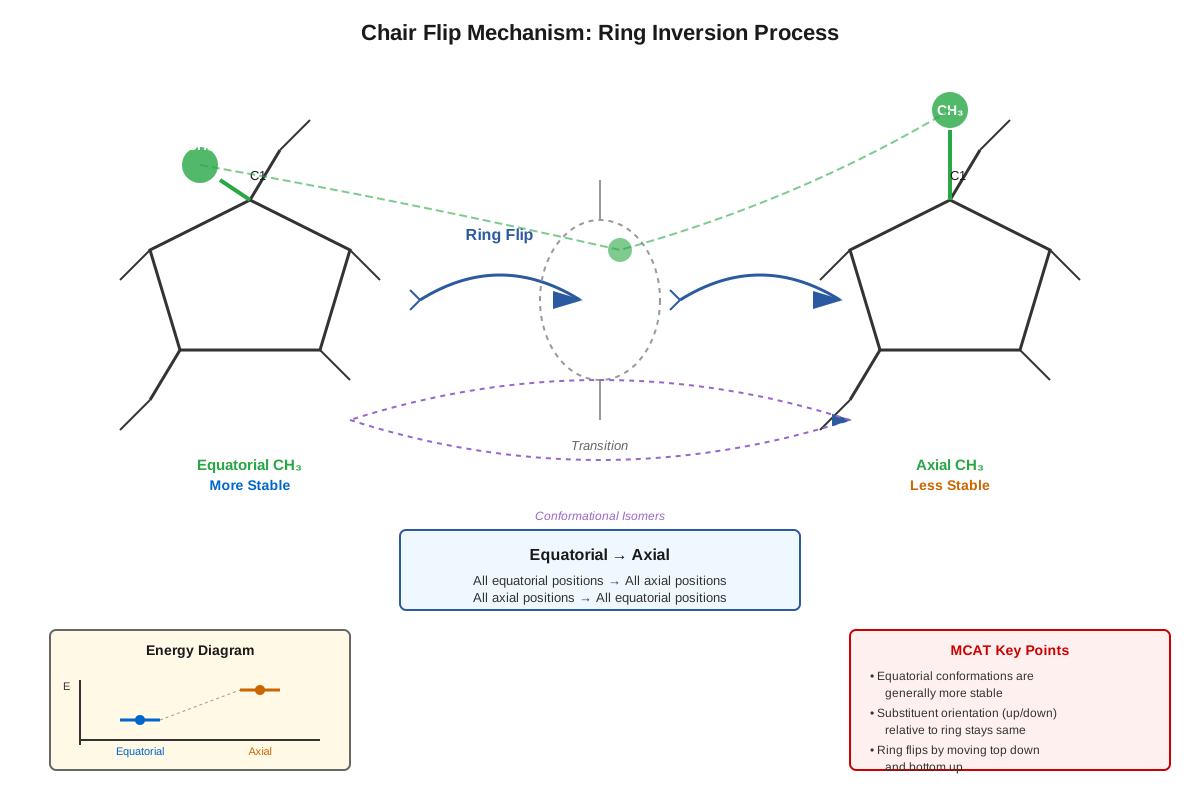
Cyclohexane rings are not static structures; they undergo a conformational change called a chair flip or ring inversion. During this process, the chair conformation converts to its alternative chair conformation through a series of bond rotations. The critical consequence of a chair flip is that all axial positions become equatorial, and all equatorial positions become axial. However, the relative stereochemistry (cis/trans relationships) between substituents remains unchanged—if two groups were cis before the flip, they remain cis afterward.
The mechanism of chair flipping involves the "seat" of the chair moving up to become the "back," while the "back" moves down to become the "seat." Carbon atoms that were above the plane move below it, and vice versa. This interconversion occurs rapidly at room temperature (approximately 100,000 times per second for unsubstituted cyclohexane), meaning the molecule exists as an equilibrium mixture of both chair conformations. For substituted cyclohexanes, the equilibrium favors the conformation with larger substituents in equatorial positions.
Conformational Stability and A-Values
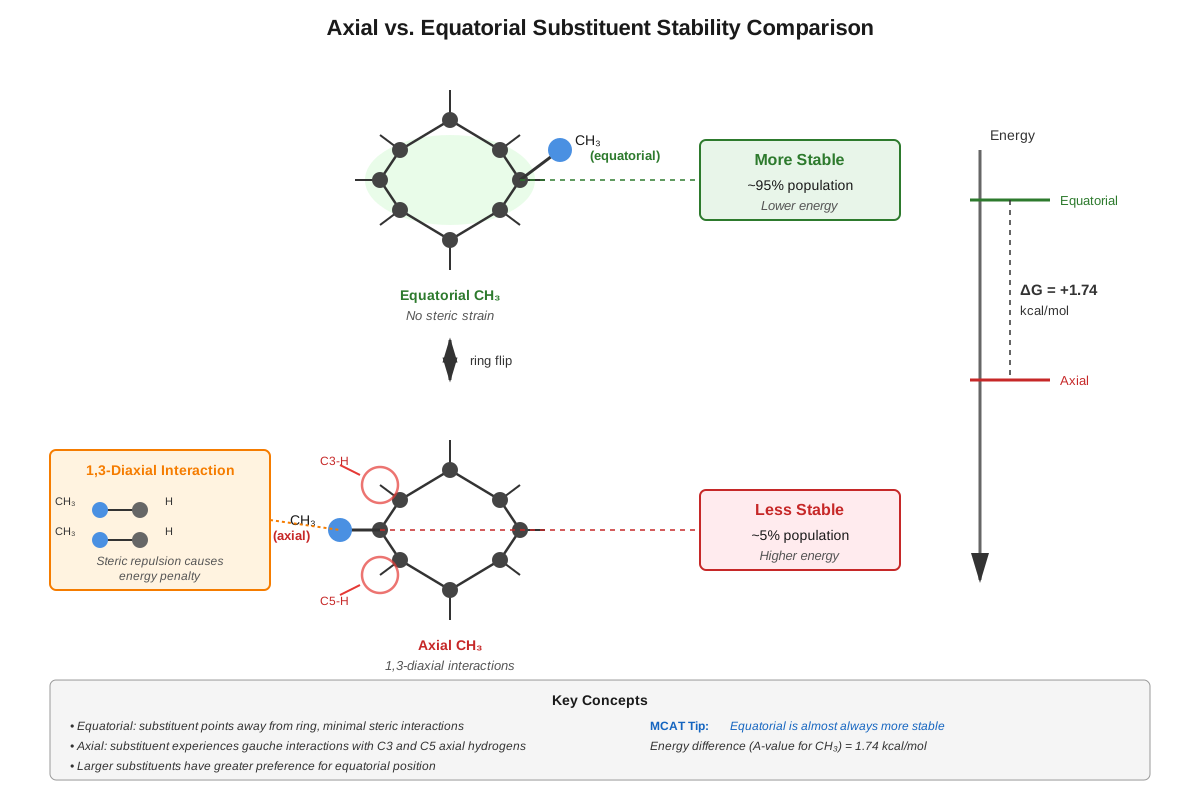
The relative stability of different chair conformations depends on the size and number of substituents and their positions. When a substituent occupies an axial position, it experiences unfavorable 1,3-diaxial interactions with the two other axial hydrogens (or substituents) on the same face of the ring, three carbons away. These steric interactions increase the energy of the conformation, making it less stable. The energy cost of placing a substituent in an axial versus equatorial position is quantified by its A-value (or conformational energy).
A-values represent the energy difference (in kJ/mol or kcal/mol) between having a substituent in the axial versus equatorial position. Larger substituents have larger A-values because they experience greater steric crowding in axial positions. For example, a methyl group has an A-value of approximately 7.6 kJ/mol (1.8 kcal/mol), while a tert-butyl group has an A-value of approximately 21 kJ/mol (5.0 kcal/mol). The tert-butyl group is so large that substituted cyclohexanes with this group exist almost exclusively in the conformation where it occupies an equatorial position.
Common A-values (approximate, in kJ/mol):
- H: 0
- F: 1.0
- Cl: 2.2
- Br: 2.4
- OH: 3.9
- CH₃: 7.6
- CH₂CH₃: 7.9
- CH(CH₃)₂: 9.2
- C(CH₃)₃: 21
Disubstituted Cyclohexanes
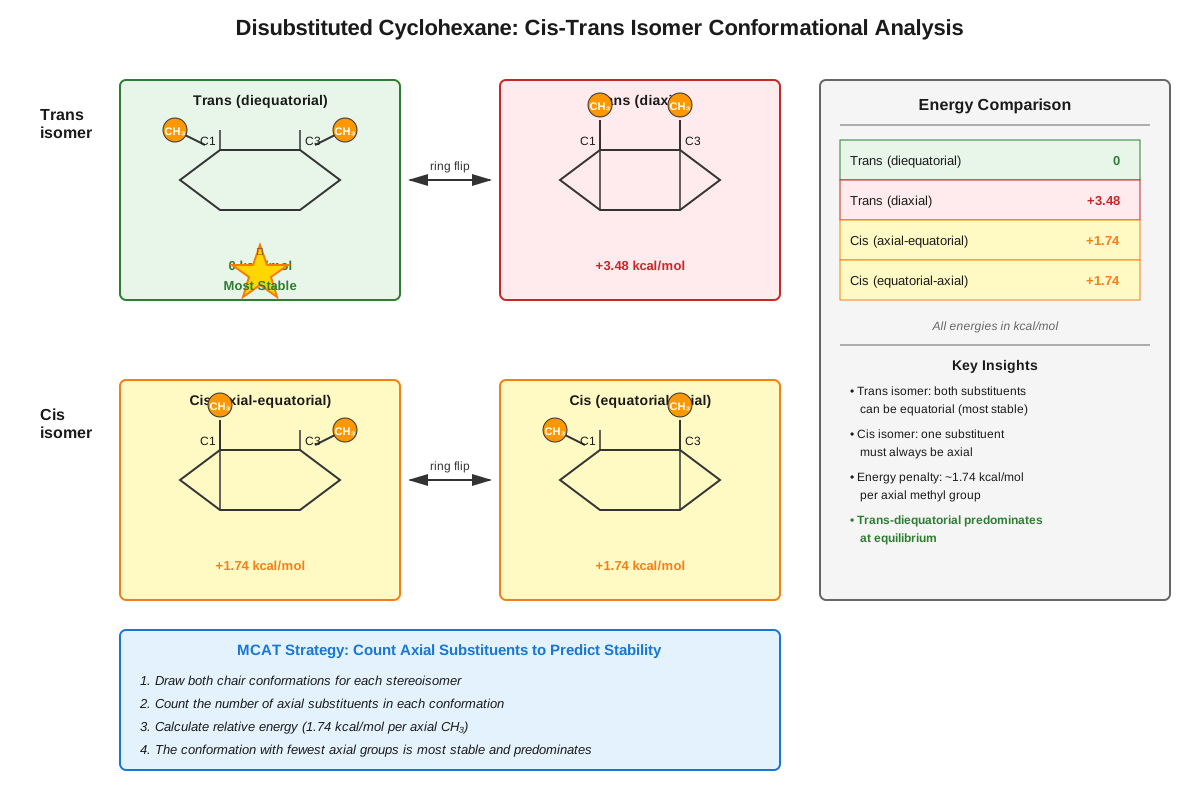
When cyclohexane bears two or more substituents, determining the most stable conformation requires considering both the size of each substituent and their relative stereochemistry. For disubstituted cyclohexanes, the relationship between substituents can be cis (on the same face of the ring) or trans (on opposite faces). These relationships remain constant during chair flips, but the axial/equatorial positions of the substituents change.
For trans-1,2-disubstituted cyclohexanes, one chair conformation places both substituents equatorial (highly stable), while the alternative chair places both axial (less stable). The equilibrium strongly favors the diequatorial conformation. For cis-1,2-disubstituted cyclohexanes, both chair conformations have one substituent axial and one equatorial, making them closer in energy. The more stable conformation places the larger substituent in the equatorial position.
For trans-1,3-disubstituted cyclohexanes, the pattern reverses: the stable conformation has both substituents equatorial, while cis-1,3 arrangements result in one axial and one equatorial substituent in both conformations. For trans-1,4-disubstituted cyclohexanes, both conformations have one axial and one equatorial substituent, similar to cis-1,2 arrangements.
Conformational Analysis and Energy Calculations
Predicting which chair conformation predominates at equilibrium requires calculating the total energy difference between the two possible chairs. This involves summing the A-values for all axial substituents in each conformation. The conformation with the lower total energy (fewer or smaller axial substituents) will be favored. The ratio of conformations at equilibrium can be calculated using the Boltzmann distribution, though the MCAT typically requires only qualitative predictions.
For example, consider trans-1-methyl-4-isopropylcyclohexane. One chair conformation has the methyl group axial (7.6 kJ/mol) and the isopropyl group equatorial (0 kJ/mol), for a total of 7.6 kJ/mol. The alternative chair has the methyl group equatorial (0 kJ/mol) and the isopropyl group axial (9.2 kJ/mol), for a total of 9.2 kJ/mol. The first conformation is more stable by 1.6 kJ/mol and will predominate at equilibrium.
Concept Relationships
The core concepts of chair conformations build upon each other in a logical progression. Understanding the basic chair conformation structure is prerequisite to distinguishing axial and equatorial positions, which in turn enables comprehension of chair flips and their consequences. The concept of 1,3-diaxial interactions explains why equatorial positions are generally more stable, leading to the quantification of stability differences through A-values. These principles combine when analyzing disubstituted cyclohexanes, where both stereochemistry and substituent size determine conformational preferences.
Chair conformations connect directly to prerequisite knowledge of Newman projections because the staggered arrangement of bonds in the chair conformation can be visualized through Newman projections along any C-C bond. The concept of ring strain explains why cyclohexane adopts the chair rather than a planar structure—the chair eliminates both angle strain and torsional strain. Understanding stereochemistry is essential because cis/trans relationships between substituents remain constant during chair flips, even as axial/equatorial positions interchange.
The relationship map flows as follows: Basic ring structure → Chair conformation geometry → Axial/equatorial distinction → Steric interactions → A-values and stability → Chair flip equilibria → Multi-substituted analysis → Prediction of predominant conformer. This progression moves from structural understanding to energetic analysis to practical prediction, mirroring the problem-solving approach needed for MCAT questions.
Chair conformations also connect forward to more advanced topics in Organic Chemistry. Understanding these conformations is essential for carbohydrate chemistry, where monosaccharides like glucose exist predominantly in chair conformations with specific substituent orientations. The topic relates to reaction mechanisms because the reactivity of functional groups can depend on their axial or equatorial position. Additionally, chair conformations provide insight into molecular recognition in biochemistry, where the three-dimensional shape of molecules determines their biological activity.
Quick check — test yourself on Chair conformations so far.
Try Flashcards →High-Yield Facts
⭐ The chair conformation is the most stable conformation of cyclohexane because all C-C-C bond angles are 109.5° and all C-H bonds are staggered
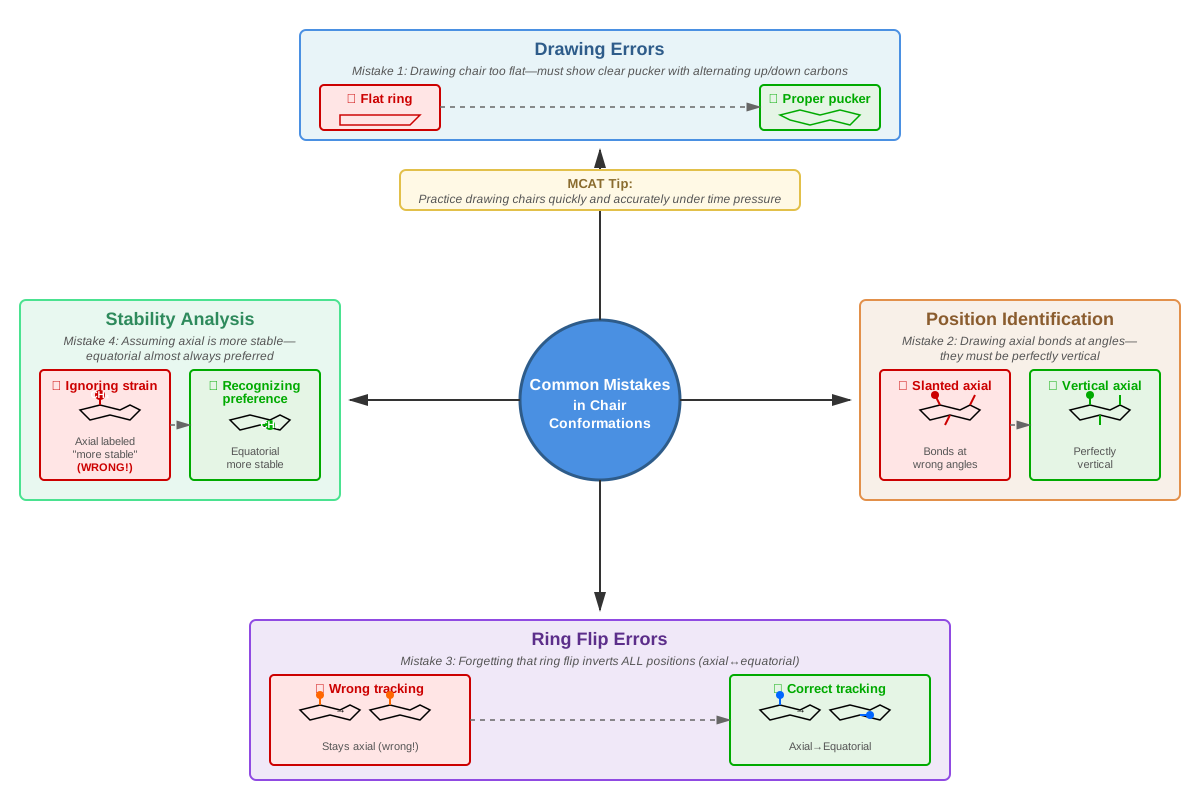
⭐ During a chair flip, all axial positions become equatorial and all equatorial positions become axial, but cis/trans relationships remain unchanged
⭐ Equatorial positions are generally more stable than axial positions for substituents due to reduced steric interactions
⭐ 1,3-diaxial interactions occur between an axial substituent and the two axial hydrogens three carbons away on the same face of the ring
⭐ The tert-butyl group (A-value ≈ 21 kJ/mol) is so large that it locks the ring in the conformation where it is equatorial
- A-values quantify the energy cost (in kJ/mol) of placing a substituent in an axial versus equatorial position
- For trans-1,2-disubstituted cyclohexanes, the most stable conformation has both substituents equatorial
- For cis-1,2-disubstituted cyclohexanes, both chair conformations have one axial and one equatorial substituent
- Trans-1,4-disubstituted cyclohexanes behave similarly to cis-1,2 arrangements (one axial, one equatorial in both chairs)
- The conformational equilibrium favors the chair with the larger substituent(s) in equatorial positions
- Cyclohexane undergoes chair flips approximately 100,000 times per second at room temperature
- When drawing chair conformations, axial bonds alternate up-down-up-down around the ring
- The energy difference between chair conformations can be estimated by summing the A-values of all axial substituents
Common Misconceptions
Misconception: Chair flips change the cis/trans relationship between substituents → Correction: Chair flips only interchange axial and equatorial positions; the relative stereochemistry (cis or trans) between substituents remains constant. If two groups are cis before the flip, they remain cis afterward, though their axial/equatorial positions will change.
Misconception: All substituents prefer equatorial positions equally → Correction: The preference for equatorial positions depends on substituent size, quantified by A-values. Small substituents like fluorine have minimal preference (A-value ≈ 1 kJ/mol), while large groups like tert-butyl have very strong preferences (A-value ≈ 21 kJ/mol).
Misconception: In disubstituted cyclohexanes, both substituents can be equatorial regardless of their stereochemical relationship → Correction: Only trans-1,2-disubstituted and trans-1,3-disubstituted cyclohexanes can have both substituents equatorial in one chair conformation. Cis-1,2 and trans-1,4 arrangements always have one axial and one equatorial substituent in both chair conformations.
Misconception: Axial bonds point straight up or straight down → Correction: Axial bonds are parallel to the vertical axis but not perfectly vertical. They angle slightly inward toward the ring center. Similarly, equatorial bonds are not perfectly horizontal but angle slightly up or down depending on the carbon's position.
Misconception: The most stable conformation always has all substituents equatorial → Correction: For certain substitution patterns (like cis-1,2 or trans-1,4), it is impossible to have all substituents equatorial simultaneously. In these cases, the most stable conformation places the largest substituent equatorial and smaller substituents axial.
Misconception: Chair conformations only matter for cyclohexane → Correction: Chair conformations are crucial for understanding many biological molecules, including carbohydrates (glucose, fructose), steroids (cholesterol, testosterone), and numerous pharmaceutical compounds containing six-membered rings.
Worked Examples
Example 1: Determining the Most Stable Conformation of a Monosubstituted Cyclohexane
Problem: Draw both chair conformations of methylcyclohexane and determine which is more stable. Calculate the percentage of each conformation at equilibrium at 25°C, given that the A-value for a methyl group is 7.6 kJ/mol.
Solution:
Step 1: Draw the first chair conformation with the methyl group in an equatorial position. In this conformation, the methyl group extends outward from the ring, minimizing steric interactions. The energy cost for axial substituents is 0 kJ/mol (no axial substituents).
Step 2: Draw the second chair conformation (after a chair flip) with the methyl group in an axial position. In this conformation, the methyl group points parallel to the ring axis and experiences 1,3-diaxial interactions with the two axial hydrogens on the same face of the ring. The energy cost is 7.6 kJ/mol.
Step 3: Calculate the energy difference: ΔE = 7.6 kJ/mol - 0 kJ/mol = 7.6 kJ/mol. The equatorial conformation is more stable by 7.6 kJ/mol.
Step 4: Use the Boltzmann distribution to calculate the equilibrium ratio. At 25°C (298 K):
K = e^(-ΔE/RT) = e^(-7600 J/mol / (8.314 J/mol·K × 298 K)) = e^(-3.07) ≈ 0.046
This means the ratio of axial:equatorial is approximately 0.046:1, or about 4.4% axial and 95.6% equatorial.
Key takeaway: For monosubstituted cyclohexanes, the conformation with the substituent equatorial predominates, with the exact ratio depending on the substituent's A-value. This example demonstrates how to apply A-values to predict conformational equilibria, a skill directly tested on the MCAT.
Example 2: Analyzing a Disubstituted Cyclohexane
Problem: Consider trans-1-chloro-3-methylcyclohexane. Draw both chair conformations, identify which is more stable, and explain your reasoning. The A-value for chlorine is 2.2 kJ/mol and for methyl is 7.6 kJ/mol.
Solution:
Step 1: Recognize that "trans-1,3" means the two substituents are on opposite faces of the ring and in a 1,3 relationship. In trans-1,3-disubstituted cyclohexanes, both substituents can be equatorial in one chair conformation.
Step 2: Draw the first chair conformation with both substituents equatorial. Start by placing the chlorine at carbon 1 in an equatorial position pointing to the right and slightly down. Carbon 3 is two carbons away; place the methyl group equatorial, pointing to the left and slightly up. Verify they are trans (on opposite faces). Energy cost: 0 kJ/mol (no axial substituents).
Step 3: Draw the second chair conformation (after a chair flip). Now the chlorine is axial (pointing up) and the methyl is axial (pointing down). They remain trans. Energy cost: 2.2 kJ/mol + 7.6 kJ/mol = 9.8 kJ/mol.
Step 4: Compare energies. The first conformation (both equatorial) is more stable by 9.8 kJ/mol and will predominate overwhelmingly at equilibrium (>99%).
Key takeaway: For trans-1,3-disubstituted cyclohexanes, the diequatorial conformation is strongly favored. This contrasts with cis-1,3 or trans-1,4 arrangements where both conformations have one axial and one equatorial substituent. Understanding these patterns allows rapid prediction of conformational preferences without detailed calculations, a valuable time-saving strategy for the MCAT.
Exam Strategy
When approaching MCAT questions on chair conformations, begin by identifying what the question asks: drawing a structure, predicting stability, or determining the effect of a chair flip. For drawing questions, start with the basic chair framework, then carefully add substituents, paying close attention to whether they should be axial or equatorial. Use the alternating up-down pattern for axial bonds and remember that equatorial bonds angle opposite to their corresponding axial bonds.
Trigger words to watch for include "most stable conformation" (look for the structure with larger groups equatorial), "chair flip" or "ring inversion" (remember axial↔equatorial but cis/trans unchanged), "1,3-diaxial interaction" (indicates steric crowding in axial positions), and "conformational equilibrium" (requires comparing energies of both chairs). Questions may also use terms like "predominant conformer" or "major conformation," which indicate you should identify the lower-energy structure.
For process-of-elimination strategies, recognize that answer choices showing planar cyclohexane rings are incorrect—cyclohexane is always puckered in its stable conformations. Eliminate options that show impossible geometries, such as both substituents equatorial in a cis-1,2-disubstituted cyclohexane. If a question asks about stability and provides multiple conformations, eliminate any with large groups (especially tert-butyl) in axial positions, as these will never be the most stable option.
Time allocation for chair conformation questions should be approximately 60-90 seconds for straightforward drawing or identification questions, and up to 2 minutes for more complex problems involving multiple substituents or conformational analysis. If a question requires drawing both chair conformations and comparing them, quickly sketch the basic chair framework, add substituents, and focus on identifying which has more or larger axial groups rather than performing detailed energy calculations. The MCAT rarely requires precise numerical answers for conformational energies; qualitative predictions are usually sufficient.
Memory Techniques
Mnemonic for axial bond pattern: "Axial bonds Alternate" - Remember that axial bonds alternate up-down-up-down around the ring. Start at any carbon with an axial bond pointing up, and the next carbon's axial bond points down.
Mnemonic for equatorial preference: "Equatorial = Easier = Energetically favorable" - Equatorial positions are easier to draw (they look more natural extending from the ring) and are energetically more favorable for substituents.
Visualization strategy for chair flips: Imagine the chair as a reclining seat. During a flip, the "footrest" becomes the "headrest" and vice versa. The person sitting in the chair (representing a substituent) moves from sitting upright (equatorial) to doing a headstand (axial), or vice versa.
Acronym for A-value trends: "BIG groups HATE axial" - Bigger groups have higher A-values and strongly prefer equatorial positions. The tert-butyl group is so big it essentially locks the ring in one conformation.
Memory aid for trans-1,3 vs. trans-1,4: "1,3 is free" (both can be equatorial), "1,4 is split" (one axial, one equatorial). This helps remember which substitution patterns allow both substituents to be equatorial simultaneously.
Visualization for 1,3-diaxial interactions: Picture three carbons in a row with axial substituents pointing up. The substituents on carbons 1 and 3 are close enough to "bump into" each other, creating unfavorable steric interactions. This spatial crowding explains why axial positions are less stable.
Summary
Chair conformations represent the most stable three-dimensional arrangement of cyclohexane and substituted cyclohexanes, characterized by optimal bond angles (109.5°) and staggered C-H bonds that eliminate angle and torsional strain. Each carbon bears two substituents in distinct orientations: axial (parallel to the ring axis) and equatorial (perpendicular to the axis). Equatorial positions are generally more stable due to reduced steric interactions, with the energy difference quantified by A-values. During chair flips, axial and equatorial positions interchange, but cis/trans stereochemical relationships remain constant. For disubstituted cyclohexanes, the most stable conformation depends on both substituent size and stereochemistry, with trans-1,2 and trans-1,3 arrangements allowing both groups to be equatorial. Mastering chair conformations requires the ability to draw accurate structures, predict conformational stability, and understand how three-dimensional molecular shape influences chemical and biological properties—skills directly tested on the MCAT and essential for understanding carbohydrate chemistry, drug design, and molecular recognition in biological systems.
Key Takeaways
- The chair conformation eliminates ring strain by maintaining ideal tetrahedral geometry (109.5° bond angles) and staggered C-H bonds throughout the cyclohexane ring
- Axial and equatorial positions differ fundamentally in their spatial orientation and stability, with equatorial positions generally preferred due to reduced 1,3-diaxial steric interactions
- Chair flips interconvert axial and equatorial positions but preserve cis/trans stereochemical relationships between substituents
- A-values quantify the energy cost of placing substituents in axial positions, with larger groups having higher A-values and stronger preferences for equatorial positions
- For disubstituted cyclohexanes, conformational stability depends on both the size of substituents and their stereochemical relationship (cis or trans)
- The tert-butyl group's large A-value (~21 kJ/mol) effectively locks the ring in the conformation where it occupies an equatorial position
- Understanding chair conformations is essential for predicting molecular stability, analyzing carbohydrate structures, and solving stereochemistry problems on the MCAT
Related Topics
Boat and Twist-Boat Conformations: While the chair is the most stable cyclohexane conformation, understanding higher-energy conformations like the boat and twist-boat helps explain conformational interconversion pathways and provides context for why the chair predominates. These conformations have higher torsional and steric strain.
Carbohydrate Chemistry: Monosaccharides like glucose, galactose, and mannose exist predominantly in chair conformations. Mastering chair conformations enables understanding of anomeric effects, glycosidic bond formation, and the structural basis for carbohydrate recognition in biological systems.
Steroid Structure: Steroids contain multiple fused cyclohexane rings in chair conformations. Understanding how substituents adopt axial or equatorial positions in these rigid polycyclic systems is essential for comprehending steroid hormone structure and function.
Conformational Analysis of Other Rings: The principles learned for cyclohexane chair conformations extend to other ring systems, including five-membered rings (envelope and half-chair conformations) and larger rings, each with characteristic conformational preferences.
Reaction Stereochemistry: The axial or equatorial position of functional groups affects their reactivity in substitution and elimination reactions. Understanding chair conformations enables prediction of reaction outcomes and stereochemical consequences.
Practice CTA
Now that you've mastered the fundamentals of chair conformations, it's time to reinforce your understanding through active practice. Challenge yourself with the practice questions and flashcards designed specifically for this topic. Drawing chair conformations repeatedly is the key to developing the spatial visualization skills needed for rapid, accurate problem-solving on test day. Remember, every expert was once a beginner who kept practicing—your investment in mastering this foundational topic will pay dividends throughout your MCAT preparation and medical education. Start practicing now, and watch your confidence with three-dimensional molecular structures soar!
Sign up free to keep reading
Create a free AnvayaPrep account to finish this MCAT guide on Chair conformations — plus flashcards and practice questions.