Overview
Ring flips are a fundamental conformational phenomenon in Organic Chemistry that describe the dynamic interconversion between different chair conformations of cyclohexane and substituted cyclohexanes. This process involves the rotation of carbon-carbon bonds that allows axial substituents to become equatorial and vice versa, without breaking any bonds. Understanding ring flips is essential for predicting the most stable conformation of cyclic molecules, which directly impacts their reactivity, physical properties, and biological activity.
For the MCAT, ring flips represent a critical intersection of Stereochemistry and Conformation concepts that frequently appear in both discrete questions and passage-based problems. The ability to visualize and predict conformational changes in cyclic systems is tested directly through questions about molecular stability and indirectly through biochemistry passages involving carbohydrate chemistry, steroid structures, and drug-receptor interactions. Students who master ring flips gain a significant advantage in quickly identifying the most stable molecular conformations, which is essential for time-efficient problem-solving on test day.
Ring flips connect to broader themes in organic chemistry including conformational analysis, steric strain, and thermodynamic stability. This topic builds upon foundational knowledge of cyclohexane structure and extends into more complex areas such as disubstituted cyclohexanes, carbohydrate anomers, and the conformational preferences that govern molecular recognition in biological systems. The principles learned here apply throughout organic chemistry and biochemistry, making this a high-yield topic that rewards thorough understanding.
Learning Objectives
- [ ] Define Ring flips using accurate Organic Chemistry terminology
- [ ] Explain why Ring flips matters for the MCAT
- [ ] Apply Ring flips to exam-style questions
- [ ] Identify common mistakes related to Ring flips
- [ ] Connect Ring flips to related Organic Chemistry concepts
- [ ] Predict the most stable chair conformation for mono- and disubstituted cyclohexanes
- [ ] Calculate the energy difference between axial and equatorial conformations using A-values
- [ ] Analyze the conformational preferences of cyclohexane derivatives in biological molecules
Prerequisites
- Basic cyclohexane structure: Understanding the chair conformation is essential because ring flips involve interconversion between two chair forms
- Axial and equatorial positions: Recognition of these positions is necessary to track how substituents change during a ring flip
- Steric strain and stability: Knowledge of how bulky groups prefer more spacious positions explains why certain conformations are favored
- Newman projections: Familiarity with conformational analysis helps visualize the energy barriers and torsional strain in cyclic systems
- Basic stereochemistry: Understanding cis/trans relationships in cyclic systems is crucial for analyzing disubstituted cyclohexanes
Why This Topic Matters
Ring flips have significant real-world and clinical relevance because the three-dimensional shape of molecules determines their biological activity. Many pharmaceuticals contain cyclohexane rings or similar six-membered ring systems, and their therapeutic efficacy depends on adopting the correct conformation to bind to target receptors. For example, the conformational preferences of carbohydrate rings affect how sugars interact with enzymes and transport proteins, directly impacting metabolism and drug delivery systems.
On the MCAT, ring flip questions appear with moderate frequency (approximately 2-4 questions per exam) and typically test students' ability to visualize three-dimensional structures and predict conformational stability. These questions most commonly appear in the Chemical and Physical Foundations of Biological Systems section, either as discrete questions testing pure organic chemistry knowledge or embedded within biochemistry passages about carbohydrate metabolism, steroid hormones, or drug mechanisms. The MCAT particularly favors questions that require students to identify the most stable conformation of substituted cyclohexanes or to recognize how conformational changes affect molecular properties.
Passage-based questions often present ring flip concepts in the context of experimental data about conformational equilibria, reaction mechanisms that depend on specific conformations, or structural biology scenarios where molecular shape determines function. Students who can quickly identify axial-equatorial relationships and predict conformational preferences gain valuable time on the exam and avoid common traps in answer choices that exploit misconceptions about ring geometry.
Core Concepts
The Ring Flip Mechanism
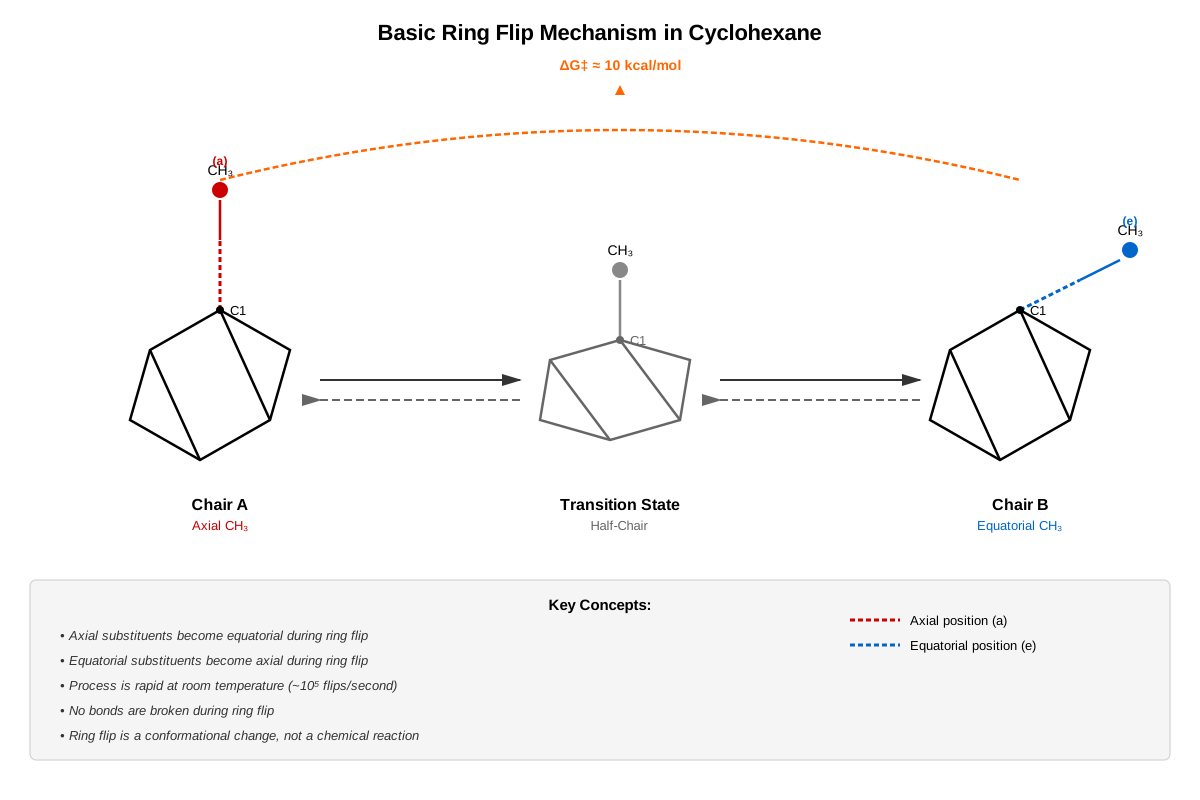
A ring flip (also called a chair flip or chair interconversion) is a conformational change in cyclohexane where one chair conformation converts to another chair conformation through a coordinated rotation of carbon-carbon bonds. During this process, the "seat" of the chair becomes the "back," and the "back" becomes the "seat." Critically, all axial substituents become equatorial, and all equatorial substituents become axial.
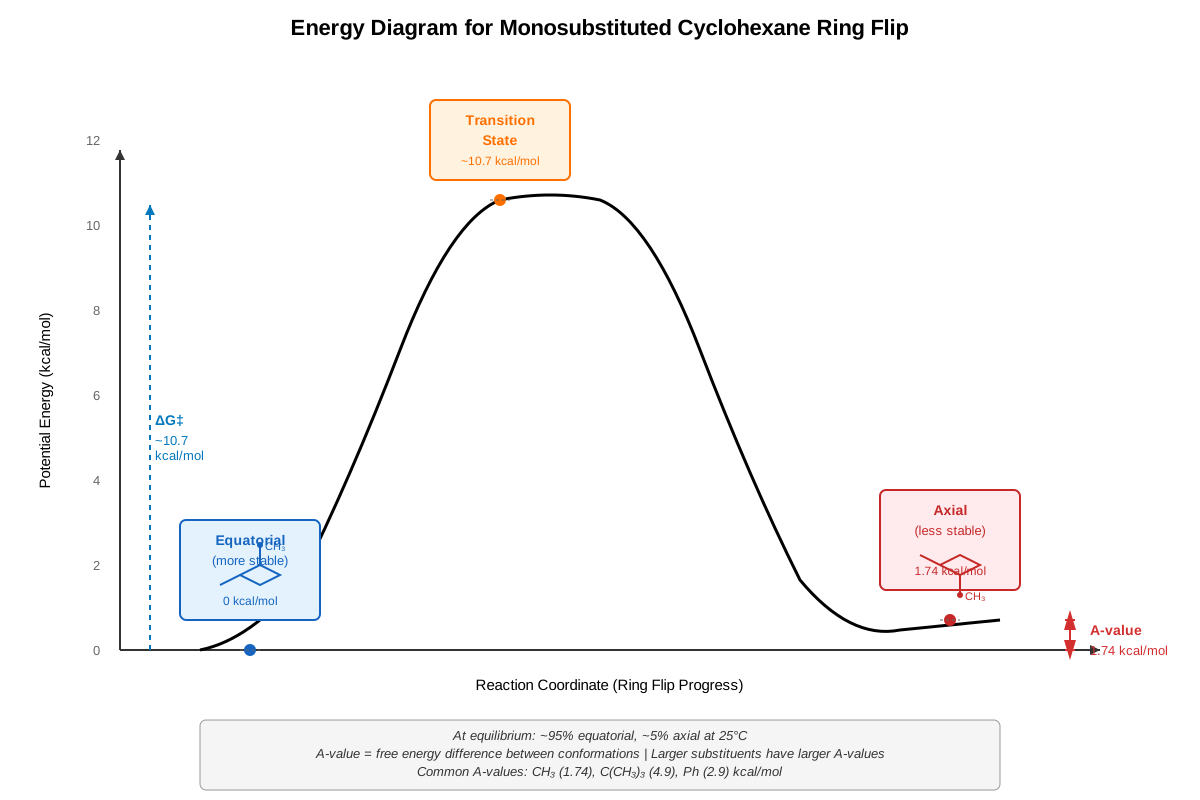
The ring flip occurs through a series of bond rotations that pass through higher-energy intermediate conformations (half-chair and twist-boat forms). At room temperature, this process is extremely rapid, occurring millions of times per second with an activation energy of approximately 10-11 kcal/mol. This low energy barrier means that cyclohexane exists as a rapidly equilibrating mixture of two chair conformations.
The mechanism proceeds as follows:
- One carbon atom (typically drawn at the "top" of the chair) moves downward
- The opposite carbon atom (at the "bottom") moves upward
- The molecule passes through a half-chair conformation (highest energy point)
- Further rotation produces a twist-boat intermediate
- Final adjustment yields the alternate chair conformation
Axial and Equatorial Position Interconversion
Understanding how substituent positions change during a ring flip is crucial for Ring flips MCAT questions. In the original chair conformation, three substituents point "up" and three point "down." After a ring flip, substituents that pointed up still point up, and those that pointed down still point down—but their designation as axial or equatorial reverses.
Key principle: The absolute spatial direction (up or down) of a substituent is maintained during a ring flip, but its relationship to the ring changes from axial to equatorial or vice versa.
For example, if a methyl group is attached to carbon-1 in an equatorial position pointing upward, after a ring flip it will be in an axial position still pointing upward. This distinction is critical for analyzing disubstituted cyclohexanes where cis/trans relationships must be preserved.
Conformational Energy and Stability
The two chair conformations of a substituted cyclohexane are not always equal in energy. The more stable conformation is the one that minimizes steric strain, which occurs when bulky substituents are forced into axial positions where they experience 1,3-diaxial interactions with other axial hydrogens on the same face of the ring.
A-values (axial strain values) quantify the energy cost of placing a substituent in an axial versus equatorial position. These values are experimentally determined and represent the free energy difference (ΔG°) in kcal/mol between the two conformations:
| Substituent | A-value (kcal/mol) | Preference |
|---|---|---|
| -H | 0.0 | No preference |
| -CH₃ | 1.7 | Strong equatorial |
| -CH₂CH₃ | 1.8 | Strong equatorial |
| -CH(CH₃)₂ | 2.1 | Very strong equatorial |
| -C(CH₃)₃ | 4.5 | Extremely strong equatorial |
| -OH | 0.6 | Moderate equatorial |
| -Cl | 0.5 | Moderate equatorial |
| -Br | 0.5 | Moderate equatorial |
The equilibrium between two chair conformations follows the Boltzmann distribution, with the population ratio determined by the energy difference. A larger A-value means the equatorial conformation is more heavily favored at equilibrium.
Monosubstituted Cyclohexanes
For a monosubstituted cyclohexane, the ring flip creates two chair conformations: one with the substituent equatorial and one with it axial. The equatorial conformation is virtually always more stable because it avoids 1,3-diaxial interactions.
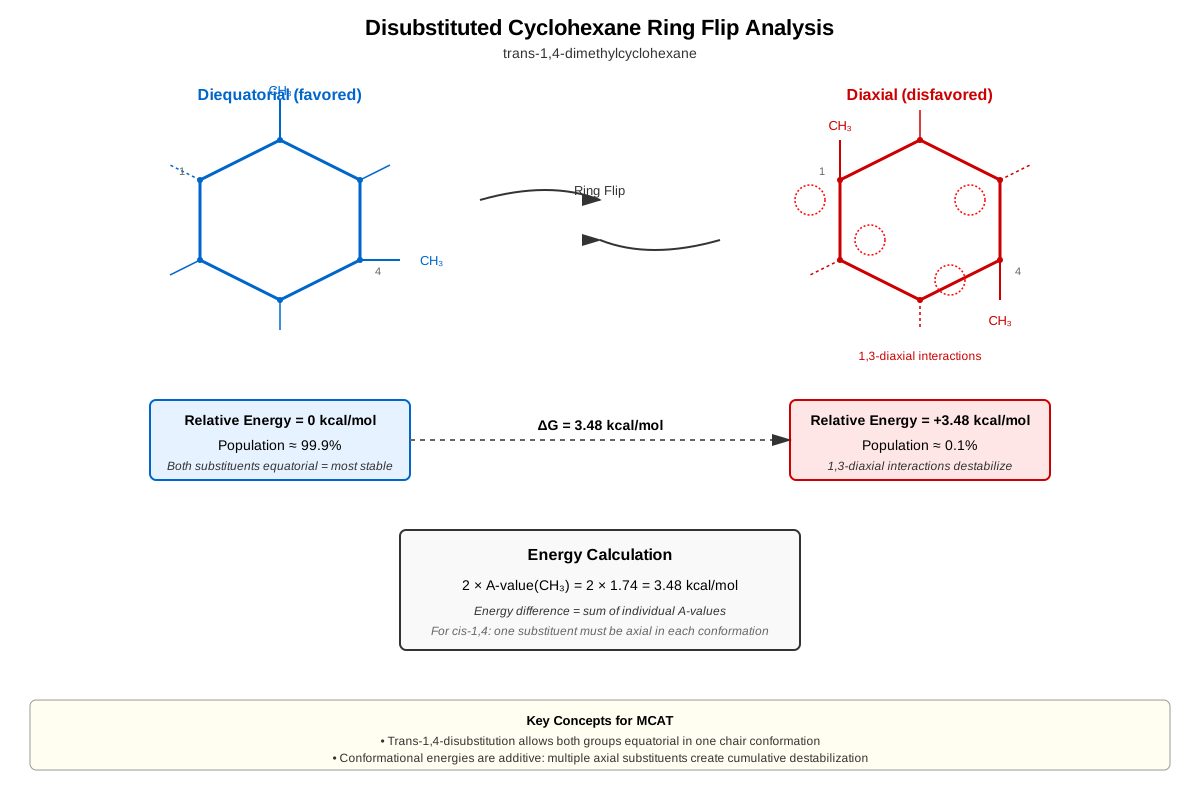
1,3-Diaxial interactions occur when an axial substituent is positioned close to two axial hydrogens (or other substituents) located three carbons away on the same face of the ring. These interactions create steric repulsion that destabilizes the axial conformation. The larger the substituent, the greater the steric clash and the stronger the preference for the equatorial position.
For methylcyclohexane, approximately 95% of molecules exist in the equatorial conformation at room temperature, with only 5% in the axial form. For tert-butylcyclohexane, the preference is so strong (A-value = 4.5 kcal/mol) that essentially 100% of molecules adopt the equatorial conformation, and the ring is effectively "locked" in one chair form.
Disubstituted Cyclohexanes
Disubstituted cyclohexanes present more complex conformational analysis because both substituents must be considered simultaneously. The most stable conformation depends on:
- The size of each substituent (A-values)
- The relative positions of the substituents (1,2-, 1,3-, or 1,4-)
- The stereochemical relationship (cis or trans)
General strategy: Draw both chair conformations, identify which substituents are axial and equatorial in each, calculate the total strain energy, and determine which conformation is more stable.
For trans-1,4-disubstituted cyclohexanes, one chair has both substituents equatorial (very stable) while the other has both axial (very unstable). The diequatorial conformation predominates overwhelmingly.
For cis-1,4-disubstituted cyclohexanes, each chair conformation has one substituent axial and one equatorial. If the substituents are identical, the two conformations are equal in energy and exist in a 50:50 ratio. If the substituents differ in size, the conformation with the larger group equatorial is favored.
For trans-1,2-disubstituted cyclohexanes, one conformation has both groups equatorial (stable) and the other has both axial (unstable), similar to trans-1,4 systems.
For cis-1,2-disubstituted cyclohexanes, both conformations have one axial and one equatorial substituent, and the larger group preferentially occupies the equatorial position.
Conformational Lock and Biological Relevance
When a substituent has a very large A-value (such as tert-butyl at 4.5 kcal/mol), it creates a conformational lock where the molecule exists almost exclusively in the conformation with that group equatorial. This principle is exploited in chemical synthesis and drug design to control molecular shape.
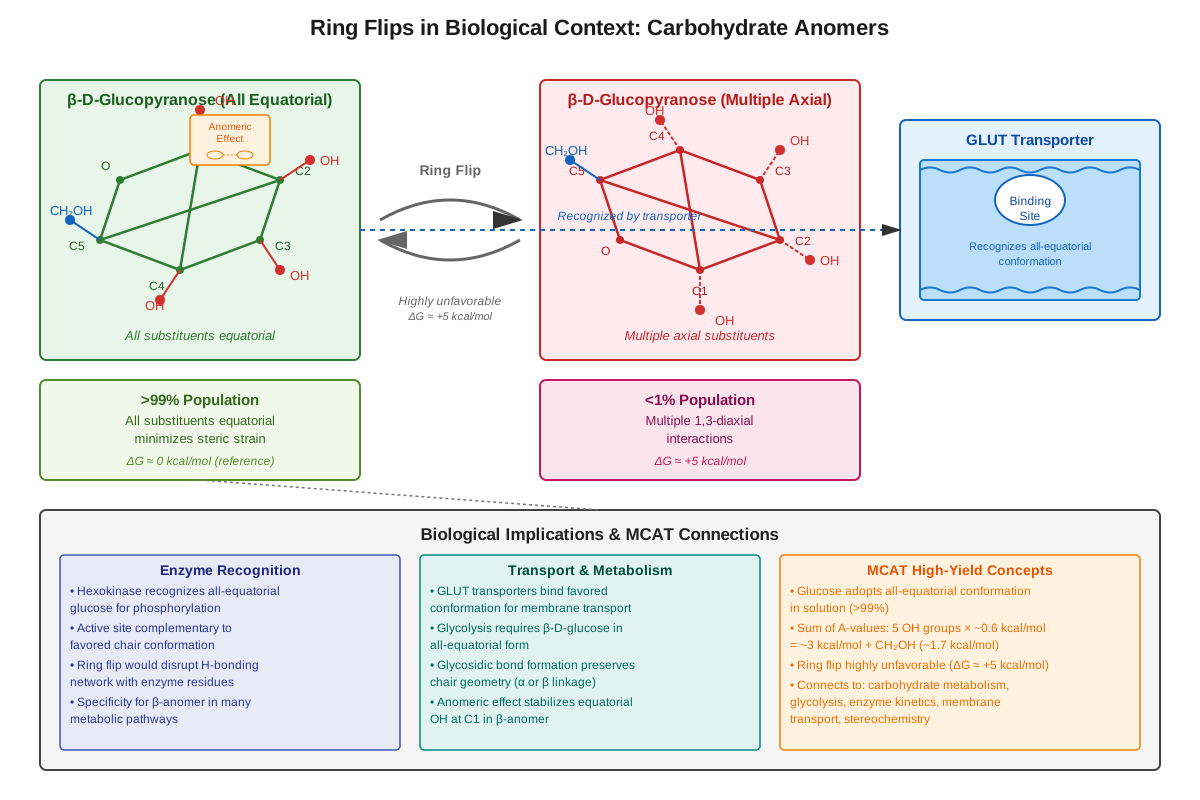
In biological systems, carbohydrate rings (pyranoses) undergo ring flips, and their conformational preferences affect enzyme recognition and metabolic processing. The anomeric effect in sugars causes certain substituents at the anomeric carbon to prefer the axial position despite steric considerations, demonstrating that electronic factors can override steric preferences in specific cases.
Concept Relationships
The core concepts of ring flips are hierarchically organized: the fundamental ring flip mechanism → leads to → understanding of axial-equatorial interconversion → which enables → analysis of conformational stability → which determines → prediction of equilibrium populations in substituted cyclohexanes.
Ring flips connect directly to prerequisite knowledge of cyclohexane chair conformations, as the chair structure provides the framework for understanding position changes. The concept of steric strain from general conformational analysis explains why certain ring flip conformations are favored. Newman projections and torsional strain analysis provide the theoretical foundation for understanding why the chair conformation is most stable and why ring flips occur through higher-energy intermediates.
Within Stereochemistry and Conformation, ring flips relate to other topics including conformational isomers (conformers), rotational barriers, and the relationship between molecular shape and physical properties. Ring flips also connect forward to more advanced topics such as carbohydrate chemistry (where pyranose ring flips affect sugar reactivity), steroid chemistry (where fused ring systems have restricted conformational mobility), and molecular recognition (where the three-dimensional shape determines biological activity).
The relationship can be mapped as: Basic cyclohexane structure → Ring flip mechanism → Axial-equatorial interconversion → Conformational energy analysis → Monosubstituted systems → Disubstituted systems → Biological applications in carbohydrates and steroids.
Quick check — test yourself on Ring flips so far.
Try Flashcards →High-Yield Facts
⭐ During a ring flip, all axial substituents become equatorial and all equatorial substituents become axial, but the absolute spatial direction (up or down) is preserved
⭐ Equatorial positions are almost always more stable than axial positions due to 1,3-diaxial interactions
⭐ The A-value for a methyl group is 1.7 kcal/mol, meaning methylcyclohexane exists ~95% in the equatorial conformation at room temperature
⭐ For trans-1,4-disubstituted cyclohexanes, the diequatorial conformation is strongly favored
⭐ A tert-butyl group (A-value = 4.5 kcal/mol) effectively locks the ring in the conformation with the tert-butyl equatorial
- Ring flips occur rapidly at room temperature (millions of times per second) with an activation energy of ~10-11 kcal/mol
- The larger the substituent, the greater its preference for the equatorial position
- For cis-1,4-disubstituted cyclohexanes with identical substituents, both chair conformations are equal in energy
- 1,3-Diaxial interactions are the primary source of strain in axial conformations
- In disubstituted cyclohexanes, the conformation with the larger group equatorial is generally most stable
- Hydroxyl groups have a relatively small A-value (0.6 kcal/mol) compared to alkyl groups
- The ring flip passes through half-chair and twist-boat intermediates, both higher in energy than the chair
Common Misconceptions
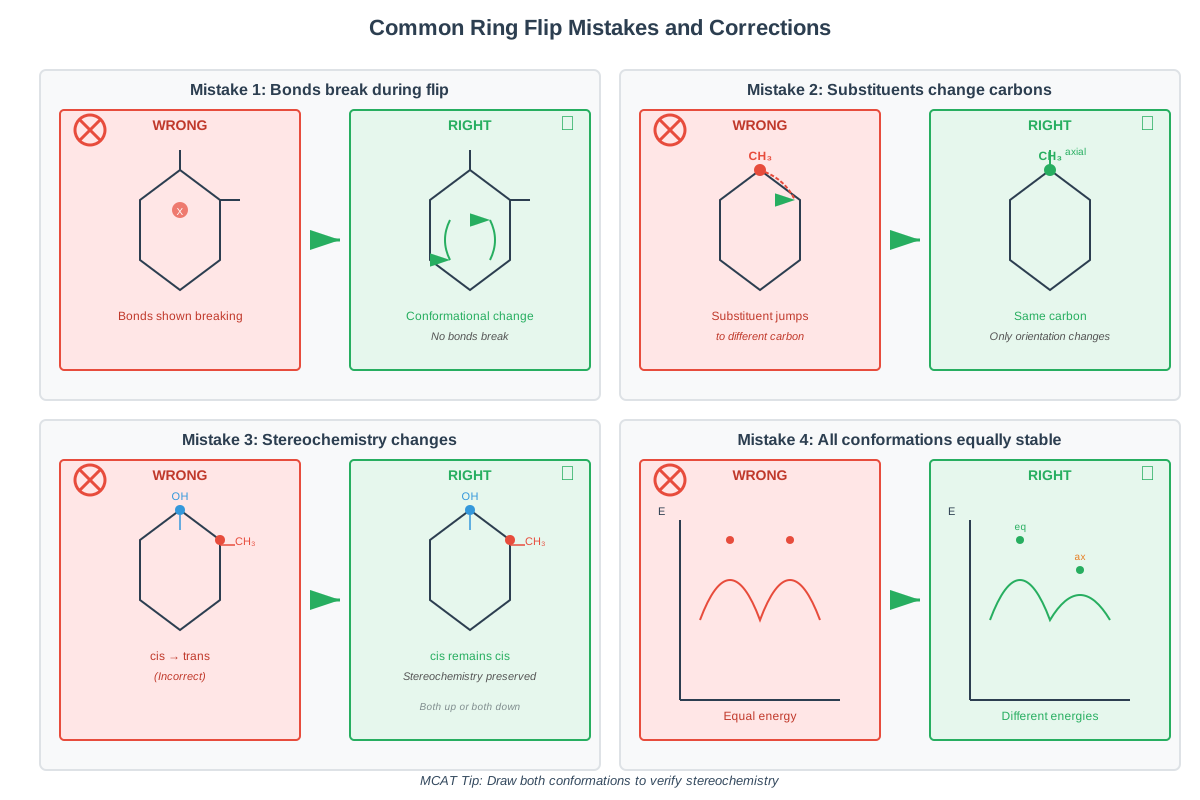
Misconception: During a ring flip, substituents that point "up" become "down" and vice versa.
Correction: The absolute spatial direction (up or down) of substituents is maintained during a ring flip. Only the designation as axial or equatorial changes. A substituent pointing up and equatorial becomes up and axial after the flip.
Misconception: Axial positions are always less stable than equatorial positions by the same amount regardless of the substituent.
Correction: The energy difference between axial and equatorial conformations depends on the size of the substituent. Small groups like hydrogen have essentially no preference, while large groups like tert-butyl have very strong preferences quantified by A-values.
Misconception: In disubstituted cyclohexanes, both substituents can be equatorial in both chair conformations.
Correction: For cis-1,4-disubstituted cyclohexanes, it is impossible for both substituents to be equatorial in the same conformation. One chair has both equatorial, the other has both axial only for trans-1,4 or trans-1,2 relationships.
Misconception: Ring flips break and reform carbon-carbon bonds.
Correction: Ring flips are conformational changes involving rotation around single bonds, not bond-breaking processes. All bonds remain intact throughout the ring flip; only bond angles and dihedral angles change.
Misconception: The most stable conformation of a disubstituted cyclohexane always has both groups equatorial.
Correction: While having both groups equatorial is ideal, this is only possible for certain stereoisomers (trans-1,4 and trans-1,2). For cis isomers, one group must be axial in any chair conformation, and stability is determined by which group is axial.
Misconception: Ring flips change the stereochemistry (cis/trans relationship) of substituents.
Correction: Ring flips are conformational changes, not configurational changes. The cis or trans relationship between substituents is maintained because no bonds are broken. A cis-disubstituted cyclohexane remains cis after any number of ring flips.
Worked Examples
Example 1: Monosubstituted Cyclohexane Stability
Question: Consider methylcyclohexane at 25°C. The A-value for a methyl group is 1.7 kcal/mol. Calculate the percentage of molecules in the equatorial conformation at equilibrium.
Solution:
Step 1: Recognize that the A-value represents the free energy difference (ΔG°) between the axial and equatorial conformations, with equatorial being more stable by 1.7 kcal/mol.
Step 2: Use the relationship between ΔG° and the equilibrium constant:
ΔG° = -RT ln(K_eq)Where R = 1.987 cal/(mol·K) and T = 298 K
Step 3: Solve for K_eq:
1.7 kcal/mol = 1700 cal/mol = -1.987 × 298 × ln(K_eq)
ln(K_eq) = -1700 / (1.987 × 298) = -2.87
K_eq = e^(-2.87) = 0.057
Step 4: This K_eq represents the ratio [axial]/[equatorial]. Therefore:
[axial]/[equatorial] = 0.057Step 5: If we define the fraction equatorial as x, then:
(1-x)/x = 0.057
1-x = 0.057x
1 = 1.057x
x = 0.946 or 94.6%Answer: Approximately 95% of methylcyclohexane molecules exist in the equatorial conformation at room temperature, with only 5% in the axial form.
Connection to learning objectives: This example demonstrates how to apply A-values to predict conformational populations and shows why equatorial conformations are strongly favored for alkyl substituents.
Example 2: Disubstituted Cyclohexane Analysis
Question: Consider trans-1-tert-butyl-4-methylcyclohexane. Draw both chair conformations and determine which is more stable and by how much. (A-value for tert-butyl = 4.5 kcal/mol; A-value for methyl = 1.7 kcal/mol)
Solution:
Step 1: Recognize that "trans-1,4" means the two substituents are on opposite faces of the ring.
Step 2: Draw Chair Conformation A:
- Place tert-butyl at position 1 equatorial (pointing up)
- For trans relationship, methyl at position 4 must also be equatorial (pointing down)
- Total strain: 0 kcal/mol (both groups equatorial)
Step 3: Draw Chair Conformation B (after ring flip):
- Tert-butyl at position 1 becomes axial (still pointing up)
- Methyl at position 4 becomes axial (still pointing down)
- Total strain: 4.5 + 1.7 = 6.2 kcal/mol
Step 4: Calculate the energy difference:
ΔG° = 6.2 - 0 = 6.2 kcal/mol
Step 5: Determine the predominant conformation:
Conformation A (both equatorial) is more stable by 6.2 kcal/mol and will represent essentially 100% of the population at equilibrium.
Answer: The conformation with both substituents equatorial is more stable by 6.2 kcal/mol and predominates overwhelmingly. The tert-butyl group effectively locks the ring in this conformation.
Connection to learning objectives: This example illustrates how to analyze disubstituted cyclohexanes, apply A-values additively, and recognize conformational locking by large substituents—all critical skills for MCAT questions on ring flips.
Exam Strategy
When approaching Ring flips MCAT questions, begin by identifying what type of cyclohexane system is presented: monosubstituted or disubstituted, and if disubstituted, determine the stereochemical relationship (cis or trans) and relative positions (1,2-, 1,3-, or 1,4-).
Trigger words and phrases to watch for:
- "Most stable conformation" → Draw both chairs and compare strain
- "Predominant form at equilibrium" → Calculate or estimate population based on A-values
- "Axial" or "equatorial" → Visualize the three-dimensional structure carefully
- "After ring flip" → Track how positions change while maintaining spatial direction
- "Trans" or "cis" → Remember these relationships are preserved during ring flips
Process-of-elimination strategies:
- Eliminate any answer choice that shows a substituent changing from "up" to "down" or vice versa during a ring flip
- Eliminate conformations that violate cis/trans relationships specified in the question
- For stability questions, eliminate any choice that places a large group (especially tert-butyl) in an axial position
- If asked about equilibrium populations, eliminate extreme answers (0% or 100%) unless a very large substituent like tert-butyl is involved
Time allocation advice: Ring flip questions typically require 60-90 seconds. Spend 20-30 seconds carefully drawing or visualizing both chair conformations, 20-30 seconds analyzing the strain in each, and 20-30 seconds selecting and confirming your answer. If a question requires detailed calculation of equilibrium populations, it may take up to 2 minutes, but most MCAT questions ask for qualitative predictions rather than quantitative calculations.
Quick decision tree:
- Is it monosubstituted? → Equatorial is more stable
- Is it disubstituted trans-1,4 or trans-1,2? → Both equatorial is strongly favored
- Is it disubstituted cis? → Larger group equatorial is favored
- Does it contain tert-butyl? → That group will be equatorial (conformational lock)
Memory Techniques
Mnemonic for ring flip position changes: "Axial Exchanges, Direction Stays" (AEDS)
- Axial and Equatorial positions exchange during the flip
- Direction (up or down) stays the same
Mnemonic for A-values: "Methyl Equals Two" (MET)
- Methyl A-value is approximately 2 kcal/mol (actually 1.7, but 2 is easier to remember for quick estimates)
- Ethyl is similar (~1.8)
- Tert-butyl is much larger (~4.5, or "more than double")
Visualization strategy for ring flips: Imagine the chair as a recliner that tips backward. The "seat" (bottom three carbons) tips up to become the "back," and the "back" (top three carbons) tips down to become the "seat." The person sitting in the chair (substituent) maintains their orientation in space but their relationship to the chair changes.
Acronym for disubstituted analysis: "TEED" - Trans wants Equatorial-Equatorial, Determine which chair delivers this
- For trans-1,4 and trans-1,2, look for the conformation with both groups equatorial
- This will be the most stable by far
Memory aid for 1,3-diaxial interactions: Hold up three fingers (index, middle, ring). The first and third fingers represent the axial hydrogens that clash with a substituent on the middle finger. This physical model helps remember why axial positions are disfavored.
Summary
Ring flips are rapid conformational interconversions between two chair forms of cyclohexane that occur through rotation of carbon-carbon bonds without breaking any bonds. During a ring flip, all axial substituents become equatorial and vice versa, while the absolute spatial direction (up or down) of each substituent is preserved. The stability of each chair conformation depends on steric strain, particularly 1,3-diaxial interactions that destabilize axial substituents. Equatorial positions are almost always preferred, with the energy difference quantified by A-values that range from 0.5 kcal/mol for small groups to 4.5 kcal/mol for tert-butyl. For monosubstituted cyclohexanes, the equatorial conformation predominates at equilibrium. For disubstituted systems, the most stable conformation depends on the size of each substituent, their relative positions, and their stereochemical relationship (cis or trans). Trans-1,4-disubstituted cyclohexanes strongly favor the diequatorial conformation, while cis isomers must have one group axial and prefer the larger group equatorial. Understanding ring flips is essential for predicting molecular stability and reactivity in organic chemistry and biochemistry contexts on the MCAT.
Key Takeaways
- Ring flips interconvert axial and equatorial positions while preserving the absolute spatial direction (up/down) of substituents
- Equatorial conformations are more stable than axial conformations due to 1,3-diaxial interactions, with the energy difference quantified by A-values
- Larger substituents have stronger preferences for equatorial positions (methyl = 1.7 kcal/mol, tert-butyl = 4.5 kcal/mol)
- For trans-1,4-disubstituted cyclohexanes, the conformation with both groups equatorial is overwhelmingly favored
- Ring flips are conformational changes, not configurational changes—cis/trans relationships are always preserved
- A tert-butyl group effectively locks the ring in the conformation with that group equatorial
- At room temperature, ring flips occur rapidly (millions of times per second), creating an equilibrium mixture of conformations
Related Topics
Carbohydrate Chemistry: Pyranose sugars (six-membered ring forms of monosaccharides) exist in chair conformations and undergo ring flips. Understanding ring flips is essential for predicting the conformational preferences of glucose, galactose, and other sugars, which affects their reactivity and biological recognition. The anomeric effect causes unique conformational preferences at the anomeric carbon.
Steroid Structure and Function: Steroids contain fused cyclohexane rings with restricted conformational mobility. While complete ring flips cannot occur in fused systems, understanding chair conformations helps predict the three-dimensional shape of steroid hormones and their interaction with receptors.
Conformational Analysis of Other Cyclic Systems: The principles learned for cyclohexane ring flips extend to other six-membered rings containing heteroatoms (piperidine, tetrahydropyran) and to five-membered rings (cyclopentane) which undergo pseudorotation rather than ring flips.
Molecular Recognition and Drug Design: The conformational preferences of cyclic molecules determine their ability to bind to biological targets. Mastering ring flips enables understanding of how drug molecules adopt specific shapes to interact with enzymes and receptors.
Practice CTA
Now that you have mastered the core concepts of ring flips, it's time to solidify your understanding through active practice. Attempt the practice questions and flashcards associated with this topic to test your ability to visualize three-dimensional structures, predict conformational stability, and apply these concepts to MCAT-style problems. Remember that ring flips appear frequently in both discrete questions and passage-based scenarios, so developing quick and accurate analysis skills will give you a significant advantage on test day. You've built a strong foundation—now reinforce it through deliberate practice!
Sign up free to keep reading
Create a free AnvayaPrep account to finish this MCAT guide on Ring flips — plus flashcards and practice questions.