Overview
Inductive effects represent one of the most fundamental concepts in Organic Chemistry and are essential for understanding molecular behavior, reactivity, and stability. This electronic phenomenon occurs when atoms or groups within a molecule withdraw or donate electron density through sigma (σ) bonds, creating a polarization effect that propagates through the molecular framework. Unlike resonance, which involves the delocalization of pi (π) electrons, inductive effects operate exclusively through the sigma bond network and diminish rapidly with distance from the electron-withdrawing or electron-donating group.
For the MCAT, mastery of inductive effects is critical because this concept underlies numerous high-yield topics including acid-base chemistry, reaction mechanisms, nucleophilicity, electrophilicity, and molecular stability. Questions testing inductive effects Organic Chemistry principles appear regularly in both discrete questions and passage-based formats, often requiring students to predict relative acidity or basicity, explain reaction outcomes, or rank compounds by stability. The MCAT frequently integrates inductive effects with other concepts in Structure and Bonding, making it a cornerstone topic that enables deeper understanding of organic reactivity patterns.
Understanding inductive effects provides the foundation for predicting how substituents influence molecular properties throughout organic chemistry. This topic connects directly to resonance effects, hybridization, electronegativity, and functional group reactivity—all high-yield areas for the MCAT Organic Chemistry section. Students who master inductive effects gain a powerful analytical tool for approaching complex molecules and predicting their behavior in biological and chemical systems, which is precisely what the MCAT demands.
Learning Objectives
- [ ] Define inductive effects using accurate Organic Chemistry terminology
- [ ] Explain why inductive effects matters for the MCAT
- [ ] Apply inductive effects to exam-style questions
- [ ] Identify common mistakes related to inductive effects
- [ ] Connect inductive effects to related Organic Chemistry concepts
- [ ] Distinguish between electron-withdrawing and electron-donating inductive effects quantitatively
- [ ] Predict the relative acidity and basicity of compounds based on inductive effects
- [ ] Evaluate the distance-dependent attenuation of inductive effects through carbon chains
Prerequisites
- Electronegativity and bond polarity: Understanding electronegativity differences is essential because inductive effects arise from unequal electron sharing between atoms of different electronegativities
- Lewis structures and formal charge: Required to visualize electron distribution and identify sites of electron density changes caused by inductive effects
- Acid-base theory (Brønsted-Lowry): Necessary because inductive effects directly influence the stability of conjugate acids and bases, affecting pKa values
- Hybridization and orbital theory: Important for understanding how electron density is distributed through different types of sigma bonds
- Functional group recognition: Essential for identifying electron-withdrawing and electron-donating groups that cause inductive effects
Why This Topic Matters
Inductive effects appear in approximately 15-20% of MCAT Organic Chemistry questions, either as the primary concept being tested or as a supporting principle needed to answer questions about acidity, basicity, nucleophilicity, or reaction mechanisms. This topic is particularly high-yield because it integrates seamlessly with acid-base chemistry, which represents one of the most frequently tested areas across all MCAT science sections.
In clinical and biochemical contexts, inductive effects explain why certain amino acid side chains are acidic or basic, how enzyme active sites stabilize charged intermediates, and why specific drug molecules interact with biological targets. For example, the acidity of the carboxylic acid group in amino acids is modulated by inductive effects from nearby substituents, affecting protein structure and function at physiological pH. Understanding these principles helps explain drug design strategies where electron-withdrawing or electron-donating groups are added to modify a molecule's reactivity, solubility, or binding affinity.
On the MCAT, inductive effects commonly appear in passage-based questions that present novel molecules and ask students to predict properties, rank compounds by acidity or basicity, or explain experimental observations. Discrete questions frequently test the ability to identify which substituents stabilize or destabilize charged species through inductive effects. The MCAT also integrates this topic with spectroscopy, reaction mechanisms, and biological chemistry, making it a versatile concept that appears across multiple question types.
Core Concepts
Definition and Mechanism of Inductive Effects
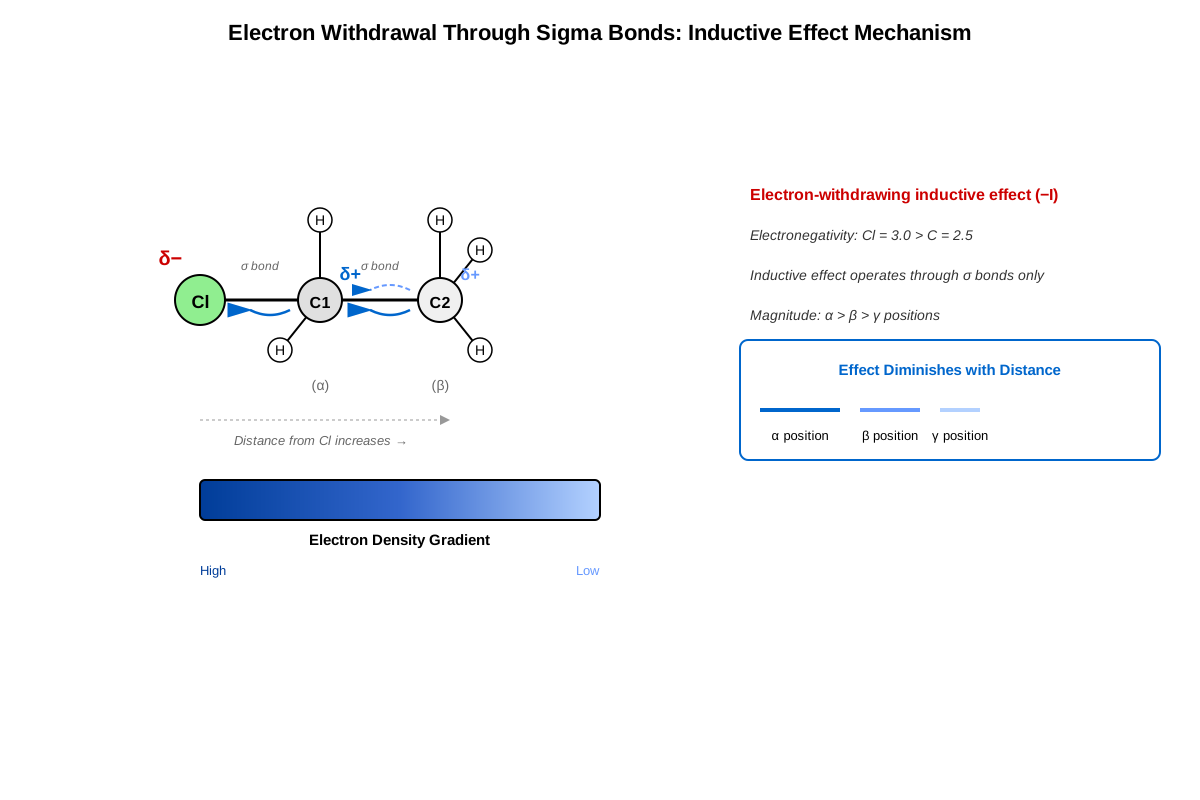
Inductive effects are the permanent polarization of sigma bonds caused by differences in electronegativity between bonded atoms. This polarization creates a dipole that transmits through the sigma bond framework, affecting electron density at distant sites within the molecule. The effect operates through a "chain" mechanism where each successive bond becomes progressively less polarized, typically becoming negligible after three to four bonds.
The mechanism involves the sequential polarization of sigma bonds. When an electronegative atom (such as fluorine, oxygen, or nitrogen) is bonded to carbon, it pulls electron density toward itself through the sigma bond. This creates a partial positive charge (δ+) on the carbon and a partial negative charge (δ-) on the electronegative atom. The carbon, now electron-deficient, pulls electron density from the next carbon in the chain, propagating the effect but with diminished magnitude.
Electron-Withdrawing Inductive Effects (-I Effect)
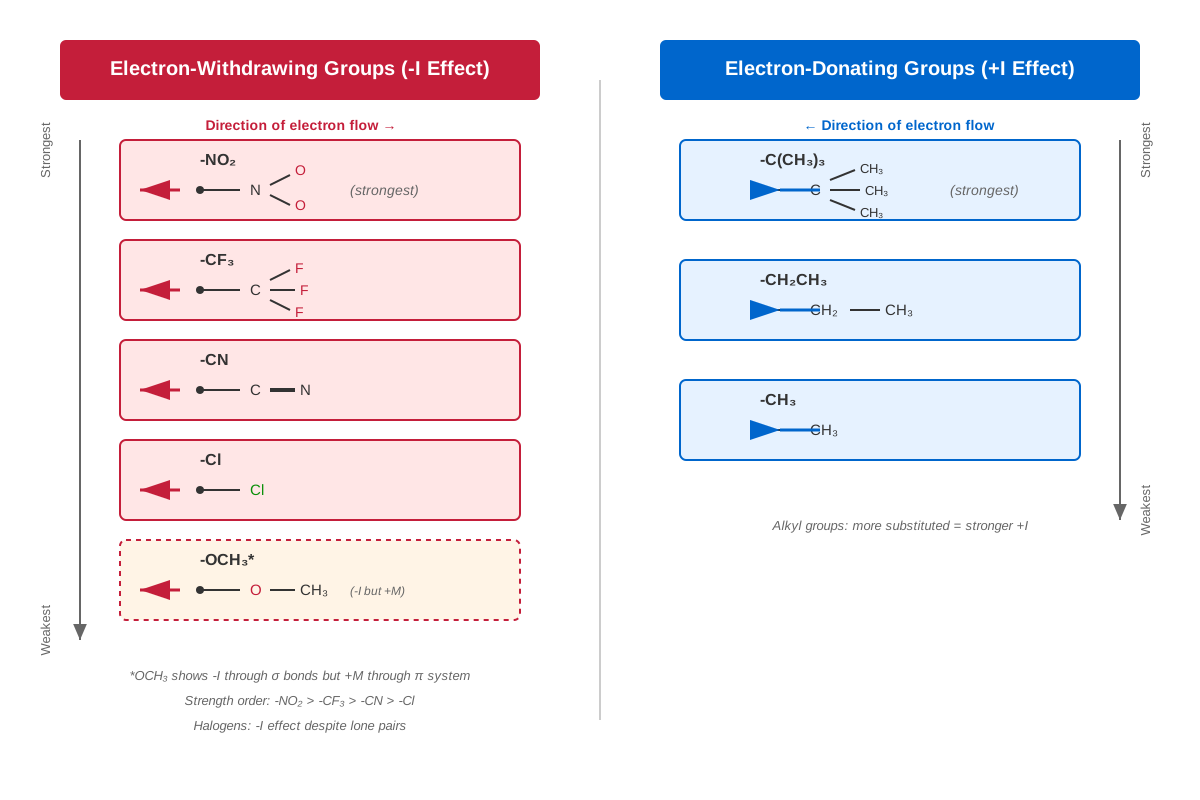
Electron-withdrawing groups (EWGs) pull electron density away from the rest of the molecule through sigma bonds, creating a negative inductive effect (designated as -I). These groups are more electronegative than carbon and include halogens (F, Cl, Br, I), nitro groups (-NO₂), cyano groups (-CN), carbonyl groups (C=O), and positively charged groups (-NH₃⁺, -NR₃⁺).
The strength of electron-withdrawing inductive effects follows electronegativity trends:
-NO₂ > -CN > -F > -Cl > -Br > -I > -OR > -OH > -NR₂ > -NH₂
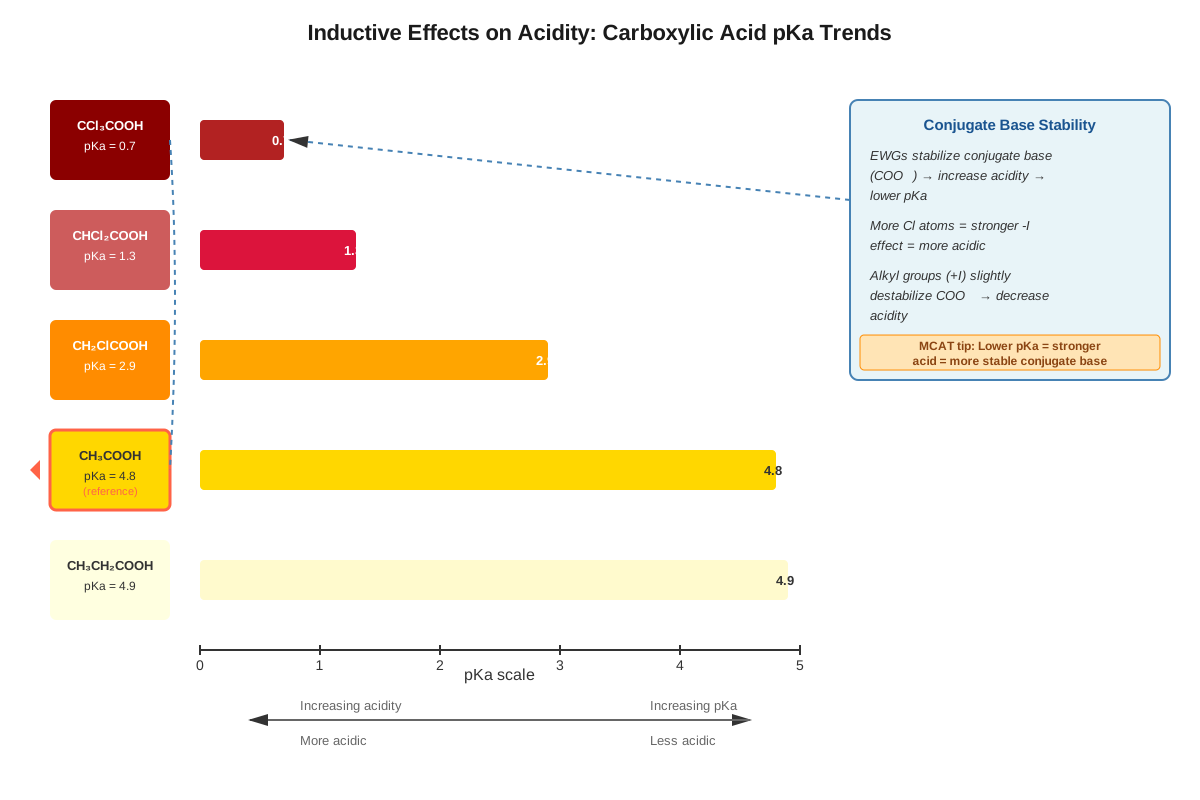
Electron-withdrawing groups stabilize negative charges and destabilize positive charges. This principle is crucial for predicting acidity: acids with electron-withdrawing groups near the acidic proton are stronger because the conjugate base (which bears a negative charge) is stabilized by the electron-withdrawing effect. For example, chloroacetic acid (ClCH₂COOH, pKa ≈ 2.9) is significantly more acidic than acetic acid (CH₃COOH, pKa ≈ 4.8) because the chlorine atom withdraws electron density, stabilizing the carboxylate anion.
Electron-Donating Inductive Effects (+I Effect)
Electron-donating groups (EDGs) push electron density toward the rest of the molecule through sigma bonds, creating a positive inductive effect (designated as +I). These groups are less electronegative than carbon or have electron-rich character. The most common electron-donating groups through inductive effects are alkyl groups (-CH₃, -CH₂CH₃, -CH(CH₃)₂, -C(CH₃)₃).
The relative electron-donating strength of alkyl groups increases with branching:
-C(CH₃)₃ > -CH(CH₃)₂ > -CH₂CH₃ > -CH₃ > -H
This ordering is sometimes called hyperconjugation when considering the stabilization of adjacent carbocations, but the inductive component involves the donation of electron density through sigma bonds. Electron-donating groups stabilize positive charges and destabilize negative charges. This explains why tert-butanol is less acidic than methanol—the bulky, electron-donating tert-butyl group destabilizes the alkoxide anion, making proton removal less favorable.
Distance Dependence and Attenuation
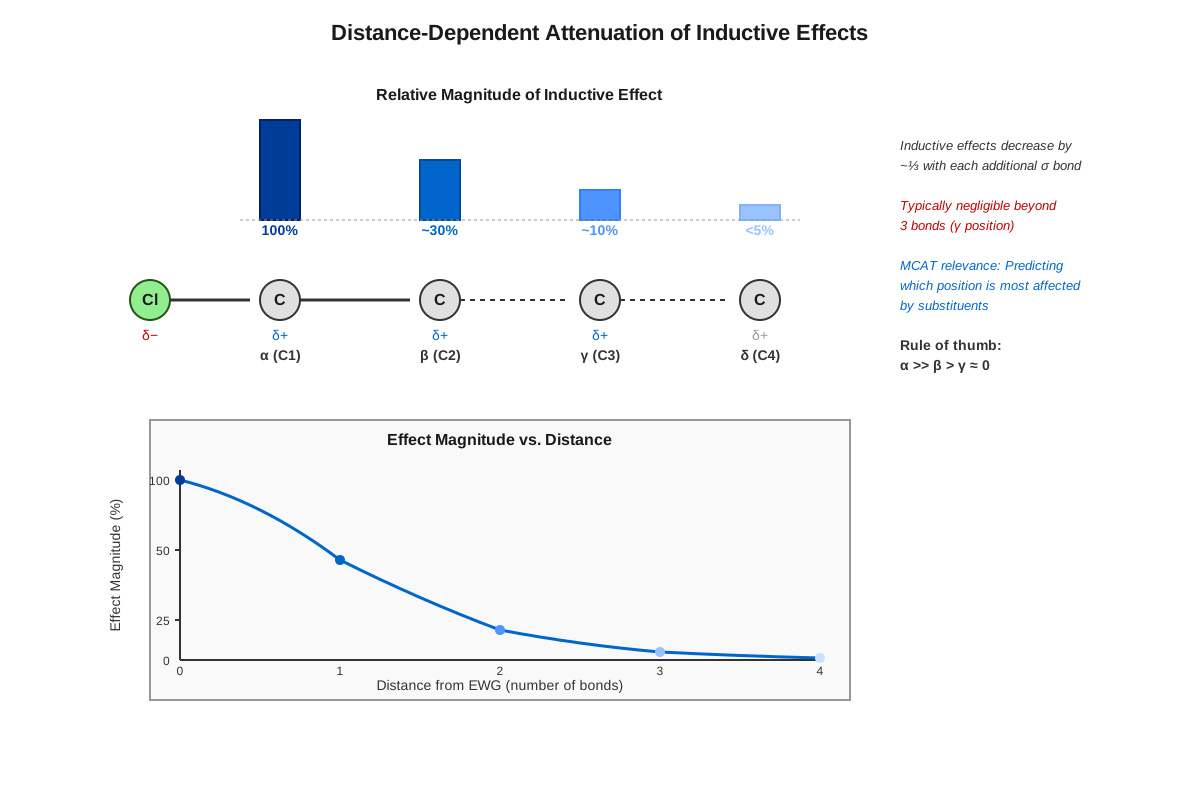
A critical feature of inductive effects is their rapid attenuation with distance. The magnitude of the effect decreases by approximately 30-50% with each additional sigma bond. This distance dependence is crucial for MCAT questions that ask students to compare molecules with electron-withdrawing or electron-donating groups at different positions.
For example, consider the acidity of chlorobutanoic acids:
- 2-chlorobutanoic acid (Cl on α-carbon): pKa ≈ 2.9
- 3-chlorobutanoic acid (Cl on β-carbon): pKa ≈ 4.0
- 4-chlorobutanoic acid (Cl on γ-carbon): pKa ≈ 4.5
The chlorine's electron-withdrawing effect diminishes as it moves farther from the carboxylic acid group, resulting in progressively weaker acids that approach the acidity of unsubstituted butanoic acid (pKa ≈ 4.8).
Cumulative and Additive Effects
Multiple electron-withdrawing or electron-donating groups produce cumulative inductive effects. The total effect is approximately additive, though not perfectly linear. Trichloroacetic acid (Cl₃CCOOH, pKa ≈ 0.7) is dramatically more acidic than chloroacetic acid (ClCH₂COOH, pKa ≈ 2.9) because three chlorine atoms withdraw electron density simultaneously, greatly stabilizing the conjugate base.
When both electron-withdrawing and electron-donating groups are present, their effects partially cancel, with the net result depending on the relative strengths and positions of the groups. This principle is essential for analyzing complex molecules on the MCAT.
Comparison with Resonance Effects
| Feature | Inductive Effects | Resonance Effects |
|---|---|---|
| Mechanism | Through σ bonds | Through π bonds and lone pairs |
| Distance dependence | Rapid attenuation (3-4 bonds) | Can extend across entire conjugated system |
| Magnitude | Generally weaker | Generally stronger |
| Reversibility | Permanent polarization | Electron delocalization |
| Bond types involved | Single bonds only | Multiple bonds and lone pairs |
When both inductive and resonance effects are possible, resonance effects typically dominate because they involve greater electron delocalization. However, inductive effects remain important for understanding the complete picture of molecular behavior, especially in saturated systems where resonance is impossible.
Application to Acidity and Basicity
Inductive effects provide a systematic framework for predicting relative acidity and basicity:
For acids: Electron-withdrawing groups increase acidity by stabilizing the conjugate base (which bears a negative charge). Electron-donating groups decrease acidity by destabilizing the conjugate base.
For bases: Electron-withdrawing groups decrease basicity by destabilizing the conjugate acid (which bears a positive charge). Electron-donating groups increase basicity by stabilizing the conjugate acid.
This framework explains trends in amino acid side chain pKa values, the acidity of phenols versus alcohols (when combined with resonance), and the basicity of substituted amines—all high-yield topics for the MCAT.
Concept Relationships
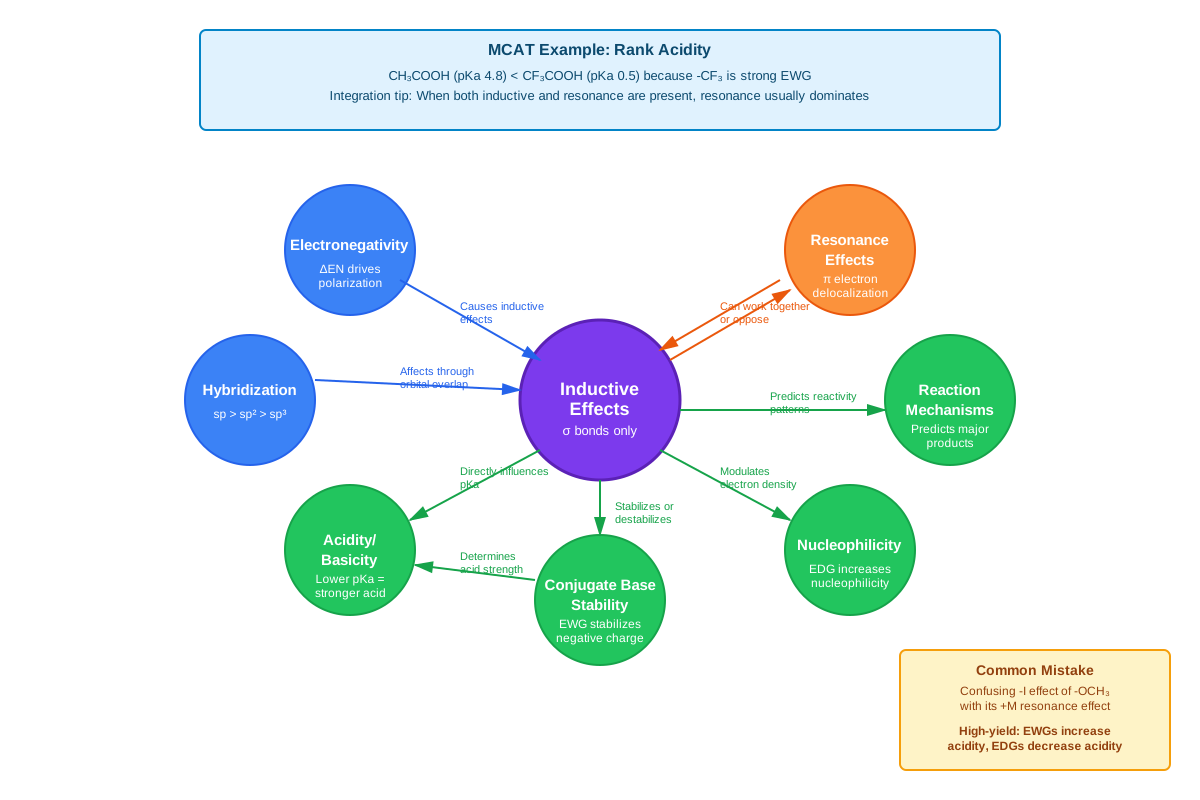
Inductive effects serve as a central organizing principle connecting multiple areas of organic chemistry. The concept flows directly from electronegativity and bond polarity → which creates inductive effects → which influences acid-base strength → which affects reaction mechanisms and nucleophilicity/electrophilicity.
Within the topic itself, the relationship between electron-withdrawing and electron-donating effects represents a complementary pair: both operate through the same sigma bond mechanism but produce opposite electronic consequences. Distance dependence modulates both types of effects equally, creating a unified framework for analysis.
Inductive effects connect intimately with resonance effects in Structure and Bonding. When analyzing a molecule, students must consider both effects and recognize that resonance typically dominates when both are present. However, in saturated systems or when resonance is blocked, inductive effects become the primary determinant of molecular properties.
The connection to acid-base chemistry is bidirectional: inductive effects explain acidity and basicity trends, while acid-base principles provide the framework for understanding how inductive effects stabilize or destabilize charged species. This relationship extends to reaction mechanisms, where inductive effects influence the stability of carbocations, carbanions, and transition states.
Inductive effects also relate to spectroscopy, particularly NMR and IR spectroscopy, where electron-withdrawing and electron-donating groups shift chemical shifts and absorption frequencies. This connection occasionally appears in MCAT passages that integrate multiple analytical techniques.
Quick check — test yourself on Inductive effects so far.
Try Flashcards →High-Yield Facts
⭐ Inductive effects operate through sigma bonds and attenuate rapidly with distance, typically becoming negligible after 3-4 bonds
⭐ Electron-withdrawing groups stabilize negative charges and increase acidity; electron-donating groups stabilize positive charges and decrease acidity
⭐ The order of electron-withdrawing strength: -NO₂ > -CN > -F > -Cl > -Br > -I > -OR > -OH
⭐ Alkyl groups are electron-donating through inductive effects, with strength increasing with branching: tert-butyl > isopropyl > ethyl > methyl
⭐ Multiple electron-withdrawing or electron-donating groups produce cumulative effects that are approximately additive
- Chloroacetic acid (pKa ≈ 2.9) is more acidic than acetic acid (pKa ≈ 4.8) due to the electron-withdrawing inductive effect of chlorine
- Trichloroacetic acid (pKa ≈ 0.7) demonstrates the cumulative effect of multiple electron-withdrawing groups
- Inductive effects are permanent polarizations, unlike resonance which involves electron delocalization
- When both inductive and resonance effects are present, resonance effects typically dominate
- Electron-withdrawing groups decrease basicity by destabilizing the protonated (positively charged) form
- The inductive effect of fluorine is stronger than chlorine despite chlorine being larger, because electronegativity is the dominant factor
- Inductive effects explain why α-amino acids have lower pKa values for their carboxylic acid groups compared to simple carboxylic acids
Common Misconceptions
Misconception: Inductive effects and resonance effects are the same phenomenon.
Correction: Inductive effects operate exclusively through sigma bonds via electronegativity differences, while resonance involves the delocalization of pi electrons and lone pairs through conjugated systems. They are distinct mechanisms that can operate simultaneously but must be analyzed separately.
Misconception: Larger atoms always have stronger electron-withdrawing inductive effects.
Correction: Electronegativity, not size, determines the strength of inductive effects. Fluorine has a stronger electron-withdrawing inductive effect than iodine despite being much smaller, because fluorine is significantly more electronegative.
Misconception: Inductive effects extend equally throughout an entire molecule regardless of distance.
Correction: Inductive effects attenuate rapidly with distance, decreasing by approximately 30-50% with each additional sigma bond. After 3-4 bonds, the effect becomes negligible for most practical purposes on the MCAT.
Misconception: Electron-donating groups always make molecules more reactive.
Correction: The effect of electron-donating groups depends on the type of reaction and the charge of reactive intermediates. Electron-donating groups stabilize positive charges (beneficial for carbocations) but destabilize negative charges (detrimental for carbanions and conjugate bases).
Misconception: Alkyl groups are electron-withdrawing because carbon is more electronegative than hydrogen.
Correction: Although carbon is slightly more electronegative than hydrogen, alkyl groups function as electron-donating groups through inductive effects. This occurs because of hyperconjugation and the polarizability of C-H bonds, which effectively push electron density toward adjacent atoms or groups.
Misconception: Inductive effects only matter for acidity and basicity questions.
Correction: While inductive effects are crucial for acid-base chemistry, they also influence nucleophilicity, electrophilicity, carbocation stability, reaction mechanisms, spectroscopic properties, and molecular dipole moments—all testable on the MCAT.
Worked Examples
Example 1: Ranking Carboxylic Acids by Acidity
Question: Rank the following carboxylic acids in order of increasing acidity (weakest to strongest): (A) CH₃CH₂COOH, (B) ClCH₂CH₂COOH, (C) Cl₂CHCOOH, (D) CH₃COOH
Solution:
Step 1: Identify the structural differences. All molecules are carboxylic acids, so we're comparing the effects of different substituents on the acidity of the COOH group.
Step 2: Recall that acidity increases when the conjugate base is stabilized. Electron-withdrawing groups stabilize the negatively charged carboxylate ion, increasing acidity.
Step 3: Analyze each compound:
- (A) CH₃CH₂COOH: Has an ethyl group, which is electron-donating through inductive effects. This destabilizes the conjugate base, making it the weakest acid among those with substituents.
- (D) CH₃COOH: Has a methyl group, which is also electron-donating but smaller than ethyl. Since methyl is less electron-donating than ethyl, this should be slightly more acidic than (A).
- (B) ClCH₂CH₂COOH: Has a chlorine atom two carbons away (β-position). Chlorine is electron-withdrawing, stabilizing the conjugate base, but the effect is attenuated by distance.
- (C) Cl₂CHCOOH: Has two chlorine atoms one carbon away (α-position). This provides both cumulative electron-withdrawing effects and closer proximity, making it the strongest acid.
Step 4: Consider the distance dependence. The chlorine in (B) is farther from the carboxylic acid group than the chlorines in (C), so its effect is weaker.
Step 5: Rank from weakest to strongest acid:
(A) < (D) < (B) < (C)
Key principle demonstrated: This example illustrates how electron-withdrawing groups increase acidity, cumulative effects strengthen the influence, and distance attenuates inductive effects.
Example 2: Predicting Basicity of Amines
Question: Which amine is the strongest base: (A) CH₃NH₂, (B) CF₃CH₂NH₂, (C) (CH₃)₂CHNH₂, or (D) CH₃CH₂NH₂?
Solution:
Step 1: Recall that basicity depends on the stability of the conjugate acid (the protonated form). Electron-donating groups stabilize the positive charge on the protonated amine, increasing basicity. Electron-withdrawing groups destabilize the positive charge, decreasing basicity.
Step 2: Analyze each compound:
- (A) CH₃NH₂: Has one methyl group, which is electron-donating through inductive effects. This stabilizes the -NH₃⁺ conjugate acid.
- (B) CF₃CH₂NH₂: Has a trifluoromethyl group one carbon away. The three fluorine atoms are strongly electron-withdrawing, destabilizing the positive charge on the protonated amine. This will be the weakest base.
- (C) (CH₃)₂CHNH₂: Has an isopropyl group, which is more electron-donating than a simple methyl or ethyl group due to increased branching. This provides the strongest stabilization of the conjugate acid.
- (D) CH₃CH₂NH₂: Has an ethyl group, which is more electron-donating than methyl but less than isopropyl.
Step 3: Rank the electron-donating strength of the substituents:
Isopropyl > Ethyl > Methyl >> CF₃CH₂- (electron-withdrawing)
Step 4: Rank from weakest to strongest base:
(B) < (A) < (D) < (C)
Answer: (C) (CH₃)₂CHNH₂ is the strongest base.
Key principle demonstrated: This example shows how electron-donating groups increase basicity by stabilizing the conjugate acid, while electron-withdrawing groups decrease basicity. It also demonstrates the trend that increased alkyl substitution generally increases basicity through inductive effects (though steric effects can complicate this trend in more complex molecules).
Exam Strategy
When approaching MCAT questions involving inductive effects, follow this systematic approach:
Step 1: Identify the question type. Look for trigger words like "most acidic," "strongest base," "most stable," "rank in order," or "explain the difference." These signal that inductive effects (possibly combined with resonance) will be key to the answer.
Step 2: Draw or visualize the structures. Even if structures are provided, mentally note the positions of electron-withdrawing and electron-donating groups relative to the reactive site (acidic proton, basic site, charged center, etc.).
Step 3: Identify all electron-withdrawing and electron-donating groups. Use the high-yield lists: halogens, -NO₂, -CN, and carbonyl groups are electron-withdrawing; alkyl groups are electron-donating.
Step 4: Consider distance. Groups closer to the reactive site have stronger effects. If comparing molecules with the same substituent at different positions, the closer one will have a more pronounced effect.
Step 5: Evaluate cumulative effects. Multiple electron-withdrawing or electron-donating groups produce additive effects.
Step 6: Apply the charge stabilization principle. Electron-withdrawing groups stabilize negative charges (increase acidity, decrease basicity). Electron-donating groups stabilize positive charges (decrease acidity, increase basicity).
Process of elimination tips:
- Eliminate answer choices that reverse the relationship between electron-withdrawing groups and acidity
- Eliminate choices that ignore distance dependence when comparing positional isomers
- Watch for distractors that confuse inductive effects with resonance effects
- Be suspicious of answers that claim inductive effects extend beyond 4-5 bonds with significant strength
Time allocation: Most inductive effects questions can be answered in 60-90 seconds once you've mastered the systematic approach. Don't spend excessive time drawing detailed structures—focus on identifying the key substituents and their positions.
Trigger phrases to watch for:
- "Electron-withdrawing group" or "electron-donating group" (direct signal)
- "Stabilize the conjugate base" (acidity question involving inductive effects)
- "Effect of the substituent" (likely testing inductive or resonance effects)
- "Rank in order of acidity/basicity" (comparative question requiring systematic analysis)
- "Explain the pKa difference" (mechanistic explanation requiring inductive effects)
Memory Techniques
Mnemonic for electron-withdrawing group strength: "NO CyaN Finds Chlorine Bringing Iodine Over"
- NO = -NO₂ (nitro)
- CyaN = -CN (cyano)
- Finds = -F (fluorine)
- Chlorine = -Cl
- Bringing = -Br (bromine)
- Iodine = -I
- Over = -OR/-OH (alkoxy/hydroxy)
Mnemonic for alkyl group electron-donating strength: "Tiny Elephants Might Hibernate"
- Tiny = tert-butyl (strongest)
- Elephants = ethyl... wait, this should be isopropyl
- Better version: "Terry Is Every Molecule's Helper"
- Terry = Tert-butyl
- Is = Isopropyl
- Every = Ethyl
- Molecule's = Methyl
- Helper = Hydrogen (weakest/reference)
Visualization strategy for distance dependence: Picture electron density as water flowing through progressively narrower pipes. Each sigma bond is a constriction that reduces flow by about half. After 3-4 constrictions, almost no water (electron density effect) reaches the end.
Acronym for analyzing acid-base problems: "SIDE"
- Substituents: Identify all electron-withdrawing and electron-donating groups
- Inductive vs. resonance: Determine which effect dominates
- Distance: Consider how far substituents are from the reactive site
- Effect on charge: Apply stabilization principles to predict acidity/basicity
Memory aid for charge stabilization:
- "Withdrawing Negatives" = Electron-Withdrawing groups stabilize Negative charges
- "Donating Positives" = Electron-Donating groups stabilize Positive charges
Summary
Inductive effects represent the permanent polarization of sigma bonds caused by electronegativity differences, creating a transmission of electron density through the molecular framework. Electron-withdrawing groups (halogens, -NO₂, -CN, carbonyls) pull electron density away, stabilizing negative charges and increasing acidity while decreasing basicity. Electron-donating groups (alkyl substituents) push electron density toward reactive sites, stabilizing positive charges and decreasing acidity while increasing basicity. The magnitude of inductive effects attenuates rapidly with distance, decreasing by approximately 30-50% per sigma bond and becoming negligible after 3-4 bonds. Multiple substituents produce cumulative effects that are approximately additive. For the MCAT, mastery of inductive effects enables systematic prediction of acid-base properties, reaction outcomes, and molecular stability—skills tested frequently in both discrete questions and passage-based formats. Understanding the interplay between inductive effects and resonance effects, with resonance typically dominating when both are present, provides a complete framework for analyzing organic molecules.
Key Takeaways
- Inductive effects operate through sigma bonds via electronegativity differences and attenuate rapidly with distance (3-4 bonds)
- Electron-withdrawing groups stabilize negative charges, increasing acidity and decreasing basicity; electron-donating groups do the opposite
- The strength of electron-withdrawing groups follows: -NO₂ > -CN > -F > -Cl > -Br > -I > -OR > -OH
- Alkyl groups are electron-donating with strength increasing by branching: tert-butyl > isopropyl > ethyl > methyl
- Multiple substituents produce cumulative inductive effects that are approximately additive
- When both inductive and resonance effects are present, resonance typically dominates, but inductive effects remain important in saturated systems
- Systematic analysis using the SIDE approach (Substituents, Inductive vs. resonance, Distance, Effect on charge) enables efficient problem-solving on MCAT questions
Related Topics
Resonance Effects: Understanding how pi electron delocalization influences molecular properties complements inductive effects and is essential for analyzing aromatic systems, carbonyl compounds, and conjugated molecules. Mastering inductive effects provides the foundation for distinguishing between these two electronic phenomena.
Acid-Base Chemistry: Inductive effects directly determine pKa values and relative acidity/basicity, making this a natural progression. The principles learned here apply immediately to predicting protonation states at physiological pH, a critical skill for biochemistry passages.
Nucleophilicity and Electrophilicity: Electron density distribution controlled by inductive effects determines how readily molecules act as nucleophiles or electrophiles in reaction mechanisms, connecting this topic to reaction prediction.
Carbocation Stability: Inductive effects from electron-donating groups stabilize carbocations, explaining reactivity patterns in substitution and elimination reactions—high-yield mechanisms for the MCAT.
Spectroscopy (NMR and IR): Electron-withdrawing and electron-donating groups shift chemical shifts and absorption frequencies, occasionally appearing in integrated MCAT passages that combine structure determination with reactivity prediction.
Practice CTA
Now that you've mastered the core concepts of inductive effects, it's time to solidify your understanding through active practice. Attempt the practice questions and flashcards associated with this topic, focusing on applying the systematic SIDE approach to each problem. Pay special attention to questions that integrate inductive effects with acid-base chemistry and reaction mechanisms, as these represent the highest-yield question types on the MCAT. Remember: understanding the concept is the first step, but achieving automaticity through deliberate practice is what translates to points on test day. You've built a strong foundation—now reinforce it through application!
Sign up free to keep reading
Create a free AnvayaPrep account to finish this MCAT guide on Inductive effects — plus flashcards and practice questions.