Overview
Resonance is a fundamental phenomenon in Physics that occurs when a system is driven at its natural frequency, resulting in a dramatic increase in amplitude of oscillation. This concept bridges mechanical oscillations, waves and sound, and even electromagnetic phenomena, making it a critical topic for the MCAT. Understanding resonance requires synthesizing knowledge of periodic motion, energy transfer, and wave behavior—all high-yield areas tested across multiple MCAT passages.
On the MCAT, resonance physics appears in diverse contexts: from analyzing musical instruments and acoustic phenomena to understanding molecular vibrations in organic chemistry passages, and even in biological systems like the human ear's response to different sound frequencies. The MCAT frequently tests resonance through conceptual questions about energy transfer efficiency, graphical analysis of amplitude versus driving frequency, and application problems involving standing waves in pipes or strings. Questions may appear in physics-focused passages or integrated passages that combine physics principles with biological or chemical contexts.
Mastering resonance MCAT concepts provides a foundation for understanding energy optimization in physical systems, a principle that extends beyond physics into biochemical pathways and physiological processes. The topic connects directly to simple harmonic motion, wave interference, standing waves, and the Doppler effect—all testable MCAT concepts. Strong comprehension of resonance enables students to quickly identify when systems will exhibit maximum energy transfer, predict amplitude behavior under various driving conditions, and analyze real-world applications from bridge engineering disasters to medical imaging technologies.
Learning Objectives
- [ ] Define Resonance using accurate Physics terminology
- [ ] Explain why Resonance matters for the MCAT
- [ ] Apply Resonance to exam-style questions
- [ ] Identify common mistakes related to Resonance
- [ ] Connect Resonance to related Physics concepts
- [ ] Calculate resonant frequencies for strings, pipes, and simple oscillators
- [ ] Analyze amplitude-frequency response curves and identify key features (resonant frequency, bandwidth, Q-factor)
- [ ] Predict the effects of damping on resonance behavior and energy transfer efficiency
Prerequisites
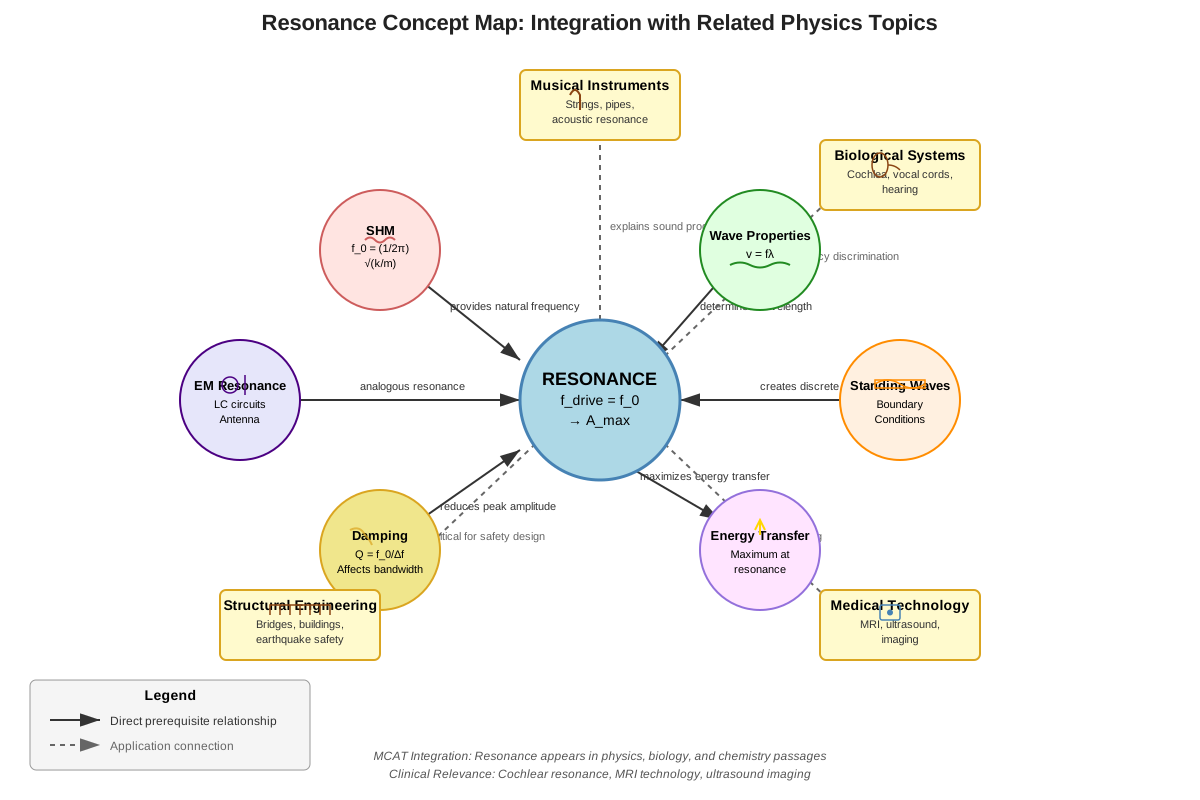
- Simple Harmonic Motion (SHM): Understanding natural frequency, period, and amplitude is essential because resonance occurs when driving frequency matches natural frequency
- Wave Properties: Knowledge of wavelength, frequency, and wave speed enables calculation of resonant frequencies in strings and pipes
- Standing Waves: Resonance in bounded systems creates standing wave patterns with specific harmonic frequencies
- Energy Conservation: Resonance represents efficient energy transfer from driver to system, requiring understanding of kinetic and potential energy exchange
- Damping Forces: Familiarity with how friction and resistance affect oscillations helps explain real-world resonance behavior
Why This Topic Matters
Clinical and Real-World Significance: Resonance phenomena appear throughout medicine and biology. The human ear achieves its remarkable sensitivity through resonance in the basilar membrane, where different positions resonate at different frequencies, enabling pitch discrimination. Medical ultrasound and MRI technologies exploit resonance principles—ultrasound uses acoustic resonance in tissues, while MRI depends on nuclear magnetic resonance of hydrogen atoms. Understanding resonance helps explain why certain sound frequencies can shatter glass, why buildings collapse during earthquakes at specific frequencies, and how musical instruments produce rich, sustained tones.
Exam Statistics: Resonance appears in approximately 2-4 questions per MCAT administration, either as direct physics problems or embedded within interdisciplinary passages. Questions typically test conceptual understanding (60%), quantitative problem-solving (30%), and graphical interpretation (10%). The topic most commonly appears in passages about sound perception, musical acoustics, or structural engineering, but can also emerge in chemistry passages discussing molecular vibrations or spectroscopy.
Common Exam Contexts: MCAT passages featuring resonance often present scenarios involving: (1) musical instruments (organ pipes, guitar strings, tuning forks) requiring calculation of harmonic frequencies; (2) biological hearing mechanisms connecting physics to anatomy; (3) structural failures (Tacoma Narrows Bridge) illustrating destructive resonance; (4) medical imaging technologies applying resonance principles; (5) molecular spectroscopy where chemical bonds resonate at characteristic frequencies. Questions frequently ask students to identify conditions for resonance, predict amplitude changes with frequency variation, or explain energy transfer mechanisms.
Core Concepts
Definition and Fundamental Principles
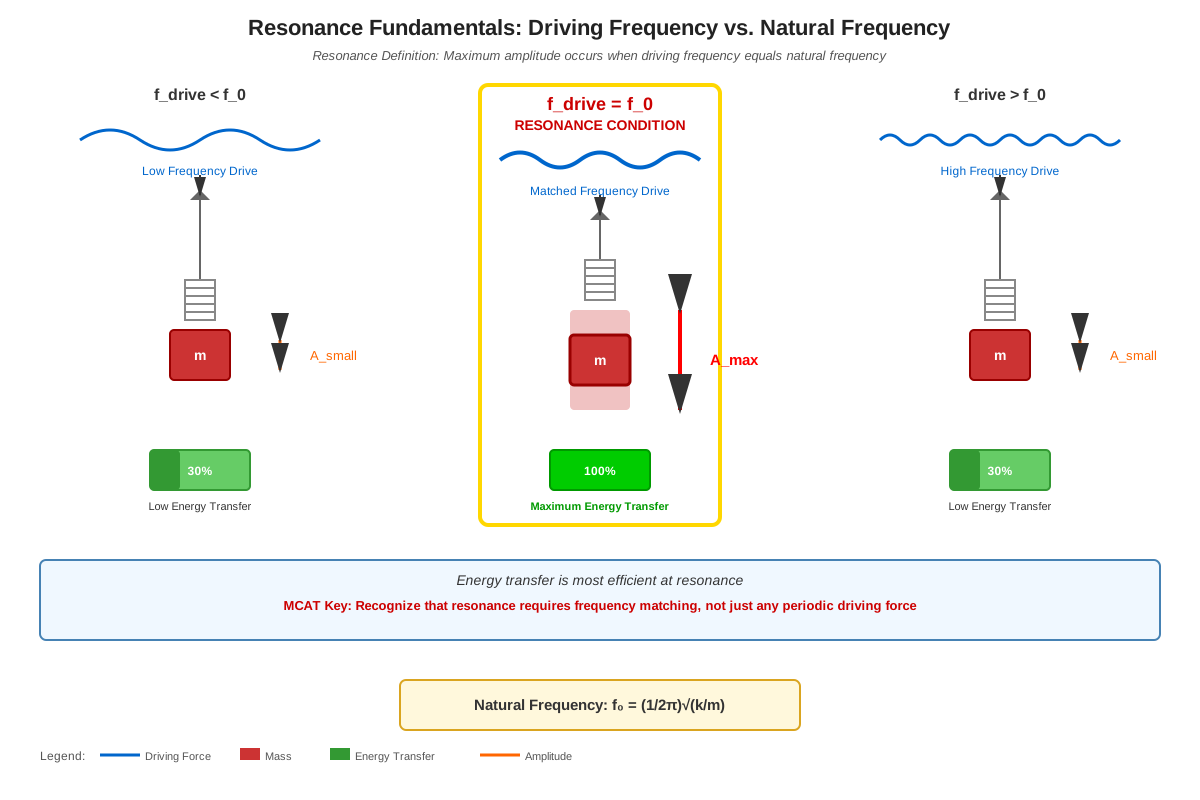
Resonance is the phenomenon where a periodically driven oscillating system experiences maximum amplitude oscillations when the driving frequency matches the system's natural frequency (also called resonant frequency or eigenfrequency). At resonance, energy transfer from the driving force to the system occurs with maximum efficiency, causing the amplitude to build up dramatically over time, limited only by damping forces.
Every oscillating system possesses one or more natural frequencies determined by its physical properties. For a mass-spring system, the natural frequency depends on mass and spring constant. For a vibrating string, it depends on tension, length, and linear mass density. When an external periodic force drives the system at frequencies far from the natural frequency, the system oscillates with relatively small amplitude. However, as the driving frequency approaches the natural frequency, the amplitude increases dramatically, reaching a maximum at exact resonance.
The mathematical condition for resonance is:
f_driving = f_naturalor equivalently:
ω_driving = ω_naturalwhere ω represents angular frequency (ω = 2πf).
Energy Transfer and Amplitude Response
At resonance, the driving force and the system's velocity are in phase, meaning the force pushes in the direction of motion at exactly the right moments to maximize energy input. This phase relationship ensures that each cycle adds energy constructively rather than destructively. Away from resonance, the driving force and velocity fall out of phase, reducing energy transfer efficiency.
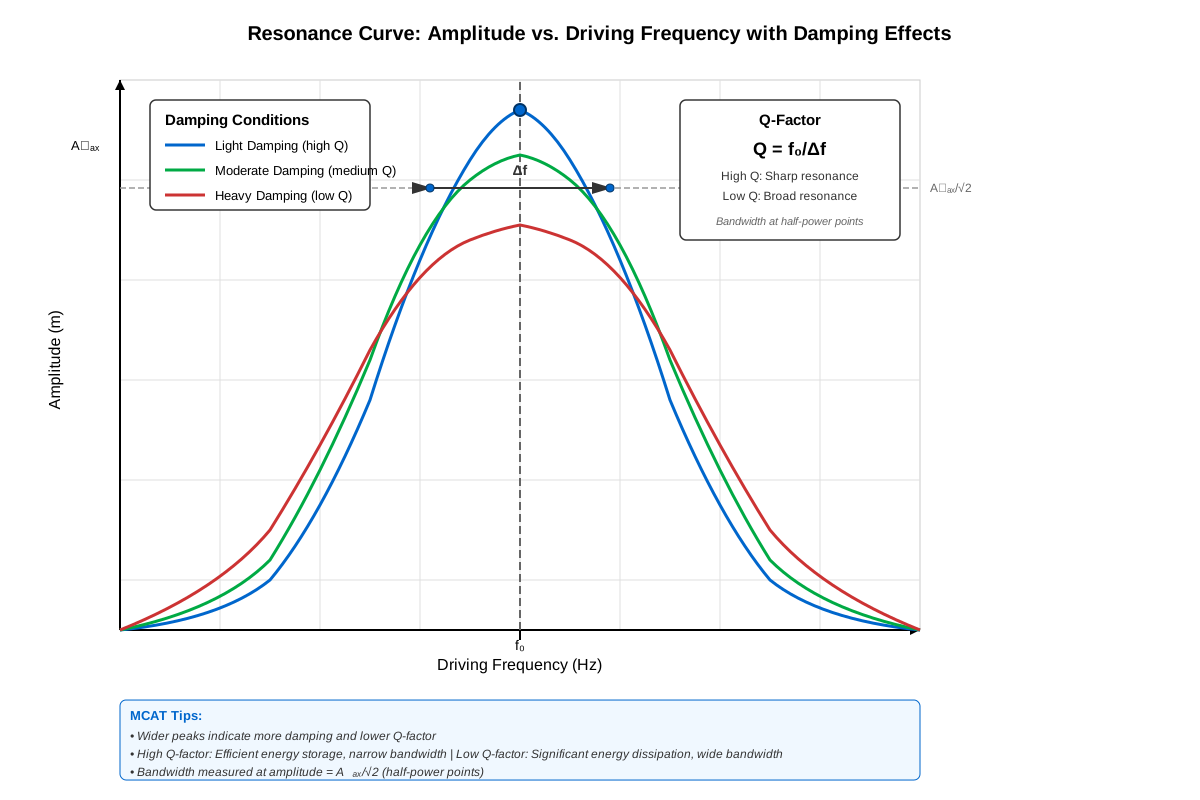
The amplitude-frequency response curve (also called resonance curve) plots oscillation amplitude versus driving frequency. This curve exhibits several key features:
| Feature | Description | MCAT Relevance |
|---|---|---|
| Peak amplitude | Maximum occurs at resonant frequency | Identifies optimal energy transfer |
| Bandwidth | Frequency range where amplitude exceeds 70.7% of maximum | Indicates selectivity of resonance |
| Q-factor | Quality factor = f₀/Δf (resonant frequency/bandwidth) | Measures sharpness of resonance peak |
| Asymptotic behavior | Amplitude approaches zero at very high and very low frequencies | Explains frequency selectivity |
High-Q systems exhibit sharp, narrow resonance peaks, meaning they respond strongly only to a narrow frequency range. Low-Q systems show broad, flat peaks, responding to wider frequency ranges but with lower maximum amplitudes. The Q-factor quantifies this behavior and relates inversely to damping—heavily damped systems have low Q-factors.
Damping Effects on Resonance
Damping refers to energy dissipation mechanisms (friction, air resistance, internal material losses) that remove energy from oscillating systems. Damping profoundly affects resonance behavior:
- Amplitude limitation: Without damping, amplitude at exact resonance would theoretically increase without bound. Damping establishes equilibrium where energy input per cycle equals energy dissipated, limiting maximum amplitude.
- Peak broadening: Increased damping broadens the resonance peak, making the system less frequency-selective but more stable.
- Peak shifting: Heavy damping can shift the peak amplitude to frequencies slightly below the natural frequency.
- Decay rate: After removing the driving force, damped systems return to equilibrium at rates proportional to damping strength.
Three damping regimes exist:
- Underdamped: System oscillates with gradually decreasing amplitude (most resonance phenomena)
- Critically damped: System returns to equilibrium as quickly as possible without oscillating
- Overdamped: System returns to equilibrium slowly without oscillating
For MCAT purposes, focus on underdamped systems where resonance effects are most pronounced.
Resonance in Strings and Pipes
Musical instruments and acoustic systems demonstrate resonance through standing waves—wave patterns that appear stationary due to interference between incident and reflected waves. These systems support only specific resonant frequencies called harmonics or normal modes.
Vibrating String (fixed at both ends):
The resonant frequencies for a string of length L, tension T, and linear mass density μ are:
f_n = (n/2L)√(T/μ)where n = 1, 2, 3, ... represents the harmonic number. The fundamental frequency (n=1) is the lowest resonant frequency, while higher harmonics (overtones) occur at integer multiples.
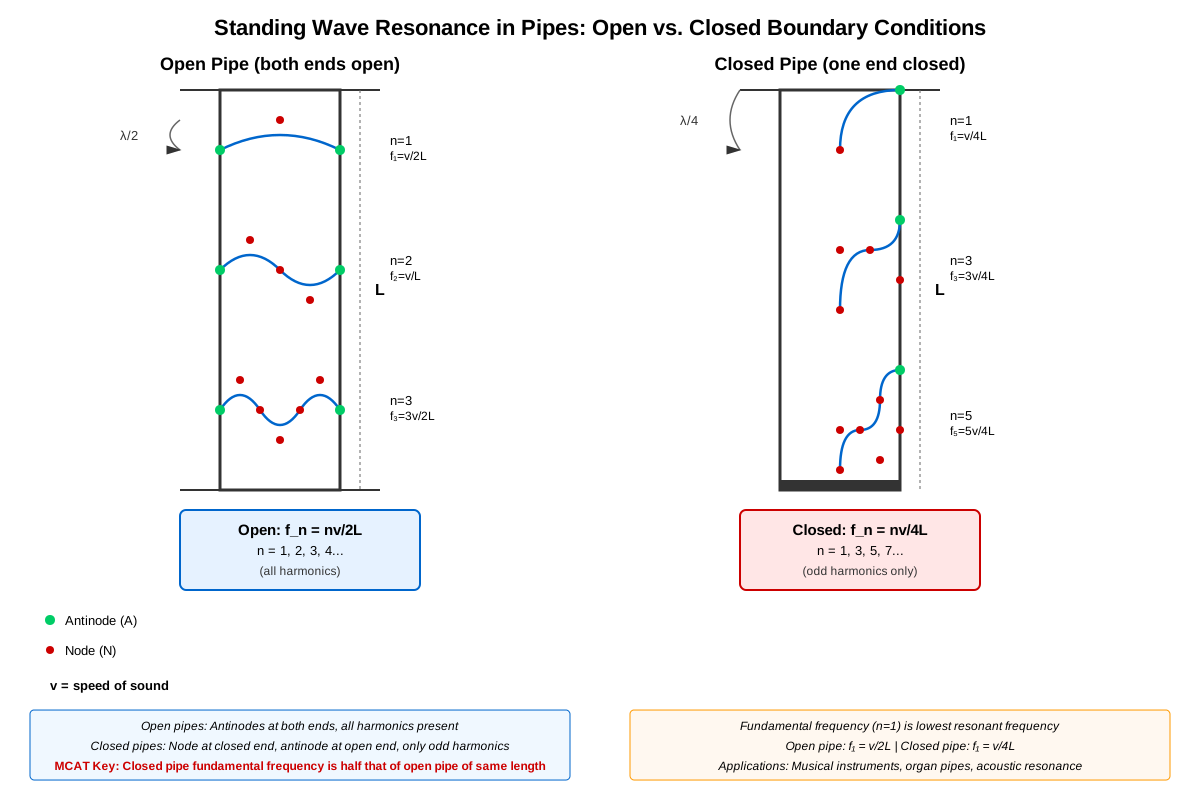
Open Pipe (open at both ends):
Air columns open at both ends have pressure nodes (displacement antinodes) at each opening:
f_n = (nv)/(2L)where v is the speed of sound and n = 1, 2, 3, ...
Closed Pipe (closed at one end, open at other):
These pipes have a displacement node at the closed end and antinode at the open end, supporting only odd harmonics:
f_n = (nv)/(4L)where n = 1, 3, 5, ... (odd integers only)
The restriction to odd harmonics gives closed pipes a distinctive timbre compared to open pipes of the same length.
Forced Oscillations vs. Free Oscillations
Understanding the distinction between forced and free oscillations clarifies resonance:
Free oscillations occur when a system is displaced and released without continued external forcing. The system oscillates at its natural frequency with amplitude determined by initial conditions, gradually decaying due to damping.
Forced oscillations occur when an external periodic force continuously drives the system. The system oscillates at the driving frequency (not necessarily the natural frequency), with amplitude determined by the relationship between driving and natural frequencies.
Resonance is a special case of forced oscillation where the driving frequency equals the natural frequency, producing maximum amplitude response. This distinction is crucial for MCAT questions that ask about frequency of oscillation (always equals driving frequency in forced oscillations) versus amplitude of oscillation (maximized when driving frequency equals natural frequency).
Practical Applications and Examples
Musical Instruments: Resonance enables sustained, loud tones from relatively weak initial excitations. A guitar string's vibration couples to the guitar body, which resonates and amplifies specific frequencies. Organ pipes resonate at frequencies determined by pipe length, producing different pitches.
Acoustic Resonance in the Ear: The ear canal acts as a closed pipe approximately 2.5 cm long, resonating around 3400 Hz. This resonance enhances sensitivity to frequencies important for speech perception. The basilar membrane exhibits position-dependent resonance, with different locations responding maximally to different frequencies—the physical basis of pitch perception.
Destructive Resonance: The 1940 Tacoma Narrows Bridge collapse resulted from wind-driven resonance at the bridge's natural frequency. Similarly, soldiers break step when crossing bridges to avoid resonant excitation. Earthquake damage concentrates in buildings whose natural frequencies match seismic wave frequencies.
Molecular Resonance: Chemical bonds vibrate at characteristic frequencies. Infrared spectroscopy identifies molecules by detecting resonant absorption of infrared light matching bond vibration frequencies. This principle extends to NMR spectroscopy, where atomic nuclei resonate at frequencies dependent on their magnetic environment.
Concept Relationships
Resonance integrates multiple foundational physics concepts into a unified phenomenon. Simple harmonic motion provides the mathematical framework for natural frequencies—the frequencies at which systems prefer to oscillate. These natural frequencies emerge from the interplay between restoring forces and inertia, whether in mass-spring systems, pendulums, or vibrating strings.
Wave interference creates the standing wave patterns observed in resonating strings and pipes. Resonance occurs at frequencies where waves traveling in opposite directions interfere constructively to form stable standing wave patterns with nodes and antinodes at fixed positions. The boundary conditions (fixed ends, open ends, closed ends) determine which wavelengths and frequencies can form standing waves, thus determining the resonant frequencies.
Energy conservation governs resonance behavior. At resonance, the driving force transfers energy to the system with maximum efficiency because force and velocity align in phase. This energy accumulates over many cycles, building amplitude until damping forces dissipate energy as fast as the driving force supplies it. Away from resonance, phase misalignment causes the driving force to sometimes oppose motion, reducing net energy transfer.
Damping (a form of non-conservative force) limits resonance amplitude and broadens resonance peaks. The balance between energy input at resonance and energy dissipation through damping determines steady-state amplitude. This connects to thermodynamics, as dissipated mechanical energy converts to thermal energy.
The relationship map flows as: Natural frequency (determined by system properties) ← Resonance condition (driving frequency matches natural frequency) → Maximum amplitude (limited by damping) → Standing waves (in bounded systems) → Harmonics (multiple resonant frequencies) → Timbre (combination of harmonics in musical instruments).
Resonance also connects forward to more advanced topics: electromagnetic resonance in LC circuits (analogous to mechanical resonance), nuclear magnetic resonance in medical imaging, and quantum mechanical resonance in molecular orbital theory.
High-Yield Facts
⭐ Resonance occurs when driving frequency equals natural frequency, producing maximum amplitude oscillations
⭐ At resonance, driving force and velocity are in phase, maximizing energy transfer efficiency
⭐ Damping limits resonance amplitude and broadens the resonance peak; without damping, amplitude would increase indefinitely
⭐ Strings fixed at both ends support harmonics at f_n = n(v/2L) where n = 1, 2, 3, ...
⭐ Closed pipes support only odd harmonics: f_n = n(v/4L) where n = 1, 3, 5, ...
- Open pipes (open both ends) support all harmonics like strings: f_n = n(v/2L)
- The Q-factor (quality factor) measures resonance sharpness: Q = f₀/Δf, where Δf is bandwidth
- In forced oscillations, the system always oscillates at the driving frequency, not the natural frequency
- Resonance amplitude depends on damping strength—light damping produces high peaks, heavy damping produces low, broad peaks
- The fundamental frequency (first harmonic, n=1) is the lowest resonant frequency a system can support
- Multiple resonant frequencies (harmonics) can exist simultaneously in a system, creating complex waveforms
- The ear canal resonates around 3400 Hz, enhancing hearing sensitivity at frequencies important for speech
- Resonance can be destructive (bridge collapse, glass shattering) or useful (musical instruments, medical imaging)
- Phase relationship between driving force and system response determines energy transfer: in-phase at resonance, out-of-phase away from resonance
- Standing waves in resonating systems have fixed nodes (zero amplitude) and antinodes (maximum amplitude)
Quick check — test yourself on Resonance so far.
Try Flashcards →Common Misconceptions
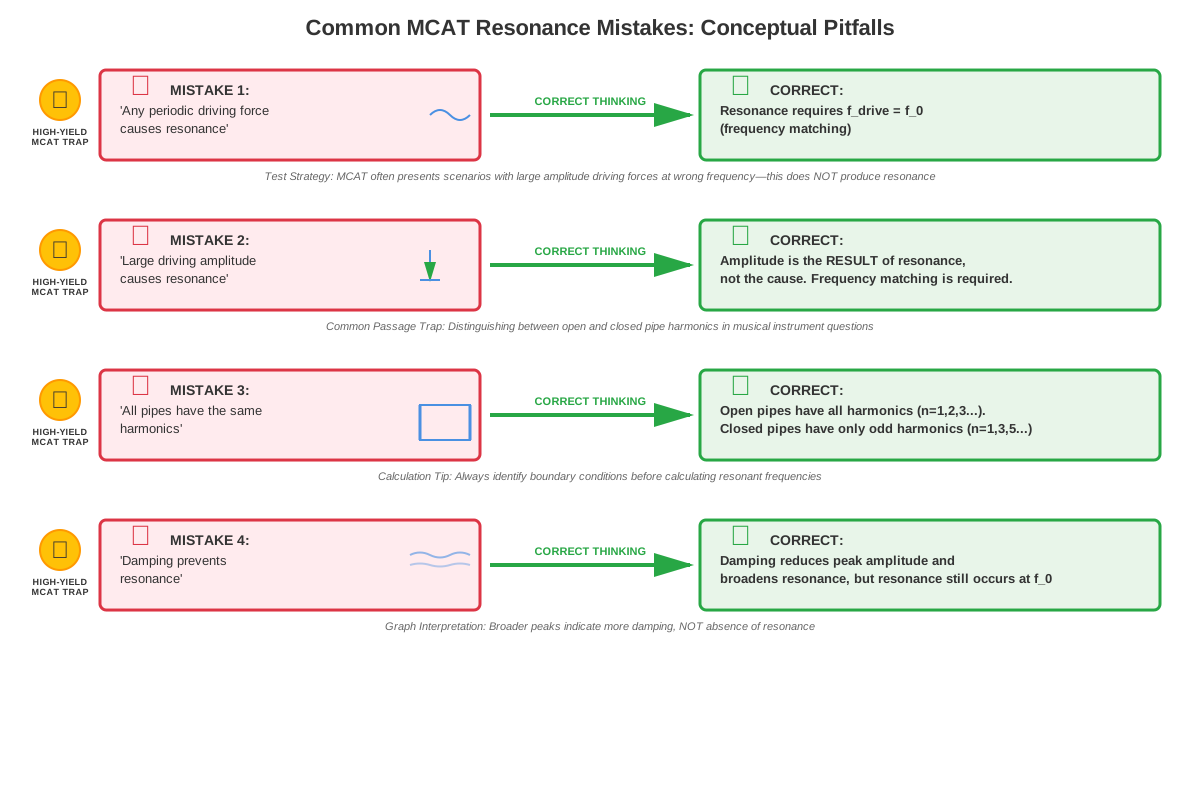
Misconception: Resonance only occurs at one specific frequency for any system.
Correction: Most systems have multiple resonant frequencies called harmonics or normal modes. A guitar string resonates at the fundamental frequency and all integer multiples (overtones). Only the fundamental is the lowest resonant frequency; higher harmonics are also resonant frequencies.
Misconception: At resonance, the system oscillates at its natural frequency because the driving force "releases" it to oscillate freely.
Correction: In forced oscillations, the system always oscillates at the driving frequency, never the natural frequency. Resonance is the special case where the driving frequency happens to equal the natural frequency, but the oscillation frequency is still determined by the driver, not by the system "choosing" its natural frequency.
Misconception: Greater driving force amplitude always produces greater oscillation amplitude.
Correction: While stronger driving forces do increase amplitude, the frequency relationship matters more. A weak force at the resonant frequency produces much larger amplitude than a strong force far from resonance. Resonance is about frequency matching, not force magnitude.
Misconception: Damping is always undesirable because it reduces resonance amplitude.
Correction: Damping is essential for system stability and safety. Without damping, resonance amplitude would grow without bound, destroying the system. Damping also broadens the resonance peak, making systems less sensitive to small frequency variations. Many applications (shock absorbers, building stabilizers) deliberately add damping to prevent destructive resonance.
Misconception: Closed pipes are half the length of open pipes producing the same fundamental frequency.
Correction: Closed pipes are one-quarter the length of open pipes for the same fundamental frequency. A closed pipe of length L has fundamental frequency v/4L, while an open pipe needs length 2L to produce the same frequency (v/4L = v/2(2L)). This factor-of-two difference is frequently tested.
Misconception: The resonance peak always occurs exactly at the natural frequency regardless of damping.
Correction: Light damping produces peaks very close to the natural frequency, but heavy damping can shift the peak to slightly lower frequencies. For MCAT purposes, assume the peak occurs at the natural frequency unless the question specifically addresses heavy damping effects.
Misconception: All harmonics have equal amplitude in resonating systems.
Correction: Harmonic amplitudes depend on how the system is excited and on damping characteristics. The fundamental typically has the largest amplitude, with higher harmonics progressively weaker. The specific combination of harmonic amplitudes determines the timbre or tone quality of musical instruments.
Worked Examples
Example 1: Resonance in an Organ Pipe
Problem: An organ pipe open at both ends has a fundamental frequency of 256 Hz (middle C). The speed of sound is 340 m/s. (a) What is the length of the pipe? (b) If one end of the pipe is closed, what is the new fundamental frequency? (c) Explain why closing one end changes the frequency.
Solution:
(a) Finding pipe length for open pipe:
For an open pipe, the fundamental frequency (n=1) is:
f₁ = v/(2L)Solving for L:
L = v/(2f₁) = 340 m/s / (2 × 256 Hz) = 340/512 = 0.664 m ≈ 66.4 cmThe pipe is approximately 66.4 cm long.
(b) Fundamental frequency when one end is closed:
For a closed pipe, the fundamental frequency is:
f₁ = v/(4L) = 340 m/s / (4 × 0.664 m) = 340/2.656 = 128 HzThe new fundamental frequency is 128 Hz, exactly half the original frequency.
(c) Explanation:
Closing one end changes the boundary conditions and thus the resonant frequencies. An open pipe has displacement antinodes (pressure nodes) at both ends, supporting a standing wave pattern with wavelength λ = 2L for the fundamental. A closed pipe has a displacement node at the closed end and antinode at the open end, requiring wavelength λ = 4L for the fundamental—twice as long. Since frequency and wavelength are inversely related (f = v/λ), doubling the wavelength halves the frequency.
Additionally, the closed pipe supports only odd harmonics (f, 3f, 5f, ...) while the open pipe supports all harmonics (f, 2f, 3f, ...). This difference in harmonic structure gives closed and open pipes distinctive timbres even when playing the same fundamental pitch.
Connection to Learning Objectives: This problem applies resonance concepts to calculate resonant frequencies in pipes, demonstrates how boundary conditions affect harmonics, and connects mathematical relationships to physical explanations—all essential MCAT skills.
Example 2: Resonance Curve Analysis
Problem: A mass-spring system has a natural frequency of 10 Hz. When driven by an external periodic force, the amplitude-frequency response is measured. At 10 Hz, the amplitude is 20 cm. At 8 Hz and 12 Hz, the amplitude is approximately 14 cm. (a) Estimate the Q-factor of this system. (b) If damping is increased, predict how the resonance curve will change. (c) At what frequency does the system oscillate when driven at 8 Hz?
Solution:
(a) Estimating Q-factor:
The Q-factor is defined as:
Q = f₀/Δfwhere f₀ is the resonant frequency and Δf is the bandwidth (frequency range where amplitude exceeds 70.7% of maximum, or 1/√2 ≈ 0.707 of maximum).
Maximum amplitude = 20 cm
70.7% of maximum = 0.707 × 20 = 14.14 cm ≈ 14 cm
The bandwidth extends from approximately 8 Hz to 12 Hz (where amplitude equals 14 cm), so:
Δf = 12 Hz - 8 Hz = 4 HzTherefore:
Q = 10 Hz / 4 Hz = 2.5The Q-factor is 2.5, indicating moderate damping (neither very sharp nor very broad resonance).
(b) Effect of increased damping:
Increasing damping will:
- Decrease peak amplitude: More energy dissipates per cycle, reducing maximum amplitude at resonance
- Broaden the resonance peak: The system becomes less frequency-selective, responding more uniformly across a wider frequency range
- Decrease Q-factor: Since Q is inversely related to damping, increased damping reduces Q
- Potentially shift peak slightly: Heavy damping can shift the peak to frequencies slightly below the natural frequency
The resonance curve will become flatter and wider, with a lower maximum.
(c) Oscillation frequency when driven at 8 Hz:
In forced oscillations, the system always oscillates at the driving frequency, regardless of the natural frequency. Therefore, when driven at 8 Hz, the system oscillates at 8 Hz.
The amplitude at 8 Hz is smaller than at resonance (14 cm vs. 20 cm) because the driving frequency doesn't match the natural frequency, reducing energy transfer efficiency. However, the frequency of oscillation is determined entirely by the driver, not by the system's natural frequency.
Connection to Learning Objectives: This problem requires interpreting resonance curves, understanding Q-factor, predicting damping effects, and distinguishing between oscillation frequency (always equals driving frequency) and amplitude (maximized at resonance)—all high-yield MCAT concepts.
Exam Strategy
Approaching MCAT Resonance Questions:
- Identify the system type first: Determine whether the question involves a mass-spring system, vibrating string, open pipe, closed pipe, or other resonating system. Each has different formulas for resonant frequencies.
- Distinguish forced vs. free oscillations: If an external periodic force is mentioned, it's forced oscillation—the system oscillates at the driving frequency. If the system is "plucked," "struck," or "released," it's free oscillation at the natural frequency.
- Look for resonance conditions: Watch for phrases like "maximum amplitude," "loudest sound," "most efficient energy transfer," or "driving frequency equals natural frequency"—all indicate resonance.
- Check boundary conditions carefully: Open vs. closed pipes have different harmonic series. Strings fixed at both ends behave like open pipes. One small word ("closed," "open," "fixed," "free") completely changes the answer.
Trigger Words and Phrases:
- "Maximum amplitude" → resonance condition
- "Natural frequency," "eigenfrequency" → intrinsic system property
- "Driving frequency," "forcing frequency" → external periodic force
- "Fundamental frequency" → lowest resonant frequency (n=1)
- "Harmonic," "overtone" → higher resonant frequencies
- "Quality factor," "Q-factor" → sharpness of resonance
- "Damping," "resistance," "friction" → energy dissipation limiting amplitude
- "In phase" → condition at resonance for maximum energy transfer
Process of Elimination Tips:
- Eliminate answers suggesting oscillation at natural frequency when a driving frequency is specified (system oscillates at driving frequency)
- Eliminate answers with closed pipe formulas for open pipes and vice versa
- Eliminate answers suggesting infinite amplitude at resonance (damping always limits amplitude)
- For harmonic questions, eliminate even harmonics (n=2, 4, 6) for closed pipes (only odd harmonics exist)
- Eliminate answers suggesting amplitude depends only on driving force magnitude (frequency relationship matters more)
Time Allocation:
Resonance questions typically require 60-90 seconds. Spend 15-20 seconds identifying system type and relevant formula, 30-40 seconds on calculation, and 15-20 seconds checking units and reasonableness. For conceptual questions without calculation, spend 30 seconds identifying the key principle and 30 seconds eliminating wrong answers.
Memory Techniques
Mnemonic for Pipe Harmonics - "COOL":
- Closed pipes: Odd harmonics Only, Longer wavelength (λ = 4L for fundamental)
- Closed pipes support n = 1, 3, 5, 7... (odd only)
- Open pipes support n = 1, 2, 3, 4... (all integers)
Mnemonic for Resonance Conditions - "FRED":
- Frequency match (driving = natural)
- Resonance produces maximum amplitude
- Energy transfer is most efficient
- Damping limits the peak
Visualization Strategy for Standing Waves:
Picture strings and pipes as jump ropes. Open ends are like hands shaking the rope—they move freely (antinodes). Fixed ends are like the rope tied to a wall—they can't move (nodes). Closed pipe ends are like walls for air—air can't move there (displacement nodes). This physical intuition helps remember boundary conditions.
Acronym for Q-factor - "SHARP":
- Selectivity of frequency response
- High Q means narrow peak
- Amplitude peak is tall
- Related to damping (inverse relationship)
- Peak width is narrow
Memory Aid for Frequency Formulas:
All resonance formulas have the pattern: frequency ∝ (wave speed)/(characteristic length)
- Strings: f ∝ √(T/μ)/L (tension over mass per length, divided by length)
- Open pipes: f ∝ v/2L (speed of sound over twice the length)
- Closed pipes: f ∝ v/4L (speed of sound over four times the length)
The denominators (2L vs. 4L) reflect how many quarter-wavelengths fit: open pipes fit 2 quarter-wavelengths (2L), closed pipes fit 1 quarter-wavelength (4L) for the fundamental.
Summary
Resonance is the dramatic amplitude increase that occurs when a periodically driven system oscillates at its natural frequency, enabling maximum energy transfer efficiency. This phenomenon requires understanding the distinction between natural frequencies (intrinsic to the system) and driving frequencies (imposed externally), recognizing that resonance occurs when these match. Damping forces limit resonance amplitude and broaden resonance peaks, preventing infinite amplitude growth and establishing steady-state oscillations where energy input balances energy dissipation. In bounded systems like strings and pipes, resonance manifests as standing waves at specific harmonic frequencies determined by boundary conditions—strings and open pipes support all integer harmonics, while closed pipes support only odd harmonics. The MCAT tests resonance through calculations of resonant frequencies, interpretation of amplitude-frequency response curves, analysis of energy transfer mechanisms, and application to real-world contexts including musical instruments, structural engineering, and biological hearing. Success requires facility with harmonic formulas, understanding phase relationships between driving forces and system response, recognizing how damping affects resonance behavior, and connecting mathematical descriptions to physical phenomena. Mastery enables rapid identification of resonance conditions, prediction of amplitude behavior across frequency ranges, and integration of wave concepts with energy principles.
Key Takeaways
- Resonance occurs when driving frequency equals natural frequency, producing maximum amplitude through efficient energy transfer with force and velocity in phase
- Damping is essential for limiting resonance amplitude and preventing system destruction; it broadens resonance peaks and reduces Q-factor
- Strings and open pipes support all harmonics (f_n = nv/2L), while closed pipes support only odd harmonics (f_n = nv/4L where n = 1, 3, 5...)
- In forced oscillations, systems always oscillate at the driving frequency, not the natural frequency; resonance is the special case where these frequencies match
- Q-factor (f₀/Δf) quantifies resonance sharpness: high Q means narrow, tall peaks (light damping); low Q means broad, flat peaks (heavy damping)
- Boundary conditions determine which wavelengths and frequencies can form standing waves, thus determining the resonant frequencies of strings and pipes
- Resonance applications span from musical instruments and hearing physiology to destructive phenomena like bridge collapse and beneficial technologies like MRI
Related Topics
Simple Harmonic Motion and Natural Frequencies: Deepening understanding of how system properties (mass, spring constant, length, tension) determine natural frequencies provides the foundation for predicting resonance conditions. Mastering SHM enables calculation of resonant frequencies for diverse oscillating systems.
Wave Interference and Standing Waves: Resonance in bounded systems creates standing wave patterns through constructive and destructive interference. Understanding nodes, antinodes, and harmonic patterns connects wave behavior to resonance phenomena.
Doppler Effect: While distinct from resonance, the Doppler effect can shift perceived frequencies, potentially moving sounds into or out of resonance with biological or mechanical systems. Both topics involve frequency analysis in wave physics.
Sound Intensity and Decibel Scale: Resonance amplifies sound intensity at specific frequencies. Understanding how intensity relates to amplitude and how the decibel scale quantifies intensity enables analysis of resonance effects in acoustic systems.
Electromagnetic Resonance: The principles of mechanical resonance extend to LC circuits in electricity and magnetism, where inductors and capacitors create oscillating currents with natural frequencies. This connection demonstrates the universality of resonance across physics domains.
Practice CTA
Now that you've mastered the core concepts of resonance, it's time to solidify your understanding through active practice. Attempt the practice questions to test your ability to apply resonance principles to MCAT-style problems, and use the flashcards to reinforce high-yield facts and formulas. Remember, resonance questions reward careful attention to system type, boundary conditions, and the distinction between driving and natural frequencies. Each practice problem strengthens your pattern recognition and problem-solving speed—essential skills for test day success. You've built a strong conceptual foundation; now transform that knowledge into points through deliberate practice!
Sign up free to keep reading
Create a free AnvayaPrep account to finish this MCAT guide on Resonance — plus flashcards and practice questions.