Overview
Organic structures form the foundation of all organic chemistry, representing the spatial and electronic arrangement of atoms within carbon-containing molecules. Understanding how to draw, interpret, and manipulate these structures is absolutely essential for MCAT success, as organic chemistry questions permeate not only the Chemical and Physical Foundations section but also appear in biochemistry passages throughout the exam. Mastery of organic structures enables students to predict reactivity, understand biological mechanisms, and solve complex problems involving biomolecules.
The ability to fluently read and write organic structures is a language skill that underpins every subsequent topic in Organic Chemistry. From understanding functional group reactivity to predicting stereochemical outcomes, from analyzing spectroscopic data to comprehending enzyme mechanisms, all advanced concepts depend on a solid grasp of structural representation. The MCAT tests this knowledge both directly through structure identification questions and indirectly through passages requiring rapid interpretation of complex molecular diagrams.
Within the broader context of Structure and Bonding, organic structures serve as the visual vocabulary through which chemists communicate molecular architecture. This topic connects intimately with concepts such as hybridization, molecular geometry, resonance, and isomerism. Students who develop fluency in drawing and interpreting structures gain a significant advantage on test day, as they can quickly analyze answer choices, eliminate impossible structures, and recognize key structural features that determine chemical behavior. The investment in mastering organic structures pays dividends across multiple MCAT sections and question types.
Learning Objectives
- [ ] Define Organic structures using accurate Organic Chemistry terminology
- [ ] Explain why Organic structures matters for the MCAT
- [ ] Apply Organic structures to exam-style questions
- [ ] Identify common mistakes related to Organic structures
- [ ] Connect Organic structures to related Organic Chemistry concepts
- [ ] Draw and interpret all major structural representations (Lewis, condensed, skeletal, and line-angle formulas)
- [ ] Determine molecular formulas from structural drawings and vice versa
- [ ] Recognize and classify functional groups within complex organic structures
Prerequisites
- Basic atomic structure and electron configuration: Understanding valence electrons is essential for determining bonding patterns in organic molecules
- Chemical bonding fundamentals (ionic and covalent): Organic structures are built on covalent bonding principles, requiring knowledge of electron sharing
- Lewis dot structures: The foundation for drawing organic structures begins with Lewis structure conventions
- Electronegativity and polarity: Predicting charge distribution and reactivity depends on understanding electronegativity differences
- Basic nomenclature rules: Recognizing alkanes, alkenes, and simple functional groups aids in structure interpretation
Why This Topic Matters
Organic structures appear in approximately 15-20% of Chemical and Physical Foundations questions and feature prominently in Biological and Biochemical Foundations passages involving amino acids, carbohydrates, lipids, and nucleotides. The MCAT frequently presents complex biochemical structures and expects students to identify reactive sites, predict interactions, or recognize structural modifications without extensive explanation.
In clinical and research contexts, understanding organic structures enables healthcare professionals to comprehend drug mechanisms, metabolic pathways, and biomolecular interactions. Pharmaceutical development relies entirely on structural modifications to optimize drug properties, while diagnostic techniques like NMR and mass spectrometry depend on structural interpretation. Medical students encounter organic structures when studying pharmacology, biochemistry, and molecular biology throughout their training.
On the MCAT, organic structures typically appear in several formats: discrete questions asking students to identify equivalent structures or count specific atoms, passage-based questions requiring interpretation of reaction schemes with complex structures, and biochemistry passages where students must recognize structural features of biomolecules. The exam particularly favors questions that test whether students can rapidly convert between different structural representations or identify functional groups within larger molecules. Students who struggle with organic structures often lose valuable time deciphering molecular drawings, while those with strong structural fluency can quickly eliminate wrong answers and focus on the chemical reasoning required.
Core Concepts
Types of Structural Representations
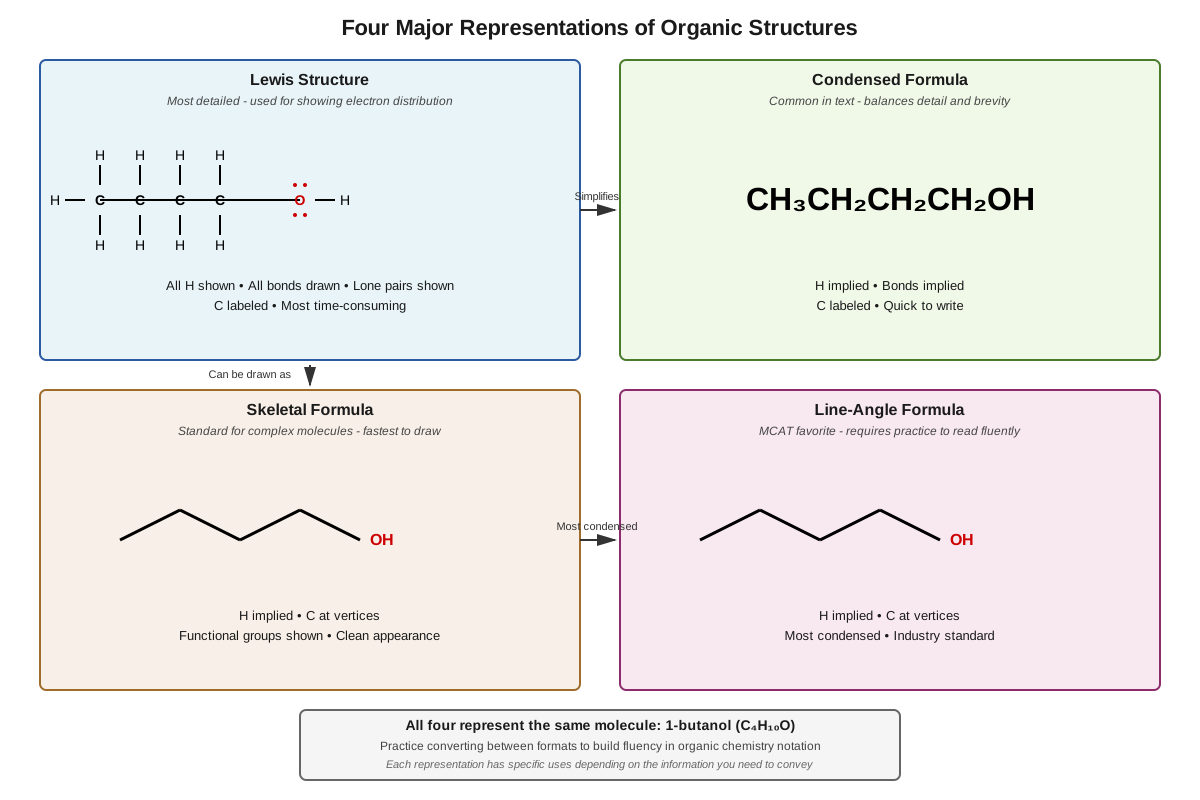
Organic structures can be represented in multiple ways, each offering different advantages for conveying molecular information. The molecular formula provides only the elemental composition (e.g., C₆H₁₂O₆) without revealing connectivity or arrangement. While useful for calculating molecular weight or degree of unsaturation, molecular formulas alone cannot distinguish between isomers.
Lewis structures show all atoms, bonds, and lone pairs explicitly, making them ideal for understanding electron distribution and formal charges. In a Lewis structure, each covalent bond appears as a line or pair of dots, and all non-bonding electrons are shown. For example, methanol (CH₃OH) would show the carbon bonded to three hydrogens and one oxygen, with the oxygen bonded to one hydrogen and possessing two lone pairs. While comprehensive, Lewis structures become cumbersome for larger molecules.
Condensed structural formulas streamline representation by grouping atoms without showing all bonds explicitly. Methanol becomes CH₃OH, and ethanol becomes CH₃CH₂OH. This format maintains clarity about connectivity while reducing visual complexity. Parentheses indicate groups attached to the preceding atom: (CH₃)₂CHOH represents isopropanol, where two methyl groups attach to the central carbon.
Line-angle formulas (also called skeletal structures or bond-line structures) represent the most efficient method for drawing organic molecules and dominate MCAT questions. In this convention:
- Carbon atoms appear at line termini and vertices (angles)
- Hydrogen atoms bonded to carbon are implied and not drawn
- Heteroatoms (O, N, S, halogens) are shown explicitly with their hydrogens
- Multiple bonds appear as multiple lines
- The structure emphasizes the carbon skeleton and functional groups
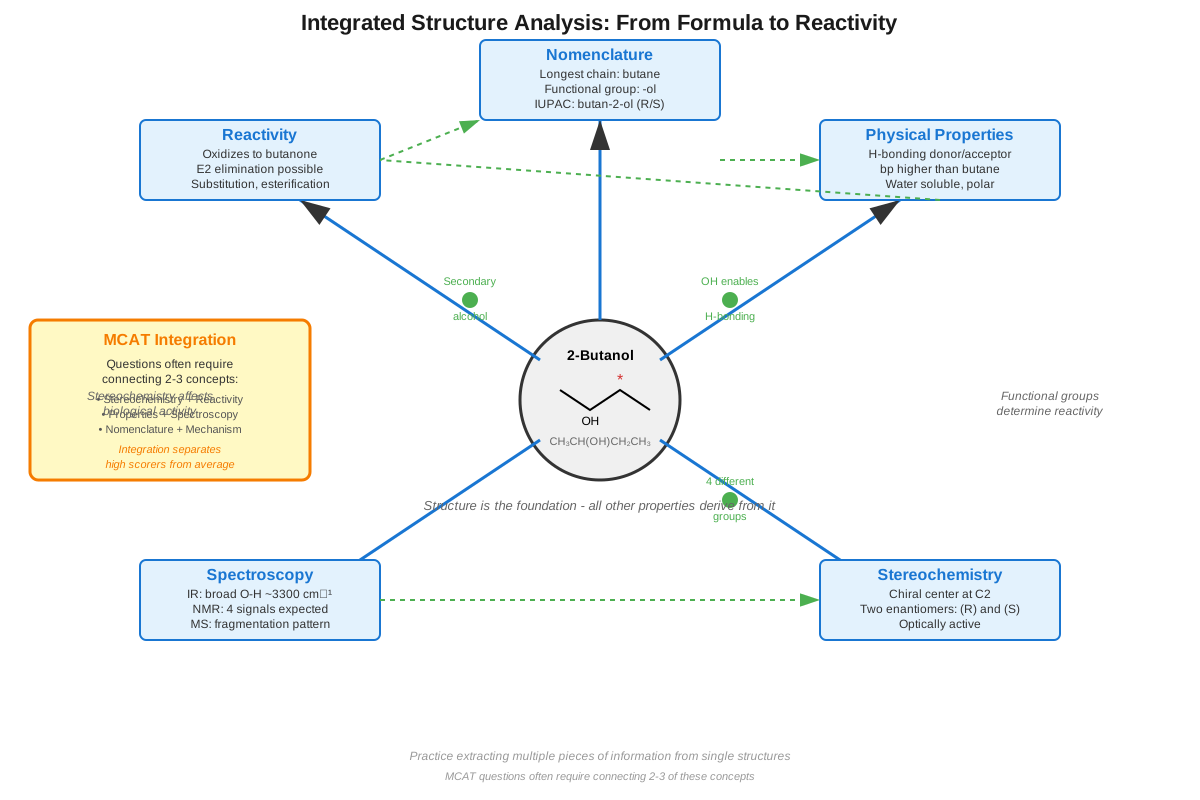
For example, butane appears as a simple zigzag line with four vertices, while 2-butanol shows the same skeleton with an OH group attached to the second carbon.
Drawing and Interpreting Line-Angle Formulas
Mastering line-angle formulas is crucial for MCAT success, as they appear in the vast majority of organic chemistry questions. Each line represents a C-C bond, and each vertex or terminus represents a carbon atom. The number of hydrogen atoms on each carbon is determined by satisfying carbon's tetravalency—each carbon forms four bonds total.
Consider hexane: drawn as a zigzag line with six vertices, students must recognize that the terminal carbons each have three hydrogens (one C-C bond plus three C-H bonds), while internal carbons each have two hydrogens (two C-C bonds plus two C-H bonds). This gives the molecular formula C₆H₁₄.
When heteroatoms appear, they must be drawn explicitly with their attached hydrogens. An alcohol group appears as -OH, an amine as -NH₂ or -NH- (depending on substitution), and a carboxylic acid as -COOH or the more detailed structure showing C=O and O-H. Double bonds appear as two parallel lines, and triple bonds as three parallel lines, with the understanding that these multiple bonds reduce the number of hydrogens on those carbons.
Functional Groups in Organic Structures
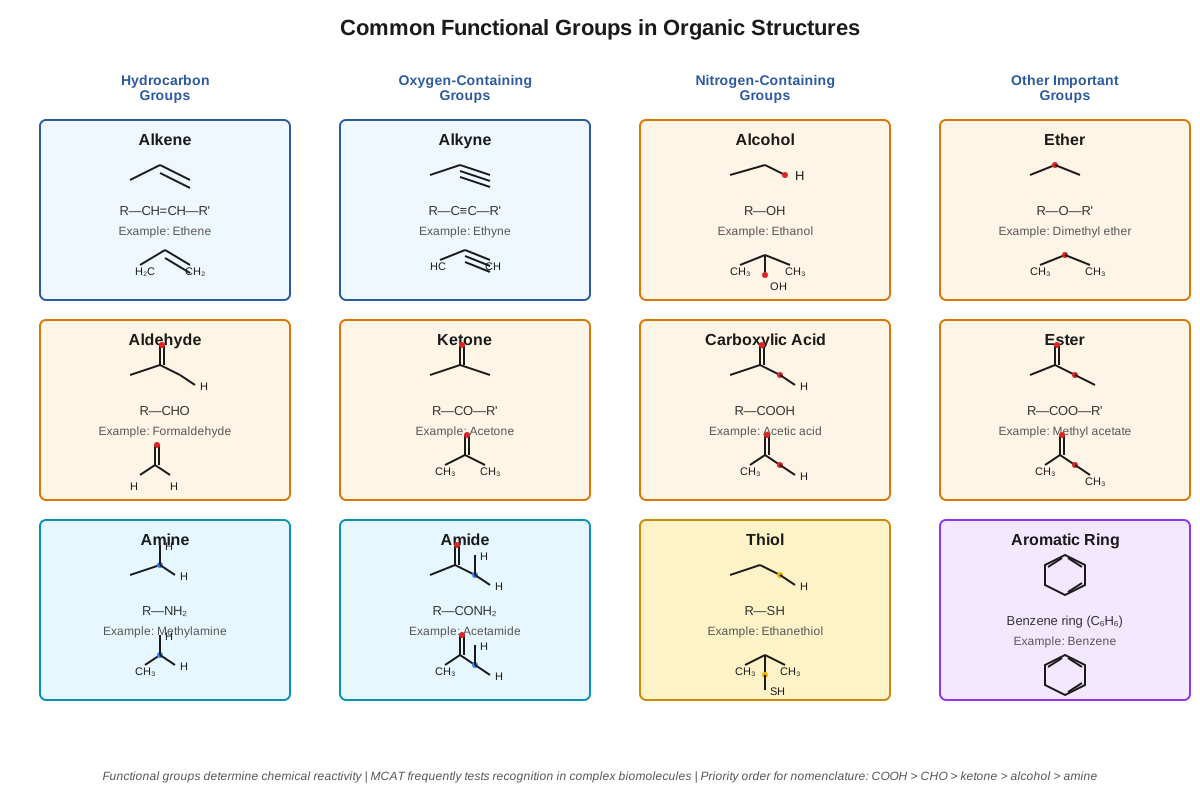
Functional groups are specific arrangements of atoms that confer characteristic chemical properties to organic molecules. Recognizing functional groups within complex structures is a high-yield MCAT skill, as reactivity and biological function often depend on these groups.
| Functional Group | Structure | Suffix/Prefix | Key Features |
|---|---|---|---|
| Alkane | C-C single bonds | -ane | Saturated, relatively unreactive |
| Alkene | C=C double bond | -ene | Unsaturated, undergoes addition |
| Alkyne | C≡C triple bond | -yne | Unsaturated, linear geometry |
| Alcohol | -OH | -ol | Hydrogen bonding, polar |
| Aldehyde | -CHO | -al | Carbonyl at terminus, oxidizable |
| Ketone | -CO- | -one | Carbonyl internal, less reactive than aldehyde |
| Carboxylic Acid | -COOH | -oic acid | Acidic, hydrogen bonding |
| Ester | -COO- | -oate | Derived from acid + alcohol |
| Amine | -NH₂, -NH-, -N- | -amine | Basic, hydrogen bonding |
| Amide | -CONH₂ | -amide | Peptide bond, resonance stabilized |
| Ether | -O- | ether | Polar but not hydrogen bond donor |
| Thiol | -SH | -thiol | Sulfur analog of alcohol |
The MCAT frequently tests whether students can identify multiple functional groups within a single molecule, such as recognizing that serine contains both alcohol and carboxylic acid groups, or that aspirin contains both ester and carboxylic acid functionalities.
Determining Molecular Formulas from Structures
Converting between structural representations and molecular formulas is a fundamental skill tested on the MCAT. When given a line-angle formula, students must systematically count all atoms, including implied hydrogens. The process involves:
- Count all explicitly drawn carbons (vertices and termini)
- Count all explicitly drawn heteroatoms
- For each carbon, determine how many bonds are shown
- Calculate implied hydrogens: 4 minus (number of bonds shown) for each carbon
- Add explicitly shown hydrogens on heteroatoms
- Compile the molecular formula in standard order: C, H, then other elements alphabetically
For example, given the structure of propanoic acid (a three-carbon chain with a carboxylic acid group), students would count three carbons, recognize that the carboxylic carbon has three bonds shown (one C-C, one C=O, one C-O), leaving one implied hydrogen on that carbon. The middle carbon has two C-C bonds and two implied hydrogens, while the terminal carbon has one C-C bond and three implied hydrogens. The carboxylic acid contributes two oxygens and one explicitly shown hydrogen on the OH group. Total: C₃H₆O₂.
Degree of Unsaturation
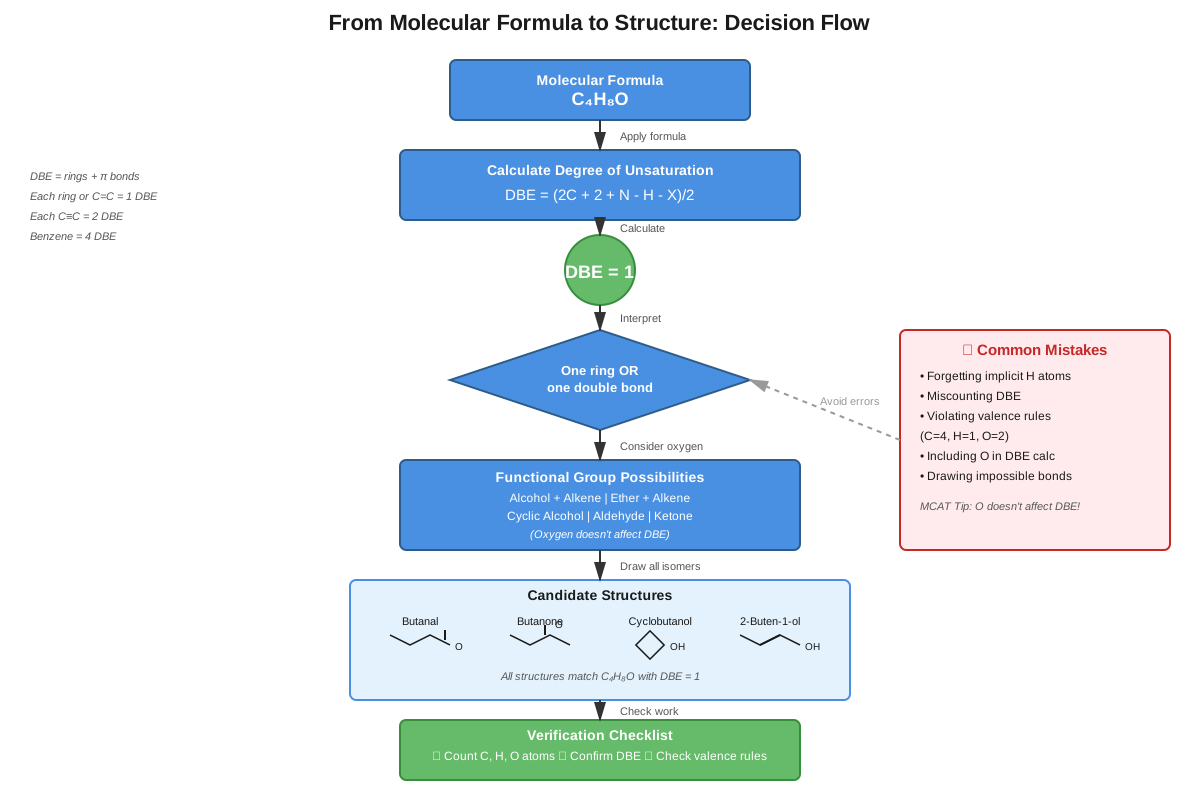
The degree of unsaturation (also called index of hydrogen deficiency) provides valuable information about molecular structure from the molecular formula alone. It indicates the number of rings and/or pi bonds present in a molecule. The formula is:
Degree of Unsaturation = (2C + 2 + N - H - X) / 2Where C = carbons, N = nitrogens, H = hydrogens, X = halogens (oxygen and sulfur are ignored).
Each degree of unsaturation corresponds to either one ring or one pi bond (double bond = 1, triple bond = 2). For example, benzene (C₆H₆) has a degree of unsaturation of 4, corresponding to three pi bonds and one ring. This calculation helps students predict structural features and eliminate impossible structures on the MCAT.
Three-Dimensional Aspects of Organic Structures
While line-angle formulas are two-dimensional representations, organic molecules exist in three-dimensional space. Wedge-and-dash notation conveys stereochemistry: solid wedges indicate bonds projecting toward the viewer, dashed wedges indicate bonds projecting away, and regular lines indicate bonds in the plane of the page.
Understanding that line-angle formulas represent three-dimensional molecules is crucial for topics like stereochemistry and conformational analysis. The tetrahedral geometry around sp³ carbons means that even simple molecules like ethane have spatial arrangements that affect their properties. The MCAT may present structures with wedge-and-dash notation to test stereochemical understanding or ask students to recognize when two structures are identical despite different orientations.
Concept Relationships
The ability to draw and interpret organic structures serves as the foundation for virtually all subsequent Organic Chemistry topics. Structure determines function: the spatial arrangement of atoms dictates physical properties (boiling point, solubility), chemical reactivity (nucleophilicity, electrophilicity), and biological activity (enzyme binding, receptor interactions).
Structure and Bonding concepts flow directly from structural representation. Understanding hybridization requires recognizing bond angles and geometries in drawn structures. Resonance structures are simply alternative ways of drawing electron distribution within the same molecular framework. Molecular orbital theory explains why certain structural features (conjugation, aromaticity) confer special stability.
The relationship map flows as follows: Molecular Formula → Degree of Unsaturation → Possible Structural Features → Detailed Structure (line-angle formula) → Functional Group Identification → Predicted Reactivity → Mechanism Understanding. Each step builds on the previous, with structural representation as the central organizing principle.
Organic structures connect to stereochemistry through the recognition that three-dimensional arrangement matters. The same connectivity (constitutional structure) can yield different stereoisomers with distinct properties. Structures also connect to spectroscopy, as NMR, IR, and mass spectrometry data are interpreted by proposing structures consistent with the spectroscopic information.
In biochemistry, organic structures enable understanding of amino acid side chains, carbohydrate configurations, lipid architectures, and nucleotide components. The MCAT frequently tests whether students can recognize structural modifications (phosphorylation, methylation, oxidation) in biological molecules, requiring fluency in both drawing and interpreting complex structures.
Quick check — test yourself on Organic structures so far.
Try Flashcards →High-Yield Facts
⭐ Line-angle formulas show carbon atoms at vertices and termini; hydrogens on carbons are implied but not drawn
⭐ Each carbon forms exactly four bonds; count visible bonds to determine implied hydrogens
⭐ Heteroatoms (O, N, S, halogens) must be drawn explicitly with their attached hydrogens
⭐ Degree of unsaturation = (2C + 2 + N - H - X) / 2; each unit represents one ring or one pi bond
⭐ Functional groups determine chemical reactivity and biological function; recognizing them is essential for predicting behavior
- Condensed formulas group atoms without showing all bonds: CH₃CH₂OH for ethanol
- Parentheses in condensed formulas indicate groups attached to the preceding atom: (CH₃)₃N for trimethylamine
- Double bonds reduce hydrogen count by two per bond; triple bonds reduce by four
- Wedge-and-dash notation indicates three-dimensional structure: solid wedge = toward viewer, dashed = away
- Skeletal structures emphasize the carbon framework and functional groups while minimizing visual clutter
- Benzene rings are often drawn as hexagons with a circle inside, representing delocalized pi electrons
- Carboxylic acids can be written as -COOH or with explicit C=O and O-H bonds
- Esters (-COO-) and amides (-CONH-) are derivatives of carboxylic acids
- Cyclic structures are drawn as polygons; cyclohexane appears as a hexagon
- Lone pairs on heteroatoms are often omitted in line-angle formulas but are understood to be present
Common Misconceptions
Misconception: Every vertex in a line-angle formula represents a CH₂ group.
Correction: Vertices represent carbon atoms, but the number of hydrogens depends on how many other bonds that carbon has. Terminal carbons typically have three hydrogens (CH₃), while internal carbons in chains have two (CH₂). Carbons with double bonds, branches, or heteroatom attachments have fewer hydrogens.
Misconception: Oxygen and nitrogen atoms in line-angle formulas have the same number of implied hydrogens as carbon.
Correction: Each atom follows its own valence rules. Oxygen typically forms two bonds (and has two lone pairs), so -O- in a chain has no hydrogens, while -OH has one. Nitrogen forms three bonds, so -NH₂ has two hydrogens, -NH- has one, and -N< has none.
Misconception: The molecular formula can be determined just by counting the atoms shown in a line-angle formula.
Correction: Hydrogens bonded to carbon are implied and must be calculated based on carbon's tetravalency. Only heteroatom hydrogens are shown explicitly. Students must systematically determine implied hydrogens for each carbon before writing the molecular formula.
Misconception: All structural representations of the same molecule are equally useful for all purposes.
Correction: Different representations serve different purposes. Lewis structures best show electron distribution and formal charges. Line-angle formulas efficiently display carbon skeletons and functional groups. Wedge-and-dash notation conveys stereochemistry. The MCAT uses primarily line-angle formulas because they balance information content with visual efficiency.
Misconception: A degree of unsaturation of 4 always means a benzene ring.
Correction: While benzene (three pi bonds + one ring = 4) is common, other structures also have four degrees of unsaturation: two separate rings with two pi bonds, four separate pi bonds, one ring with three pi bonds, etc. The degree of unsaturation indicates the total number of rings and pi bonds but doesn't specify their arrangement.
Misconception: Functional groups exist in isolation and don't affect each other.
Correction: Multiple functional groups in the same molecule can interact through electronic effects (induction, resonance) or steric effects. For example, a carbonyl group adjacent to an alcohol makes that alcohol more acidic. The MCAT tests understanding of how functional groups influence each other's reactivity.
Worked Examples
Example 1: Converting Line-Angle Formula to Molecular Formula
Problem: Determine the molecular formula for the following compound (described): A six-carbon chain with a double bond between carbons 2 and 3, a hydroxyl group on carbon 4, and a methyl branch on carbon 5.
Solution:
Step 1: Draw the structure mentally or on scratch paper. The main chain has six carbons numbered 1-6.
Step 2: Account for the double bond between C2 and C3. This creates one degree of unsaturation and reduces the hydrogen count.
Step 3: Count carbons systematically:
- Main chain: 6 carbons
- Methyl branch: 1 carbon
- Total carbons: 7
Step 4: Determine hydrogens on each carbon:
- C1 (terminal): 3 hydrogens (one C-C bond)
- C2 (double bond): 1 hydrogen (one C-C single bond, one C=C double bond)
- C3 (double bond): 1 hydrogen (one C=C double bond, one C-C single bond)
- C4 (with OH): 1 hydrogen (two C-C bonds, one C-O bond)
- C5 (with branch): 1 hydrogen (two C-C bonds, one C-C branch bond)
- C6 (terminal): 3 hydrogens (one C-C bond)
- Methyl branch: 3 hydrogens (one C-C bond)
- OH group: 1 hydrogen
- Total hydrogens: 3+1+1+1+1+3+3+1 = 14
Step 5: Count oxygens: 1 (from the hydroxyl group)
Answer: C₇H₁₄O
Verification: Check degree of unsaturation: (2×7 + 2 - 14)/2 = (14 + 2 - 14)/2 = 2/2 = 1, which matches our one double bond.
Example 2: Identifying Functional Groups in a Complex Structure
Problem: A passage describes a molecule with the following features in line-angle notation: a five-carbon chain with a carbonyl group at carbon 2, an amino group at carbon 4, and a carboxylic acid group at carbon 5. Identify all functional groups and predict which site is most acidic.
Solution:
Step 1: Identify functional groups systematically:
- Carbonyl at C2 (not at terminus) = ketone functional group
- Amino group at C4 = amine functional group (specifically primary amine if -NH₂)
- Carboxylic acid at C5 = carboxylic acid functional group
Step 2: Classify the overall molecule:
This is an amino acid derivative (has both amine and carboxylic acid) with an additional ketone functionality. It could be described as a keto-amino acid.
Step 3: Determine most acidic site:
- Carboxylic acid proton: pKa ≈ 4-5 (highly acidic due to resonance stabilization of conjugate base)
- Amine proton: pKa ≈ 35-40 (not acidic; amines are basic)
- Alpha hydrogens next to ketone: pKa ≈ 19-20 (weakly acidic due to enolate stabilization)
Answer: The molecule contains three functional groups: ketone, amine, and carboxylic acid. The carboxylic acid proton is by far the most acidic site (lowest pKa), making this the site most likely to be deprotonated at physiological pH.
MCAT Connection: This type of question tests both structural recognition and understanding of functional group properties. The exam might ask which form predominates at pH 7.4 (carboxylate anion, protonated amine) or which site reacts with a specific reagent.
Exam Strategy
When approaching MCAT questions involving organic structures, begin by quickly assessing what type of structural representation is provided. If line-angle formulas appear, immediately identify functional groups and any unusual structural features (rings, multiple bonds, heteroatoms). This initial scan takes 5-10 seconds but provides crucial context for the question.
Trigger words to watch for: "structure shown," "compound depicted," "molecule in Figure 1," "skeletal formula," "line-angle representation," "constitutional isomer," "same molecular formula"
For questions asking about molecular formulas or atom counts, use systematic counting rather than trying to visualize the entire molecule at once. Count carbons first (easiest), then methodically determine hydrogens on each carbon, then count heteroatoms. Write down intermediate counts to avoid errors.
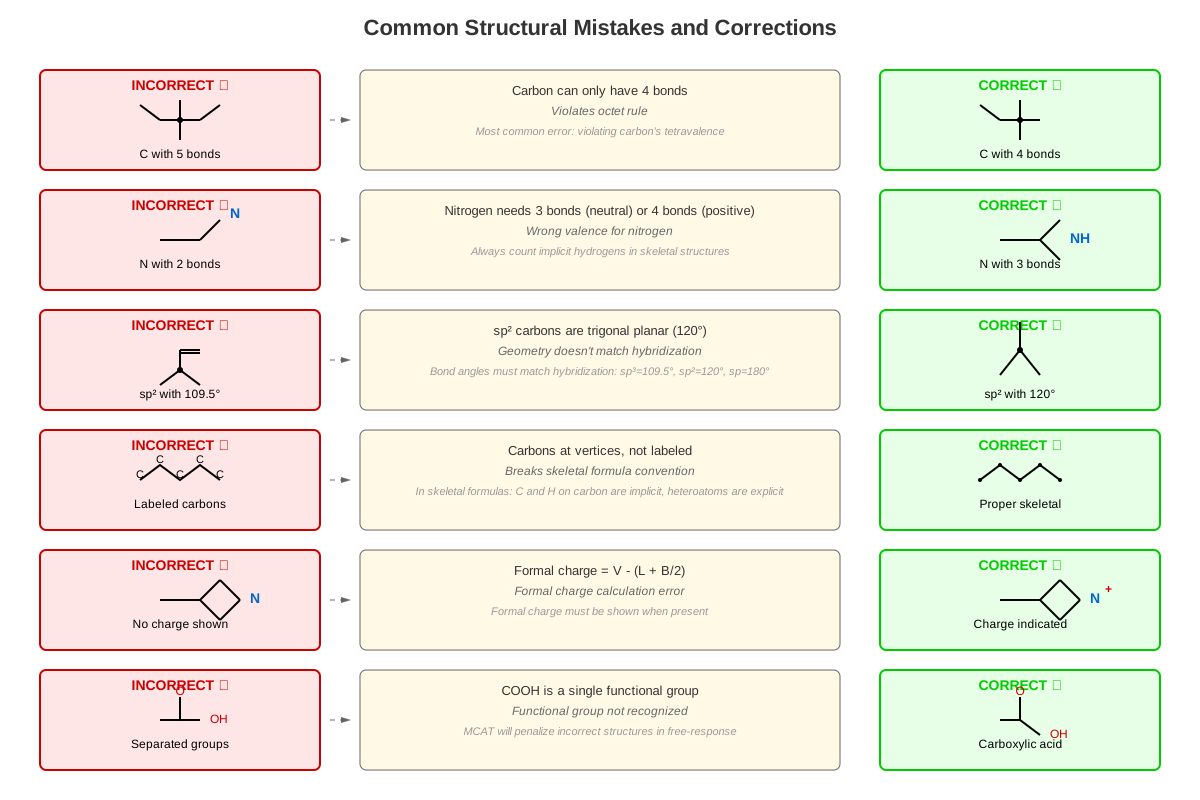
When answer choices show different structures, look for distinguishing features first. Don't compare every atom; instead, identify what makes each choice unique (functional group position, branching pattern, ring size). Eliminate choices that violate valence rules—carbon must have four bonds, oxygen two, nitrogen three.
Time-saving tip: If a question asks whether two structures are identical, look for differences in functional group position or connectivity first. If those match, the structures are likely identical even if drawn differently. Don't waste time redrawing structures unless absolutely necessary.
For passage-based questions, annotate structures in the passage as you read. Circle functional groups, number carbons in important molecules, and note any structural transformations described. These annotations save time when questions refer back to passage structures.
Process of elimination is particularly powerful for structure questions. Wrong answers often contain:
- Incorrect valence (five bonds to carbon, three to oxygen)
- Wrong molecular formula (count atoms if suspicious)
- Impossible stereochemistry (five substituents on one carbon)
- Misplaced functional groups (ester where ether should be)
Allocate approximately 60-90 seconds for discrete structure questions and up to 2 minutes for complex passage-based questions requiring structural analysis. If a structure seems overly complex, look for symmetry or repeating units that simplify analysis.
Memory Techniques
Mnemonic for common functional groups (in order of oxidation state for carbon):
"All Alcohols Are Kept Cool"
- Alkane (most reduced)
- Alcohol
- Aldehyde
- Ketone
- Carboxylic acid
- Carbon dioxide (most oxidized)
Mnemonic for heteroatom valences:
"HON if you're 1-2-3"
- Hydrogen forms 1 bond
- Oxygen forms 2 bonds
- Nitrogen forms 3 bonds
(Carbon forms 4, but that's so fundamental it needs no mnemonic)
Visualization strategy for line-angle formulas:
Imagine walking along the carbon chain. Each turn (vertex) is a carbon atom where you change direction. Each endpoint is a carbon atom where you stop. Heteroatoms are "roadblocks" that you must acknowledge explicitly. This kinesthetic approach helps students who struggle with abstract structural representations.
Acronym for systematic structure analysis: "CHOF"
- Count carbons
- Hydrogens (calculate implied)
- Other atoms (heteroatoms)
- Functional groups (identify)
Memory aid for degree of unsaturation:
"Double the carbons, add two, then subtract hydrogens and halogens, add nitrogens, divide by two"
This verbal formula helps students remember the calculation sequence without memorizing the algebraic expression.
Summary
Organic structures represent the fundamental language of organic chemistry, providing the visual and conceptual framework for understanding molecular architecture, reactivity, and biological function. Mastery of structural representations—particularly line-angle formulas—is non-negotiable for MCAT success, as these drawings appear throughout the Chemical and Physical Foundations section and in biochemistry passages. Students must develop fluency in converting between different structural representations, determining molecular formulas from drawings, calculating degrees of unsaturation, and identifying functional groups within complex molecules. The ability to rapidly and accurately interpret organic structures enables efficient problem-solving, as structural features directly predict chemical behavior and biological activity. Understanding that carbon forms four bonds, heteroatoms must be drawn explicitly, and hydrogens on carbon are implied forms the foundation for all structural interpretation. This topic connects to every subsequent organic chemistry concept and appears in approximately 15-20% of relevant MCAT questions, making it a high-yield investment of study time.
Key Takeaways
- Line-angle formulas are the primary structural representation on the MCAT; carbon atoms appear at vertices and termini, with hydrogens implied
- Each carbon forms exactly four bonds; count visible bonds to determine the number of implied hydrogens on each carbon
- Heteroatoms (O, N, S, halogens) must be drawn explicitly with their attached hydrogens and follow their own valence rules
- Functional groups are the reactive centers of organic molecules; identifying them enables prediction of chemical behavior
- Degree of unsaturation [(2C + 2 + N - H - X)/2] reveals the number of rings and pi bonds in a molecule
- Converting between structural representations and molecular formulas requires systematic counting of all atoms, including implied hydrogens
- Three-dimensional structure matters; wedge-and-dash notation conveys stereochemical information essential for understanding isomerism
Related Topics
Isomerism and Stereochemistry: Building on structural representation, this topic explores how the same molecular formula can yield different structures (constitutional isomers) or different spatial arrangements (stereoisomers). Mastering organic structures is prerequisite to understanding chirality, enantiomers, and diastereomers.
Functional Group Reactivity: Once functional groups can be identified within structures, the next step is predicting how they react. This topic covers nucleophiles, electrophiles, and characteristic reactions of alcohols, carbonyls, amines, and other functional groups.
Resonance and Electron Delocalization: Understanding how to draw resonance structures requires fluency in structural representation. This topic explains how electron delocalization affects stability and reactivity.
Nomenclature: Systematic IUPAC naming depends on identifying structural features—longest chain, functional groups, substituent positions. Strong structural skills make nomenclature much more intuitive.
Spectroscopy: NMR, IR, and mass spectrometry data are interpreted by proposing structures consistent with the spectroscopic information. Students must be able to draw candidate structures and evaluate them against experimental data.
Practice CTA
Now that you've mastered the fundamentals of organic structures, it's time to reinforce your learning through active practice. Attempt the practice questions associated with this topic, focusing on converting between different structural representations, identifying functional groups, and calculating molecular formulas. Use the flashcards to drill high-yield facts until structural interpretation becomes automatic. Remember: fluency with organic structures is like learning a new language—regular practice transforms conscious effort into intuitive understanding. The time you invest now in mastering structural representation will pay dividends across every organic chemistry and biochemistry question you encounter on test day. You've got this!
Sign up free to keep reading
Create a free AnvayaPrep account to finish this MCAT guide on Organic structures — plus flashcards and practice questions.