Overview
Resonance is a fundamental concept in Organic Chemistry that describes the delocalization of electrons within molecules containing conjugated systems or lone pairs adjacent to multiple bonds. Rather than existing as a single static structure, many organic molecules are best represented as a hybrid of multiple contributing structures, called resonance structures or resonance forms. This electron delocalization profoundly affects molecular stability, reactivity, acidity, basicity, and spectroscopic properties—all of which are frequently tested on the MCAT.
Understanding resonance is essential for predicting reaction mechanisms, explaining why certain intermediates are more stable than others, and rationalizing the physical properties of organic compounds. The concept bridges Structure and Bonding with reactivity patterns throughout organic chemistry, biochemistry, and even general chemistry topics on the MCAT. Students who master resonance gain a powerful tool for analyzing molecular behavior without memorizing countless individual reactions.
For the MCAT, resonance appears in multiple contexts: predicting the stability of carbocations and carbanions, understanding the reactivity of carbonyl compounds, explaining the acidity of carboxylic acids versus alcohols, and interpreting aromatic systems. The Chemical and Physical Foundations of Biological Systems section frequently incorporates resonance into passage-based questions about drug mechanisms, enzyme active sites, and metabolic intermediates. Mastery of this topic provides a significant competitive advantage, as it enables rapid problem-solving across diverse question types.
Learning Objectives
- [ ] Define Resonance using accurate Organic Chemistry terminology
- [ ] Explain why Resonance matters for the MCAT
- [ ] Apply Resonance to exam-style questions
- [ ] Identify common mistakes related to Resonance
- [ ] Connect Resonance to related Organic Chemistry concepts
- [ ] Draw all significant resonance structures for a given molecule following proper arrow-pushing conventions
- [ ] Rank resonance contributors by relative stability and determine the major contributor to the resonance hybrid
- [ ] Predict the effect of resonance stabilization on molecular properties including acidity, basicity, and reactivity
Prerequisites
- Lewis structures and formal charge calculation: Essential for drawing resonance structures and evaluating their relative contributions to the hybrid
- Electronegativity trends: Necessary for predicting electron distribution and assessing resonance structure stability
- Basic bonding theory (sigma and pi bonds): Required to understand which electrons can participate in delocalization
- Molecular orbital concepts: Provides the theoretical foundation for why electron delocalization occurs
- Acid-base chemistry fundamentals: Needed to appreciate how resonance affects pKa values and conjugate base stability
Why This Topic Matters
Resonance is not merely an abstract drawing exercise—it has profound implications for biological systems and pharmaceutical design. Many drug molecules exploit resonance stabilization to achieve proper binding affinity, membrane permeability, and metabolic stability. For example, aspirin's mechanism involves resonance-stabilized intermediates, and the peptide bond's partial double-bond character (due to resonance) determines protein secondary structure.
On the MCAT, resonance appears in approximately 3-5 questions per exam, either directly or as prerequisite knowledge for answering questions about reaction mechanisms, molecular stability, or spectroscopy. Questions may appear as discrete items testing conceptual understanding or embedded within passages about enzyme mechanisms, drug design, or metabolic pathways. The Chemical and Physical Foundations section most frequently tests resonance, but it also appears in Biological and Biochemical Foundations when discussing amino acid properties or nucleotide structure.
Common exam presentations include: (1) ranking molecules by acidity or basicity based on conjugate base/acid stabilization, (2) predicting major products by identifying the most stable carbocation intermediate, (3) explaining spectroscopic data (IR, NMR) based on bond character, and (4) analyzing reaction mechanisms where resonance-stabilized intermediates determine pathway selectivity. Recognizing these patterns allows efficient question triage and confident answer selection.
Core Concepts
Definition and Fundamental Principles
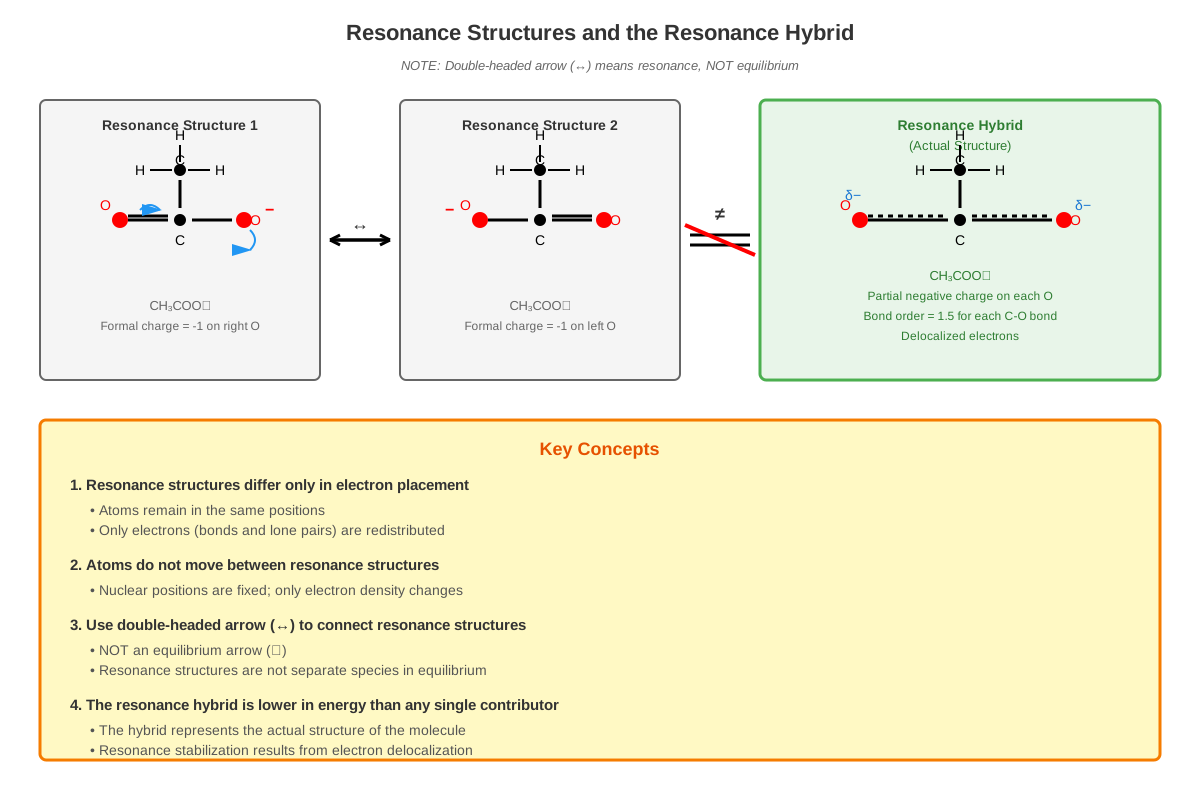
Resonance describes the phenomenon where a molecule's actual electronic structure cannot be adequately represented by a single Lewis structure. Instead, the true structure—called the resonance hybrid—is a weighted average of multiple contributing structures called resonance structures or resonance forms. Critically, resonance structures are not isomers and do not represent different molecules; they are alternative representations of the same molecule with electrons distributed differently.
The key principle underlying resonance is electron delocalization: pi electrons and lone pairs can spread across multiple atoms when the molecular geometry permits orbital overlap. This delocalization lowers the overall energy of the molecule compared to any single contributing structure, providing resonance stabilization. The energy difference between the most stable resonance contributor and the actual hybrid is called the resonance energy or delocalization energy.
Rules for Drawing Resonance Structures
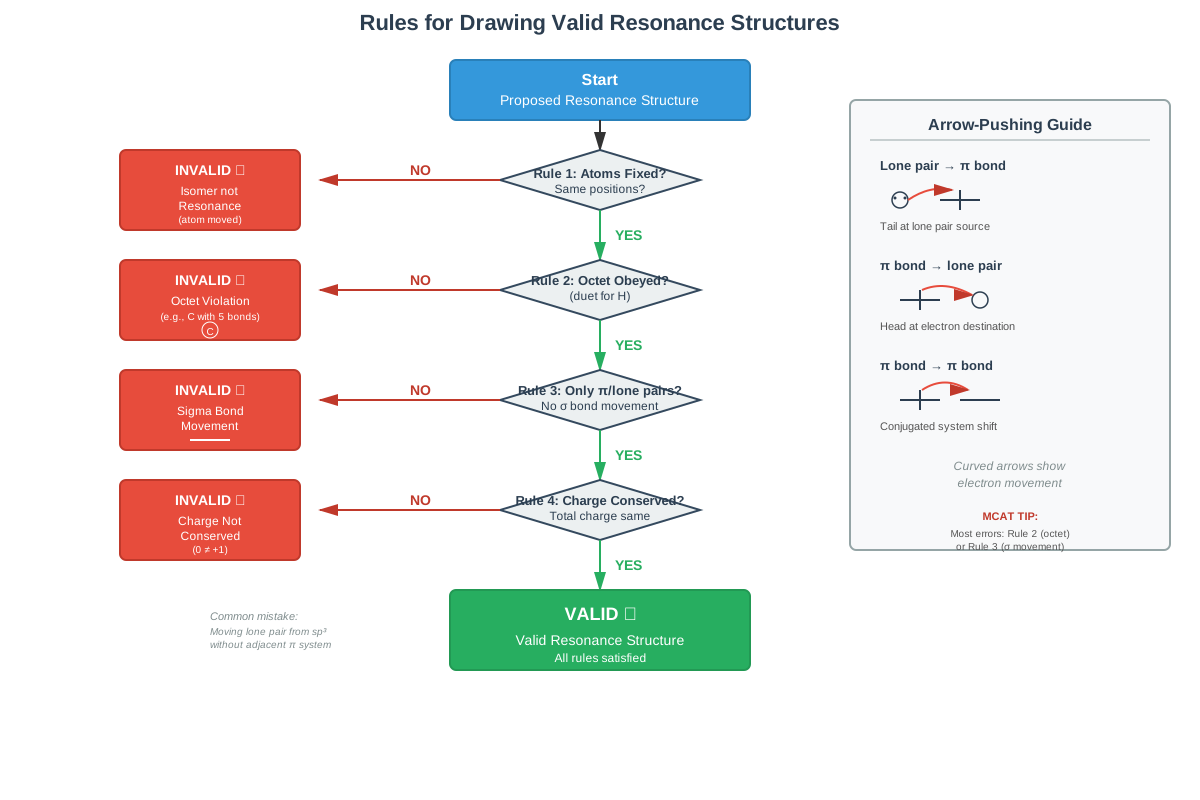
Drawing valid resonance structures requires following specific rules:
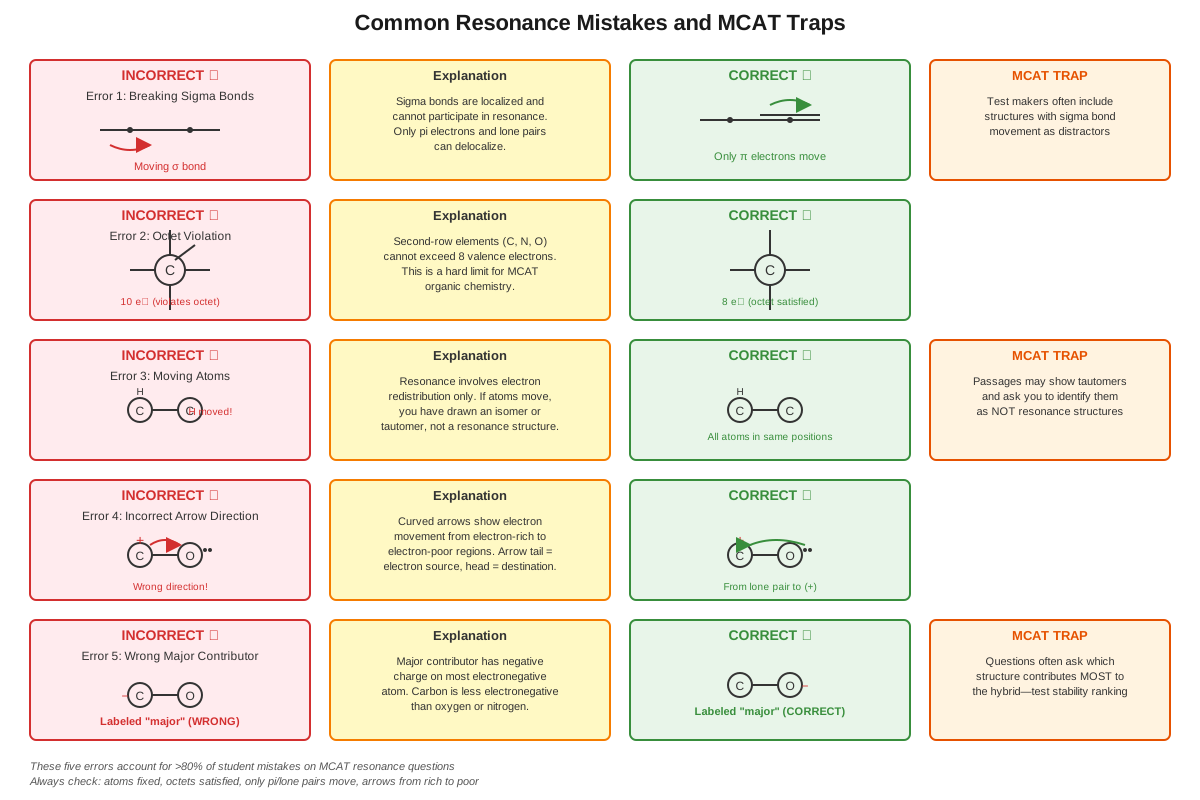
- Only electrons move, never atoms: The nuclear positions remain fixed; only pi electrons and lone pairs are redistributed
- Total number of electrons must remain constant: Cannot add or remove electrons between resonance forms
- Octet rule should be maintained when possible: Structures violating the octet rule (except for elements in period 3+) contribute less to the hybrid
- Overall charge must remain constant: The sum of formal charges must equal the molecular charge in all structures
- Use curved arrows to show electron movement: A double-headed arrow (↔) separates resonance structures, while curved arrows show electron flow
Curved Arrow Notation
Proper curved arrow notation is essential for communicating electron movement. A curved arrow originates from an electron source (lone pair or pi bond) and points to the electron destination (forming a new bond or becoming a lone pair). Common patterns include:
- Lone pair to adjacent pi bond: Creates a new pi bond while breaking an existing one
- Pi bond to adjacent atom: Moves pi electrons to create a lone pair or new bond
- Allylic systems: Electrons move across alternating single and double bonds
Evaluating Resonance Structure Stability
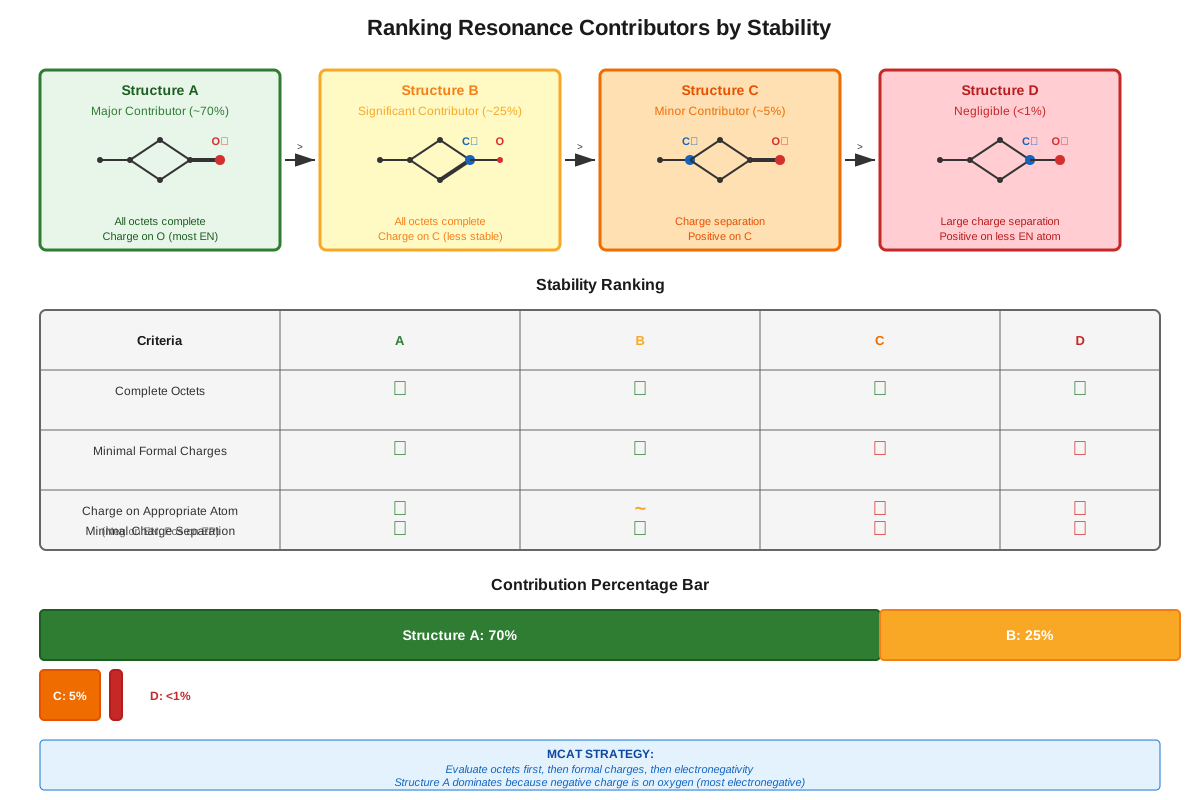
Not all resonance structures contribute equally to the hybrid. The major contributor most closely resembles the actual molecule and has the lowest energy. Stability ranking follows these guidelines (in order of importance):
- Complete octets: Structures where all atoms (except H) have complete octets are most stable
- Minimal formal charges: Structures with fewer formal charges are more stable
- Negative charge on more electronegative atoms: When formal charges exist, negative charges should reside on electronegative atoms (O, N, halogens)
- Positive charge on less electronegative atoms: Positive charges are more stable on less electronegative atoms (C vs. O)
- Charge separation: Structures with separated charges are less stable than those with neutral atoms or adjacent opposite charges
- Like charges separated: Structures with like charges far apart are more stable than those with like charges close together
| Stability Factor | More Stable | Less Stable |
|---|---|---|
| Octet completion | All octets complete | Incomplete octets |
| Formal charge quantity | Fewer charges | More charges |
| Negative charge location | On O, N, F | On C, H |
| Positive charge location | On C | On O, N, F |
| Charge distribution | Charges separated or absent | Like charges adjacent |
Common Resonance Patterns
Allylic Systems
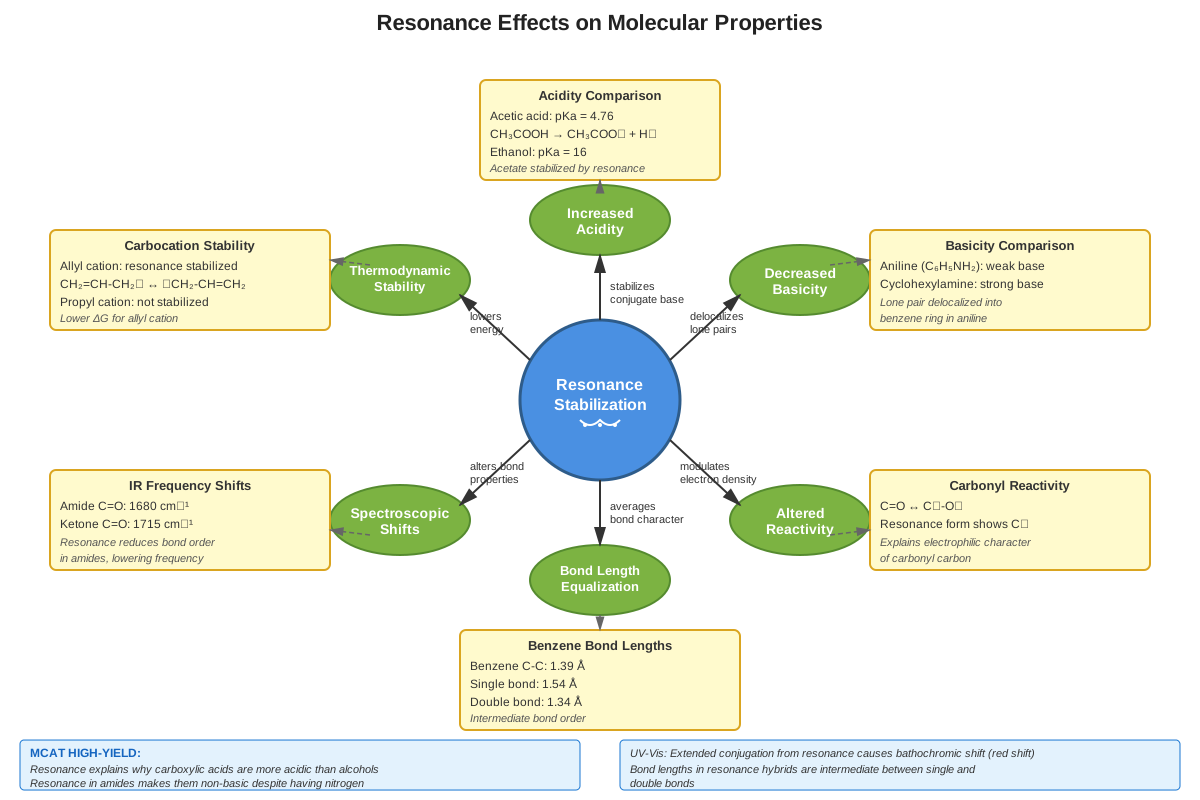
Allylic systems contain a pi bond adjacent to an atom with a lone pair, positive charge, or negative charge. The classic example is the allyl cation (CH₂=CH-CH₂⁺), where the positive charge delocalizes across C1 and C3, with C2 maintaining partial double-bond character to both terminal carbons.
Carbonyl Compounds
The carbonyl group (C=O) exhibits resonance where the pi electrons shift to oxygen, creating C⁺-O⁻. While the C=O structure is the major contributor (complete octets), the charge-separated form explains the carbonyl carbon's electrophilic character and oxygen's nucleophilic character.
Carboxylate Ions
Carboxylate ions (RCOO⁻) demonstrate equivalent resonance structures where the negative charge delocalizes equally between both oxygen atoms. This extensive delocalization explains why carboxylic acids are significantly more acidic (pKa ~5) than alcohols (pKa ~16). The resonance hybrid shows both C-O bonds with identical length (between single and double bonds) and both oxygens bearing -0.5 formal charge.
Amides
The amide functional group exhibits resonance between N-C=O and N⁺=C-O⁻ forms. This delocalization creates partial double-bond character in the C-N bond, restricting rotation and making the amide group planar—crucial for protein structure. The nitrogen's lone pair is less available for protonation, making amides much less basic than amines.
Aromatic Systems
Aromatic compounds like benzene represent the ultimate resonance stabilization. Benzene's six pi electrons delocalize equally across all six carbons, creating a ring of electron density above and below the plane. This delocalization provides approximately 36 kcal/mol of stabilization energy compared to hypothetical localized double bonds, explaining benzene's resistance to addition reactions.
Enolates
Enolate ions form when a carbonyl compound loses an alpha proton, creating a resonance-stabilized anion where negative charge delocalizes between the alpha carbon and carbonyl oxygen. This ambident nucleophile can react at either position, leading to C-alkylation or O-alkylation depending on conditions.
Resonance Effects on Molecular Properties
Acidity and Basicity
Resonance profoundly affects acid-base properties by stabilizing conjugate bases or acids. A compound is more acidic if its conjugate base is resonance-stabilized. For example:
- Acetic acid (pKa 4.76) vs. ethanol (pKa 16): The acetate ion has two equivalent resonance structures, while ethoxide has none
- Phenol (pKa 10) vs. cyclohexanol (pKa 16): The phenoxide ion delocalizes negative charge into the aromatic ring
- Aniline (pKb 9.4) vs. cyclohexylamine (pKb 3.3): Aniline's lone pair participates in aromatic resonance, making it less available for protonation
Bond Lengths and Strengths
Resonance affects bond characteristics by creating partial multiple-bond character. The C-N bond in amides (1.33 Å) is shorter than typical C-N single bonds (1.47 Å) but longer than C=N double bonds (1.27 Å). Similarly, carboxylate C-O bonds are identical and intermediate between single and double bonds.
Reactivity Patterns
Resonance-stabilized intermediates form more readily, directing reaction pathways. Carbocations adjacent to pi bonds or lone pairs (allylic, benzylic) are more stable and form preferentially. Electrophilic aromatic substitution occurs because the carbocation intermediate is resonance-stabilized, though less stable than the aromatic starting material.
Concept Relationships
Resonance connects intimately with multiple organic chemistry concepts, forming a conceptual network essential for MCAT success. Lewis structures provide the foundation → Resonance extends Lewis theory to molecules requiring multiple structures → Molecular stability is enhanced by resonance → Reaction mechanisms proceed through resonance-stabilized intermediates → Acidity and basicity are explained by conjugate species stabilization → Aromatic chemistry depends entirely on resonance stabilization.
The relationship to formal charge is bidirectional: formal charge calculation helps evaluate resonance structure stability, while resonance explains why formal charges don't always predict reactivity. Electronegativity determines which resonance structures contribute most significantly, as electronegative atoms better accommodate negative charges.
Conjugation (alternating single and double bonds) enables resonance by providing continuous p-orbital overlap. This connects to molecular orbital theory, where resonance is explained as electron delocalization across multiple atomic orbitals forming extended pi systems. Understanding hybridization is crucial because only p-orbitals participate in pi bonding and resonance; sp³-hybridized atoms cannot participate in resonance delocalization.
The concept extends to spectroscopy: resonance affects IR absorption frequencies (amide C=O stretches at lower frequency than ketone C=O), NMR chemical shifts (aromatic protons are deshielded), and UV-Vis absorption (conjugated systems absorb at longer wavelengths). In reaction mechanisms, recognizing resonance-stabilized intermediates predicts major products and explains regioselectivity.
Quick check — test yourself on Resonance so far.
Try Flashcards →High-Yield Facts
⭐ Resonance structures are not isomers or equilibrium forms—they are different representations of a single molecule with delocalized electrons
⭐ The resonance hybrid is more stable (lower energy) than any individual resonance contributor, with the energy difference called resonance energy
⭐ Carboxylate ions have two equivalent resonance structures, making carboxylic acids much more acidic (pKa ~5) than alcohols (pKa ~16)
⭐ Resonance structures with complete octets and minimal formal charges contribute most to the hybrid
⭐ Amide nitrogen is weakly basic because its lone pair participates in resonance with the carbonyl, creating partial C-N double-bond character
- Allylic and benzylic carbocations are stabilized by resonance, making them more likely intermediates in substitution and elimination reactions
- Aromatic compounds resist addition reactions because they would lose resonance stabilization (aromaticity)
- Enolate ions are ambident nucleophiles due to resonance delocalization between carbon and oxygen
- Phenoxide ion is more stable than alkoxide ions due to resonance with the aromatic ring, making phenols more acidic than alcohols
- The C-N bond in peptides has partial double-bond character from resonance, restricting rotation and maintaining protein structure
- Resonance electron donation (through conjugation) activates aromatic rings toward electrophilic substitution, while resonance withdrawal deactivates them
- Conjugated dienes are more stable than isolated dienes by approximately 3-4 kcal/mol due to resonance
Common Misconceptions
Misconception: Resonance structures represent different molecules that interconvert rapidly.
Correction: Resonance structures are not separate molecules or equilibrium forms. They are different drawings of the same molecule, which exists as a single hybrid structure with delocalized electrons. The double-headed arrow (↔) between resonance structures is distinct from equilibrium arrows (⇌).
Misconception: All resonance structures contribute equally to the resonance hybrid.
Correction: Resonance structures contribute proportionally to their stability. Structures with complete octets, minimal formal charges, and appropriate charge placement contribute more. The major contributor most closely resembles the actual molecule, while minor contributors may contribute negligibly.
Misconception: Atoms move when drawing resonance structures.
Correction: Only electrons move between resonance structures; atomic positions remain fixed. Moving atoms would create constitutional isomers, not resonance structures. The molecular skeleton and geometry stay constant while pi electrons and lone pairs redistribute.
Misconception: More resonance structures always mean greater stability.
Correction: The number of resonance structures matters less than their quality. Two equivalent, high-quality resonance structures (like in carboxylate) provide more stabilization than five poor-quality structures with charge separation or incomplete octets. Focus on significant contributors, not total count.
Misconception: Resonance only occurs in molecules with double bonds.
Correction: While pi bonds commonly participate in resonance, lone pairs adjacent to pi bonds or empty p-orbitals also create resonance. For example, carbocations adjacent to atoms with lone pairs (like oxygen or nitrogen) are resonance-stabilized even though the heteroatom initially has no pi bond.
Misconception: The resonance hybrid is an equilibrium mixture of resonance structures.
Correction: The hybrid is not a mixture but a single structure with intermediate properties. For example, benzene doesn't alternate between two Kekulé structures; it exists as one molecule with six equivalent C-C bonds, each with bond order 1.5. Electrons are truly delocalized, not rapidly moving between positions.
Worked Examples
Example 1: Comparing Acidity Using Resonance
Question: Rank the following compounds in order of increasing acidity: cyclohexanol, phenol, and benzoic acid. Explain your reasoning using resonance.
Solution:
Step 1: Identify what makes a compound acidic—stability of the conjugate base. More stable conjugate base = stronger acid.
Step 2: Draw the conjugate base of each compound:
- Cyclohexanol → cyclohexoxide (C₆H₁₁O⁻): negative charge localized on oxygen
- Phenol → phenoxide (C₆H₅O⁻): negative charge on oxygen adjacent to aromatic ring
- Benzoic acid → benzoate (C₆H₅COO⁻): negative charge delocalized between two oxygens
Step 3: Evaluate resonance stabilization:
- Cyclohexoxide: No resonance structures possible; charge remains localized on oxygen
- Phenoxide: Negative charge delocalizes into the aromatic ring through four resonance structures, placing negative charge on ortho and para carbons
- Benzoate: Two equivalent resonance structures with negative charge equally distributed between both oxygens (most stable)
Step 4: Rank by conjugate base stability (most stable = strongest acid):
Benzoate > phenoxide > cyclohexoxide
Answer: Cyclohexanol < phenol < benzoic acid (increasing acidity)
Typical pKa values: cyclohexanol (~16), phenol (~10), benzoic acid (~4.2)
MCAT Connection: This question type appears frequently, testing whether students recognize that resonance stabilization of the conjugate base increases acidity. Watch for comparisons between carboxylic acids and alcohols, or phenols and aliphatic alcohols.
Example 2: Drawing and Evaluating Resonance Structures
Question: Draw all significant resonance structures for the acetate ion (CH₃COO⁻) and identify the major contributor(s).
Solution:
Step 1: Draw the initial Lewis structure:
    O⁻
    ‖
CH₃-C
    ‖
    O
Step 2: Identify electrons that can move—the pi bond between C and O can shift, and the negative charge (lone pair) on one oxygen can form a pi bond.
Step 3: Use curved arrows to show electron movement:
- Arrow from O⁻ lone pair toward C-O bond
- Arrow from C=O pi bond toward the other oxygen
Step 4: Draw the resulting resonance structure:
    O
    ‖
CH₃-C
    ‖
    O⁻
Step 5: Evaluate stability—both structures have:
- Complete octets on all atoms ✓
- Same number of formal charges (one negative) ✓
- Negative charge on oxygen (appropriate for electronegative atom) ✓
- Identical connectivity and geometry ✓
Answer: Two equivalent resonance structures exist, both contributing equally to the hybrid. The actual structure has both C-O bonds with identical length (1.27 Å, between single and double) and both oxygens bearing -0.5 formal charge.
MCAT Connection: Recognizing equivalent resonance structures is crucial for understanding why carboxylic acids are acidic and why carboxylate salts are good leaving groups in biochemical reactions (like acetyl-CoA).
Exam Strategy
When approaching MCAT questions involving resonance, follow this systematic strategy:
Recognition Phase: Identify resonance-relevant trigger words and structural features. Watch for: "most acidic," "most basic," "most stable intermediate," "major product," "conjugated system," "aromatic," "delocalized," or any question asking about relative stability. Structurally, look for pi bonds adjacent to lone pairs, charges, or other pi bonds.
Analysis Phase: For ranking questions (acidity, basicity, stability), immediately draw or visualize the relevant species—usually conjugate bases for acidity questions or carbocation intermediates for stability questions. Count the number of significant resonance structures and evaluate their quality using the stability hierarchy (complete octets > minimal charges > appropriate charge placement).
Elimination Strategy: Eliminate answers that violate fundamental principles:
- Choices suggesting resonance structures are equilibrium forms or isomers
- Answers placing negative charges on carbon when oxygen is available
- Options ignoring resonance stabilization entirely
- Selections that violate the octet rule without justification
Time Management: Resonance questions typically require 60-90 seconds. If a question asks you to draw all resonance structures, focus on significant contributors only—don't waste time on minor structures with charge separation or incomplete octets unless specifically asked. For ranking questions, if you can identify the most and least stable species, you can often eliminate 2-3 answer choices immediately.
Common Question Formats:
- Ranking by acidity/basicity: Focus on conjugate species stability
- Predicting major products: Identify which intermediate is most resonance-stabilized
- Explaining spectroscopic data: Resonance affects bond character and electron density
- Mechanism questions: Recognize when resonance-stabilized intermediates form
Exam Tip: If you're unsure between two answer choices, favor the option that invokes resonance stabilization. The MCAT frequently tests whether students recognize resonance effects, so answers incorporating this concept are often correct.
Memory Techniques
Mnemonic for Resonance Structure Stability (OCEAN):
- Octets complete (most important)
- Charges minimized
- Electronegative atoms hold negative charges
- Appropriate charge placement
- No like charges adjacent
Visualization Strategy: Picture resonance as "electron sharing" rather than electron movement. Imagine pi electrons as a cloud spread across multiple atoms rather than localized between two atoms. For aromatic systems, visualize a donut of electron density above and below the ring.
Acronym for Common Resonance Patterns (CAAE):
- Carbonyl (C=O ↔ C⁺-O⁻)
- Allylic (C=C-C⁺ ↔ C⁺-C=C)
- Amide (N-C=O ↔ N⁺=C-O⁻)
- Enolate (C⁻-C=O ↔ C=C-O⁻)
Arrow-Pushing Reminder: "Electrons flow from high to low"—curved arrows always originate from electron-rich regions (lone pairs, pi bonds, negative charges) and point toward electron-poor regions (positive charges, atoms that can accept electrons).
Acidity Memory Aid: "Resonance Relaxes Anions" (RRA)—resonance stabilization of the conjugate base (anion) increases acidity. The more relaxed (delocalized) the negative charge, the stronger the acid.
Summary
Resonance is a fundamental concept describing electron delocalization in molecules that cannot be adequately represented by a single Lewis structure. The actual molecular structure—the resonance hybrid—is a weighted average of multiple resonance contributors, with more stable structures contributing more significantly. Resonance stabilization occurs when pi electrons or lone pairs delocalize across multiple atoms through continuous p-orbital overlap, lowering the molecule's overall energy. This delocalization profoundly affects molecular properties including acidity, basicity, reactivity, and bond characteristics. For the MCAT, mastering resonance enables prediction of reaction outcomes, explanation of relative acidity and basicity, understanding of aromatic chemistry, and analysis of biological molecules like peptides and nucleotides. Success requires ability to draw resonance structures using proper curved-arrow notation, evaluate their relative stability using the hierarchy of complete octets, minimal formal charges, and appropriate charge placement, and apply these principles to predict molecular behavior in diverse contexts.
Key Takeaways
- Resonance structures are alternative representations of a single molecule with delocalized electrons, not separate molecules or equilibrium forms
- The resonance hybrid is more stable than any individual contributor, with stability determined by complete octets, minimal formal charges, and appropriate charge placement
- Resonance stabilization of conjugate bases increases acidity; carboxylic acids (pKa ~5) are much more acidic than alcohols (pKa ~16) due to carboxylate resonance
- Common resonance patterns include allylic systems, carbonyl compounds, carboxylates, amides, enolates, and aromatic rings
- Amide nitrogen is weakly basic because its lone pair participates in resonance with the carbonyl, creating partial C-N double-bond character
- Only electrons move between resonance structures (shown with curved arrows); atomic positions remain fixed
- For MCAT questions, focus on drawing significant resonance contributors and using resonance stabilization to rank acidity, basicity, or intermediate stability
Related Topics
Aromatic Chemistry: Builds directly on resonance principles, as aromaticity requires cyclic delocalization of pi electrons. Understanding resonance is prerequisite for mastering electrophilic aromatic substitution and explaining aromatic stability.
Carbonyl Chemistry: Resonance explains carbonyl reactivity patterns, including nucleophilic addition mechanisms, enolate formation, and the behavior of carboxylic acid derivatives. The concept of resonance donation and withdrawal determines reactivity differences between aldehydes, ketones, esters, and amides.
Reaction Mechanisms: Resonance-stabilized intermediates (carbocations, carbanions, radicals) determine reaction pathways and product distributions. Mastering resonance enables prediction of major products in substitution, elimination, and addition reactions.
Acid-Base Chemistry: Resonance provides the molecular-level explanation for pKa differences, enabling prediction of acid-base equilibria in biological systems and organic reactions.
Molecular Orbital Theory: Provides the quantum mechanical foundation for resonance, explaining electron delocalization through constructive orbital overlap and energy level diagrams.
Practice CTA
Now that you've mastered the core concepts of resonance, it's time to solidify your understanding through active practice. Challenge yourself with the accompanying practice questions that test your ability to draw resonance structures, rank molecular acidity and basicity, and apply resonance principles to predict reaction outcomes. Use the flashcards to reinforce high-yield facts and common patterns. Remember, resonance is not just about drawing structures—it's about understanding how electron delocalization affects every aspect of molecular behavior. The more you practice applying these principles, the more intuitive they become, giving you a significant advantage on test day. You've got this!
Sign up free to keep reading
Create a free AnvayaPrep account to finish this MCAT guide on Resonance — plus flashcards and practice questions.