Overview
Steric effects represent one of the most fundamental yet frequently underappreciated concepts in Organic Chemistry. These effects arise from the physical space occupied by atoms and groups of atoms within molecules, influencing everything from molecular geometry to reaction rates and product distributions. Understanding steric effects is essential for predicting how molecules will behave in three-dimensional space—a critical skill for the MCAT, where questions often require visualization of molecular interactions and prediction of reaction outcomes.
On the MCAT, steric effects appear across multiple contexts within Organic Chemistry and biochemistry. Test-makers frequently incorporate steric considerations into questions about nucleophilic substitution mechanisms (SN1 vs. SN2), elimination reactions (E1 vs. E2), conformational analysis, and even enzyme-substrate interactions. The ability to recognize when bulky groups will hinder or prevent reactions distinguishes high-scoring students from those who merely memorize reaction conditions without understanding the underlying spatial constraints.
Steric effects connect intimately with broader principles of Structure and Bonding, serving as a bridge between two-dimensional structural formulas and three-dimensional molecular reality. They influence bond angles, molecular stability, reaction kinetics, and thermodynamics. Mastering steric effects enables students to predict reactivity patterns, explain stereochemical outcomes, and understand why certain conformations are favored over others—all high-yield topics for Steric effects MCAT questions that appear consistently across test administrations.
Learning Objectives
- [ ] Define Steric effects using accurate Organic Chemistry terminology
- [ ] Explain why Steric effects matters for the MCAT
- [ ] Apply Steric effects to exam-style questions
- [ ] Identify common mistakes related to Steric effects
- [ ] Connect Steric effects to related Organic Chemistry concepts
- [ ] Predict how steric hindrance influences reaction mechanisms and rates
- [ ] Evaluate conformational stability based on steric interactions
- [ ] Distinguish between steric and electronic effects in molecular systems
Prerequisites
- Basic molecular geometry and VSEPR theory: Understanding three-dimensional molecular shapes is essential for visualizing how groups occupy space and interact
- Lewis structures and formal charges: Necessary for identifying where electron density resides and how atoms are connected before considering spatial arrangements
- Nomenclature and functional groups: Required to recognize and communicate about different substituents and their relative sizes
- Basic thermodynamics and kinetics: Needed to understand how steric effects influence reaction rates and equilibrium positions
- Hybridization and orbital theory: Provides the foundation for understanding bond angles and spatial orientation of groups
Why This Topic Matters
Steric effects have profound clinical and real-world significance. Drug design relies heavily on understanding how molecular shape affects binding to biological targets. Many pharmaceuticals exist as specific stereoisomers because steric interactions determine which form fits properly into enzyme active sites or receptor binding pockets. For example, thalidomide's tragic history stems partly from different biological activities of its enantiomers, where steric factors influence how each form interacts with biological systems.
On the MCAT, Steric effects Organic Chemistry questions appear with moderate to high frequency, typically comprising 2-4 questions per exam either directly or as part of passage-based scenarios. These questions most commonly appear in:
- Discrete questions testing mechanism selection (SN1 vs. SN2, E1 vs. E2)
- Passage-based questions involving conformational analysis of cyclic compounds
- Biochemistry passages discussing enzyme specificity and substrate binding
- Research-based passages presenting novel reactions where students must predict outcomes based on steric considerations
The MCAT particularly favors questions that require students to integrate steric effects with other concepts, such as predicting major products when both steric and electronic factors compete, or explaining why certain conformations predominate in biological systems. Understanding steric effects is not merely about memorizing that "bulky groups slow reactions"—it requires spatial reasoning and the ability to visualize three-dimensional interactions, skills that separate top performers from average test-takers.
Core Concepts
Definition and Fundamental Principles
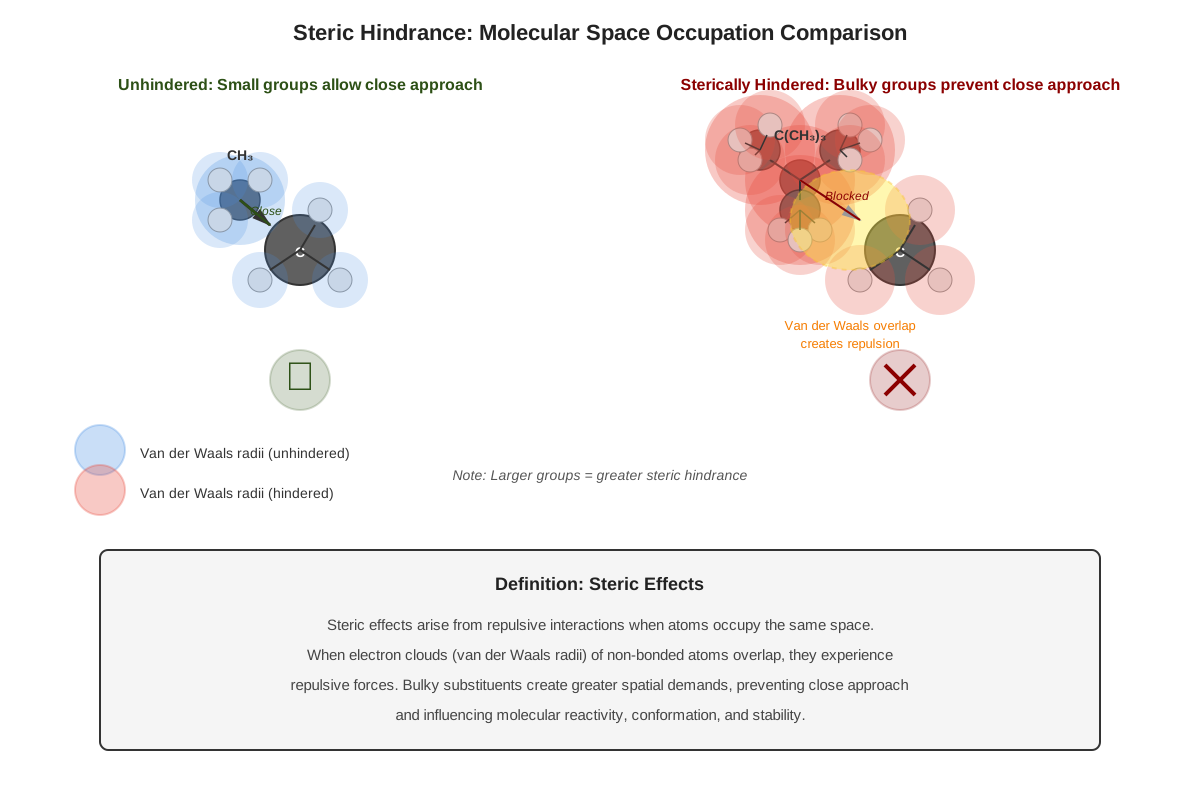
Steric effects refer to the influence that the spatial arrangement of atoms within a molecule has on the molecule's structure, stability, and reactivity. These effects arise because atoms and groups of atoms occupy physical space, and when groups are forced into close proximity, repulsive interactions occur between their electron clouds. This steric hindrance or steric strain increases the energy of the system and influences molecular behavior.
The magnitude of steric effects depends on several factors:
- The size of the groups involved (larger groups create more hindrance)
- The distance between interacting groups (closer proximity increases repulsion)
- The geometry of the molecule (bond angles and conformations)
- The flexibility of the molecular framework (rigid vs. flexible systems)
Types of Steric Interactions
Van der Waals Repulsion
When non-bonded atoms approach closer than the sum of their van der Waals radii, strong repulsive forces develop. This repulsion increases exponentially as distance decreases, making it energetically unfavorable for bulky groups to occupy the same region of space. This principle underlies most steric effects observed in organic molecules.
Torsional Strain
Torsional strain arises from eclipsing interactions between bonds on adjacent atoms. When viewing a molecule along a carbon-carbon bond (Newman projection), eclipsed conformations place electron density from adjacent bonds in close proximity, creating repulsive interactions. This type of steric effect is particularly important in conformational analysis.
Angle Strain
When bond angles deviate from ideal values (109.5° for sp³, 120° for sp², 180° for sp), angle strain results. While primarily a bonding phenomenon, angle strain often works in concert with steric effects, especially in small ring systems where geometric constraints force unfavorable spatial arrangements.
Steric Effects in Conformational Analysis
Conformational analysis examines the different three-dimensional arrangements that molecules can adopt through rotation around single bonds. Steric effects play the dominant role in determining which conformations are most stable.
For ethane, rotation around the C-C bond generates conformations ranging from staggered (lowest energy) to eclipsed (highest energy). The energy difference (~3 kcal/mol) arises primarily from torsional strain in the eclipsed conformation.
For butane, the analysis becomes more complex. The anti conformation (dihedral angle = 180°) is most stable, followed by gauche conformations (dihedral angle ≈ 60°), with eclipsed conformations highest in energy. The gauche conformation experiences gauche interactions—steric repulsion between the two methyl groups when they occupy adjacent positions. This destabilizes the gauche form by approximately 0.9 kcal/mol relative to the anti conformation.
Steric Effects in Cyclic Systems
Cyclic compounds provide excellent examples of steric effects because their rigid frameworks prevent groups from simply rotating away from each other.
Cyclohexane adopts a chair conformation to minimize steric interactions. In this conformation, substituents can occupy two positions:
- Axial positions: oriented perpendicular to the ring plane
- Equatorial positions: oriented roughly in the ring plane
Substituents strongly prefer equatorial positions because axial substituents experience 1,3-diaxial interactions—steric repulsion with axial hydrogens on carbons 1 and 3 positions away. The energy cost of placing a substituent in an axial position increases with substituent size:
| Substituent | Energy Cost (kcal/mol) |
|---|---|
| H | 0.0 |
| CH₃ | 1.8 |
| CH₂CH₃ | 1.9 |
| CH(CH₃)₂ | 2.1 |
| C(CH₃)₃ | ~5.0 |
The tert-butyl group is so large that it essentially "locks" the cyclohexane ring into the conformation where it occupies an equatorial position.
Steric Effects on Reaction Rates
Steric effects profoundly influence reaction kinetics, particularly in reactions involving nucleophilic attack or approach of reagents to reactive centers.
SN2 Reactions
The SN2 mechanism requires backside attack by a nucleophile, with the nucleophile approaching from the side opposite the leaving group. Bulky substituents on the carbon undergoing substitution create a "shield" that blocks nucleophile approach, dramatically slowing the reaction.
Relative SN2 reaction rates follow this pattern:
- Methyl (CH₃X): fastest (no steric hindrance)
- Primary (RCH₂X): fast (minimal hindrance)
- Secondary (R₂CHX): slow (moderate hindrance)
- Tertiary (R₃CX): essentially no reaction (severe hindrance)
This steric effect is so pronounced that tertiary substrates virtually never undergo SN2 reactions under normal conditions.
SN1 Reactions
The SN1 mechanism proceeds through a carbocation intermediate. While the rate-determining step (carbocation formation) is less affected by steric factors, bulky groups actually stabilize carbocations through hyperconjugation and inductive effects. However, steric effects influence the second step—nucleophile attack on the carbocation. Bulky groups surrounding the carbocation can direct nucleophile attack to the less hindered face, affecting stereochemical outcomes.
Elimination Reactions
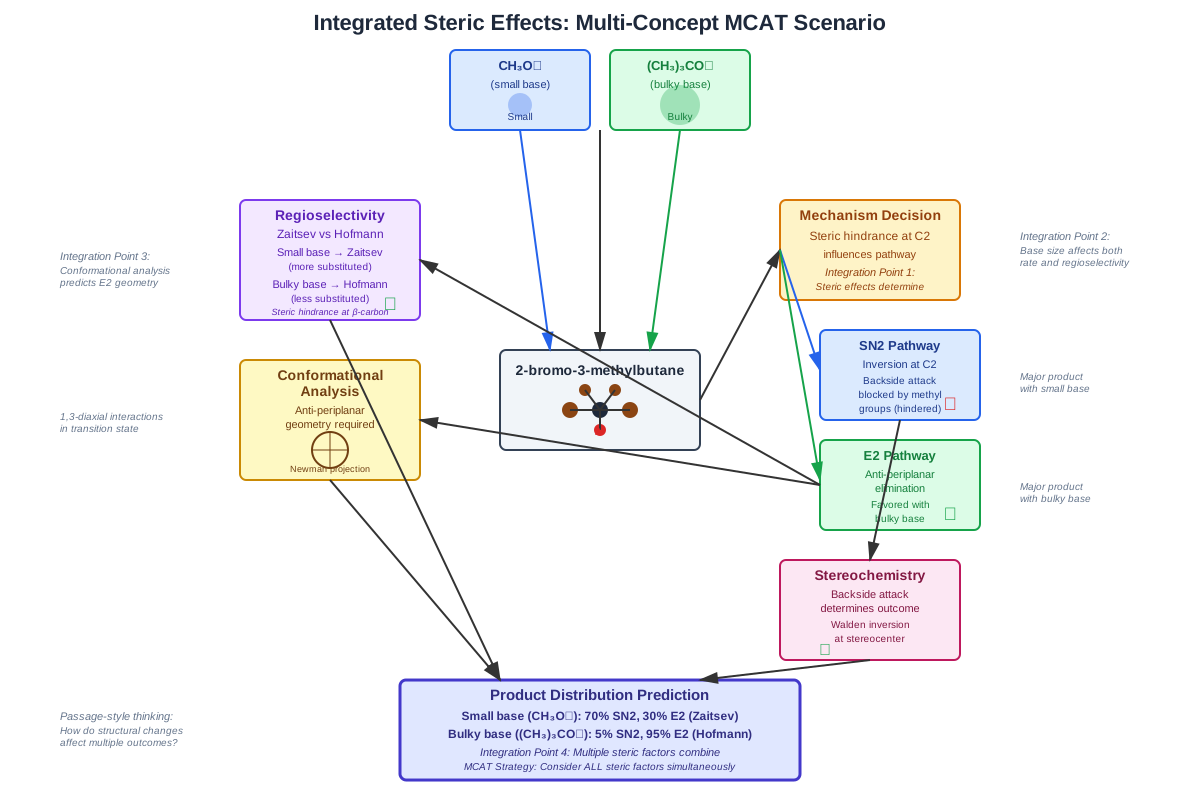
In E2 eliminations, steric effects influence both the rate and the regiochemistry (which product forms). Bulky bases preferentially abstract less hindered protons, often leading to formation of the less substituted (Hofmann) product rather than the more substituted (Zaitsev) product. This steric control of regiochemistry is particularly important with bases like tert-butoxide.
Steric Effects on Equilibria and Stability
Steric effects influence thermodynamic stability and equilibrium positions. Molecules with severe steric strain are higher in energy and less stable than less crowded alternatives.
A-values quantify the preference of substituents for equatorial positions in cyclohexane. These values directly reflect the magnitude of steric interactions and allow prediction of conformational equilibria.
In carbonyl addition reactions, steric effects influence the position of equilibrium. Bulky groups near the carbonyl carbon destabilize the tetrahedral addition product more than the planar carbonyl starting material, shifting equilibrium toward the carbonyl form.
Steric vs. Electronic Effects
Distinguishing between steric effects and electronic effects is crucial for MCAT success. While steric effects arise from physical space occupation, electronic effects result from electron donation or withdrawal through bonds (inductive effects) or through space (field effects) or through π systems (resonance).
These effects often work together but can also oppose each other. For example:
- Tert-butyl groups are both sterically bulky (steric effect) and electron-donating (electronic effect)
- In some reactions, steric hindrance dominates, slowing reactions
- In others, electronic stabilization dominates, accelerating reactions
The MCAT frequently tests the ability to determine which effect predominates in a given situation.
Concept Relationships
Steric effects serve as a central organizing principle connecting multiple areas of organic chemistry. The foundational concept of atoms occupying space → leads to → conformational preferences in acyclic and cyclic systems. These conformational preferences → influence → reaction rates and mechanisms, particularly in substitution and elimination reactions.
The relationship between steric effects and molecular geometry is bidirectional: molecular geometry determines the spatial arrangement of groups (creating potential steric interactions), while steric effects drive molecules toward geometries that minimize unfavorable interactions. This feedback loop → explains → why certain conformations predominate and why molecules adopt specific three-dimensional shapes.
Steric effects → connect to → stereochemistry through their influence on reaction outcomes. When nucleophiles attack sterically hindered carbons, they preferentially approach from the less hindered face, determining the stereochemical configuration of products. This principle → extends to → biochemical systems, where enzyme active sites use steric constraints to achieve substrate specificity and control reaction stereochemistry.
The concept also → relates to → thermodynamics and kinetics: steric strain increases molecular energy (thermodynamic effect) and creates energy barriers to reactions (kinetic effect). Understanding this dual influence → enables → prediction of both reaction rates and equilibrium positions.
Finally, steric effects → must be distinguished from but often work alongside → electronic effects. Both influence stability and reactivity, and the interplay between them → determines → outcomes in complex molecular systems, a relationship frequently tested on the MCAT.
Quick check — test yourself on Steric effects so far.
Try Flashcards →High-Yield Facts
⭐ Steric hindrance decreases SN2 reaction rates in the order: methyl > primary > secondary >> tertiary (essentially no reaction)
⭐ Equatorial positions in cyclohexane are favored over axial positions due to 1,3-diaxial interactions; tert-butyl groups essentially lock the ring conformation
⭐ Bulky bases (like tert-butoxide) favor Hofmann elimination products (less substituted alkene) over Zaitsev products due to steric effects
⭐ Gauche interactions in butane destabilize the gauche conformation by ~0.9 kcal/mol relative to the anti conformation
⭐ The energy cost of placing a methyl group in an axial position on cyclohexane is approximately 1.8 kcal/mol
- Steric effects arise from van der Waals repulsion when non-bonded atoms approach closer than the sum of their van der Waals radii
- Torsional strain in eclipsed conformations contributes approximately 3 kcal/mol to the rotational barrier in ethane
- Steric hindrance at carbonyl carbons shifts addition equilibria toward the carbonyl form rather than the tetrahedral adduct
- In SN1 reactions, steric effects primarily influence the second step (nucleophile attack) rather than the rate-determining carbocation formation
- Enzyme active sites exploit steric effects to achieve substrate specificity, accepting only molecules with appropriate size and shape
- Steric effects and electronic effects can work synergistically or oppose each other; determining which dominates requires analysis of the specific system
- Ring strain in small cyclic compounds results from a combination of angle strain, torsional strain, and steric interactions
Common Misconceptions
Misconception: Steric effects only slow down reactions. → Correction: While steric hindrance typically decreases reaction rates, steric effects can also influence product distribution, conformational equilibria, and even accelerate certain reactions by destabilizing starting materials or intermediates more than transition states.
Misconception: Larger molecules always experience more steric strain. → Correction: Steric strain depends on how groups are arranged in space, not just molecular size. A large, linear molecule may have minimal steric interactions, while a small, highly branched molecule can experience severe steric strain. The key is proximity of non-bonded groups.
Misconception: Axial and equatorial positions in cyclohexane are fixed. → Correction: Cyclohexane undergoes rapid ring flipping at room temperature, interconverting axial and equatorial positions. What matters is the equilibrium distribution—substituents spend more time in the lower-energy equatorial position, but both conformations exist in dynamic equilibrium.
Misconception: Steric effects and electronic effects are the same thing. → Correction: Steric effects arise from physical space occupation and van der Waals repulsion, while electronic effects result from electron donation or withdrawal through bonds or space. A tert-butyl group is both sterically bulky and electron-donating, but these are distinct properties with different consequences.
Misconception: Tertiary carbocations are less stable than primary carbocations because of steric crowding. → Correction: Tertiary carbocations are actually MORE stable than primary carbocations due to hyperconjugation and inductive effects (electronic factors). The steric bulk of tertiary substrates affects the rate of SN2 reactions (making them impossible), not carbocation stability in SN1 reactions.
Misconception: Steric effects only matter in organic chemistry, not in biochemistry. → Correction: Steric effects are crucial in biochemistry, determining enzyme-substrate specificity, protein folding, drug-receptor interactions, and the three-dimensional structure of biomolecules. The MCAT frequently tests steric concepts in biological contexts.
Worked Examples
Example 1: Predicting SN1 vs. SN2 Mechanism
Question: Consider the reaction of 2-bromo-2-methylpropane (tert-butyl bromide) with sodium methoxide in methanol. Will this reaction proceed by SN1 or SN2 mechanism, and what is the major product?
Solution:
Step 1: Identify the substrate structure. 2-bromo-2-methylpropane is a tertiary alkyl halide with three methyl groups attached to the carbon bearing the bromine.
Step 2: Analyze steric factors for SN2. An SN2 mechanism requires backside attack by the nucleophile. The three methyl groups create severe steric hindrance, effectively blocking all approach angles for the nucleophile. Tertiary substrates essentially never undergo SN2 reactions.
Step 3: Consider SN1 possibility. The SN1 mechanism proceeds through carbocation formation. Tertiary carbocations are highly stable due to hyperconjugation from the three adjacent methyl groups. The leaving group can depart without nucleophile assistance.
Step 4: Evaluate the nucleophile and solvent. Methoxide is a strong nucleophile, but methanol is a polar protic solvent that can stabilize carbocations. The combination of a tertiary substrate and a polar protic solvent favors SN1.
Step 5: Predict the product. The SN1 mechanism produces a planar carbocation intermediate. Methoxide can attack from either face, but since the carbocation is symmetrical, only one product forms: 2-methoxy-2-methylpropane (tert-butyl methyl ether).
Answer: The reaction proceeds by SN1 mechanism due to severe steric hindrance preventing SN2 and the stability of the tertiary carbocation. The major product is tert-butyl methyl ether.
Connection to learning objectives: This example demonstrates how steric effects determine reaction mechanism selection, a critical skill for MCAT success.
Example 2: Conformational Analysis with Multiple Substituents
Question: Draw the most stable conformation of trans-1-tert-butyl-4-methylcyclohexane and explain your reasoning.
Solution:
Step 1: Understand the constraint. "Trans" means the two substituents are on opposite faces of the ring. If one is axial, the other must be equatorial, and vice versa.
Step 2: Consider each substituent's preference. The tert-butyl group has an A-value of approximately 5.0 kcal/mol—it has an extremely strong preference for the equatorial position due to severe 1,3-diaxial interactions when axial. The methyl group has an A-value of 1.8 kcal/mol—it also prefers equatorial but less strongly.
Step 3: Analyze the two possible chair conformations:
- Conformation A: tert-butyl equatorial, methyl axial
- Energy cost: 0 (tert-butyl) + 1.8 (methyl) = 1.8 kcal/mol
- Conformation B: tert-butyl axial, methyl equatorial
- Energy cost: 5.0 (tert-butyl) + 0 (methyl) = 5.0 kcal/mol
Step 4: Compare energies. Conformation A is 3.2 kcal/mol more stable than Conformation B. The tert-butyl group's preference for equatorial is so strong that it "wins" the competition, forcing the methyl group into the less favorable axial position.
Step 5: Draw the structure. The most stable conformation has the tert-butyl group equatorial (roughly in the plane of the ring) and the methyl group axial (perpendicular to the ring plane), with both on opposite faces of the ring to maintain the trans relationship.
Answer: The most stable conformation has tert-butyl equatorial and methyl axial. The enormous steric bulk of the tert-butyl group makes its axial placement so unfavorable that the molecule accepts the smaller energy cost of placing the methyl group axial instead.
Connection to learning objectives: This example illustrates how to evaluate competing steric effects and predict conformational equilibria, demonstrating the quantitative application of steric principles.
Exam Strategy
When approaching Steric effects MCAT questions, begin by visualizing the three-dimensional structure. Many students struggle with steric effects because they think in two dimensions. Practice drawing Newman projections for acyclic molecules and chair conformations for cyclohexanes—these representations make steric interactions visible.
Trigger words and phrases that signal steric effects questions include:
- "Bulky," "hindered," or "crowded"
- "Conformation" or "conformational analysis"
- "Axial" or "equatorial"
- "SN1 vs. SN2" or "E1 vs. E2"
- "Major product" when multiple products are possible
- "Reaction rate" comparisons between similar substrates
- "Substrate specificity" in biochemistry passages
For mechanism selection questions, use this decision tree:
- Identify the substrate (methyl, 1°, 2°, 3°)
- If tertiary → SN1 or E1 (steric hindrance prevents SN2)
- If primary → SN2 or E2 (carbocation too unstable for SN1)
- If secondary → consider both nucleophile strength and steric factors
For conformational analysis questions:
- Draw both chair conformations
- Identify which substituents are axial in each
- Use A-values to calculate relative energies
- The conformation with lower total energy predominates
Process of elimination tips:
- Eliminate any answer suggesting SN2 for tertiary substrates
- Eliminate answers that place large groups (especially tert-butyl) in axial positions without justification
- Be suspicious of answers that ignore steric factors when comparing reaction rates
- Watch for answers that confuse steric effects with electronic effects
Time allocation: Steric effects questions typically require 60-90 seconds. Spend 20-30 seconds visualizing the structure, 30-40 seconds analyzing steric interactions, and 10-20 seconds selecting and confirming your answer. If a question requires drawing chair conformations, budget an extra 30 seconds.
Exam Tip: When stuck between two answers, ask yourself: "Which option minimizes steric repulsion?" The MCAT consistently rewards answers that recognize how molecules adopt structures and undergo reactions that reduce unfavorable steric interactions.
Memory Techniques
Mnemonic for SN2 reactivity order: "My Poor Sister Totally Failed" = Methyl > Primary > Secondary > Tertiary (Failed = no reaction)
Mnemonic for A-values (equatorial preference): "The Bigger The Group, The Stronger The Preference" = Tert-Butyl > Isopropyl > Ethyl > Methyl. Remember tert-butyl is approximately 1.8 kcal/mol (like methyl), but actually ~5 kcal/mol—it's in a different league.
Visualization strategy for cyclohexane: Imagine the chair as a recliner. Axial positions are like the armrests (sticking up and down), while equatorial positions are like the seat and back (roughly in the plane). Large groups prefer to sit in the comfortable seat (equatorial), not stick out like armrests (axial).
Acronym for conformational analysis: SAGE = Staggered is Always Good Energetically. Staggered conformations (anti and gauche) are always lower in energy than eclipsed conformations.
Memory aid for gauche interactions: "Gauche = Gets in the way" (approximately 0.9 kcal/mol penalty). When two large groups are gauche to each other, they get in each other's way.
Conceptual anchor: Think of steric effects as "molecular personal space." Just as people feel uncomfortable when crowded, atoms experience repulsion when forced too close together. Molecules adopt conformations and undergo reactions that maximize their "personal space."
Summary
Steric effects represent the influence of physical space occupation on molecular structure, stability, and reactivity. These effects arise from van der Waals repulsion between non-bonded atoms forced into close proximity. Understanding steric effects requires three-dimensional thinking and the ability to visualize how groups interact in space. On the MCAT, steric effects determine conformational preferences (particularly axial vs. equatorial in cyclohexane), control reaction mechanisms (especially SN1 vs. SN2 selection), influence reaction rates (with bulky groups slowing reactions requiring close approach), and affect product distributions (such as Hofmann vs. Zaitsev elimination). The magnitude of steric effects increases with substituent size, with tert-butyl groups creating particularly severe hindrance. Successful MCAT performance requires distinguishing steric effects from electronic effects, applying A-values to predict conformational equilibria, and recognizing how steric constraints influence both organic reactions and biological systems like enzyme-substrate interactions.
Key Takeaways
- Steric effects arise from van der Waals repulsion when atoms occupy overlapping space, increasing molecular energy and influencing structure and reactivity
- Tertiary substrates cannot undergo SN2 reactions due to severe steric hindrance blocking nucleophile approach, while tertiary carbocations are stable in SN1 mechanisms
- Equatorial positions in cyclohexane are strongly favored over axial positions, with the preference increasing with substituent size (tert-butyl A-value ≈ 5.0 kcal/mol)
- Bulky bases favor Hofmann elimination products (less substituted alkenes) because steric effects direct them to abstract less hindered protons
- Steric effects must be distinguished from electronic effects; both influence molecular behavior but arise from different physical phenomena
- Conformational analysis requires comparing total steric strain in different conformations, with the lowest-energy conformation predominating at equilibrium
- The MCAT frequently tests steric effects in mechanism selection, conformational analysis, and biochemical contexts like enzyme specificity
Related Topics
Nucleophilic Substitution Mechanisms (SN1 and SN2): Steric effects are the primary factor determining which mechanism operates. Mastering steric effects enables accurate mechanism prediction, essential for understanding reactivity patterns in organic chemistry.
Elimination Reactions (E1 and E2): Steric effects influence both mechanism selection and regiochemistry. Understanding how bulky bases alter product distributions builds directly on steric principles.
Stereochemistry and Chirality: Steric effects determine the stereochemical outcome of many reactions by controlling which face of a molecule is accessible to reagents. This connection is crucial for understanding stereoselective synthesis.
Enzyme Kinetics and Specificity: Biological systems exploit steric effects to achieve substrate specificity. Understanding steric constraints in enzyme active sites connects organic chemistry to biochemistry, a high-yield MCAT integration.
Conformational Analysis of Complex Molecules: Advanced applications include analyzing molecules with multiple rings, fused ring systems, and biological macromolecules. Mastering basic steric effects provides the foundation for these more complex systems.
Practice CTA
Now that you've mastered the core concepts of steric effects, it's time to solidify your understanding through active practice. Attempt the practice questions and work through the flashcards to reinforce these principles. Focus particularly on visualizing three-dimensional structures and predicting how steric interactions influence molecular behavior. Remember: the MCAT rewards students who can think spatially and apply steric principles to novel situations. Your investment in truly understanding these concepts—not just memorizing facts—will pay dividends on test day. Challenge yourself with increasingly complex scenarios, and don't hesitate to draw structures to make steric interactions visible. You've got this!
Sign up free to keep reading
Create a free AnvayaPrep account to finish this MCAT guide on Steric effects — plus flashcards and practice questions.