Overview
Chirality is a fundamental concept in Organic Chemistry that describes the three-dimensional geometric property of molecules that cannot be superimposed on their mirror images. This property arises when a molecule lacks an internal plane of symmetry, most commonly occurring when a carbon atom is bonded to four different substituents, creating what is known as a chiral center or stereocenter. Understanding chirality is essential for mastering Stereochemistry and Conformation, as it forms the foundation for distinguishing between enantiomers, diastereomers, and other stereoisomeric relationships that appear frequently on the MCAT.
The significance of Chirality Organic Chemistry extends far beyond academic interest—it has profound implications in biochemistry, pharmacology, and medicine. Biological systems are inherently chiral environments, with enzymes, receptors, and other biomolecules exhibiting specific three-dimensional arrangements. This means that two enantiomers of the same drug can have dramatically different biological activities: one may be therapeutic while the other is inactive or even harmful. The MCAT tests this concept regularly, particularly in passages involving drug mechanisms, enzyme-substrate interactions, and amino acid chemistry.
Chirality MCAT questions typically appear in both the Chemical and Physical Foundations of Biological Systems section and the Biological and Biochemical Foundations of Living Systems section. These questions may ask students to identify chiral centers, determine the relationship between stereoisomers, predict optical activity, or apply the Cahn-Ingold-Prelog priority rules to assign R/S configurations. Mastery of chirality enables students to tackle more advanced topics including Fischer projections, carbohydrate chemistry, amino acid structure, and the stereochemical outcomes of organic reactions—all high-yield areas for exam success.
Learning Objectives
- [ ] Define Chirality using accurate Organic Chemistry terminology
- [ ] Explain why Chirality matters for the MCAT
- [ ] Apply Chirality to exam-style questions
- [ ] Identify common mistakes related to Chirality
- [ ] Connect Chirality to related Organic Chemistry concepts
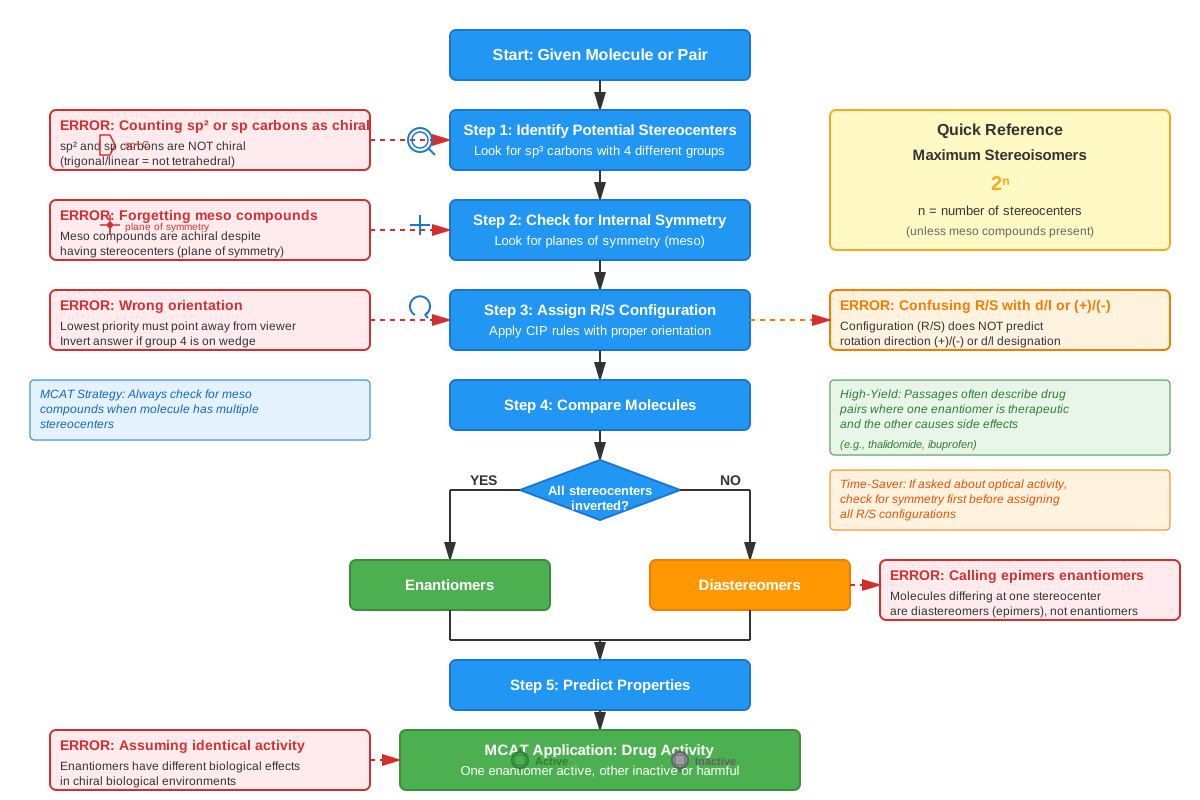
- [ ] Determine whether a molecule is chiral by identifying planes of symmetry and chiral centers
- [ ] Assign R and S configurations to chiral centers using the Cahn-Ingold-Prelog priority rules
- [ ] Distinguish between enantiomers, diastereomers, and meso compounds based on stereochemical relationships
- [ ] Predict the optical activity of pure enantiomers, racemic mixtures, and meso compounds
Prerequisites
- Basic bonding theory and molecular geometry: Understanding tetrahedral geometry is essential for visualizing the three-dimensional arrangement of substituents around chiral centers
- Constitutional isomers vs. stereoisomers: Recognizing that stereoisomers have the same connectivity but different spatial arrangements provides the foundation for understanding chirality
- Functional group identification: Ability to recognize common organic functional groups helps in applying priority rules and predicting reactivity
- Basic nomenclature: Familiarity with IUPAC naming conventions facilitates communication about specific stereoisomers
Why This Topic Matters
Chirality represents one of the most clinically relevant concepts in organic chemistry. The tragic thalidomide disaster of the 1960s serves as a powerful reminder: one enantiomer of thalidomide effectively treated morning sickness in pregnant women, while its mirror image caused severe birth defects. Modern pharmaceutical development requires rigorous testing of individual enantiomers, and many drugs are now marketed as single enantiomers rather than racemic mixtures. The FDA has specific guidelines requiring separate evaluation of each stereoisomer's biological activity.
On the MCAT, chirality appears in approximately 3-5 questions per exam, either as discrete questions or embedded within passage-based questions. The exam frequently tests this concept through:
- Amino acid passages: All naturally occurring amino acids except glycine are chiral, and the MCAT expects students to recognize L-amino acids and their stereochemical properties
- Carbohydrate chemistry: Sugars contain multiple chiral centers, and questions may involve Fischer projections, D/L designations, or epimer relationships
- Drug mechanism passages: Passages describing pharmaceutical agents often include stereochemical considerations
- Enzyme kinetics: Enzyme specificity for particular stereoisomers demonstrates the biological importance of chirality
- Organic reaction mechanisms: SN1 and SN2 reactions have stereochemical consequences that depend on the chirality of starting materials
The MCAT particularly favors questions that integrate chirality with biological concepts, such as why enzymes are stereospecific or how receptor-ligand interactions depend on three-dimensional complementarity. Students who master chirality gain a significant advantage in both the chemistry and biology sections of the exam.
Core Concepts
Definition and Fundamental Properties of Chirality
Chirality (from the Greek word "cheir," meaning hand) describes the geometric property of an object that cannot be superimposed on its mirror image. A molecule is chiral if it lacks an internal plane of symmetry. The most common source of chirality in organic molecules is a chiral center (also called a stereocenter or asymmetric carbon)—a carbon atom bonded to four different substituents. When a carbon has four distinct groups attached, the molecule exists in two non-superimposable mirror image forms called enantiomers.
The concept of achiral molecules is equally important. A molecule is achiral if it possesses an internal plane of symmetry, meaning it can be divided into two halves that are mirror images of each other. Even molecules with chiral centers can be achiral if they contain an internal plane of symmetry, as seen in meso compounds.
Identifying Chiral Centers
To identify chiral centers systematically:
- Locate all sp³-hybridized (tetrahedral) carbon atoms
- Examine each carbon to determine if it has four different substituents
- Consider the entire molecular environment—two groups may appear identical initially but differ when traced through the complete structure
- Remember that double bonds and triple bonds cannot be chiral centers because they lack tetrahedral geometry
Important considerations:
- Carbons in CH₃ groups cannot be chiral (two hydrogens are identical)
- Carbons in CH₂ groups cannot be chiral (two hydrogens are identical)
- Quaternary carbons (no hydrogens) can be chiral if all four substituents differ
- Heteroatoms (N, P, S) can also be chiral centers under certain conditions, though this is less common on the MCAT
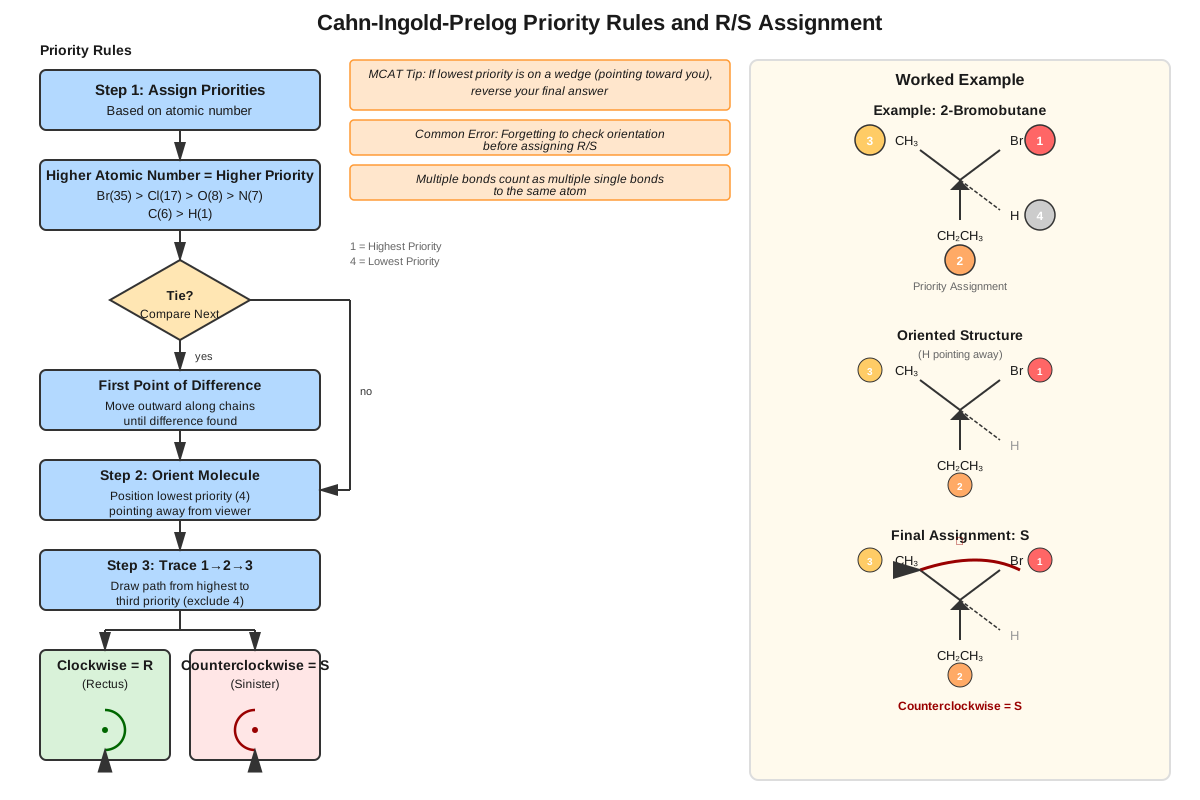
The Cahn-Ingold-Prelog Priority Rules
The Cahn-Ingold-Prelog (CIP) priority rules provide a systematic method for assigning R (rectus, Latin for "right") or S (sinister, Latin for "left") absolute configuration to chiral centers:
- Assign priorities (1-4) to the four substituents based on atomic number of the atom directly attached to the chiral center. Higher atomic number = higher priority.
- If two atoms are identical, move outward along the chain until a difference is found. Compare the atoms at the first point of difference.
- For multiple bonds, treat them as if the atom is duplicated. For example, C=O is treated as if the carbon is bonded to two oxygens (and the oxygen is bonded to two carbons).
- Orient the molecule so the lowest priority group (usually hydrogen, #4) points away from you.
- Trace a path from priority 1 → 2 → 3:
- If the path moves clockwise, the configuration is R
- If the path moves counterclockwise, the configuration is S
Enantiomers and Their Properties
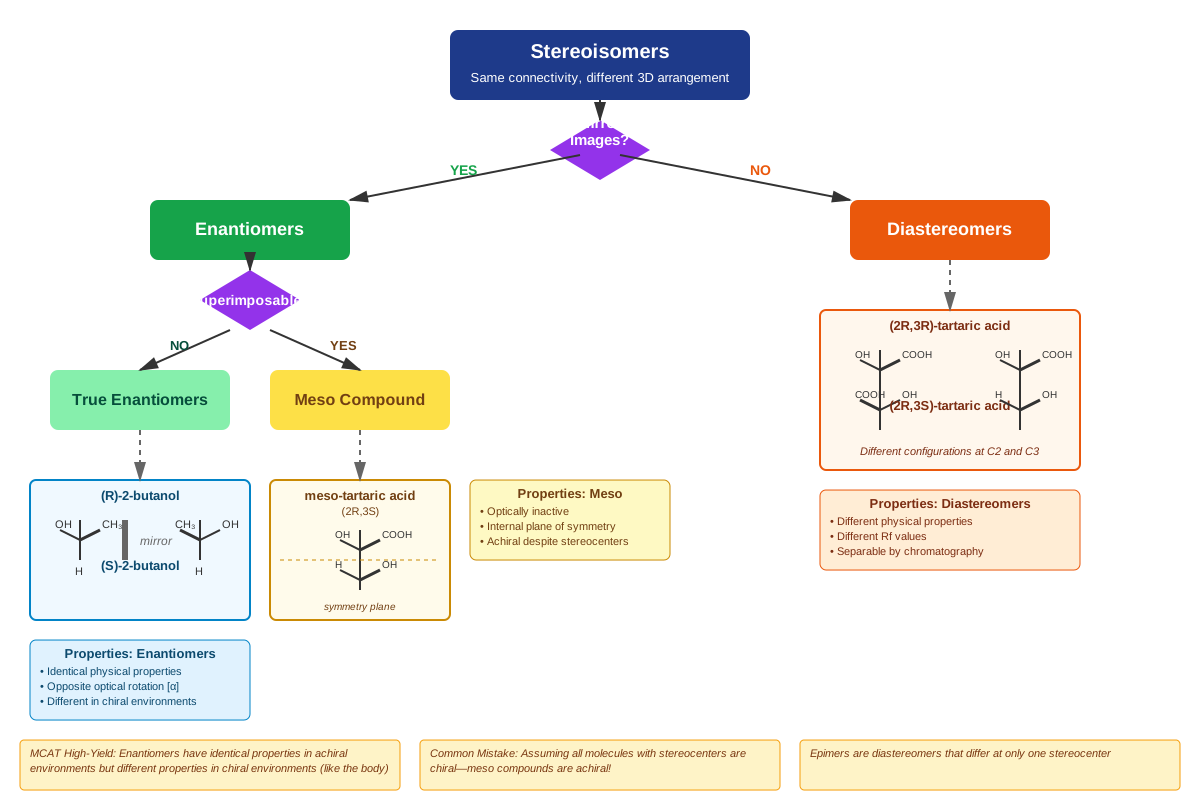
Enantiomers are stereoisomers that are non-superimposable mirror images of each other. They have identical physical properties except for their interaction with plane-polarized light and their behavior in chiral environments.
| Property | Enantiomers |
|---|---|
| Melting point | Identical |
| Boiling point | Identical |
| Density | Identical |
| Refractive index | Identical |
| Solubility in achiral solvents | Identical |
| Optical rotation | Equal magnitude, opposite sign |
| Biological activity | Often dramatically different |
| Reactivity with achiral reagents | Identical |
| Reactivity with chiral reagents | Different |
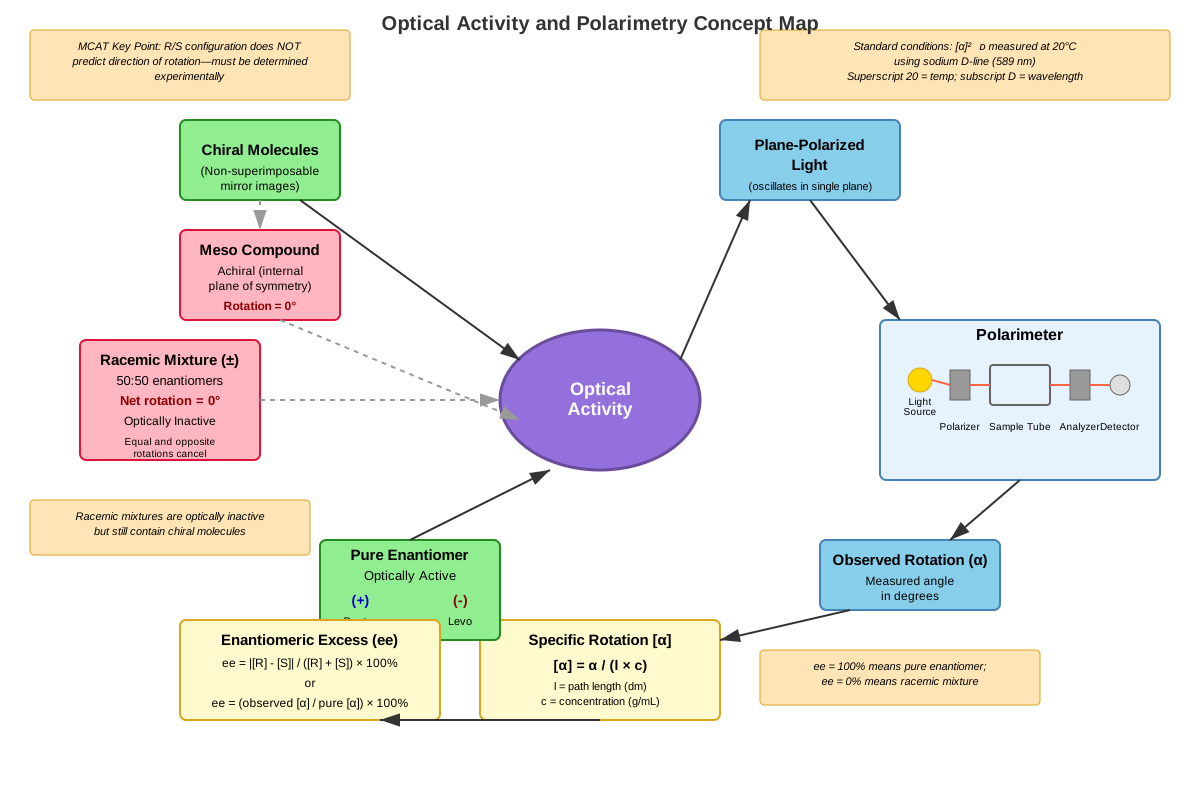
Optical activity refers to the ability of chiral molecules to rotate plane-polarized light. A dextrorotatory (+) or d enantiomer rotates light clockwise, while a levorotatory (−) or l enantiomer rotates light counterclockwise. The magnitude of rotation is measured using a polarimeter and expressed as specific rotation [α].
Exam Tip: The direction of optical rotation (+/− or d/l) is NOT the same as R/S configuration. These are independent properties determined experimentally vs. by structure.
Racemic Mixtures
A racemic mixture (or racemate) is a 1:1 mixture of two enantiomers. Because the enantiomers rotate plane-polarized light in equal but opposite directions, a racemic mixture shows no net optical rotation and is designated as (±) or (dl). Racemic mixtures are optically inactive despite containing chiral molecules.
Many organic reactions that create chiral centers from achiral starting materials produce racemic mixtures because the reaction occurs with equal probability from either face of a planar intermediate. For example, SN1 reactions typically produce racemic products when the carbocation intermediate is planar.
Diastereomers
Diastereomers are stereoisomers that are not mirror images of each other. They arise in molecules with two or more chiral centers. Unlike enantiomers, diastereomers have different physical properties (melting points, boiling points, solubilities) and different chemical reactivities, even with achiral reagents.
For a molecule with n chiral centers, the maximum number of stereoisomers is 2ⁿ (though this number may be reduced by symmetry, as in meso compounds).
Meso Compounds
A meso compound is a molecule that contains chiral centers but is achiral overall due to an internal plane of symmetry. Meso compounds are optically inactive because the rotation caused by one half of the molecule is canceled by the equal and opposite rotation from the other half.
Classic examples include:
- meso-tartaric acid (2,3-dihydroxybutanedioic acid)
- cis-1,2-dimethylcyclopropane
- meso-2,3-dibromobutane
High-Yield: Meso compounds reduce the number of stereoisomers below the 2ⁿ prediction. For example, 2,3-dibromobutane has 2 chiral centers, suggesting 2² = 4 stereoisomers, but one is meso, leaving only 3 distinct stereoisomers: (R,R), (S,S), and meso (R,S).
Fischer Projections
Fischer projections are two-dimensional representations of three-dimensional molecules, particularly useful for molecules with multiple chiral centers like carbohydrates and amino acids. In Fischer projections:
- The carbon chain is drawn vertically with the most oxidized carbon at the top
- Horizontal lines represent bonds coming out of the page (toward the viewer)
- Vertical lines represent bonds going into the page (away from the viewer)
- The intersection represents the chiral center
Rules for manipulating Fischer projections:
- Rotating 180° in the plane of the paper maintains configuration
- Rotating 90° inverts configuration
- Swapping any two groups inverts configuration
- Swapping two pairs of groups maintains configuration
Biological Significance of Chirality
Living systems are inherently chiral. Enzymes, which are made of L-amino acids, create chiral active sites that recognize and bind only specific stereoisomers of substrates. This stereoselectivity explains why:
- Only D-sugars are metabolized in human glycolysis
- Only L-amino acids are incorporated into human proteins
- Drug enantiomers can have different pharmacological effects
- Receptors bind preferentially to one enantiomer over another
The lock-and-key model and induced-fit model of enzyme-substrate interactions both depend on precise three-dimensional complementarity, making chirality essential for biological function.
Concept Relationships
Chirality serves as the foundation for understanding stereochemistry and connects to numerous other organic chemistry concepts. The relationship map flows as follows:
Molecular geometry → determines whether a carbon can be a chiral center → leads to enantiomers (mirror images) → which can be distinguished by R/S configuration (using CIP rules) → and measured by optical activity (rotation of plane-polarized light)
Multiple chiral centers → create diastereomers (non-mirror image stereoisomers) → unless internal symmetry exists → producing meso compounds (achiral despite chiral centers)
Chirality connects backward to prerequisite topics:
- Bonding theory explains the tetrahedral geometry necessary for chirality
- Constitutional isomers must be distinguished from stereoisomers before analyzing chirality
- Functional groups determine priorities in R/S assignment
Chirality connects forward to advanced topics:
- Reaction mechanisms (SN1, SN2, E1, E2) have stereochemical consequences
- Carbohydrate chemistry requires understanding multiple chiral centers and Fischer projections
- Amino acid structure depends on recognizing L-configuration
- Conformational analysis examines how stereoisomers adopt different three-dimensional shapes
- Spectroscopy uses optical rotation and circular dichroism to characterize chiral molecules
The concept of chirality also bridges to biochemistry:
- Enzyme kinetics depends on stereospecific substrate binding
- Protein structure arises from chiral amino acids
- Drug-receptor interactions require stereochemical complementarity
Quick check — test yourself on Chirality so far.
Try Flashcards →High-Yield Facts
⭐ A molecule is chiral if it lacks an internal plane of symmetry; the most common source is a carbon bonded to four different substituents
⭐ Enantiomers have identical physical properties except optical rotation and behavior in chiral environments
⭐ R/S configuration is determined by structure using CIP rules; (+)/(−) optical rotation is determined experimentally—these are independent properties
⭐ A racemic mixture is a 1:1 mixture of enantiomers that shows no net optical rotation
⭐ For n chiral centers, the maximum number of stereoisomers is 2ⁿ, but meso compounds reduce this number
- Diastereomers have different physical properties (melting point, boiling point, solubility) and different reactivities
- Meso compounds contain chiral centers but are achiral overall due to internal symmetry
- In Fischer projections, horizontal lines come out of the page and vertical lines go into the page
- All naturally occurring amino acids except glycine are chiral and have L-configuration
- Enzymes are stereospecific because their active sites are chiral environments made of L-amino acids
- The thalidomide tragedy demonstrated that enantiomers can have dramatically different biological effects
- Quaternary carbons (no hydrogens) can be chiral centers if all four substituents differ
- Double bonds and triple bonds cannot be chiral centers because they lack tetrahedral geometry
- Swapping any two groups on a Fischer projection inverts the configuration at that chiral center
- Biological systems preferentially use D-sugars and L-amino acids due to evolutionary selection
Common Misconceptions
Misconception: All molecules with chiral centers are chiral.
Correction: Meso compounds contain chiral centers but possess an internal plane of symmetry, making them achiral overall. Always check for internal symmetry before concluding a molecule is chiral.
Misconception: R configuration corresponds to (+) optical rotation and S corresponds to (−).
Correction: R/S configuration is determined by applying CIP priority rules to the structure, while (+)/(−) optical rotation is an experimental measurement. These properties are completely independent—an R enantiomer might be (+) or (−) depending on the specific molecule.
Misconception: Enantiomers have different physical properties like melting point and boiling point.
Correction: Enantiomers have identical physical properties in achiral environments. Only their interaction with plane-polarized light and behavior in chiral environments (like enzyme active sites) differ. Diastereomers, not enantiomers, have different physical properties.
Misconception: A molecule with two chiral centers always has four stereoisomers.
Correction: While 2ⁿ predicts the maximum number of stereoisomers, internal symmetry can reduce this number. For example, 2,3-dibromobutane has only three stereoisomers because one is a meso compound.
Misconception: In Fischer projections, you can freely rotate the molecule to make it easier to assign R/S configuration.
Correction: Fischer projections have strict rules—rotating 90° inverts the configuration, while only 180° rotation maintains it. Improper manipulation of Fischer projections leads to incorrect stereochemical assignments.
Misconception: Chirality only matters for carbon atoms.
Correction: While carbon is the most common chiral center in organic chemistry, other atoms like nitrogen, phosphorus, and sulfur can also be chiral centers under appropriate conditions (though this is less commonly tested on the MCAT).
Misconception: Racemic mixtures and meso compounds are the same because both are optically inactive.
Correction: Racemic mixtures contain two chiral enantiomers in equal amounts (the mixture is achiral), while meso compounds are individual achiral molecules that happen to contain chiral centers. They are fundamentally different types of optically inactive substances.
Worked Examples
Example 1: Identifying Chiral Centers and Assigning Configuration
Question: Consider 3-methylhexane. Identify any chiral centers and assign the R/S configuration.
Solution:
Step 1: Draw the structure of 3-methylhexane:
CH₃-CH₂-CH(CH₃)-CH₂-CH₂-CH₃Step 2: Identify potential chiral centers by finding sp³ carbons with four different substituents.
- C-3 has: H, CH₃, CH₂CH₃ (ethyl), and CH₂CH₂CH₃ (propyl)
- These are four different groups, so C-3 is a chiral center
Step 3: Assign priorities using CIP rules:
- Priority 1: CH₂CH₂CH₃ (propyl) - carbon chain of 3
- Priority 2: CH₂CH₃ (ethyl) - carbon chain of 2
- Priority 3: CH₃ (methyl) - carbon chain of 1
- Priority 4: H (hydrogen) - lowest atomic number
Step 4: Orient the molecule with H (priority 4) pointing away.
Step 5: Trace the path 1→2→3:
If the path moves clockwise, the configuration is R; if counterclockwise, it's S.
For the specific three-dimensional arrangement, if we place the propyl group pointing toward us, ethyl to the right, and methyl to the left, with H pointing away, the path 1→2→3 moves counterclockwise, giving us (S)-3-methylhexane.
Key Learning Point: This example demonstrates that even simple alkanes can be chiral. The presence of different alkyl chains on either side of a carbon creates the four different substituents necessary for chirality.
Example 2: Analyzing a Passage-Based MCAT Question
Passage Context: A pharmaceutical company is developing a new anti-inflammatory drug. The active compound contains a single chiral center. During synthesis, the company produces a racemic mixture. Biological testing reveals that one enantiomer reduces inflammation effectively, while the other enantiomer is inactive but causes mild gastrointestinal side effects.
Question: Which of the following statements best explains why the two enantiomers have different biological activities?
A) The enantiomers have different molecular formulas, leading to different receptor binding.
B) The enantiomers have different physical properties such as melting points, affecting their absorption.
C) The enzyme active sites are chiral environments that bind stereospecifically to one enantiomer.
D) The racemic mixture undergoes rapid interconversion in vivo, producing more of the active enantiomer.
Solution:
Step 1: Recall that enantiomers are mirror images with identical molecular formulas and identical physical properties in achiral environments.
- This eliminates options A and B
Step 2: Consider the biological environment.
- Enzymes and receptors are made of L-amino acids, creating chiral active sites
- These chiral environments can distinguish between enantiomers through three-dimensional complementarity
Step 3: Evaluate option C.
- This correctly explains stereospecificity: one enantiomer fits the active site geometry while the other does not
- This is the fundamental reason for different biological activities of enantiomers
Step 4: Evaluate option D.
- Enantiomers do NOT interconvert under physiological conditions
- Chiral centers are stable unless specific reactions occur to break and reform bonds
Answer: C
Key Learning Point: This question integrates chirality with biochemistry, demonstrating why the MCAT emphasizes this topic. Understanding that biological systems are chiral environments explains drug specificity, enzyme selectivity, and metabolic pathways.
Exam Strategy
When approaching Chirality MCAT questions, use this systematic strategy:
Step 1: Identify the question type
- Structure-based: "How many chiral centers does this molecule have?"
- Configuration assignment: "What is the R/S configuration at C-3?"
- Stereoisomer relationships: "What is the relationship between these two molecules?"
- Optical activity: "Will this compound rotate plane-polarized light?"
- Biological application: "Why does this enzyme prefer one enantiomer?"
Step 2: Watch for trigger words and phrases
- "Chiral center," "stereocenter," "asymmetric carbon" → identify carbons with four different substituents
- "Enantiomers" → look for mirror image relationship
- "Diastereomers" → look for stereoisomers that are NOT mirror images
- "Optically active" → the compound must be chiral and not racemic
- "Racemic mixture" → equal amounts of enantiomers, no net rotation
- "Meso compound" → chiral centers present but internal symmetry makes it achiral
- "Stereospecific" → the reaction or enzyme distinguishes between stereoisomers
Step 3: Use process of elimination effectively
- If a question asks about enantiomer properties, eliminate any answer suggesting different melting points or boiling points
- If a molecule has an internal plane of symmetry, eliminate answers calling it chiral
- If the question involves biological activity, favor answers involving chiral environments and stereospecificity
- For stereoisomer counting, calculate 2ⁿ first, then check for meso compounds to eliminate duplicates
Step 4: Time allocation
- Discrete chirality questions: 60-90 seconds
- Passage-based questions: 90-120 seconds
- Complex stereoisomer counting or configuration assignment: up to 2 minutes
Step 5: Common traps to avoid
- Don't confuse R/S with (+)/(−)
- Don't assume all molecules with chiral centers are chiral (check for meso)
- Don't forget that racemic mixtures are optically inactive despite containing chiral molecules
- Don't misapply Fischer projection rules (remember 90° rotation inverts configuration)
Exam Tip: If you're running short on time and face a complex R/S assignment question, focus on questions about enantiomer properties or biological significance instead—these often require less calculation and more conceptual understanding.
Memory Techniques
Mnemonic for CIP Priority Rules: "Atomic Number Determines Priority" (AND-P)
- Look at the Atomic Number of atoms Directly attached to determine Priority
Mnemonic for R/S Assignment: "Right = Rectus, Sinister = South"
- When the lowest priority group points away, if 1→2→3 goes clockwise (to the Right), it's R
- If 1→2→3 goes counterclockwise (toward the South on a compass), it's S
Visualization Strategy for Enantiomers: "Hands Are Non-superimposable Duplicates" (HAND)
- Your left and right Hands Are mirror images that are Non-superimposable Duplicates
- This helps remember that enantiomers are like hands—mirror images that can't be superimposed
Mnemonic for Fischer Projections: "Horizontal = Hug (comes toward you)"
- Horizontal lines in Fischer projections represent bonds that Hug you (come out of the page)
- Vertical lines go away (into the page)
Acronym for Stereoisomer Types: "Every Day Matters" (EDM)
- Enantiomers: mirror images
- Diastereomers: not mirror images
- Meso: internal symmetry despite chiral centers
Memory Aid for Biological Chirality: "Life Loves Left" and "Dessert has D-sugars"
- L-amino acids are used in Life
- D-sugars (like D-glucose) are metabolized for energy (like Dessert)
Summary
Chirality represents a fundamental three-dimensional property of molecules that lack internal planes of symmetry, most commonly arising from tetrahedral carbons bonded to four different substituents. Enantiomers—non-superimposable mirror images—have identical physical properties except for their interaction with plane-polarized light and their behavior in chiral biological environments. The Cahn-Ingold-Prelog priority rules provide a systematic method for assigning R/S absolute configuration, which is independent of experimentally measured optical rotation. Molecules with multiple chiral centers can exist as diastereomers (non-mirror image stereoisomers with different properties) or meso compounds (achiral molecules with internal symmetry despite containing chiral centers). The biological significance of chirality cannot be overstated: enzymes, receptors, and other biomolecules are inherently chiral, leading to stereospecific interactions that explain why enantiomers of drugs can have dramatically different therapeutic effects. For MCAT success, students must master chiral center identification, R/S assignment, stereoisomer relationships, and the biological implications of chirality in enzyme-substrate interactions and drug mechanisms.
Key Takeaways
- Chirality arises when molecules lack internal planes of symmetry, most commonly from carbons with four different substituents creating chiral centers
- Enantiomers are non-superimposable mirror images with identical physical properties except optical rotation; they behave differently only in chiral environments
- R/S configuration (structural) and (+)/(−) optical rotation (experimental) are independent properties that must not be confused
- Racemic mixtures contain equal amounts of enantiomers and show no net optical rotation despite containing chiral molecules
- Meso compounds contain chiral centers but are achiral overall due to internal symmetry, reducing the number of stereoisomers below 2ⁿ
- Biological systems are chiral environments where stereospecificity determines enzyme-substrate interactions and drug efficacy
- The maximum number of stereoisomers for n chiral centers is 2ⁿ, but always check for meso compounds that reduce this number
Related Topics
Stereoisomer Nomenclature and Fischer Projections: Building on chirality fundamentals, this topic covers advanced representation methods for molecules with multiple chiral centers, particularly important for carbohydrate chemistry. Mastering chirality enables efficient use of Fischer projections to assign D/L configurations.
Reaction Stereochemistry (SN1, SN2, E1, E2): Understanding how reactions create or destroy chiral centers and whether they proceed with retention, inversion, or racemization of configuration. Chirality knowledge is prerequisite for predicting stereochemical outcomes.
Carbohydrate Chemistry: Monosaccharides contain multiple chiral centers, and their stereochemical relationships (enantiomers, epimers, anomers) depend entirely on chirality concepts. This topic represents a major application of chirality on the MCAT.
Amino Acid Structure and Protein Chemistry: All naturally occurring amino acids except glycine are chiral L-amino acids. Understanding their stereochemistry is essential for protein structure and enzyme function questions.
Conformational Analysis: While chirality deals with stereoisomers that cannot interconvert without breaking bonds, conformational analysis examines rotational isomers. Together, these topics provide complete understanding of three-dimensional molecular structure.
Optical Activity and Polarimetry: Advanced study of how chiral molecules interact with plane-polarized light, including specific rotation calculations and applications in determining enantiomeric excess.
Practice CTA
Now that you've mastered the core concepts of chirality, it's time to solidify your understanding through active practice. Attempt the practice questions and flashcards associated with this topic to test your ability to identify chiral centers, assign R/S configurations, distinguish between stereoisomer types, and apply chirality concepts to biological scenarios. Remember that stereochemistry questions on the MCAT reward systematic thinking and careful three-dimensional visualization—skills that improve dramatically with deliberate practice. Each practice problem you work through strengthens your pattern recognition and builds the confidence needed to tackle even the most complex stereochemistry passages on test day. You've built a strong foundation; now apply it!
Sign up free to keep reading
Create a free AnvayaPrep account to finish this MCAT guide on Chirality — plus flashcards and practice questions.