Overview
The Hofmann product represents a critical concept in Organic Chemistry that appears regularly on the MCAT, particularly in questions involving Substitution and Elimination reactions. When a molecule undergoes elimination to form an alkene, two or more constitutional isomers may be possible depending on which hydrogen is removed. The Hofmann product refers to the less substituted (less stable) alkene that forms under specific reaction conditions, contrasting with the more common Zaitsev product. Understanding when and why the Hofmann product forms requires mastery of reaction mechanisms, steric effects, and the influence of leaving groups and bases on elimination pathways.
This topic is essential for the MCAT because it tests students' ability to predict reaction outcomes based on mechanistic understanding rather than simple memorization. The MCAT frequently presents elimination reactions where students must determine which regioisomer will predominate, requiring knowledge of both thermodynamic (Zaitsev) and kinetic (Hofmann) control. Questions may involve bulky bases, quaternary ammonium salts, or specific reaction conditions that favor Hofmann selectivity. The ability to distinguish between these pathways demonstrates sophisticated understanding of how molecular structure and reaction conditions influence product distribution.
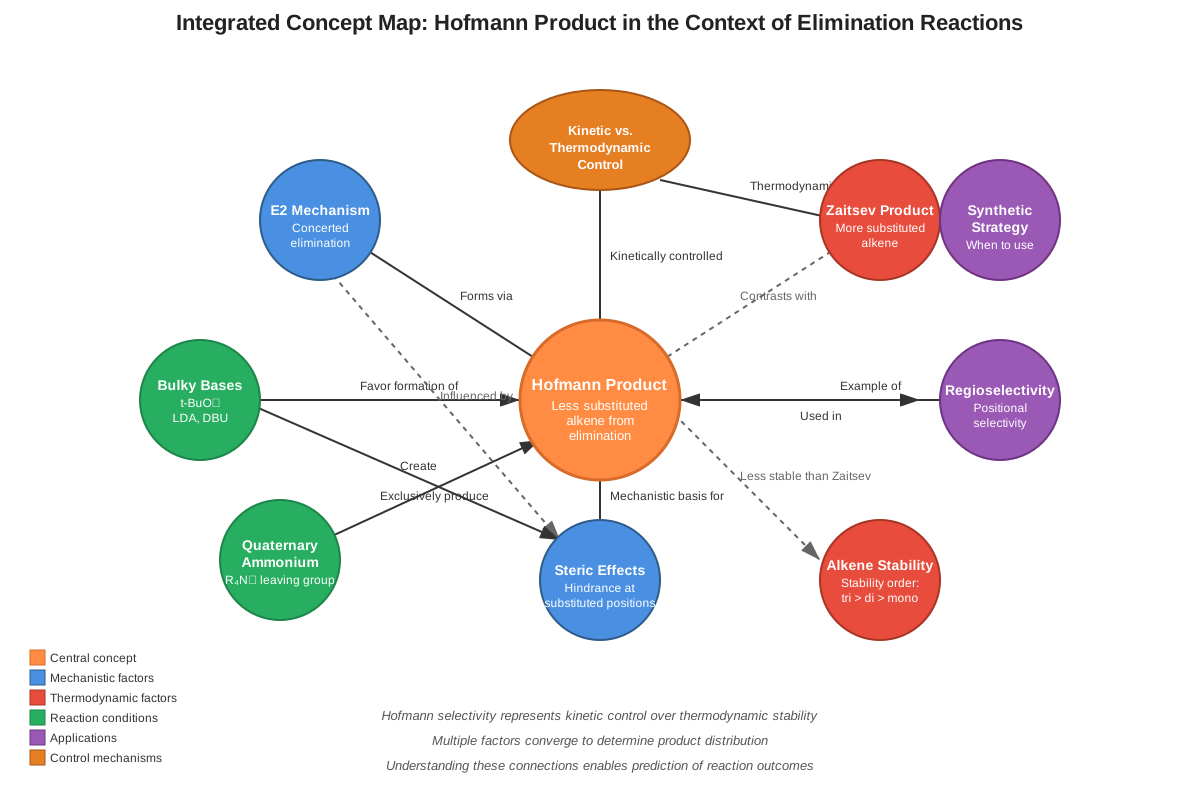
Within the broader context of Organic Chemistry, the Hofmann product concept connects elimination reactions to fundamental principles of sterics, base strength, and reaction mechanisms. It bridges E2 elimination mechanisms with concepts of regioselectivity and product stability, while also introducing students to the practical considerations chemists face when designing synthetic routes. Mastery of this topic enables students to predict outcomes in complex multi-step synthesis problems and understand how reaction conditions can be manipulated to achieve desired products.
Learning Objectives
- [ ] Define Hofmann product using accurate Organic Chemistry terminology
- [ ] Explain why Hofmann product matters for the MCAT
- [ ] Apply Hofmann product to exam-style questions
- [ ] Identify common mistakes related to Hofmann product
- [ ] Connect Hofmann product to related Organic Chemistry concepts
- [ ] Predict when Hofmann vs. Zaitsev products will predominate based on reaction conditions
- [ ] Analyze the role of base size and leaving group identity in determining product distribution
- [ ] Evaluate the thermodynamic vs. kinetic factors that control elimination regioselectivity
Prerequisites
- E2 elimination mechanism: Understanding the concerted, one-step nature of E2 reactions is essential because Hofmann product formation occurs through this pathway
- Alkene stability: Knowledge that more substituted alkenes are generally more stable (Zaitsev's rule) provides the baseline against which Hofmann selectivity is understood
- Acid-base chemistry: Recognizing base strength and size is crucial for predicting which elimination pathway will dominate
- Carbocation stability: While E2 reactions don't form carbocations, understanding stability trends helps explain why Zaitsev products are thermodynamically favored
- Stereochemistry of elimination: The anti-periplanar requirement for E2 reactions influences which hydrogens can be removed
Why This Topic Matters
The Hofmann product concept has significant practical importance in synthetic organic chemistry and pharmaceutical development. When chemists design multi-step syntheses, they must control regioselectivity to obtain desired products efficiently. The Hofmann elimination is particularly important in the degradation of quaternary ammonium compounds and in the synthesis of less substituted alkenes that cannot be easily accessed through Zaitsev-favoring conditions. This selectivity has been exploited in natural product synthesis and drug development where specific alkene regioisomers possess different biological activities.
On the MCAT, elimination reactions appear in approximately 3-5% of Organic Chemistry questions, with Hofmann vs. Zaitsev selectivity being a high-yield distinction tested regularly. Questions typically appear in discrete format or within passage-based scenarios involving multi-step synthesis or reaction mechanism analysis. The MCAT specifically tests whether students can move beyond memorization to understand the mechanistic basis for product selectivity. This topic frequently appears alongside questions about base strength, steric hindrance, and reaction conditions, making it an integrative concept that assesses multiple areas of organic chemistry knowledge simultaneously.
Common MCAT question formats include: (1) predicting the major product when a specific base is used in elimination, (2) explaining why certain conditions favor Hofmann over Zaitsev products, (3) identifying which base would produce a specific alkene regioisomer, and (4) analyzing experimental data showing product distributions under different conditions. Passage-based questions may present synthetic schemes where students must recognize when Hofmann conditions are being employed and why they're necessary for the desired transformation.
Core Concepts
Definition of Hofmann Product
The Hofmann product is the less substituted alkene formed during an elimination reaction, named after August Wilhelm von Hofmann who first observed this selectivity pattern in 1851. In any elimination reaction where multiple β-hydrogens are available for removal, different alkene regioisomers can form. The Hofmann product specifically refers to the alkene with fewer alkyl substituents on the double bond carbons—the thermodynamically less stable product. This contrasts with the Zaitsev product (also called Saytzeff product), which is the more substituted, more stable alkene that typically predominates under standard elimination conditions.
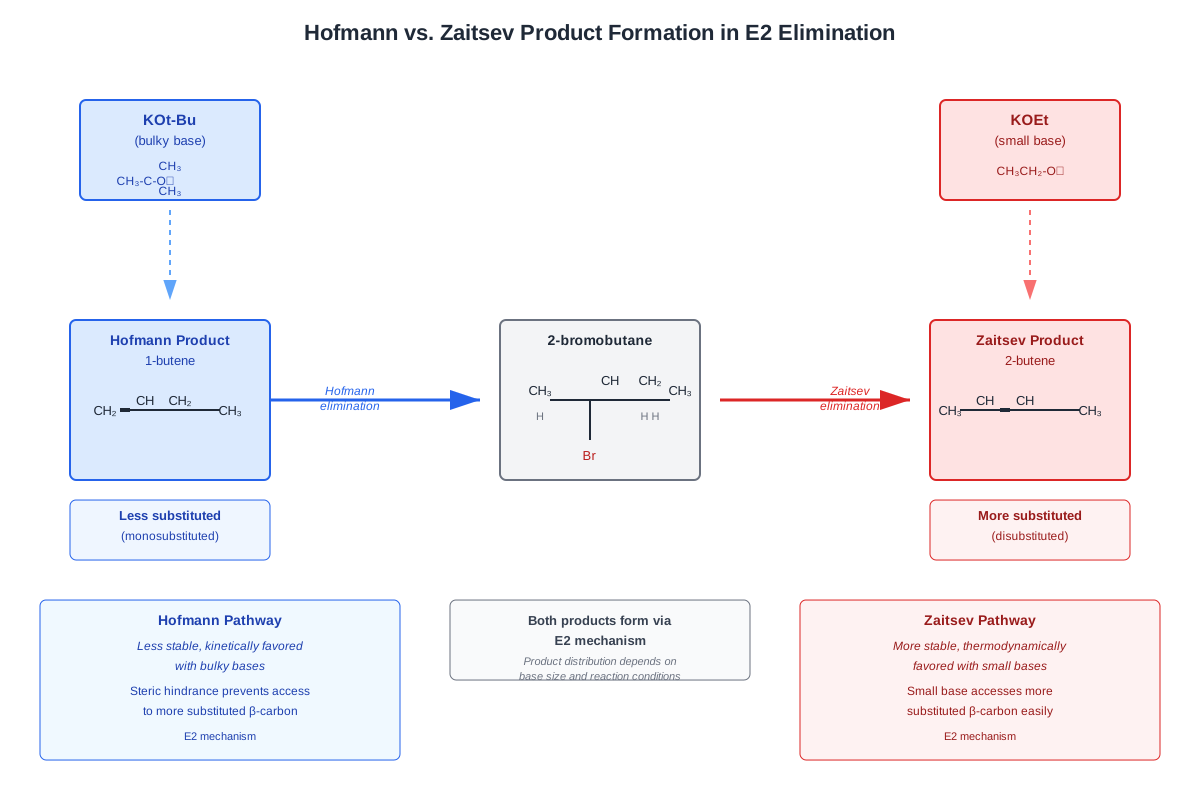
For example, when 2-bromobutane undergoes elimination, two products are possible: 1-butene (Hofmann product, monosubstituted) and 2-butene (Zaitsev product, disubstituted). Under typical conditions with small, strong bases like hydroxide or ethoxide, 2-butene predominates. However, under Hofmann-favoring conditions, 1-butene becomes the major product despite being less thermodynamically stable.
Conditions Favoring Hofmann Product Formation
Several specific reaction conditions promote Hofmann product formation over Zaitsev products:
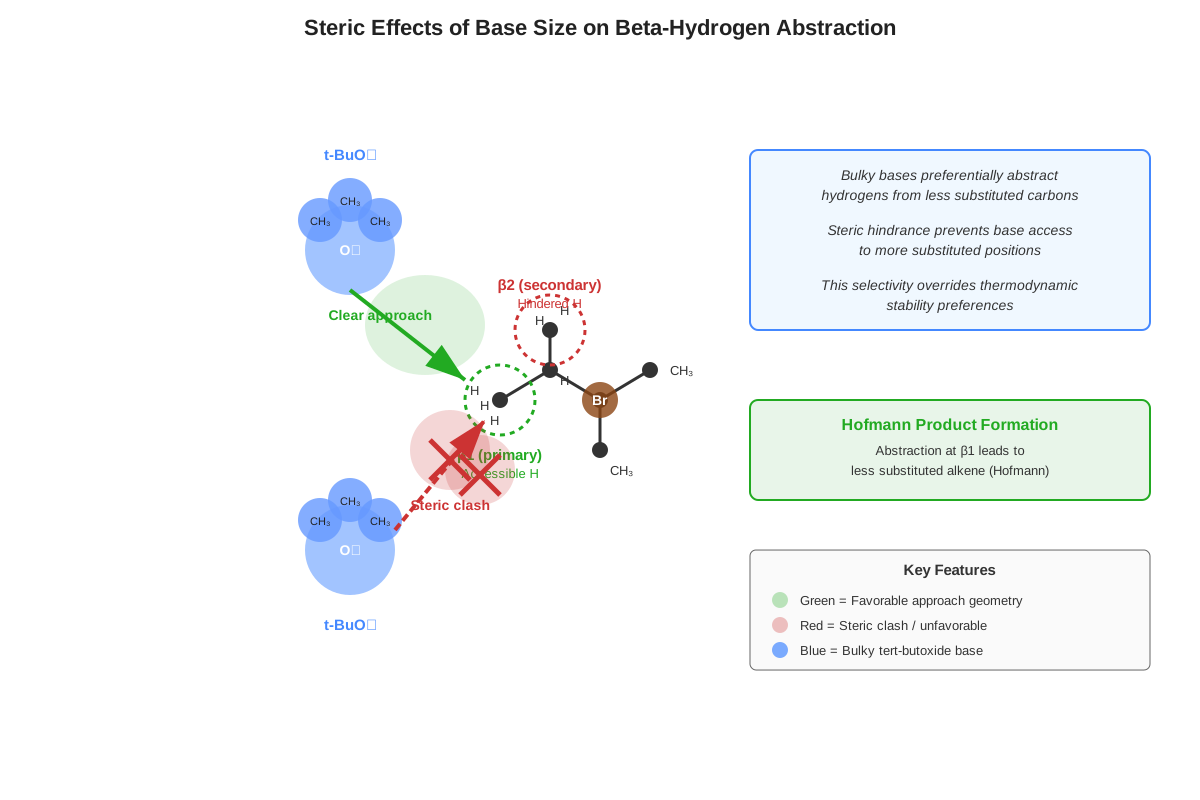
Bulky, sterically hindered bases are the primary factor favoring Hofmann selectivity. Large bases such as tert-butoxide (t-BuO⁻), lithium diisopropylamide (LDA), and diisopropylethylamine (Hünig's base) cannot easily access the more substituted β-carbons due to steric crowding from adjacent alkyl groups. These bases preferentially abstract the most accessible hydrogen—typically on the least substituted β-carbon—leading to formation of the less substituted alkene. The steric effect overrides the thermodynamic preference for the more stable product.
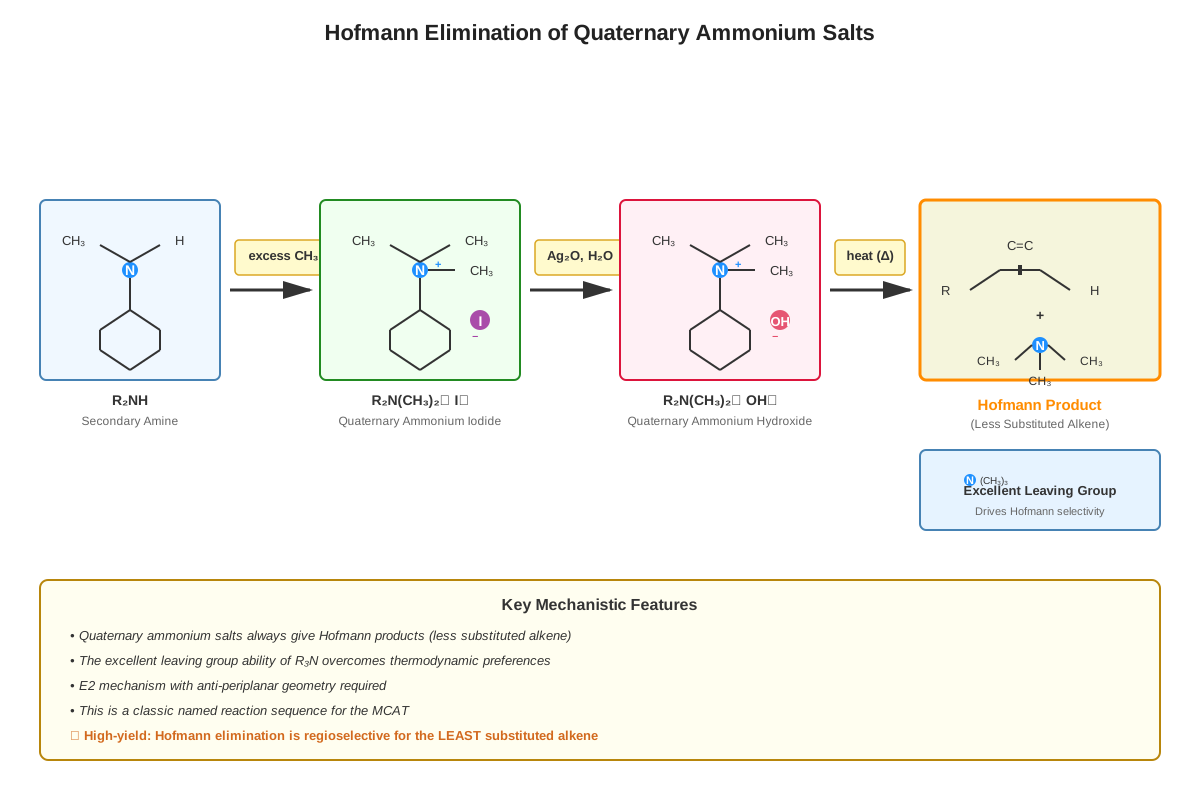
Quaternary ammonium salts as leaving groups strongly favor Hofmann elimination. When a quaternary ammonium hydroxide (R₄N⁺OH⁻) undergoes elimination upon heating (Hofmann elimination reaction), the bulky positively charged nitrogen group creates significant steric hindrance. This steric bulk, combined with the excellent leaving group ability of the neutral amine, directs elimination toward the least hindered position, producing the Hofmann product with high selectivity.
Poor leaving groups can also shift selectivity toward Hofmann products. When the leaving group is poor (such as fluoride), the E2 transition state occurs earlier along the reaction coordinate (Hammond postulate). This early transition state has less double-bond character, making alkene stability less important in determining the activation energy. Consequently, steric accessibility becomes the dominant factor, favoring Hofmann selectivity.
Mechanistic Basis for Hofmann Selectivity
The E2 elimination mechanism proceeds through a concerted, single-step process where base abstraction of a β-hydrogen and loss of the leaving group occur simultaneously. The reaction requires anti-periplanar geometry, where the C-H bond being broken and the C-leaving group bond are 180° apart. In the transition state, partial double-bond character develops between the α and β carbons.
For Zaitsev products, the transition state benefits from hyperconjugative stabilization from adjacent alkyl groups, similar to how alkyl groups stabilize the final alkene product. This stabilization lowers the activation energy for forming the more substituted alkene. However, when a bulky base approaches the substrate, steric interactions in the transition state become significant. The base must approach close enough to abstract the β-hydrogen, and when that hydrogen is on a more substituted carbon (surrounded by alkyl groups), severe steric clashing occurs between the base and these substituents.
With bulky bases, the activation energy for abstracting a hydrogen from the more substituted position increases dramatically due to steric strain in the transition state. Meanwhile, the activation energy for abstracting a hydrogen from the less substituted position remains relatively low because there's less steric crowding. Even though the resulting Hofmann product is thermodynamically less stable, it forms faster (lower activation energy) under these conditions—an example of kinetic control overriding thermodynamic preferences.
Comparison: Hofmann vs. Zaitsev Products
| Feature | Hofmann Product | Zaitsev Product |
|---|---|---|
| Substitution | Less substituted alkene | More substituted alkene |
| Thermodynamic stability | Less stable | More stable |
| Favoring conditions | Bulky bases, quaternary ammonium salts | Small bases, good leaving groups |
| Control type | Kinetic control | Thermodynamic control |
| Steric accessibility | More accessible β-hydrogen | Less accessible β-hydrogen |
| Common bases | t-BuO⁻, LDA, DBU | OH⁻, EtO⁻, MeO⁻ |
| Transition state | Less stabilized but less hindered | More stabilized but more hindered |
Quantitative Aspects of Product Distribution
The ratio of Hofmann to Zaitsev products depends on the relative activation energies for forming each product. This relationship follows the Boltzmann distribution and can be expressed through the Curtin-Hammett principle. When the energy difference between transition states is small (with moderately bulky bases), mixtures of both products form. As base size increases, the energy difference grows, and Hofmann selectivity increases.
Temperature also affects product distribution, though less dramatically than base size. Higher temperatures generally favor the more stable (Zaitsev) product slightly because the energy difference between products becomes less significant relative to thermal energy. However, this effect is usually minor compared to steric factors.
The Hofmann Elimination Reaction
The classic Hofmann elimination (also called Hofmann degradation) is a specific reaction sequence used to convert primary amines to alkenes:
- Exhaustive methylation: The amine is treated with excess methyl iodide (CH₃I) to form a quaternary ammonium iodide salt
- Ion exchange: Silver oxide (Ag₂O) and water convert the iodide salt to the quaternary ammonium hydroxide
- Thermal elimination: Heating the hydroxide salt causes E2 elimination, producing the Hofmann product (less substituted alkene), water, and a tertiary amine
This reaction sequence was historically important for structure determination of complex amines and alkaloids because it predictably produces the less substituted alkene, allowing chemists to deduce the original amine structure.
Synthetic Applications
Understanding Hofmann selectivity enables chemists to control elimination regioselectivity in synthesis. When a synthetic route requires a less substituted alkene, chemists employ bulky bases or convert alcohols to quaternary ammonium salts before elimination. Conversely, when the more substituted alkene is desired, small strong bases under standard conditions are used.
This control is particularly valuable in complex molecule synthesis where specific alkene geometry and substitution patterns are required for subsequent reactions. For example, less substituted alkenes are often better substrates for hydroboration-oxidation when anti-Markovnikov alcohol synthesis is needed.
Concept Relationships
The Hofmann product concept sits at the intersection of multiple fundamental organic chemistry principles. E2 elimination mechanism provides the mechanistic foundation → which leads to understanding how base size and sterics influence transition state energies → resulting in kinetic vs. thermodynamic control of product distribution → ultimately determining regioselectivity in elimination reactions.
The concept connects directly to alkene stability (prerequisite knowledge) by representing cases where the less stable product predominates due to kinetic factors. This relationship illustrates the broader principle that reaction outcomes depend not only on product stability but also on the pathway taken to reach those products.
Steric effects in Hofmann selectivity parallel steric effects in SN2 vs. SN1 reactions, where bulky groups influence reaction pathways. Both concepts demonstrate how molecular structure affects reaction mechanisms and outcomes. Additionally, the role of leaving group ability in Hofmann selectivity connects to broader patterns in substitution and elimination chemistry, where leaving group quality influences reaction rates and mechanisms.
The Hofmann elimination reaction specifically connects to amine chemistry and Hofmann rearrangement (a different reaction with a similar name), requiring students to distinguish between these related but distinct transformations. Understanding Hofmann products also enables deeper comprehension of E1 vs. E2 mechanisms, as E1 reactions typically favor Zaitsev products regardless of base size due to the carbocation intermediate.
Quick check — test yourself on Hofmann product so far.
Try Flashcards →High-Yield Facts
⭐ The Hofmann product is the less substituted, less stable alkene formed in elimination reactions under specific conditions
⭐ Bulky bases (t-BuO⁻, LDA) favor Hofmann products due to steric hindrance preventing access to more substituted β-carbons
⭐ Quaternary ammonium salts (R₄N⁺) as leaving groups strongly favor Hofmann elimination due to steric bulk
⭐ Hofmann selectivity represents kinetic control, where the faster-forming product predominates despite being less stable
⭐ Small, strong bases (OH⁻, EtO⁻) favor Zaitsev products (more substituted alkenes) under thermodynamic control
- The Hofmann elimination reaction converts primary amines to less substituted alkenes through exhaustive methylation followed by thermal elimination
- Poor leaving groups shift elimination toward Hofmann products due to earlier transition states with less double-bond character
- Temperature has minimal effect on Hofmann vs. Zaitsev selectivity compared to base size
- The anti-periplanar requirement for E2 elimination must still be satisfied regardless of whether Hofmann or Zaitsev products form
- Hofmann selectivity is most pronounced when there's a significant difference in steric environment between different β-positions
- In cyclic systems, Hofmann selectivity may be influenced by ring strain and conformational factors in addition to sterics
Common Misconceptions
Misconception: Hofmann products are always the minor product in elimination reactions → Correction: Hofmann products become the major product when bulky bases or quaternary ammonium leaving groups are used. The product distribution depends on reaction conditions, not a fixed rule.
Misconception: The Hofmann product is more stable than the Zaitsev product → Correction: The Hofmann product is less substituted and therefore less thermodynamically stable. It forms as the major product under kinetic control when steric factors make it form faster despite being less stable.
Misconception: All bulky molecules favor Hofmann elimination → Correction: It's specifically the bulkiness of the base that matters, not the substrate. A bulky substrate with a small base will still favor Zaitsev products. The base must be sterically hindered to favor Hofmann selectivity.
Misconception: Hofmann elimination and Hofmann rearrangement are the same reaction → Correction: These are completely different reactions. Hofmann elimination converts quaternary ammonium salts to alkenes, while Hofmann rearrangement converts primary amides to primary amines with loss of one carbon.
Misconception: E1 reactions can show Hofmann selectivity with bulky bases → Correction: E1 reactions proceed through carbocation intermediates and always favor the more stable (Zaitsev) alkene regardless of base size, because the base doesn't participate in the rate-determining step. Hofmann selectivity only occurs in E2 reactions where the base directly abstracts the β-hydrogen.
Misconception: The Hofmann product always has the double bond at the terminal position → Correction: The Hofmann product is simply the less substituted alkene, which isn't necessarily terminal. For example, elimination from 3-bromopentane could give 2-pentene (Zaitsev) or 1-pentene (Hofmann), but neither is at a terminal position of the carbon chain.
Misconception: Strong bases always favor Zaitsev products → Correction: Base strength and base size are independent properties. A base can be both strong and bulky (like t-BuO⁻), favoring Hofmann products, or strong and small (like OH⁻), favoring Zaitsev products. Strength affects reaction rate, while size affects regioselectivity.
Worked Examples
Example 1: Predicting Major Product with Different Bases
Question: 2-Bromo-2-methylbutane is treated with base to undergo elimination. Predict the major product when (A) sodium ethoxide (NaOEt) is used versus (B) potassium tert-butoxide (t-BuOK) is used.
Solution:
First, identify the structure: 2-bromo-2-methylbutane has the bromine on a tertiary carbon (C2) with a methyl branch also at C2. The β-carbons are C1 and C3.
For elimination, we need to identify possible products:
- Removing H from C1 gives 2-methyl-1-butene (less substituted, disubstituted alkene)
- Removing H from C3 gives 2-methyl-2-butene (more substituted, trisubstituted alkene)
(A) With sodium ethoxide (small base):
Ethoxide (EtO⁻) is a small, strong base that can easily access all β-hydrogens. The reaction will favor the thermodynamically more stable product (Zaitsev product). The trisubstituted alkene (2-methyl-2-butene) is more stable than the disubstituted alkene.
Major product: 2-methyl-2-butene (Zaitsev product)
(B) With potassium tert-butoxide (bulky base):
tert-Butoxide is a very bulky base. The C3 position is more hindered (surrounded by the methyl branch on C2 and the ethyl group extending from C3), while C1 is less hindered (only one methyl group nearby). The bulky base preferentially abstracts the more accessible hydrogen from C1.
Major product: 2-methyl-1-butene (Hofmann product)
Key reasoning: This example demonstrates how changing only the base size can completely reverse regioselectivity, shifting from thermodynamic (Zaitsev) to kinetic (Hofmann) control.
Example 2: Hofmann Elimination Mechanism
Question: A primary amine, CH₃CH₂CH₂CH₂NH₂ (1-butanamine), undergoes Hofmann elimination. Show the products and explain the regioselectivity.
Solution:
Step 1 - Exhaustive methylation:
The primary amine is treated with excess CH₃I, resulting in quaternary ammonium salt:
CH₃CH₂CH₂CH₂NH₂ + 3 CH₃I → CH₃CH₂CH₂CH₂N⁺(CH₃)₃ I⁻
Step 2 - Ion exchange:
Treatment with Ag₂O and H₂O converts the iodide to hydroxide:
CH₃CH₂CH₂CH₂N⁺(CH₃)₃ I⁻ + Ag₂O + H₂O → CH₃CH₂CH₂CH₂N⁺(CH₃)₃ OH⁻
Step 3 - Thermal elimination:
Heating causes E2 elimination. The β-carbons are C3 and C1 (numbering from the nitrogen-bearing carbon as C4).
Possible products:
- Removing H from C3 gives 1-butene (terminal, monosubstituted)
- Removing H from C1 (if we consider the methyl groups on nitrogen) - not applicable here as those are N-methyl groups
Actually, let's reconsider the structure: The nitrogen is on C1 of the butyl chain. The β-carbons relative to nitrogen are C2. Removing H from C2 could give different products depending on which side.
The quaternary ammonium group is extremely bulky. The least hindered β-hydrogen is on C2, but more specifically, the hydrogens furthest from the bulky trimethylammonium group. The elimination strongly favors formation of the terminal alkene.
Major product: 1-butene (CH₂=CH-CH₂-CH₃) + (CH₃)₃N + H₂O
Explanation: The bulky trimethylammonium leaving group creates severe steric hindrance, directing elimination toward the least substituted position. This is classic Hofmann selectivity, producing the terminal (least substituted) alkene as the major product. The excellent leaving group ability of the neutral trimethylamine also facilitates this elimination.
Exam Strategy
When approaching MCAT questions on Hofmann products, follow this systematic strategy:
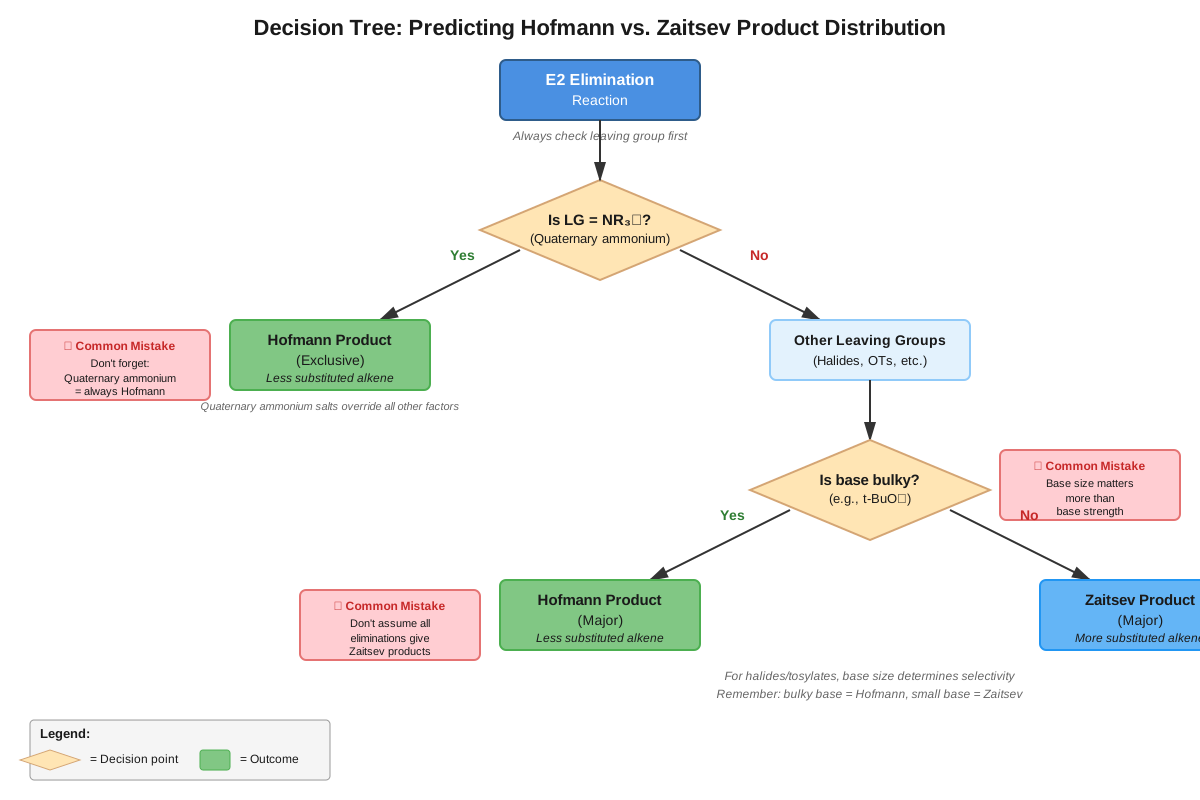
Step 1 - Identify the reaction type: Confirm that the question involves an elimination reaction (E2 specifically). Look for bases, leaving groups, and β-hydrogens. If you see terms like "elimination," "alkene formation," or specific bases mentioned, you're likely dealing with this topic.
Step 2 - Assess the base: This is the critical decision point. Immediately categorize the base as small (OH⁻, EtO⁻, MeO⁻) or bulky (t-BuO⁻, LDA, DBU). Small bases → expect Zaitsev products. Bulky bases → expect Hofmann products. If the base isn't explicitly named but described as "sterically hindered" or "bulky," that's your trigger for Hofmann selectivity.
Step 3 - Examine the leaving group: Check if it's a quaternary ammonium salt (R₄N⁺). This is an automatic indicator of Hofmann selectivity regardless of base size. If you see a Hofmann elimination sequence (methylation, Ag₂O treatment, heating), the answer will be the less substituted alkene.
Step 4 - Draw all possible alkene products: Identify each unique β-carbon and draw the alkene that would result from hydrogen removal at that position. Count the substituents on each alkene (mono-, di-, tri-, tetrasubstituted).
Step 5 - Apply the appropriate rule: For small bases → choose the most substituted alkene (Zaitsev). For bulky bases or quaternary ammonium salts → choose the least substituted alkene (Hofmann).
Trigger words and phrases to watch for:
- "Bulky base," "sterically hindered base" → Hofmann product
- "tert-butoxide," "LDA," "DBU" → Hofmann product
- "Quaternary ammonium," "R₄N⁺" → Hofmann product
- "Exhaustive methylation," "Hofmann elimination" → Hofmann product
- "Ethoxide," "methoxide," "hydroxide" (without "bulky") → Zaitsev product
- "Most stable alkene" → Zaitsev product
- "Least substituted alkene" → Hofmann product
Process-of-elimination tips:
- If answer choices include both more and less substituted alkenes, the question is testing Hofmann vs. Zaitsev selectivity
- Eliminate answers that show the wrong mechanism (E1 vs. E2) by checking if the base and conditions match
- If the question mentions "kinetic control," favor the Hofmann product; "thermodynamic control" favors Zaitsev
- In passage-based questions, look for experimental data showing unexpected product distributions—this often signals Hofmann conditions
Time allocation: These questions typically require 60-90 seconds. Spend 20 seconds identifying the base and leaving group, 30 seconds drawing possible products, and 20 seconds applying the selectivity rule. Don't waste time drawing detailed mechanisms unless specifically asked.
Memory Techniques
Mnemonic for base size and product:
"Big Bases Build Little alkenes" - Bulky bases favor less substituted (Hofmann) products
Mnemonic for Hofmann vs. Zaitsev:
"Hofmann is Humble" - Hofmann products are the humble (less substituted, less stable) alkenes
"Zaitsev is Zealous" - Zaitsev products are zealously stable (more substituted)
Visualization strategy:
Picture a large, bulky base (imagine a basketball) trying to reach between crowded alkyl groups (imagine a dense forest). The basketball can only reach the open spaces (less substituted positions). This mental image helps remember that bulky bases favor Hofmann products.
Acronym for Hofmann-favoring conditions:
"BQP" - Bulky bases, Quaternary ammonium salts, Poor leaving groups
Memory aid for quaternary ammonium:
Think "4 groups = 4ward to least substituted" - Quaternary (four groups on nitrogen) pushes the reaction forward toward the least substituted alkene.
Conceptual anchor:
Remember that Hofmann selectivity is kinetic control - the product forms faster (not more stable). Link this to other kinetic vs. thermodynamic control examples you know (like enolate formation) to create a broader conceptual framework.
Summary
The Hofmann product represents the less substituted, thermodynamically less stable alkene formed during elimination reactions under specific conditions that favor kinetic over thermodynamic control. This selectivity arises primarily when bulky, sterically hindered bases cannot easily access more substituted β-carbons, forcing them to abstract hydrogens from less hindered positions. Quaternary ammonium salts as leaving groups also strongly favor Hofmann elimination due to their significant steric bulk. Understanding Hofmann selectivity requires integrating knowledge of E2 mechanisms, steric effects, transition state energies, and the distinction between kinetic and thermodynamic control. For the MCAT, students must recognize the conditions that favor Hofmann products (bulky bases like t-BuO⁻ or LDA, quaternary ammonium leaving groups) versus those favoring Zaitsev products (small bases like OH⁻ or EtO⁻), and predict the major elimination product accordingly. This concept frequently appears in questions testing regioselectivity, synthetic strategy, and mechanistic understanding, making it a high-yield topic that integrates multiple areas of organic chemistry.
Key Takeaways
- The Hofmann product is the less substituted, less stable alkene formed under kinetic control in elimination reactions
- Bulky bases (t-BuO⁻, LDA) favor Hofmann products because steric hindrance prevents access to more substituted β-carbons
- Quaternary ammonium salts (R₄N⁺) as leaving groups strongly favor Hofmann elimination regardless of base size
- Small bases (OH⁻, EtO⁻) favor Zaitsev products (more substituted alkenes) under thermodynamic control
- Hofmann selectivity demonstrates kinetic control where the faster-forming product predominates despite being less thermodynamically stable
- The MCAT tests this concept by asking students to predict major products based on base size and leaving group identity
- Recognizing trigger words like "bulky base," "sterically hindered," or "quaternary ammonium" immediately signals Hofmann selectivity
Related Topics
Zaitsev's Rule and Zaitsev Products: The complementary concept to Hofmann selectivity, explaining why more substituted alkenes typically predominate in elimination reactions. Mastering Hofmann products requires understanding Zaitsev's rule as the baseline expectation.
E1 vs. E2 Mechanisms: Hofmann selectivity only applies to E2 reactions; understanding why E1 reactions always favor Zaitsev products deepens mechanistic knowledge and helps predict outcomes in different scenarios.
Steric Effects in Organic Reactions: The principles governing Hofmann selectivity apply broadly to other reactions where steric hindrance influences outcomes, including SN2 reactions and nucleophilic additions.
Alkene Stability and Hyperconjugation: Understanding why more substituted alkenes are more stable provides the thermodynamic foundation against which Hofmann selectivity (kinetic control) is understood.
Synthetic Strategy and Regiocontrol: Hofmann selectivity is one tool chemists use to control regioselectivity in synthesis; this connects to broader topics in retrosynthetic analysis and multi-step synthesis planning.
Practice CTA
Now that you've mastered the core concepts of Hofmann products and their role in elimination reactions, it's time to solidify your understanding through active practice. Challenge yourself with practice questions that require you to predict products under different conditions, distinguish between Hofmann and Zaitsev selectivity, and apply these concepts to complex synthetic scenarios. Use flashcards to drill the conditions favoring each type of product until recognition becomes automatic. Remember, the MCAT rewards not just knowledge but the ability to apply concepts quickly and accurately under time pressure—practice is what builds that skill. You've got this!
Sign up free to keep reading
Create a free AnvayaPrep account to finish this MCAT guide on Hofmann product — plus flashcards and practice questions.