Overview
The photoelectric effect represents one of the most revolutionary discoveries in modern physics, fundamentally challenging classical wave theory and establishing the quantum nature of light. This phenomenon occurs when light strikes a metal surface and ejects electrons, but only under specific conditions that cannot be explained by classical electromagnetic theory. The photoelectric effect demonstrates that light behaves as discrete packets of energy called photons, with each photon carrying energy proportional to its frequency. This discovery, for which Albert Einstein received the Nobel Prize in 1905, bridged the gap between classical and quantum physics and laid the groundwork for our understanding of atomic structure and light-matter interactions.
For the MCAT, the photoelectric effect is a medium-yield topic that appears regularly in the Physics section, particularly within questions addressing Atomic and Nuclear Physics. Understanding this phenomenon requires integrating concepts from electromagnetism, wave mechanics, and quantum theory. MCAT questions typically test the mathematical relationships governing the photoelectric effect, the interpretation of experimental observations, and the ability to distinguish between classical and quantum predictions. Students must be comfortable with the photoelectric equation, work function concepts, and the relationship between photon energy and frequency.
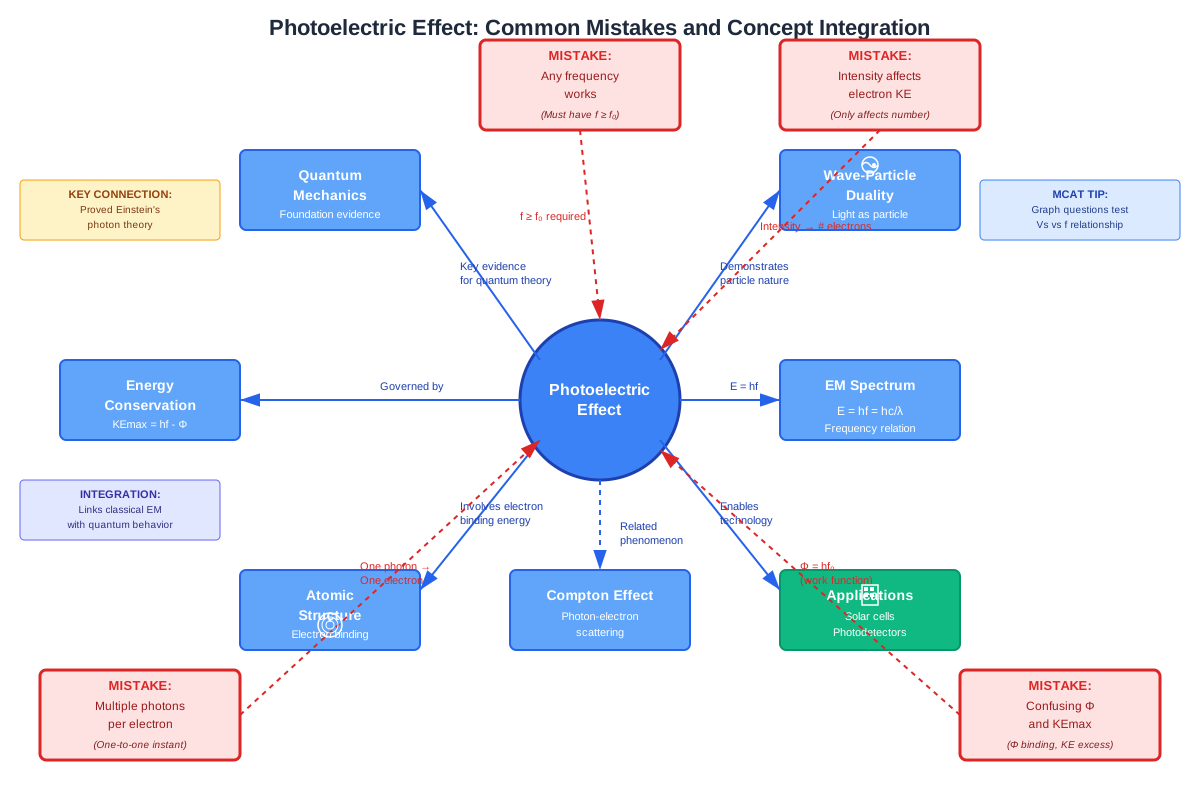
The photoelectric effect connects to broader Physics concepts including electromagnetic radiation, energy conservation, atomic structure, and quantum mechanics. It serves as a gateway to understanding how matter and energy interact at the atomic scale, which is essential for comprehending spectroscopy, electron transitions, and nuclear phenomena. Mastery of this topic strengthens the conceptual foundation needed for related MCAT subjects including atomic emission spectra, electron configuration, and the wave-particle duality of matter.
Learning Objectives
- [ ] Define photoelectric effect using accurate Physics terminology
- [ ] Explain why photoelectric effect matters for the MCAT
- [ ] Apply photoelectric effect to exam-style questions
- [ ] Identify common mistakes related to photoelectric effect
- [ ] Connect photoelectric effect to related Physics concepts
- [ ] Calculate maximum kinetic energy of ejected photoelectrons using Einstein's photoelectric equation
- [ ] Distinguish between classical wave predictions and quantum observations of the photoelectric effect
- [ ] Analyze graphical representations of photoelectric effect data including stopping potential versus frequency plots
Prerequisites
- Electromagnetic radiation and the electromagnetic spectrum: Understanding wavelength, frequency, and the speed of light is essential for calculating photon energy and interpreting photoelectric effect experiments
- Energy conservation principles: The photoelectric effect involves energy transfer from photons to electrons, requiring solid understanding of how energy is conserved and transformed
- Basic atomic structure: Knowledge of electrons in atoms and their binding energies provides context for understanding why certain metals exhibit different photoelectric properties
- Work and kinetic energy: The photoelectric effect involves work done to remove electrons and the resulting kinetic energy of ejected electrons
- Wave properties of light: Familiarity with classical wave theory helps appreciate why the photoelectric effect was so revolutionary and contradicted existing predictions
Why This Topic Matters
The photoelectric effect has profound real-world applications that extend far beyond theoretical physics. Photoelectric sensors are ubiquitous in modern technology, from automatic door openers and light meters in cameras to solar panels that convert sunlight directly into electrical energy. Medical imaging technologies, including certain types of radiation detectors and photomultiplier tubes used in PET scans, rely on photoelectric principles. Understanding this phenomenon is also crucial for comprehending how spectroscopic techniques work, which are essential tools in biochemistry and clinical diagnostics.
On the MCAT, the photoelectric effect appears in approximately 2-4% of Physics passages and discrete questions, making it a medium-yield topic that students cannot afford to ignore. Questions typically appear as either discrete items testing direct application of the photoelectric equation or as part of passages describing experimental setups involving light-matter interactions. The AAMC frequently tests this topic through graphical analysis questions, asking students to interpret plots of kinetic energy versus frequency or stopping potential versus wavelength. Additionally, the photoelectric effect often appears in interdisciplinary passages that connect physics concepts to biological applications, such as photosynthesis or vision.
Common MCAT question formats include: calculating the threshold frequency or wavelength for electron ejection, determining the maximum kinetic energy of photoelectrons, analyzing the effect of changing light intensity versus frequency, and identifying which experimental observations support quantum theory over classical wave theory. The topic also appears in questions requiring students to apply energy conservation principles to photon-electron interactions and to interpret data from photoelectric effect experiments presented in tabular or graphical form.
Core Concepts
Definition and Fundamental Principle
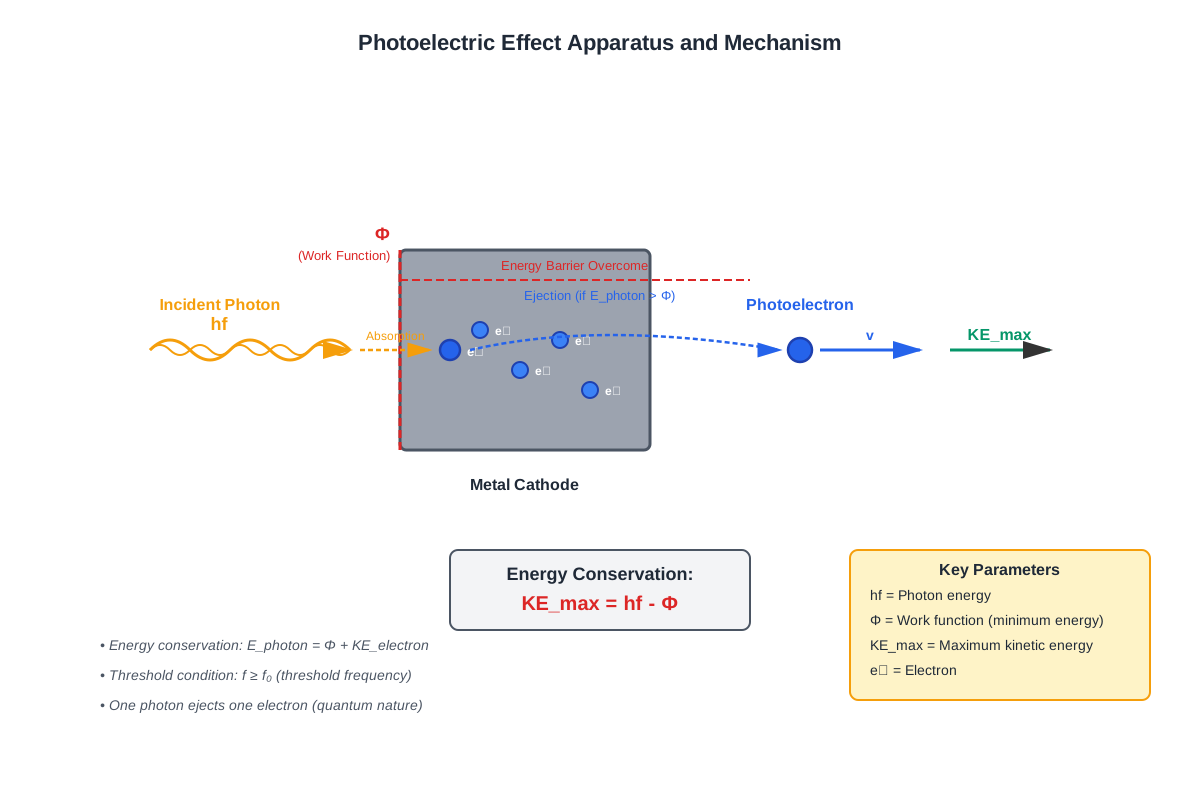
The photoelectric effect is the phenomenon in which electrons are ejected from a metal surface when electromagnetic radiation (typically ultraviolet or visible light) strikes that surface. This process occurs when photons transfer their energy to electrons in the metal, providing sufficient energy to overcome the attractive forces binding the electrons to the material. The ejected electrons are called photoelectrons, and their emission demonstrates the particle nature of light.
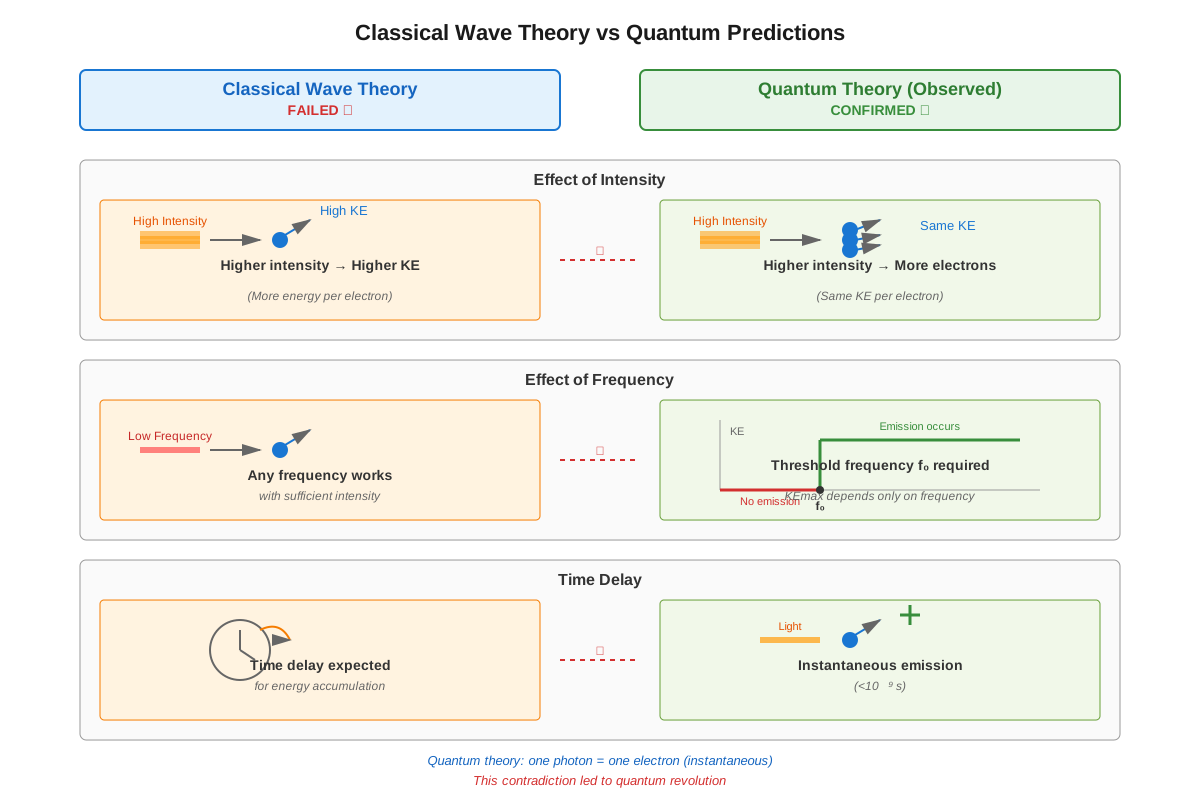
The fundamental principle underlying the photoelectric effect is that light consists of discrete energy packets called photons, each carrying energy proportional to the frequency of the electromagnetic radiation. This quantum description of light contradicts classical wave theory, which predicted that light of any frequency should eventually eject electrons if the intensity is sufficiently high. Instead, experimental observations revealed that only light above a certain threshold frequency could cause electron ejection, regardless of intensity.
Einstein's Photoelectric Equation
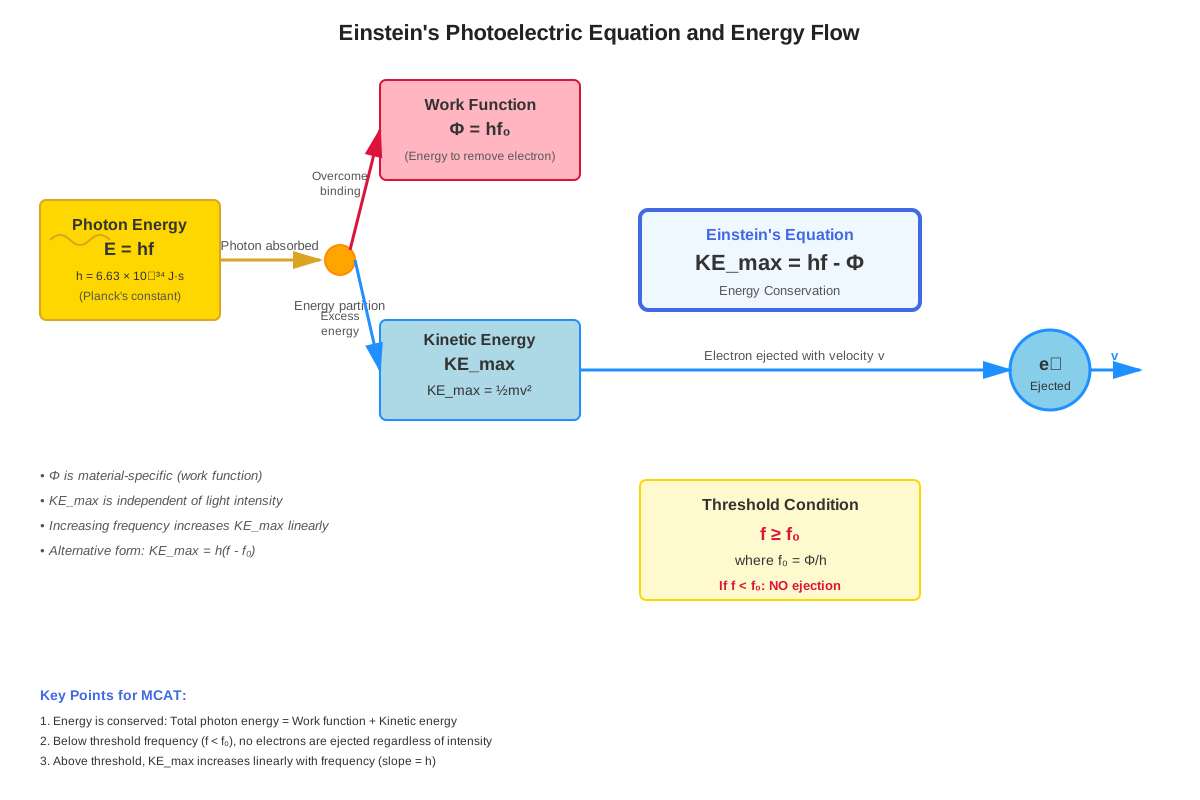
The mathematical relationship governing the photoelectric effect is expressed by Einstein's photoelectric equation:
KE_max = hf - φWhere:
- KE_max = maximum kinetic energy of ejected photoelectrons (in joules or electron volts)
- h = Planck's constant (6.626 × 10⁻³⁴ J·s or 4.14 × 10⁻¹⁵ eV·s)
- f = frequency of incident light (in Hz)
- φ = work function of the metal (in joules or electron volts)
The work function (φ) represents the minimum energy required to remove an electron from the metal surface. It is a characteristic property of each material, reflecting the strength of the attractive forces holding electrons within the metal. Different metals have different work functions, which explains why some materials exhibit the photoelectric effect with visible light while others require ultraviolet radiation.
The term hf represents the energy of a single photon, derived from Planck's relationship E = hf. When a photon strikes an electron, it transfers all its energy to that electron in a single quantum event. If the photon energy exceeds the work function, the excess energy appears as kinetic energy of the ejected electron.
Threshold Frequency and Wavelength
The threshold frequency (f₀) is the minimum frequency of light required to eject electrons from a particular metal surface. At the threshold frequency, the photon energy exactly equals the work function, and electrons are ejected with zero kinetic energy:
hf₀ = φTherefore:
f₀ = φ/hSince frequency and wavelength are inversely related through the speed of light (c = λf), we can also define a threshold wavelength (λ₀):
λ₀ = c/f₀ = hc/φLight with frequency below f₀ (or wavelength above λ₀) cannot eject electrons regardless of intensity. This observation was impossible to explain using classical wave theory and provided crucial evidence for the quantum nature of light.
Key Experimental Observations
The photoelectric effect exhibits several characteristic behaviors that distinguish quantum from classical predictions:
| Observation | Classical Prediction | Quantum Explanation |
|---|---|---|
| Frequency dependence | Any frequency should work if intensity is high enough | Only frequencies above threshold can eject electrons |
| Intensity effect | Higher intensity should increase electron kinetic energy | Higher intensity increases number of ejected electrons, not their energy |
| Time delay | Electrons should be ejected after accumulating sufficient energy (time delay expected) | Electron ejection is instantaneous (< 10⁻⁹ seconds) |
| Maximum kinetic energy | Should depend on light intensity | Depends only on frequency, not intensity |
These observations conclusively demonstrated that light behaves as particles (photons) in this context, with each photon-electron interaction being an individual quantum event.
Stopping Potential
The stopping potential (V₀) is the minimum potential difference required to prevent the most energetic photoelectrons from reaching a collecting electrode in a photoelectric effect apparatus. The stopping potential is directly related to the maximum kinetic energy of photoelectrons:
KE_max = eV₀Where e is the elementary charge (1.6 × 10⁻¹⁹ C). Combining this with Einstein's photoelectric equation:
eV₀ = hf - φRearranging:
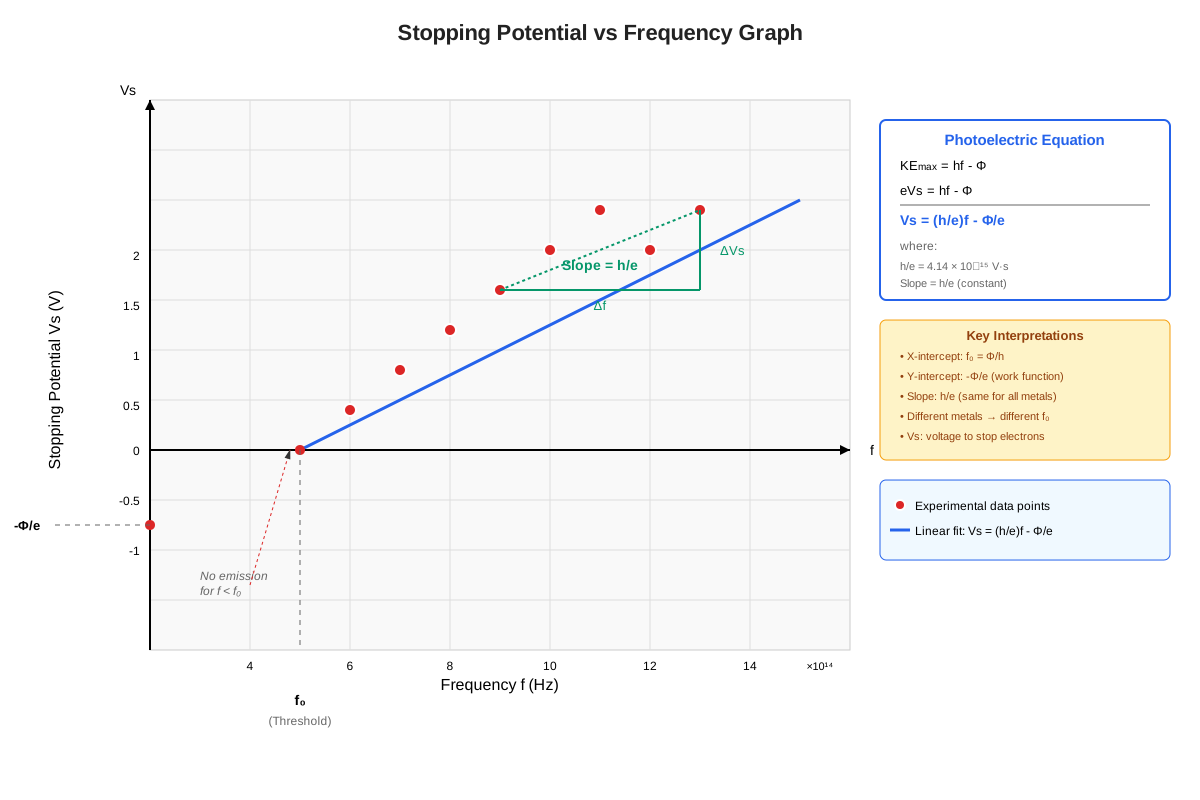
V₀ = (h/e)f - φ/eThis linear relationship between stopping potential and frequency is often tested on the MCAT through graphical analysis. A plot of V₀ versus f yields a straight line with slope h/e and y-intercept -φ/e. The x-intercept of this plot corresponds to the threshold frequency.
Intensity and Photocurrent
While light intensity does not affect the maximum kinetic energy of individual photoelectrons, it does influence the photocurrent—the total number of electrons ejected per unit time. Higher intensity means more photons strike the surface per second, resulting in more photoelectric events and greater current. This relationship is linear: doubling the intensity doubles the photocurrent (assuming frequency remains above threshold).
This distinction is crucial for MCAT questions: intensity affects quantity (how many electrons), while frequency affects quality (how much energy each electron has).
Concept Relationships
The photoelectric effect integrates multiple fundamental physics concepts into a coherent framework. At its core, the phenomenon demonstrates energy conservation: the photon's energy (hf) is completely transferred to an electron, with part used to overcome the work function (φ) and the remainder appearing as kinetic energy (KE_max). This relationship directly connects electromagnetic radiation properties (frequency, wavelength) to mechanical energy concepts (kinetic energy, work).
The work function concept links the photoelectric effect to atomic structure and chemical bonding. Metals with loosely bound valence electrons have lower work functions and exhibit the photoelectric effect with lower-energy (longer wavelength) light. This connection extends to the periodic table: alkali metals (Group 1) have particularly low work functions due to their single valence electron, while transition metals typically require higher-energy photons.
The photoelectric effect also bridges wave-particle duality: light behaves as waves when propagating through space (exhibiting interference and diffraction) but as particles (photons) when interacting with matter. This dual nature is fundamental to quantum mechanics and appears in related MCAT topics including Compton scattering and matter waves (de Broglie wavelength).
Graphically, the relationship between stopping potential and frequency creates a linear function, connecting the photoelectric effect to mathematical analysis and data interpretation skills. The slope of this line (h/e) is a universal constant, while the intercepts reveal material-specific properties (work function and threshold frequency).
The concept flow can be mapped as: Electromagnetic radiation → carries energy in photons (E = hf) → Photon-electron interaction → energy transfer governed by conservation → Work function determines if ejection occurs → Excess energy becomes kinetic energy → Stopping potential measures this kinetic energy → Photocurrent reflects number of interactions.
Quick check — test yourself on Photoelectric effect so far.
Try Flashcards →High-Yield Facts
⭐ The photoelectric effect demonstrates the particle nature of light: Photons transfer energy to electrons in discrete quantum events, not continuous waves.
⭐ Einstein's photoelectric equation: KE_max = hf - φ, where h = 6.626 × 10⁻³⁴ J·s (or 4.14 × 10⁻¹⁵ eV·s).
⭐ Only light above the threshold frequency can eject electrons, regardless of intensity; below threshold, no electrons are ejected no matter how bright the light.
⭐ Increasing light intensity increases the number of ejected electrons (photocurrent) but does NOT increase their maximum kinetic energy.
⭐ The work function is material-specific and represents the minimum energy needed to remove an electron from that particular metal surface.
- The threshold frequency is calculated as f₀ = φ/h, and threshold wavelength as λ₀ = hc/φ.
- Stopping potential V₀ relates to maximum kinetic energy by KE_max = eV₀, where e = 1.6 × 10⁻¹⁹ C.
- A plot of stopping potential versus frequency is linear with slope h/e and x-intercept at the threshold frequency.
- Photoelectron ejection is instantaneous (< 10⁻⁹ seconds), contradicting classical predictions of a time delay.
- The photoelectric effect cannot be explained by classical wave theory, which incorrectly predicted that any frequency should work if intensity is high enough.
- Different colors of light have different frequencies: violet/UV light has higher frequency (shorter wavelength) than red light, making it more effective for the photoelectric effect.
- The maximum kinetic energy of photoelectrons increases linearly with frequency above threshold: higher frequency photons transfer more excess energy.
Common Misconceptions
Misconception: Increasing light intensity will increase the kinetic energy of ejected electrons. → Correction: Intensity only affects the number of electrons ejected (photocurrent), not their individual kinetic energies. Maximum kinetic energy depends solely on photon frequency (KE_max = hf - φ). Higher intensity means more photons per second, resulting in more photoelectric events, but each photon-electron interaction follows the same energy relationship.
Misconception: If light below the threshold frequency shines on a metal long enough, electrons will eventually accumulate enough energy to be ejected. → Correction: The photoelectric effect is a quantum phenomenon involving individual photon-electron interactions. Each photon either has enough energy to eject an electron or it doesn't—there is no accumulation of energy over time. A single photon must possess energy hf ≥ φ for ejection to occur. This instantaneous nature was one of the key observations that contradicted classical wave theory.
Misconception: All metals have the same work function and threshold frequency. → Correction: Work function is a material-specific property that varies significantly among different metals. Alkali metals like cesium have low work functions (~2 eV) and can exhibit the photoelectric effect with visible light, while metals like platinum have high work functions (~6 eV) requiring ultraviolet light. This variation reflects differences in electron binding energy related to atomic structure and metallic bonding.
Misconception: The photoelectric effect proves that light is only a particle, not a wave. → Correction: The photoelectric effect demonstrates the particle nature of light in the context of light-matter interactions, but light exhibits both wave and particle properties depending on the experimental context (wave-particle duality). Light propagates as waves (showing interference and diffraction) but interacts with matter as particles (photons). Both descriptions are necessary for a complete understanding of electromagnetic radiation.
Misconception: The work function represents the energy of the ejected electron. → Correction: The work function is the minimum energy required to remove an electron from the metal surface—it represents energy that must be supplied to overcome binding forces, not energy the electron possesses afterward. The kinetic energy of the ejected electron is the excess photon energy beyond the work function: KE_max = hf - φ. The work function is essentially "lost" energy used to break the electron free from the metal.
Worked Examples
Example 1: Calculating Maximum Kinetic Energy
Problem: Light with a wavelength of 400 nm strikes a potassium surface. The work function of potassium is 2.3 eV. Calculate: (a) the energy of the incident photons in eV, (b) the maximum kinetic energy of ejected photoelectrons, and (c) the stopping potential.
Solution:
(a) Finding photon energy:
First, convert wavelength to frequency using c = λf:
f = c/λ = (3.0 × 10⁸ m/s)/(400 × 10⁻⁹ m) = 7.5 × 10¹⁴ HzNow calculate photon energy using E = hf. Since the answer should be in eV, use h = 4.14 × 10⁻¹⁵ eV·s:
E = hf = (4.14 × 10⁻¹⁵ eV·s)(7.5 × 10¹⁴ Hz) = 3.1 eV(b) Finding maximum kinetic energy:
Apply Einstein's photoelectric equation:
KE_max = hf - φ = 3.1 eV - 2.3 eV = 0.8 eV(c) Finding stopping potential:
Use the relationship KE_max = eV₀:
V₀ = KE_max/e = 0.8 eV/e = 0.8 V(Note: When kinetic energy is already in eV, the stopping potential in volts is numerically equal)
Key reasoning: This problem requires converting between wavelength and frequency, applying the photoelectric equation, and understanding the relationship between kinetic energy and stopping potential. The photon energy (3.1 eV) exceeds the work function (2.3 eV), confirming that photoelectron ejection will occur. The excess energy (0.8 eV) becomes the maximum kinetic energy of ejected electrons.
Example 2: Analyzing Experimental Data
Problem: In a photoelectric effect experiment, light of various frequencies is directed at a metal surface, and the stopping potential is measured for each frequency. The data shows that when f = 6.0 × 10¹⁴ Hz, V₀ = 0.5 V, and when f = 8.0 × 10¹⁴ Hz, V₀ = 1.3 V. Determine: (a) the work function of the metal in eV, and (b) the threshold frequency.
Solution:
(a) Finding the work function:
The relationship between stopping potential and frequency is:
V₀ = (h/e)f - φ/eThis is a linear equation (y = mx + b form) where the slope is h/e. We can use the two data points to find the slope:
slope = ΔV₀/Δf = (1.3 V - 0.5 V)/(8.0 × 10¹⁴ Hz - 6.0 × 10¹⁴ Hz)
slope = 0.8 V/(2.0 × 10¹⁴ Hz) = 4.0 × 10⁻¹⁵ V·s
This slope should equal h/e. We can verify: h/e = (4.14 × 10⁻¹⁵ eV·s)/(1 e) = 4.14 × 10⁻¹⁵ V·s ✓
Now use one data point to find the work function. Using the first point:
0.5 V = (4.14 × 10⁻¹⁵ V·s)(6.0 × 10¹⁴ Hz) - φ/e
0.5 V = 2.48 V - φ/e
φ/e = 1.98 V
φ = 1.98 eV ≈ 2.0 eV
(b) Finding threshold frequency:
At threshold frequency, V₀ = 0 (electrons are ejected with zero kinetic energy):
0 = (h/e)f₀ - φ/e
f₀ = φ/h = (2.0 eV)/(4.14 × 10⁻¹⁵ eV·s) = 4.8 × 10¹⁴ Hz
Key reasoning: This problem tests graphical analysis skills and the ability to extract material properties from experimental data. The linear relationship between stopping potential and frequency is fundamental to photoelectric effect experiments. The slope is a universal constant (h/e), while the intercepts reveal material-specific properties. This type of data analysis question is common on the MCAT.
Exam Strategy
When approaching photoelectric effect MCAT questions, first identify what type of question is being asked: calculation-based (applying Einstein's equation), conceptual (distinguishing classical from quantum predictions), or graphical analysis (interpreting stopping potential versus frequency plots). Each requires a different strategic approach.
Trigger words and phrases to watch for include: "threshold frequency," "work function," "stopping potential," "maximum kinetic energy," "photocurrent," and "intensity." When you see "threshold," immediately think about the minimum photon energy required (hf₀ = φ). When "intensity" appears, remember it affects quantity (number of electrons) not quality (their energy). The phrase "maximum kinetic energy" should trigger Einstein's equation: KE_max = hf - φ.
For calculation questions, organize your approach systematically:
- Identify what's given and what's being asked
- Determine if unit conversion is needed (wavelength ↔ frequency, joules ↔ eV)
- Select the appropriate equation (photoelectric equation, threshold relationship, or stopping potential)
- Solve algebraically before plugging in numbers
- Check if your answer makes physical sense
For conceptual questions, use process of elimination by identifying answer choices that reflect classical wave predictions (these are wrong). Eliminate any choice suggesting that: intensity affects electron kinetic energy, any frequency can work if intensity is high enough, or there's a time delay in electron ejection. Correct answers will emphasize the quantum nature: photon energy depends on frequency, threshold frequency exists, and interactions are instantaneous.
Time allocation: Discrete photoelectric effect questions typically require 60-90 seconds. Straightforward calculations using Einstein's equation should take about 60 seconds. More complex problems involving graphical analysis or multi-step reasoning may require up to 90 seconds. If a question requires more than 90 seconds, consider flagging it and returning later—there may be a simpler approach you're missing.
Exam Tip: When graphs of stopping potential versus frequency appear, remember the x-intercept gives threshold frequency, the y-intercept gives -φ/e, and the slope is always h/e (a universal constant). This single graph contains all the information about the photoelectric effect for that material.
Memory Techniques
Mnemonic for Einstein's Photoelectric Equation: "High Frequency Photons Kick Electrons" helps remember KE = hf - φ (the "kick" represents the work function that must be overcome).
Acronym for Key Observations: FINT helps remember what matters:
- Frequency determines maximum kinetic energy (not intensity)
- Intensity determines number of electrons ejected (photocurrent)
- No time delay in electron ejection (instantaneous)
- Threshold frequency must be exceeded for any ejection
Visualization strategy: Picture photons as tiny energy packets (like balls) hitting electrons. Each ball must be "heavy enough" (high enough frequency) to knock an electron free. Throwing more balls (higher intensity) means more electrons get knocked out, but each ball's "weight" (frequency) determines how fast the electron flies away. A ball that's too light (below threshold frequency) can never knock an electron free, no matter how many you throw.
Threshold relationship memory aid: "Work Function Halts Feeble Photons" reminds you that φ = hf₀ at threshold (Work function = h × frequency₀).
Units reminder: Remember "eV is easy Voltage"—when kinetic energy is in electron volts (eV), the stopping potential in volts (V) is numerically equal because KE_max = eV₀, so V₀ = KE_max/e.
Summary
The photoelectric effect is a quantum phenomenon demonstrating that light behaves as discrete energy packets (photons) when interacting with matter. When electromagnetic radiation strikes a metal surface, electrons are ejected only if the photon frequency exceeds a material-specific threshold frequency, regardless of light intensity. Einstein's photoelectric equation, KE_max = hf - φ, quantifies this relationship, showing that maximum kinetic energy of photoelectrons depends on photon frequency minus the work function. The work function represents the minimum energy required to remove an electron from the metal surface and varies among different materials. Light intensity affects only the number of ejected electrons (photocurrent), not their individual kinetic energies. The stopping potential, which prevents photoelectrons from reaching a collector, relates directly to maximum kinetic energy through KE_max = eV₀. Experimental observations of the photoelectric effect—including the existence of threshold frequency, instantaneous electron ejection, and the independence of kinetic energy from intensity—contradicted classical wave theory and provided crucial evidence for the quantum nature of light. For the MCAT, students must master the mathematical relationships, distinguish between classical and quantum predictions, and interpret graphical data relating stopping potential to frequency.
Key Takeaways
- The photoelectric effect proves light's particle nature: photons transfer energy to electrons in discrete quantum events described by KE_max = hf - φ
- Only photons with frequency above the threshold frequency (f₀ = φ/h) can eject electrons, regardless of light intensity
- Light intensity affects the number of ejected electrons (photocurrent) but NOT their maximum kinetic energy, which depends solely on frequency
- The work function (φ) is a material-specific property representing the minimum energy needed to remove an electron from that metal surface
- Stopping potential (V₀) relates to maximum kinetic energy through KE_max = eV₀, and a plot of V₀ versus frequency is linear with slope h/e
- The photoelectric effect contradicts classical wave theory, which incorrectly predicted that any frequency should work if intensity is sufficient
- Understanding the photoelectric effect requires integrating concepts of electromagnetic radiation, energy conservation, atomic structure, and quantum mechanics
Related Topics
Atomic emission spectra and electron transitions: The photoelectric effect's quantum energy principles extend to understanding how electrons transition between energy levels in atoms, emitting or absorbing photons of specific frequencies. Mastering the photoelectric effect provides the foundation for understanding spectroscopy.
Compton scattering: This phenomenon further demonstrates photon particle behavior through photon-electron collisions that change the photon's wavelength. The photoelectric effect and Compton scattering together establish the photon concept.
Wave-particle duality and de Broglie wavelength: After understanding light's particle nature through the photoelectric effect, students can explore how matter (like electrons) also exhibits wave properties, completing the quantum mechanical picture.
Quantum mechanics and the uncertainty principle: The photoelectric effect serves as an introduction to quantum theory, preparing students for more advanced quantum concepts including wave functions and the Heisenberg uncertainty principle.
Solar cells and photovoltaic devices: Practical applications of the photoelectric effect in energy conversion technologies demonstrate real-world relevance and may appear in interdisciplinary MCAT passages.
Practice CTA
Now that you've mastered the conceptual framework and mathematical relationships governing the photoelectric effect, it's time to solidify your understanding through active practice. Attempt the practice questions and flashcards to test your ability to apply Einstein's photoelectric equation, distinguish between classical and quantum predictions, and analyze experimental data. Focus especially on questions involving graphical analysis and multi-step calculations, as these frequently appear on the MCAT. Remember, the photoelectric effect integrates multiple physics concepts—energy conservation, electromagnetic radiation, and quantum theory—making it an excellent topic for developing the integrative thinking skills essential for MCAT success. Each practice problem you work through strengthens your ability to recognize patterns and apply strategic problem-solving approaches under exam conditions. You've got this!
Sign up free to keep reading
Create a free AnvayaPrep account to finish this MCAT guide on Photoelectric effect — plus flashcards and practice questions.