Overview
Wavelength is a fundamental property of all wave phenomena and represents one of the most frequently tested concepts in the Physics section of the MCAT. As a measurable characteristic that describes the spatial extent of one complete wave cycle, wavelength serves as a bridge between the mathematical description of waves and their observable physical behaviors. Understanding wavelength is essential not only for mastering Waves and Sound but also for comprehending electromagnetic radiation, optics, and even quantum mechanical phenomena that appear across multiple MCAT sections.
The concept of wavelength extends far beyond abstract physics problems. In biological and medical contexts, wavelength determines how different types of electromagnetic radiation interact with tissue—from the penetrating power of X-rays used in diagnostic imaging to the specific wavelengths of light that photoreceptors in the retina can detect. On the MCAT, wavelength appears in diverse question formats: quantitative problems requiring calculation using the wave equation, conceptual questions about the relationship between wavelength and energy, and passage-based questions integrating wavelength with topics like the electromagnetic spectrum, sound propagation through different media, or the photoelectric effect.
Mastering wavelength Physics requires understanding its mathematical relationships with frequency, wave speed, and period, as well as its inverse relationship with energy for electromagnetic radiation. This topic connects directly to fundamental wave properties, the electromagnetic spectrum, sound intensity and pitch, optics (including diffraction and interference), and even quantum mechanics through the de Broglie wavelength. A solid grasp of wavelength concepts enables students to tackle complex, multi-step MCAT problems that integrate wave behavior with energy, momentum, and the interaction of radiation with matter.
Learning Objectives
- [ ] Define wavelength using accurate Physics terminology
- [ ] Explain why wavelength matters for the MCAT
- [ ] Apply wavelength to exam-style questions
- [ ] Identify common mistakes related to wavelength
- [ ] Connect wavelength to related Physics concepts
- [ ] Calculate wavelength given frequency and wave speed using the wave equation
- [ ] Predict how wavelength changes when waves transition between different media
- [ ] Compare and contrast wavelengths across the electromagnetic spectrum and relate them to energy and frequency
Prerequisites
- Basic wave properties: Understanding that waves transfer energy without transferring matter is essential for comprehending how wavelength describes spatial periodicity
- Units and dimensional analysis: Facility with metric units (meters, nanometers) and unit conversion enables accurate wavelength calculations
- Algebraic manipulation: Solving for variables in equations like v = fλ requires comfort with basic algebra
- Frequency and period: Knowing that frequency describes temporal oscillation helps distinguish it from wavelength's spatial description
- Speed, distance, and time relationships: The wave equation builds directly on these fundamental kinematic concepts
Why This Topic Matters
Wavelength appears in approximately 8-12% of MCAT Physics questions and frequently serves as a connecting concept in interdisciplinary passages that span physics, chemistry, and biology. Medical applications of wavelength are ubiquitous: diagnostic imaging modalities (ultrasound, X-ray, MRI) all depend on wave properties; phototherapy treatments use specific wavelengths to target tissues; and understanding how different wavelengths of UV radiation cause DNA damage requires wavelength knowledge. The MCAT specifically tests whether students can move fluidly between wavelength, frequency, and energy—a skill essential for understanding both classical wave phenomena and quantum mechanical concepts.
On the exam, wavelength appears in multiple question formats. Discrete questions often test direct calculation using the wave equation or require students to identify how wavelength changes when wave speed or frequency changes. Passage-based questions frequently embed wavelength in contexts like Doppler ultrasound (where wavelength shifts indicate blood flow velocity), spectroscopy (where wavelength identifies molecular structures), or fiber optic technology (where wavelength determines information-carrying capacity). The MCAT particularly favors questions that require students to recognize inverse relationships—between wavelength and frequency, or between wavelength and photon energy—making this a high-yield topic for strategic preparation.
Understanding wavelength also provides the foundation for more advanced topics tested on the MCAT, including interference and diffraction patterns (where path differences are expressed in wavelengths), the photoelectric effect (where threshold wavelength determines whether electrons are ejected), and atomic spectra (where specific wavelengths correspond to electronic transitions). Students who master wavelength concepts gain a significant advantage in tackling the integrative, multi-concept questions that distinguish high scorers.
Core Concepts
Definition and Mathematical Description
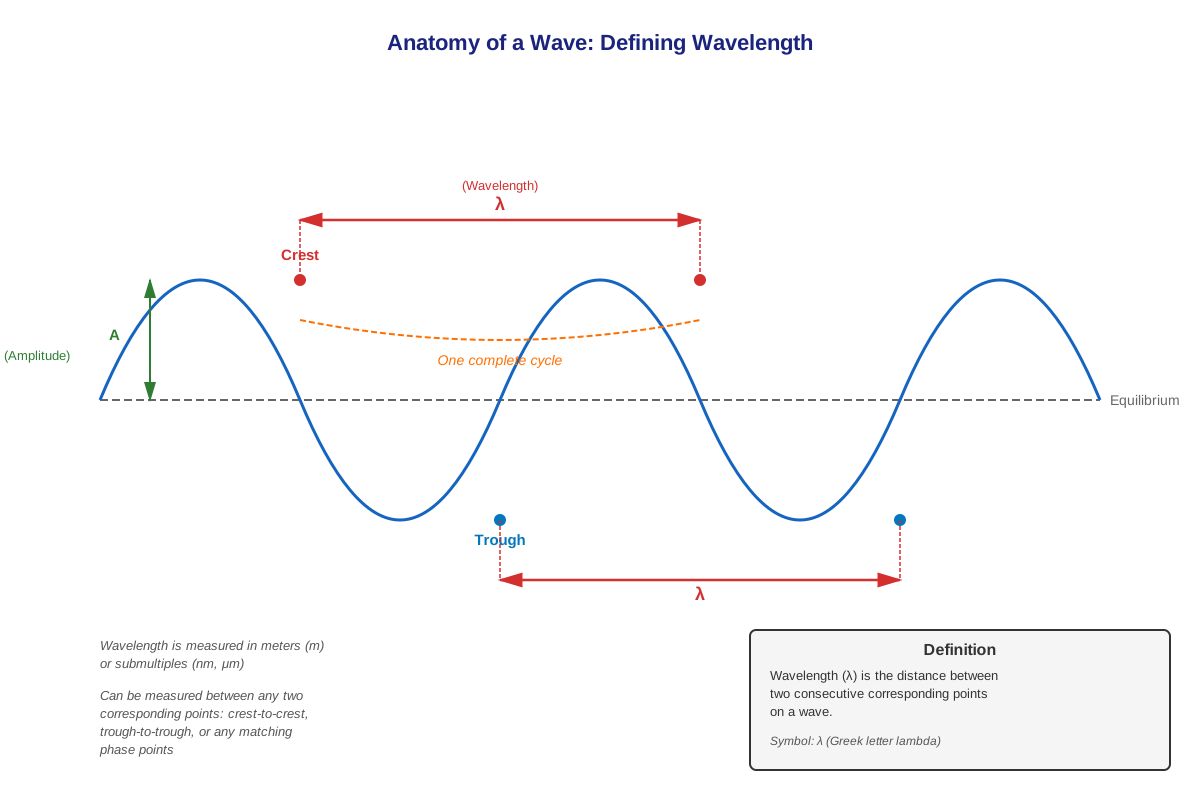
Wavelength (symbol: λ, Greek letter lambda) is defined as the spatial distance over which a wave's shape repeats—the distance between two consecutive points that are in phase with each other. For a sinusoidal wave, wavelength represents the distance from one crest to the next crest, one trough to the next trough, or between any two points that are at identical positions in their oscillation cycle. Wavelength is measured in units of length, typically meters (m) for sound waves and macroscopic phenomena, or nanometers (nm) for visible light and other electromagnetic radiation.
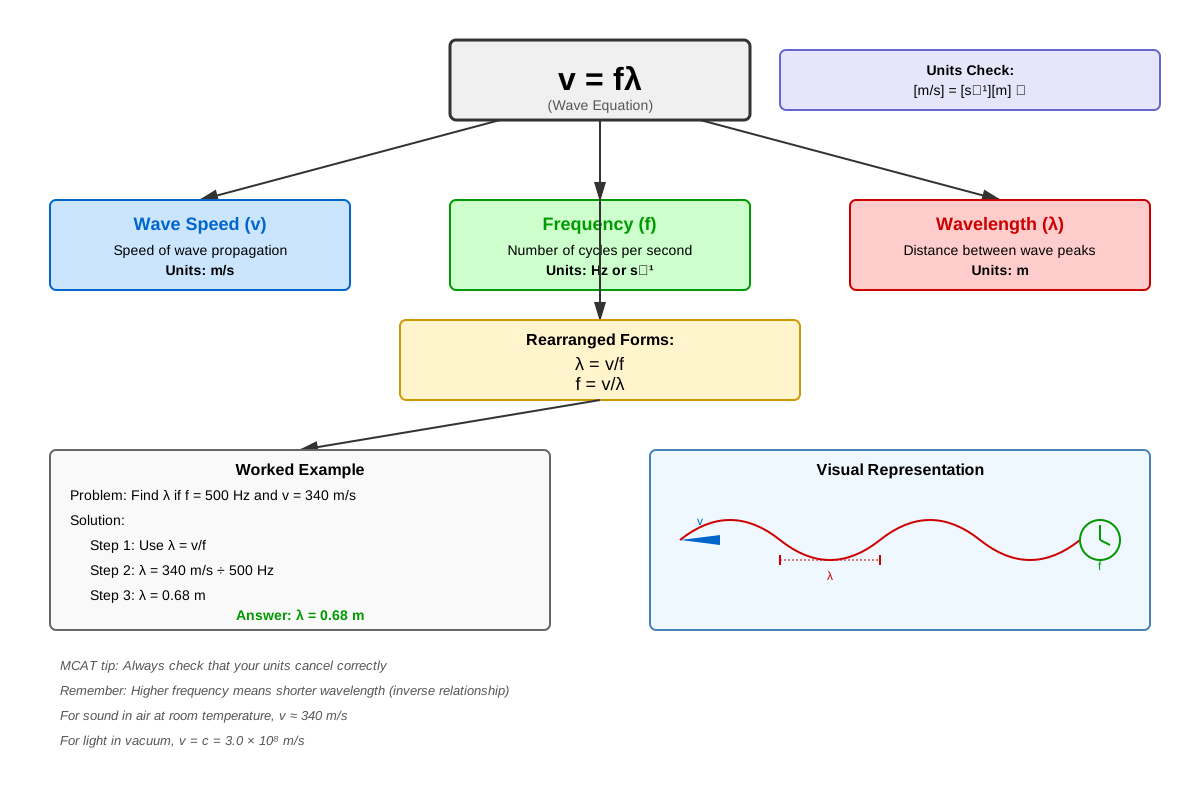
The fundamental relationship governing wavelength is the wave equation:
v = fλwhere v is the wave speed (m/s), f is the frequency (Hz or s⁻¹), and λ is the wavelength (m). This equation reveals that wavelength and frequency are inversely proportional when wave speed remains constant: as frequency increases, wavelength decreases proportionally. This inverse relationship is crucial for MCAT problem-solving and appears repeatedly in both quantitative and conceptual questions.
Wavelength in Different Wave Types
Mechanical waves (including sound waves, water waves, and waves on strings) require a medium for propagation, and their wavelength depends on both the properties of the medium and the frequency of the source. For sound waves in air at room temperature, wavelengths range from approximately 17 meters (for 20 Hz, the lower limit of human hearing) to 17 millimeters (for 20,000 Hz, the upper limit). The wave speed in mechanical waves depends on medium properties: for sound, v = √(B/ρ), where B is the bulk modulus and ρ is density.
Electromagnetic waves do not require a medium and travel at the speed of light (c = 3.0 × 10⁸ m/s) in vacuum. For electromagnetic radiation, the wave equation becomes:
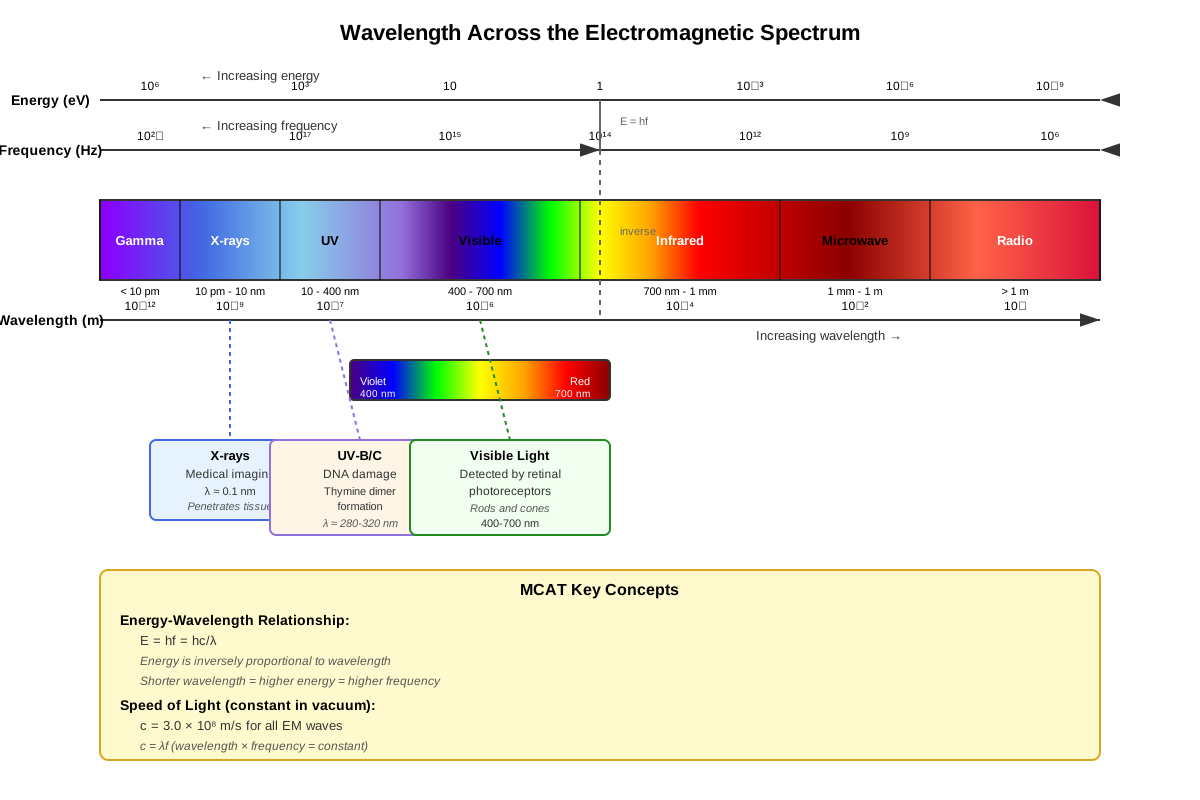
c = fλThe electromagnetic spectrum spans an enormous range of wavelengths, from gamma rays (λ < 10⁻¹² m) to radio waves (λ > 10³ m). Visible light occupies a narrow band from approximately 400 nm (violet) to 700 nm (red). The MCAT frequently tests whether students can identify which regions of the electromagnetic spectrum correspond to different wavelength ranges and understand the energy implications.
Wavelength and Energy Relationship
For electromagnetic radiation, wavelength has an inverse relationship with photon energy, expressed through Planck's equation:
E = hf = hc/λwhere E is photon energy (J), h is Planck's constant (6.626 × 10⁻³⁴ J·s), c is the speed of light, and λ is wavelength. This equation reveals that shorter wavelengths correspond to higher energy photons. This relationship explains why UV radiation (shorter wavelength than visible light) can damage DNA while infrared radiation (longer wavelength) cannot—the photon energy is insufficient to break chemical bonds.
| Wavelength Range | Type of Radiation | Approximate Energy | Biological Effect |
|---|---|---|---|
| < 10 nm | X-rays, Gamma rays | > 100 eV | Ionizing; breaks bonds |
| 10-400 nm | Ultraviolet | 3-100 eV | DNA damage; sunburn |
| 400-700 nm | Visible light | 1.8-3.1 eV | Vision; photosynthesis |
| 700 nm - 1 mm | Infrared | < 1.8 eV | Thermal effects |
| > 1 mm | Microwave, Radio | < 0.001 eV | Non-ionizing |
Wavelength Changes at Boundaries
When a wave crosses a boundary between two media, its frequency remains constant (determined by the source), but its speed changes, causing wavelength to change proportionally. This principle is critical for understanding refraction, Snell's law, and sound propagation through tissue layers. If a wave enters a medium where it travels more slowly, its wavelength decreases; if it enters a medium where it travels faster, its wavelength increases.
For example, when sound waves travel from air into water, the speed increases by a factor of approximately 4.3, so the wavelength also increases by this factor while frequency remains unchanged. This concept appears frequently in MCAT passages about ultrasound imaging, where sound waves transition between different tissue types with varying acoustic properties.
Standing Waves and Resonance
In confined systems (strings, pipes, cavities), only certain wavelengths can form standing waves—patterns where the wave appears stationary. For a string fixed at both ends, the allowed wavelengths are:
λₙ = 2L/nwhere L is the length of the string and n is a positive integer (1, 2, 3, ...). The fundamental frequency (n = 1) has the longest allowed wavelength (λ = 2L), while higher harmonics have progressively shorter wavelengths. This concept connects wavelength to resonance phenomena and appears in MCAT questions about musical instruments, vocal cords, and even molecular vibrations.
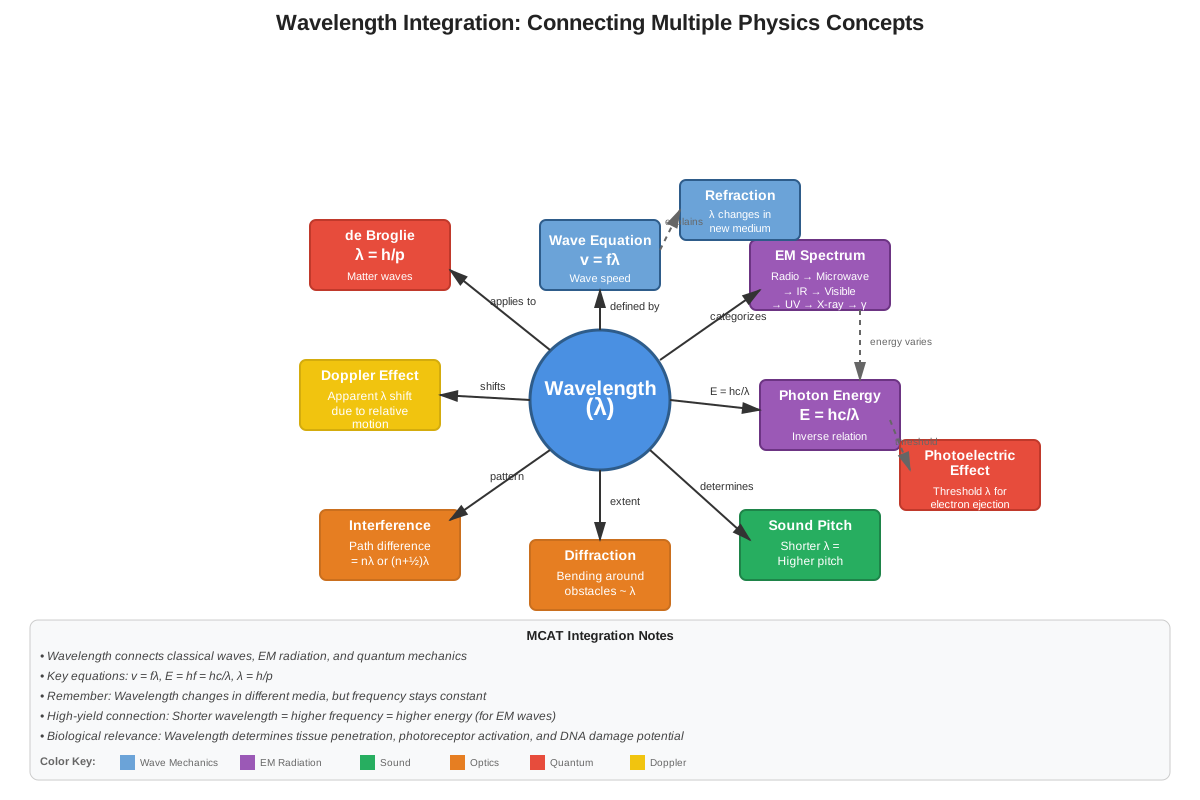
Concept Relationships
Wavelength serves as a central hub connecting multiple wave properties and phenomena. The wave equation (v = fλ) directly links wavelength to frequency and wave speed, establishing that these three quantities are interdependent—knowing any two allows calculation of the third. This relationship extends to period (T), since f = 1/T, allowing wavelength to be expressed as λ = vT, which represents the distance a wave travels during one complete oscillation cycle.
For electromagnetic radiation, wavelength connects to photon energy through E = hc/λ, creating a bridge between wave descriptions and quantum mechanical (particle) descriptions of light. This dual nature becomes essential when analyzing phenomena like the photoelectric effect, where wavelength determines whether photons have sufficient energy to eject electrons. Shorter wavelength → higher frequency → higher energy represents a critical conceptual chain for MCAT success.
Wavelength also determines diffraction and interference behavior. The extent of diffraction (wave bending around obstacles) depends on the ratio of wavelength to obstacle size: significant diffraction occurs when λ ≈ obstacle dimension. In interference patterns, path differences expressed in wavelengths (constructive interference when Δpath = nλ; destructive when Δpath = (n + ½)λ) determine whether waves reinforce or cancel. These relationships make wavelength the key parameter for understanding double-slit experiments, thin-film interference, and diffraction gratings.
The relationship map flows as follows: Source frequency → determines → Wavelength (via v = fλ) → determines → Photon energy (via E = hc/λ) → determines → Interaction with matter (absorption, transmission, reflection). Simultaneously, Medium properties → determine → Wave speed → affects → Wavelength (while frequency remains constant). Understanding these interconnections enables students to predict how changing one variable affects the entire system.
Quick check — test yourself on Wavelength so far.
Try Flashcards →High-Yield Facts
⭐ Wavelength and frequency are inversely proportional when wave speed is constant: λ = v/f
⭐ For electromagnetic waves in vacuum, c = fλ, where c = 3.0 × 10⁸ m/s
⭐ Visible light wavelengths range from approximately 400 nm (violet) to 700 nm (red)
⭐ Shorter wavelength electromagnetic radiation carries higher energy per photon: E = hc/λ
⭐ When waves enter a new medium, frequency stays constant but wavelength changes proportionally with speed
- The wavelength of sound in air at 343 m/s and frequency 1000 Hz is 0.343 m (34.3 cm)
- X-rays have wavelengths shorter than 10 nm; infrared has wavelengths longer than 700 nm
- For standing waves on a string fixed at both ends, the fundamental wavelength is λ₁ = 2L
- Wavelength determines the resolution limit in microscopy: smaller wavelengths enable higher resolution
- The de Broglie wavelength (λ = h/p) applies to matter particles, connecting wavelength to momentum
Common Misconceptions
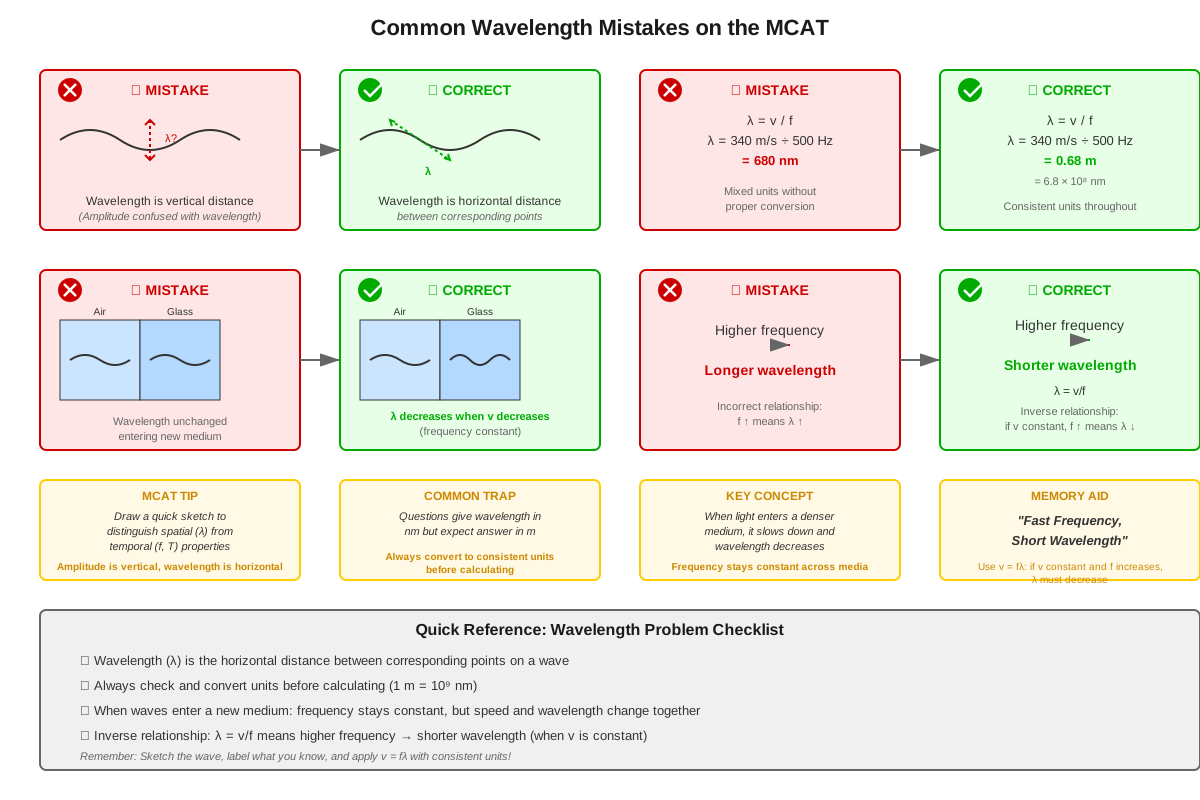
Misconception: Wavelength and frequency both change when a wave enters a new medium.
Correction: Only wavelength changes when crossing boundaries; frequency remains constant because it is determined by the source. The wave speed changes, and since v = fλ, wavelength must adjust proportionally to maintain the constant frequency.
Misconception: Longer wavelength means higher energy for electromagnetic radiation.
Correction: The opposite is true. Energy is inversely proportional to wavelength (E = hc/λ), so shorter wavelengths correspond to higher energy photons. Gamma rays (very short wavelength) are far more energetic than radio waves (very long wavelength).
Misconception: Wavelength is measured from crest to trough.
Correction: Wavelength is the distance between consecutive crests (or consecutive troughs, or any two consecutive points in phase). The distance from crest to trough is half a wavelength, and the vertical distance from crest to trough is twice the amplitude, not related to wavelength.
Misconception: All electromagnetic waves have the same wavelength.
Correction: Electromagnetic waves span an enormous range of wavelengths, from less than 10⁻¹² m (gamma rays) to more than 10³ m (radio waves). What remains constant for all electromagnetic waves in vacuum is their speed (c), not their wavelength or frequency.
Misconception: Wavelength has no units or is measured in Hertz.
Correction: Wavelength is a distance measurement and must have units of length (meters, nanometers, etc.). Hertz (Hz) is the unit for frequency, not wavelength. Confusing these units leads to dimensional analysis errors in calculations.
Misconception: Doubling the frequency doubles the wavelength.
Correction: Doubling the frequency halves the wavelength (assuming constant wave speed). The relationship is inverse: λ = v/f, so if f increases by a factor of 2, λ decreases by a factor of 2.
Worked Examples
Example 1: Calculating Wavelength from Frequency
Question: A radio station broadcasts at a frequency of 98.5 MHz. What is the wavelength of these radio waves?
Solution:
Step 1: Identify the known values and the target variable.
- Frequency: f = 98.5 MHz = 98.5 × 10⁶ Hz
- Speed of electromagnetic waves: c = 3.0 × 10⁸ m/s
- Target: wavelength λ
Step 2: Select the appropriate equation.
For electromagnetic waves: c = fλ
Step 3: Solve for wavelength.
λ = c/f = (3.0 × 10⁸ m/s) / (98.5 × 10⁶ Hz)
Step 4: Calculate.
λ = (3.0 × 10⁸) / (98.5 × 10⁶) = 3.0/98.5 × 10² m
λ ≈ 0.0305 × 10² m = 3.05 m
Step 5: Verify reasonableness.
Radio waves have long wavelengths (meters to kilometers), so 3.05 m is reasonable for FM radio.
Answer: The wavelength is approximately 3.0 meters.
Connection to learning objectives: This problem directly applies the wave equation to calculate wavelength, demonstrating the inverse relationship between frequency and wavelength for electromagnetic radiation.
Example 2: Wavelength Change Across Media
Question: An ultrasound wave with frequency 2.0 MHz travels through soft tissue (v = 1540 m/s) and then enters bone (v = 4080 m/s). What are the wavelengths in each medium?
Solution:
Step 1: Calculate wavelength in soft tissue.
Using v = fλ, we get λ = v/f
λ_tissue = 1540 m/s / (2.0 × 10⁶ Hz)
λ_tissue = 1540 / (2.0 × 10⁶) m
λ_tissue = 770 × 10⁻⁶ m = 0.77 mm
Step 2: Calculate wavelength in bone.
The frequency remains 2.0 MHz (frequency doesn't change at boundaries)
λ_bone = 4080 m/s / (2.0 × 10⁶ Hz)
λ_bone = 4080 / (2.0 × 10⁶) m
λ_bone = 2040 × 10⁻⁶ m = 2.04 mm
Step 3: Analyze the relationship.
The speed ratio is 4080/1540 ≈ 2.65
The wavelength ratio is 2.04/0.77 ≈ 2.65
This confirms that wavelength changes proportionally with speed.
Step 4: Verify the principle.
Frequency constant: 2.0 MHz in both media ✓
Wavelength increases where speed increases ✓
v = fλ satisfied in both media ✓
Answer: Wavelength in soft tissue is 0.77 mm; wavelength in bone is 2.04 mm.
Connection to learning objectives: This problem demonstrates how wavelength changes when waves cross boundaries between media while frequency remains constant—a critical concept for understanding ultrasound imaging and wave refraction.
Exam Strategy
When approaching wavelength MCAT questions, first identify whether the problem involves mechanical waves (sound, strings, water) or electromagnetic waves (light, X-rays, radio). This distinction determines which wave speed to use: for electromagnetic waves in vacuum, always use c = 3.0 × 10⁸ m/s; for sound in air at room temperature, use approximately 340 m/s; for other media, the passage will provide the necessary speed values.
Exam Tip: Watch for trigger phrases like "enters a new medium," "crosses a boundary," or "refracts into"—these signal that wavelength will change while frequency remains constant. Immediately write down f₁ = f₂ to remind yourself of this constraint.
For quantitative problems, perform dimensional analysis before calculating. Wavelength must have units of length; if your calculation yields units of time or inverse length, you've made an algebraic error. Common unit conversions include: 1 nm = 10⁻⁹ m, 1 MHz = 10⁶ Hz, and 1 eV = 1.6 × 10⁻¹⁹ J. Keep these conversions readily accessible during practice.
Process-of-elimination strategies work well for wavelength questions. If a question asks about energy and wavelength, immediately eliminate any answer choice suggesting they're directly proportional—they're inversely related. If asked how wavelength changes when frequency doubles (at constant speed), eliminate choices showing wavelength doubling or remaining constant; it must halve. For electromagnetic spectrum questions, memorize the order (radio → microwave → infrared → visible → UV → X-ray → gamma) and eliminate choices that violate this sequence.
Time allocation for wavelength problems should follow the standard MCAT physics approach: spend 30-45 seconds reading and identifying the question type, 60-90 seconds on calculation or conceptual analysis, and 15-30 seconds checking your answer's reasonableness. If a calculation becomes complex, consider whether the question can be solved conceptually or through proportional reasoning instead—the MCAT often rewards efficient problem-solving over brute-force calculation.
Memory Techniques
Mnemonic for electromagnetic spectrum (increasing frequency/decreasing wavelength): "Rabbits Mate In Very Unusual X-tra Green" (Radio, Microwave, Infrared, Visible, Ultraviolet, X-ray, Gamma). Remember that as you move right in this sequence, wavelength decreases and energy increases.
Visualization for wavelength: Picture wavelength as the "spatial footprint" of one complete wave cycle. Imagine walking along a frozen ocean wave—wavelength is the distance you'd walk from one crest to the next crest. This spatial visualization helps distinguish wavelength (space) from period (time).
Acronym for wave equation relationships: "Very Few Lamb" reminds you that V = F × L (v = f × λ). When you need to solve for wavelength, think "Lamb Very Few" to remember λ = v/f.
Memory aid for inverse relationships: Hold your hands apart to represent wavelength. As you bring them together (decreasing wavelength), say "frequency up, energy up." As you spread them apart (increasing wavelength), say "frequency down, energy down." This kinesthetic memory reinforces the inverse relationship between wavelength and both frequency and energy.
Visible spectrum wavelength ranges: Remember "400 Violet, 700 Red" (400 nm is violet end, 700 nm is red end). The middle (green) is approximately 550 nm. This provides anchor points for estimating wavelengths of visible light.
Summary
Wavelength represents the spatial distance over which a wave pattern repeats and serves as a fundamental descriptor of all wave phenomena tested on the MCAT. Defined mathematically through the wave equation v = fλ, wavelength maintains an inverse relationship with frequency when wave speed is constant. For electromagnetic radiation, wavelength additionally relates inversely to photon energy through E = hc/λ, making shorter wavelengths correspond to higher energy radiation. When waves cross boundaries between media, frequency remains constant while wavelength changes proportionally with wave speed—a principle essential for understanding refraction and ultrasound imaging. The electromagnetic spectrum spans wavelengths from less than 10⁻¹² m (gamma rays) to more than 10³ m (radio waves), with visible light occupying the narrow range from 400 nm (violet) to 700 nm (red). Mastery of wavelength requires facility with unit conversions, recognition of inverse relationships, and the ability to apply the wave equation in diverse contexts ranging from sound propagation to photon energy calculations.
Key Takeaways
- Wavelength (λ) is the spatial distance between consecutive points in phase on a wave, measured in units of length
- The wave equation v = fλ establishes that wavelength and frequency are inversely proportional at constant wave speed
- For electromagnetic waves, c = fλ (where c = 3.0 × 10⁸ m/s) and E = hc/λ (shorter wavelength = higher energy)
- Frequency remains constant when waves cross boundaries; wavelength changes proportionally with wave speed
- Visible light spans approximately 400-700 nm; this narrow band sits within the vast electromagnetic spectrum
- Common MCAT applications include ultrasound imaging, electromagnetic spectrum identification, photon energy calculations, and standing wave analysis
- Master unit conversions (nm ↔ m, MHz ↔ Hz) and dimensional analysis to avoid calculation errors
Related Topics
Frequency and Period: Understanding the temporal characteristics of waves (how often oscillations occur) complements wavelength's spatial description and enables full application of the wave equation. Mastering wavelength provides the foundation for analyzing how frequency determines pitch in sound and color in light.
Electromagnetic Spectrum: Detailed knowledge of the different regions (radio, microwave, infrared, visible, UV, X-ray, gamma) builds directly on wavelength concepts, as each region is defined by wavelength ranges. Understanding wavelength enables prediction of how different types of radiation interact with biological tissues.
Wave Speed and Properties of Media: Exploring how wave speed depends on medium properties (density, elasticity, temperature) explains why wavelength changes at boundaries and connects to clinical applications like ultrasound and fiber optics.
Photon Energy and the Photoelectric Effect: The relationship E = hc/λ becomes central to understanding quantum phenomena, including why certain wavelengths can eject electrons while others cannot—a key concept bridging classical and modern physics on the MCAT.
Interference and Diffraction: These wave phenomena depend critically on wavelength, as path differences and obstacle sizes are compared to λ to predict constructive/destructive interference and diffraction patterns.
Practice CTA
Now that you've mastered the core concepts of wavelength, it's time to solidify your understanding through active practice. Challenge yourself with the practice questions and flashcards designed specifically for this topic—they'll help you identify any remaining gaps and build the rapid recall essential for MCAT success. Remember, understanding wavelength opens doors to mastering interference, the electromagnetic spectrum, and photon energy calculations. Each practice problem you complete strengthens the neural pathways that will serve you on test day. You've built a strong foundation—now reinforce it through deliberate practice!
Sign up free to keep reading
Create a free AnvayaPrep account to finish this MCAT guide on Wavelength — plus flashcards and practice questions.