Overview
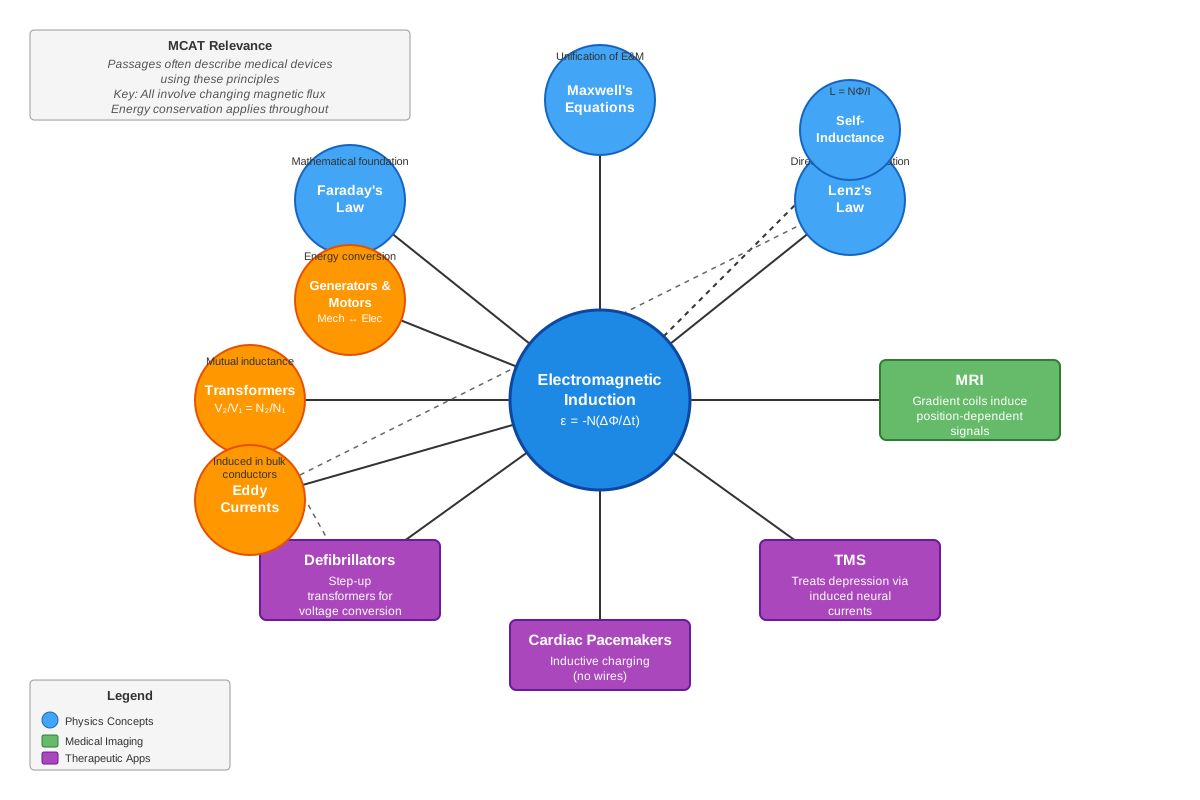
Electromagnetic induction is one of the most fundamental principles in Physics, bridging the relationship between electricity and magnetism in ways that have revolutionized modern technology and medicine. This phenomenon describes how a changing magnetic field can generate an electric current in a conductor, or conversely, how a changing electric current produces a magnetic field. For the MCAT, electromagnetic induction represents a critical intersection of concepts within Electricity and Magnetism, requiring students to understand not just the mathematical relationships but also the physical mechanisms and directional conventions that govern induced currents and voltages.
The importance of electromagnetic induction for the MCAT cannot be overstated. This topic appears regularly in both passage-based and discrete questions, often integrated with circuits, energy conservation, and real-world applications like medical imaging devices. Understanding electromagnetic induction enables students to tackle questions involving transformers, generators, motors, and even the principles underlying MRI machines—all of which are fair game for MCAT passages. The topic demands both conceptual understanding and quantitative problem-solving skills, making it a medium-difficulty but high-yield area of study.
Within the broader context of Physics, electromagnetic induction connects directly to fundamental concepts including magnetic fields, electric fields, circuits, and energy transformations. It represents one of Maxwell's equations and demonstrates the unified nature of electromagnetic phenomena. Mastering this topic provides the foundation for understanding how energy can be converted between mechanical, electrical, and magnetic forms—a principle that underlies countless medical technologies and biological processes tested on the MCAT.
Learning Objectives
- [ ] Define electromagnetic induction using accurate Physics terminology
- [ ] Explain why electromagnetic induction matters for the MCAT
- [ ] Apply electromagnetic induction to exam-style questions
- [ ] Identify common mistakes related to electromagnetic induction
- [ ] Connect electromagnetic induction to related Physics concepts
- [ ] Calculate induced EMF using Faraday's Law in various geometric configurations
- [ ] Determine the direction of induced current using Lenz's Law
- [ ] Analyze energy transformations in electromagnetic induction scenarios
- [ ] Distinguish between motional EMF and changing magnetic flux scenarios
Prerequisites
- Magnetic fields and magnetic force: Understanding how magnetic fields interact with moving charges and current-carrying wires is essential for comprehending how changing fields induce currents
- Electric circuits and Ohm's Law: Induced EMF drives current through circuits, requiring knowledge of resistance, current, and voltage relationships
- Electric fields and electric potential: The concept of EMF (electromotive force) builds on understanding potential difference and electric field work
- Vector operations and right-hand rules: Determining directions of induced currents and forces requires facility with vector cross products and directional conventions
- Energy conservation: Electromagnetic induction problems often involve energy transformations between kinetic, electrical, and magnetic forms
Why This Topic Matters
Electromagnetic induction Physics has profound clinical and technological significance that makes it particularly relevant for future physicians. Magnetic Resonance Imaging (MRI), one of medicine's most powerful diagnostic tools, relies fundamentally on electromagnetic induction principles. The changing magnetic fields in MRI machines induce signals in hydrogen nuclei that create detailed anatomical images. Similarly, transcranial magnetic stimulation (TMS), an emerging treatment for depression and neurological disorders, uses rapidly changing magnetic fields to induce electrical currents in brain tissue. Understanding electromagnetic induction provides the conceptual foundation for comprehending these and other medical technologies.
On the MCAT, electromagnetic induction appears with moderate frequency but high impact. Approximately 2-4 questions per exam directly test this concept, typically appearing in the Chemical and Physical Foundations of Biological Systems section. Questions may be discrete or embedded in passages describing experimental setups, medical devices, or energy generation systems. The AAMC has shown particular interest in testing students' ability to apply Faraday's Law, determine current direction using Lenz's Law, and analyze energy conservation in induction scenarios.
Common passage contexts include: generators and motors in experimental apparatus, electromagnetic braking systems, wireless charging technology, metal detectors, and electromagnetic flow meters used in medical settings. The MCAT frequently presents scenarios requiring students to predict what happens when magnetic flux changes—whether through motion, changing field strength, or changing loop area. Questions often integrate electromagnetic induction with other topics like circuits, forces, or energy, testing the ability to synthesize multiple concepts simultaneously.
Core Concepts
Magnetic Flux
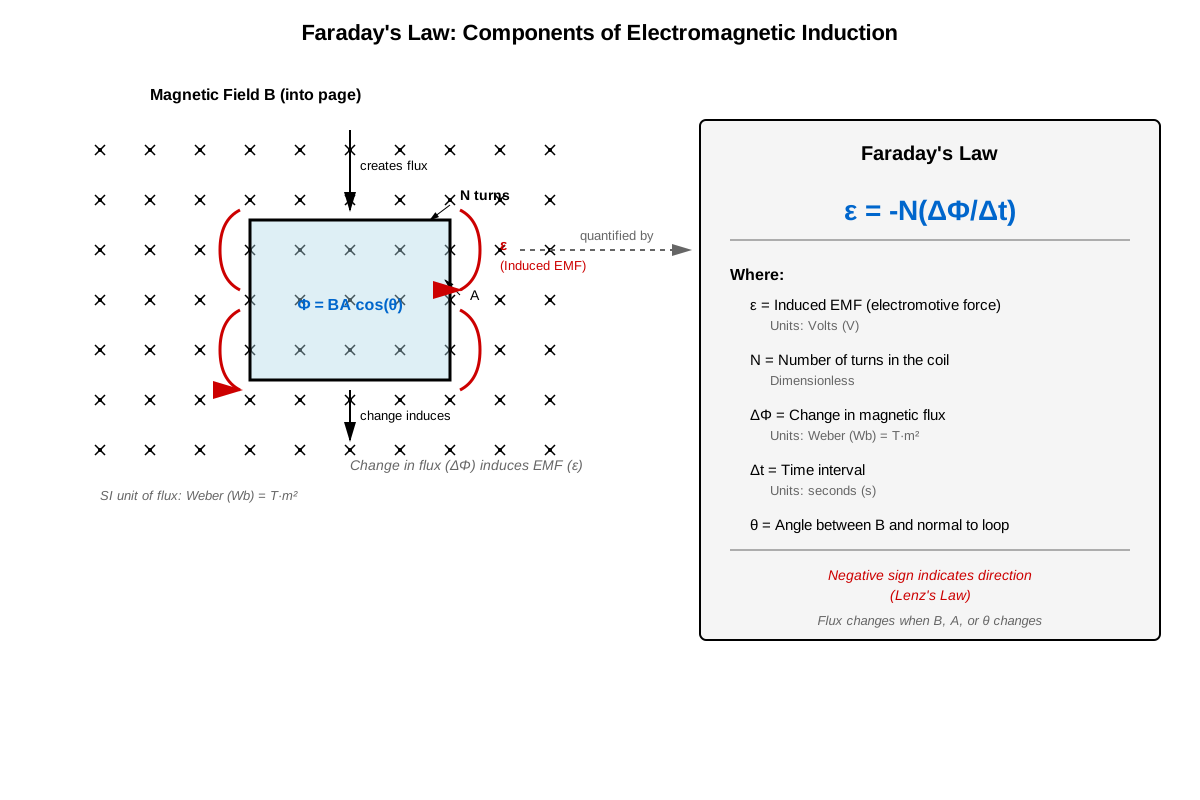
Magnetic flux (Φ) represents the total magnetic field passing through a given area and serves as the fundamental quantity in electromagnetic induction. Mathematically, magnetic flux is defined as:
Φ = B·A·cos(θ) = BA cos(θ)where B is the magnetic field strength (in Tesla), A is the area through which the field passes (in m²), and θ is the angle between the magnetic field vector and the normal (perpendicular) to the surface. The SI unit for magnetic flux is the Weber (Wb), where 1 Wb = 1 T·m².
The concept of flux captures not just the strength of the magnetic field but also the geometry of the situation. Maximum flux occurs when the magnetic field is perpendicular to the surface (θ = 0°, cos(θ) = 1), while zero flux occurs when the field is parallel to the surface (θ = 90°, cos(θ) = 0). This geometric dependence becomes crucial when analyzing rotating loops or changing orientations in induction problems.
Faraday's Law of Electromagnetic Induction
Faraday's Law quantifies the relationship between changing magnetic flux and induced electromotive force (EMF). The law states that the magnitude of induced EMF in a circuit equals the rate of change of magnetic flux through that circuit:
|ε| = |dΦ/dt| = |d(BA cos θ)/dt|For a coil with N turns, the induced EMF multiplies by the number of turns:
|ε| = N|dΦ/dt|This equation reveals three distinct ways to change magnetic flux and thereby induce an EMF:
- Changing magnetic field strength (B): Increasing or decreasing the field magnitude while keeping area and angle constant
- Changing area (A): Expanding, contracting, or moving a loop into or out of a magnetic field region
- Changing orientation (θ): Rotating a loop within a magnetic field
The induced EMF represents the work done per unit charge by the non-conservative electric field created by the changing magnetic flux. This EMF can drive current through a closed conducting loop, converting magnetic energy into electrical energy.
Lenz's Law and Direction of Induced Current
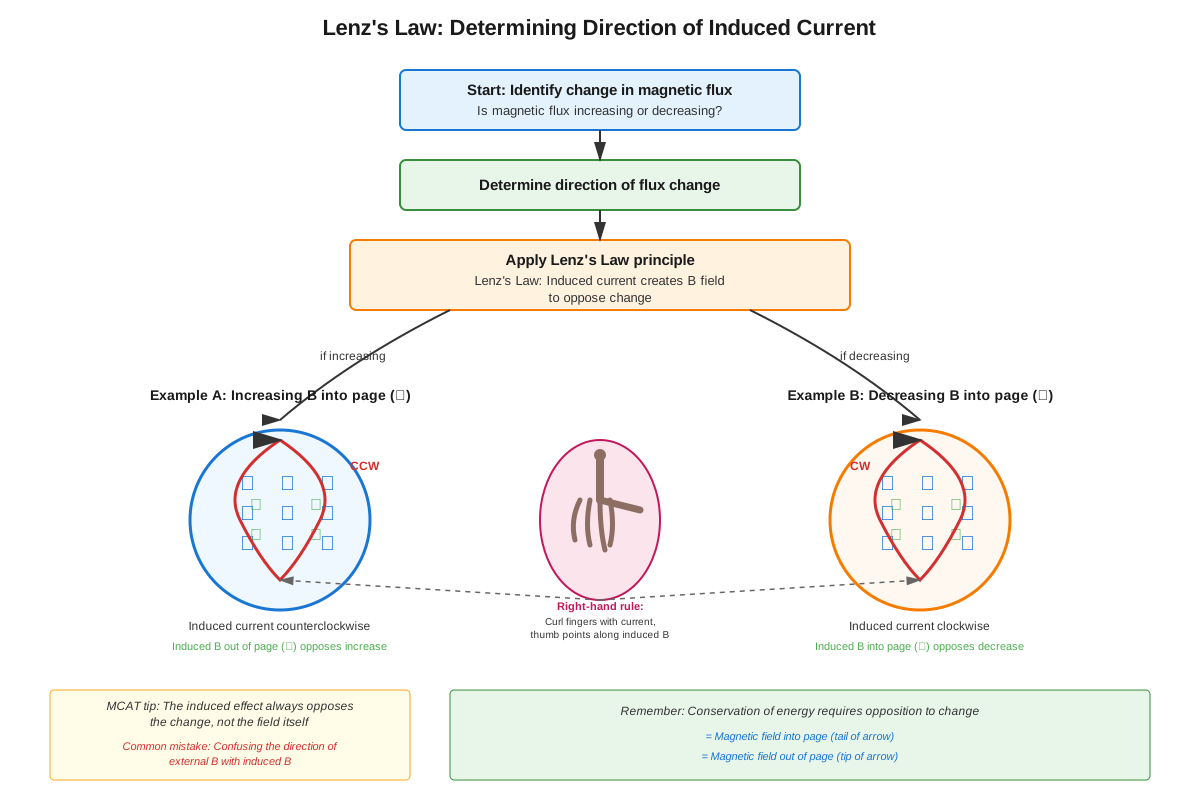
Lenz's Law provides the critical directional information missing from Faraday's Law's magnitude equation. It states that the direction of induced current creates a magnetic field that opposes the change in magnetic flux that produced it. This opposition principle reflects energy conservation—the induced current must work against the change to prevent perpetual motion machines.
The application of Lenz's Law follows a systematic process:
- Determine the direction of the original magnetic field through the loop
- Identify whether the magnetic flux is increasing or decreasing
- Determine what direction of induced magnetic field would oppose this change
- Use the right-hand rule to find the current direction that produces this opposing field
For example, if magnetic flux pointing upward through a loop is increasing, the induced current must create a downward magnetic field to oppose the increase. Using the right-hand rule (fingers curl in current direction, thumb points in field direction), the induced current flows clockwise when viewed from above.
The negative sign in the complete form of Faraday's Law captures Lenz's Law mathematically:
ε = -N(dΦ/dt)Motional EMF
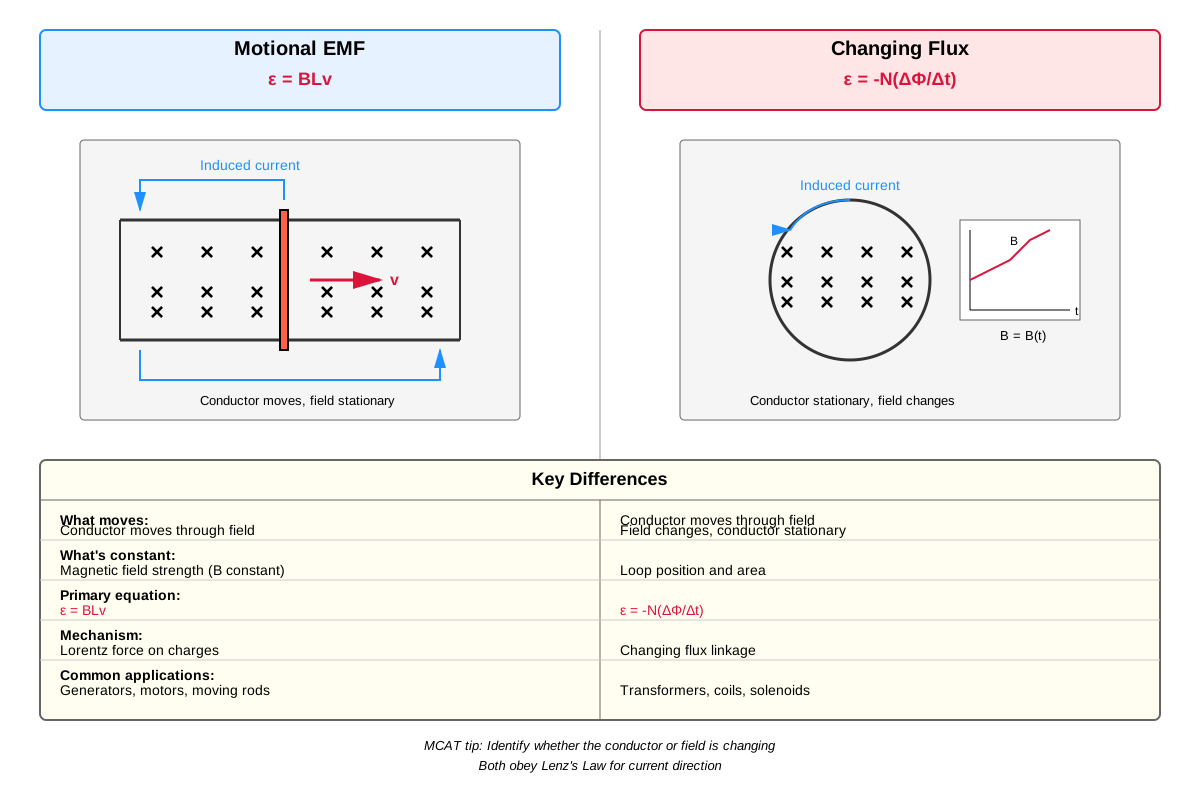
Motional EMF represents a special case of electromagnetic induction where a conductor moves through a magnetic field, causing charge separation due to the magnetic force on moving charges. When a straight conductor of length L moves with velocity v perpendicular to a magnetic field B, the induced EMF is:
ε = BLvThis equation derives from the magnetic force on charges in the moving conductor. As the conductor moves, free electrons experience a magnetic force (F = qvB) that pushes them toward one end, creating charge separation and thus a potential difference. The motional EMF continues until the electric field from charge separation balances the magnetic force.
For a rectangular loop partially in a magnetic field being pulled out at constant velocity, motional EMF appears across the portion of the loop still in the field. This scenario commonly appears on the MCAT, often requiring students to calculate the force needed to maintain constant velocity against the magnetic force on the induced current.
Induced Current and Power Dissipation
When an induced EMF drives current through a circuit with resistance R, the current magnitude follows Ohm's Law:
I = ε/R = (1/R)|dΦ/dt|This induced current dissipates power as heat according to:
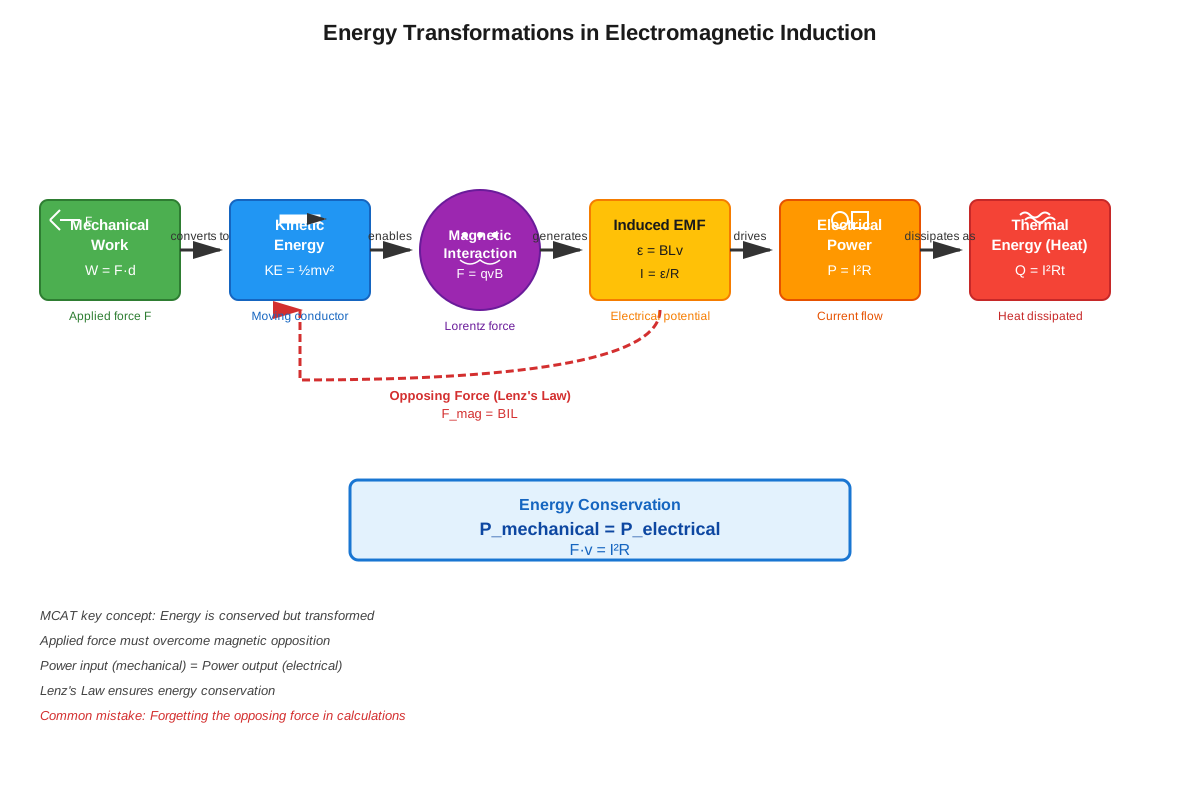
P = I²R = ε²/R = (1/R)(dΦ/dt)²The energy dissipated must come from somewhere—typically from the mechanical work done to change the magnetic flux. For a loop being pulled from a magnetic field at constant velocity, the pulling force must overcome the magnetic force on the induced current, doing work that converts to electrical energy and then heat. This energy conservation principle frequently appears in MCAT questions asking about forces or power in induction scenarios.
Self-Inductance and Inductors
Self-inductance (L) describes a circuit's opposition to changes in its own current. When current through a coil changes, the changing magnetic field induces an EMF in the same coil that opposes the current change:
ε_L = -L(dI/dt)The inductance L depends on the coil's geometry (number of turns, area, length) and is measured in henries (H). While detailed inductor analysis rarely appears on the MCAT, understanding that inductors oppose current changes helps explain circuit behavior and energy storage in magnetic fields.
Applications: Generators and Transformers
Electric generators convert mechanical energy to electrical energy through electromagnetic induction. A rotating loop in a magnetic field experiences continuously changing flux, producing alternating EMF:
ε(t) = NABω sin(ωt)where ω is the angular velocity. This sinusoidal EMF produces alternating current (AC), the basis for electrical power generation.
Transformers use electromagnetic induction to change AC voltage levels. A changing current in the primary coil creates changing magnetic flux in an iron core, inducing EMF in the secondary coil. The voltage ratio relates to the turns ratio:
V_s/V_p = N_s/N_pFor ideal transformers (no energy loss), power conservation requires:
V_p I_p = V_s I_sUnderstanding transformers helps explain power transmission systems and medical equipment like X-ray machines that require high voltages.
Concept Relationships
The concepts within electromagnetic induction form an interconnected web centered on the relationship between changing magnetic flux and induced EMF. Magnetic flux serves as the foundational quantity, with its rate of change directly determining induced EMF through Faraday's Law. Lenz's Law adds directional information to Faraday's Law, ensuring energy conservation by requiring induced effects to oppose their causes. Motional EMF represents a specific mechanism for changing flux—through conductor motion rather than field changes—but ultimately produces the same electromagnetic induction phenomenon.
The relationship map flows as follows:
Changing Magnetic Flux → (quantified by) → Faraday's Law → (produces) → Induced EMF → (direction determined by) → Lenz's Law → (drives) → Induced Current → (through resistance produces) → Power Dissipation → (requires) → Mechanical Work Input → (demonstrating) → Energy Conservation
Connections to prerequisite topics include:
- Magnetic fields provide the B in flux calculations and determine forces on induced currents
- Electric circuits govern how induced EMF drives current through resistance
- Energy conservation constrains all induction scenarios, requiring work input to equal electrical energy output
- Vector operations enable proper application of right-hand rules and angle calculations in flux
Connections to related Physics topics extend to:
- AC circuits: Generators produce alternating current through electromagnetic induction
- Waves: Electromagnetic waves involve coupled changing electric and magnetic fields
- Energy transformations: Induction converts between mechanical, electrical, and thermal energy
- Forces and motion: Magnetic forces on induced currents require mechanical work to maintain motion
High-Yield Facts
⭐ Faraday's Law: The magnitude of induced EMF equals the rate of change of magnetic flux: |ε| = |dΦ/dt|
⭐ Lenz's Law: Induced current direction always opposes the change in magnetic flux that produced it
⭐ Magnetic flux: Φ = BA cos(θ), where θ is the angle between field and surface normal; maximum when field is perpendicular to surface
⭐ Motional EMF: For a conductor of length L moving with velocity v perpendicular to field B: ε = BLv
⭐ Energy conservation: Mechanical work done to change flux equals electrical energy produced plus heat dissipated
- Induced EMF exists even in an open circuit (no current flows, but potential difference exists)
- Increasing the number of turns in a coil increases induced EMF proportionally: ε = N|dΦ/dt|
- The direction of induced current creates a magnetic field opposing flux change, not opposing the original field
- Transformers only work with AC (changing current); DC produces no changing flux and no secondary voltage
- Induced current magnitude: I = ε/R = (1/R)|dΦ/dt|, showing inverse relationship with resistance
- Power dissipated in resistance: P = ε²/R, requiring mechanical power input to maintain constant velocity
- Pulling a loop from a magnetic field at constant velocity requires force F = B²L²v/R to overcome magnetic force on induced current
- The Weber (Wb) is the SI unit of magnetic flux: 1 Wb = 1 T·m² = 1 V·s
- Self-inductance causes inductors to oppose current changes: ε_L = -L(dI/dt)
- Generator EMF varies sinusoidally with rotation: ε(t) = NABω sin(ωt)
Quick check — test yourself on Electromagnetic induction so far.
Try Flashcards →Common Misconceptions
Misconception: Lenz's Law means induced current opposes the original magnetic field.
Correction: Induced current opposes the change in magnetic flux, not the field itself. If flux is increasing, the induced field opposes the increase (points opposite to original field). If flux is decreasing, the induced field opposes the decrease (points in the same direction as the original field, trying to maintain it).
Misconception: Electromagnetic induction only occurs when a conductor moves through a magnetic field.
Correction: Induction occurs whenever magnetic flux through a circuit changes, which can happen through conductor motion (motional EMF), changing magnetic field strength, changing loop area, or changing orientation. A stationary loop in a strengthening magnetic field experiences induction without any motion.
Misconception: Induced EMF requires a complete circuit for current to flow.
Correction: Induced EMF exists regardless of whether a complete circuit exists. An open circuit experiences induced EMF (measurable voltage) but no current flow. A closed circuit allows current to flow in response to the EMF.
Misconception: The faster a loop moves through a uniform magnetic field, the greater the induced EMF.
Correction: In a completely uniform field, moving a loop at constant velocity produces constant flux (no change), so no EMF is induced. EMF only appears when entering or exiting the field region, or when the field is non-uniform. The rate of flux change matters, not velocity alone.
Misconception: Increasing resistance in a circuit increases induced current.
Correction: Induced EMF depends only on the rate of flux change (ε = |dΦ/dt|), independent of resistance. However, induced current follows Ohm's Law (I = ε/R), so increasing resistance decreases current for a given EMF. Higher resistance means less current but the same induced voltage.
Misconception: Transformers can increase power output beyond power input.
Correction: Ideal transformers conserve power (V_p I_p = V_s I_s). Step-up transformers increase voltage but proportionally decrease current, maintaining constant power. Real transformers lose some power to heat, making output power less than input power.
Misconception: The angle θ in Φ = BA cos(θ) is the angle between the field and the surface.
Correction: The angle θ is between the magnetic field vector and the normal (perpendicular) to the surface. When the field is perpendicular to the surface (θ = 0°), flux is maximum. When the field is parallel to the surface (θ = 90°), flux is zero.
Worked Examples
Example 1: Loop Exiting a Magnetic Field
Problem: A rectangular conducting loop with dimensions 0.20 m × 0.10 m and total resistance 5.0 Ω is pulled horizontally out of a uniform magnetic field of 0.50 T at a constant velocity of 2.0 m/s. The magnetic field is perpendicular to the plane of the loop, pointing into the page. Calculate: (a) the induced EMF, (b) the induced current and its direction, (c) the power dissipated, and (d) the force required to maintain constant velocity.
Solution:
(a) Induced EMF: As the loop exits the field, the area inside the field decreases. The rate of area change equals the width of the loop (perpendicular to motion) times velocity:
dA/dt = L × v = 0.10 m × 2.0 m/s = 0.20 m²/sSince B is constant and perpendicular (cos(0°) = 1):
|ε| = |dΦ/dt| = B|dA/dt| = 0.50 T × 0.20 m²/s = 0.10 VAlternatively, using motional EMF for the edge still in the field:
ε = BLv = 0.50 T × 0.10 m × 2.0 m/s = 0.10 V(b) Induced current: Using Ohm's Law:
I = ε/R = 0.10 V / 5.0 Ω = 0.020 A = 20 mADirection: The magnetic flux into the page is decreasing as the loop exits. By Lenz's Law, the induced current must create a magnetic field into the page to oppose this decrease. Using the right-hand rule (fingers curl with current, thumb points in field direction), current must flow clockwise when viewed from the front: down the right edge (still in field), left across the bottom, up the left edge, and right across the top.
(c) Power dissipated:
P = I²R = (0.020 A)² × 5.0 Ω = 0.0020 W = 2.0 mWOr equivalently: P = ε²/R = (0.10 V)² / 5.0 Ω = 2.0 mW
(d) Force required: The induced current in the portion of the loop still in the field (the right edge) experiences a magnetic force. Using F = ILB for a current-carrying wire in a magnetic field:
F_magnetic = ILB = 0.020 A × 0.10 m × 0.50 T = 0.0010 NBy Lenz's Law, this force opposes the motion (points left, into the field). To maintain constant velocity, the applied force must equal this magnetic force:
F_applied = 0.0010 N (to the right)Verification: The mechanical power input (F·v) should equal electrical power dissipated:
P_mechanical = F × v = 0.0010 N × 2.0 m/s = 0.0020 W = 2.0 mW ✓This confirms energy conservation.
Example 2: Rotating Loop in Magnetic Field
Problem: A circular loop with 50 turns, radius 0.05 m, and total resistance 10 Ω rotates at 120 revolutions per minute in a uniform magnetic field of 0.30 T. The rotation axis is perpendicular to the magnetic field. Calculate: (a) the maximum induced EMF, (b) the maximum induced current, and (c) the average power dissipated over one complete rotation.
Solution:
(a) Maximum induced EMF: First, convert angular velocity to rad/s:
ω = 120 rev/min × (2π rad/rev) × (1 min/60 s) = 4π rad/s ≈ 12.57 rad/sThe area of the circular loop:
A = πr² = π(0.05 m)² = 7.85 × 10⁻³ m²As the loop rotates, the flux varies as Φ(t) = NBA cos(ωt). The induced EMF is:
ε(t) = -dΦ/dt = NBAω sin(ωt)Maximum EMF occurs when sin(ωt) = 1:
ε_max = NBAω = 50 × 0.30 T × 7.85 × 10⁻³ m² × 4π rad/sε_max = 50 × 0.30 × 7.85 × 10⁻³ × 12.57 ≈ 1.48 V(b) Maximum induced current:
I_max = ε_max/R = 1.48 V / 10 Ω = 0.148 A ≈ 148 mA(c) Average power dissipated: For sinusoidal current, the average power over a complete cycle is:
P_avg = (I_max)²R / 2 = (0.148 A)² × 10 Ω / 2 = 0.109 W ≈ 110 mWOr using RMS values: I_rms = I_max/√2, so P_avg = (I_rms)²R = (I_max/√2)²R = (I_max)²R/2
Physical interpretation: The EMF and current vary sinusoidally as the loop rotates. Maximum values occur when the loop is horizontal (flux changing most rapidly). Zero EMF occurs when the loop is vertical (flux momentarily constant at maximum or minimum). This rotating loop functions as a simple AC generator, converting mechanical rotational energy into electrical energy.
Exam Strategy
When approaching electromagnetic induction MCAT questions, begin by identifying what is changing: magnetic field strength, loop area, or orientation angle. This determines which term in Φ = BA cos(θ) varies with time and guides the mathematical approach. Questions often provide scenarios with multiple changing quantities; carefully determine which changes are relevant to the induced EMF.
Trigger words and phrases to watch for include:
- "Pulled through," "moved into/out of," "rotating" → suggests motional EMF or changing area
- "Increasing field," "strengthening magnet" → suggests changing B
- "Constant velocity" → signals force balance and energy conservation questions
- "Number of turns" → multiply EMF by N
- "Direction of current" → requires Lenz's Law application
- "Power required," "force needed" → involves energy conservation and F = BIL
For direction questions, use this systematic approach:
- Sketch the situation and clearly mark the original magnetic field direction
- Determine if flux is increasing or decreasing (or changing direction)
- Apply Lenz's Law: induced field opposes the change
- Use right-hand rule to find current direction producing that induced field
- Verify your answer makes physical sense (induced current should resist the change)
Process-of-elimination tips:
- Eliminate answers suggesting induced current aids the flux change (violates Lenz's Law and energy conservation)
- Eliminate answers with incorrect units (EMF in volts, current in amperes, flux in webers)
- For quantitative questions, check if the answer has reasonable magnitude (induced EMF typically ranges from millivolts to volts in MCAT problems)
- Eliminate answers suggesting induction occurs in uniform fields with constant velocity (no flux change = no induction)
Time allocation: Discrete electromagnetic induction questions typically require 60-90 seconds. Allocate 30 seconds to identify what's changing and set up the relevant equation, 30 seconds for calculation, and 30 seconds to verify using Lenz's Law or energy conservation. Passage-based questions may require 90-120 seconds, with additional time to extract relevant information from the passage and figures.
For complex scenarios, prioritize finding the rate of flux change (dΦ/dt) first, as this immediately gives induced EMF. Then, if needed, calculate current (I = ε/R), power (P = ε²/R), or force (F = BIL). Many MCAT questions only ask for one of these quantities, so avoid unnecessary calculations.
Memory Techniques
FARADAY mnemonic for electromagnetic induction problem-solving:
- Flux: Calculate Φ = BA cos(θ)
- Alter: Identify what's changing (B, A, or θ)
- Rate: Find dΦ/dt
- Absolute value: |ε| = |dΦ/dt|
- Direction: Apply Lenz's Law
- Amperage: Calculate I = ε/R if needed
- Yield: Check energy conservation
"OPPOSE the CHANGE" for Lenz's Law: Visualize the induced current as stubborn and resistant, always fighting against whatever change is happening. If flux is increasing, induced current creates a field pointing backward (opposing increase). If flux is decreasing, induced current creates a field pointing forward (opposing decrease, trying to maintain the original flux).
Right-hand rule visualization: Imagine gripping a wire with your right hand, thumb pointing in the direction of magnetic field you want to create. Your fingers curl in the direction current must flow. For loops, this becomes: fingers curl with current around the loop, thumb points in the direction of the magnetic field that current produces.
"BLV" for motional EMF: Remember the three letters in alphabetical order: B-field, L-length, V-velocity. Multiply them together (ε = BLv) when a straight conductor moves perpendicular to a magnetic field. This only works when all three vectors are mutually perpendicular.
Transformer ratio memory: "Turns determine voltage, power stays the same." The voltage ratio equals the turns ratio (V_s/V_p = N_s/N_p), but power is conserved (V_p I_p = V_s I_s). Step-up voltage means step-down current, and vice versa.
Flux maximum/minimum: "Perpendicular = maximum flux, parallel = zero flux." When the magnetic field is perpendicular to the loop surface (θ = 0°), cos(0°) = 1 gives maximum flux. When parallel to the surface (θ = 90°), cos(90°) = 0 gives zero flux.
Summary
Electromagnetic induction describes the fundamental phenomenon where changing magnetic flux through a conducting loop induces an electromotive force (EMF) that can drive current. Faraday's Law quantifies this relationship: the magnitude of induced EMF equals the rate of change of magnetic flux (|ε| = |dΦ/dt|), where flux Φ = BA cos(θ) depends on magnetic field strength, area, and orientation. Lenz's Law provides directional information, stating that induced current always opposes the flux change that produced it, ensuring energy conservation. Motional EMF (ε = BLv) represents a special case where conductor motion through a magnetic field causes charge separation. Induced current follows Ohm's Law (I = ε/R) and dissipates power (P = ε²/R), requiring mechanical work input equal to electrical energy output. For the MCAT, students must master calculating induced EMF from various flux changes, determining current direction using Lenz's Law, and applying energy conservation to find forces and power in induction scenarios. This topic connects directly to circuits, magnetic forces, and energy transformations, appearing regularly in both discrete questions and passages involving generators, transformers, and medical imaging technology.
Key Takeaways
- Electromagnetic induction occurs whenever magnetic flux through a circuit changes, producing induced EMF proportional to the rate of flux change: |ε| = |dΦ/dt|
- Magnetic flux Φ = BA cos(θ) can change through varying field strength (B), area (A), or orientation angle (θ), all producing induction
- Lenz's Law dictates that induced current direction always opposes the flux change, never the original field itself, reflecting energy conservation
- Motional EMF (ε = BLv) applies when a straight conductor moves perpendicular to a magnetic field, with all three quantities mutually perpendicular
- Energy conservation requires mechanical work input to equal electrical energy output plus heat dissipated: P_mechanical = P_electrical = ε²/R
- Induced EMF exists even without current flow (open circuit), but current requires a complete conducting path and follows I = ε/R
- Applications including generators (mechanical to electrical energy conversion) and transformers (AC voltage transformation) rely fundamentally on electromagnetic induction principles tested on the MCAT
Related Topics
AC Circuits and Impedance: Electromagnetic induction produces alternating current in generators, leading to the study of capacitive and inductive reactance, phase relationships, and resonance in AC circuits. Mastering induction provides the foundation for understanding how inductors oppose current changes and store energy in magnetic fields.
Electromagnetic Waves: The coupling of changing electric and magnetic fields extends electromagnetic induction principles to wave propagation. Understanding how changing magnetic fields induce electric fields (and vice versa) explains how electromagnetic radiation travels through space.
Magnetic Force and Torque: The force on current-carrying conductors in magnetic fields (F = ILB) directly relates to electromagnetic induction through Lenz's Law. The magnetic force on induced current opposes the motion causing induction, requiring mechanical work input.
Energy Conservation and Thermodynamics: Electromagnetic induction provides concrete examples of energy transformation between mechanical, electrical, and thermal forms. The requirement that work input equals electrical energy output plus heat dissipated connects to broader thermodynamic principles.
Medical Imaging Technology: MRI, CT, and other imaging modalities rely on electromagnetic induction principles. Understanding induction enables comprehension of how these diagnostic tools function, relevant for both MCAT passages and future medical practice.
Practice CTA
Now that you've mastered the core concepts of electromagnetic induction, it's time to solidify your understanding through active practice. Work through the practice questions to test your ability to apply Faraday's Law, determine current directions using Lenz's Law, and solve energy conservation problems. Use the flashcards to reinforce high-yield facts and ensure rapid recall of key equations and concepts. Remember: electromagnetic induction questions reward systematic problem-solving approaches—identify what's changing, calculate the rate of flux change, apply Lenz's Law for direction, and verify with energy conservation. With focused practice, you'll develop the confidence and speed needed to excel on MCAT electromagnetic induction questions. You've got this!
Sign up free to keep reading
Create a free AnvayaPrep account to finish this MCAT guide on Electromagnetic induction — plus flashcards and practice questions.