Overview
Magnetic force is a fundamental concept in Physics that describes the force exerted on moving charged particles or current-carrying conductors when placed in a magnetic field. This topic sits at the intersection of Electricity and Magnetism, two domains that are intimately connected through Maxwell's equations and form the basis for understanding electromagnetic phenomena. On the MCAT, magnetic force represents a high-yield topic that frequently appears in both passage-based and discrete questions, testing students' ability to apply vector mathematics, right-hand rules, and conceptual understanding to novel scenarios.
Understanding magnetic force is essential because it bridges multiple physics concepts tested on the MCAT. The force on a moving charge in a magnetic field connects kinematics, circular motion, electrostatics, and magnetism into a unified framework. This topic requires students to visualize three-dimensional vector relationships, apply mathematical formulas correctly, and interpret the physical meaning of cross products—skills that are repeatedly assessed on the exam. Unlike electric forces that act on stationary charges, magnetic forces only affect charges in motion, introducing velocity-dependent behavior that creates unique physical phenomena.
The magnetic force MCAT questions often integrate multiple physics principles simultaneously. Students might encounter passages describing mass spectrometers, cyclotrons, or charged particle detectors where magnetic forces cause circular motion. These scenarios require combining magnetic force concepts with centripetal acceleration, kinetic energy, and momentum conservation. Additionally, magnetic forces on current-carrying wires appear in contexts involving motors, generators, and electromagnetic devices. Mastering this topic provides the foundation for understanding electromagnetic induction, a related high-yield concept, and prepares students for interdisciplinary questions that connect physics with biological applications like MRI technology or ion channel behavior.
Learning Objectives
- [ ] Define magnetic force using accurate Physics terminology
- [ ] Explain why magnetic force matters for the MCAT
- [ ] Apply magnetic force to exam-style questions
- [ ] Identify common mistakes related to magnetic force
- [ ] Connect magnetic force to related Physics concepts
- [ ] Calculate the magnitude and determine the direction of magnetic force on moving charges using the right-hand rule
- [ ] Analyze the motion of charged particles in uniform magnetic fields, including circular and helical trajectories
- [ ] Distinguish between magnetic force on point charges versus current-carrying conductors and apply appropriate formulas
Prerequisites
- Vector operations and cross products: Magnetic force involves the cross product of velocity and magnetic field vectors, requiring understanding of vector multiplication and resulting perpendicular directions
- Electric force and fields: Magnetic force parallels electric force conceptually but differs in key ways; comparing these forces aids comprehension
- Circular motion and centripetal acceleration: Charged particles in magnetic fields often undergo circular motion, requiring application of centripetal force equations
- Current and charge flow: Understanding current as moving charge is essential for analyzing magnetic forces on conductors
- Basic trigonometry: Calculating force components and angles between vectors requires sine and cosine functions
Why This Topic Matters
Magnetic force has profound clinical and technological significance that extends beyond pure physics. Magnetic Resonance Imaging (MRI), one of the most important diagnostic tools in modern medicine, relies fundamentally on magnetic forces acting on hydrogen nuclei in the body. Understanding how charged particles respond to magnetic fields helps explain how MRI machines generate detailed anatomical images. Similarly, mass spectrometry—used extensively in biochemistry and pharmacology to identify molecular structures—separates ions based on their mass-to-charge ratios using magnetic forces. These real-world applications make magnetic force a natural topic for MCAT passages that integrate physics with biological or medical contexts.
From an exam statistics perspective, magnetic force appears in approximately 3-5% of MCAT physics questions, making it a high-yield topic relative to study time investment. Questions typically appear in two formats: discrete questions testing direct application of formulas and right-hand rules, and passage-based questions embedding magnetic force within complex experimental setups. The AAMC frequently presents scenarios involving particle accelerators, velocity selectors, or electromagnetic devices where students must identify forces, predict particle trajectories, or calculate field strengths. The topic's mathematical nature means questions often have definitively correct answers, making it an excellent opportunity to secure points with proper preparation.
Common MCAT passage contexts include: charged particles entering magnetic fields at various angles, comparing electric and magnetic force magnitudes, analyzing the radius of circular paths in mass spectrometers, determining the direction of deflection for positive versus negative charges, and calculating the magnetic force on current-carrying wires in biological contexts like nerve conduction or electromagnetic stimulation devices. The interdisciplinary nature of these passages rewards students who can quickly identify the relevant physics principles and apply them systematically.
Core Concepts
Magnetic Force on a Moving Point Charge
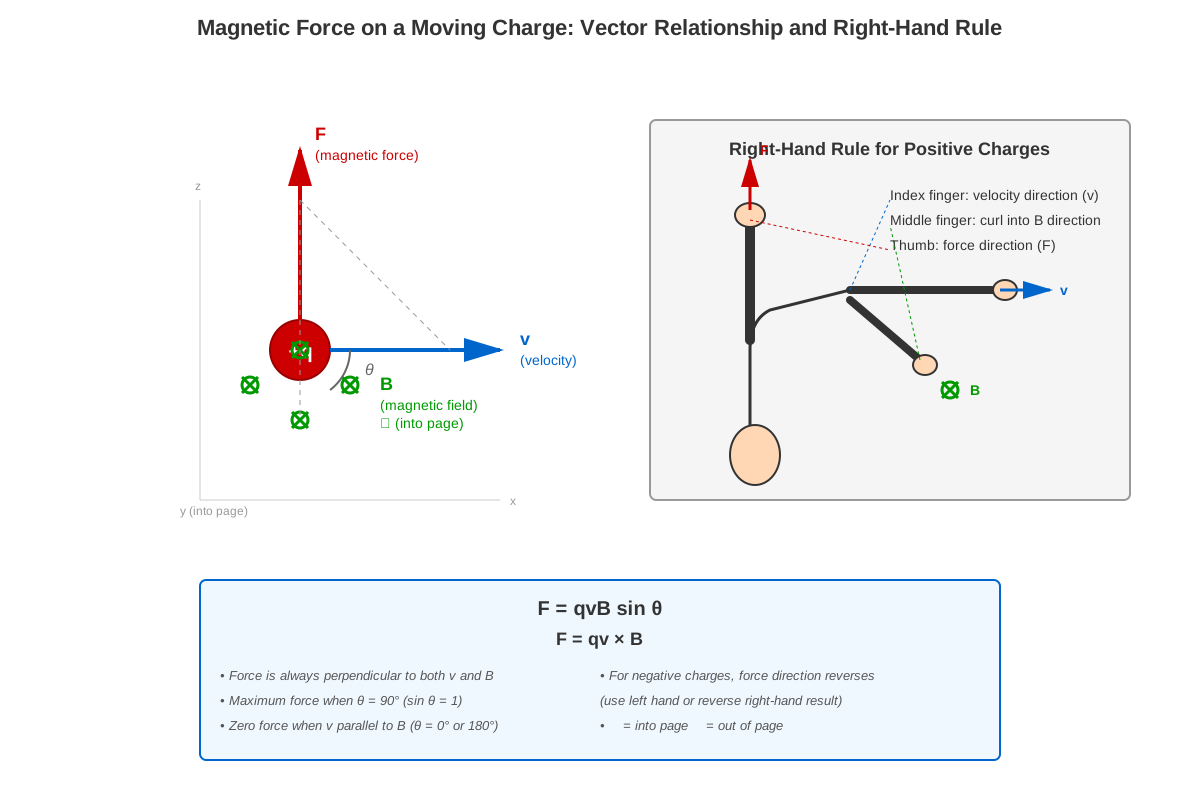
The magnetic force on a moving charged particle represents one of the fundamental forces in electromagnetism. Unlike electric forces that act on any charged particle regardless of motion, magnetic forces only affect charges that are moving relative to the magnetic field. The force is given by the equation:
F = qvB sin(θ)where q is the charge magnitude (in coulombs), v is the velocity of the charge (in m/s), B is the magnetic field strength (in tesla, T), and θ is the angle between the velocity vector and the magnetic field vector. This equation reveals several critical properties: the force is maximized when the particle moves perpendicular to the field (θ = 90°, sin(θ) = 1), and the force is zero when the particle moves parallel or antiparallel to the field (θ = 0° or 180°, sin(θ) = 0).
The vector form of this equation is:
F⃗ = q(v⃗ × B⃗)The cross product indicates that the magnetic force is always perpendicular to both the velocity and the magnetic field. This perpendicularity has profound consequences: magnetic forces do no work on charged particles because force and displacement are perpendicular, meaning magnetic forces cannot change a particle's kinetic energy or speed—they can only change the direction of motion.
The Right-Hand Rule for Magnetic Force
Determining the direction of magnetic force requires applying the right-hand rule, a critical skill for MCAT success. For a positive charge, point the fingers of your right hand in the direction of the velocity vector, curl them toward the magnetic field vector, and your thumb points in the direction of the force. For negative charges, the force direction is opposite to what the right-hand rule indicates for positive charges.
There are multiple versions of the right-hand rule, but the most reliable for magnetic force is: (1) Point your fingers in the direction of v⃗, (2) Bend your fingers in the direction of B⃗, (3) Your thumb points in the direction of F⃗ for positive charges. This method works consistently across different orientations and is less prone to confusion than alternative formulations.
Circular Motion of Charged Particles in Magnetic Fields
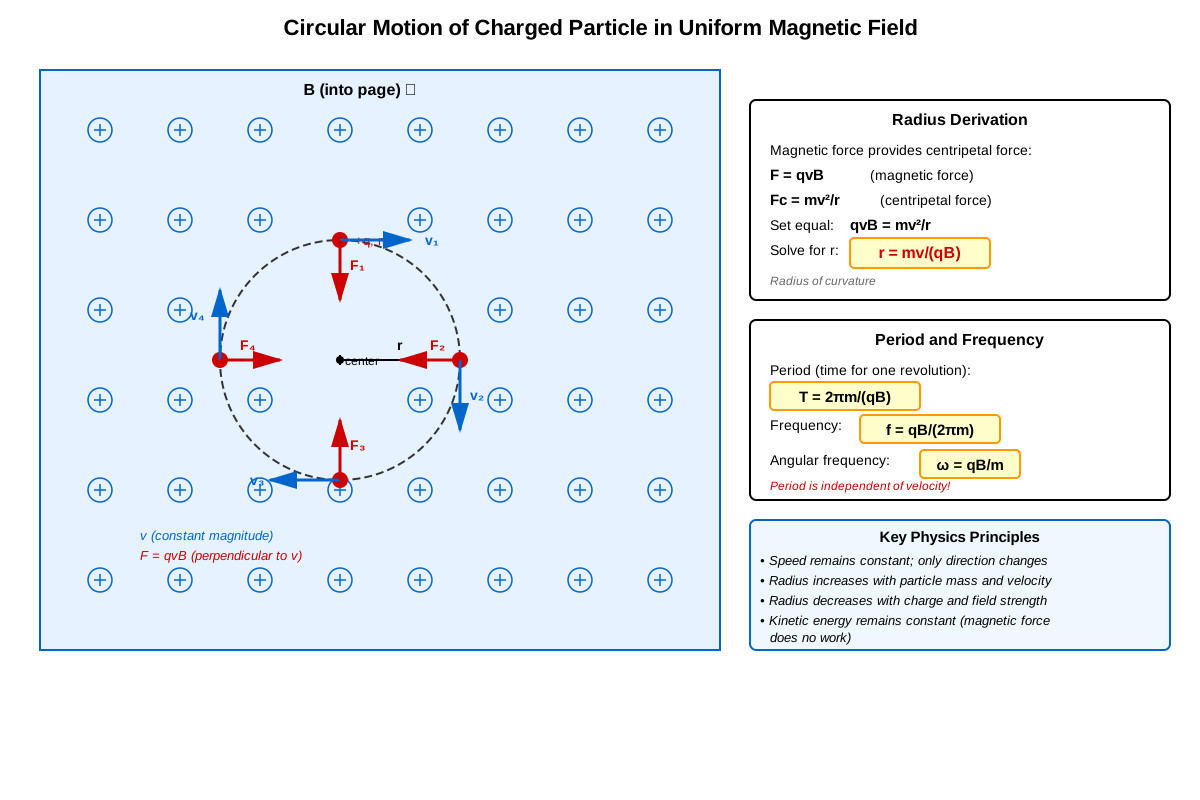
When a charged particle enters a uniform magnetic field perpendicular to its velocity, it experiences a constant-magnitude force that is always perpendicular to its motion. This creates uniform circular motion, with the magnetic force providing the centripetal force:
qvB = mv²/rSolving for the radius of the circular path:
r = mv/(qB)This equation reveals that the radius depends on the particle's momentum (mv), charge, and field strength. Heavier particles or faster particles follow larger circular paths, while stronger fields or greater charges produce tighter curves. This principle underlies mass spectrometry, where particles with different mass-to-charge ratios separate spatially.
The period of circular motion (time for one complete revolution) is:
T = 2πr/v = 2πm/(qB)Remarkably, the period is independent of velocity—faster particles travel larger circles but complete them in the same time. The frequency of revolution, called the cyclotron frequency, is:
f = qB/(2πm)Helical Motion: Velocity Components Parallel and Perpendicular to B
When a charged particle enters a magnetic field at an angle (neither parallel nor perpendicular), its motion becomes helical. The velocity component parallel to the field (v∥) experiences no magnetic force and remains constant, causing the particle to drift along the field direction. The velocity component perpendicular to the field (v⊥) experiences the full magnetic force and causes circular motion in the plane perpendicular to the field. The combination produces a helical trajectory—a corkscrew path that spirals along the field lines.
The radius of the helix is determined by the perpendicular velocity component:
r = mv⊥/(qB)The pitch of the helix (distance traveled along the field direction per revolution) is:
pitch = v∥T = v∥(2πm)/(qB)Magnetic Force on Current-Carrying Conductors
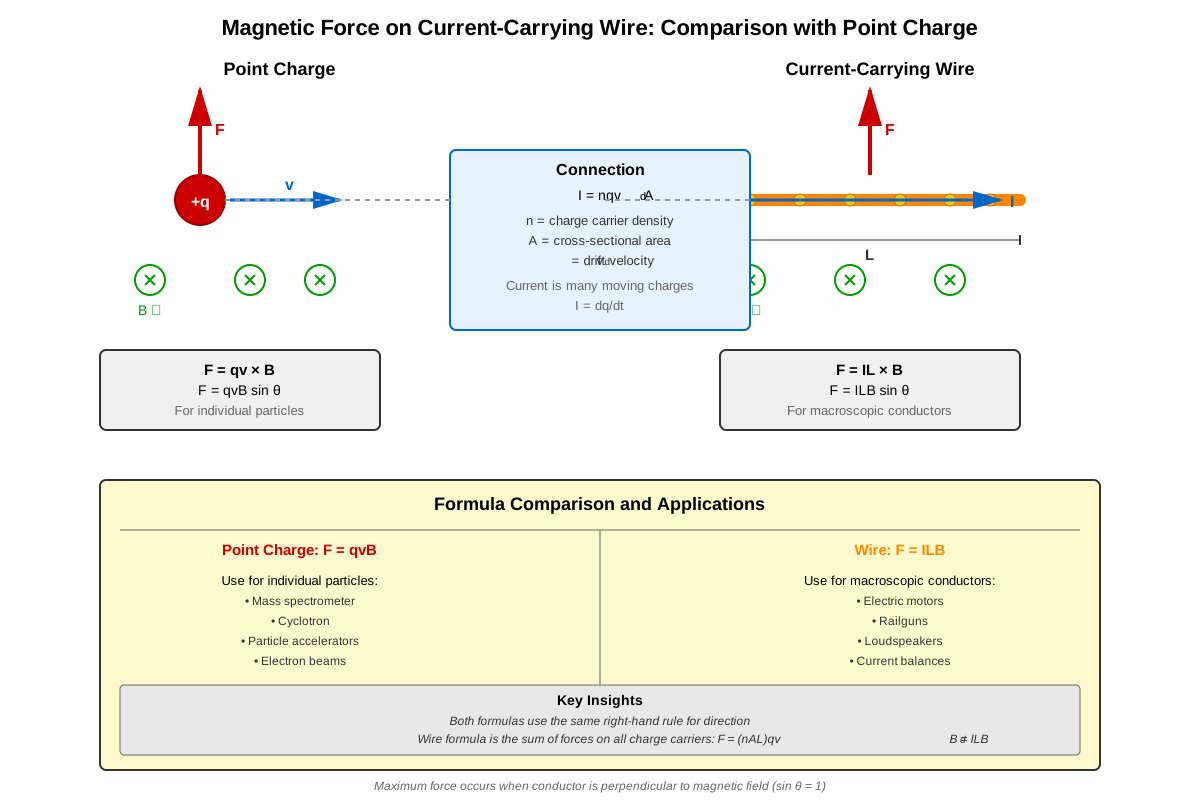
When current flows through a wire in a magnetic field, the moving charges within the conductor experience magnetic forces that collectively produce a force on the wire itself. The force on a straight wire segment of length L carrying current I in a magnetic field is:
F = ILB sin(θ)where θ is the angle between the current direction and the magnetic field. The vector form is:
F⃗ = I(L⃗ × B⃗)where L⃗ is a vector pointing in the direction of current flow with magnitude equal to the wire length. The right-hand rule applies here too: point fingers in the direction of current, curl toward the magnetic field, and the thumb indicates force direction.
This principle explains how electric motors work: current-carrying coils in magnetic fields experience torques that cause rotation. It also appears in MCAT questions about electromagnetic devices and biological applications involving current flow in magnetic fields.
Comparison of Electric and Magnetic Forces
Understanding the similarities and differences between electric and magnetic forces is crucial for MCAT success:
| Property | Electric Force | Magnetic Force |
|---|---|---|
| Acts on | Any charged particle | Only moving charged particles |
| Direction | Along field lines | Perpendicular to both v⃗ and B⃗ |
| Work done | Can do work, changes KE | Does no work, KE constant |
| Depends on | Charge only | Charge and velocity |
| Field units | N/C or V/m | Tesla (T) or Wb/m² |
| Force equation | F = qE | F = qvB sin(θ) |
Both forces follow superposition—when both fields are present, the total force is the vector sum. This creates velocity selectors where specific velocities experience zero net force when electric and magnetic forces balance.
Magnetic Field Units and Typical Magnitudes
The SI unit of magnetic field strength is the tesla (T), defined as one newton per ampere-meter (N/(A·m)). An older unit, the gauss (G), relates to tesla by: 1 T = 10,000 G. For MCAT context:
- Earth's magnetic field: ~0.5 G = 5 × 10⁻⁵ T
- Refrigerator magnet: ~0.01 T = 100 G
- MRI machine: 1.5-3 T (clinical) or up to 7 T (research)
- Strongest laboratory magnets: ~45 T
Understanding these magnitudes helps assess whether calculated values are reasonable and aids in eliminating incorrect answer choices.
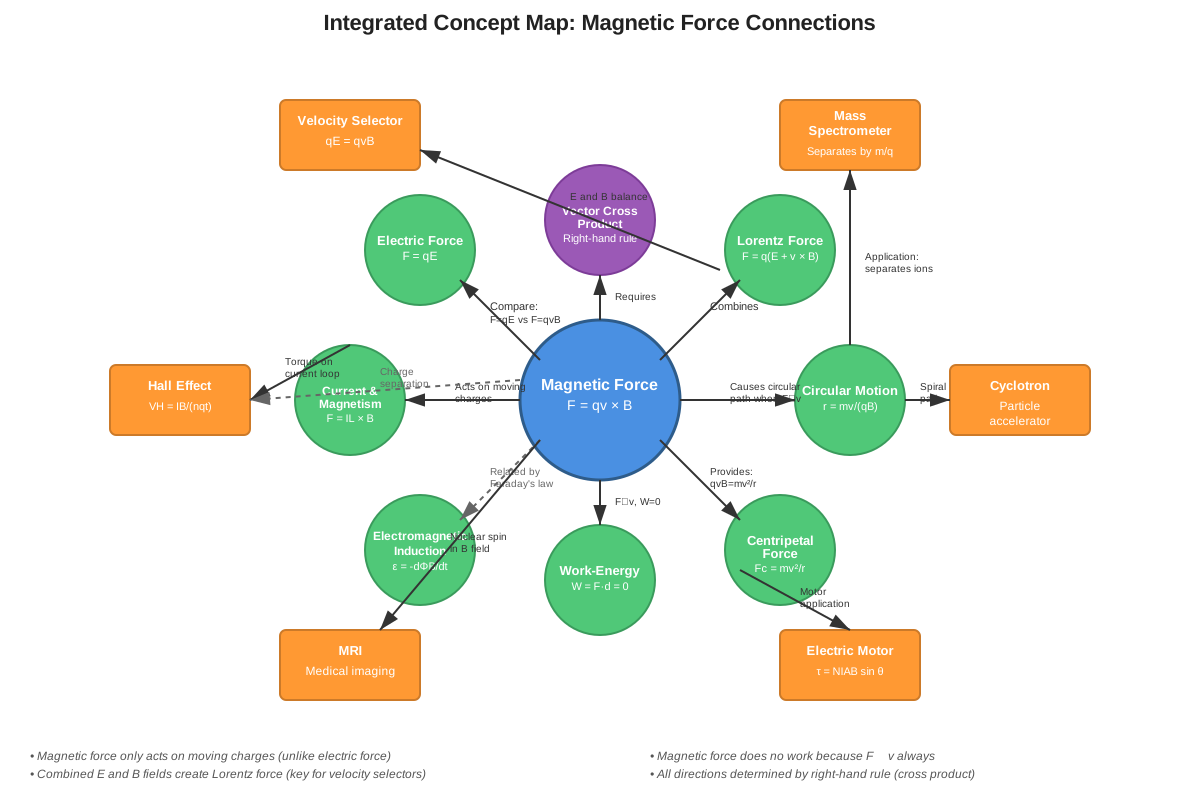
Concept Relationships
The magnetic force concept connects hierarchically and laterally to multiple physics domains. At the foundation, electrostatics provides the concept of charge and electric force, which magnetic force parallels but with velocity dependence. The cross product from vector mathematics determines both the magnitude (through the sine function) and direction (perpendicularity) of magnetic force, making vector operations prerequisite knowledge.
When magnetic force acts as centripetal force, it connects directly to circular motion concepts: centripetal acceleration, period, frequency, and radius relationships. This connection enables analysis of particle trajectories and underlies mass spectrometry applications. The relationship flows: magnetic force → centripetal force → circular motion parameters → trajectory prediction.
The current-carrying wire formulation connects magnetic force to current and circuits, bridging the gap between point charge behavior and macroscopic electromagnetic devices. This relationship extends to torque when analyzing current loops in magnetic fields, which explains motor operation.
Magnetic force connects forward to electromagnetic induction: moving conductors in magnetic fields experience forces, and conversely, changing magnetic fields induce electric fields and currents (Faraday's law). This reciprocal relationship between electricity and magnetism forms the foundation of electromagnetic theory.
The velocity selector application demonstrates how magnetic force combines with electric force through vector addition, requiring students to analyze competing forces and equilibrium conditions. This connects to force diagrams and Newton's laws, reinforcing mechanics concepts in an electromagnetic context.
Energy considerations reveal that magnetic force does no work because force and displacement are perpendicular, connecting to work-energy theorem and conservation of energy. This explains why magnetic fields cannot accelerate particles—they can only deflect them.
Quick check — test yourself on Magnetic force so far.
Try Flashcards →High-Yield Facts
⭐ Magnetic force is always perpendicular to both the velocity and magnetic field vectors, resulting from the cross product relationship F⃗ = q(v⃗ × B⃗)
⭐ Magnetic forces do no work on charged particles because force and displacement are perpendicular; kinetic energy and speed remain constant
⭐ The radius of circular motion in a magnetic field is r = mv/(qB), directly proportional to momentum and inversely proportional to charge and field strength
⭐ For positive charges, use the right-hand rule directly; for negative charges, the force direction is opposite to what the right-hand rule indicates
⭐ When velocity is parallel to the magnetic field (θ = 0° or 180°), magnetic force is zero because sin(0°) = sin(180°) = 0
- The cyclotron frequency f = qB/(2πm) is independent of particle velocity, meaning faster particles travel larger circles in the same time period
- Magnetic force on a current-carrying wire is F = ILB sin(θ), where current direction replaces velocity direction in the right-hand rule
- In a velocity selector, electric and magnetic forces balance when v = E/B, allowing only particles with this specific velocity to pass undeflected
- The SI unit of magnetic field is the tesla (T), where 1 T = 1 N/(A·m) = 10,000 gauss
- Helical motion occurs when velocity has components both parallel and perpendicular to the magnetic field; the parallel component determines pitch while the perpendicular component determines radius
- Mass spectrometers separate ions by mass-to-charge ratio using the relationship r = mv/(qB), where heavier ions follow larger circular paths
- The magnetic force equation F = qvB sin(θ) reaches maximum when θ = 90° (perpendicular motion) and minimum (zero) when θ = 0° (parallel motion)
Common Misconceptions
Misconception: Magnetic forces can speed up or slow down charged particles.
Correction: Magnetic forces are always perpendicular to velocity, so they do no work and cannot change kinetic energy or speed. They can only change the direction of motion. To change a particle's speed, electric forces or other non-magnetic forces are required.
Misconception: The right-hand rule works the same way for negative charges as for positive charges.
Correction: For negative charges, the force direction is opposite to what the right-hand rule indicates. After applying the right-hand rule as if the charge were positive, reverse the direction by 180° for negative charges. Alternatively, some students prefer using the left hand for negative charges.
Misconception: A charged particle at rest in a magnetic field experiences a magnetic force.
Correction: Magnetic force requires motion—specifically, velocity relative to the magnetic field. A stationary charge (v = 0) experiences zero magnetic force regardless of field strength because F = qvB sin(θ) = 0 when v = 0. Only moving charges experience magnetic forces.
Misconception: Magnetic force is strongest when the particle moves parallel to the magnetic field.
Correction: Magnetic force is actually zero when velocity is parallel (or antiparallel) to the magnetic field because sin(0°) = 0. The force is maximum when velocity is perpendicular to the field (sin(90°) = 1). This is a common trap in MCAT questions.
Misconception: The radius of circular motion increases when magnetic field strength increases.
Correction: The radius r = mv/(qB) is inversely proportional to magnetic field strength. Stronger magnetic fields produce tighter (smaller radius) circular paths because the increased force causes sharper deflection. This relationship is crucial for mass spectrometry questions.
Misconception: Magnetic force and magnetic field point in the same direction.
Correction: Magnetic force is perpendicular to the magnetic field (and also perpendicular to velocity). The force direction is determined by the cross product v⃗ × B⃗, which always produces a vector perpendicular to both input vectors. Never assume force and field are parallel.
Misconception: Heavier particles always move in smaller circles than lighter particles in the same magnetic field.
Correction: The radius r = mv/(qB) depends on the mass-to-charge ratio and velocity. A heavier particle with proportionally greater charge or lower velocity might actually follow a smaller circle. Mass spectrometry exploits this by accelerating ions to the same kinetic energy, making radius proportional to √(m/q).
Worked Examples
Example 1: Circular Motion in a Mass Spectrometer
Problem: A singly ionized carbon-12 atom (mass = 12 u = 2.0 × 10⁻²⁶ kg, charge = +e = 1.6 × 10⁻¹⁹ C) is accelerated through a potential difference of 1000 V and then enters a uniform magnetic field of 0.50 T perpendicular to its velocity. Calculate (a) the velocity of the ion upon entering the magnetic field, and (b) the radius of its circular path.
Solution:
(a) First, find the velocity using energy conservation. The electric potential energy is converted to kinetic energy:
qV = ½mv²Solving for v:
v = √(2qV/m) = √(2 × 1.6 × 10⁻¹⁹ C × 1000 V / 2.0 × 10⁻²⁶ kg)v = √(3.2 × 10⁻¹⁶ / 2.0 × 10⁻²⁶) = √(1.6 × 10¹⁰) = 1.26 × 10⁵ m/s(b) For circular motion in a magnetic field, the magnetic force provides centripetal force:
qvB = mv²/rSolving for r:
r = mv/(qB) = (2.0 × 10⁻²⁶ kg × 1.26 × 10⁵ m/s)/(1.6 × 10⁻¹⁹ C × 0.50 T)r = (2.52 × 10⁻²¹)/(8.0 × 10⁻²⁰) = 0.0315 m = 3.15 cmKey insights: This problem demonstrates the typical mass spectrometry setup where ions are accelerated then deflected. Notice that the radius depends on the mass-to-charge ratio—heavier isotopes would follow larger circular paths. The perpendicular entry (θ = 90°) maximizes the magnetic force and produces pure circular motion rather than helical motion.
Example 2: Force Direction and Magnitude on a Current-Carrying Wire
Problem: A straight wire segment 0.25 m long carries a current of 3.0 A in the +x direction. It is placed in a uniform magnetic field of 0.40 T pointing in the +y direction. (a) Determine the magnitude and direction of the magnetic force on the wire. (b) If the wire were rotated to carry current in the +y direction (parallel to the field), what would be the force?
Solution:
(a) The force on a current-carrying wire is:
F = ILB sin(θ)Since the current (+x direction) is perpendicular to the field (+y direction), θ = 90° and sin(90°) = 1:
F = 3.0 A × 0.25 m × 0.40 T × 1 = 0.30 NFor direction, use the right-hand rule: point fingers in the current direction (+x), curl them toward the field direction (+y), and the thumb points in the +z direction (out of the xy-plane).
Answer: The force magnitude is 0.30 N in the +z direction.
(b) When current is parallel to the magnetic field, θ = 0° and sin(0°) = 0:
F = ILB sin(0°) = 0Answer: The force is zero when current flows parallel to the magnetic field.
Key insights: This problem reinforces that magnetic force depends critically on the angle between current (or velocity) and field. The perpendicular configuration produces maximum force, while parallel alignment produces zero force. This concept appears frequently in MCAT questions about electromagnetic devices and motor operation. The right-hand rule application for current-carrying wires is identical to that for moving positive charges, with current direction replacing velocity direction.
Exam Strategy
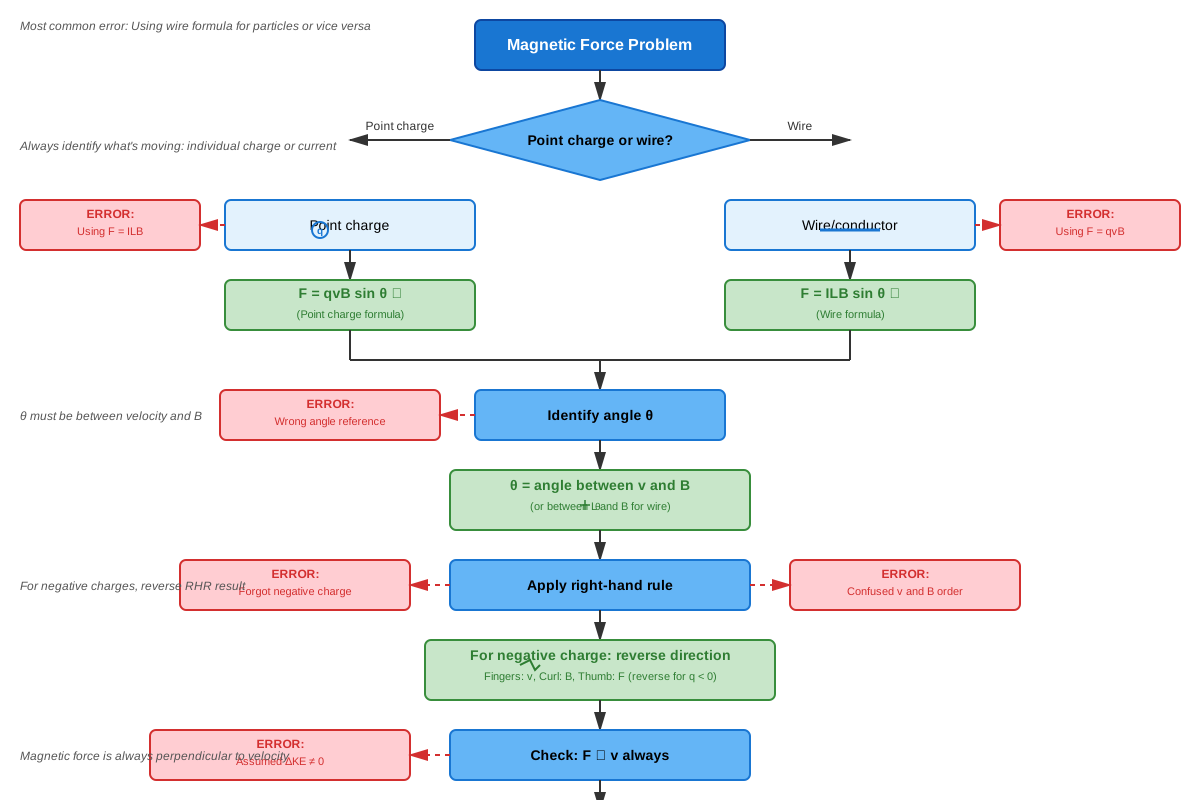
When approaching magnetic force MCAT questions, begin by identifying whether the problem involves a point charge or a current-carrying conductor, as this determines which formula to apply. For point charges, look for information about charge magnitude, velocity, and magnetic field strength. For conductors, identify current, wire length, and field strength. Always check whether the angle between velocity (or current) and field is explicitly stated or must be inferred from the geometry.
Trigger words that signal magnetic force questions include: "charged particle enters a magnetic field," "circular path," "radius of curvature," "deflection," "mass spectrometer," "cyclotron," "current-carrying wire in a field," "motor," and "perpendicular to the field." Phrases like "does no work" or "kinetic energy remains constant" should immediately suggest magnetic force, since this is a unique property distinguishing it from electric force.
For direction questions, systematically apply the right-hand rule rather than trying to visualize the answer. Draw a quick 3D coordinate system if needed, and remember to reverse the direction for negative charges. MCAT questions often test whether students remember this reversal, making it a common trap for positive-charge-only thinkers.
When eliminating answer choices, use dimensional analysis and limiting cases. If velocity is zero or parallel to the field, force must be zero—eliminate any answer suggesting otherwise. If the question asks about kinetic energy changes, eliminate any answer suggesting magnetic forces can increase or decrease speed. For radius calculations, remember that stronger fields produce smaller radii (inverse relationship), and heavier particles produce larger radii (direct relationship).
Time allocation: Discrete magnetic force questions typically require 60-90 seconds—enough time to identify the relevant formula, substitute values, and calculate. Passage-based questions may require 90-120 seconds as you extract information from the passage and potentially combine multiple concepts. If a question requires extensive calculation, consider whether estimation or answer choice elimination might be faster. The MCAT rewards strategic thinking over brute-force calculation.
For questions combining electric and magnetic forces (velocity selectors, crossed fields), draw a force diagram showing both forces and apply vector addition. Remember that for a particle to travel undeflected, the net force must be zero, requiring F_E = F_B, which gives v = E/B.
Memory Techniques
Right-Hand Rule Mnemonic: "First Velocity, Bend to B-field, Thumb for Force" (FVB-TF). This reminds you to point fingers along velocity first, bend them toward the B-field, and your thumb gives the force direction.
Magnetic Force Does No Work: Remember "Magnetic forces are Perpendicular, No Work" (MPNW). Since force and displacement are perpendicular, the dot product F⃗·d⃗ = 0, meaning no work is done.
Radius Formula Memory: Think "Momentum Over Charge and B-field" (MOC-B) for r = mv/(qB). The radius is proportional to momentum (mv) and inversely proportional to charge and field strength.
Angle Dependence: Remember "Perpendicular is Powerful, Parallel is Powerless" (4 P's). Maximum force occurs at 90° (perpendicular), zero force at 0° (parallel).
Visualization Strategy: For three-dimensional problems, use the "page plane" method: if the magnetic field points into the page (represented by ⊗, like the tail of an arrow), and velocity is in the plane of the page, the force will also be in the plane of the page, perpendicular to velocity. If the field points out of the page (represented by ⊙, like the tip of an arrow), apply the same logic.
Cyclotron Frequency Independence: Remember "Faster particles travel Farther but Finish together" to recall that period T = 2πm/(qB) is independent of velocity—faster particles have larger radii but complete circles in the same time.
Summary
Magnetic force represents a fundamental electromagnetic interaction that acts exclusively on moving charged particles, producing a force perpendicular to both velocity and magnetic field vectors. The magnitude is given by F = qvB sin(θ) for point charges and F = ILB sin(θ) for current-carrying conductors, with maximum force occurring when motion is perpendicular to the field and zero force when parallel. The right-hand rule determines force direction for positive charges, with negative charges experiencing force in the opposite direction. A critical property distinguishing magnetic from electric forces is that magnetic forces do no work—they cannot change kinetic energy or speed, only direction of motion. When charged particles enter uniform magnetic fields perpendicularly, they undergo circular motion with radius r = mv/(qB), a relationship exploited in mass spectrometers and particle accelerators. The cyclotron frequency f = qB/(2πm) is remarkably independent of velocity. For MCAT success, students must master formula application, right-hand rule execution, and conceptual understanding of when magnetic forces are zero, maximum, or intermediate based on velocity-field orientation.
Key Takeaways
- Magnetic force acts only on moving charges and is given by F = qvB sin(θ), where θ is the angle between velocity and magnetic field vectors
- The force direction is perpendicular to both velocity and field, determined by the right-hand rule for positive charges (opposite for negative charges)
- Magnetic forces do no work because force and displacement are perpendicular, meaning kinetic energy and speed remain constant
- Circular motion radius is r = mv/(qB), inversely proportional to magnetic field strength and charge, directly proportional to momentum
- Force is maximum when velocity is perpendicular to the field (θ = 90°) and zero when parallel (θ = 0° or 180°)
- Current-carrying wires experience force F = ILB sin(θ), with direction determined by treating current as positive charge flow
- Mass spectrometers separate particles by mass-to-charge ratio using the radius relationship, making this a high-yield MCAT application
Related Topics
Electromagnetic Induction: Mastering magnetic force provides the foundation for understanding Faraday's law and Lenz's law, where changing magnetic fields induce electric fields and currents. The reciprocal relationship between electricity and magnetism becomes clear when studying how moving conductors in magnetic fields generate EMF.
Lorentz Force: The complete electromagnetic force on a charged particle combines electric and magnetic components: F⃗ = q(E⃗ + v⃗ × B⃗). Understanding magnetic force is essential before tackling this unified treatment.
Torque on Current Loops: Extending magnetic force concepts to current loops reveals how motors work, as the force on different wire segments creates rotational motion. This connects magnetic force to rotational dynamics.
Magnetic Fields from Currents: After understanding how magnetic fields affect moving charges, the next step is learning how moving charges (currents) create magnetic fields, completing the electricity-magnetism connection through Ampère's law and the Biot-Savart law.
Particle Physics Applications: Cyclotrons, synchrotrons, and other particle accelerators use magnetic forces to control high-energy particles, connecting this physics topic to nuclear chemistry and modern physics concepts tested on the MCAT.
Practice CTA
Now that you've mastered the core concepts of magnetic force, it's time to solidify your understanding through active practice. Attempt the practice questions and flashcards to test your ability to apply formulas, execute the right-hand rule under time pressure, and identify common traps. Focus especially on questions requiring three-dimensional visualization and those combining magnetic force with other physics concepts. Remember: understanding the theory is only half the battle—MCAT success requires rapid, accurate application under exam conditions. Each practice problem you solve strengthens the neural pathways that will serve you on test day. You've got this!
Sign up free to keep reading
Create a free AnvayaPrep account to finish this MCAT guide on Magnetic force — plus flashcards and practice questions.