Overview
Faraday's law represents one of the most fundamental principles in Electricity and Magnetism, establishing the critical relationship between changing magnetic fields and induced electric currents. This electromagnetic induction phenomenon forms the theoretical foundation for countless technologies, from power generators and transformers to MRI machines and wireless charging systems. For MCAT preparation, Faraday's law bridges the gap between static magnetic field concepts and dynamic electromagnetic phenomena, requiring students to integrate their understanding of magnetic flux, electric fields, and circuit behavior.
The Faraday law MCAT content typically appears in passages involving experimental setups with moving magnets, rotating coils, or changing magnetic fields. Questions may present scenarios involving power generation, electromagnetic devices, or laboratory experiments where students must calculate induced voltages, determine current direction, or predict the behavior of conducting loops in magnetic fields. Understanding this principle requires both conceptual mastery and quantitative problem-solving skills, as MCAT questions frequently combine mathematical calculations with conceptual reasoning about the direction and magnitude of induced effects.
Within the broader Physics curriculum, Faraday's law connects electromagnetic concepts to energy conservation principles and serves as a precursor to understanding electromagnetic waves and alternating current circuits. This topic exemplifies how the MCAT tests integrated scientific reasoning—students must simultaneously apply vector concepts, calculus-based rate-of-change thinking, and circuit analysis skills. Mastery of Faraday's law enables deeper understanding of Lenz's law, inductance, and the electromagnetic spectrum, making it a cornerstone concept for the Electricity and Magnetism section.
Learning Objectives
- [ ] Define Faraday law using accurate Physics terminology
- [ ] Explain why Faraday law matters for the MCAT
- [ ] Apply Faraday law to exam-style questions
- [ ] Identify common mistakes related to Faraday law
- [ ] Connect Faraday law to related Physics concepts
- [ ] Calculate the magnitude of induced electromotive force (EMF) given changing magnetic flux
- [ ] Determine the direction of induced current using Lenz's law in conjunction with Faraday's law
- [ ] Analyze scenarios involving motional EMF and distinguish them from flux-change EMF
Prerequisites
- Magnetic fields and magnetic flux: Understanding magnetic field vectors and how to calculate flux through a surface is essential for applying Faraday's law, which depends on the rate of flux change
- Basic circuit concepts: Knowledge of voltage, current, and resistance enables analysis of the electrical effects produced by electromagnetic induction
- Vector operations and dot products: Calculating magnetic flux requires computing the dot product between magnetic field vectors and area vectors
- Calculus fundamentals (derivatives): Faraday's law involves the time derivative of magnetic flux, requiring basic understanding of rates of change
- Right-hand rules: Determining directions of magnetic fields, forces, and induced currents relies on consistent application of right-hand rule conventions
Why This Topic Matters
Faraday's law has profound clinical and technological significance that extends far beyond theoretical physics. Magnetic Resonance Imaging (MRI), one of medicine's most powerful diagnostic tools, relies fundamentally on electromagnetic induction principles. The rapidly changing magnetic field gradients in MRI machines induce currents in receiver coils, generating the signals that create detailed anatomical images. Transcranial magnetic stimulation (TMS), an emerging psychiatric treatment, uses rapidly changing magnetic fields to induce currents in brain tissue, demonstrating direct therapeutic applications of Faraday's law.
On the MCAT, Faraday law Physics appears with moderate frequency, typically in 1-3 questions per exam administration. Questions most commonly appear in passage-based formats (approximately 70% of the time) rather than as discrete items. These passages often describe experimental setups involving rotating coils, moving conductors through magnetic fields, or time-varying magnetic field sources. The Chemical and Physical Foundations of Biological Systems section accounts for the majority of these questions, though occasional interdisciplinary passages may appear in the Biological and Biochemical Foundations section when discussing medical imaging technologies.
Common exam presentations include: (1) quantitative problems requiring calculation of induced EMF from given flux changes, (2) conceptual questions about the direction of induced currents, (3) energy conservation scenarios involving mechanical work and electrical energy generation, (4) comparative questions about how changing different parameters affects induced EMF, and (5) graph interpretation problems showing time-varying magnetic fields or flux. Understanding both the mathematical formulation and the physical intuition behind electromagnetic induction is essential for efficiently handling these diverse question types.
Core Concepts
Mathematical Statement of Faraday's Law
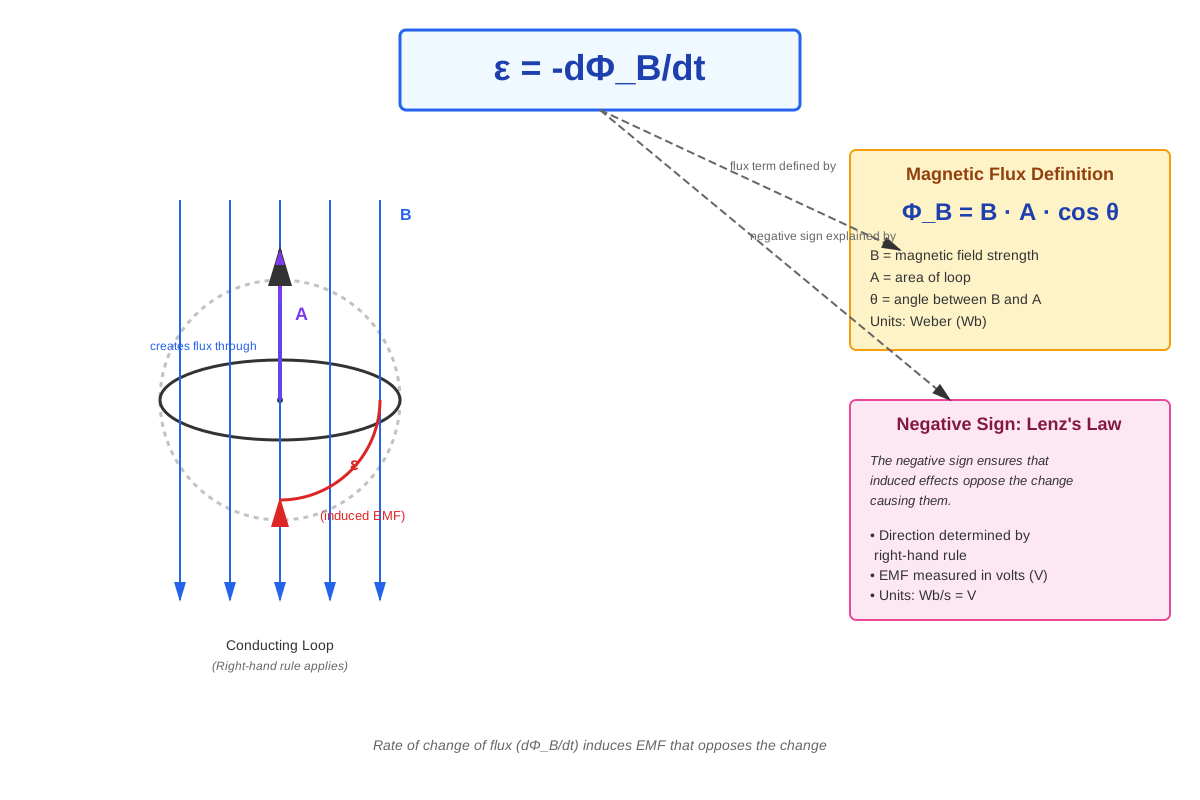
Faraday's law quantitatively describes electromagnetic induction through a precise mathematical relationship. The law states that the induced electromotive force (EMF) in a closed conducting loop equals the negative rate of change of magnetic flux through that loop:
ε = -dΦ_B/dtWhere ε represents the induced EMF (measured in volts), Φ_B denotes the magnetic flux through the loop (measured in webers, Wb), and t represents time (in seconds). The negative sign, formalized by Lenz's law, indicates that the induced EMF creates a current whose magnetic field opposes the change in flux that produced it—a manifestation of energy conservation.
Magnetic flux itself is defined as:
Φ_B = B⊥A = BA cos(θ)Where B represents the magnetic field strength (in tesla, T), A is the area of the loop (in m²), and θ is the angle between the magnetic field vector and the normal (perpendicular) to the loop's surface. The subscript ⊥ emphasizes that only the perpendicular component of the magnetic field contributes to flux.
For a coil with N turns, Faraday's law becomes:
ε = -N(dΦ_B/dt)This relationship shows that multiple loops amplify the induced EMF proportionally—a principle exploited in transformer design and generator construction.
Three Ways to Change Magnetic Flux
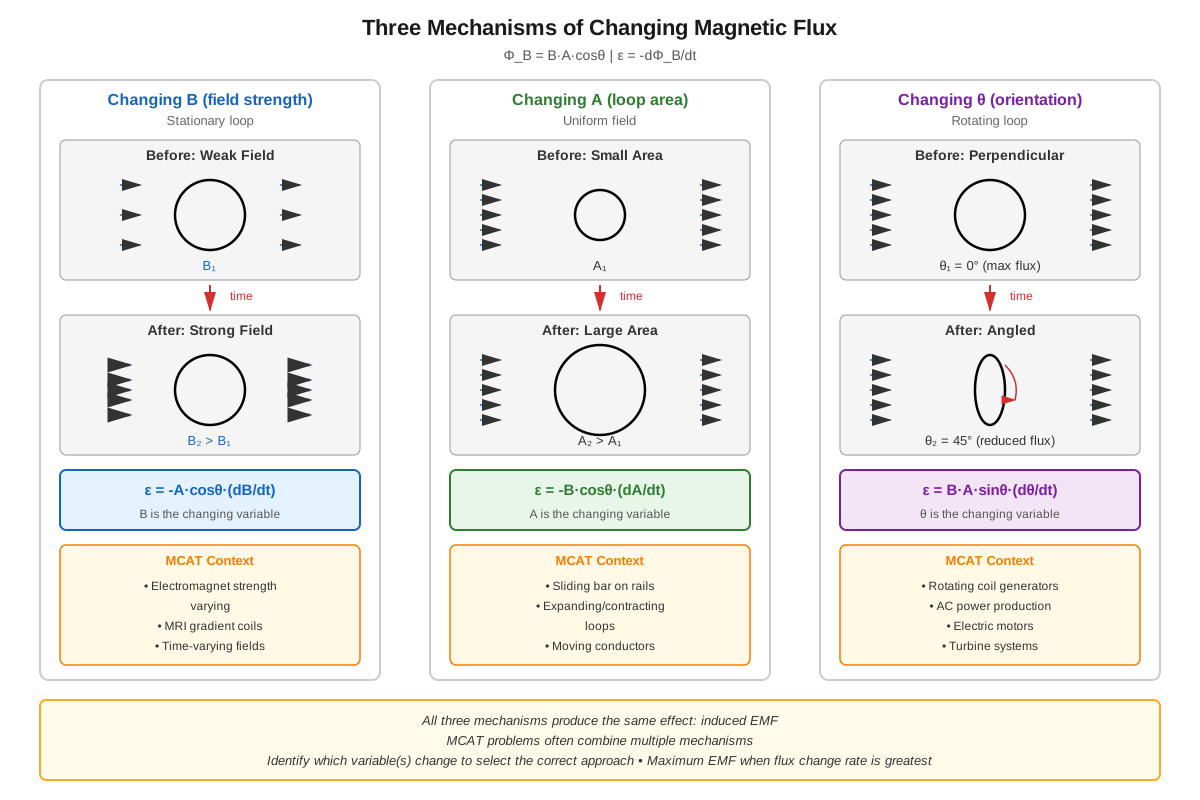
Understanding that induced EMF depends on changing flux, students must recognize the three distinct mechanisms that can alter magnetic flux through a loop:
- Changing magnetic field strength (B): When the magnitude of the magnetic field through a stationary loop changes with time, flux changes even though the loop geometry remains constant. This occurs in scenarios with electromagnets whose current varies, or in AC transformers where alternating current creates oscillating magnetic fields.
- Changing loop area (A): When a conducting loop expands, contracts, or deforms while in a uniform magnetic field, the flux through it changes. Examples include a sliding bar on conducting rails that increases the enclosed area, or a collapsing coil in a magnetic field.
- Changing orientation (θ): When a loop rotates in a magnetic field, the angle between the field and the loop's normal vector changes, altering the flux. This mechanism underlies electric generator operation, where mechanical rotation produces electrical energy.
The total rate of flux change can involve any combination of these three mechanisms:
dΦ_B/dt = A cos(θ)(dB/dt) + B cos(θ)(dA/dt) + BA(-sin(θ))(dθ/dt)Lenz's Law and Direction Determination
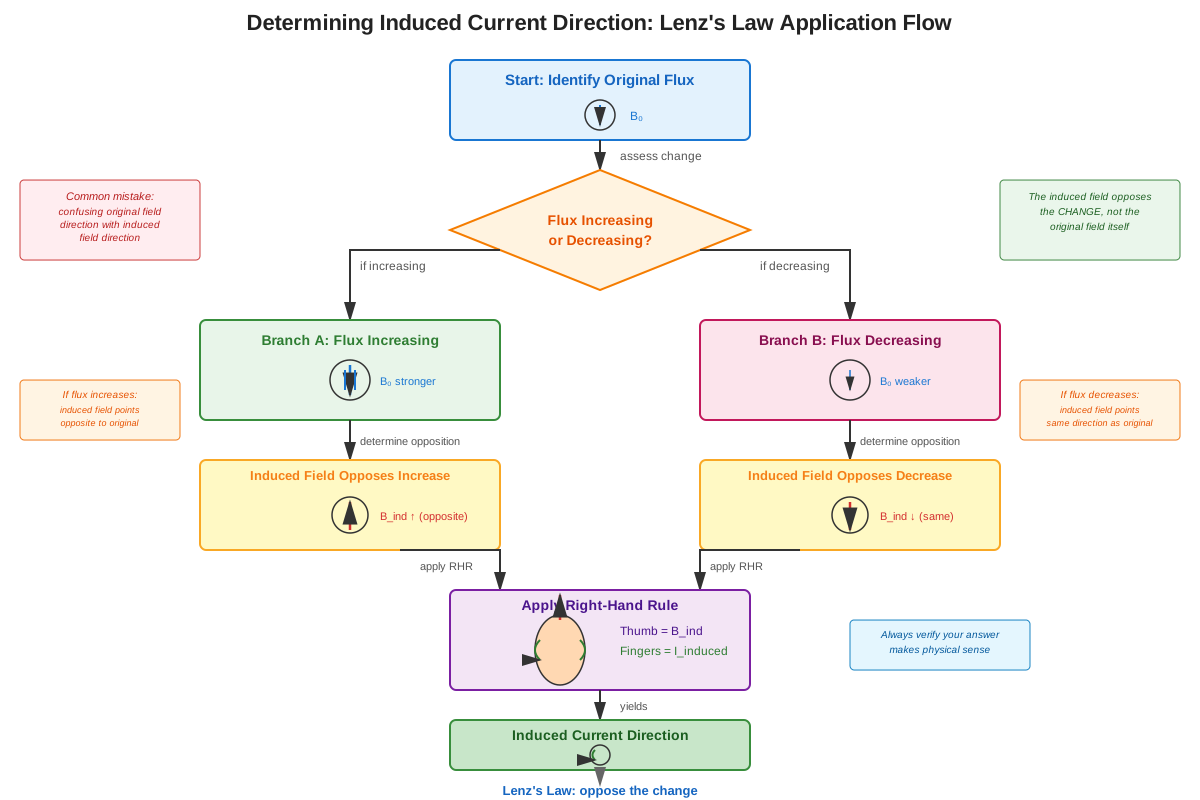
Lenz's law provides the physical interpretation of the negative sign in Faraday's law: the induced current flows in a direction that creates a magnetic field opposing the change in flux. This opposition principle reflects energy conservation—if induced currents reinforced flux changes, systems would spontaneously accelerate without energy input, violating thermodynamic principles.
To determine induced current direction:
- Identify the original magnetic field direction through the loop
- Determine whether flux is increasing or decreasing
- Apply Lenz's law: if flux increases, induced current creates a field opposing the increase (opposite direction); if flux decreases, induced current creates a field opposing the decrease (same direction as original)
- Use the right-hand rule to find the current direction that produces the required opposing field
Motional EMF
Motional EMF represents a special case of electromagnetic induction where a conductor moves through a magnetic field. When a straight conductor of length L moves with velocity v perpendicular to a magnetic field B, the induced EMF is:
ε = BLvThis formula derives from Faraday's law by considering the changing area swept by the moving conductor. The magnetic force on charge carriers within the moving conductor causes charge separation, creating a potential difference across the conductor's ends.
For a conductor moving at an angle θ to its length direction:
ε = BLv sin(θ)Where θ is the angle between the velocity vector and the conductor length. This relationship explains how generators convert mechanical energy into electrical energy—rotating conductors continuously sweep through magnetic fields, inducing EMF.
Energy Considerations
Electromagnetic induction fundamentally involves energy conversion between mechanical and electrical forms. When a conductor moves through a magnetic field and induced current flows, the magnetic force on that current-carrying conductor opposes the motion (by Lenz's law). External mechanical work must be performed to maintain motion against this magnetic force, and this mechanical energy converts to electrical energy in the induced current.
The power delivered by the induced EMF equals:
P = εI = ε²/RWhere I is the induced current and R is the circuit resistance. This power must equal the mechanical power input (force times velocity) in steady-state conditions, demonstrating energy conservation.
Comparison Table: Faraday's Law Scenarios
| Scenario | Flux Change Mechanism | EMF Formula | Key Application |
|---|---|---|---|
| Stationary coil, changing B-field | dB/dt ≠ 0 | ε = -NA(dB/dt) | Transformers, AC circuits |
| Moving conductor in uniform B-field | dA/dt ≠ 0 | ε = BLv | Linear generators, railguns |
| Rotating coil in uniform B-field | dθ/dt ≠ 0 | ε = NABω sin(ωt) | AC generators, motors |
| Expanding/contracting loop | dA/dt ≠ 0 | ε = -B(dA/dt) | Experimental demonstrations |
Concept Relationships
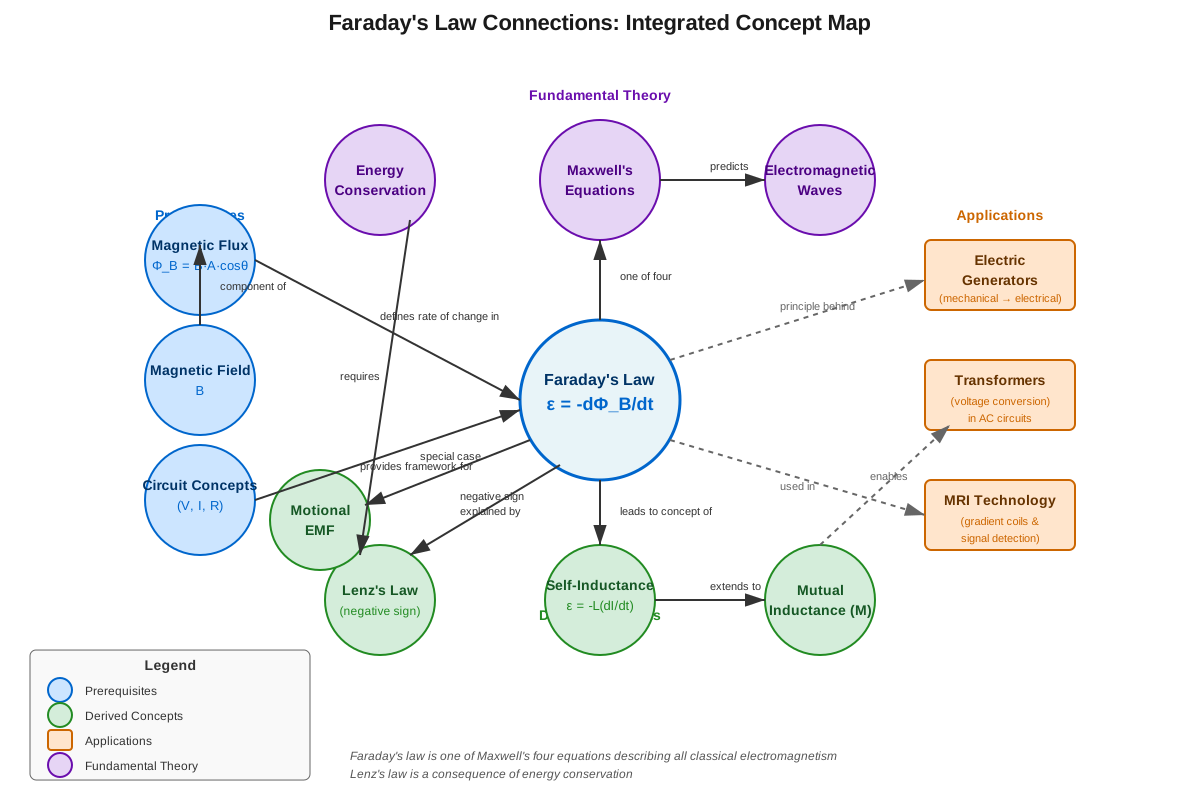
Faraday's law serves as the central organizing principle connecting multiple electromagnetic concepts. The law fundamentally depends on magnetic flux, which itself requires understanding of magnetic field vectors and geometric area vectors. The calculation of flux through vector dot products links back to prerequisite vector mathematics, while the time derivative operation connects to calculus fundamentals.
The relationship flows as: Magnetic field concepts → Magnetic flux definition → Faraday's law (flux change creates EMF) → Lenz's law (determines current direction) → Induced current effects → Energy conservation principles.
Lenz's law emerges as a direct consequence of Faraday's law's negative sign, providing the directional information that the magnitude-focused equation alone cannot supply. Together, these principles enable complete analysis of electromagnetic induction scenarios. The induced EMF drives current through circuits according to Ohm's law (I = ε/R), connecting electromagnetic induction to circuit analysis.
Motional EMF represents a special application of Faraday's law where geometric changes (moving conductors) cause flux variations. This concept bridges electromagnetic induction with mechanics, as moving conductors experience magnetic forces that oppose their motion. The interplay between mechanical work input and electrical power output demonstrates energy conservation, a unifying principle across all physics domains.
Looking forward, Faraday's law provides the foundation for understanding inductance (self-induced EMF opposing current changes), AC circuits (time-varying currents and voltages), transformers (mutual induction between coils), and electromagnetic waves (coupled electric and magnetic field oscillations). The principle that changing magnetic fields create electric fields represents half of Maxwell's equations, with the complementary principle (changing electric fields create magnetic fields) completing the electromagnetic theory that predicts light as an electromagnetic wave.
High-Yield Facts
⭐ Faraday's law states that induced EMF equals the negative rate of change of magnetic flux: ε = -dΦ_B/dt
⭐ Magnetic flux can change through three mechanisms: changing B-field strength, changing loop area, or changing orientation angle
⭐ Lenz's law (the negative sign) means induced currents always oppose the flux change that created them
⭐ For N-turn coils, induced EMF multiplies by N: ε = -N(dΦ_B/dt)
⭐ Motional EMF for a conductor moving perpendicular to a magnetic field: ε = BLv
- The SI unit of magnetic flux is the weber (Wb), equivalent to T·m²
- Induced EMF exists even in open circuits (no current flows, but potential difference exists)
- The direction of induced current follows from applying the right-hand rule to the opposing magnetic field required by Lenz's law
- Maximum flux occurs when the magnetic field is perpendicular to the loop surface (θ = 0°, cos(θ) = 1)
- Zero flux occurs when the magnetic field is parallel to the loop surface (θ = 90°, cos(θ) = 0)
- AC generators produce sinusoidally varying EMF because rotating coils experience sinusoidally varying flux: ε = NABω sin(ωt)
- The induced current magnitude depends on both the induced EMF and the circuit resistance: I = ε/R
- Faster flux changes produce larger induced EMF—doubling the rate of change doubles the EMF
- Electromagnetic induction converts mechanical energy to electrical energy in generators and electrical to mechanical in motors
Quick check — test yourself on Faraday law so far.
Try Flashcards →Common Misconceptions
Misconception: Induced EMF requires current to flow through the circuit.
Correction: Induced EMF exists whenever flux changes through a conducting loop, regardless of whether the circuit is complete. In an open circuit, EMF creates a potential difference across the gap, but no current flows. Current only flows when a complete conducting path exists, with magnitude determined by I = ε/R.
Misconception: The negative sign in Faraday's law is just a mathematical convention without physical meaning.
Correction: The negative sign embodies Lenz's law and represents a fundamental physical principle—energy conservation. If induced currents reinforced rather than opposed flux changes, systems would spontaneously accelerate, creating energy from nothing. The negative sign ensures that maintaining induced currents requires continuous energy input.
Misconception: Magnetic flux and magnetic field are the same thing.
Correction: Magnetic field (B) is a vector quantity measured in tesla that exists at each point in space. Magnetic flux (Φ_B) is a scalar quantity measured in webers that represents the total magnetic field passing through a surface area. Flux depends on both field strength and the area/orientation of the surface: Φ_B = BA cos(θ).
Misconception: Only changing magnetic fields can induce EMF.
Correction: Any mechanism that changes magnetic flux induces EMF. A conductor moving through a static, uniform magnetic field experiences induced EMF (motional EMF) because the flux through the circuit changes as the conductor sweeps out new area. The magnetic field itself remains constant, but the flux through the loop changes.
Misconception: Larger loops always have more induced EMF than smaller loops.
Correction: Induced EMF depends on the rate of flux change, not the absolute flux or loop size. A small loop in a rapidly changing magnetic field can have much larger induced EMF than a large loop in a slowly changing field. However, for the same rate of magnetic field change (dB/dt), larger loops do produce more EMF because ε = -A(dB/dt).
Misconception: The induced current direction can be determined from Faraday's law alone.
Correction: Faraday's law provides only the magnitude of induced EMF. Determining current direction requires Lenz's law: identify whether flux is increasing or decreasing, determine what magnetic field direction would oppose that change, then use the right-hand rule to find the current direction producing that opposing field.
Misconception: Motional EMF (ε = BLv) and Faraday's law are separate, unrelated principles.
Correction: Motional EMF is a special case of Faraday's law. When a conductor of length L moves with velocity v perpendicular to field B, it sweeps area at rate dA/dt = Lv. Applying Faraday's law: ε = -B(dA/dt) = -B(Lv) = BLv (the negative sign is incorporated into the direction determination via Lenz's law).
Worked Examples
Example 1: Calculating Induced EMF from Changing Magnetic Field
Problem: A circular coil with 50 turns has a radius of 0.10 m and lies flat on a table. A uniform magnetic field perpendicular to the coil increases steadily from 0.20 T to 0.80 T over 3.0 seconds. Calculate the magnitude of the induced EMF in the coil.
Solution:
Step 1: Identify the given information
- Number of turns: N = 50
- Radius: r = 0.10 m
- Initial magnetic field: B₁ = 0.20 T
- Final magnetic field: B₂ = 0.80 T
- Time interval: Δt = 3.0 s
- Field is perpendicular to coil, so θ = 0° and cos(θ) = 1
Step 2: Calculate the coil area
A = πr² = π(0.10 m)² = 0.0314 m²Step 3: Determine the change in magnetic flux
Since the field is perpendicular and area is constant, only B changes:
ΔΦ_B = AΔB = A(B₂ - B₁) = (0.0314 m²)(0.80 T - 0.20 T) = 0.0188 WbStep 4: Calculate the rate of flux change
dΦ_B/dt ≈ ΔΦ_B/Δt = 0.0188 Wb / 3.0 s = 0.00627 Wb/sStep 5: Apply Faraday's law for N turns
|ε| = N|dΦ_B/dt| = 50 × 0.00627 V = 0.31 VAnswer: The magnitude of induced EMF is 0.31 V or 310 mV.
Key Insights: This problem demonstrates the standard application of Faraday's law when magnetic field strength changes. The 50-turn coil amplifies the EMF by a factor of 50 compared to a single loop. The perpendicular orientation (θ = 0°) maximizes flux and simplifies calculations. On the MCAT, watch for whether the question asks for magnitude (ignore the negative sign) or direction (apply Lenz's law).
Example 2: Motional EMF and Lenz's Law Application
Problem: A metal rod of length 0.50 m moves at constant velocity 2.0 m/s perpendicular to its length through a uniform 0.40 T magnetic field directed into the page. The rod slides along two parallel conducting rails connected by a resistor, forming a complete circuit. (a) Calculate the induced EMF. (b) If the circuit resistance is 5.0 Ω, what is the induced current? (c) Determine the direction of current flow through the resistor. (d) What force must be applied to maintain constant velocity?
Solution:
Part (a): Calculate induced EMF
Using the motional EMF formula:
ε = BLv = (0.40 T)(0.50 m)(2.0 m/s) = 0.40 VPart (b): Calculate induced current
Apply Ohm's law:
I = ε/R = 0.40 V / 5.0 Ω = 0.080 A = 80 mAPart (c): Determine current direction
Step 1: As the rod moves right, the area of the circuit loop increases
Step 2: Since B points into the page and area increases, flux into the page increases
Step 3: By Lenz's law, induced current must create a magnetic field out of the page to oppose this increase
Step 4: Using the right-hand rule, current must flow counterclockwise in the loop
Step 5: Therefore, current flows from bottom to top through the moving rod, and from top to bottom through the resistor
Part (d): Calculate applied force
The current-carrying rod experiences a magnetic force opposing its motion:
F_magnetic = BIL = (0.40 T)(0.080 A)(0.50 m) = 0.016 NTo maintain constant velocity, the applied force must equal the magnetic force:
F_applied = 0.016 N (to the right)Answers: (a) 0.40 V, (b) 80 mA, (c) from top to bottom through the resistor, (d) 0.016 N to the right
Key Insights: This problem integrates multiple concepts: motional EMF, Lenz's law for direction, Ohm's law for current, and force analysis for energy considerations. The applied force does work at rate P = Fv = (0.016 N)(2.0 m/s) = 0.032 W, which equals the electrical power dissipated: P = I²R = (0.080 A)²(5.0 Ω) = 0.032 W, confirming energy conservation. MCAT questions often test whether students recognize that maintaining motion requires continuous work input, converting mechanical energy to electrical energy.
Exam Strategy
When approaching Faraday law MCAT questions, begin by identifying which type of electromagnetic induction scenario is presented. Look for trigger phrases: "changing magnetic field" suggests dB/dt problems, "moving conductor" or "sliding bar" indicates motional EMF, and "rotating coil" points to angular variation problems. Immediately sketch the situation, drawing the magnetic field direction, loop orientation, and any motion vectors—visual representation prevents directional errors.
For calculation problems, systematically work through the flux formula before applying Faraday's law. Write Φ_B = BA cos(θ) explicitly, identify which variables change with time, then take the derivative. Many students skip directly to memorized formulas like ε = BLv without recognizing when they apply, leading to errors. The general approach (start with Φ_B, identify what changes, apply ε = -dΦ_B/dt) works universally.
Direction questions require methodical application of Lenz's law. Create a mental checklist: (1) What is the original flux direction? (2) Is flux increasing or decreasing? (3) What magnetic field direction opposes this change? (4) What current direction produces that opposing field? Rushing through these steps causes the most common errors. Remember that "opposes the change" means opposing the increase if flux increases, or opposing the decrease if flux decreases—not simply opposing the original field.
Process-of-elimination strategies prove particularly effective for conceptual questions. If a question asks how induced EMF changes when a parameter doubles, eliminate answers that violate the mathematical relationships: doubling the number of turns doubles EMF, doubling the rate of change doubles EMF, but doubling the area only doubles EMF if dB/dt drives the change (not if rotation drives it). For direction questions, eliminate answers that violate energy conservation—induced effects must oppose changes, never reinforce them.
Time management for electromagnetic induction problems: straightforward calculation questions should take 60-90 seconds, while complex scenarios involving multiple steps or direction determination may require 90-120 seconds. If a problem requires both magnitude and direction, calculate magnitude first (faster, builds confidence) then tackle direction. If stuck on direction, make an educated guess and move on—direction questions often have 50/50 odds after eliminating obviously wrong answers.
Exam Tip: When questions present graphs of magnetic field versus time, the induced EMF at any moment equals the negative slope of the B(t) graph multiplied by NA. Constant slope means constant EMF; zero slope means zero EMF; steeper slope means larger EMF magnitude.
Memory Techniques
FARADAY mnemonic for problem-solving steps:
- Flux: Calculate or identify the magnetic flux expression
- Alter: Determine what changes with time (B, A, or θ)
- Rate: Find the rate of change (derivative)
- Apply: Use ε = -N(dΦ_B/dt)
- Direction: Apply Lenz's law for current direction
- Answer: Check units and reasonableness
- Yield: Connect to energy conservation if needed
"OPPOSE" for Lenz's law direction:
- Observe the original flux direction
- Pinpoint whether flux increases or decreases
- Predict the opposing field direction needed
- Orient your right hand for that field
- See which way your fingers curl (current direction)
- Evaluate: does this make physical sense?
Visualization strategy: Imagine the magnetic field lines as physical objects pushing through the loop. When more lines push through (increasing flux), the induced current creates a "magnetic shield" trying to block them. When lines withdraw (decreasing flux), the induced current creates a "magnetic pull" trying to hold them. This anthropomorphic visualization helps internalize Lenz's law's opposition principle.
Formula family tree: Remember that all electromagnetic induction formulas derive from ε = -dΦ_B/dt:
- For changing B: ε = -NA(dB/dt) [A and θ constant]
- For motional EMF: ε = BLv [derives from dA/dt = Lv]
- For rotating coil: ε = NABω sin(ωt) [derives from dθ/dt = ω]
Recognizing this family relationship prevents formula confusion and enables derivation if you forget a specific case.
Right-hand rule consistency: Always use the same right-hand rule convention. Recommended: thumb points in current direction, fingers curl in the direction of the magnetic field that current produces. Practice this with simple examples until it becomes automatic—inconsistent application causes most direction errors.
Summary
Faraday's law establishes that changing magnetic flux through a conducting loop induces an electromotive force proportional to the rate of flux change: ε = -dΦ_B/dt. This fundamental principle of electromagnetic induction explains how mechanical energy converts to electrical energy in generators and underlies technologies from transformers to MRI machines. Magnetic flux (Φ_B = BA cos θ) can change through varying magnetic field strength, loop area, or orientation angle, with each mechanism producing characteristic induced EMF patterns. Lenz's law, embodied in the negative sign, ensures that induced currents create magnetic fields opposing the flux change that produced them—a manifestation of energy conservation. For MCAT success, students must master both quantitative calculations using Faraday's law and qualitative reasoning about current direction using Lenz's law, recognizing that motional EMF represents a special case where geometric changes drive flux variation. The principle connects electromagnetic concepts to circuit analysis, mechanics, and energy conservation, making it a cornerstone of integrated physics reasoning tested on the exam.
Key Takeaways
- Faraday's law (ε = -dΦ_B/dt) quantifies electromagnetic induction: induced EMF equals the negative rate of magnetic flux change through a conducting loop
- Magnetic flux can change through three mechanisms: varying magnetic field strength (dB/dt), changing loop area (dA/dt), or rotating orientation (dθ/dt)
- Lenz's law (the negative sign) dictates that induced currents always oppose the flux change that created them, ensuring energy conservation
- Motional EMF (ε = BLv) for moving conductors derives from Faraday's law by recognizing that motion changes the flux through the circuit
- Multiple-turn coils amplify induced EMF by the number of turns: ε = -N(dΦ_B/dt)
- Direction determination requires systematic application: identify flux change direction, determine opposing field needed, apply right-hand rule for current
- Electromagnetic induction converts mechanical energy to electrical energy, with the magnetic force on induced currents opposing the motion that generates them
Related Topics
Inductance and Self-Induction: Faraday's law extends to self-inductance, where changing current in a coil induces EMF in that same coil, opposing current changes. This concept explains inductor behavior in AC circuits and energy storage in magnetic fields. Mastering Faraday's law provides the foundation for understanding how inductors resist current changes and store energy.
AC Circuits and Transformers: Alternating current systems rely fundamentally on electromagnetic induction, with transformers using mutual induction between coils to change voltage levels. Understanding Faraday's law enables analysis of how transformer turns ratios determine voltage transformation and why AC power transmission uses high voltages.
Maxwell's Equations and Electromagnetic Waves: Faraday's law represents one of Maxwell's four equations describing all electromagnetic phenomena. The principle that changing magnetic fields create electric fields, combined with the complementary principle that changing electric fields create magnetic fields, predicts electromagnetic wave propagation at the speed of light.
Magnetic Force and Lorentz Force: The magnetic force on current-carrying conductors (F = BIL) explains why induced currents experience forces opposing the motion that generates them. This connection between Faraday's law and magnetic force demonstrates energy conservation in electromagnetic systems.
Energy Conservation in Electromagnetic Systems: Analyzing the work-energy relationships in electromagnetic induction scenarios deepens understanding of how mechanical work converts to electrical energy and why Lenz's law must hold for energy conservation.
Practice CTA
Now that you've mastered the core concepts of Faraday's law, reinforce your understanding by working through practice questions and flashcards. Focus on problems requiring both calculation and direction determination, as these integrated questions most closely mirror MCAT format. Challenge yourself with scenarios involving multiple changing parameters or complex geometries—these advanced problems build the flexible reasoning skills needed for test day success. Remember that electromagnetic induction questions reward systematic problem-solving approaches: sketch the situation, identify what changes, apply Faraday's law methodically, and verify your answer makes physical sense. Your investment in practice now will pay dividends in confident, accurate performance on exam day!
Sign up free to keep reading
Create a free AnvayaPrep account to finish this MCAT guide on Faraday law — plus flashcards and practice questions.