Overview
Lenz's law is a fundamental principle in Electricity and Magnetism that describes the direction of induced currents and the resulting magnetic fields when magnetic flux through a circuit changes. Named after physicist Heinrich Lenz, this law is essentially a statement about energy conservation in electromagnetic systems. When a magnetic field through a conducting loop changes—whether by moving a magnet near the loop, changing the current in a nearby wire, or moving the loop itself—an electromotive force (EMF) is induced that drives a current. Lenz's law tells us that this induced current flows in a direction that creates a magnetic field opposing the change in flux that produced it. This opposition is not arbitrary; it reflects nature's tendency to resist changes in energy states and ensures that electromagnetic induction doesn't violate conservation of energy.
For the MCAT, understanding Lenz's law is essential because it bridges multiple concepts in Physics: Faraday's law of electromagnetic induction, magnetic fields, current direction, and energy conservation. The MCAT frequently tests students' ability to predict the direction of induced currents in various scenarios, from moving conductors through magnetic fields to changing current in transformers. Questions may appear as standalone discrete items or embedded within passages describing experimental setups, generators, or electromagnetic devices. The ability to quickly determine current direction using Lenz's law can be the difference between answering a question in 30 seconds versus struggling for two minutes.
The big-picture relationship connects Lenz's law to Faraday's law (which quantifies induced EMF), Ampère's law (which relates currents to magnetic fields), and the right-hand rules (which determine field and force directions). Together, these concepts form the foundation of electromagnetic induction, explaining how generators produce electricity, how transformers change voltage, and how eddy currents create damping forces. Mastering Lenz's law provides the conceptual framework for understanding any situation where changing magnetic fields interact with conductors—a scenario that appears repeatedly on the MCAT.
Learning Objectives
- [ ] Define Lenz's law using accurate Physics terminology
- [ ] Explain why Lenz's law matters for the MCAT
- [ ] Apply Lenz's law to exam-style questions
- [ ] Identify common mistakes related to Lenz's law
- [ ] Connect Lenz's law to related Physics concepts
- [ ] Predict the direction of induced current in a conducting loop given a changing magnetic flux
- [ ] Explain the relationship between Lenz's law and conservation of energy
- [ ] Determine the direction of induced magnetic fields using right-hand rules in conjunction with Lenz's law
Prerequisites
- Magnetic fields and field lines: Understanding that magnetic fields have direction and can be represented by field lines is essential for visualizing how induced fields oppose changes
- Current and conventional current flow: Knowing that current flows from positive to negative (conventional current) allows proper application of right-hand rules
- Faraday's law of electromagnetic induction: Lenz's law provides the direction (sign) for the EMF calculated using Faraday's law
- Right-hand rules: These rules determine the relationship between current direction and magnetic field direction, which is crucial for applying Lenz's law
- Magnetic flux: Understanding flux as the product of magnetic field, area, and the cosine of the angle between them is necessary to identify what "change" Lenz's law opposes
Why This Topic Matters
Lenz's law has profound real-world applications that extend from power generation to medical imaging. Every electrical generator—from massive hydroelectric turbines to small bicycle dynamos—relies on electromagnetic induction, and Lenz's law explains why mechanical work must be done to generate electricity. The opposing force predicted by Lenz's law is what makes generators harder to turn when they're producing more current. In medical applications, eddy currents (which follow Lenz's law) are used in magnetic braking systems and contribute to image contrast in MRI machines. Understanding Lenz's law also explains why metal detectors work and why dropping a magnet through a copper tube causes it to fall slowly—the induced currents create magnetic fields that oppose the motion.
On the MCAT, Lenz's law appears with moderate frequency, typically in 2-4 questions per exam. These questions most commonly appear in the Chemical and Physical Foundations of Biological Systems section, either as discrete questions or within passages describing experimental apparatus, generators, or electromagnetic phenomena. The MCAT favors conceptual understanding over complex calculations, so questions typically ask students to predict current direction, explain why induced currents oppose changes, or identify which way a conductor will move in a magnetic field. Passage-based questions might describe a research setup involving changing magnetic fields and ask students to predict experimental outcomes based on Lenz's law.
Common question formats include: determining the direction of induced current when a magnet approaches or recedes from a loop; predicting which way a conducting loop will rotate when placed in a changing magnetic field; explaining why a falling magnet slows down when passing through a conducting tube; and identifying the direction of force on a conductor moving through a magnetic field. The MCAT particularly likes questions that combine Lenz's law with energy conservation, asking students to explain why work must be done to induce current or why induced currents always oppose the change that created them.
Core Concepts
Fundamental Statement of Lenz's Law
Lenz's law states that the direction of an induced current in a conductor is such that the magnetic field created by the induced current opposes the change in magnetic flux that produced it. This can be expressed mathematically as a negative sign in Faraday's law:
ε = -N(dΦ_B/dt)Where ε is the induced EMF, N is the number of turns in the coil, and dΦ_B/dt is the rate of change of magnetic flux. The negative sign is the mathematical representation of Lenz's law—it indicates that the induced EMF creates a current whose magnetic field opposes the flux change.
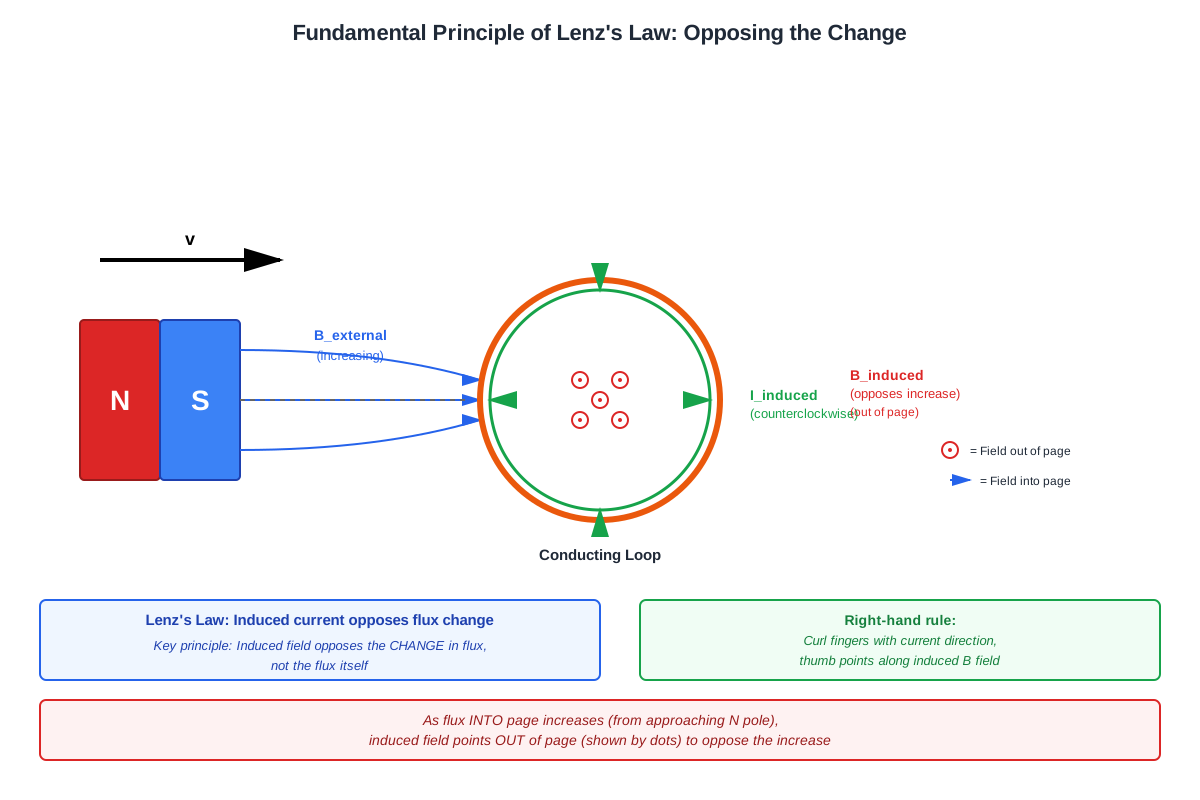
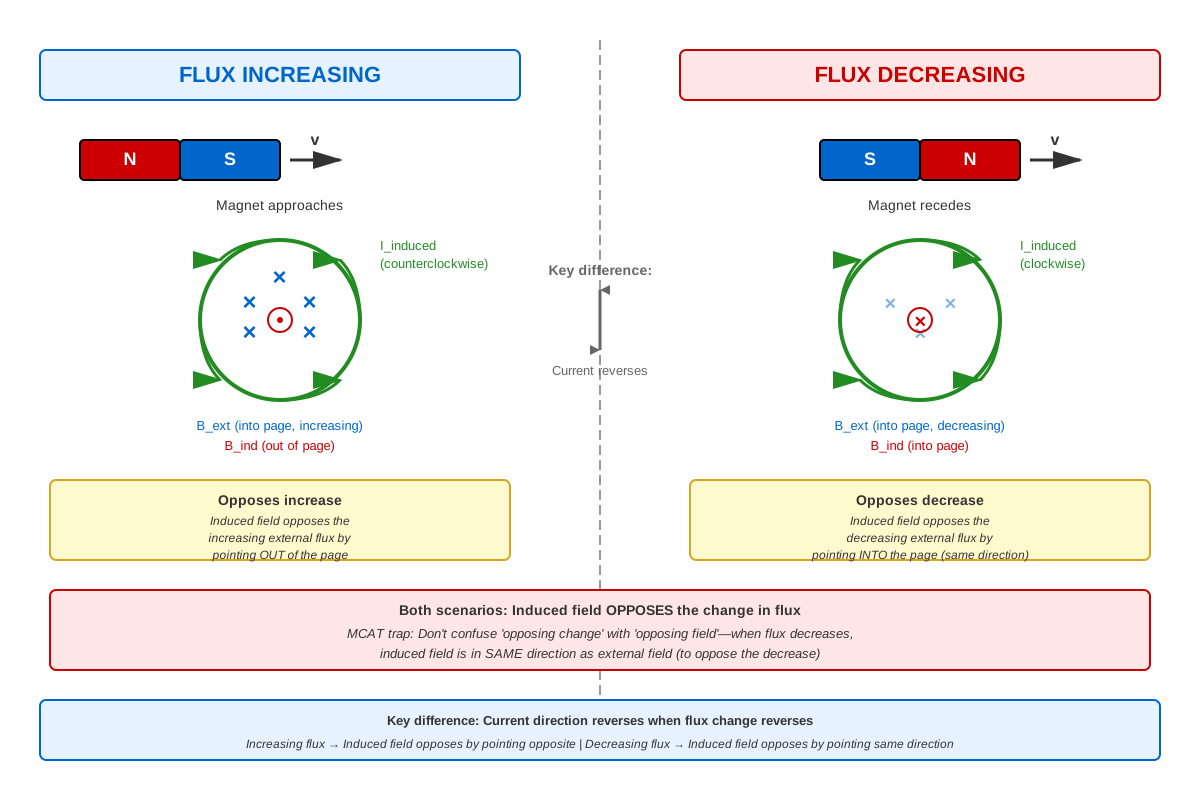
The key word in Lenz's law is "opposes." The induced current doesn't oppose the magnetic field itself; it opposes the change in magnetic flux. If flux is increasing, the induced current creates a magnetic field in the opposite direction to reduce the net flux. If flux is decreasing, the induced current creates a magnetic field in the same direction to maintain the flux. This opposition is a direct consequence of energy conservation—if induced currents reinforced the change instead of opposing it, we could create energy from nothing, violating the first law of thermodynamics.
Magnetic Flux and Its Changes
Magnetic flux (Φ_B) quantifies the amount of magnetic field passing through a surface and is calculated as:
Φ_B = B·A·cos(θ)Where B is the magnetic field strength, A is the area of the surface, and θ is the angle between the magnetic field and the normal (perpendicular) to the surface. Magnetic flux can change in three ways:
- Changing magnetic field strength (B changes): Moving a magnet closer to or farther from a loop changes the field strength through the loop
- Changing area (A changes): Expanding or contracting a loop in a magnetic field changes the flux
- Changing orientation (θ changes): Rotating a loop in a magnetic field changes the angle and thus the flux
For Lenz's law applications, identifying which of these changes is occurring helps determine how the induced current will respond. The induced current always acts to counteract whichever change is happening.
Applying Lenz's Law: Step-by-Step Process
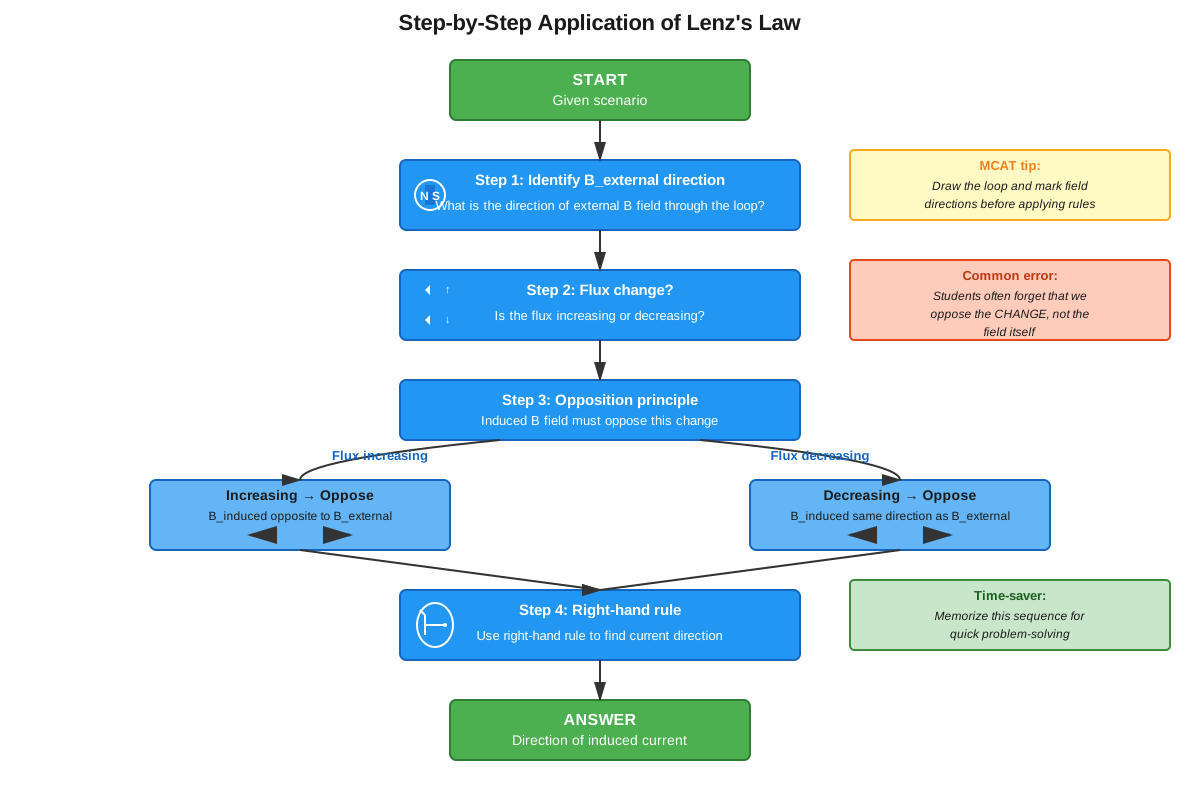
To determine the direction of induced current using Lenz's law, follow this systematic approach:
- Identify the initial magnetic flux direction through the conducting loop (into or out of the page, up or down, etc.)
- Determine whether flux is increasing or decreasing (or if a new flux is being introduced)
- Determine the direction of the induced magnetic field that would oppose this change:
- If flux is increasing, the induced field points opposite to the original field
- If flux is decreasing, the induced field points in the same direction as the original field
- Use the right-hand rule to find the current direction that produces this induced field:
- Curl fingers in the direction of current flow
- Thumb points in the direction of the magnetic field created by that current
- Verify that this current direction creates opposition to the flux change
Connection to Energy Conservation
Lenz's law is fundamentally a statement about energy conservation in electromagnetic systems. When a conductor moves through a magnetic field or experiences a changing flux, work must be done to induce current. The induced current creates a magnetic field that opposes the motion or change, meaning an external force must do work against this opposition. This work is converted into electrical energy in the conductor.
Consider a magnet falling through a copper tube: as the magnet falls, it induces currents in the tube walls (called eddy currents). By Lenz's law, these currents create magnetic fields that oppose the magnet's motion—the induced field above the magnet attracts it upward, while the induced field below repels it upward. The magnet experiences an upward force that slows its fall. The gravitational potential energy lost by the slower fall is converted into electrical energy (heating the copper tube through resistance). If Lenz's law didn't create this opposition, the magnet would fall at normal speed while also generating electrical energy, creating energy from nothing.
Lenz's Law and Faraday's Law Integration
While Faraday's law tells us the magnitude of induced EMF, Lenz's law provides the direction. Together, they completely describe electromagnetic induction:
ε = -N(dΦ_B/dt)The magnitude |dΦ_B/dt| tells us how strong the induced EMF will be—faster changes in flux produce larger EMF. The negative sign (Lenz's law) tells us the EMF's polarity—it drives current in a direction that opposes the flux change. For MCAT purposes, questions typically focus on the directional aspect (Lenz's law) rather than calculating exact EMF values, though understanding both components demonstrates complete mastery.
Practical Applications and Examples
| Scenario | Flux Change | Induced Current Direction | Result |
|---|---|---|---|
| Magnet north pole approaches loop | Increasing flux into page | Counterclockwise (viewed from magnet) | Creates field out of page to oppose increase |
| Magnet north pole recedes from loop | Decreasing flux into page | Clockwise (viewed from magnet) | Creates field into page to oppose decrease |
| Loop pulled out of magnetic field | Decreasing flux | Current flows to create field in original direction | Opposes flux reduction |
| Current in nearby wire increases | Increasing flux from wire's field | Current flows to create opposing field | Reduces net flux change |
Understanding these scenarios helps develop intuition for Lenz's law applications on the MCAT, where visual representations of magnetic field changes are common.
Concept Relationships
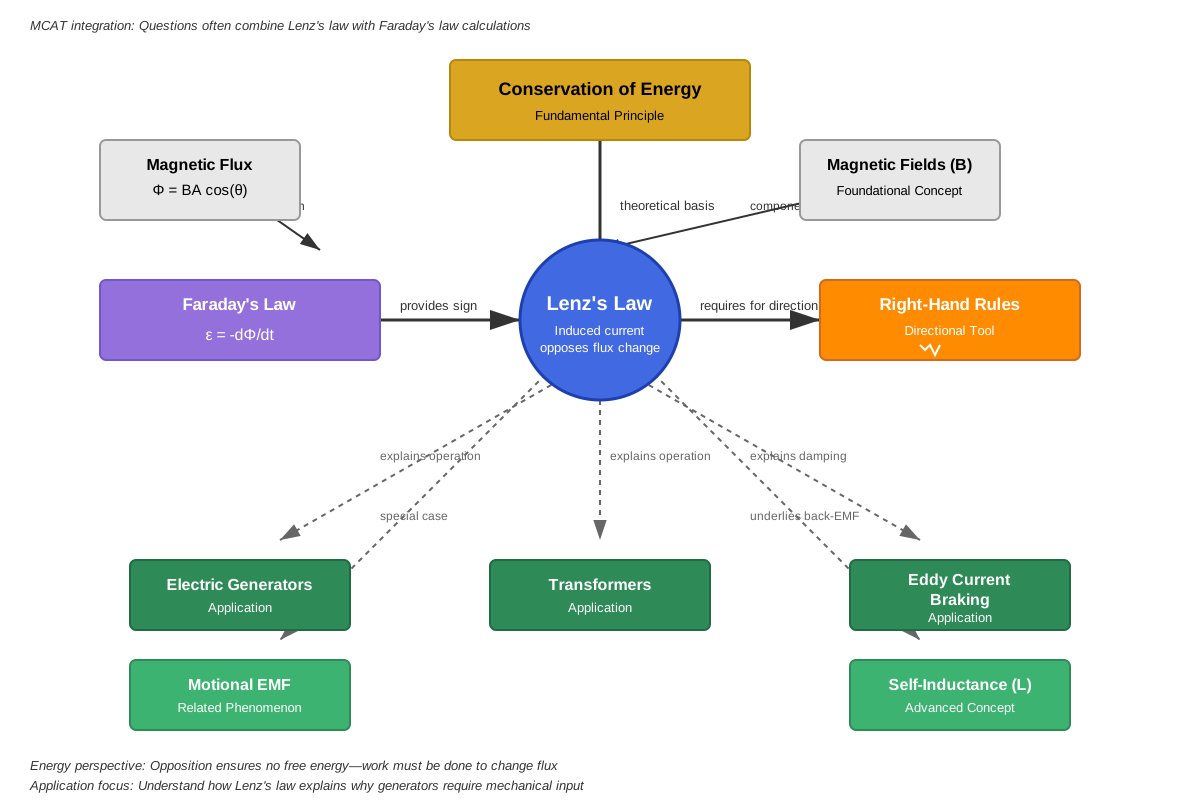
Lenz's law sits at the intersection of multiple electromagnetic concepts, serving as the directional component of Faraday's law while relying on understanding of magnetic fields, current, and energy conservation. The relationship flow works as follows:
Magnetic flux (Φ_B = B·A·cos θ) → Change in flux (dΦ_B/dt) → Faraday's law (ε = -N dΦ_B/dt) → Lenz's law (negative sign indicates opposition) → Induced current direction → Induced magnetic field (via Ampère's law and right-hand rules) → Opposition to original change (energy conservation)
The connection to prerequisite topics is essential: Right-hand rules provide the tool for determining field direction from current direction (or vice versa), which is necessary for applying Lenz's law. Magnetic field concepts establish what field lines look like and how they interact, providing the visual framework for understanding flux changes. Current flow understanding ensures correct application of right-hand rules and proper identification of which way charges move.
Lenz's law also connects forward to more advanced topics: Transformers rely on Lenz's law to explain why changing current in the primary coil induces current in the secondary coil. Generators and motors both involve Lenz's law—generators convert mechanical energy to electrical energy through electromagnetic induction (with Lenz's law explaining the resistance to rotation), while motors do the reverse. Eddy currents are a direct application of Lenz's law in bulk conductors, explaining magnetic braking and induction heating.
The relationship to energy conservation is bidirectional: Lenz's law can be derived from energy conservation principles, and conversely, Lenz's law ensures that electromagnetic induction doesn't violate energy conservation. This makes Lenz's law a powerful tool for checking whether a proposed current direction makes physical sense—if the induced current would reinforce rather than oppose the change, energy conservation is violated, and the answer must be wrong.
High-Yield Facts
⭐ Lenz's law states that induced currents flow in a direction that opposes the change in magnetic flux that produced them, never reinforcing the change
⭐ The negative sign in Faraday's law (ε = -N dΦ_B/dt) is the mathematical expression of Lenz's law
⭐ If magnetic flux through a loop is increasing, the induced current creates a magnetic field opposing (pointing opposite to) the increasing flux
⭐ If magnetic flux through a loop is decreasing, the induced current creates a magnetic field in the same direction as the decreasing flux to oppose its reduction
⭐ Lenz's law is a direct consequence of energy conservation—if induced currents reinforced changes instead of opposing them, perpetual motion machines would be possible
- When a magnet's north pole approaches a conducting loop, the induced current creates a north pole facing the approaching magnet (repulsion)
- When a magnet's north pole recedes from a conducting loop, the induced current creates a south pole facing the receding magnet (attraction)
- Eddy currents in conductors always flow in directions that oppose the motion causing them, creating a damping force
- The mechanical work required to move a conductor through a magnetic field equals the electrical energy generated plus energy lost to resistance
- In a generator, Lenz's law explains why the generator becomes harder to turn when more current is drawn from it—the induced current creates forces opposing the rotation
Quick check — test yourself on Lenz law so far.
Try Flashcards →Common Misconceptions
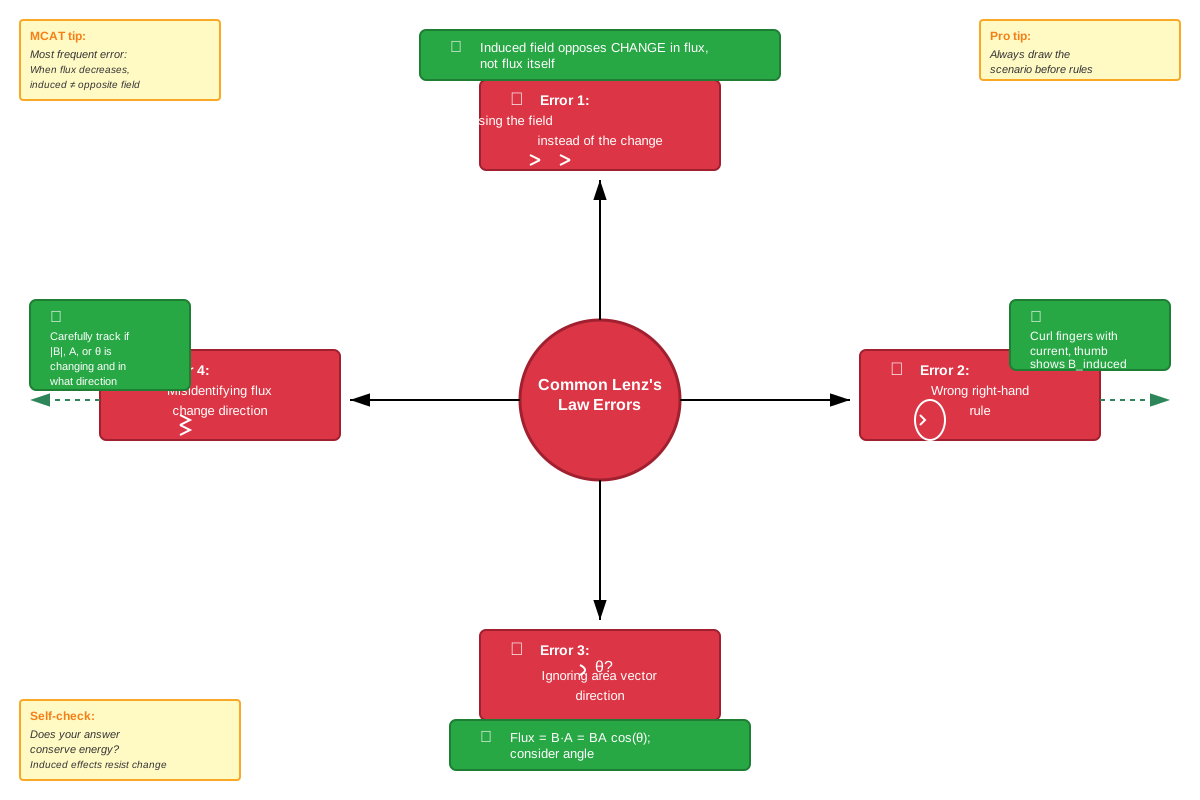
Misconception: Lenz's law means induced currents oppose the magnetic field itself.
Correction: Induced currents oppose the change in magnetic flux, not the field itself. If flux is decreasing, the induced current actually creates a field in the same direction as the original field to oppose the decrease.
Misconception: The negative sign in Faraday's law is just a mathematical convention without physical meaning.
Correction: The negative sign is the mathematical representation of Lenz's law and has profound physical significance—it ensures energy conservation and determines the actual direction of induced current.
Misconception: When a magnet approaches a loop, the induced current always flows clockwise.
Correction: Current direction depends on which pole approaches and from which side you're viewing the loop. The induced current creates a magnetic field opposing the flux change, which requires careful application of right-hand rules to determine the specific current direction.
Misconception: Lenz's law only applies to loops of wire, not to solid conductors.
Correction: Lenz's law applies to any conductor experiencing changing magnetic flux. In solid conductors, it explains eddy currents—circulating currents within the bulk material that oppose flux changes.
Misconception: If you move a conductor through a magnetic field faster, Lenz's law creates a stronger opposing force that prevents any increase in induced current.
Correction: While Lenz's law does create an opposing force, moving faster increases both the induced EMF (by Faraday's law) and the induced current. The opposing force increases, but doesn't completely prevent the increase in current—it just means more mechanical work is required.
Misconception: Lenz's law and Faraday's law are separate, unrelated principles.
Correction: Lenz's law is actually part of Faraday's law—specifically, it's what the negative sign represents. They're two aspects of the same phenomenon: Faraday's law gives the magnitude of induced EMF, while Lenz's law gives its direction.
Worked Examples
Example 1: Magnet Approaching a Conducting Loop
Problem: A bar magnet with its north pole facing downward is dropped toward a horizontal conducting loop lying on a table. As the magnet approaches the loop, determine: (a) the direction of the induced current in the loop as viewed from above, and (b) whether the loop experiences an upward or downward magnetic force.
Solution:
Step 1: Identify the initial flux and its change
The north pole of the magnet points downward, so magnetic field lines emerge from the north pole and point downward through the loop. As the magnet approaches, the magnetic field strength through the loop increases, so flux pointing downward is increasing.
Step 2: Determine the direction of induced magnetic field
By Lenz's law, the induced current must create a magnetic field that opposes this increase in downward flux. Therefore, the induced magnetic field must point upward (opposite to the increasing downward flux).
Step 3: Apply right-hand rule to find current direction
To create an upward magnetic field through the loop, use the right-hand rule: if the thumb points upward (direction of induced field), the fingers curl in the direction of current flow. Viewed from above, the current flows counterclockwise.
Step 4: Determine force on loop
The induced current creates an upward-pointing magnetic field, which means the loop acts like a magnet with its north pole facing upward. Since the approaching magnet has its north pole facing downward, the two north poles repel. The loop experiences an upward force (and by Newton's third law, the falling magnet experiences a downward force greater than just gravity alone... wait, that's wrong—the magnet experiences an upward force opposing its fall).
Answer: (a) Counterclockwise when viewed from above; (b) The loop experiences a downward force (attracted toward the approaching magnet), but more importantly, the magnet experiences an upward force that opposes its fall.
Connection to learning objectives: This example demonstrates applying Lenz's law to predict current direction and connects to energy conservation—the magnet's kinetic energy is partially converted to electrical energy, slowing its fall.
Example 2: Loop Pulled from Magnetic Field
Problem: A rectangular conducting loop is partially inside a uniform magnetic field pointing into the page. The loop is pulled to the right, out of the field region, at constant velocity. Determine: (a) the direction of induced current in the loop, (b) the direction of force on the loop due to the induced current, and (c) explain why work must be done to pull the loop at constant velocity.
Solution:
Step 1: Identify flux change
Initially, the left portion of the loop is in the magnetic field (into the page), while the right portion is outside the field. As the loop moves right, less area remains in the field, so the magnetic flux through the loop (into the page) is decreasing.
Step 2: Apply Lenz's law
The flux into the page is decreasing. By Lenz's law, the induced current must create a magnetic field into the page to oppose this decrease (to try to maintain the flux).
Step 3: Determine current direction
Using the right-hand rule: to create a magnetic field into the page, curl fingers into the page, and the thumb indicates current direction. The current flows clockwise around the loop (when viewing the page from the front): down on the left side, right along the bottom, up on the right side, and left along the top.
Step 4: Determine force direction
The left side of the loop (where current flows downward) is still in the magnetic field. Using the force equation F = IL × B (or the right-hand rule for force), with current flowing downward and field into the page, the force points to the left—opposing the rightward motion.
Step 5: Explain work requirement
To pull the loop at constant velocity, an external force must exactly balance the leftward magnetic force. This external force does work over the distance the loop moves. This work is converted into electrical energy (the induced current) and eventually thermal energy (due to resistance in the loop). This demonstrates energy conservation and Lenz's law—the induced current creates a force opposing the motion, ensuring that mechanical work is required to generate electrical energy.
Answer: (a) Clockwise (viewed from front); (b) Leftward (opposing the rightward pull); (c) Work must be done to overcome the magnetic force that opposes the motion, converting mechanical energy into electrical energy, consistent with Lenz's law and energy conservation.
Connection to learning objectives: This example shows how Lenz's law connects to energy conservation and demonstrates the systematic application of right-hand rules to determine both current and force directions.
Exam Strategy
When approaching MCAT questions on Lenz's law, follow this strategic framework:
Trigger words to watch for: "induced current," "changing magnetic field," "moving conductor," "approaching magnet," "increasing/decreasing flux," "direction of current," "opposes," and "electromagnetic induction." These phrases signal that Lenz's law is relevant. Also watch for descriptions of generators, transformers, or any scenario involving time-varying magnetic fields.
Systematic approach:
- Sketch the situation if not provided—draw the loop, magnetic field direction, and motion
- Identify what's changing: Is B changing? Is area changing? Is angle changing?
- Determine if flux is increasing or decreasing (or being introduced/removed)
- Apply Lenz's law: Induced field opposes the change
- Use right-hand rules to convert field direction to current direction
- Double-check by verifying that your answer creates opposition, not reinforcement
Process of elimination tips:
- Eliminate any answer choice where the induced current would reinforce the flux change—this violates Lenz's law and energy conservation
- If an answer suggests no current is induced when flux is clearly changing, eliminate it
- If an answer suggests the induced force aids the motion causing induction, eliminate it (Lenz's law always creates opposition)
- For questions about energy, eliminate answers that suggest energy is created from nothing or that no work is required when current is induced
Time allocation: Most Lenz's law questions can be answered in 45-60 seconds once you've mastered the systematic approach. If you find yourself spending more than 90 seconds, you may be overcomplicating the problem—return to the basic principle that induced currents oppose changes. Don't waste time calculating exact EMF values unless explicitly asked; the MCAT typically tests conceptual understanding of direction rather than quantitative calculations.
Common question variations:
- Direction questions: "Which direction does current flow?" → Apply the systematic approach above
- Force questions: "What force does the loop experience?" → Find current direction first, then apply F = IL × B
- Energy questions: "Why must work be done?" → Invoke Lenz's law and energy conservation
- Comparison questions: "What happens when the magnet moves faster?" → Faster change means larger EMF and current, but still opposing
Exam Tip: If you're stuck between two current directions, ask yourself: "Which direction would create a magnetic field that opposes the change?" The answer that creates opposition is always correct for Lenz's law questions.
Memory Techniques
Mnemonic for Lenz's Law: "Lenz Opposes Change" → LOC (like "lock" the change in place)
Visualization strategy: Imagine magnetic flux as water flowing through a loop. When you try to increase the water flow, the loop "fights back" by creating a current that pushes water the opposite direction. When you try to decrease the flow, the loop "fights back" by creating a current that pulls water in the same direction. The loop always resists your attempt to change the flow.
Right-hand rule integration:
- Thumb = magnetic field direction created by current
- Fingers = current direction
- Palm = pushes in the direction of force on positive charges
For Lenz's law specifically: Point your thumb in the direction the induced field needs to point (to oppose the change), and your fingers curl in the direction current must flow.
The "Lazy Loop" memory device: Think of the conducting loop as "lazy"—it doesn't want anything to change. If you try to increase flux through it, it creates a current that says "no, less flux!" If you try to decrease flux, it creates a current that says "no, more flux!" The loop always opposes your efforts.
Acronym for systematic approach: FIDOC
- Flux: Identify the magnetic flux direction
- Increase or decrease: Determine if flux is increasing or decreasing
- Direction: Determine induced field direction (opposes change)
- Orient: Use right-hand rule to find current direction
- Check: Verify opposition to change
Energy conservation reminder: "LENZ = LESS ENERGY NONSENSE" → Lenz's law prevents energy from being created from nothing by ensuring induced effects oppose their causes.
Summary
Lenz's law is a fundamental principle stating that induced currents flow in directions that create magnetic fields opposing the changes in flux that produced them. This opposition is mathematically represented by the negative sign in Faraday's law and physically represents energy conservation in electromagnetic systems. When magnetic flux through a conducting loop changes—whether through changing field strength, changing loop area, or changing orientation—an EMF is induced that drives current in a direction determined by Lenz's law. If flux is increasing, the induced current creates a field opposing (pointing opposite to) that increase; if flux is decreasing, the induced current creates a field in the same direction to oppose the decrease. This principle explains why mechanical work must be done to generate electrical energy, why magnets fall slowly through conducting tubes, and why generators become harder to turn when producing more current. For the MCAT, mastering Lenz's law requires understanding the systematic approach: identify the flux change, determine the induced field direction that opposes it, and use right-hand rules to find the current direction. This conceptual understanding, combined with recognition that Lenz's law ensures energy conservation, provides the foundation for answering any electromagnetic induction question on the exam.
Key Takeaways
- Lenz's law states that induced currents always flow in directions that oppose the change in magnetic flux that created them, never reinforcing the change
- The negative sign in Faraday's law (ε = -N dΦ_B/dt) is the mathematical expression of Lenz's law and represents energy conservation
- To apply Lenz's law: identify the flux change → determine the induced field direction that opposes it → use right-hand rules to find current direction
- Lenz's law is a consequence of energy conservation—if induced currents reinforced changes, perpetual motion would be possible
- Induced currents create forces that oppose the motion or change causing the induction, explaining why work must be done to generate electricity
- When flux is increasing, induced current creates a field pointing opposite to the flux; when flux is decreasing, induced current creates a field in the same direction as the flux
- Lenz's law applies to all conductors experiencing changing flux, from wire loops to bulk conductors (eddy currents)
Related Topics
Faraday's Law of Electromagnetic Induction: Quantifies the magnitude of induced EMF as the rate of change of magnetic flux; Lenz's law provides the direction component, making these two laws complementary aspects of electromagnetic induction.
Motional EMF: Describes EMF induced in a conductor moving through a magnetic field; Lenz's law determines the direction of induced current and the resulting force opposing motion.
Transformers: Devices that use electromagnetic induction to change voltage levels; understanding Lenz's law explains why changing current in the primary coil induces current in the secondary coil and why energy is conserved in the process.
Generators and Motors: Generators convert mechanical energy to electrical energy through electromagnetic induction (with Lenz's law explaining the resistance to rotation), while motors reverse this process; mastering Lenz's law enables understanding of both devices.
Eddy Currents: Circulating currents induced in bulk conductors by changing magnetic fields; Lenz's law explains why these currents create forces opposing the motion that induced them, leading to applications in magnetic braking and induction heating.
Practice CTA
Now that you've mastered the core concepts of Lenz's law, it's time to solidify your understanding through active practice. Work through the practice questions to test your ability to predict current directions, explain energy conservation in electromagnetic systems, and apply the systematic approach to various scenarios. Use the flashcards to reinforce high-yield facts and ensure you can quickly recall the key principles under exam conditions. Remember: Lenz's law questions are highly predictable once you've internalized the opposition principle—every practice problem you complete builds the pattern recognition that will make test-day questions feel familiar and manageable. You've got this!
Sign up free to keep reading
Create a free AnvayaPrep account to finish this MCAT guide on Lenz law — plus flashcards and practice questions.