Overview
Magnetic fields represent one of the fundamental forces in nature and constitute a critical component of the MCAT Physics curriculum within Electricity and Magnetism. Understanding magnetic fields requires mastery of vector concepts, force interactions, and the relationship between electricity and magnetism—topics that frequently appear in both standalone questions and passage-based items on the exam. A magnetic field is a vector field that describes the magnetic influence on moving electric charges, electric currents, and magnetic materials, and it serves as the foundation for understanding electromagnetic induction, motors, generators, and numerous medical imaging technologies.
For MCAT preparation, magnetic fields bridge multiple physics concepts including electrostatics, circuits, and electromagnetic waves. The exam tests not only computational skills involving magnetic force calculations but also conceptual understanding of field direction, the behavior of charged particles in magnetic fields, and the right-hand rules that govern these interactions. Students must be comfortable visualizing three-dimensional field configurations and applying vector cross products to determine force directions—skills that distinguish high-scoring test-takers from those who struggle with Magnetic fields Physics applications.
The relevance of Magnetic fields MCAT content extends beyond pure physics into practical medical applications. Magnetic Resonance Imaging (MRI), one of medicine's most powerful diagnostic tools, relies entirely on the principles of magnetic fields interacting with hydrogen nuclei in the body. Transcranial magnetic stimulation (TMS) for treating depression, mass spectrometry for analyzing biological molecules, and cyclotrons for producing medical isotopes all depend on magnetic field principles. This real-world applicability makes magnetic fields a high-yield topic that connects physics knowledge to clinical reasoning—exactly the type of integration the MCAT emphasizes.
Learning Objectives
- [ ] Define magnetic fields using accurate Physics terminology
- [ ] Explain why magnetic fields matter for the MCAT
- [ ] Apply magnetic fields to exam-style questions
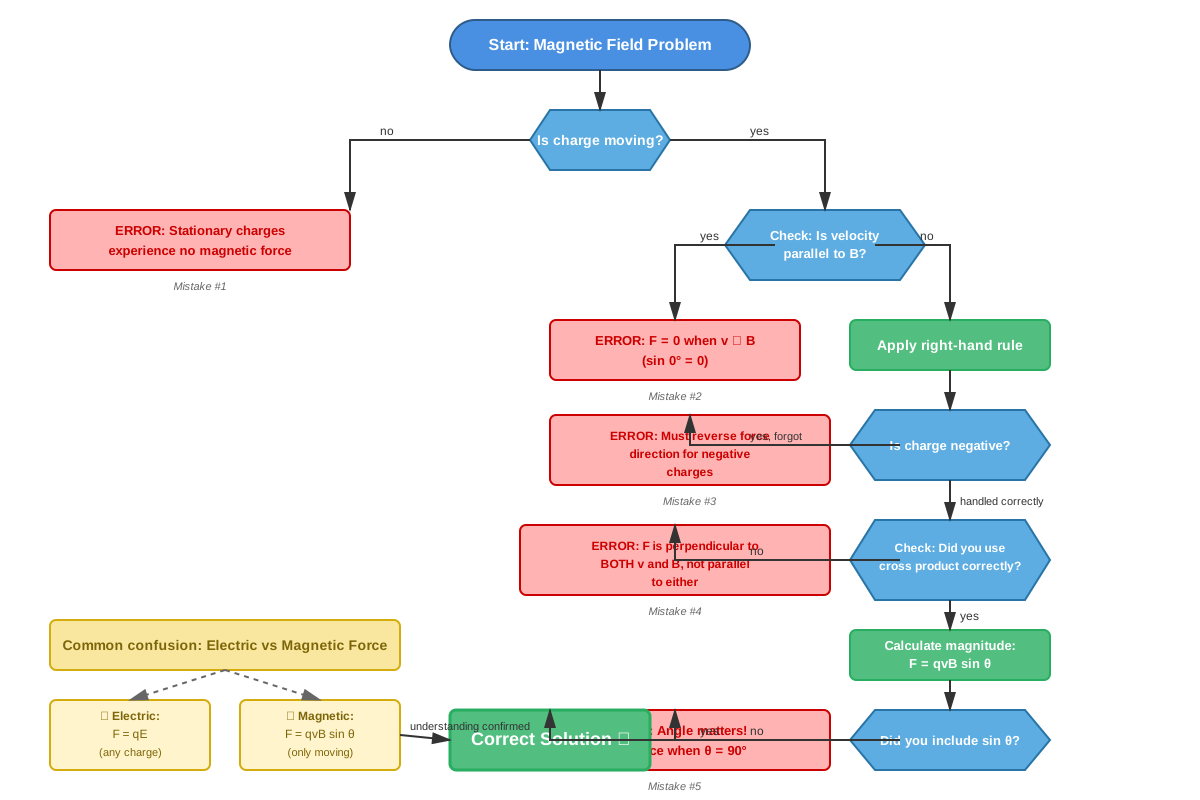
- [ ] Identify common mistakes related to magnetic fields
- [ ] Connect magnetic fields to related Physics concepts
- [ ] Calculate magnetic forces on moving charges and current-carrying wires using appropriate formulas
- [ ] Apply right-hand rules to determine the direction of magnetic fields and forces in three-dimensional space
- [ ] Analyze the motion of charged particles in uniform magnetic fields, including circular and helical trajectories
Prerequisites
- Vector operations and cross products: Magnetic forces involve vector cross products, requiring comfort with vector multiplication and three-dimensional spatial reasoning
- Electric charges and Coulomb's Law: Understanding charge interactions provides the foundation for comprehending how moving charges create and respond to magnetic fields
- Electric current and circuits: Current is moving charge, and magnetic fields interact fundamentally with currents in wires and circuits
- Newton's Laws of Motion: Analyzing particle trajectories in magnetic fields requires applying F = ma and circular motion principles
- Trigonometry and geometry: Calculating force components and understanding field orientations demands solid trigonometric skills
Why This Topic Matters
Magnetic fields appear consistently on the MCAT, typically in 2-4 questions per exam across both standalone items and passage-based questions. The Chemical and Physical Foundations of Biological Systems section frequently integrates magnetic field concepts with biological applications, particularly in passages describing medical imaging technology, particle separation techniques, or electromagnetic phenomena in physiological systems. Questions may ask students to calculate forces, predict particle trajectories, determine field directions, or explain the operating principles of devices like mass spectrometers or cyclotrons.
Clinically, magnetic fields underpin several revolutionary medical technologies. MRI scanners use powerful magnetic fields (1.5-3 Tesla for clinical machines) to align hydrogen protons in tissues, then detect their relaxation signals to create detailed anatomical images without ionizing radiation. Understanding how charged particles behave in magnetic fields explains how mass spectrometry separates ions by mass-to-charge ratio, enabling protein identification and drug analysis. Transcranial magnetic stimulation uses rapidly changing magnetic fields to induce electrical currents in specific brain regions, treating depression and mapping brain function. Even the Earth's magnetic field affects biological systems, with some organisms using magnetoreception for navigation.
The MCAT particularly favors questions that require spatial reasoning and application of right-hand rules—skills that cannot be memorized but must be practiced. Passages often present novel scenarios involving magnetic fields, testing whether students can transfer fundamental principles to unfamiliar contexts. This makes magnetic fields an excellent discriminator between students who have developed true conceptual mastery versus those who have merely memorized formulas. The topic also frequently appears in interdisciplinary contexts, connecting physics to chemistry (mass spectrometry), biology (biomagnetism), and medicine (imaging technology).
Core Concepts
Definition and Properties of Magnetic Fields
A magnetic field (symbol B) is a vector field that exerts forces on moving electric charges and magnetic dipoles. The SI unit of magnetic field strength is the tesla (T), though the smaller unit gauss (G) is sometimes used (1 T = 10,000 G). Magnetic fields are produced by moving charges (electric currents), changing electric fields, and the intrinsic magnetic moments of elementary particles. Unlike electric fields, which can be produced by stationary charges, magnetic fields require motion or intrinsic spin.
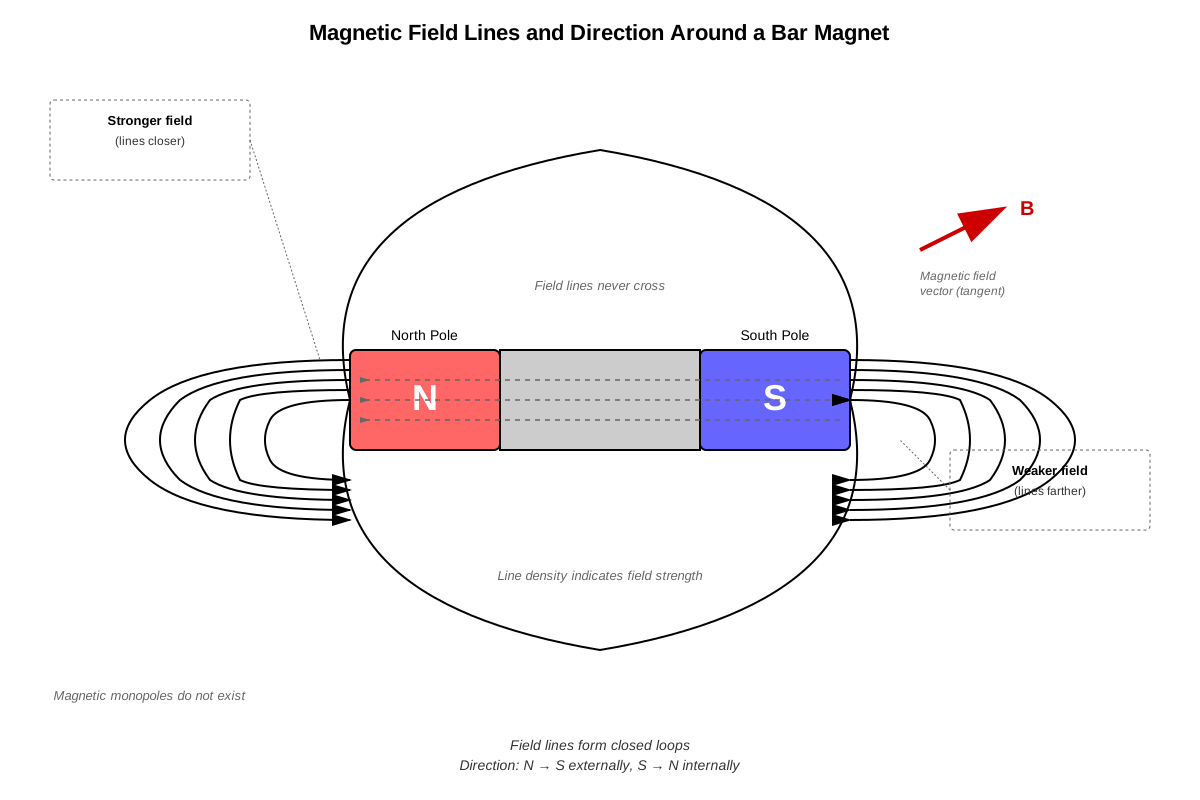
Magnetic field lines represent the direction a north magnetic pole would experience force. These lines always form closed loops—they emerge from north poles and enter south poles, but unlike electric field lines, they never begin or end at a point. This reflects a fundamental property: magnetic monopoles (isolated north or south poles) have never been observed in nature. Every magnet has both a north and south pole, and cutting a magnet in half produces two smaller magnets, each with both poles.
The strength of a magnetic field determines the magnitude of force it can exert on moving charges. Earth's magnetic field is approximately 0.5 gauss (5 × 10⁻⁵ T), while a refrigerator magnet produces about 100 gauss (0.01 T), and clinical MRI machines operate at 1.5-3 T. The strongest continuous magnetic fields produced in laboratories exceed 40 T, while pulsed fields can briefly reach over 100 T.
Magnetic Force on Moving Charges
The fundamental equation governing magnetic forces on moving charges is the Lorentz force law:
F = qvB sin(θ)Where:
- F = magnetic force (newtons)
- q = charge magnitude (coulombs)
- v = velocity of the charge (m/s)
- B = magnetic field strength (tesla)
- θ = angle between velocity vector and magnetic field vector
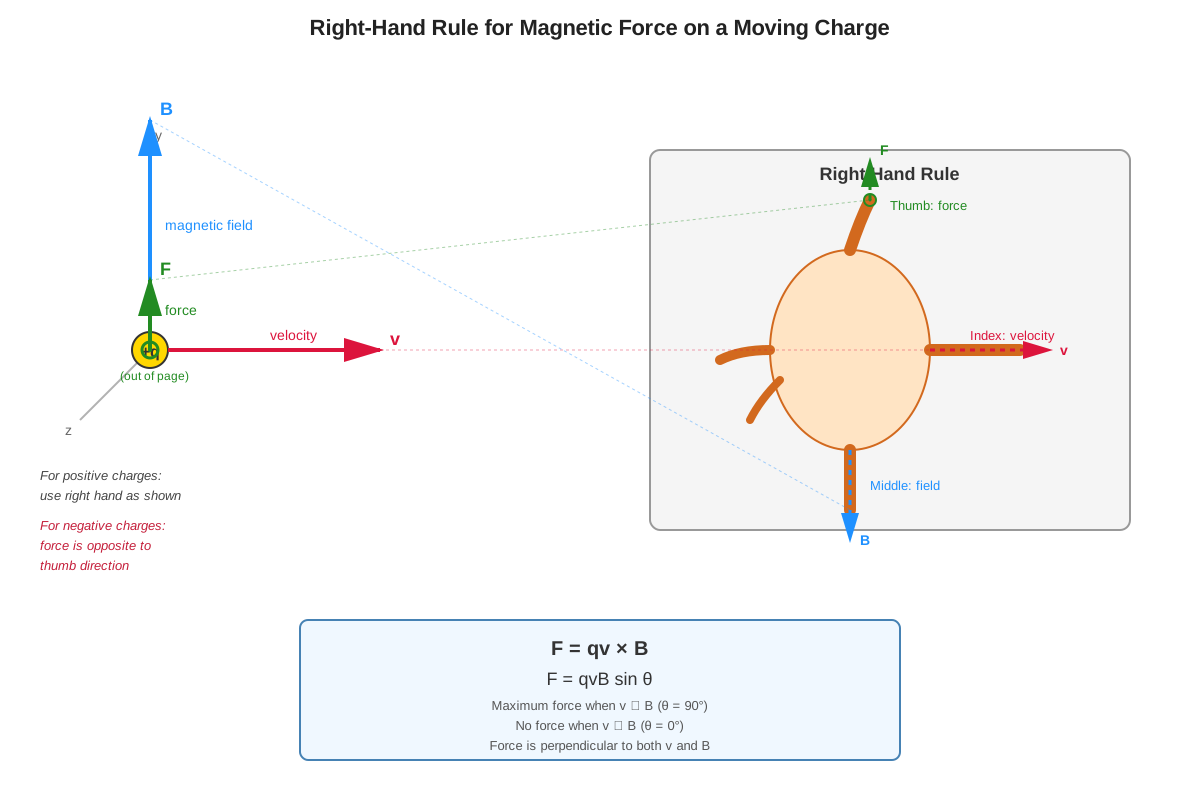
This equation reveals several critical properties. First, the force is perpendicular to both the velocity and the magnetic field—a consequence of the cross product relationship. Second, stationary charges (v = 0) experience no magnetic force. Third, charges moving parallel or antiparallel to the field (θ = 0° or 180°) experience no force since sin(0°) = sin(180°) = 0. Maximum force occurs when the charge moves perpendicular to the field (θ = 90°, sin(90°) = 1).
The direction of the magnetic force follows the right-hand rule for moving charges: point fingers in the direction of velocity (v), curl them toward the magnetic field direction (B), and the thumb points in the force direction for a positive charge. For negative charges, the force direction is opposite to the thumb direction. This three-dimensional relationship is crucial for MCAT questions and requires practice to master.
Circular Motion of Charged Particles
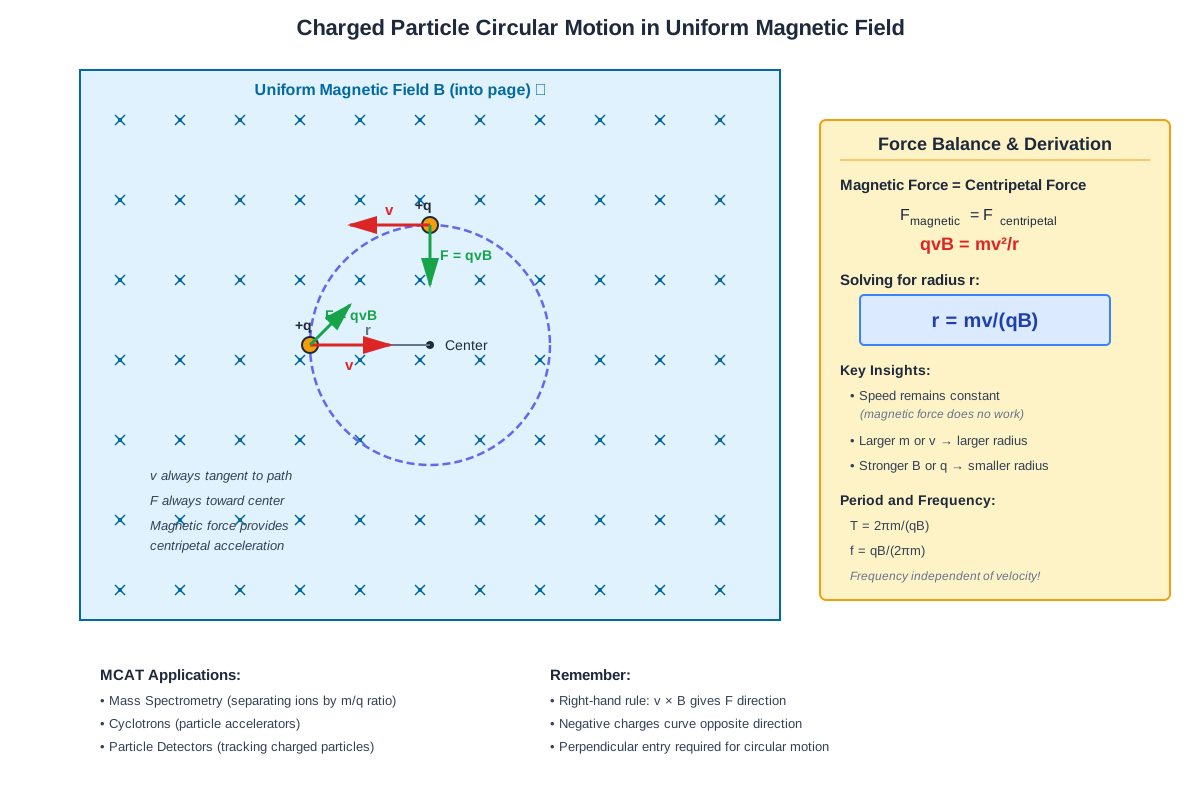
When a charged particle enters a uniform magnetic field perpendicular to its velocity, it experiences a constant-magnitude force perpendicular to its motion—the exact condition for uniform circular motion. The magnetic force provides the centripetal force:
qvB = mv²/rSolving for the radius of the circular path:
r = mv/(qB)This cyclotron radius equation shows that:
- More massive particles follow larger circles
- Faster particles follow larger circles
- Stronger fields produce tighter circles
- Higher charge produces tighter circles
The period of one complete revolution is:
T = 2πr/v = 2πm/(qB)Remarkably, the period is independent of velocity—faster particles travel larger circles but complete them in the same time. This principle underlies the cyclotron particle accelerator.
If a charged particle enters a magnetic field at an angle (neither parallel nor perpendicular), it follows a helical trajectory. The velocity component parallel to the field remains constant (no force in that direction), while the perpendicular component produces circular motion. The result is a corkscrew path along the field lines.
Magnetic Force on Current-Carrying Wires
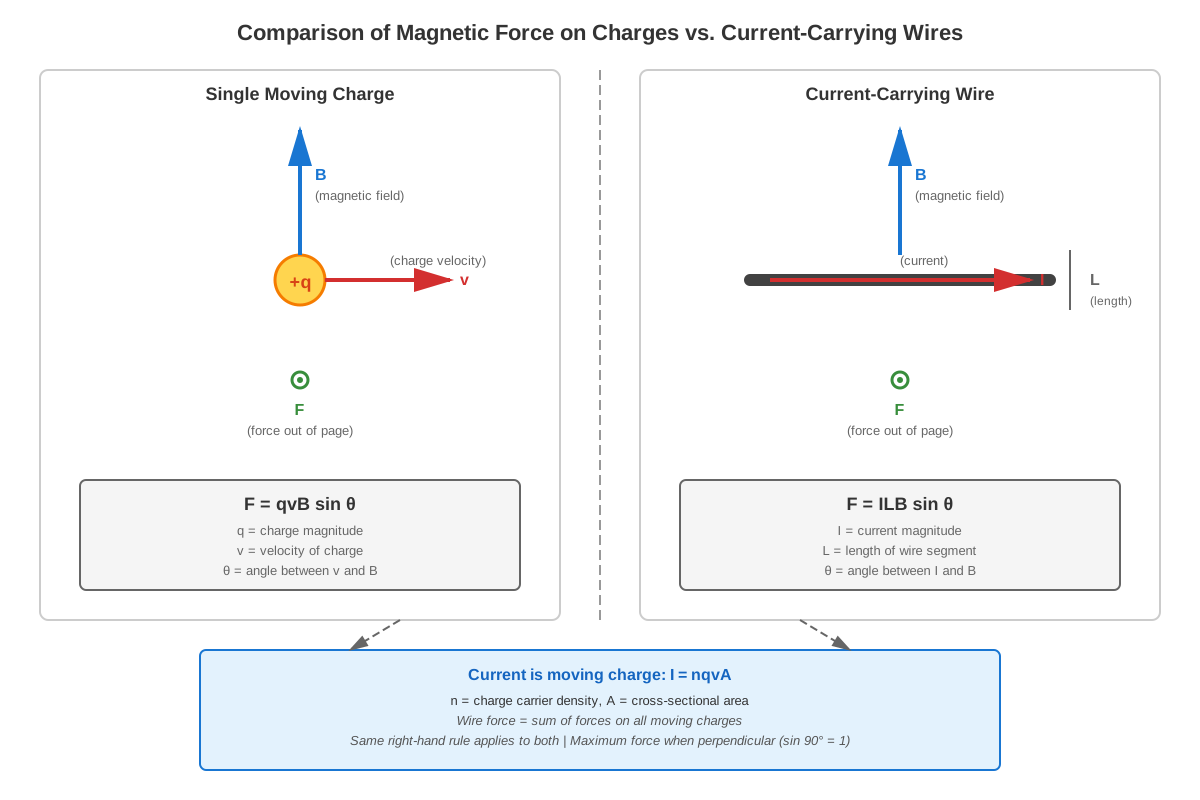
Since electric current consists of moving charges, wires carrying current experience forces in magnetic fields. For a straight wire segment:
F = ILB sin(θ)Where:
- I = current (amperes)
- L = length of wire in the field (meters)
- θ = angle between current direction and magnetic field
The direction follows a right-hand rule for currents: point fingers along the current direction, curl toward the field, and the thumb indicates force direction. This principle explains how electric motors work—current-carrying coils in magnetic fields experience torques that produce rotation.
For parallel current-carrying wires, magnetic interactions occur. Wires with currents in the same direction attract each other, while wires with currents in opposite directions repel. The force per unit length between two parallel wires is:
F/L = (μ₀I₁I₂)/(2πd)Where μ₀ is the permeability of free space (4π × 10⁻⁷ T·m/A) and d is the separation distance.
Sources of Magnetic Fields
Moving charges and currents create magnetic fields. For a long, straight current-carrying wire, the magnetic field at distance r is:
B = (μ₀I)/(2πr)The field forms concentric circles around the wire. The direction follows the right-hand rule for fields: grasp the wire with the thumb pointing in the current direction, and fingers curl in the field direction.
For a circular loop of current with radius R, the magnetic field at the center is:
B = (μ₀I)/(2R)A solenoid (long coil of wire) produces a nearly uniform magnetic field inside:
B = μ₀nIWhere n is the number of turns per unit length. Solenoids are used in electromagnets, MRI machines, and many laboratory instruments.
Magnetic Field Comparison Table
| Source | Field Equation | Field Pattern | Key Applications |
|---|---|---|---|
| Long straight wire | B = μ₀I/(2πr) | Concentric circles | Power lines, simple electromagnets |
| Circular loop | B = μ₀I/(2R) at center | Loops through center | Helmholtz coils, current sensors |
| Solenoid | B = μ₀nI | Uniform inside, loops outside | MRI magnets, electromagnets |
| Bar magnet | Complex | Dipole pattern | Compasses, magnetic separation |
Concept Relationships
The study of magnetic fields builds directly on electrostatics and electric fields, extending the concept of field-mediated forces to moving charges. While stationary charges create electric fields that exert forces on other charges regardless of motion, magnetic fields only affect charges in motion—revealing the deep connection between electricity and magnetism that culminates in electromagnetic theory.
Electric current → Magnetic field creation: Moving charges (current) generate magnetic fields around conductors, with field strength proportional to current magnitude and inversely proportional to distance. This relationship enables electromagnets and forms the basis for electromagnetic induction.
Magnetic field + Moving charge → Magnetic force: The Lorentz force law connects field strength, charge velocity, and force magnitude, with the perpendicular nature of the force leading to circular or helical particle trajectories. This principle explains mass spectrometry, cyclotrons, and particle beam steering.
Circular motion principles + Magnetic force → Cyclotron motion: When magnetic force provides centripetal acceleration, Newton's second law yields the cyclotron radius equation, connecting mechanics to electromagnetism. This relationship is crucial for understanding particle accelerators and mass spectrometers.
Magnetic fields + Current-carrying wires → Motor effect: Forces on current-carrying conductors in magnetic fields produce the torques that drive electric motors, generators, and galvanometers. This connects circuit theory to mechanical work and energy conversion.
Changing magnetic fields → Induced electric fields: Though beyond basic magnetic field concepts, Faraday's law of electromagnetic induction shows that time-varying magnetic fields create electric fields, completing the symmetry between electricity and magnetism. This relationship underlies transformers, generators, and electromagnetic waves.
The progression from static electric fields to magnetic fields to electromagnetic induction represents increasing sophistication in understanding how electric and magnetic phenomena interrelate. Mastering magnetic fields provides the foundation for understanding electromagnetic waves, which propagate through space as coupled oscillating electric and magnetic fields—a concept essential for understanding light, radiation, and spectroscopy on the MCAT.
Quick check — test yourself on Magnetic fields so far.
Try Flashcards →High-Yield Facts
⭐ Magnetic force is always perpendicular to both the velocity of the charge and the magnetic field direction, resulting in no work done by magnetic forces (W = Fd cos(90°) = 0)
⭐ The cyclotron radius r = mv/(qB) shows that particle trajectory radius increases with mass and velocity but decreases with charge and field strength
⭐ Stationary charges experience no magnetic force; only moving charges interact with magnetic fields through the Lorentz force
⭐ Magnetic field lines always form closed loops and never begin or end at a point, reflecting the non-existence of magnetic monopoles
⭐ The right-hand rule determines force direction: fingers point along velocity, curl toward field, thumb shows force direction for positive charges
- The magnetic force equation F = qvB sin(θ) shows maximum force when velocity is perpendicular to the field (θ = 90°) and zero force when parallel (θ = 0° or 180°)
- Parallel currents attract while antiparallel currents repel, explaining why wires carrying current in the same direction pull together
- The period of circular motion in a magnetic field T = 2πm/(qB) is independent of particle velocity, a principle used in cyclotron accelerators
- Solenoids produce uniform magnetic fields inside with strength B = μ₀nI, where n is turns per unit length
- The tesla (T) is a large unit; Earth's field is ~5 × 10⁻⁵ T while MRI machines operate at 1.5-3 T
- Magnetic fields cannot change the kinetic energy of a charged particle because the force is always perpendicular to motion
- The magnetic field around a long straight wire decreases with distance as B = μ₀I/(2πr), forming concentric circles
Common Misconceptions
Misconception: Magnetic fields can do work on charged particles and change their kinetic energy.
Correction: Magnetic forces are always perpendicular to velocity, so W = Fd cos(90°) = 0. Magnetic fields can change the direction of motion but never the speed or kinetic energy. Only electric fields can change a particle's kinetic energy.
Misconception: The right-hand rule gives the same result for positive and negative charges.
Correction: The right-hand rule directly gives the force direction for positive charges. For negative charges, the force is in the opposite direction (reverse the thumb direction). This is why electrons and protons curve in opposite directions in the same magnetic field.
Misconception: A charged particle always moves in a circle in a magnetic field.
Correction: Circular motion only occurs when velocity is perpendicular to the field. If velocity is parallel to the field, there is no force and the particle continues straight. If velocity is at an angle, the particle follows a helical path—circular motion combined with constant velocity along the field direction.
Misconception: Stronger magnetic fields always produce larger forces on charged particles.
Correction: While F = qvB shows force is proportional to field strength, the force also depends on charge magnitude, velocity, and the angle between velocity and field. A particle moving parallel to even a very strong field experiences zero force.
Misconception: Magnetic field lines show the path a charged particle will follow.
Correction: Magnetic field lines show the direction of the field (the direction a north pole would point), not particle trajectories. Charged particles generally do not follow field lines; instead, they curve perpendicular to the field lines due to the Lorentz force.
Misconception: The magnetic force equation F = ILB applies to any wire configuration in a magnetic field.
Correction: This equation applies to straight wire segments. For curved wires or loops, the force must be calculated by integrating over small segments or using specialized formulas. The angle θ must be carefully considered for each segment.
Misconception: Magnetic fields exist only around permanent magnets.
Correction: Any moving charge or electric current creates a magnetic field. Current-carrying wires, charged particles in motion, and even changing electric fields all produce magnetic fields. Permanent magnets are just one source, arising from aligned atomic magnetic moments.
Worked Examples
Example 1: Charged Particle in Uniform Magnetic Field
Problem: A proton (mass = 1.67 × 10⁻²⁷ kg, charge = 1.6 × 10⁻¹⁹ C) enters a uniform magnetic field of 0.5 T with velocity 2 × 10⁶ m/s perpendicular to the field. (a) Calculate the radius of the circular path. (b) Calculate the period of one complete revolution. (c) If an electron with the same speed enters the same field, how does its path compare?
Solution:
(a) Using the cyclotron radius equation:
r = mv/(qB)
r = (1.67 × 10⁻²⁷ kg)(2 × 10⁶ m/s) / [(1.6 × 10⁻¹⁹ C)(0.5 T)]
r = (3.34 × 10⁻²¹) / (8 × 10⁻²⁰)
r = 0.042 m = 4.2 cm
(b) The period is:
T = 2πm/(qB)
T = 2π(1.67 × 10⁻²⁷ kg) / [(1.6 × 10⁻¹⁹ C)(0.5 T)]
T = (1.05 × 10⁻²⁶) / (8 × 10⁻²⁰)
T = 1.31 × 10⁻⁷ s = 131 ns
(c) An electron has much smaller mass (9.1 × 10⁻³¹ kg, about 1/1836 the proton mass) but the same charge magnitude. From r = mv/(qB), the radius is proportional to mass at constant v, q, and B. Therefore, the electron's radius is approximately 1/1836 times smaller, or about 0.023 mm. The electron also curves in the opposite direction because it has negative charge. The period would also be 1/1836 times shorter.
Key Concepts Applied: This problem demonstrates the cyclotron radius and period equations, showing how particle mass affects trajectory size. It reinforces that magnetic fields cannot change particle speed (the speed remains 2 × 10⁶ m/s throughout the circular motion) and that opposite charges curve in opposite directions.
Example 2: Force on Current-Carrying Wire
Problem: A straight wire carrying 5 A of current runs perpendicular to a uniform magnetic field of 0.2 T. If 30 cm of the wire is within the field, (a) calculate the magnetic force on the wire, and (b) determine the direction of the force if the current flows east and the magnetic field points north.
Solution:
(a) Using the force equation for current-carrying wires:
F = ILB sin(θ)Since the wire is perpendicular to the field, θ = 90° and sin(90°) = 1:
F = (5 A)(0.30 m)(0.2 T)(1)
F = 0.3 N
(b) Apply the right-hand rule for currents:
- Point fingers in the current direction (east)
- Curl fingers toward the field direction (north)
- Thumb points in the force direction
Following this procedure: fingers point east, curling toward north means rotating upward, so the thumb points upward (vertically). The force on the wire is 0.3 N upward.
Alternative approach: Using vector notation, if current flows in the +x direction (east) and field points in the +y direction (north), then:
F = I(L × B)The cross product of +x and +y gives +z (upward), confirming the upward force direction.
Key Concepts Applied: This problem demonstrates the force on current-carrying conductors and the right-hand rule application. It shows how to handle perpendicular orientations and emphasizes the three-dimensional nature of magnetic forces. This principle explains how electric motors produce mechanical force from electrical current.
Exam Strategy
When approaching MCAT questions on magnetic fields, first identify what type of problem is presented: force calculation, trajectory determination, or field source identification. Look for trigger words like "charged particle," "current-carrying wire," "circular path," "perpendicular," and "uniform magnetic field." These phrases signal which equations and concepts to apply.
For force calculations, immediately check whether the charge is moving and whether velocity is perpendicular, parallel, or at an angle to the field. Remember that parallel motion produces zero force—this is a common trap answer. If the question asks about work or energy changes, recall that magnetic forces do no work because they're perpendicular to motion.
Right-hand rule questions are frequent and test spatial reasoning. If struggling to visualize, sketch a quick 3D diagram with labeled axes. Practice the right-hand rule with your actual hand during study sessions until it becomes automatic. For negative charges, remember to reverse the direction after applying the rule for positive charges.
When questions involve circular motion, recognize that you're combining magnetic force with centripetal acceleration. Set qvB = mv²/r and solve for the requested variable. If comparing different particles (proton vs. electron, for example), use ratios rather than calculating absolute values—this saves time and reduces arithmetic errors.
For process of elimination, remember these principles:
- Eliminate any answer suggesting magnetic fields change kinetic energy
- Eliminate answers showing particles following field lines (they don't)
- Eliminate answers with incorrect units (force in teslas, field in newtons, etc.)
- Eliminate trajectory answers that violate the perpendicular force requirement
Time management: Straightforward calculation questions should take 60-90 seconds. Passage-based questions requiring conceptual application may take 90-120 seconds. If a question requires extensive calculation, check whether estimation or ratio comparison can yield the answer more quickly. The MCAT rewards efficient problem-solving over exhaustive calculation.
Watch for interdisciplinary connections: passages may describe mass spectrometry (chemistry), MRI physics (biology/medicine), or particle accelerators (research applications). Extract the relevant physics principles from the biological or chemical context, apply magnetic field concepts, then translate back to the passage context.
Memory Techniques
Right-Hand Rule Mnemonic: "Velocity First, Bend to Field, Thumb shows Force" (VF-BF-TF). Point fingers along velocity, curl toward the magnetic field, thumb indicates force for positive charges.
Force Equation Memory: "Quick Vehicles Brake Smoothly" reminds you of F = qvB sin(θ), with each word's first letter corresponding to a variable in order.
Cyclotron Radius Visualization: Imagine a particle on a string (like a tetherball). Heavier particles (larger m) need longer strings (larger r). Faster particles (larger v) fly outward more (larger r). Stronger fields (larger B) and more charge (larger q) pull harder inward (smaller r). This gives r = mv/(qB).
Parallel Currents Mnemonic: "Same direction Sticks together, Opposite Opens apart" (SS-OO). Currents in the same direction attract; opposite currents repel.
Field Source Memory: "Long wires make Circles, Loops make Lines, Solenoids are Straight inside" helps remember field patterns: straight wires produce circular fields, loops produce field lines through the center, solenoids produce uniform fields inside.
No Work Acronym: "MFNW - Magnetic Forces Never Work" reminds you that magnetic forces do no work because they're perpendicular to motion (W = Fd cos(90°) = 0).
Visualization Strategy: Always draw three perpendicular axes (x, y, z) when working magnetic field problems. Label velocity along one axis, field along another, and force will be along the third. This spatial organization prevents directional errors and makes right-hand rule application clearer.
Summary
Magnetic fields represent vector fields that exert forces on moving charges and current-carrying conductors, with force magnitude given by F = qvB sin(θ) and direction determined by right-hand rules. The perpendicular nature of magnetic forces means they cannot change particle kinetic energy but instead alter motion direction, producing circular or helical trajectories with radius r = mv/(qB). Current-carrying wires experience forces F = ILB sin(θ) in magnetic fields, enabling electric motors and explaining interactions between parallel conductors. Moving charges and currents create magnetic fields following specific patterns: straight wires produce concentric circular fields (B = μ₀I/2πr), while solenoids generate uniform internal fields (B = μ₀nI). Mastery requires understanding vector relationships, applying right-hand rules confidently, and recognizing that magnetic field lines form closed loops without beginning or ending points. These principles underlie critical medical technologies including MRI, mass spectrometry, and particle accelerators, making magnetic fields essential for MCAT success and future medical practice.
Key Takeaways
- Magnetic forces act only on moving charges and are always perpendicular to both velocity and field direction, doing no work and changing only motion direction, not speed
- The Lorentz force law F = qvB sin(θ) and cyclotron radius r = mv/(qB) are fundamental equations for calculating forces and trajectories in magnetic fields
- Right-hand rules determine force and field directions: for forces, point fingers along velocity, curl toward field, thumb shows force (reverse for negative charges)
- Charged particles undergo circular motion when entering perpendicular to uniform fields, with period T = 2πm/(qB) independent of velocity
- Current-carrying wires experience forces F = ILB sin(θ) in magnetic fields, with parallel currents attracting and antiparallel currents repelling
- Magnetic field lines always form closed loops, reflecting the absence of magnetic monopoles in nature
- Medical applications including MRI, mass spectrometry, and transcranial magnetic stimulation rely directly on magnetic field principles tested on the MCAT
Related Topics
Electromagnetic Induction: Changing magnetic fields induce electric fields and currents, explaining generators, transformers, and Faraday's law. Mastering static magnetic fields provides the foundation for understanding time-varying fields and induced EMF.
Electromagnetic Waves: Oscillating electric and magnetic fields propagate through space as electromagnetic radiation, including visible light. Understanding magnetic fields is essential for comprehending wave propagation and the electromagnetic spectrum.
Mass Spectrometry: This analytical technique uses magnetic fields to separate ions by mass-to-charge ratio, with applications in protein identification and drug analysis. The cyclotron motion principles learned here directly explain mass spectrometer operation.
Lorentz Force and Particle Accelerators: Combining electric and magnetic fields enables sophisticated particle control in cyclotrons, synchrotrons, and linear accelerators used in physics research and medical isotope production.
Magnetic Properties of Materials: Diamagnetism, paramagnetism, and ferromagnetism explain how materials respond to magnetic fields, relevant for understanding MRI contrast agents and magnetic separation techniques in biology.
Practice CTA
Now that you've mastered the core concepts of magnetic fields, it's time to solidify your understanding through active practice. Work through the practice questions to test your ability to apply right-hand rules, calculate forces and trajectories, and analyze magnetic field scenarios under timed conditions. Use the flashcards to reinforce high-yield facts and equations until they become automatic. Remember, magnetic fields require spatial reasoning skills that develop through repeated practice—each problem you solve strengthens your three-dimensional visualization abilities and builds the confidence needed for test day success. The investment you make in practicing these concepts will pay dividends not only on the MCAT but throughout your medical career as you encounter magnetic field applications in imaging technology and medical devices.
Sign up free to keep reading
Create a free AnvayaPrep account to finish this MCAT guide on Magnetic fields — plus flashcards and practice questions.