Overview
Parallel circuits represent one of the two fundamental ways electrical components can be connected in a circuit, alongside series circuits. In a parallel circuit, components are connected across common points or junctions, creating multiple pathways for current to flow. This configuration is ubiquitous in real-world applications—from household electrical systems to the complex circuitry within medical devices—making it an essential topic for MCAT preparation. Understanding parallel circuits requires mastery of how voltage, current, and resistance behave when multiple pathways exist, and how these relationships differ fundamentally from series configurations.
For the MCAT, parallel circuits Physics appears frequently in both discrete questions and passage-based problems within the Electricity and Magnetism section of Physics. The exam tests not only computational skills but also conceptual understanding of how adding or removing components affects overall circuit behavior. Students must recognize parallel configurations in circuit diagrams, apply Kirchhoff's laws correctly, and understand the practical implications of parallel wiring in biological systems such as neural networks and cardiovascular circulation.
The study of parallel circuits MCAT content connects directly to broader physics principles including conservation of energy, Ohm's law, and power dissipation. These circuits also provide a foundation for understanding more complex topics like combination circuits, capacitor networks, and the electrical properties of cell membranes. Mastering parallel circuits enables students to approach interdisciplinary MCAT questions that integrate physics concepts with biological systems, particularly those involving electrical signaling and energy distribution.
Learning Objectives
- [ ] Define parallel circuits using accurate Physics terminology
- [ ] Explain why parallel circuits matters for the MCAT
- [ ] Apply parallel circuits to exam-style questions
- [ ] Identify common mistakes related to parallel circuits
- [ ] Connect parallel circuits to related Physics concepts
- [ ] Calculate equivalent resistance for parallel resistor networks using multiple methods
- [ ] Analyze how current divides among parallel branches based on resistance values
- [ ] Predict the effects of adding or removing components in parallel configurations
- [ ] Compare and contrast voltage, current, and resistance behavior in parallel versus series circuits
Prerequisites
- Ohm's Law (V = IR): Essential for calculating voltage, current, and resistance relationships in any circuit configuration
- Basic circuit terminology (voltage, current, resistance, power): Required to understand how electrical quantities behave in parallel arrangements
- Series circuits: Provides contrast and comparison framework for understanding parallel circuit behavior
- Kirchhoff's Current Law (KCL): Fundamental principle governing current distribution at circuit junctions
- Kirchhoff's Voltage Law (KVL): Necessary for analyzing voltage drops and energy conservation in circuits
- Basic algebra and fraction manipulation: Required for calculating equivalent resistance and solving circuit problems
Why This Topic Matters
Parallel circuits appear in approximately 15-20% of MCAT physics questions related to electricity and magnetism, making them a high-yield topic for exam preparation. The MCAT frequently tests parallel circuits through quantitative problems requiring resistance calculations, conceptual questions about circuit behavior, and passage-based scenarios involving medical devices or biological systems with parallel pathways.
In clinical and real-world contexts, parallel circuits are fundamental to understanding how electrical systems maintain functionality even when individual components fail. Household electrical systems use parallel wiring so that when one appliance fails, others continue operating—a principle directly analogous to collateral circulation in blood vessels. Medical devices such as electrocardiogram (ECG) machines, defibrillators, and neural stimulators rely on parallel circuit principles. The human nervous system itself can be modeled as a parallel network where multiple neural pathways allow for redundancy and complex signal processing.
On the MCAT, parallel circuits commonly appear in several formats: discrete questions asking for equivalent resistance calculations, passage-based problems involving experimental apparatus with parallel components, and conceptual questions comparing circuit behaviors. The exam particularly favors questions that test understanding of how voltage remains constant across parallel branches while current divides, and how adding resistors in parallel decreases total resistance—a counterintuitive concept that frequently appears in wrong answer choices designed to trap students who confuse series and parallel behavior.
Core Concepts
Definition and Basic Structure
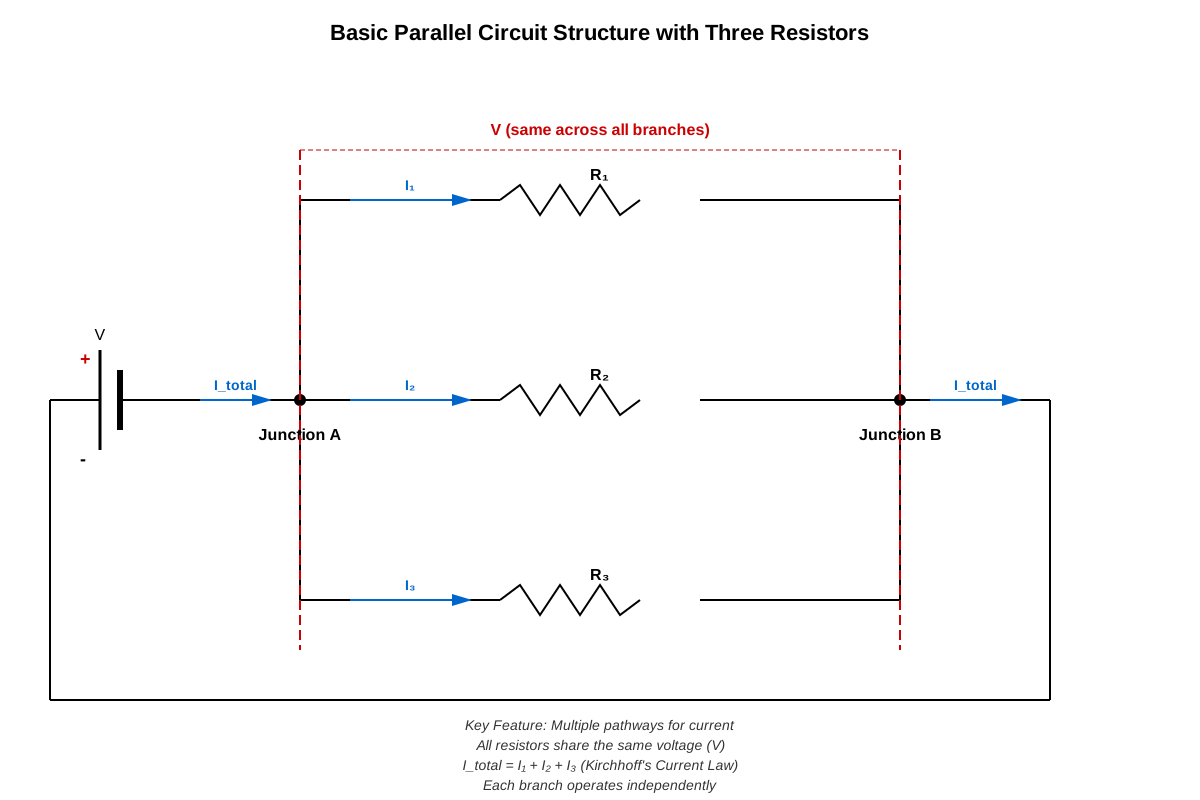
A parallel circuit is an electrical circuit configuration in which components are connected across the same two points, creating multiple independent pathways for current flow. Each component in a parallel arrangement has its terminals connected to common junctions or nodes, ensuring that all components experience the same potential difference (voltage) across them. This fundamental characteristic distinguishes parallel circuits from series circuits, where components share a single current pathway.
The defining feature of parallel circuits is that current has multiple routes to travel from the positive terminal of the voltage source to the negative terminal. At each junction point (node), the current divides among the available branches according to the resistance of each pathway. Components in parallel are said to be "across" each other, meaning they share common connection points at both ends.
Voltage Behavior in Parallel Circuits
The most critical principle governing parallel circuits is that voltage remains constant across all parallel branches. Every component connected in parallel experiences the same potential difference, which equals the voltage supplied by the source. This occurs because all parallel components are connected directly to the same two nodes, and voltage represents the potential difference between two specific points.
Mathematically, for a parallel circuit with n branches:
V_total = V_1 = V_2 = V_3 = ... = V_nThis voltage constancy has profound implications for circuit analysis and represents a key distinction from series circuits, where voltage divides among components. The MCAT frequently tests whether students recognize that adding or removing parallel components does not change the voltage across remaining components.
Current Distribution in Parallel Circuits
While voltage remains constant, current divides among parallel branches according to Kirchhoff's Current Law (KCL). The total current leaving the voltage source equals the sum of currents through all parallel branches. At any junction, the current entering must equal the current leaving, reflecting conservation of charge.
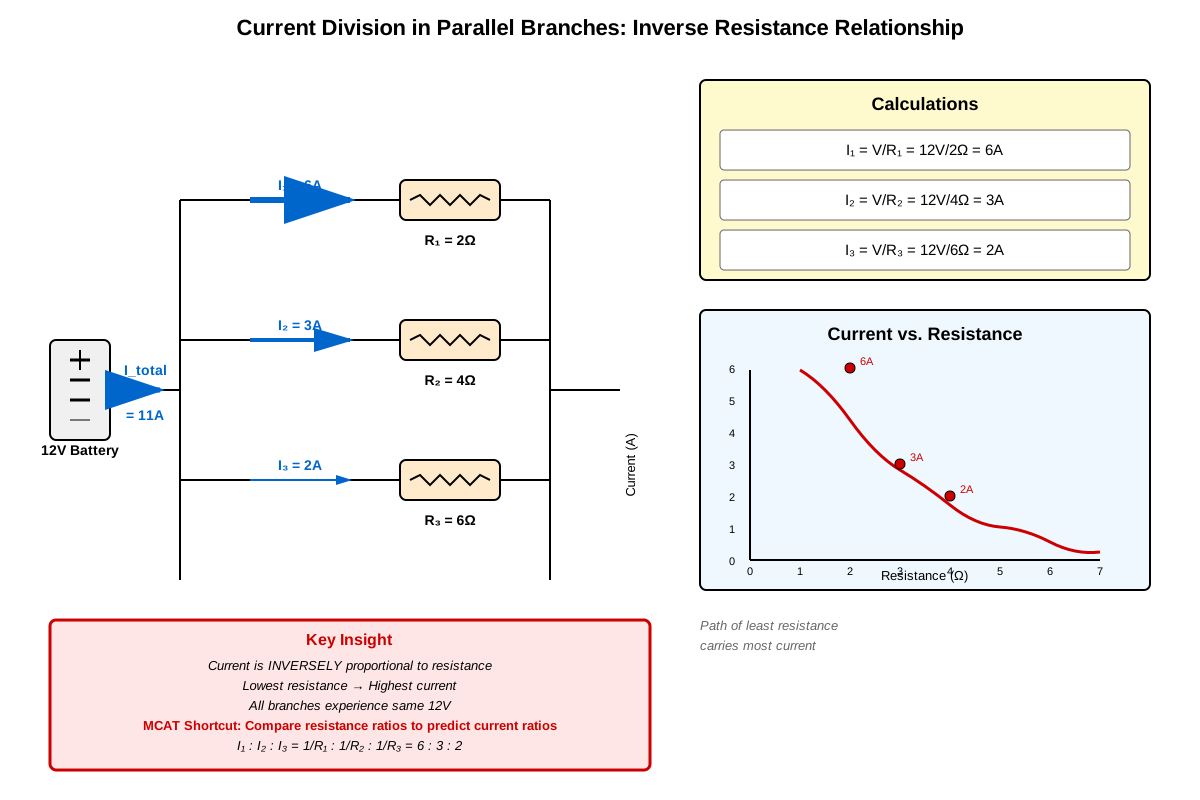
I_total = I_1 + I_2 + I_3 + ... + I_nThe current through each branch depends on that branch's resistance according to Ohm's law. Branches with lower resistance carry more current, while branches with higher resistance carry less current. This current division follows the principle that charge carriers take all available paths, with more charge flowing through easier (lower resistance) pathways.
For two resistors in parallel, the current divides according to the inverse ratio of resistances:
I_1/I_2 = R_2/R_1This relationship, known as the current divider rule, allows rapid calculation of branch currents without solving the entire circuit.
Equivalent Resistance Calculation
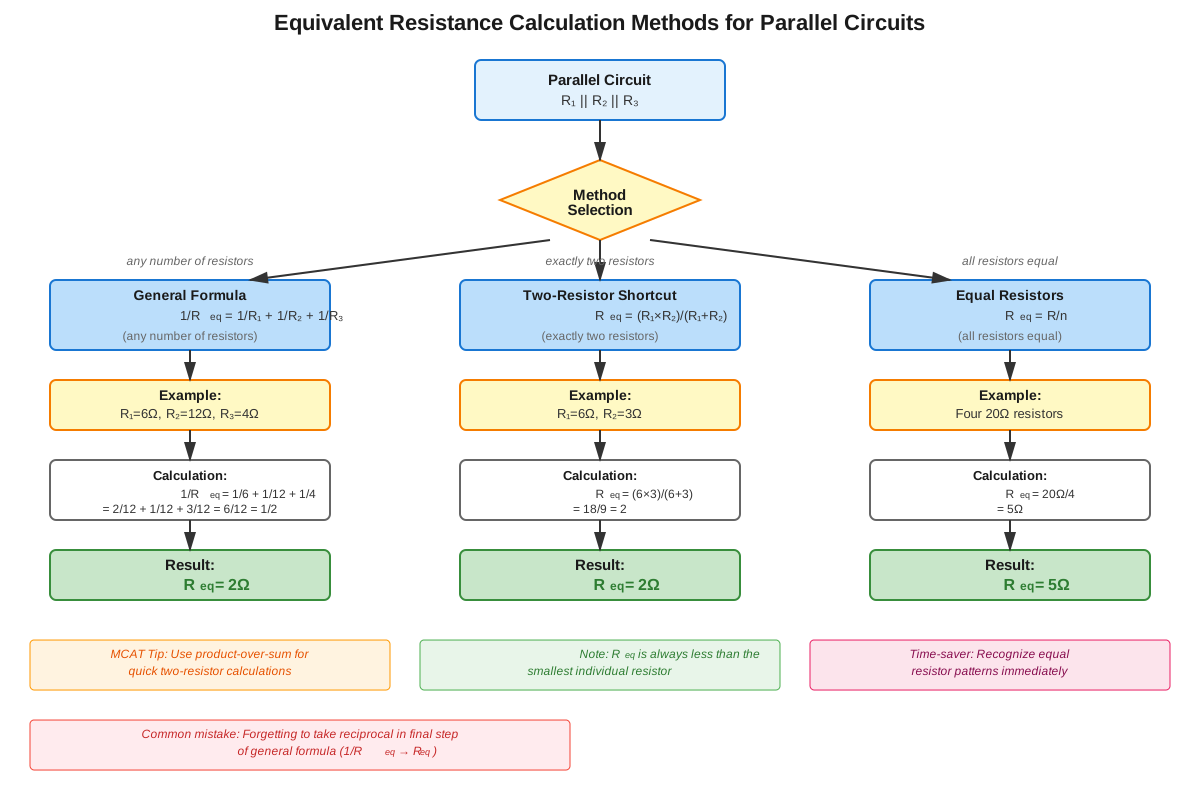
The equivalent resistance of parallel resistors is always less than the smallest individual resistance in the network. This counterintuitive result occurs because adding parallel pathways provides additional routes for current flow, effectively making it easier for charge to move through the circuit.
For resistors in parallel, the reciprocal of the equivalent resistance equals the sum of reciprocals of individual resistances:
1/R_eq = 1/R_1 + 1/R_2 + 1/R_3 + ... + 1/R_nFor two resistors in parallel, this simplifies to the product-over-sum formula:
R_eq = (R_1 × R_2)/(R_1 + R_2)For n identical resistors of resistance R in parallel:
R_eq = R/nThese formulas are essential for MCAT problem-solving and must be memorized and applied accurately under time pressure.
Power Dissipation in Parallel Circuits
Power dissipation in parallel circuits follows the general relationship P = IV = V²/R = I²R, but with specific implications due to constant voltage across branches. Since voltage is the same for all parallel components, the power dissipated by each component depends solely on its resistance:
P = V²/RComponents with lower resistance dissipate more power in parallel configurations because they carry more current. The total power dissipated equals the sum of power dissipated by each branch:
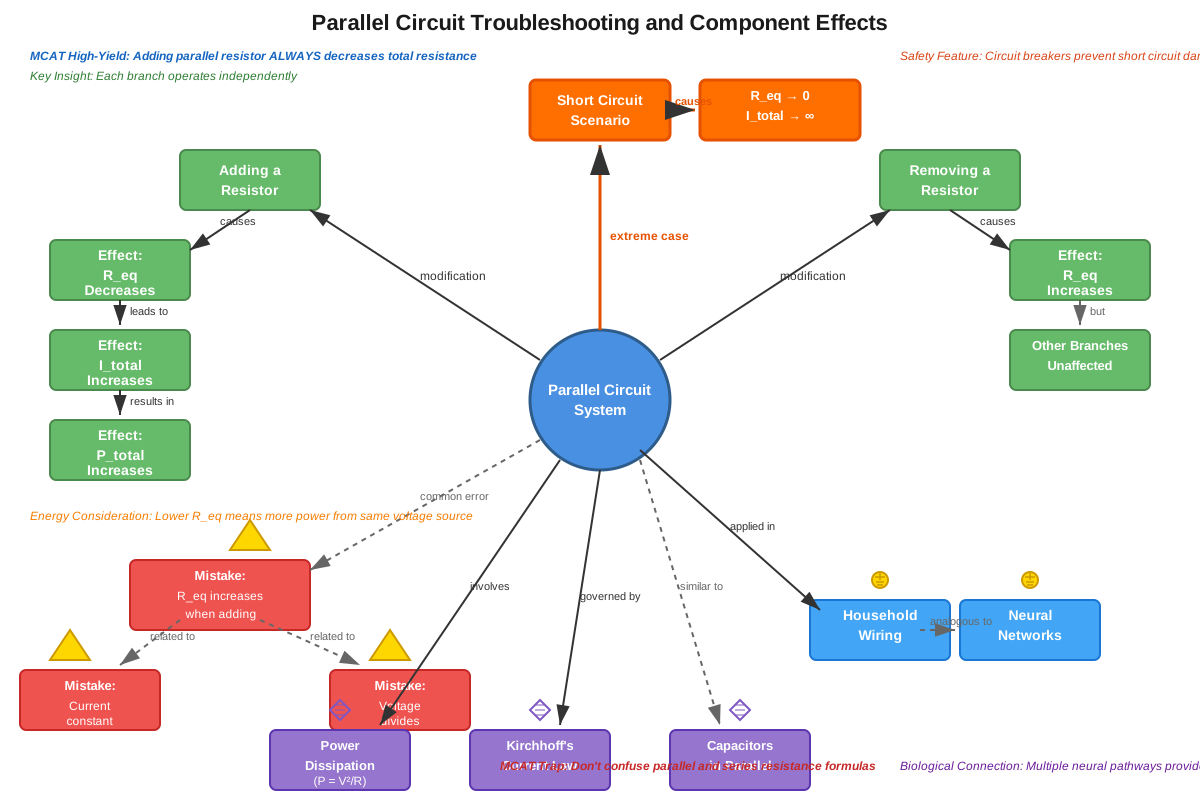
P_total = P_1 + P_2 + P_3 + ... + P_nThis relationship is crucial for understanding why circuit breakers trip when too many devices operate simultaneously on a parallel household circuit—the total current (and thus total power) increases with each additional device.
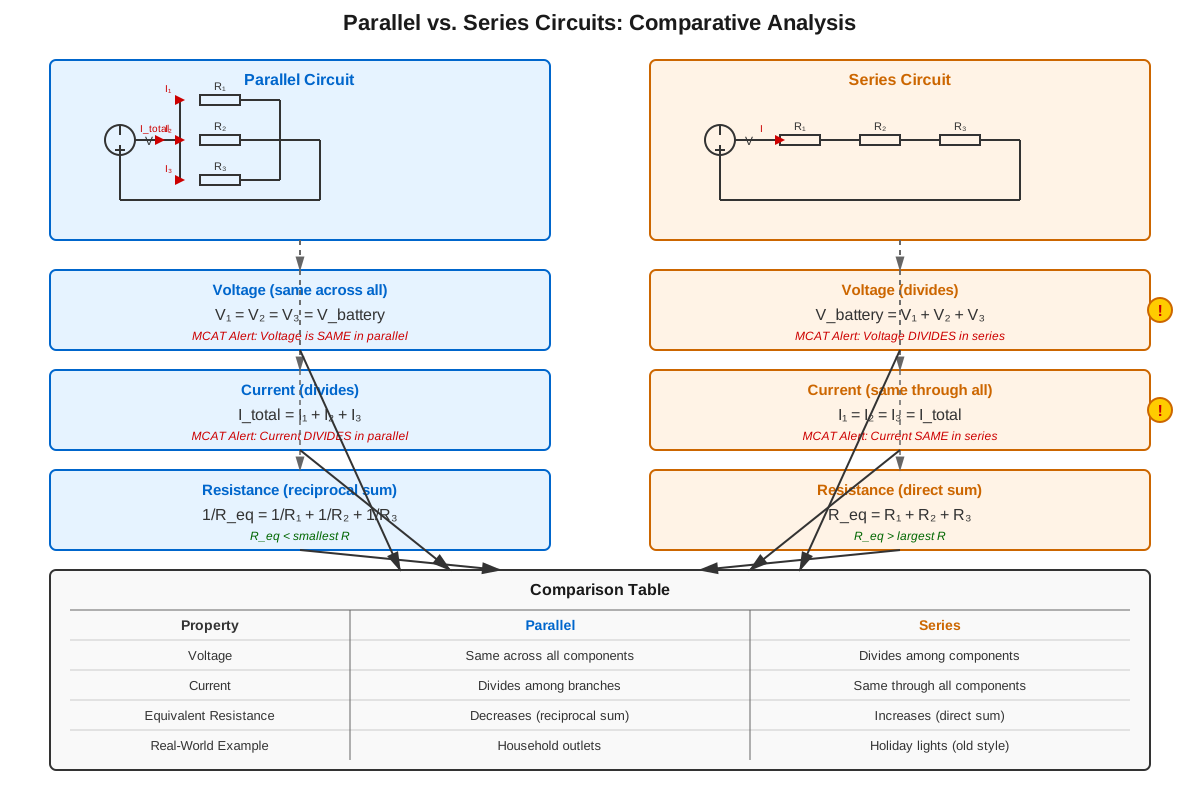
Comparison Table: Series vs. Parallel Circuits
| Property | Series Circuit | Parallel Circuit |
|---|---|---|
| Current | Same through all components (I_total = I_1 = I_2) | Divides among branches (I_total = I_1 + I_2) |
| Voltage | Divides among components (V_total = V_1 + V_2) | Same across all components (V_total = V_1 = V_2) |
| Equivalent Resistance | Sum of resistances (R_eq = R_1 + R_2) | Reciprocal sum (1/R_eq = 1/R_1 + 1/R_2) |
| Effect of Adding Resistor | Increases total resistance | Decreases total resistance |
| Component Failure | Breaks entire circuit | Other components continue functioning |
| Brightness of Identical Bulbs | Dimmer with more bulbs | Same brightness regardless of number |
Practical Implications and Circuit Behavior
When components are added in parallel, the equivalent resistance decreases, causing total current from the source to increase (assuming constant voltage). This behavior explains why circuit breakers trip when too many appliances operate simultaneously—each additional parallel device decreases total resistance and increases current draw.
Conversely, when a component is removed or fails in a parallel circuit, the remaining components continue operating normally because they maintain their direct connection to the voltage source. This redundancy makes parallel circuits ideal for applications requiring reliability, such as household wiring and critical medical equipment.
The independence of parallel branches means that changes to one branch (such as adjusting a variable resistor) do not affect voltage or current in other branches, though they do affect the total current drawn from the source. This property is essential for understanding complex circuits and troubleshooting electrical systems.
Concept Relationships
The core concepts of parallel circuits are deeply interconnected through fundamental electrical principles. Voltage constancy across parallel branches directly results from the definition of voltage as potential difference between two specific points—since all parallel components connect to the same two nodes, they must experience identical potential differences. This voltage constancy then determines current distribution through Ohm's law: with voltage fixed, current through each branch depends inversely on that branch's resistance.
Current division connects to Kirchhoff's Current Law, which itself reflects conservation of charge. The total current entering a junction must equal the total current leaving, causing current to split among available parallel pathways. This current splitting, combined with voltage constancy, leads to the equivalent resistance formula: since more pathways allow more total current for the same voltage, equivalent resistance must decrease as parallel branches are added.
Power dissipation integrates voltage constancy and current distribution—with voltage fixed across all branches, components with lower resistance carry more current and therefore dissipate more power (P = V²/R). This relationship connects parallel circuits to energy conservation principles and practical applications like circuit breaker design.
The relationship map flows as follows:
Circuit Configuration → Voltage Constancy → Ohm's Law Application → Current Distribution → Equivalent Resistance Calculation → Power Analysis → Practical Circuit Behavior
Parallel circuits connect to prerequisite topics through direct application of Ohm's law and Kirchhoff's laws. Understanding series circuits provides essential contrast—recognizing that voltage and current behaviors are essentially "swapped" between series and parallel configurations. This topic enables progression to combination circuits (mixed series-parallel), capacitor networks, and complex circuit analysis using nodal or mesh methods.
High-Yield Facts
⭐ Voltage is identical across all components in parallel (V_total = V_1 = V_2 = V_3)
⭐ Total current equals the sum of branch currents (I_total = I_1 + I_2 + I_3)
⭐ Equivalent resistance is always less than the smallest individual resistance in a parallel network
⭐ For parallel resistors: 1/R_eq = 1/R_1 + 1/R_2 + 1/R_3
⭐ Adding resistors in parallel decreases total resistance and increases total current
- For two equal resistors in parallel, equivalent resistance is half the individual resistance (R_eq = R/2)
- The product-over-sum formula for two resistors: R_eq = (R_1 × R_2)/(R_1 + R_2)
- Current divides inversely proportional to resistance: higher resistance branches carry less current
- If one component fails in a parallel circuit, other components continue operating normally
- Power dissipated in each branch: P = V²/R, where V is constant across all branches
- Total power equals the sum of individual branch powers: P_total = P_1 + P_2 + P_3
- Household electrical outlets are wired in parallel to maintain constant 120V across all devices
- The branch with lowest resistance carries the most current and dissipates the most power
- Parallel circuits provide redundancy and reliability in electrical systems
Quick check — test yourself on Parallel circuits so far.
Try Flashcards →Common Misconceptions
Misconception: Adding resistors in parallel increases total resistance, similar to series circuits.
Correction: Adding resistors in parallel decreases total resistance because additional pathways make it easier for current to flow. Each new parallel branch provides an additional route for charge carriers, reducing the overall opposition to current flow. The equivalent resistance formula (1/R_eq = 1/R_1 + 1/R_2) mathematically ensures R_eq is always less than the smallest individual resistance.
Misconception: Current is the same through all parallel branches.
Correction: Current divides among parallel branches according to each branch's resistance. The total current splits at junctions, with more current flowing through lower-resistance branches. Only voltage remains constant across parallel components; current varies inversely with resistance according to Ohm's law (I = V/R).
Misconception: When one component fails in a parallel circuit, all components stop working.
Correction: In parallel circuits, each component has an independent connection to the voltage source. When one component fails (creating an open circuit in that branch), other branches maintain their direct connection to the source and continue operating normally. This is why household lights continue working when one bulb burns out.
Misconception: The equivalent resistance of parallel resistors can be found by simply adding the resistances.
Correction: Parallel resistance requires adding reciprocals: 1/R_eq = 1/R_1 + 1/R_2. Simply adding resistances (R_eq = R_1 + R_2) is the formula for series circuits. This distinction is critical and frequently tested on the MCAT through answer choices that include both calculations.
Misconception: Identical light bulbs in parallel will be dimmer than a single bulb because they "share" the current.
Correction: Identical bulbs in parallel maintain the same brightness as a single bulb because each receives the full source voltage. While the total current from the source increases, each individual bulb draws the same current it would draw alone (I = V/R). The bulbs don't "share" current; rather, the source supplies additional current to maintain constant voltage.
Misconception: The voltage across parallel components adds up to the source voltage.
Correction: In parallel circuits, voltage does not add; each component experiences the full source voltage. Voltage addition (V_total = V_1 + V_2) applies only to series circuits. This confusion often stems from mixing series and parallel rules and is a common trap in MCAT questions.
Misconception: Power dissipation is the same for all parallel components.
Correction: Power dissipation varies among parallel components according to their resistance. Using P = V²/R (with V constant), components with lower resistance dissipate more power. A 10Ω resistor in parallel with a 20Ω resistor dissipates twice as much power as the 20Ω resistor.
Worked Examples
Example 1: Calculating Equivalent Resistance and Circuit Currents
Problem: Three resistors with values 6Ω, 12Ω, and 4Ω are connected in parallel across a 24V battery. Calculate: (a) the equivalent resistance, (b) the total current from the battery, (c) the current through each resistor, and (d) the power dissipated by the 4Ω resistor.
Solution:
(a) Equivalent Resistance
Using the parallel resistance formula:
1/R_eq = 1/R_1 + 1/R_2 + 1/R_3
1/R_eq = 1/6 + 1/12 + 1/4
Finding common denominator (12):
1/R_eq = 2/12 + 1/12 + 3/12 = 6/12 = 1/2
R_eq = 2Ω
Note that the equivalent resistance (2Ω) is less than the smallest individual resistance (4Ω), confirming our calculation is reasonable.
(b) Total Current
Using Ohm's law with the equivalent resistance:
I_total = V/R_eq = 24V/2Ω = 12A(c) Current Through Each Resistor
Since voltage is constant across all parallel components (24V), we apply Ohm's law to each branch:
For the 6Ω resistor:
I_1 = V/R_1 = 24V/6Ω = 4AFor the 12Ω resistor:
I_2 = V/R_2 = 24V/12Ω = 2AFor the 4Ω resistor:
I_3 = V/R_3 = 24V/4Ω = 6AVerification using KCL: I_total = I_1 + I_2 + I_3 = 4A + 2A + 6A = 12A ✓
Notice that the 4Ω resistor (lowest resistance) carries the most current (6A), while the 12Ω resistor (highest resistance) carries the least current (2A).
(d) Power Dissipated by 4Ω Resistor
Using P = V²/R (or alternatively P = IV):
P = V²/R = (24V)²/4Ω = 576/4 = 144WOr using P = IV:
P = I × V = 6A × 24V = 144WKey Takeaways from Example 1: This problem demonstrates the systematic approach to parallel circuit analysis: (1) calculate equivalent resistance using reciprocals, (2) find total current using Ohm's law, (3) recognize that voltage is constant across all branches, (4) calculate individual branch currents using Ohm's law, (5) verify using KCL, and (6) calculate power using the most convenient formula. The problem also reinforces that lower resistance branches carry more current and dissipate more power.
Example 2: Analyzing Circuit Changes
Problem: A parallel circuit contains two resistors: R_1 = 30Ω and R_2 = 60Ω connected to a 12V battery. (a) Calculate the initial total current. (b) A third resistor R_3 = 20Ω is added in parallel. Calculate the new total current. (c) Explain what happens to the current through R_1 when R_3 is added. (d) If the circuit is protected by a fuse rated for 2A, will the fuse blow when R_3 is added?
Solution:
(a) Initial Total Current
First, find the equivalent resistance of R_1 and R_2:
1/R_eq = 1/30 + 1/60 = 2/60 + 1/60 = 3/60 = 1/20
R_eq = 20Ω
Calculate total current:
I_total = V/R_eq = 12V/20Ω = 0.6A(b) New Total Current with R_3 Added
Find new equivalent resistance with all three resistors:
1/R_eq_new = 1/30 + 1/60 + 1/20Finding common denominator (60):
1/R_eq_new = 2/60 + 1/60 + 3/60 = 6/60 = 1/10
R_eq_new = 10Ω
Calculate new total current:
I_total_new = V/R_eq_new = 12V/10Ω = 1.2A(c) Effect on Current Through R_1
The current through R_1 depends only on the voltage across it and its resistance:
I_1 = V/R_1 = 12V/30Ω = 0.4AThis current through R_1 remains unchanged when R_3 is added because: (1) the voltage across R_1 remains 12V (voltage is constant across all parallel branches), and (2) R_1's resistance hasn't changed. This demonstrates the independence of parallel branches—changes to one branch don't affect current in other branches, though they do affect total current from the source.
(d) Fuse Analysis
The new total current (1.2A) is less than the fuse rating (2A), so the fuse will not blow. However, this problem illustrates an important practical consideration: adding parallel components increases total current draw. If enough devices were added in parallel, the total current would eventually exceed the fuse rating, causing it to blow and protect the circuit from overheating.
Key Takeaways from Example 2: This problem reinforces several critical concepts: (1) adding parallel resistors decreases equivalent resistance and increases total current, (2) individual branch currents remain unchanged when other parallel branches are added or removed, (3) parallel branches operate independently, and (4) circuit protection devices respond to total current, which increases as parallel loads are added. This type of conceptual analysis frequently appears on the MCAT.
Exam Strategy
When approaching MCAT questions on parallel circuits, begin by identifying the circuit configuration. Look for components connected across the same two points or nodes—this visual recognition is faster than analyzing the circuit mathematically. Draw or redraw the circuit if necessary to clarify the parallel arrangement.
Trigger words and phrases that indicate parallel circuit questions include: "connected across," "same voltage," "independent pathways," "current divides," "branches," and "nodes." Questions asking about what happens when "one component fails" or "a device is added" almost always involve parallel circuits, since these scenarios highlight the independence of parallel branches.
For calculation problems, follow this systematic approach:
- Identify all parallel components
- Recognize that voltage is constant across all parallel branches
- Calculate equivalent resistance using 1/R_eq = 1/R_1 + 1/R_2 + ...
- Find total current using Ohm's law: I_total = V/R_eq
- Calculate individual branch currents using I = V/R for each branch
- Verify using Kirchhoff's Current Law: I_total = sum of branch currents
For conceptual questions, immediately recall the key distinctions between series and parallel circuits. If an answer choice suggests that voltage divides among parallel components or that current is the same through all parallel branches, eliminate it immediately—these describe series behavior, not parallel behavior.
Process-of-elimination tips: Wrong answers often include calculations using series formulas (R_eq = R_1 + R_2) or suggest that equivalent resistance increases when parallel components are added. Any answer suggesting that parallel components affect each other's voltage or current (beyond affecting total current from the source) is incorrect. Watch for answer choices that correctly calculate one quantity but then use it incorrectly in subsequent steps.
Time allocation: For straightforward parallel resistance calculations, allocate 60-90 seconds. For multi-step problems involving current distribution and power calculations, allocate 2-3 minutes. If a problem requires extensive calculation, check whether estimation or conceptual reasoning could eliminate answer choices more quickly. For example, knowing that equivalent resistance must be less than the smallest individual resistance can eliminate wrong answers without complete calculation.
When passages describe experimental apparatus or medical devices, quickly sketch the circuit to identify series and parallel components. Passages often provide more information than necessary—focus on the electrical configuration and the specific quantities asked about in the questions.
Memory Techniques
VIPER mnemonic for parallel circuit properties:
- Voltage is the same across all branches
- Independent branches (one component failing doesn't affect others)
- Pathways are multiple (current has several routes)
- Equivalent resistance is less than smallest individual resistance
- Reciprocals add (1/R_eq = 1/R_1 + 1/R_2)
"Parallel = Voltage Parity": The word "parity" means equality, reminding you that voltage is equal across all parallel components.
"Resistance Reciprocates in Parallel": The alliteration helps remember that parallel resistance requires adding reciprocals.
"Current Splits, Voltage Sticks": In parallel circuits, current splits among branches while voltage sticks (remains constant) across all branches.
Visualization strategy: Picture a river splitting into multiple channels around an island. The water level (analogous to voltage) is the same in all channels, but the flow rate (analogous to current) varies depending on each channel's width and depth (analogous to resistance). Wider channels carry more water, just as lower-resistance branches carry more current.
The "Less Than Least" rule: For parallel resistance, remember that the equivalent resistance is always "less than the least"—less than the smallest individual resistance. This provides an immediate check on calculations.
Two-resistor shortcut: For exactly two resistors in parallel, remember "product over sum": R_eq = (R_1 × R_2)/(R_1 + R_2). Visualize a fraction with multiplication on top and addition on bottom.
Equal resistors rule: For n identical resistors R in parallel, equivalent resistance is R/n. Visualize dividing the resistance by the number of resistors: two 10Ω resistors in parallel give 5Ω, three give 3.33Ω, etc.
Summary
Parallel circuits represent a fundamental electrical configuration where components connect across common nodes, creating multiple pathways for current flow. The defining characteristic of parallel circuits is that voltage remains constant across all branches while current divides among them according to each branch's resistance. The equivalent resistance of parallel resistors is always less than the smallest individual resistance, calculated using the reciprocal formula: 1/R_eq = 1/R_1 + 1/R_2 + 1/R_3. Adding components in parallel decreases total resistance and increases total current from the source, though individual branch currents remain unchanged. This independence of parallel branches means that component failure in one branch doesn't affect other branches, making parallel circuits ideal for applications requiring reliability. Power dissipation in each branch depends on that branch's resistance, with lower-resistance branches dissipating more power. Understanding these principles enables analysis of household electrical systems, medical devices, and biological systems with parallel pathways. For MCAT success, students must distinguish parallel from series behavior, apply appropriate formulas accurately, and recognize how circuit changes affect various electrical quantities.
Key Takeaways
- Voltage is identical across all components in parallel circuits (V_total = V_1 = V_2), while current divides among branches (I_total = I_1 + I_2)
- Equivalent resistance for parallel resistors uses reciprocals: 1/R_eq = 1/R_1 + 1/R_2, and is always less than the smallest individual resistance
- Adding resistors in parallel decreases total resistance and increases total current, opposite to series circuit behavior
- Parallel branches operate independently—changes to one branch don't affect voltage or current in other branches, though they affect total current from the source
- Lower-resistance branches carry more current and dissipate more power (P = V²/R with constant V)
- Component failure in parallel circuits doesn't interrupt other branches, providing redundancy and reliability
- The MCAT frequently tests parallel circuits through resistance calculations, current distribution problems, and conceptual questions about circuit behavior changes
Related Topics
Combination Circuits: Mixed series-parallel configurations that require systematic analysis by identifying and simplifying series and parallel sections sequentially. Mastering parallel circuits is essential before tackling these more complex arrangements.
Capacitors in Parallel: Capacitor networks follow different rules than resistors—capacitances add directly in parallel (C_eq = C_1 + C_2), opposite to resistor behavior. Understanding parallel circuit principles provides the foundation for this comparison.
Kirchhoff's Laws: Both Current Law (KCL) and Voltage Law (KVL) are fundamental to analyzing parallel circuits. Deeper study of these laws enables analysis of complex multi-loop circuits.
RC Circuits: Resistor-capacitor circuits in parallel configurations exhibit time-dependent behavior during charging and discharging. Parallel circuit mastery is prerequisite to understanding these dynamic systems.
Electrical Properties of Cells: Biological membranes can be modeled as parallel RC circuits, with ion channels representing parallel resistive pathways. This connection bridges physics and biology for MCAT passages.
Power Distribution Systems: Household and medical facility electrical systems use parallel wiring principles. Understanding parallel circuits enables analysis of circuit breakers, fuses, and electrical safety.
Practice CTA
Now that you've mastered the core concepts of parallel circuits, it's time to solidify your understanding through active practice. Attempt the practice questions and flashcards to test your ability to calculate equivalent resistance, analyze current distribution, and apply these concepts to MCAT-style problems. Focus particularly on distinguishing parallel from series behavior and recognizing how circuit changes affect various electrical quantities. Remember that consistent practice with varied problem types is the key to achieving automaticity and confidence on test day. Each problem you solve strengthens your conceptual understanding and builds the pattern recognition skills essential for rapid, accurate performance under exam conditions. You've built a strong foundation—now reinforce it through deliberate practice!
Sign up free to keep reading
Create a free AnvayaPrep account to finish this MCAT guide on Parallel circuits — plus flashcards and practice questions.