Overview
Power is a fundamental concept in Physics that quantifies the rate at which work is done or energy is transferred. In the context of Mechanics, power bridges the gap between force, displacement, and time, providing insight into how quickly physical processes occur. While work tells us how much energy has been transferred, power tells us how fast that transfer happens—a distinction that proves critical in both theoretical physics problems and practical applications.
For the MCAT, understanding power is essential because it appears across multiple contexts within the Chemical and Physical Foundations of Biological Systems section. Questions may involve calculating the power output of muscles during physical activity, determining the efficiency of energy conversion in biological systems, or analyzing mechanical systems where time constraints matter. The MCAT frequently tests power in integrated passages that combine mechanics with physiology, such as cardiovascular work, metabolic energy expenditure, or biomechanical analyses of human movement.
Power MCAT questions typically require students to manipulate fundamental equations, convert between units, and apply conceptual understanding to novel scenarios. This topic connects intimately with work, energy, force, velocity, and efficiency—all high-yield concepts in mechanics. Mastering power enables students to tackle complex multi-step problems and strengthens their ability to reason through quantitative passages that appear regularly on test day.
Learning Objectives
- [ ] Define Power using accurate Physics terminology
- [ ] Explain why Power matters for the MCAT
- [ ] Apply Power to exam-style questions
- [ ] Identify common mistakes related to Power
- [ ] Connect Power to related Physics concepts
- [ ] Calculate power using multiple formulas and determine which is most appropriate for a given scenario
- [ ] Distinguish between instantaneous and average power in various physical contexts
- [ ] Analyze the relationship between power, efficiency, and energy conservation in biological and mechanical systems
Prerequisites
- Work and Energy: Power is defined as the rate of work done or energy transferred, making a solid understanding of work (W = Fd cos θ) and kinetic/potential energy essential for all power calculations.
- Force and Newton's Laws: Since power can be expressed as P = Fv, understanding force vectors and their relationship to motion is necessary for deriving and applying power equations.
- Kinematics: Velocity and displacement appear in power formulas, requiring familiarity with motion equations and the distinction between average and instantaneous quantities.
- Unit Conversions: Power problems frequently require converting between watts, joules per second, kilowatts, horsepower, and calories per second—a skill that must be automatic.
- Basic Algebra: Manipulating equations to solve for unknown variables is required in virtually every power calculation on the MCAT.
Why This Topic Matters
Power has profound clinical and real-world significance that extends far beyond abstract physics problems. In human physiology, power output determines athletic performance, with muscles generating power to move limbs, pump blood, and maintain posture. Cardiac output, measured as the rate of blood flow, directly relates to the power generated by the heart. Metabolic rate—the rate at which the body converts chemical energy from food—is fundamentally a power measurement. Understanding power allows medical professionals to assess exercise capacity, design rehabilitation protocols, and evaluate cardiovascular function.
On the MCAT, power appears in approximately 3-5% of physics questions, making it a medium-yield topic that nevertheless appears consistently across test administrations. Questions typically fall into three categories: direct calculation problems requiring formula application, conceptual questions testing understanding of the relationship between power and other variables, and passage-based questions integrating power with biological systems. Common passage contexts include muscle physiology during exercise, efficiency of energy conversion in cellular respiration, mechanical advantage in skeletal systems, and cardiovascular hemodynamics.
The MCAT particularly favors questions that require students to recognize when power is relevant even when not explicitly mentioned. For example, a passage might describe a person climbing stairs in different time intervals and ask which scenario requires greater "effort" or "intensity"—both coded language for power. Similarly, passages about metabolic rate, basal energy expenditure, or oxygen consumption often test power concepts without using the term explicitly. Recognizing these implicit power questions separates high-scoring students from those who only recognize explicit formula-based problems.
Core Concepts
Definition of Power
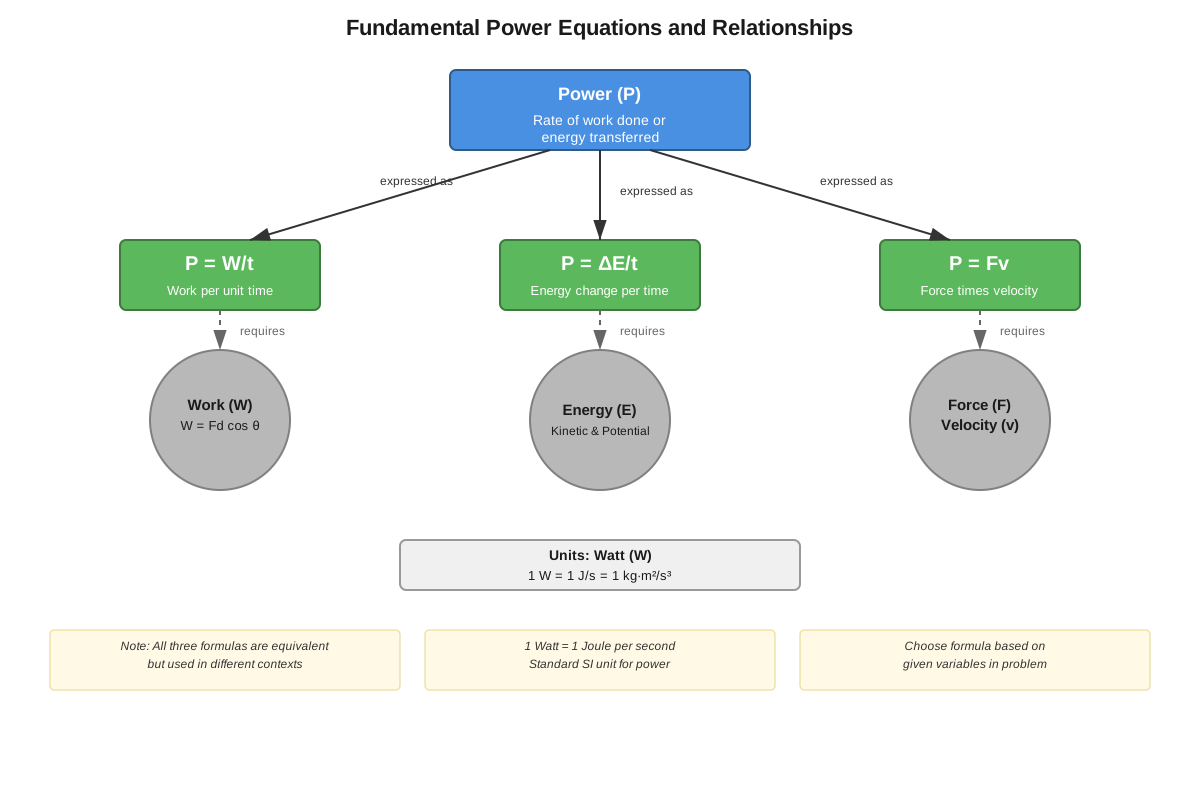
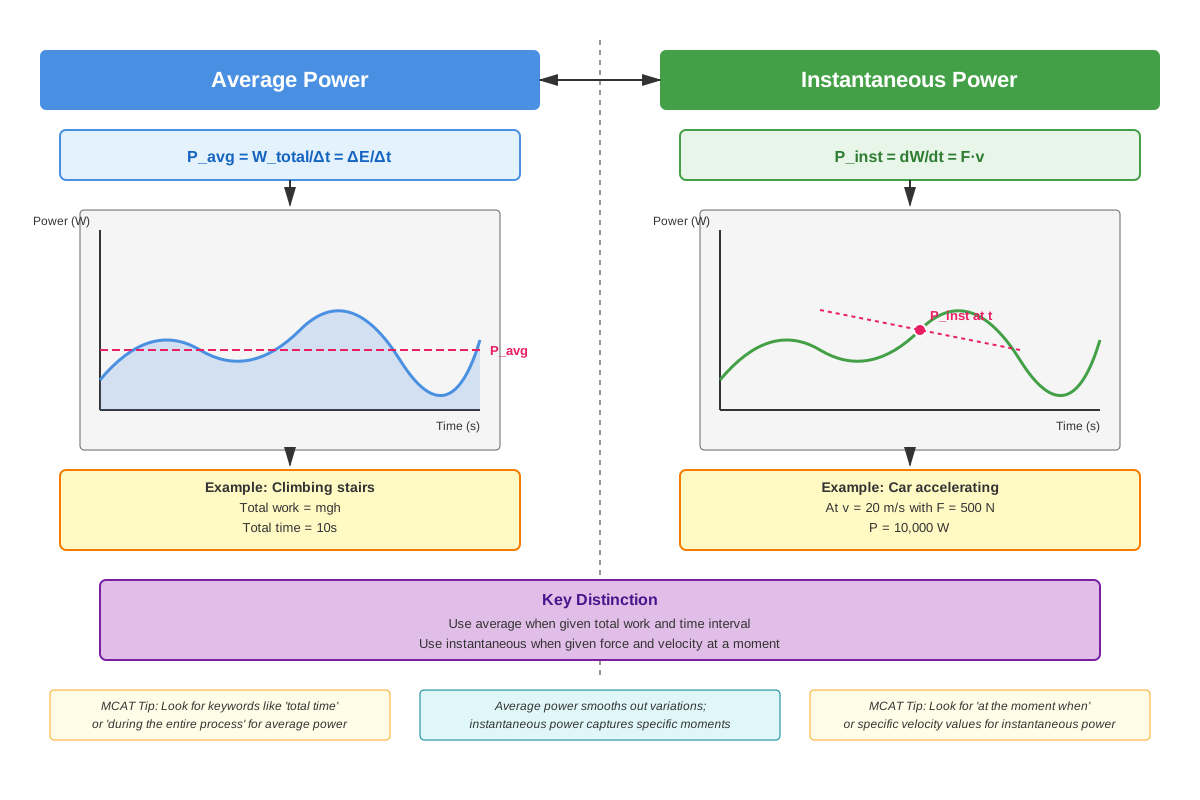
Power is defined as the rate at which work is done or energy is transferred with respect to time. Mathematically, the average power is expressed as:
P_avg = W/t = ΔE/twhere P represents power (measured in watts), W represents work (measured in joules), ΔE represents change in energy (also in joules), and t represents time (measured in seconds). The SI unit of power is the watt (W), where 1 watt equals 1 joule per second (1 W = 1 J/s).
Instantaneous power represents the power at a specific moment in time and is defined using calculus as:
P_inst = dW/dt = dE/dtFor the MCAT, students should focus primarily on average power calculations, though understanding the conceptual difference between average and instantaneous power can help with interpretation questions.
Alternative Power Formulas
Power can be expressed in multiple equivalent forms depending on the information provided in a problem. The most commonly used alternative formula derives from the work equation:
P = W/t = (F·d·cos θ)/t = F·(d/t)·cos θ = F·v·cos θWhen force and velocity are parallel (θ = 0°), this simplifies to:
P = F·vThis formula is particularly useful for problems involving constant velocity motion, such as a car traveling at steady speed against air resistance or a person walking at constant pace. The force in this equation represents the applied force in the direction of motion.
For problems involving changes in kinetic energy, power can be expressed as:
P = ΔKE/t = (½m·v_f² - ½m·v_i²)/tFor problems involving gravitational potential energy, such as lifting objects or climbing stairs:
P = ΔPE/t = (m·g·h)/tUnits and Conversions
While the watt is the SI unit, the MCAT may present power in various units requiring conversion:
| Unit | Equivalent | Common Context |
|---|---|---|
| Watt (W) | 1 J/s | Standard SI unit |
| Kilowatt (kW) | 1000 W | Household appliances, engines |
| Megawatt (MW) | 10⁶ W | Power plants, large machinery |
| Horsepower (hp) | 746 W | Automotive, historical |
| Calorie per second (cal/s) | 4.184 W | Metabolic processes |
| Kilocalorie per hour (kcal/hr) | 1.163 W | Basal metabolic rate |
The conversion between horsepower and watts (1 hp ≈ 750 W) is particularly high-yield for MCAT problems involving engines or motors. For biological contexts, remember that nutritional "Calories" (capital C) are actually kilocalories, so 1 Cal/s = 4184 W.
Power and Efficiency
Efficiency quantifies how effectively a system converts input energy into useful output energy, always expressed as a percentage or decimal less than or equal to 1:
Efficiency (η) = (Useful Energy Output / Total Energy Input) × 100%When dealing with power, efficiency can be expressed as:
η = (P_output / P_input) × 100%Real-world systems always have efficiency less than 100% due to energy losses from friction, heat dissipation, sound, and other non-useful forms. For example, human muscles typically operate at 20-25% efficiency, meaning that for every 100 J of chemical energy consumed, only 20-25 J becomes useful mechanical work, with the remainder released as heat.
The relationship between input power, output power, and efficiency is crucial for MCAT problems:
P_output = η × P_input
P_input = P_output / η
Power in Biological Systems
The human body constantly generates and consumes power through various physiological processes. Basal metabolic rate (BMR) represents the power required to maintain basic physiological functions at rest, typically 60-100 W for an average adult. During exercise, total metabolic power can increase to 300-2000 W depending on intensity.
Cardiac power represents the rate at which the heart performs work pumping blood. It can be calculated as:
P_cardiac = (Blood Pressure) × (Cardiac Output)where cardiac output is the volume of blood pumped per unit time. This relationship explains why both high blood pressure and high cardiac output increase the heart's workload.
Muscle power during activities like jumping, sprinting, or lifting depends on both the force generated and the velocity of contraction. Maximum power output occurs at intermediate velocities—not at maximum force (which occurs at zero velocity) or maximum velocity (which occurs at zero force). This force-velocity relationship is fundamental to understanding athletic performance.
Relationship Between Power, Work, and Time
A critical conceptual understanding for the MCAT is that the same amount of work can be accomplished with different power outputs by varying the time:
- High power, short time: Sprinting up stairs in 10 seconds
- Low power, long time: Walking up the same stairs in 60 seconds
Both scenarios involve the same work (same change in gravitational potential energy), but the power differs by a factor of 6. This concept frequently appears in MCAT questions asking students to compare different scenarios or explain why certain activities feel more strenuous despite accomplishing the same total work.
Concept Relationships
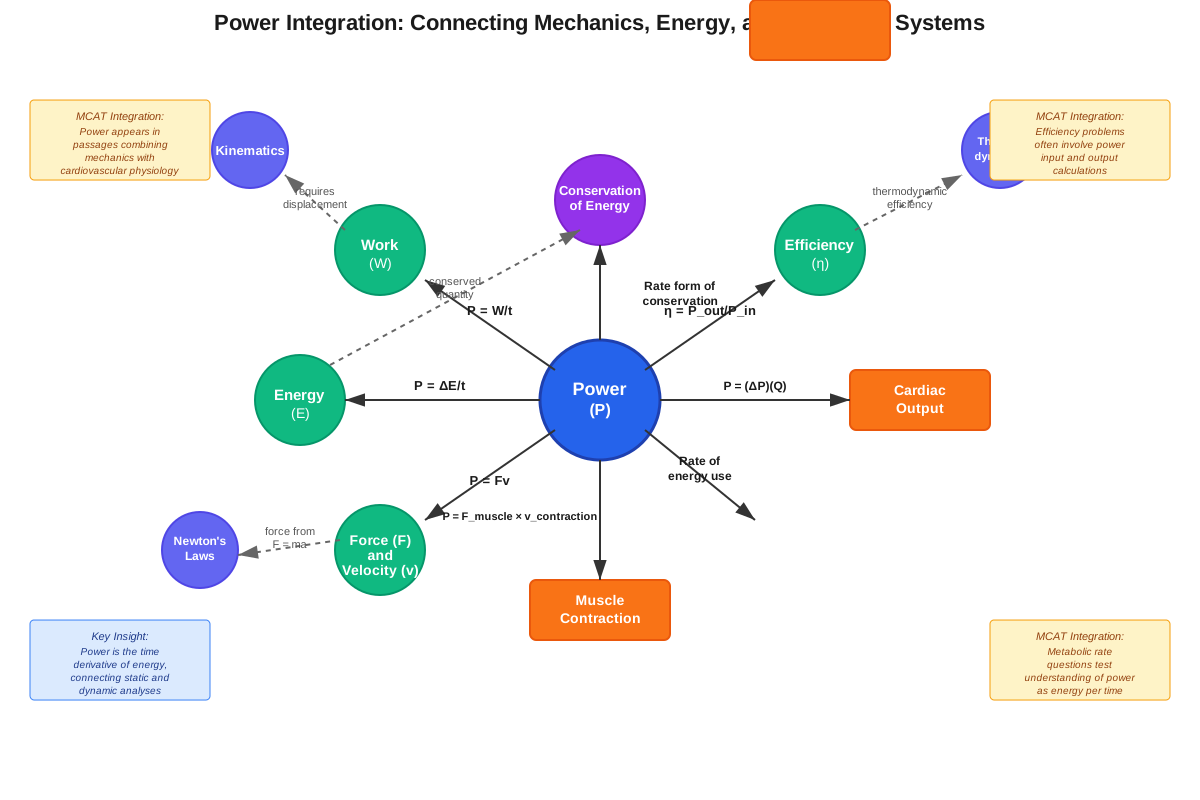
Power serves as a central hub connecting multiple fundamental concepts in mechanics. The primary relationship flows from work and energy → power → time-dependent processes. Since power is defined as the rate of energy transfer, any understanding of power requires first understanding what work and energy represent.
The equation P = Fv creates a direct bridge between force (from Newton's laws) and velocity (from kinematics), showing that power depends on both how hard you push and how fast you move. This relationship explains why cars need more powerful engines to maintain high speeds—air resistance increases with velocity, requiring greater force, and the product Fv grows rapidly.
Power connects to conservation of energy through efficiency calculations. When a system converts energy from one form to another, power quantifies the rate of conversion, while efficiency quantifies the completeness of conversion. Together, these concepts allow analysis of real-world systems where energy is conserved overall but distributed among useful and non-useful forms.
In biological contexts, power links mechanics to thermodynamics and metabolism. The chemical energy stored in ATP converts to mechanical work in muscles at a certain rate (power), with excess energy released as heat. This connection appears frequently in integrated MCAT passages combining physics with biochemistry or physiology.
The relationship map flows as: Force × Displacement = Work → Work / Time = Power → Power / Efficiency = Input Power Required → Input Power × Time = Total Energy Consumed. Understanding this chain allows students to work backward and forward through multi-step problems efficiently.
High-Yield Facts
⭐ Power is the rate of energy transfer or work done, measured in watts (W), where 1 W = 1 J/s
⭐ The two primary power formulas are P = W/t and P = Fv (when force and velocity are parallel)
⭐ Doubling the time to do the same work cuts the required power in half; halving the time doubles the required power
⭐ Efficiency = (Power output / Power input) × 100%, and is always ≤ 100% in real systems
⭐ 1 horsepower ≈ 750 watts, a conversion frequently tested on the MCAT
- Power has units of energy per time, making it fundamentally different from work or energy despite being calculated from them
- When climbing stairs, the work done depends only on mass and height change, but power depends on how quickly you climb
- Human muscles typically operate at 20-25% efficiency, meaning 75-80% of metabolic energy becomes heat
- Instantaneous power can vary even when average power remains constant, such as during periodic motion
- The power required to maintain constant velocity against resistance equals the resistance force times the velocity
- Metabolic rate (measured in kcal/day or watts) is a power measurement representing the rate of energy consumption
- In problems involving multiple energy conversions, overall efficiency equals the product of individual efficiencies
Quick check — test yourself on Power so far.
Try Flashcards →Common Misconceptions
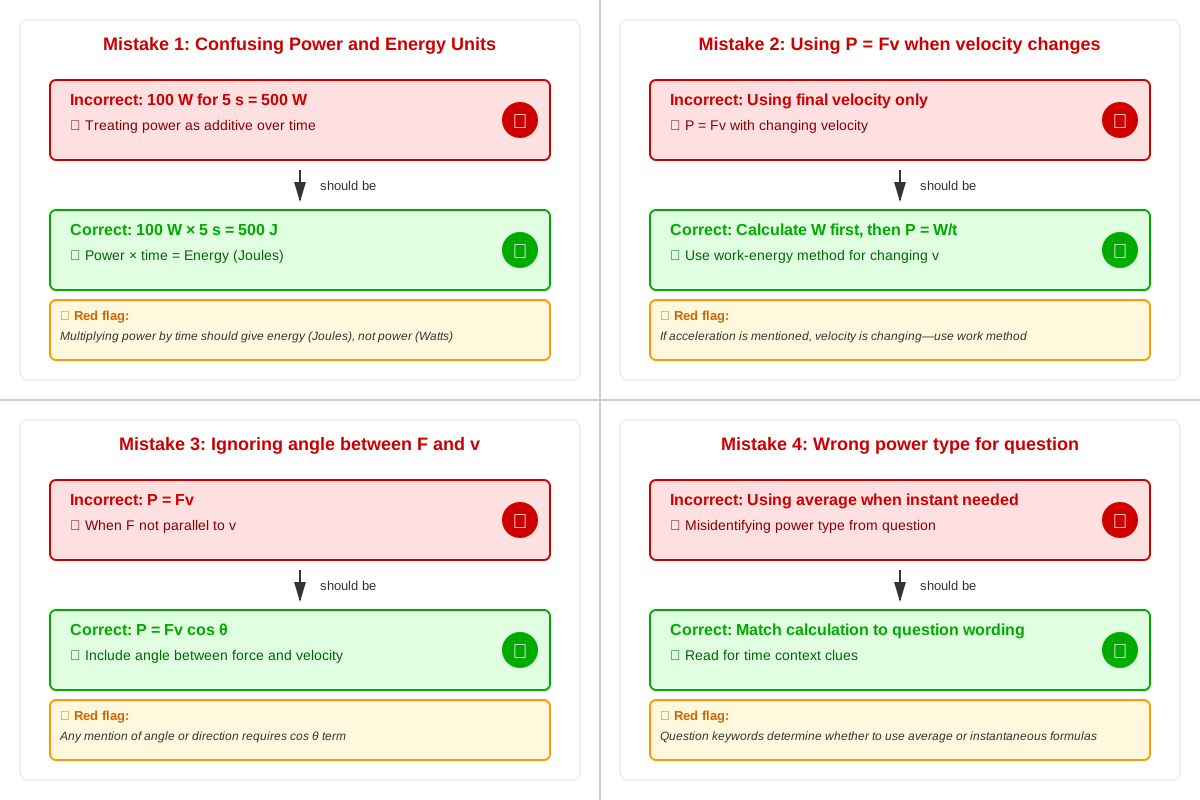
Misconception: Power and energy are the same thing, just measured in different units.
Correction: Power and energy are fundamentally different quantities. Energy (measured in joules) represents the capacity to do work or the total work done, while power (measured in watts) represents the rate at which energy is transferred or work is done. The same amount of energy can be transferred at different power levels by changing the time interval.
Misconception: Higher power always means more work is done.
Correction: Higher power means work is done more quickly, not necessarily that more total work is accomplished. A person who climbs stairs in 10 seconds does the same work as someone who climbs in 30 seconds (same mass, same height), but the faster climber generates three times the power. Total work depends on force and displacement; power additionally depends on time.
Misconception: The formula P = Fv can be used regardless of the angle between force and velocity.
Correction: The simplified formula P = Fv applies only when force and velocity are parallel (or antiparallel). When they form an angle θ, the correct formula is P = Fv cos θ, accounting for only the component of force in the direction of motion. This is analogous to the work formula W = Fd cos θ.
Misconception: A more efficient machine produces more power output.
Correction: Efficiency describes what fraction of input energy becomes useful output energy, not the absolute magnitude of power. A highly efficient machine with low input power will have low output power. A less efficient machine with very high input power might have higher output power. Efficiency and power are independent variables: η = P_out/P_in, so P_out = η × P_in depends on both factors.
Misconception: Power is always constant during a process.
Correction: Power can vary throughout a process. For example, when accelerating a car from rest, power increases as velocity increases (since P = Fv and v is increasing). The formulas P = W/t and P = ΔE/t calculate average power over a time interval, which may differ significantly from instantaneous power at any given moment. The MCAT typically focuses on average power, but recognizing when power varies helps with conceptual questions.
Misconception: Doubling the force doubles the power.
Correction: The effect of doubling force on power depends on the situation. If velocity remains constant (as when overcoming resistance), then P = Fv means doubling F doubles P. However, if you're accelerating an object, doubling the force increases acceleration, which changes velocity over time, making the relationship more complex. Always identify whether the problem involves constant velocity or acceleration before applying power formulas.
Worked Examples
Example 1: Climbing Stairs
Problem: A 70-kg student climbs a flight of stairs with a vertical height of 4.0 m. In trial A, the student climbs the stairs in 5.0 seconds. In trial B, the student climbs the same stairs in 15 seconds. Calculate the power output in each trial and determine how many times greater the power is in trial A compared to trial B.
Solution:
Step 1: Identify what type of energy change occurs. The student increases gravitational potential energy: ΔPE = mgh
Step 2: Calculate the work done (which equals the change in potential energy):
W = ΔPE = mgh = (70 kg)(10 m/s²)(4.0 m) = 2800 JNote: Using g = 10 m/s² is standard for MCAT calculations unless otherwise specified.
Step 3: Calculate power for trial A using P = W/t:
P_A = 2800 J / 5.0 s = 560 WStep 4: Calculate power for trial B:
P_B = 2800 J / 15 s = 187 W ≈ 190 WStep 5: Determine the ratio:
P_A / P_B = 560 W / 187 W = 3.0Answer: The power output in trial A is 560 W, in trial B is approximately 190 W, and trial A requires 3 times the power of trial B.
Key Insight: This problem illustrates that the same work (same mass, same height) requires different power depending on time. The faster climb requires proportionally more power. This concept appears frequently in MCAT questions comparing different scenarios.
Example 2: Engine Efficiency and Power
Problem: A car engine has a power output of 150 hp and operates at 25% efficiency. How much total power input (in watts) does the engine require? If the car travels at a constant velocity of 30 m/s against a total resistance force, what is the magnitude of that resistance force?
Solution:
Step 1: Convert horsepower to watts:
P_output = 150 hp × 750 W/hp = 112,500 W ≈ 113 kWStep 2: Use efficiency to find input power:
η = P_output / P_input
P_input = P_output / η = 112,500 W / 0.25 = 450,000 W = 450 kW
Step 3: For constant velocity, the engine's output power equals the power dissipated against resistance. Use P = Fv:
P_output = F_resistance × v
F_resistance = P_output / v = 112,500 W / 30 m/s = 3,750 NAnswer: The engine requires 450 kW of input power, and the resistance force is 3,750 N.
Key Insight: This problem combines unit conversion, efficiency, and the P = Fv formula. At constant velocity, net force is zero, so the engine's driving force equals the resistance force. The power output of the engine goes entirely into overcoming resistance. The 75% of input power "lost" to inefficiency becomes heat in the engine and exhaust. This type of multi-step problem is characteristic of MCAT physics passages.
Exam Strategy
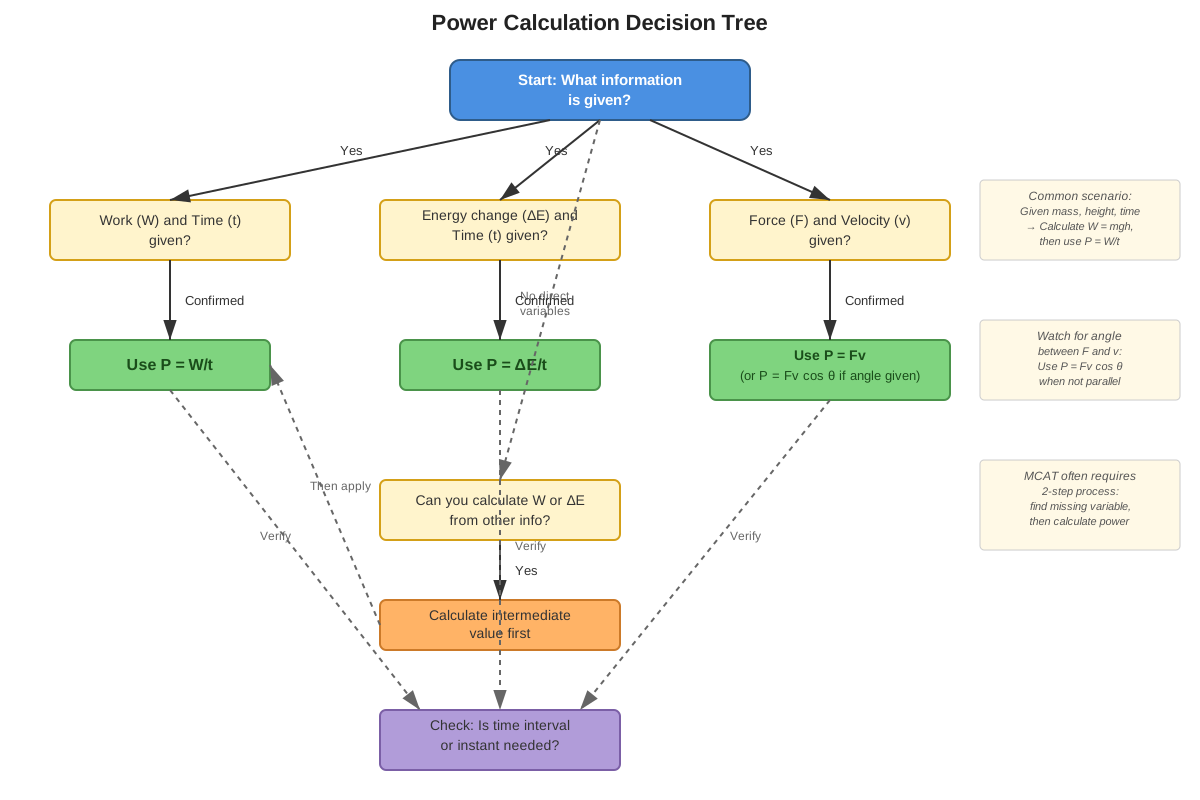
When approaching Power MCAT questions, begin by identifying what information is provided and what is being asked. Power problems typically give you three of four variables (power, work/energy, force, velocity, time) and ask you to find the fourth. Quickly determine which formula is most appropriate:
- If given work/energy and time → use P = W/t or P = ΔE/t
- If given force and velocity → use P = Fv (check if they're parallel)
- If given mass, height, and time → use P = mgh/t
- If given efficiency and one power value → use η = P_out/P_in
Trigger words that indicate power is relevant include: "rate," "how quickly," "intensity," "per unit time," "metabolic rate," "output," and comparisons involving time differences for the same task. Phrases like "which requires more effort" or "which is more strenuous" often test power concepts even without using the word "power."
For process-of-elimination, remember these principles:
- Power must have units of energy/time (eliminate answers with wrong units)
- Power increases if the same work is done in less time (eliminate answers showing the opposite)
- Power output cannot exceed power input (eliminate answers violating this for efficiency problems)
- Doubling velocity doubles power if force is constant (use this to eliminate inconsistent answers)
Time allocation: Straightforward power calculations should take 30-45 seconds. Multi-step problems involving efficiency or unit conversions may require 60-90 seconds. If a problem requires more than 2 minutes, you may be overcomplicating it—look for a simpler approach or flag it and return later.
For passage-based questions, scan for numerical values of energy, work, force, velocity, and time. Often the passage provides more information than needed, and identifying the relevant values quickly is key. Draw a simple diagram if the scenario involves motion or energy conversion—visual representation often clarifies which formula to apply.
Memory Techniques
"Power Plays Fast": Remember that power is all about speed—how fast work gets done or energy transfers. This helps distinguish power from work/energy.
"WATT = Work And Time Together": The watt is the unit of power, reminding you that power involves both work and time (P = W/t).
"FV for Fast Vehicles": The formula P = Fv is useful for vehicles or objects moving at constant velocity. The alliteration helps recall when to use this formula.
"750 Horses": Remember that 1 horsepower ≈ 750 watts by visualizing 750 horses (an absurd image that sticks in memory).
"Efficiency is a Fraction": Efficiency is always output/input, which is always ≤ 1 (or ≤ 100%). Visualize efficiency as a fraction of a pie—you never get more pie out than you put in.
"Same Work, Different Power": For problems comparing scenarios, remember this phrase. If two situations involve the same displacement and force (same work), the one with less time has more power. Visualize two people climbing identical stairs—the faster climber generates more power.
"Power Pyramid": Visualize a pyramid with Power at the top, Work and Time at the base. This represents P = W/t and reminds you that power sits "above" work and time conceptually.
Summary
Power represents the rate of energy transfer or work done, quantified as energy per unit time with SI units of watts (1 W = 1 J/s). The fundamental formulas P = W/t and P = Fv provide complementary approaches to power calculations depending on available information. Understanding that the same work can be accomplished at different power levels by varying time is essential for conceptual questions. Efficiency relates input and output power through η = P_out/P_in, always yielding values ≤ 100% in real systems due to energy losses. For the MCAT, power appears in diverse contexts including muscle physiology, cardiovascular function, metabolic rate, and mechanical systems. Success requires facility with unit conversions (especially horsepower to watts), recognition of when power is relevant even when not explicitly mentioned, and ability to select the appropriate formula based on given information. Power bridges mechanics with biological systems, making it a high-yield topic for integrated passages that test both physics knowledge and scientific reasoning.
Key Takeaways
- Power is the rate of energy transfer or work done, fundamentally different from energy or work itself, measured in watts (J/s)
- The two essential formulas are P = W/t (or P = ΔE/t) and P = Fv, with the choice depending on what information is provided
- The same amount of work done in less time requires proportionally more power—this concept underlies many MCAT comparison questions
- Efficiency (η = P_out/P_in) is always ≤ 100% in real systems, with the "lost" energy typically becoming heat
- Unit conversions are critical: 1 hp ≈ 750 W, and metabolic rates in kcal/day must be converted to watts for power calculations
- Power appears in biological contexts as metabolic rate, cardiac output, and muscle performance, requiring integration of physics with physiology
- Recognizing implicit power questions (using trigger words like "rate," "intensity," or "how quickly") separates high-scoring students from those who only recognize explicit formula-based problems
Related Topics
Work and Energy: Mastering power requires deep understanding of work (W = Fd cos θ) and various forms of energy (kinetic, potential, thermal). Power quantifies the rate of work or energy transfer, making these prerequisite concepts essential.
Conservation of Energy: Power problems often involve energy transformations where total energy is conserved but distributed among different forms. Understanding conservation principles helps analyze efficiency and energy flow in complex systems.
Forces and Newton's Laws: The formula P = Fv directly connects force to power, requiring understanding of force vectors, net force, and the relationship between force and motion.
Circular Motion and Rotational Dynamics: Rotational power (P = τω, where τ is torque and ω is angular velocity) extends linear power concepts to rotating systems, relevant for problems involving wheels, pulleys, and rotating biological structures.
Fluids and Hemodynamics: Cardiac power and blood flow involve fluid dynamics principles combined with power concepts, appearing in integrated MCAT passages about cardiovascular physiology.
Thermodynamics: The connection between mechanical power, heat generation, and efficiency bridges mechanics with thermodynamics, particularly relevant for understanding metabolic processes and engine operation.
Practice CTA
Now that you've mastered the core concepts of power, it's time to solidify your understanding through active practice. Attempt the practice questions and flashcards associated with this topic to reinforce your knowledge and identify any remaining gaps. Remember, the MCAT rewards not just conceptual understanding but also speed and accuracy in application—skills that develop only through deliberate practice. Each problem you solve strengthens your pattern recognition and builds the confidence you'll need on test day. You've built a strong foundation; now put it to work!
Sign up free to keep reading
Create a free AnvayaPrep account to finish this MCAT guide on Power — plus flashcards and practice questions.