Overview
Hydrostatic pressure represents one of the most clinically relevant and frequently tested concepts in the Fluids section of MCAT Physics. This fundamental principle describes the pressure exerted by a fluid at rest due to the force of gravity acting on the fluid column above a given point. Understanding hydrostatic pressure is essential not only for solving quantitative physics problems but also for interpreting physiological phenomena such as blood pressure variations throughout the body, cerebrospinal fluid dynamics, and the mechanics of intravenous fluid administration.
The MCAT consistently tests hydrostatic pressure through both standalone questions and integrated passages that combine physics principles with biological applications. Students must be comfortable deriving and applying the hydrostatic pressure equation, understanding how pressure varies with depth in static fluids, and recognizing the relationship between fluid density, gravitational acceleration, and pressure changes. This topic serves as a bridge between pure physics concepts and their medical applications, making it particularly high-yield for the exam.
Hydrostatic pressure Physics connects intimately with other core concepts including Pascal's principle, buoyancy, fluid dynamics, and the continuity equation. Mastery of this topic provides the foundation for understanding more complex fluid behavior, pressure measurement devices like manometers and barometers, and the cardiovascular system's pressure gradients. The principles learned here will resurface in biological contexts throughout the MCAT, particularly when analyzing circulatory physiology, respiratory mechanics, and kidney function.
Learning Objectives
- [ ] Define hydrostatic pressure using accurate Physics terminology
- [ ] Explain why hydrostatic pressure matters for the MCAT
- [ ] Apply hydrostatic pressure to exam-style questions
- [ ] Identify common mistakes related to hydrostatic pressure
- [ ] Connect hydrostatic pressure to related Physics concepts
- [ ] Calculate pressure at various depths in single and multi-layered fluid systems
- [ ] Predict how changes in fluid density or gravitational field affect hydrostatic pressure
- [ ] Analyze physiological scenarios involving hydrostatic pressure gradients in the human body
Prerequisites
- Basic algebra and equation manipulation: Required for rearranging the hydrostatic pressure equation and solving for unknown variables
- Understanding of force and pressure: Hydrostatic pressure builds on the fundamental definition of pressure as force per unit area
- Familiarity with density: The relationship between mass, volume, and density is central to hydrostatic pressure calculations
- Knowledge of gravitational acceleration: The constant g = 9.8 m/s² (or approximately 10 m/s² for MCAT calculations) appears in all hydrostatic pressure equations
- Unit conversions: Students must convert between pascals, atmospheres, mmHg, and other pressure units commonly used in medical contexts
Why This Topic Matters
Hydrostatic pressure MCAT questions appear with remarkable consistency across all test administrations, making this a truly high-yield topic. The concept appears in approximately 60-70% of MCAT exams, either as direct calculation problems or embedded within passage-based questions about fluid systems. The MCAT particularly favors questions that integrate hydrostatic pressure with biological systems, requiring students to apply physics principles to physiological contexts.
Clinically, hydrostatic pressure governs numerous critical physiological processes. Blood pressure measurements reflect hydrostatic pressure differences between the heart and measurement site, which is why blood pressure readings differ between the arm and ankle. Cerebral edema, pulmonary edema, and peripheral edema all involve disruptions in normal hydrostatic pressure gradients. Intravenous fluid administration rates depend on the height difference between the IV bag and the insertion site. Understanding these principles helps future physicians interpret clinical findings and make informed treatment decisions.
On the MCAT, hydrostatic pressure commonly appears in passages about: cardiovascular physiology and blood pressure regulation; diving physiology and the effects of depth on the body; kidney function and glomerular filtration; respiratory mechanics and pleural pressure; experimental apparatus involving fluid columns and pressure measurements; and U-tube manometer problems. Questions typically require students to either calculate absolute pressure at a given depth, determine pressure differences between two points, or predict how system changes affect pressure distributions.
Core Concepts
Definition and Fundamental Equation
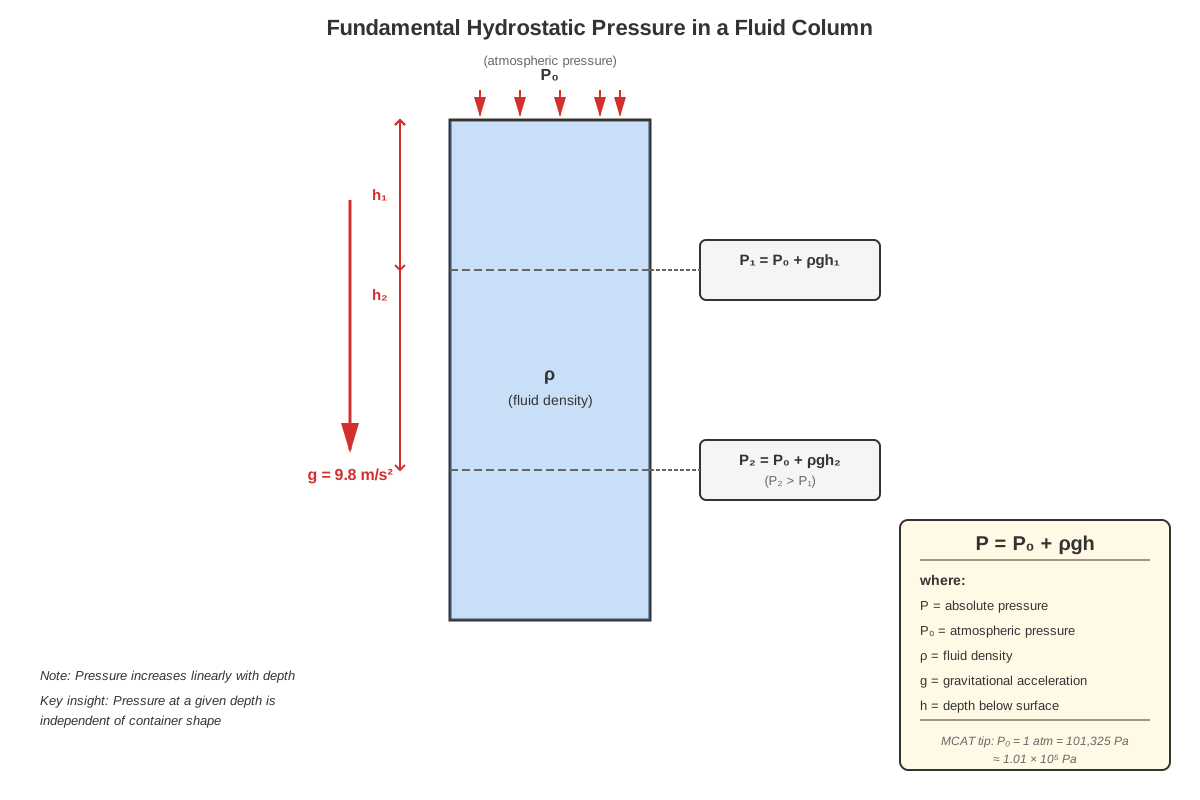
Hydrostatic pressure is the pressure exerted by a fluid at equilibrium at any point within the fluid due to the force of gravity. Unlike dynamic pressure (which involves fluid motion), hydrostatic pressure exists in static fluids and depends only on the depth below the surface, fluid density, and gravitational acceleration.
The fundamental equation for hydrostatic pressure is:
P = P₀ + ρghWhere:
- P = absolute pressure at depth h (measured in pascals, Pa, or N/m²)
- P₀ = pressure at the surface of the fluid (often atmospheric pressure = 101,325 Pa ≈ 1 atm)
- ρ (rho) = density of the fluid (kg/m³)
- g = gravitational acceleration (9.8 m/s² or approximately 10 m/s² for MCAT calculations)
- h = depth below the surface (meters)
The term ρgh represents the gauge pressure—the pressure due solely to the fluid column above the point of interest. The absolute pressure includes both this gauge pressure and the pressure acting on the fluid's surface.
Pressure Variation with Depth
A critical principle of hydrostatics is that pressure increases linearly with depth in a uniform fluid. For every meter of depth in water (density ≈ 1000 kg/m³), the pressure increases by approximately 10,000 Pa (or about 0.1 atm). This linear relationship means that:
- Pressure is the same at all points at the same horizontal level in a connected fluid
- Pressure increases as you move downward in a fluid
- Pressure decreases as you move upward in a fluid
- The rate of pressure change depends on fluid density (denser fluids show greater pressure increases per unit depth)
This principle explains why deep-sea divers experience enormous pressures, why dams must be thicker at the bottom than the top, and why blood pressure is higher in the feet than in the head when standing.
Gauge Pressure vs. Absolute Pressure
Understanding the distinction between gauge pressure and absolute pressure is essential for MCAT success:
| Pressure Type | Definition | Equation | When to Use |
|---|---|---|---|
| Gauge Pressure | Pressure relative to atmospheric pressure | P_gauge = ρgh | When measuring pressure differences; manometer readings |
| Absolute Pressure | Total pressure including atmospheric | P_absolute = P₀ + ρgh | When calculating forces; comparing pressures in different systems |
Most pressure-measuring devices (like tire pressure gauges and blood pressure cuffs) measure gauge pressure. However, physics calculations often require absolute pressure, particularly when using the ideal gas law or calculating forces on surfaces.
Hydrostatic Pressure in Layered Fluids
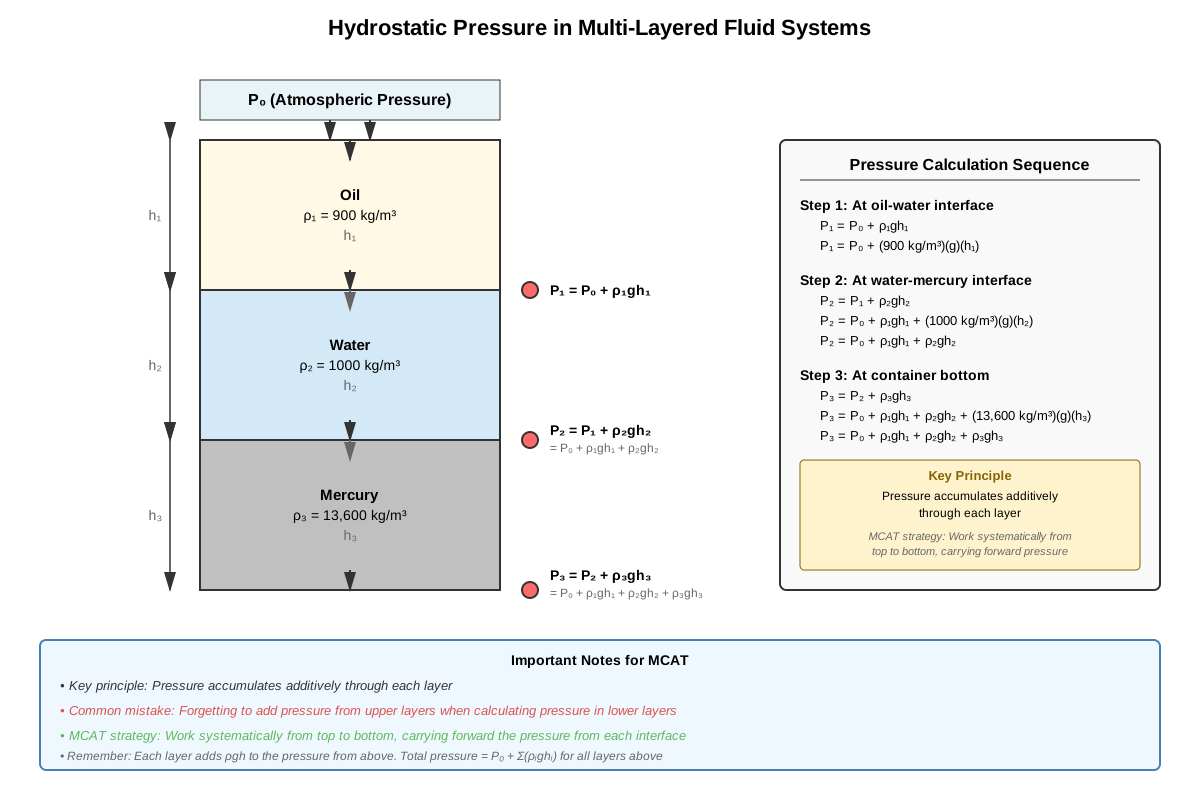
When multiple immiscible fluids of different densities are layered in a container, the total pressure at any depth must account for all fluid layers above that point:
P = P₀ + ρ₁gh₁ + ρ₂gh₂ + ρ₃gh₃ + ...Each fluid layer contributes to the total pressure based on its own density and thickness. This concept frequently appears in MCAT problems involving oil floating on water, or in physiological contexts where different body fluids have different densities.
Pascal's Principle and Hydrostatic Pressure
Pascal's principle states that a pressure change applied to an enclosed fluid is transmitted undiminished to every point in the fluid and to the walls of the container. This principle works in conjunction with hydrostatic pressure: while hydrostatic pressure varies with depth, any additional pressure applied to the system (like pressing on the surface) is added equally throughout the fluid.
This explains how hydraulic systems work and why squeezing a closed water bottle increases pressure equally at all points inside, even though hydrostatic pressure still varies with depth within the bottle.
Physiological Applications
In the human body, hydrostatic pressure creates significant pressure gradients:
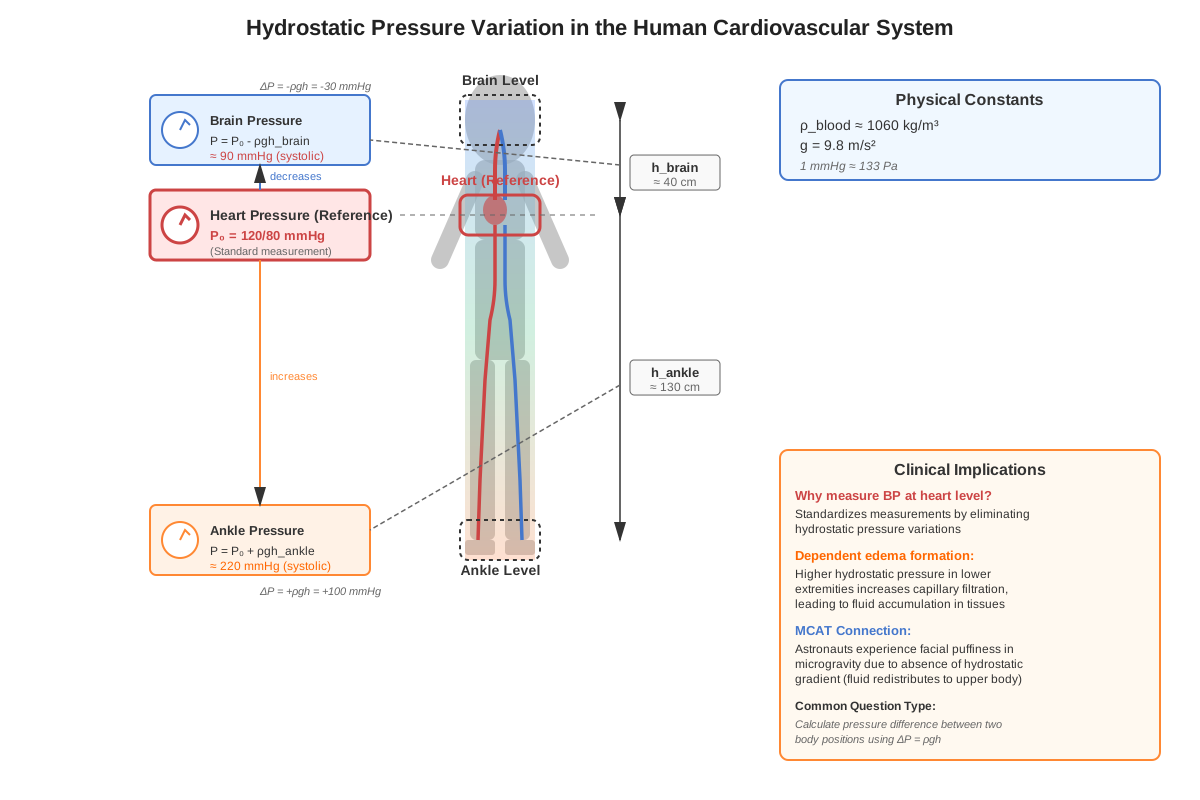
Cardiovascular System: When standing, blood pressure in the feet is approximately 90-100 mmHg higher than at heart level due to the hydrostatic pressure of the blood column. This is why prolonged standing can cause ankle swelling as increased capillary pressure forces fluid into tissues.
Cerebrospinal Fluid (CSF): The brain and spinal cord are surrounded by CSF, which exerts hydrostatic pressure. Changes in CSF pressure (measured via lumbar puncture) can indicate conditions like hydrocephalus or intracranial hemorrhage.
Glomerular Filtration: Kidney function depends on pressure gradients, including the hydrostatic pressure of blood in glomerular capillaries, which drives filtration of plasma into Bowman's capsule.
Concept Relationships
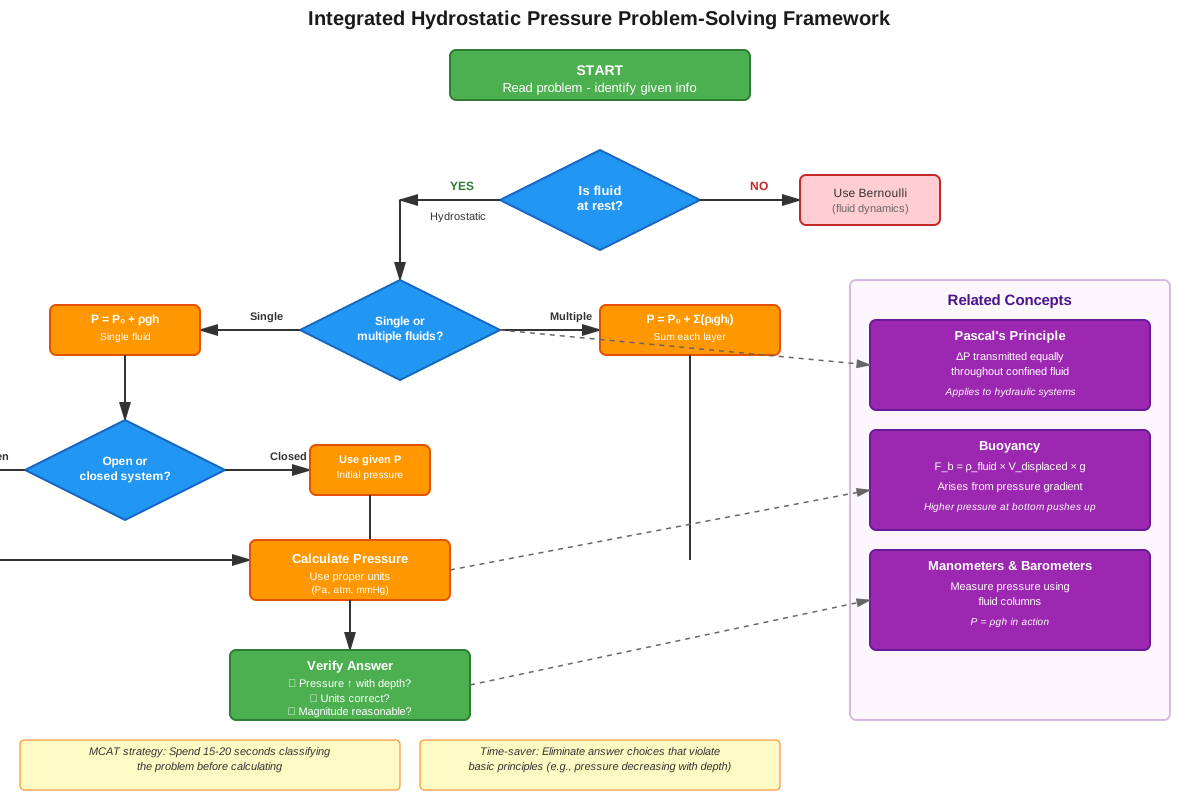
Hydrostatic pressure serves as a central hub connecting multiple physics and biological concepts. The relationship map flows as follows:
Density and Mass → determines → Hydrostatic Pressure → influences → Buoyancy and Archimedes' Principle
Gravitational Force → creates → Hydrostatic Pressure → combines with → Pascal's Principle → enables → Hydraulic Systems
Hydrostatic Pressure → special case of → Fluid Statics → contrasts with → Fluid Dynamics (Bernoulli's equation)
Pressure Gradients (from hydrostatic pressure) → drive → Fluid Flow → governed by → Continuity Equation and Poiseuille's Law
Within the topic itself, the core equation P = P₀ + ρgh connects surface pressure, fluid properties (density), gravitational effects, and geometric factors (depth). Understanding that pressure increases linearly with depth leads to recognizing that pressure differences drive fluid movement, which connects to cardiovascular physiology. The distinction between gauge and absolute pressure relates to measurement techniques and experimental design, frequently tested in passage-based questions.
The prerequisite knowledge of force and pressure (P = F/A) provides the foundation for understanding why fluid weight creates pressure. This connects forward to buoyancy, where the pressure difference between the top and bottom of a submerged object creates an upward buoyant force. Similarly, hydrostatic pressure principles extend to understanding barometers and manometers, which are essentially applications of the hydrostatic pressure equation to measure atmospheric or system pressures.
High-Yield Facts
⭐ Hydrostatic pressure increases linearly with depth: For every 10 meters of depth in water, pressure increases by approximately 1 atmosphere (101,325 Pa).
⭐ The hydrostatic pressure equation is P = P₀ + ρgh: This is the single most important equation for this topic and must be memorized with all variable definitions.
⭐ Pressure at a given depth is independent of container shape: A point 5 meters below the surface experiences the same pressure whether in a narrow tube or wide ocean, as long as the fluid and depth are the same.
⭐ Gauge pressure equals ρgh: When measuring pressure relative to atmospheric pressure, use only the fluid column term without P₀.
⭐ Blood pressure varies by approximately 0.77 mmHg per centimeter of height difference in the human body due to hydrostatic pressure of blood (density ≈ 1060 kg/m³).
- Hydrostatic pressure acts perpendicular to any surface in contact with the fluid, regardless of surface orientation.
- In a U-tube manometer, the pressure difference between two points equals ρgh, where h is the vertical height difference between fluid levels.
- Atmospheric pressure (1 atm = 101,325 Pa ≈ 760 mmHg) is equivalent to the hydrostatic pressure of approximately 10 meters of water or 760 mm of mercury.
- For layered immiscible fluids, calculate pressure by summing the contributions from each layer: P = P₀ + Σ(ρᵢgHᵢ).
- The pressure difference between two points at different depths in the same fluid is ΔP = ρgΔh, independent of the path taken between the points.
- Hydrostatic pressure in a static fluid depends only on vertical depth, not horizontal position.
- When a fluid is in a rotating container (like a centrifuge), an effective "gravity" must be used that includes centripetal acceleration.
Quick check — test yourself on Hydrostatic pressure so far.
Try Flashcards →Common Misconceptions
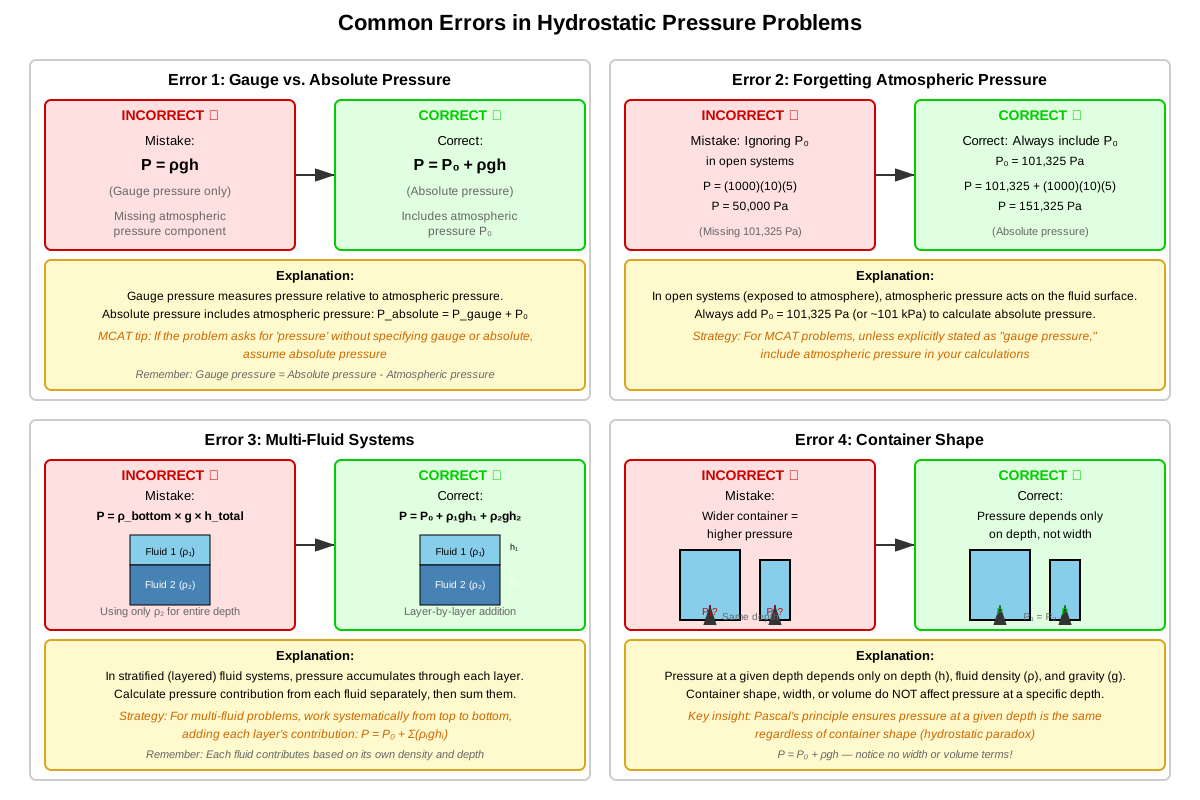
Misconception: Hydrostatic pressure depends on the total volume or mass of fluid in the container.
Correction: Hydrostatic pressure depends only on the vertical depth below the surface, fluid density, and gravitational acceleration. A narrow tube and a wide ocean have the same pressure at the same depth if filled with the same fluid. This is known as the hydrostatic paradox.
Misconception: Gauge pressure and absolute pressure are the same thing and can be used interchangeably.
Correction: Gauge pressure measures pressure relative to atmospheric pressure (P_gauge = ρgh), while absolute pressure includes atmospheric pressure (P_absolute = P₀ + ρgh). Using the wrong type leads to errors of approximately 101,325 Pa (1 atm). Blood pressure measurements are gauge pressures, but calculations involving gas laws require absolute pressure.
Misconception: Pressure acts only downward in a fluid because gravity pulls downward.
Correction: While gravity acts downward, the pressure at any point in a static fluid acts equally in all directions (isotropic pressure). This is why a submerged object experiences pressure forces perpendicular to all its surfaces, not just the top surface.
Misconception: In a U-tube with different fluids in each arm, the heights must be equal when the system is at equilibrium.
Correction: At equilibrium, the pressures at the same horizontal level must be equal, not the heights. If fluids have different densities, the heights will differ such that ρ₁gh₁ = ρ₂gh₂. The denser fluid will have a lower height.
Misconception: The depth h in the equation P = P₀ + ρgh is measured from the bottom of the container.
Correction: The depth h is always measured downward from the surface of the fluid (or from the reference point where pressure P₀ is defined). Measuring from the bottom would give negative or incorrect values.
Misconception: Hydrostatic pressure applies only to liquids, not gases.
Correction: Hydrostatic pressure applies to all fluids, including gases. However, because gases have much lower densities than liquids, the pressure change over typical height differences is often negligible. Atmospheric pressure variation with altitude is an example of hydrostatic pressure in a gas.
Misconception: When calculating pressure in layered fluids, you can use an average density.
Correction: Each layer must be calculated separately using its own density and thickness, then summed: P = P₀ + ρ₁gh₁ + ρ₂gh₂ + ... Using an average density will give incorrect results unless the layers have equal thicknesses.
Worked Examples
Example 1: Calculating Absolute Pressure at Depth
Problem: A diver descends to a depth of 20 meters below the surface of the ocean. The density of seawater is 1025 kg/m³, and atmospheric pressure at the surface is 101,325 Pa. What is the absolute pressure experienced by the diver? What is the gauge pressure?
Solution:
Step 1: Identify the known variables
- Depth: h = 20 m
- Fluid density: ρ = 1025 kg/m³
- Gravitational acceleration: g = 9.8 m/s² (use 10 m/s² for quick estimation)
- Surface pressure: P₀ = 101,325 Pa
Step 2: Apply the hydrostatic pressure equation for absolute pressure
P_absolute = P₀ + ρgh
P_absolute = 101,325 Pa + (1025 kg/m³)(10 m/s²)(20 m)
P_absolute = 101,325 Pa + 205,000 Pa
P_absolute = 306,325 Pa ≈ 3.0 atm
Step 3: Calculate gauge pressure
P_gauge = ρgh = 205,000 Pa ≈ 2.0 atmKey Insights:
- The absolute pressure is approximately 3 atmospheres, meaning the diver experiences three times the pressure at sea level
- The gauge pressure (2 atm) represents the additional pressure beyond atmospheric
- For every 10 meters of depth in seawater, pressure increases by approximately 1 atmosphere
- This connects to the learning objective of applying hydrostatic pressure to exam-style calculations
Example 2: Blood Pressure Variation in the Body
Problem: A person is standing upright. The pressure at heart level is 100 mmHg. What is the blood pressure in the person's feet, which are 130 cm below the heart? The density of blood is 1060 kg/m³. (Note: 1 mmHg = 133.3 Pa)
Solution:
Step 1: Convert units and identify variables
- Height difference: h = 130 cm = 1.30 m
- Blood density: ρ = 1060 kg/m³
- Gravitational acceleration: g = 10 m/s² (MCAT approximation)
- Pressure at heart: P_heart = 100 mmHg
Step 2: Calculate the pressure increase due to the blood column
ΔP = ρgh = (1060 kg/m³)(10 m/s²)(1.30 m)
ΔP = 13,780 Pa
Step 3: Convert to mmHg
ΔP = 13,780 Pa × (1 mmHg / 133.3 Pa) ≈ 103 mmHgStep 4: Calculate total pressure in feet
P_feet = P_heart + ΔP = 100 mmHg + 103 mmHg ≈ 203 mmHgAlternative approach using the conversion factor:
Blood pressure increases by approximately 0.77 mmHg per cm of height difference:
ΔP ≈ 0.77 mmHg/cm × 130 cm ≈ 100 mmHg
P_feet ≈ 100 mmHg + 100 mmHg = 200 mmHg
Key Insights:
- Blood pressure in the feet is approximately double that at heart level when standing
- This explains why prolonged standing causes ankle swelling (increased capillary hydrostatic pressure forces fluid into tissues)
- This demonstrates the physiological relevance of hydrostatic pressure for the MCAT
- The approximation method (0.77 mmHg/cm) provides a quick way to estimate blood pressure changes with height
- This connects hydrostatic pressure physics to cardiovascular physiology, a common MCAT integration
Exam Strategy
When approaching hydrostatic pressure MCAT questions, follow this systematic strategy:
Step 1: Identify the question type
- Direct calculation (find pressure at a given depth)
- Comparison question (which point has higher pressure?)
- Conceptual question (what happens if density changes?)
- Integrated passage (applying hydrostatics to a biological or experimental system)
Step 2: Draw a diagram
Always sketch the fluid system, labeling:
- Surface of the fluid (where P₀ acts)
- Point(s) of interest
- Depth measurements (h values)
- Different fluid layers if present
- Reference points for pressure comparisons
Step 3: Identify trigger words and phrases
- "At a depth of..." → use P = P₀ + ρgh
- "Gauge pressure" → use P = ρgh (omit P₀)
- "Absolute pressure" → use P = P₀ + ρgh (include P₀)
- "Below the surface" → h is positive
- "Pressure difference between two points" → use ΔP = ρgΔh
- "At the same horizontal level" → pressures are equal in connected fluid
Step 4: Check units
MCAT problems may give measurements in various units:
- Depth: meters, centimeters, feet
- Density: kg/m³, g/cm³
- Pressure: Pa, atm, mmHg, torr, psi
Convert everything to SI units (meters, kg/m³, pascals) before calculating, then convert the answer to the requested units.
Step 5: Use process of elimination
- Eliminate answers that violate the principle that pressure increases with depth
- Eliminate answers with incorrect units or unreasonable magnitudes
- For comparison questions, eliminate options that contradict the fact that pressure is equal at the same horizontal level in a connected fluid
Time allocation: Straightforward hydrostatic pressure calculations should take 45-60 seconds. Passage-based questions requiring integration with biological concepts may take 90-120 seconds. If a problem requires multiple steps (unit conversions, layered fluids, etc.), allocate up to 2 minutes but consider flagging and returning if it's taking longer.
Common trap answers: Watch for answer choices that:
- Use gauge pressure when absolute pressure is asked (or vice versa)
- Forget to include atmospheric pressure P₀
- Use incorrect units (mixing Pa and atm without conversion)
- Calculate pressure from the bottom instead of from the surface
- Use average density in layered fluid problems instead of summing each layer
Memory Techniques
Mnemonic for the hydrostatic pressure equation: "Pretty People Really Get High"
- P = P₀ + Rho Gravity Height
- This helps remember both the equation structure and that P₀ comes first
Visualization strategy: Picture a swimming pool with a vertical ruler. As you move the ruler deeper:
- The water above gets "heavier" (more mass)
- The pressure increases linearly (straight line relationship)
- Every meter down adds the same pressure increment
- The ruler experiences pressure from all directions (not just from above)
Acronym for pressure units: "PAT" for the three most common MCAT pressure units:
- Pascals (Pa) - SI unit
- Atmospheres (atm) - convenient for large pressures
- Torr or mmHg - medical/physiological contexts
Memory aid for gauge vs. absolute:
- Gauge = Gravity only (just ρgh, relative to atmosphere)
- Absolute = All pressure (includes P₀, total pressure)
Depth relationship rhyme: "Down you go, pressure grows; up you rise, pressure dies"
- Reinforces that pressure increases with depth and decreases with height
Conversion memory: "Ten and Ten"
- 10 meters of water ≈ 1 atmosphere of pressure
- Use g ≈ 10 m/s² for quick MCAT calculations
- This makes mental math much faster: P = (1000)(10)(10) = 100,000 Pa ≈ 1 atm
Summary
Hydrostatic pressure represents the pressure exerted by a static fluid due to gravitational force acting on the fluid column above a given point. The fundamental equation P = P₀ + ρgh encapsulates the relationship between absolute pressure, surface pressure, fluid density, gravitational acceleration, and depth. This principle explains why pressure increases linearly with depth in a uniform fluid and why pressure remains constant at any given horizontal level in a connected fluid system. The distinction between gauge pressure (ρgh, relative to atmospheric pressure) and absolute pressure (including P₀) is critical for correctly solving MCAT problems. Hydrostatic pressure has profound physiological implications, governing blood pressure variations throughout the body, cerebrospinal fluid dynamics, and kidney filtration processes. Mastery requires understanding the conceptual basis (pressure results from fluid weight), computational proficiency (applying the equation with correct units), and the ability to integrate this physics principle with biological systems. Students must recognize that hydrostatic pressure depends only on depth, density, and gravity—not on container shape or total fluid volume—and that pressure acts equally in all directions at any point in a static fluid.
Key Takeaways
- The hydrostatic pressure equation P = P₀ + ρgh is the foundation: memorize it completely with all variable definitions and units
- Pressure increases linearly with depth: approximately 1 atm per 10 meters in water, creating significant physiological pressure gradients in the human body
- Gauge pressure (ρgh) vs. absolute pressure (P₀ + ρgh): know when to use each type based on question context and measurement reference
- Pressure is equal at the same horizontal level in a connected static fluid, regardless of container shape or width
- Hydrostatic pressure acts in all directions (isotropic), not just downward, explaining why submerged objects experience pressure forces on all surfaces
- Physiological applications are high-yield: blood pressure variation with height, CSF pressure, glomerular filtration, and edema formation all involve hydrostatic pressure
- For layered fluids, sum each layer's contribution: P = P₀ + ρ₁gh₁ + ρ₂gh₂ + ..., never use an average density
Related Topics
Pascal's Principle: Understanding how pressure changes are transmitted through fluids builds directly on hydrostatic pressure concepts and explains hydraulic systems, which appear in MCAT physics passages.
Buoyancy and Archimedes' Principle: The buoyant force results from the pressure difference between the top and bottom of a submerged object, making hydrostatic pressure essential for understanding why objects float or sink.
Fluid Dynamics and Bernoulli's Equation: While hydrostatic pressure applies to static fluids, Bernoulli's equation extends these concepts to moving fluids, incorporating kinetic energy and showing how pressure varies with fluid velocity.
Circulatory System Physiology: Blood pressure regulation, capillary exchange, and cardiovascular pathology all depend on understanding pressure gradients created by hydrostatic pressure combined with cardiac pumping.
Manometers and Barometers: These pressure-measuring devices are direct applications of the hydrostatic pressure equation, frequently appearing in experimental passages on the MCAT.
Poiseuille's Law and Fluid Flow: Pressure gradients (often created by hydrostatic pressure differences) drive fluid flow through tubes, connecting to blood flow through vessels and respiratory airflow.
Practice CTA
Now that you've mastered the core concepts of hydrostatic pressure, it's time to solidify your understanding through active practice. Attempt the practice questions and flashcards associated with this topic to test your ability to apply these principles under exam conditions. Focus particularly on problems that integrate hydrostatic pressure with physiological systems, as these represent the highest-yield question types on the MCAT. Remember: understanding the concept is the first step, but exam success requires rapid, accurate application under time pressure. Each practice problem you complete strengthens your pattern recognition and builds the confidence you need to excel on test day. You've got this!
Sign up free to keep reading
Create a free AnvayaPrep account to finish this MCAT guide on Hydrostatic pressure — plus flashcards and practice questions.