Overview
Buoyancy is a fundamental concept in Fluids mechanics that describes the upward force exerted by a fluid on an object immersed in it. This phenomenon, governed by Archimedes' principle, explains why ships float, why helium balloons rise, and why humans feel lighter when submerged in water. For the MCAT, buoyancy represents a high-yield topic that bridges multiple Physics concepts including density, pressure, force equilibrium, and fluid dynamics. Understanding buoyancy is essential not only for solving direct physics problems but also for interpreting biological scenarios such as blood cell sedimentation, lung function during diving, and the behavior of lipid droplets in cellular environments.
The MCAT frequently tests Buoyancy Physics through both standalone questions and passage-based problems that integrate biological contexts. Students must be comfortable calculating buoyant forces, determining whether objects will float or sink, and analyzing systems at equilibrium in fluids. The topic appears across multiple sections of the exam, particularly in passages discussing physiological adaptations to aquatic environments, medical devices like catheters and stents, and experimental setups involving fluid-based measurements. Mastery of buoyancy requires both conceptual understanding and quantitative problem-solving skills.
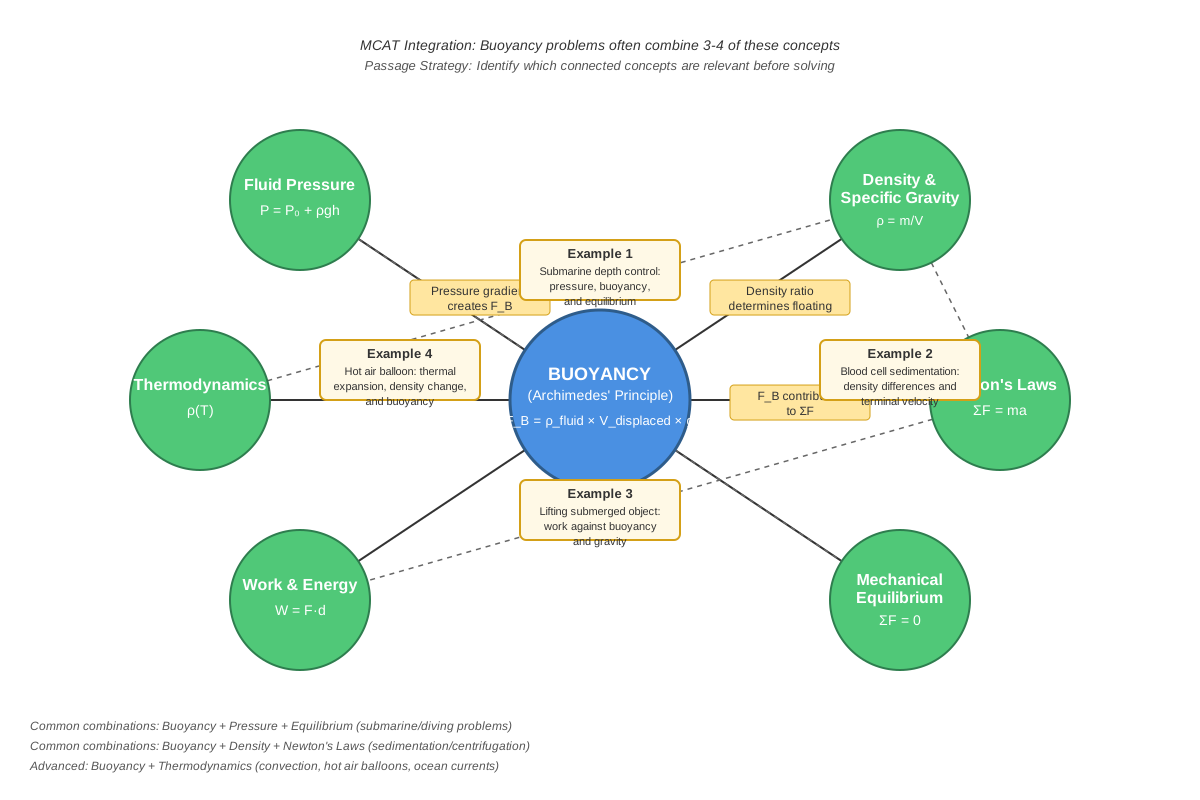
From a broader perspective, buoyancy connects intimately with other physics principles tested on the MCAT. It relies on understanding fluid pressure and how pressure varies with depth, requires facility with density calculations and unit conversions, and often involves force analysis and Newton's laws. Additionally, buoyancy problems frequently incorporate concepts of mechanical equilibrium, work-energy relationships, and even thermodynamics when temperature-dependent density changes are involved. This interconnectedness makes buoyancy an excellent topic for developing integrated problem-solving skills essential for MCAT success.
Learning Objectives
- [ ] Define Buoyancy using accurate Physics terminology
- [ ] Explain why Buoyancy matters for the MCAT
- [ ] Apply Buoyancy to exam-style questions
- [ ] Identify common mistakes related to Buoyancy
- [ ] Connect Buoyancy to related Physics concepts
- [ ] Calculate buoyant force using Archimedes' principle for objects of various shapes and densities
- [ ] Determine the fraction of an object's volume submerged when floating at equilibrium
- [ ] Analyze complex scenarios involving multiple fluids with different densities
- [ ] Predict the motion of objects in fluids based on the relationship between buoyant force and weight
Prerequisites
- Density and specific gravity: Essential for comparing object and fluid properties to determine floating behavior and calculate buoyant forces
- Pressure in fluids: Buoyancy arises from pressure differences at different depths, making pressure concepts foundational
- Newton's laws of motion: Analyzing buoyancy requires force equilibrium and understanding net force relationships
- Volume calculations: Computing buoyant force requires determining the volume of fluid displaced by submerged objects
- Unit conversions: MCAT problems often require converting between different unit systems (kg/L to g/cm³, etc.)
Why This Topic Matters
Buoyancy MCAT questions appear with remarkable frequency across multiple exam sections. Statistical analysis of recent MCAT administrations indicates that buoyancy concepts appear in approximately 15-20% of physics passages and 8-12% of standalone physics questions. Beyond direct physics applications, buoyancy principles underpin numerous biological and medical scenarios tested on the exam, including blood cell separation via centrifugation, pulmonary function during diving, lipid transport in blood, and the design of medical flotation devices.
Clinically, buoyancy explains critical physiological phenomena. The density differences between oxygenated and deoxygenated blood affect circulation patterns. Fat tissue's lower density compared to muscle influences body composition assessment methods. Understanding buoyancy is essential for comprehending decompression sickness in divers, where dissolved gases form bubbles that rise through body fluids. Medical imaging techniques like density gradient centrifugation rely entirely on buoyancy principles to separate cellular components.
On the MCAT, buoyancy typically appears in three contexts: (1) experimental passages describing fluid-based separation techniques or measurement devices, (2) physiological passages discussing aquatic adaptations or diving physiology, and (3) standalone questions testing direct application of Archimedes' principle. Questions may ask students to calculate forces, predict motion, determine equilibrium conditions, or explain observations. The topic frequently integrates with other concepts, requiring students to combine buoyancy calculations with energy conservation, pressure gradients, or fluid flow principles.
Core Concepts
Archimedes' Principle and the Buoyant Force
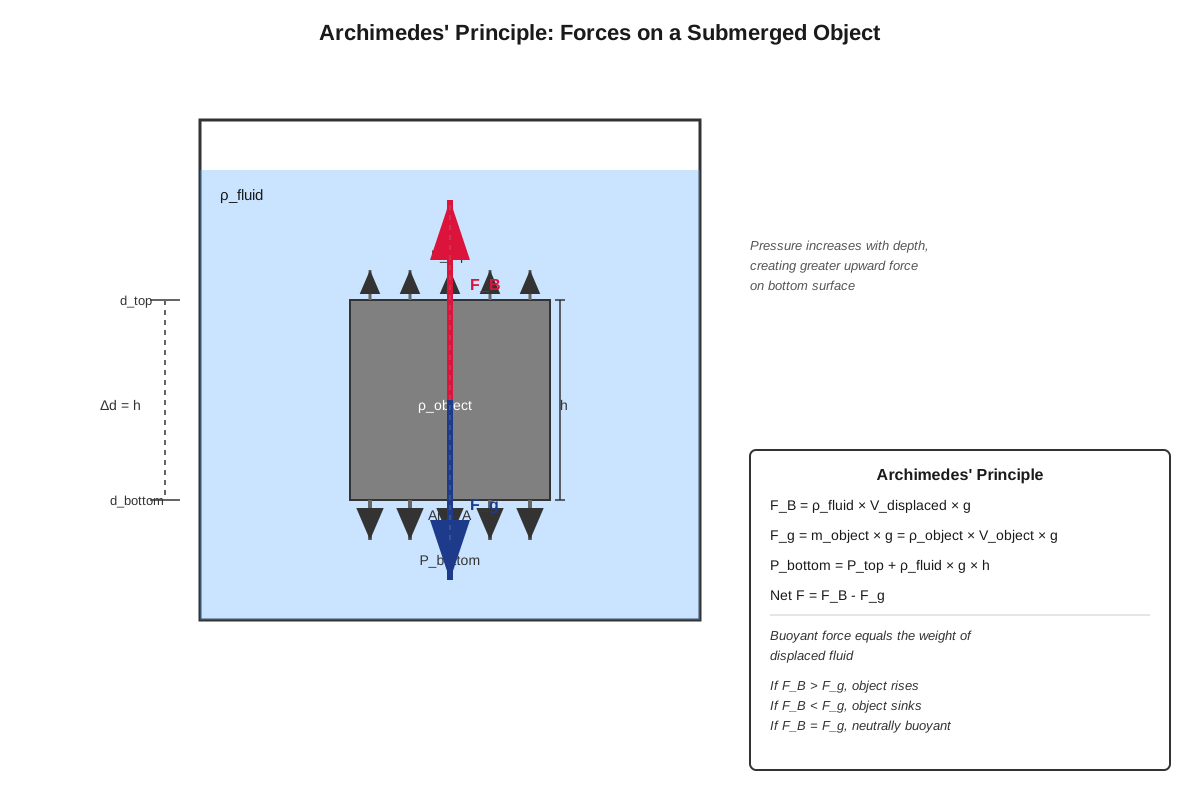
Archimedes' principle states that any object completely or partially submerged in a fluid experiences an upward buoyant force equal to the weight of the fluid displaced by the object. This principle, discovered over 2,000 years ago, remains the foundation for all buoyancy calculations on the MCAT.
The buoyant force can be expressed mathematically as:
F_b = ρ_fluid × V_displaced × gWhere:
- F_b = buoyant force (N)
- ρ_fluid = density of the fluid (kg/m³)
- V_displaced = volume of fluid displaced (m³)
- g = gravitational acceleration (9.8 m/s²)
The buoyant force always acts vertically upward, opposing gravity, and is applied at the center of buoyancy (the centroid of the displaced fluid volume). Importantly, the buoyant force depends only on the fluid's density and the volume displaced—not on the object's mass, composition, or depth below the surface (though depth affects pressure, the net upward force remains constant).
Physical Origin of Buoyancy
Buoyancy arises from pressure gradients in fluids. Pressure in a static fluid increases linearly with depth according to P = P₀ + ρgh. When an object is submerged, the bottom surface experiences greater pressure than the top surface because it's at a greater depth. This pressure difference creates a net upward force.
Consider a cube submerged in water: the downward pressure force on the top surface is P_top × A, while the upward pressure force on the bottom is P_bottom × A. Since P_bottom > P_top, the net force is upward. When you calculate this pressure difference and multiply by area, the result exactly equals the weight of fluid that would occupy the cube's volume—confirming Archimedes' principle from first principles.
Floating, Sinking, and Neutral Buoyancy
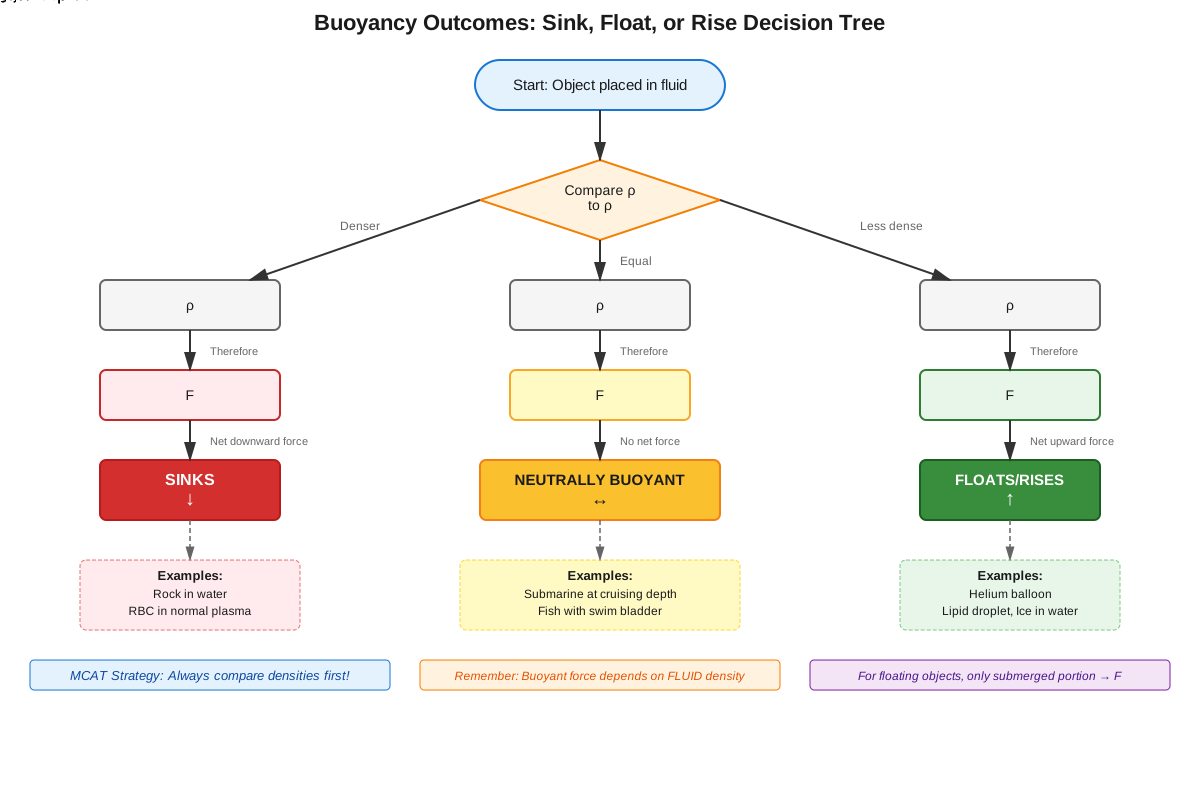
The behavior of an object in a fluid depends on the relationship between the buoyant force and the object's weight:
| Condition | Relationship | Result | Example |
|---|---|---|---|
| Sinking | F_b < W (ρ_object > ρ_fluid) | Net downward force; object accelerates downward | Rock in water |
| Floating | F_b = W (ρ_object < ρ_fluid) | Equilibrium with partial submersion | Wood in water |
| Neutral Buoyancy | F_b = W (ρ_object = ρ_fluid) | Equilibrium with complete submersion | Submarine at constant depth |
| Rising | F_b > W (ρ_object < ρ_fluid, fully submerged) | Net upward force; object accelerates upward | Helium balloon in air |
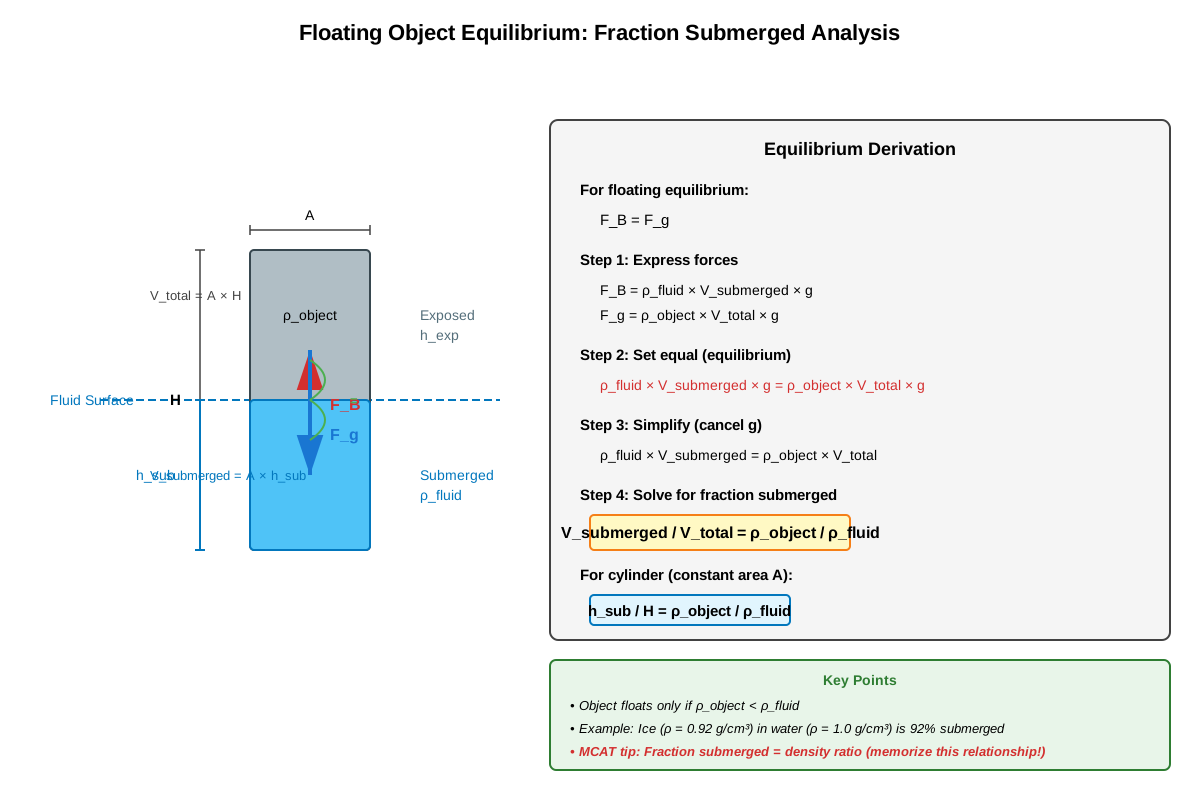
For objects floating at equilibrium, only the submerged portion displaces fluid. The fraction of volume submerged can be calculated using:
V_submerged / V_total = ρ_object / ρ_fluidThis relationship is particularly high-yield for MCAT questions. For example, ice floats with approximately 90% of its volume submerged because ice has about 90% the density of liquid water (917 kg/m³ vs. 1000 kg/m³).
Apparent Weight in Fluids
When an object is submerged in a fluid, it experiences an apparent weight less than its true weight due to the upward buoyant force. The apparent weight is:
W_apparent = W_actual - F_b = mg - ρ_fluid × V_object × gThis concept explains why objects feel lighter when lifted underwater and is the principle behind hydrostatic weighing for body composition analysis. The apparent weight can even be negative if the buoyant force exceeds the actual weight, meaning you must push downward to keep the object submerged.
Buoyancy in Multiple Fluids
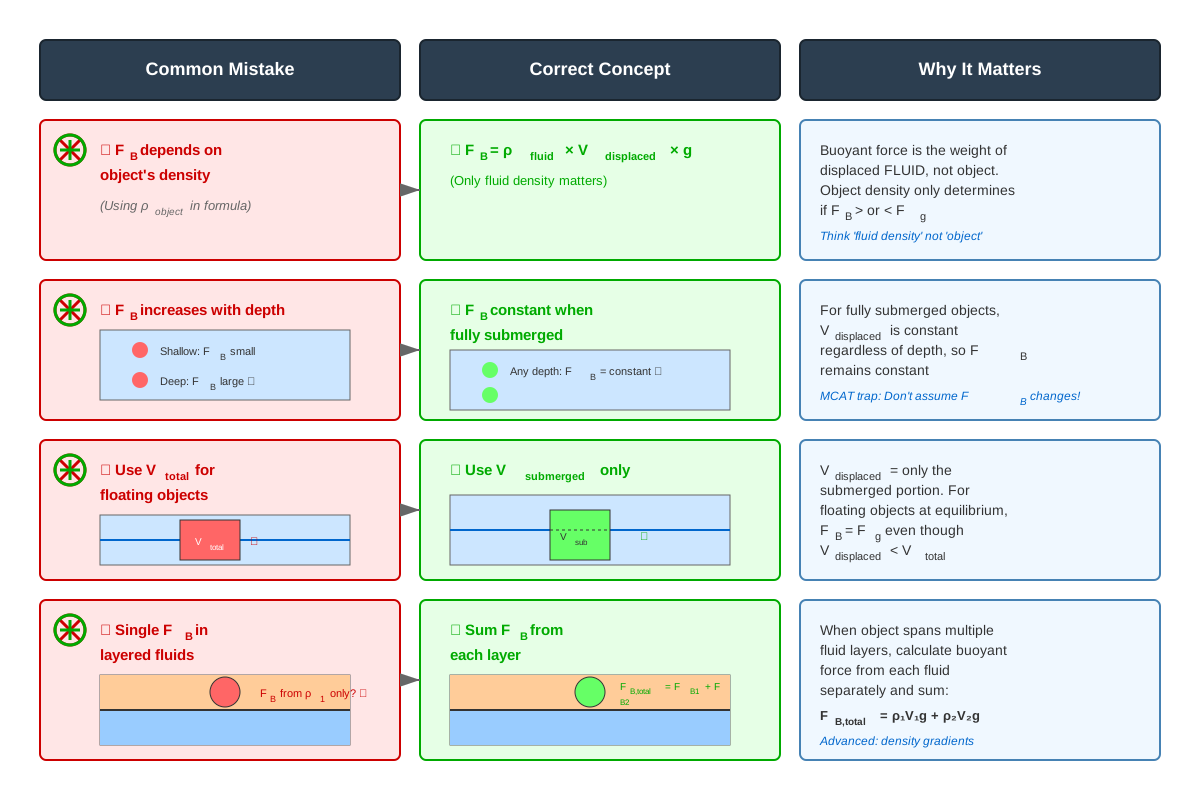
When an object floats at the interface between two immiscible fluids of different densities (like oil and water), the total buoyant force equals the sum of forces from each fluid:
F_b,total = ρ_fluid1 × V_in_fluid1 × g + ρ_fluid2 × V_in_fluid2 × gAt equilibrium, this total buoyant force equals the object's weight. These problems require careful attention to which portion of the object is submerged in which fluid. The MCAT may present such scenarios in the context of lipid layers in biological membranes or separation techniques using density gradients.
Density and Specific Gravity
Density (ρ) is mass per unit volume and is the critical property determining buoyancy behavior. Specific gravity (SG) is the ratio of an object's density to the density of water:
SG = ρ_object / ρ_waterSpecific gravity is dimensionless and particularly useful for quick comparisons. An object with SG < 1 will float in water; SG > 1 means it will sink. The MCAT frequently provides specific gravity values rather than absolute densities, requiring students to recognize that SG directly indicates floating behavior.
Temperature and Pressure Effects on Buoyancy
Fluid density changes with temperature and pressure, affecting buoyancy. Generally, fluids expand when heated (decreasing density) and compress when pressurized (increasing density). For gases, these effects are substantial; for liquids, they're smaller but still significant in precision applications.
The MCAT may test understanding of how temperature stratification in water bodies affects buoyancy (warmer, less dense water floats on cooler, denser water) or how gas bubbles expand as they rise and pressure decreases, potentially changing their buoyancy characteristics.
Concept Relationships
Buoyancy integrates multiple foundational physics concepts into a unified framework. At its core, buoyancy emerges from fluid pressure principles—specifically, the pressure gradient with depth creates the net upward force. This connection means that understanding P = P₀ + ρgh is prerequisite to deriving Archimedes' principle from first principles.
Density serves as the critical property linking objects and fluids in buoyancy problems. The comparison between ρ_object and ρ_fluid determines all qualitative behavior (floating vs. sinking), while quantitative calculations require precise density values. This connects buoyancy to thermodynamics when temperature-dependent density changes are considered.
Within buoyancy problems, force analysis using Newton's laws is essential. The buoyant force, weight, and any applied forces must be analyzed as vectors to determine net force and predict motion. At equilibrium (floating or neutral buoyancy), ΣF = 0, connecting to statics and equilibrium concepts.
The relationship map flows as follows:
Fluid Pressure Gradients → generate → Buoyant Force → combines with → Weight (mg) → determines → Net Force → predicts → Motion or Equilibrium → depends on → Density Comparison → may involve → Temperature/Pressure Effects
Buoyancy also connects forward to more advanced topics. Understanding buoyancy is essential for fluid dynamics (objects moving through fluids experience both buoyancy and drag), Bernoulli's equation applications (where pressure differences drive both flow and buoyancy), and rotational motion (objects may rotate if the center of buoyancy and center of mass don't align).
Quick check — test yourself on Buoyancy so far.
Try Flashcards →High-Yield Facts
⭐ The buoyant force equals the weight of displaced fluid, not the weight of the object (Archimedes' principle)
⭐ An object floats when its average density is less than the fluid density (ρ_object < ρ_fluid)
⭐ The fraction of a floating object's volume submerged equals the ratio of densities: V_sub/V_total = ρ_object/ρ_fluid
⭐ Buoyant force depends only on fluid density and displaced volume, not on object depth
⭐ Apparent weight in a fluid equals actual weight minus buoyant force: W_apparent = W - F_b
- The buoyant force acts upward at the center of buoyancy (centroid of displaced volume)
- Specific gravity > 1 indicates an object will sink in water; SG < 1 indicates floating
- Ice floats with approximately 90% submerged because ρ_ice ≈ 0.92 ρ_water
- For neutral buoyancy (submarine, fish), the object's average density exactly equals the fluid density
- Buoyancy in air is usually negligible for solid objects but significant for balloons and gases
- The buoyant force on a completely submerged object is constant regardless of depth
- Hollow objects can float even if their material density exceeds the fluid density (ships float because their average density including air space is less than water)
- In a density gradient (like a centrifuge tube), objects settle at the level where their density matches the surrounding fluid
Common Misconceptions
Misconception: Heavier objects experience less buoyant force than lighter objects of the same size.
Correction: Buoyant force depends only on displaced fluid volume and fluid density, not on the object's mass. Two objects of identical volume experience identical buoyant forces in the same fluid, regardless of their weights.
Misconception: The buoyant force increases as an object sinks deeper into a fluid.
Correction: For a completely submerged object, buoyant force remains constant at all depths. While pressure increases with depth, the pressure difference between top and bottom surfaces (which creates buoyancy) remains constant as long as the object is fully submerged.
Misconception: An object floats because the buoyant force is greater than its weight.
Correction: A floating object is in equilibrium, meaning the buoyant force exactly equals its weight (F_b = W). The object floats partially submerged, displacing just enough fluid to create a buoyant force equal to its weight. If F_b > W, the object would accelerate upward, not float stationary.
Misconception: Buoyancy only applies to objects in liquids, not gases.
Correction: Buoyancy occurs in all fluids, including gases. Helium balloons rise due to buoyancy in air. However, because air density is much lower than liquid densities, buoyant forces in air are typically much smaller and often negligible for solid objects.
Misconception: The shape of an object affects the buoyant force it experiences.
Correction: Only the volume of displaced fluid matters for buoyancy, not the object's shape. A sphere, cube, and irregular object of identical volume experience identical buoyant forces when fully submerged in the same fluid. Shape affects drag and flow patterns but not buoyancy.
Misconception: If an object's material density is greater than water, it cannot float under any circumstances.
Correction: The relevant density is the average density of the entire object, including any hollow spaces. Steel ships float because their average density (steel plus air) is less than water, even though steel's material density far exceeds water's density.
Misconception: Apparent weight and buoyant force are the same thing.
Correction: Apparent weight is the net downward force (W - F_b), while buoyant force is the upward force from the fluid. They are related but distinct concepts. An object with W = 100 N and F_b = 30 N has an apparent weight of 70 N.
Worked Examples
Example 1: Floating Ice Cube
Problem: An ice cube with density 920 kg/m³ floats in water (density 1000 kg/m³). If the ice cube has a total volume of 8.0 cm³, what volume is above the water surface?
Solution:
Step 1: Identify the relevant principle. For a floating object at equilibrium, the buoyant force equals the weight.
Step 2: Set up the equilibrium equation:
F_b = W
ρ_water × V_submerged × g = ρ_ice × V_total × g
Step 3: Cancel g from both sides and solve for V_submerged:
V_submerged = (ρ_ice / ρ_water) × V_total
V_submerged = (920 kg/m³ / 1000 kg/m³) × 8.0 cm³
V_submerged = 0.92 × 8.0 cm³ = 7.36 cm³
Step 4: Calculate the volume above water:
V_above = V_total - V_submerged
V_above = 8.0 cm³ - 7.36 cm³ = 0.64 cm³Answer: 0.64 cm³ of the ice cube is above the water surface.
Key Insight: This problem demonstrates the high-yield relationship that the fraction submerged equals the density ratio. Approximately 92% of the ice is submerged, leaving 8% above water. This principle applies to any floating object and is frequently tested on the MCAT.
Example 2: Apparent Weight in Water
Problem: A rock with mass 2.0 kg and volume 750 cm³ is completely submerged in water (density 1000 kg/m³). What is the apparent weight of the rock? What is the net force on the rock, and will it sink or rise?
Solution:
Step 1: Calculate the actual weight of the rock:
W = mg = 2.0 kg × 9.8 m/s² = 19.6 NStep 2: Convert volume to m³:
V = 750 cm³ × (1 m / 100 cm)³ = 750 × 10⁻⁶ m³ = 7.5 × 10⁻⁴ m³Step 3: Calculate the buoyant force:
F_b = ρ_water × V × g
F_b = 1000 kg/m³ × 7.5 × 10⁻⁴ m³ × 9.8 m/s²
F_b = 7.35 N
Step 4: Calculate apparent weight:
W_apparent = W - F_b = 19.6 N - 7.35 N = 12.25 N ≈ 12.3 NStep 5: Determine net force and motion:
Since W > F_b, there is a net downward force of 12.3 N. The rock will sink.
Step 6: Verify by comparing densities:
ρ_rock = m/V = 2.0 kg / (7.5 × 10⁻⁴ m³) = 2667 kg/m³Since ρ_rock > ρ_water, the rock sinks (confirms our force analysis).
Answer: The apparent weight is 12.3 N, the net force is 12.3 N downward, and the rock will sink.
Key Insight: This problem integrates multiple concepts: calculating buoyant force, determining apparent weight, analyzing forces to predict motion, and verifying results using density comparison. The MCAT frequently requires this type of multi-step analysis.
Exam Strategy
When approaching Buoyancy MCAT questions, begin by identifying whether the problem asks for qualitative prediction (will it float or sink?) or quantitative calculation (what is the force or volume?). For qualitative questions, immediately compare densities: ρ_object vs. ρ_fluid determines behavior. For quantitative problems, write out Archimedes' principle and identify which variables are given.
Trigger words to watch for include:
- "Submerged" or "immersed" → object is completely underwater; V_displaced = V_object
- "Floating" → object is at equilibrium; F_b = W and only partially submerged
- "Apparent weight" → calculate W - F_b
- "Specific gravity" → dimensionless density ratio; directly indicates floating behavior
- "Displaces" → focus on the volume of fluid moved, not object volume
Process-of-elimination strategies:
- Eliminate answers where buoyant force depends on object mass or depth (common distractors)
- For floating objects, eliminate answers showing 100% submersion or 0% submersion (unless densities are equal or vastly different)
- Check unit consistency—buoyant force must be in Newtons, not kg or m³
- For density comparisons, eliminate answers that contradict the ρ_object vs. ρ_fluid relationship
Time allocation: Straightforward buoyancy calculations should take 60-90 seconds. If a problem requires more than 2 minutes, check whether you're overcomplicating it—most MCAT buoyancy questions test direct application of F_b = ρVg or the floating equilibrium condition. Complex multi-step problems may warrant 2-3 minutes but should still follow systematic approaches.
Common question formats:
- Calculating buoyant force given object dimensions and fluid density
- Determining fraction submerged for floating objects
- Predicting motion based on density comparisons
- Analyzing experimental setups involving fluid displacement
- Interpreting graphs of force vs. depth or volume submerged
Always draw a free-body diagram for force problems, labeling weight (downward) and buoyant force (upward). This visual representation prevents sign errors and clarifies whether the object is in equilibrium or experiencing net force.
Memory Techniques
Archimedes' Principle Mnemonic: "Fluid Displaced Volume Gives" → F_b = ρ_fluid × V_displaced × g
Floating Fraction: "Density Determines Depth" → The density ratio (ρ_object/ρ_fluid) gives the fraction submerged. Lower object density means less depth needed.
Sink or Float Decision Tree:
Compare densities
├─ ρ_object > ρ_fluid → SINK
├─ ρ_object = ρ_fluid → NEUTRAL (suspended)
└─ ρ_object < ρ_fluid → FLOAT (or rise if fully submerged)
Visualization Strategy: Picture a scale with the object on one side and the displaced fluid on the other. Archimedes' principle says the buoyant force equals the weight of fluid on the scale. If the object weighs more than the displaced fluid, it sinks (scale tips toward object). If it weighs less, it floats (scale tips toward fluid).
Apparent Weight Acronym: "WAB" → Weight - Apparent = Buoyancy (W - W_apparent = F_b)
Pressure Origin Memory: Remember "Pressure Bottom Beats Top" → The pressure at the bottom of a submerged object exceeds the pressure at the top, creating the net upward buoyant force.
Summary
Buoyancy represents a fundamental fluid mechanics principle essential for MCAT success. The buoyant force, equal to the weight of displaced fluid (Archimedes' principle), acts upward on any object in a fluid and arises from pressure gradients with depth. Whether an object floats, sinks, or maintains neutral buoyancy depends entirely on the comparison between object density and fluid density. For floating objects at equilibrium, the fraction submerged equals the density ratio (ρ_object/ρ_fluid), while the buoyant force exactly equals the object's weight. Quantitative problems require calculating F_b = ρ_fluid × V_displaced × g and analyzing force equilibrium. The apparent weight of submerged objects (W - F_b) explains why objects feel lighter underwater. Mastery requires understanding both the physical origin of buoyancy from pressure differences and the mathematical relationships for solving problems. This topic integrates density, pressure, force analysis, and equilibrium concepts, making it a high-yield area that connects multiple physics domains tested on the MCAT.
Key Takeaways
- Archimedes' principle: Buoyant force equals the weight of displaced fluid (F_b = ρ_fluid × V_displaced × g)
- Density comparison determines behavior: Objects sink when ρ_object > ρ_fluid, float when ρ_object < ρ_fluid, and achieve neutral buoyancy when densities are equal
- Floating equilibrium: For objects floating at rest, F_b = W and the fraction submerged equals ρ_object/ρ_fluid
- Buoyant force is independent of depth: Once fully submerged, an object experiences constant buoyant force regardless of how deep it goes
- Apparent weight: Objects feel lighter in fluids by an amount equal to the buoyant force (W_apparent = W - F_b)
- Buoyancy arises from pressure gradients: The greater pressure at an object's bottom surface compared to its top creates the net upward force
- Volume displaced, not object mass, determines buoyant force: Two objects of equal volume experience equal buoyant forces in the same fluid, regardless of their masses
Related Topics
Fluid Pressure and Pascal's Principle: Understanding how pressure varies with depth and transmits through fluids provides the foundation for deriving buoyancy from first principles. Mastering pressure concepts enables deeper comprehension of why buoyant forces exist.
Fluid Dynamics and Bernoulli's Equation: Moving beyond static fluids, these topics examine objects moving through fluids, where both buoyancy and drag forces operate. Buoyancy mastery is prerequisite for understanding complex flow scenarios.
Density and Specific Gravity: These fundamental properties determine all buoyancy behavior. Advanced applications include temperature-dependent density changes and mixture densities in biological systems.
Hydrostatic Weighing and Body Composition: This clinical application uses buoyancy principles to measure body fat percentage, directly connecting physics concepts to medical practice.
Centrifugation and Sedimentation: These laboratory techniques exploit density differences and buoyancy principles to separate biological materials, representing high-yield MCAT passage topics.
Practice CTA
Now that you've mastered the core concepts of buoyancy, it's time to solidify your understanding through active practice. Attempt the practice questions and flashcards associated with this topic to test your ability to apply Archimedes' principle, analyze floating equilibrium, and solve complex buoyancy problems under timed conditions. Remember, the MCAT rewards not just knowledge but the ability to apply concepts quickly and accurately. Each practice problem you solve strengthens your pattern recognition and builds the confidence needed for test day success. You've built a strong foundation—now prove it through practice!
Sign up free to keep reading
Create a free AnvayaPrep account to finish this MCAT guide on Buoyancy — plus flashcards and practice questions.