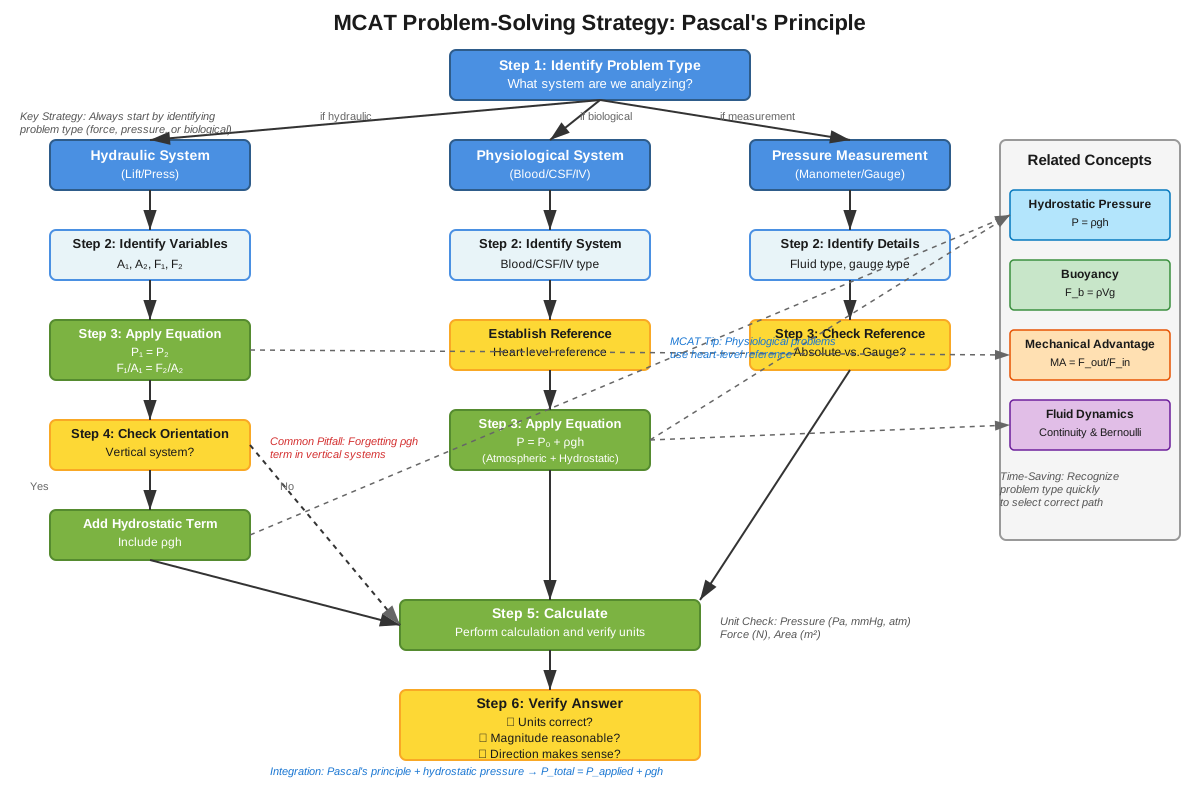
Overview
Pascal's principle is a foundational concept in fluid mechanics that describes how pressure changes propagate through incompressible fluids. Named after French mathematician and physicist Blaise Pascal, this principle states that when pressure is applied to a confined fluid, that pressure is transmitted undiminished to every point within the fluid and to the walls of the container. This seemingly simple concept has profound implications for understanding hydraulic systems, blood pressure physiology, and numerous medical devices that appear regularly on the MCAT.
For MCAT success, Pascal's principle represents a high-yield topic that bridges pure Physics concepts with biological applications. The principle appears in questions involving cardiovascular physiology, medical instrumentation, and mechanical advantage systems. Understanding Pascal's principle enables students to analyze how hydraulic lifts work, why blood pressure measurements are taken at heart level, and how small forces can be amplified to produce large mechanical outputs—a concept critical for understanding both engineered systems and biological pressure regulation.
Within the broader context of Fluids physics, Pascal's principle connects intimately with concepts of pressure, density, and fluid statics. It serves as the theoretical foundation for understanding pressure transmission in both static and dynamic fluid systems, making it essential for analyzing everything from syringes and blood pressure cuffs to the behavior of cerebrospinal fluid. Mastery of this principle provides the conceptual framework needed to tackle complex MCAT passages involving fluid mechanics in physiological contexts.
Learning Objectives
- [ ] Define Pascal's principle using accurate Physics terminology
- [ ] Explain why Pascal's principle matters for the MCAT
- [ ] Apply Pascal's principle to exam-style questions
- [ ] Identify common mistakes related to Pascal's principle
- [ ] Connect Pascal's principle to related Physics concepts
- [ ] Derive and apply the mathematical relationship for hydraulic systems using Pascal's principle
- [ ] Analyze the relationship between force, pressure, and area in confined fluid systems
- [ ] Evaluate the conditions under which Pascal's principle applies and recognize its limitations
Prerequisites
- Pressure definition and units: Understanding that pressure equals force per unit area (P = F/A) is essential for applying Pascal's principle quantitatively
- Fluid properties: Knowledge of incompressible fluids versus compressible fluids determines when Pascal's principle applies
- Force and mechanical advantage: Familiarity with force vectors and mechanical systems helps understand how Pascal's principle creates force multiplication
- Density and buoyancy basics: Understanding fluid density provides context for how fluids transmit pressure uniformly
- Basic algebra and ratio manipulation: Mathematical facility with proportions is necessary for solving hydraulic system problems
Why This Topic Matters
Pascal's principle appears with remarkable frequency on the MCAT, showing up in approximately 15-20% of Physics passages involving fluids. The principle's importance stems from its dual relevance to both pure physics applications and physiological systems. In clinical contexts, Pascal's principle explains how blood pressure is measured, why intravenous fluid bags must be positioned at specific heights, and how pressure changes in one part of the circulatory system affect the entire system.
On the MCAT, Pascal's principle typically appears in three distinct question formats: (1) quantitative problems requiring calculation of forces or pressures in hydraulic systems, (2) conceptual questions about pressure transmission in physiological fluids like blood or cerebrospinal fluid, and (3) passage-based questions involving medical devices such as blood pressure cuffs, syringes, or hydraulic surgical instruments. The principle frequently appears alongside questions about hydrostatic pressure, creating compound problems that test multiple fluid mechanics concepts simultaneously.
Real-world medical applications make this topic particularly high-yield. Understanding Pascal's principle is essential for comprehending how automated blood pressure monitors work, why patients with increased intracranial pressure experience symptoms throughout the brain rather than locally, and how minimally invasive hydraulic surgical tools can generate sufficient force for tissue manipulation. These clinical connections make Pascal's principle questions some of the most integrative on the MCAT, often requiring students to bridge physics concepts with biological reasoning.
Core Concepts
The Pascal Principle Definition
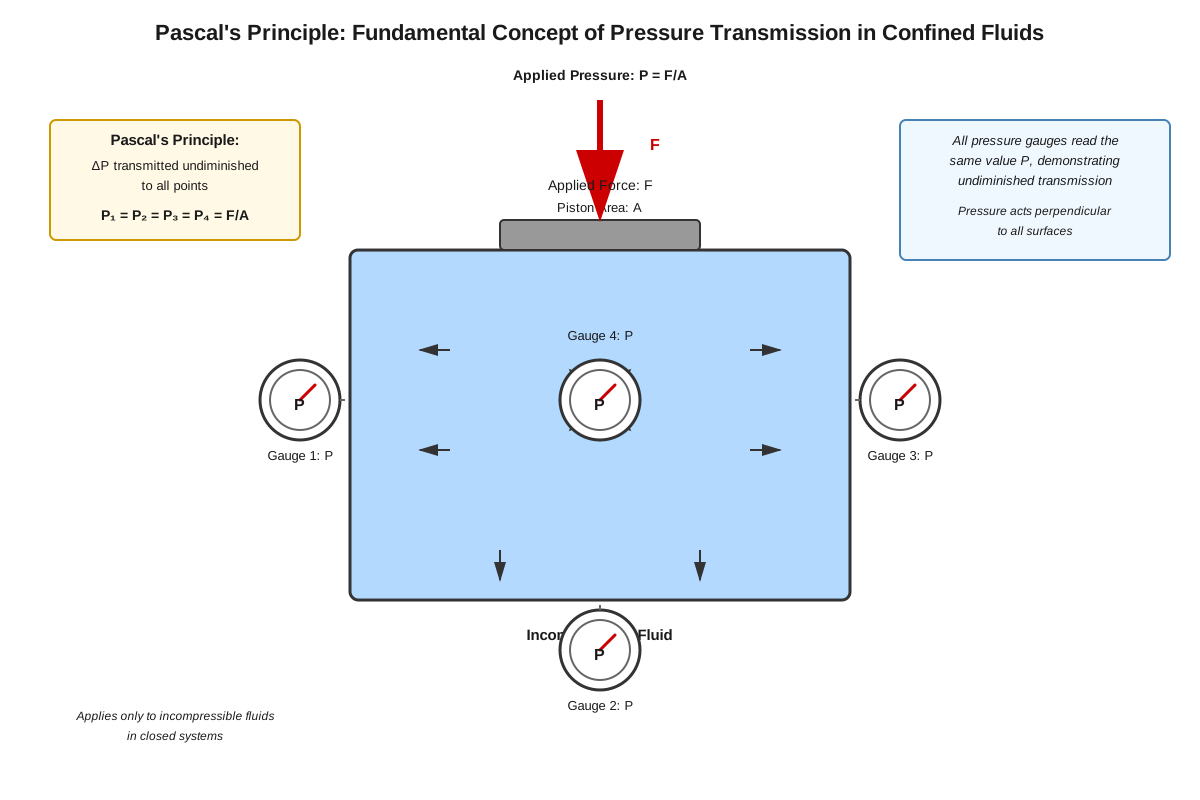
Pascal's principle (also called Pascal's law) states that a pressure change at any point in a confined incompressible fluid is transmitted undiminished to all portions of the fluid and to the walls of its container. Mathematically, if a pressure change ΔP is applied to a confined fluid, every point in that fluid experiences the same pressure change ΔP, regardless of the shape of the container or the location within the fluid.
ΔP₁ = ΔP₂ = ΔP₃ = ... = ΔPₙThe key qualifier "confined" means the fluid must be enclosed in a container with no escape routes. The term "incompressible" indicates that the fluid's volume doesn't change significantly under pressure—a reasonable assumption for liquids but not gases. This principle fundamentally differs from pressure distribution in compressible fluids, where pressure changes can be absorbed by volume changes rather than transmitted throughout the medium.
Pressure Transmission in Confined Fluids
When force is applied to a fluid through a piston or other interface, the resulting pressure increase propagates instantaneously throughout the entire fluid volume. This occurs because fluid molecules are in constant contact with their neighbors, and any force applied to one region creates a chain reaction of molecular collisions that distributes the pressure uniformly. The pressure at any point equals the force applied divided by the area over which it acts:
P = F/ABecause pressure is transmitted equally throughout the fluid, we can write:
P₁ = P₂
F₁/A₁ = F₂/A₂
This relationship forms the mathematical foundation for analyzing hydraulic systems and is the most commonly tested equation involving Pascal's principle on the MCAT.
Hydraulic Systems and Mechanical Advantage
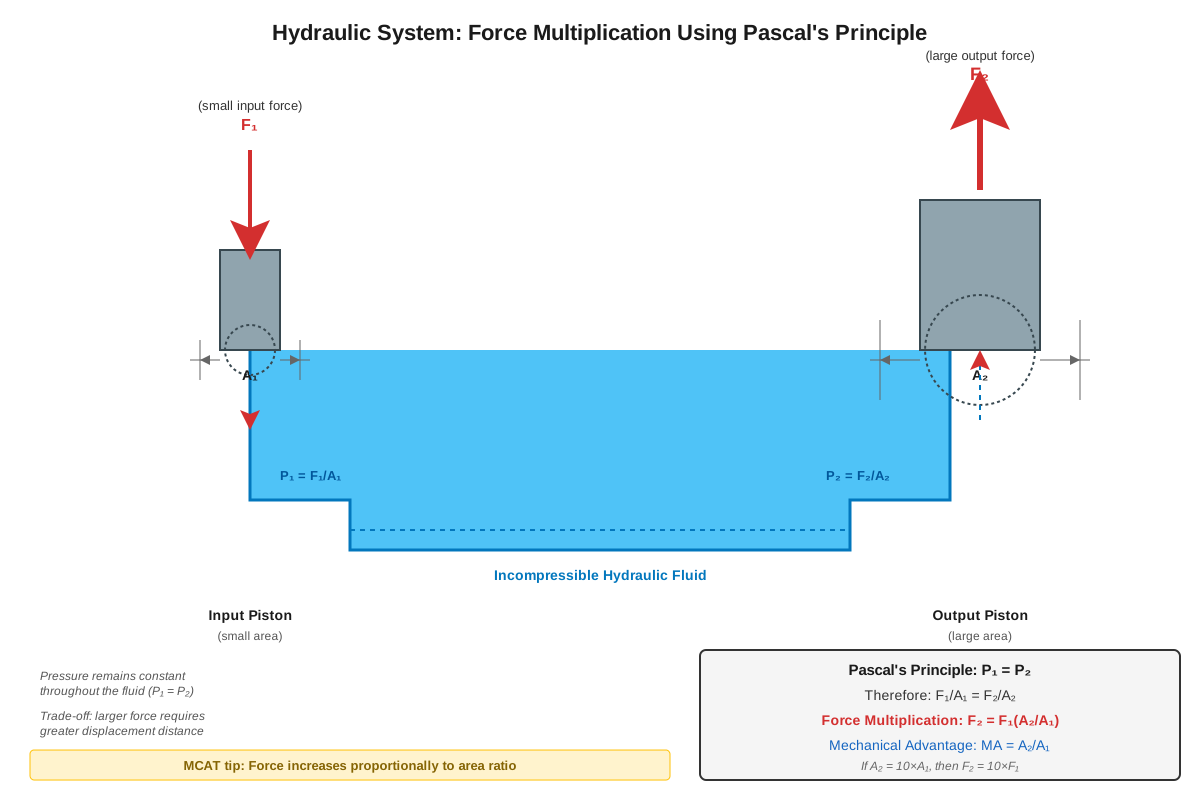
The practical power of Pascal's principle emerges in hydraulic systems, which use confined fluids to transmit and amplify forces. A hydraulic system consists of two pistons of different areas connected by a fluid-filled chamber. When force F₁ is applied to the smaller piston (area A₁), it creates pressure P₁ = F₁/A₁. According to Pascal's principle, this pressure transmits unchanged to the larger piston (area A₂), producing output force F₂ = P₁ × A₂.
Combining these relationships yields the hydraulic force equation:
F₂ = F₁ × (A₂/A₁)When A₂ > A₁, the output force F₂ exceeds the input force F₁, creating mechanical advantage. This force multiplication doesn't violate energy conservation because the smaller piston must move through a greater distance than the larger piston. The work input (F₁ × d₁) equals the work output (F₂ × d₂), maintaining energy balance:
F₁ × d₁ = F₂ × d₂Volume Displacement Relationships
In hydraulic systems, the volume of fluid displaced by the input piston equals the volume displaced by the output piston (assuming incompressible fluid). Since volume equals area times distance:
V₁ = V₂
A₁ × d₁ = A₂ × d₂
This relationship reveals the trade-off inherent in hydraulic systems: gaining force multiplication requires sacrificing distance. If the output piston has 10 times the area of the input piston, it produces 10 times the force but moves only 1/10 the distance.
Conditions and Limitations
Pascal's principle applies under specific conditions that MCAT questions often test implicitly:
| Condition | Requirement | Why It Matters |
|---|---|---|
| Fluid confinement | Sealed container with no leaks | Pressure cannot transmit if fluid escapes |
| Incompressibility | Liquid rather than gas | Gases compress under pressure, absorbing rather than transmitting pressure changes |
| Static or quasi-static | No significant fluid acceleration | Rapid motion creates pressure gradients that violate uniform transmission |
| Negligible viscosity | Low internal friction | High viscosity causes pressure drops during transmission |
| Uniform temperature | No thermal gradients | Temperature differences create density variations affecting pressure distribution |
Most MCAT problems assume ideal conditions where Pascal's principle applies perfectly, but recognizing these limitations helps identify when the principle might not apply in more complex scenarios.
Absolute vs. Applied Pressure
An important distinction exists between absolute pressure and applied pressure changes. Pascal's principle specifically addresses pressure changes (ΔP), not absolute pressures. In a fluid column, absolute pressure varies with depth due to hydrostatic pressure (P = P₀ + ρgh), but when additional pressure is applied at the surface, that pressure change transmits uniformly throughout the fluid regardless of depth. This distinction frequently appears in MCAT questions combining Pascal's principle with hydrostatic pressure calculations.
Concept Relationships
Pascal's principle serves as a central hub connecting multiple fluid mechanics concepts. The principle directly builds upon the fundamental definition of pressure as force per unit area, making pressure the primary variable through which forces transmit in fluid systems. This pressure-force relationship enables the mechanical advantage calculations that make hydraulic systems practically useful.
The principle connects intimately with hydrostatic pressure through the concept of pressure transmission. While hydrostatic pressure describes how pressure varies with depth in a static fluid column (P = P₀ + ρgh), Pascal's principle explains how pressure changes applied at any point affect the entire system. These concepts combine in problems where external pressure is applied to a fluid column, requiring students to calculate both the hydrostatic component and the transmitted pressure change.
Continuity equation and Bernoulli's equation represent extensions of Pascal's principle into dynamic fluid flow. While Pascal's principle applies to static or quasi-static situations, the continuity equation (A₁v₁ = A₂v₂) describes how fluid velocity changes with cross-sectional area in flowing systems, and Bernoulli's equation incorporates pressure, velocity, and height in moving fluids. Understanding Pascal's principle provides the foundational pressure concepts necessary for analyzing these more complex dynamic situations.
The relationship map flows as follows:
Pressure definition (P = F/A) → enables → Pascal's principle (uniform pressure transmission) → creates → Hydraulic mechanical advantage (F₂/F₁ = A₂/A₁) → combines with → Volume conservation (A₁d₁ = A₂d₂) → ensures → Energy conservation (work in = work out) → extends to → Dynamic fluid flow concepts
High-Yield Facts
⭐ Pascal's principle states that pressure applied to a confined incompressible fluid is transmitted undiminished to every point in the fluid and container walls
⭐ In hydraulic systems, the force ratio equals the area ratio: F₂/F₁ = A₂/A₁
⭐ Pascal's principle applies only to incompressible fluids (liquids), not compressible fluids (gases)
⭐ The mechanical advantage gained in force is exactly offset by the distance ratio: d₁/d₂ = A₂/A₁
⭐ Pascal's principle describes pressure changes (ΔP), not absolute pressure values
- Hydraulic systems conserve energy: F₁d₁ = F₂d₂ (work input equals work output)
- Volume displaced by the input piston equals volume displaced by the output piston: A₁d₁ = A₂d₂
- Pressure transmits instantaneously throughout an ideal incompressible fluid
- The principle applies to static or quasi-static conditions where fluid acceleration is negligible
- In physiological systems, Pascal's principle explains uniform blood pressure transmission throughout vessels
- Medical devices like blood pressure cuffs and syringes operate based on Pascal's principle
- The principle works regardless of container shape—pressure transmits equally in all directions
Quick check — test yourself on Pascal principle so far.
Try Flashcards →Common Misconceptions
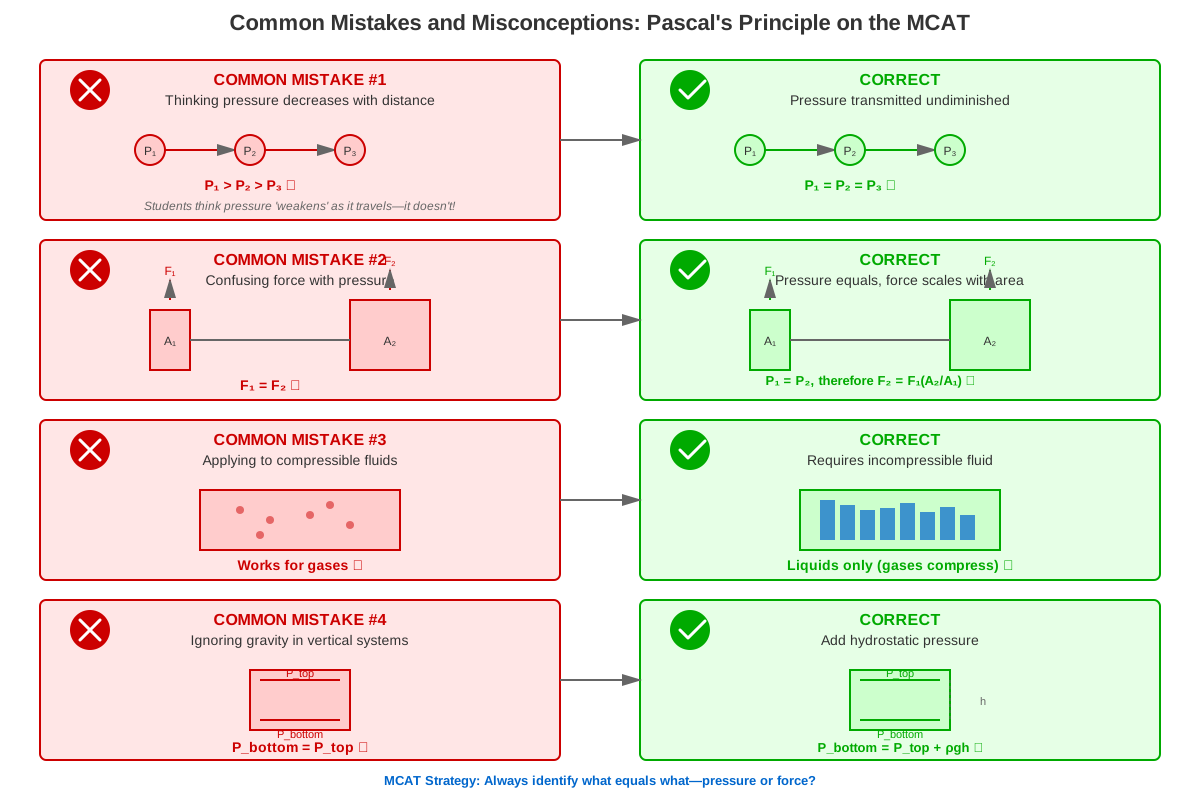
Misconception: Pascal's principle creates energy from nothing by multiplying force in hydraulic systems.
Correction: While hydraulic systems multiply force, they do not violate energy conservation. The output piston moves through a proportionally smaller distance than the input piston, keeping work input equal to work output (F₁d₁ = F₂d₂). Force multiplication is traded for distance reduction.
Misconception: Pascal's principle applies equally well to gases as to liquids.
Correction: Pascal's principle specifically requires incompressible fluids. Gases are highly compressible, meaning applied pressure causes volume changes rather than uniform pressure transmission. When pressure is applied to a confined gas, the gas compresses rather than transmitting the pressure undiminished throughout the volume.
Misconception: Pressure is the same everywhere in a fluid at rest, so Pascal's principle is redundant.
Correction: Absolute pressure varies with depth due to hydrostatic pressure (P = P₀ + ρgh). Pascal's principle specifically addresses how pressure changes transmit uniformly, not absolute pressure values. When additional pressure is applied at one point, that pressure change adds equally to all points regardless of their different absolute pressures.
Misconception: A larger piston in a hydraulic system always produces more force than a smaller piston.
Correction: The output force depends on both the piston area and the applied pressure. If equal forces are applied to pistons of different sizes, the smaller piston creates higher pressure (P = F/A) and thus produces greater force at the output. The area ratio determines force multiplication only when comparing input and output pistons in the same system.
Misconception: Pascal's principle means pressure is the same at all depths in a fluid column.
Correction: Pascal's principle addresses pressure transmission, not pressure distribution. In a static fluid column, pressure increases with depth due to the weight of overlying fluid (hydrostatic pressure). Pascal's principle states that if additional pressure is applied at the top, that additional pressure transmits to all depths, but the absolute pressure still varies with depth.
Misconception: Hydraulic systems can multiply both force and distance simultaneously.
Correction: Hydraulic systems create a trade-off between force and distance. If force is multiplied by factor n (F₂ = nF₁), distance is divided by the same factor (d₂ = d₁/n). This trade-off ensures energy conservation and prevents perpetual motion machines.
Worked Examples
Example 1: Hydraulic Lift System
Problem: A hydraulic car lift has an input piston with radius 5 cm and an output piston with radius 25 cm. If a mechanic applies a force of 100 N to the input piston, what force is exerted on the car? How far must the input piston move to raise the car 10 cm?
Solution:
Step 1: Calculate piston areas.
The area of a circle is A = πr².
Input piston area:
A₁ = π(0.05 m)² = π(0.0025 m²) = 0.00785 m²Output piston area:
A₂ = π(0.25 m)² = π(0.0625 m²) = 0.196 m²Step 2: Apply Pascal's principle to find output force.
Since P₁ = P₂, we have F₁/A₁ = F₂/A₂
F₂ = F₁ × (A₂/A₁) = 100 N × (0.196 m²/0.00785 m²)
F₂ = 100 N × 25 = 2,500 N
Step 3: Calculate input piston displacement using volume conservation.
Since V₁ = V₂, we have A₁d₁ = A₂d₂
d₁ = d₂ × (A₂/A₁) = 0.10 m × 25 = 2.5 mAnswer: The force exerted on the car is 2,500 N (approximately 562 pounds). The input piston must move 2.5 m to raise the car 10 cm.
Key Insight: This example demonstrates the fundamental trade-off in hydraulic systems. The force is multiplied by 25 (the ratio of areas), but the input piston must move 25 times farther than the output piston. This connects directly to the learning objective of applying Pascal's principle to exam-style calculations.
Example 2: Blood Pressure Measurement
Problem: A blood pressure cuff is wrapped around a patient's upper arm at heart level. The cuff is inflated to 120 mmHg, temporarily stopping blood flow. Explain using Pascal's principle why the cuff pressure must equal the blood pressure to stop flow, and why measurements taken with the arm raised above the heart would give different readings.
Solution:
Step 1: Apply Pascal's principle to the blood-cuff system.
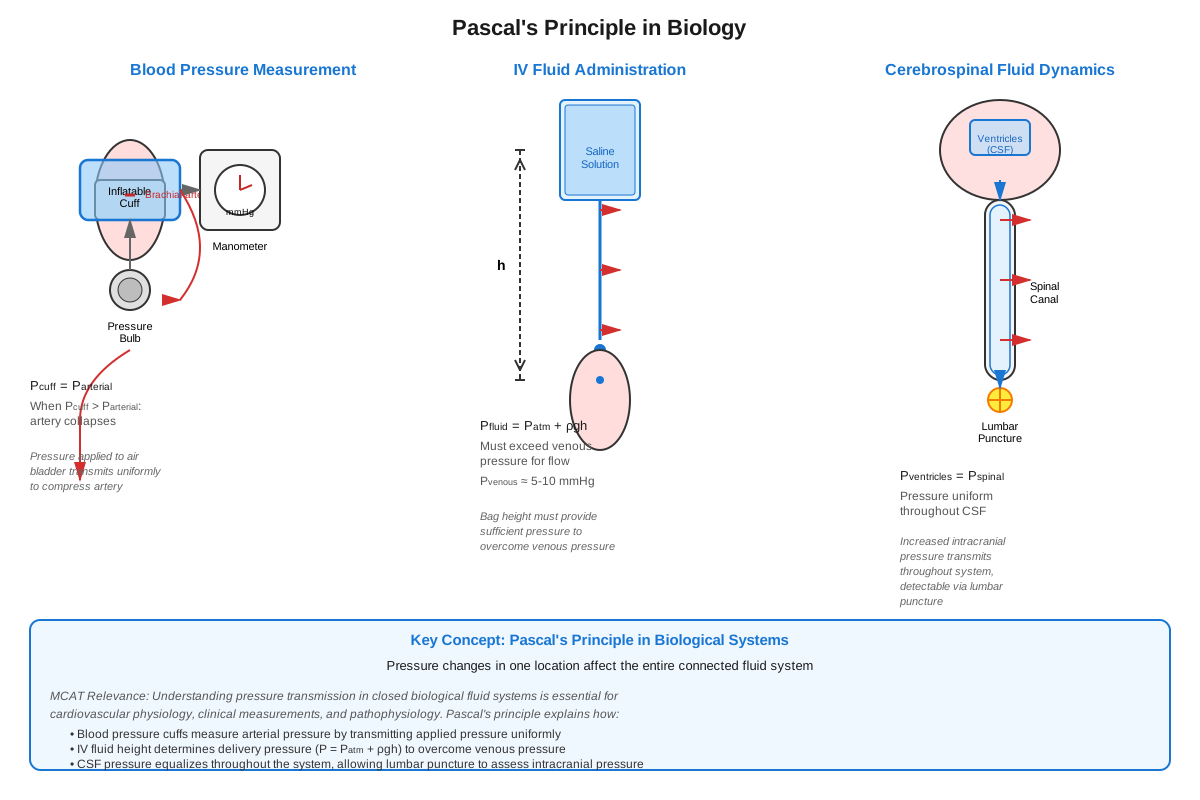
The blood pressure cuff applies external pressure to the arm tissue, which transmits this pressure to the brachial artery. According to Pascal's principle, this applied pressure transmits uniformly through the incompressible tissue fluids and compresses the artery. When the cuff pressure equals the systolic blood pressure (the maximum pressure in the artery during heart contraction), the external pressure exactly balances the internal blood pressure, temporarily collapsing the artery and stopping blood flow.
Step 2: Explain the pressure balance condition.
For blood flow to stop:
P_cuff = P_bloodWhen P_cuff < P_blood, the internal pressure keeps the artery open and blood flows. When P_cuff > P_blood, the artery collapses completely. The systolic pressure is detected as the cuff pressure at which blood just begins to flow again as the cuff deflates, producing the characteristic Korotkoff sounds.
Step 3: Address the effect of arm elevation.
If the arm is raised above heart level, hydrostatic pressure reduces the blood pressure in the arm by ρgh, where h is the vertical height difference. The pressure difference is:
ΔP = ρgh = (1060 kg/m³)(9.8 m/s²)(h)For every 10 cm of elevation, blood pressure decreases by approximately 8 mmHg. This means a measurement taken with the arm raised 30 cm above the heart would read approximately 24 mmHg lower than the true pressure at heart level, even though Pascal's principle still applies—the cuff pressure still transmits uniformly to compress the artery, but the baseline blood pressure is lower due to hydrostatic effects.
Answer: Pascal's principle ensures that cuff pressure transmits uniformly to compress the artery. Flow stops when external cuff pressure equals internal blood pressure. Arm elevation changes the baseline blood pressure due to hydrostatic pressure differences, not because Pascal's principle fails, but because the absolute pressure in the elevated artery is lower.
Key Insight: This example illustrates how Pascal's principle applies to physiological systems and why it must be combined with hydrostatic pressure concepts for complete analysis. It addresses the learning objective of connecting Pascal's principle to related physics concepts and demonstrates why the topic matters for MCAT success.
Exam Strategy
When approaching MCAT questions involving Pascal's principle, begin by identifying whether the question asks about pressure transmission, force relationships, or distance/volume relationships. Look for trigger phrases like "hydraulic system," "confined fluid," "pressure applied to," or "force transmitted through." These phrases signal that Pascal's principle is the relevant concept.
For quantitative problems, immediately write down the fundamental relationship P₁ = P₂, which translates to F₁/A₁ = F₂/A₂. Most MCAT calculations involving Pascal's principle require manipulating this equation to solve for an unknown force or area. If the question asks about distances or volumes, remember that volume conservation (A₁d₁ = A₂d₂) provides the necessary relationship. Always check whether the question provides diameters or radii—a common trap is forgetting to square the radius when calculating area (A = πr²).
Process-of-elimination strategies work particularly well for Pascal's principle questions. If an answer choice suggests that force can be multiplied without any trade-off, eliminate it immediately—energy conservation always applies. If a choice claims Pascal's principle works for gases, eliminate it unless the question specifically states the gas is confined and the pressure changes are small. If an answer suggests pressure varies within a static confined fluid when external pressure is applied, eliminate it—Pascal's principle guarantees uniform pressure transmission.
Time management for Pascal's principle questions should allocate approximately 60-90 seconds for straightforward calculations and up to 2 minutes for complex passage-based questions requiring integration with other concepts. If a question seems to require multiple steps, quickly sketch a diagram showing the two pistons, label known values, and write the relevant equations before attempting calculations. This organizational step prevents errors and often reveals the solution path more clearly than attempting mental calculations.
Watch for questions that combine Pascal's principle with hydrostatic pressure—these are high-yield on the MCAT. The key is recognizing that Pascal's principle addresses pressure changes while hydrostatic pressure describes pressure distribution. When both concepts appear, calculate the hydrostatic pressure component first, then apply Pascal's principle to determine how additional applied pressure affects the system.
Memory Techniques
"PUFF" for Pascal's Principle Conditions:
- Pressure transmitted uniformly
- Uncompressible fluid required
- Force ratio equals area ratio
- Fluid must be confined
"FADA" for Hydraulic System Relationships:
- Force ratio = Area ratio (F₂/F₁ = A₂/A₁)
- Distance ratio = Area ratio inverted (d₁/d₂ = A₂/A₁)
Visualization Strategy: Picture a syringe filled with water. When you push the plunger (applying force to a small area), the pressure increases throughout the entire water volume equally. If you connect this syringe to a larger cylinder, the same pressure acts on the larger area, producing a larger force. Visualize the water molecules as tightly packed spheres that can't compress—when you push on one side, the entire mass of spheres shifts, transmitting the pressure instantly throughout.
"Pressure Propagates Perfectly": This alliterative phrase helps remember that pressure changes transmit uniformly throughout confined incompressible fluids—the core of Pascal's principle.
Area-Force-Distance Triangle: Remember that in hydraulic systems, three quantities relate through ratios. Draw a triangle with Force at the top, Area on the bottom left, and Distance on the bottom right. Force and Area ratios are equal (F₂/F₁ = A₂/A₁), while Distance ratio is inverted (d₁/d₂ = A₂/A₁). This visual helps recall all relationships quickly.
Summary
Pascal's principle is a fundamental concept in fluid mechanics stating that pressure applied to a confined incompressible fluid transmits undiminished throughout the fluid and to container walls. This principle enables hydraulic systems to multiply force through the relationship F₂/F₁ = A₂/A₁, where larger output piston areas produce proportionally larger forces. The principle applies specifically to incompressible fluids (liquids) under static or quasi-static conditions, and it addresses pressure changes rather than absolute pressure values. Energy conservation ensures that force multiplication is offset by distance reduction (d₁/d₂ = A₂/A₁), maintaining work input equal to work output. For MCAT success, students must recognize that Pascal's principle combines with hydrostatic pressure concepts in physiological applications, appears frequently in questions about medical devices and cardiovascular physiology, and requires facility with area calculations and ratio manipulations. Understanding the conditions under which the principle applies—confinement, incompressibility, and negligible fluid acceleration—helps identify when Pascal's principle is the appropriate analytical tool for solving problems.
Key Takeaways
- Pascal's principle states that pressure changes in confined incompressible fluids transmit uniformly to all points in the fluid
- Hydraulic systems create mechanical advantage through the relationship F₂/F₁ = A₂/A₁, multiplying force at the expense of distance
- The principle applies only to incompressible fluids (liquids), not compressible fluids (gases)
- Energy conservation requires that work input equals work output: F₁d₁ = F₂d₂
- Pascal's principle addresses pressure changes (ΔP), not absolute pressure distributions, which vary with depth due to hydrostatic pressure
- Medical applications include blood pressure measurement, syringe operation, and understanding pressure transmission in physiological fluids
- Common MCAT questions combine Pascal's principle with hydrostatic pressure, requiring analysis of both pressure transmission and pressure variation with depth
Related Topics
Hydrostatic Pressure: Understanding how pressure varies with depth in static fluids (P = P₀ + ρgh) is essential for combining with Pascal's principle in complex problems involving fluid columns and physiological systems. Mastering Pascal's principle provides the foundation for analyzing how applied pressures affect systems where hydrostatic pressure also plays a role.
Continuity Equation: This principle describes mass conservation in flowing fluids (A₁v₁ = A₂v₂), extending the area-velocity relationships that parallel the area-force relationships in Pascal's principle. Understanding static fluid pressure transmission prepares students for analyzing dynamic fluid flow.
Bernoulli's Equation: This fundamental equation relates pressure, velocity, and height in flowing fluids, representing a more comprehensive treatment of fluid dynamics that builds upon the pressure concepts introduced through Pascal's principle.
Cardiovascular Physiology: Pascal's principle directly applies to understanding blood pressure regulation, pressure transmission through vessels, and the function of the circulatory system, making it essential for MCAT Biology/Biochemistry passages involving cardiovascular topics.
Mechanical Advantage and Simple Machines: The force multiplication achieved through hydraulic systems parallels mechanical advantage in levers, pulleys, and inclined planes, connecting Pascal's principle to broader physics concepts about work and energy conservation.
Practice CTA
Now that you've mastered the core concepts of Pascal's principle, it's time to solidify your understanding through active practice. Work through the practice questions and flashcards to test your ability to apply these concepts under exam conditions. Focus particularly on problems that combine Pascal's principle with hydrostatic pressure or require multi-step calculations involving force, area, and distance relationships. Remember that Pascal's principle is a high-yield topic that appears frequently on the MCAT—your investment in mastering this material will pay dividends on test day. Challenge yourself with increasingly complex scenarios, and don't just aim for correct answers; strive to understand why each answer is correct and why the distractors are wrong. This deeper level of analysis will prepare you for the most challenging MCAT questions and help you achieve your target score.
Sign up free to keep reading
Create a free AnvayaPrep account to finish this MCAT guide on Pascal principle — plus flashcards and practice questions.