Overview
Poiseuille law (also known as the Hagen-Poiseuille equation) is a fundamental principle in Fluids Physics that describes the volumetric flow rate of an incompressible, viscous fluid through a cylindrical pipe under laminar flow conditions. This law establishes a quantitative relationship between flow rate and four critical variables: the pressure gradient driving the flow, the radius of the tube, the length of the tube, and the viscosity of the fluid. For the MCAT, Poiseuille law represents one of the most high-yield topics in fluid dynamics because it directly connects to cardiovascular physiology, respiratory mechanics, and clinical scenarios involving blood flow through vessels.
Understanding Poiseuille law Physics is essential for the MCAT because it bridges pure physics concepts with biological applications that appear frequently in both the Chemical and Physical Foundations of Biological Systems section and passages in the Biological and Biochemical Foundations of Living Systems section. The MCAT tests not only the mathematical application of the equation but also conceptual understanding of how changes in vessel radius, blood viscosity, or pressure gradients affect flow rates in physiological contexts. Questions may present clinical vignettes involving atherosclerosis (reduced vessel radius), polycythemia (increased blood viscosity), or hypertension (altered pressure gradients), requiring students to predict how these pathological conditions affect blood flow.
The Poiseuille law MCAT content connects to broader Physics concepts including fluid dynamics, pressure, resistance, laminar versus turbulent flow, and energy conservation in fluids. It also relates to the continuity equation, Bernoulli's equation, and the concept of resistance in both fluid systems and electrical circuits (as the equations share analogous mathematical forms). Mastering this topic provides a foundation for understanding vascular resistance, cardiac output calculations, and the physiological regulation of blood pressure—all of which are testable concepts that integrate physics principles with human physiology.
Learning Objectives
- [ ] Define Poiseuille law using accurate Physics terminology
- [ ] Explain why Poiseuille law matters for the MCAT
- [ ] Apply Poiseuille law to exam-style questions
- [ ] Identify common mistakes related to Poiseuille law
- [ ] Connect Poiseuille law to related Physics concepts
- [ ] Quantitatively predict how changes in tube radius, length, pressure gradient, and viscosity affect flow rate
- [ ] Distinguish between conditions where Poiseuille law applies versus situations requiring alternative fluid dynamics principles
- [ ] Analyze clinical scenarios involving cardiovascular pathology using Poiseuille law principles
Prerequisites
- Pressure and pressure gradients: Poiseuille law depends on the pressure difference between two points driving fluid flow through a tube
- Basic fluid properties (density, viscosity): Viscosity appears directly in the Poiseuille equation and determines resistance to flow
- Laminar versus turbulent flow: Poiseuille law applies only to laminar (smooth, layered) flow, not turbulent flow
- Basic algebra and proportional reasoning: The equation involves fourth-power relationships that require comfort with mathematical manipulation
- Circulatory system anatomy: Applications to blood flow require understanding of arteries, arterioles, capillaries, and veins
Why This Topic Matters
Poiseuille law has profound clinical significance because it governs blood flow through the cardiovascular system, which is the primary physiological application tested on the MCAT. The law explains why small changes in blood vessel radius have dramatic effects on blood flow and why the body tightly regulates vessel diameter through vasoconstriction and vasodilation. Clinical conditions such as atherosclerosis (plaque buildup narrowing vessels), hypertension (elevated blood pressure), anemia (reduced blood viscosity), and polycythemia (increased blood viscosity) all directly relate to variables in Poiseuille's equation. Understanding this law enables students to predict how these pathological states affect tissue perfusion and cardiovascular function.
From an exam perspective, Poiseuille law appears in approximately 10-15% of MCAT physics passages involving fluids, and it frequently appears in interdisciplinary passages that combine physics with physiology. Questions typically fall into three categories: (1) direct calculation problems requiring application of the equation, (2) conceptual questions asking students to predict the effect of changing one variable while others remain constant, and (3) passage-based questions presenting clinical scenarios where students must identify which variable has changed and predict physiological consequences. The MCAT particularly favors questions about the radius dependence (fourth power relationship) because this represents the most dramatic and clinically relevant effect.
Common passage contexts include: experimental setups measuring fluid flow through tubes of varying dimensions, cardiovascular physiology passages discussing blood pressure regulation, respiratory passages involving airflow through bronchioles, and clinical vignettes presenting patients with vascular disease. The MCAT also tests Poiseuille law in comparison with the continuity equation, requiring students to distinguish between scenarios where cross-sectional area affects flow velocity versus flow rate. Recognizing these patterns and understanding when to apply Poiseuille law versus other fluid dynamics principles is crucial for exam success.
Core Concepts
The Poiseuille Law Equation
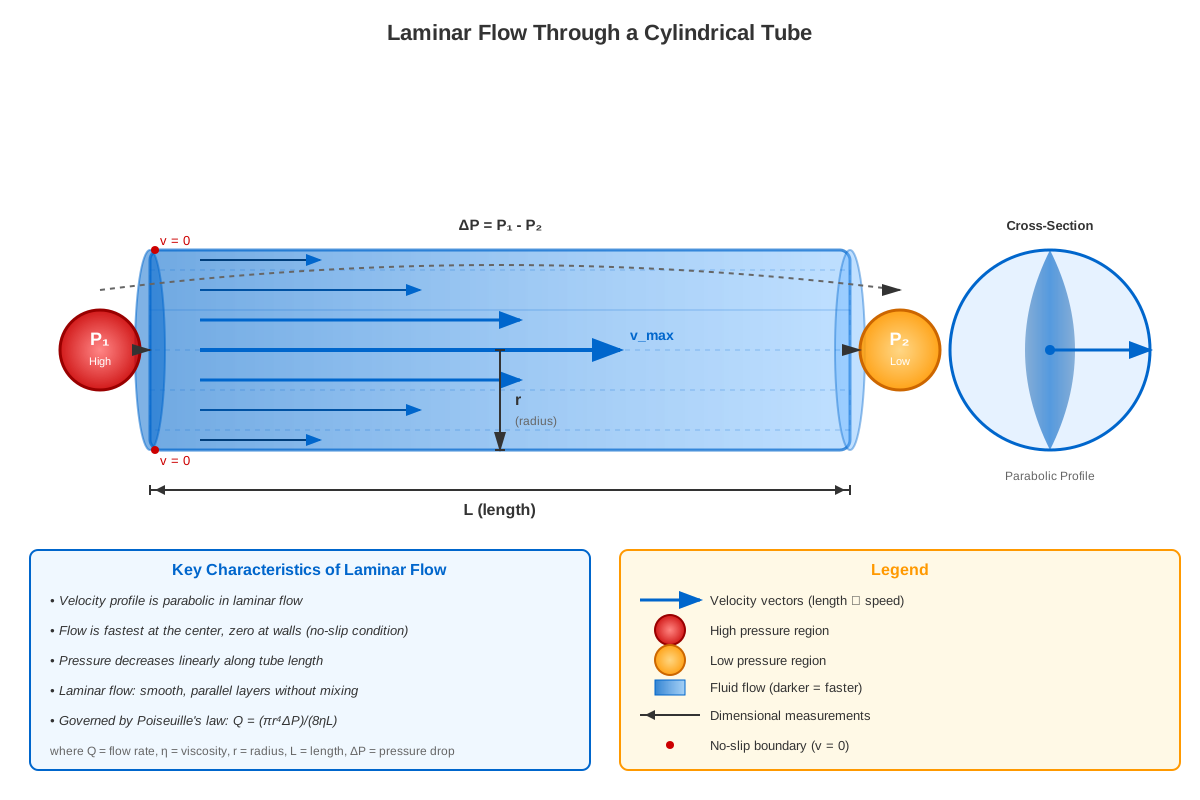
Poiseuille law mathematically describes the volumetric flow rate (Q) of a viscous, incompressible fluid through a cylindrical tube under conditions of laminar flow. The complete equation is:
Q = (π × ΔP × r⁴) / (8 × η × L)Where:
- Q = volumetric flow rate (volume per unit time, typically m³/s or mL/s)
- ΔP = pressure difference between the two ends of the tube (Pa or mmHg)
- r = internal radius of the tube (m or cm)
- η (eta) = dynamic viscosity of the fluid (Pa·s or poise)
- L = length of the tube (m or cm)
- π = mathematical constant (approximately 3.14159)
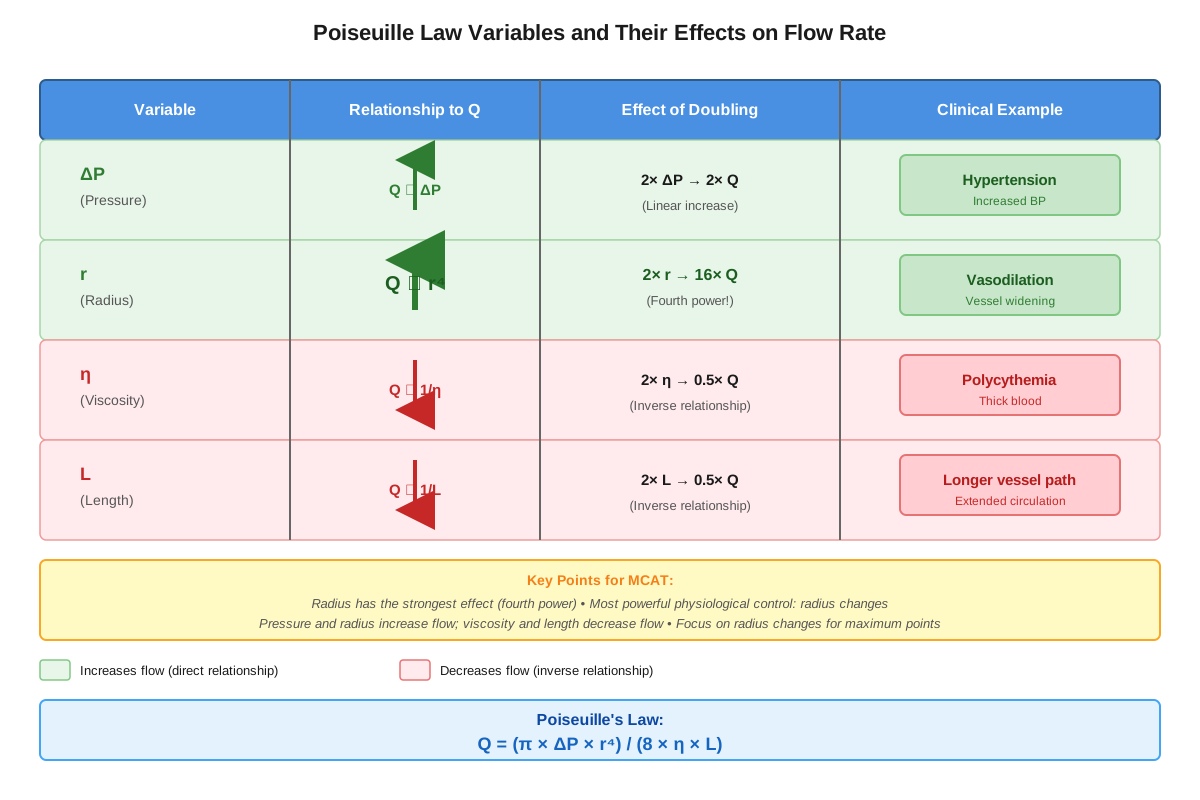
The equation reveals that flow rate is directly proportional to the pressure gradient and the fourth power of the radius, while inversely proportional to viscosity and tube length. The factor of 8 in the denominator arises from the integration of the velocity profile across the tube's cross-section during the derivation from first principles.
Radius Dependence: The Fourth Power Relationship
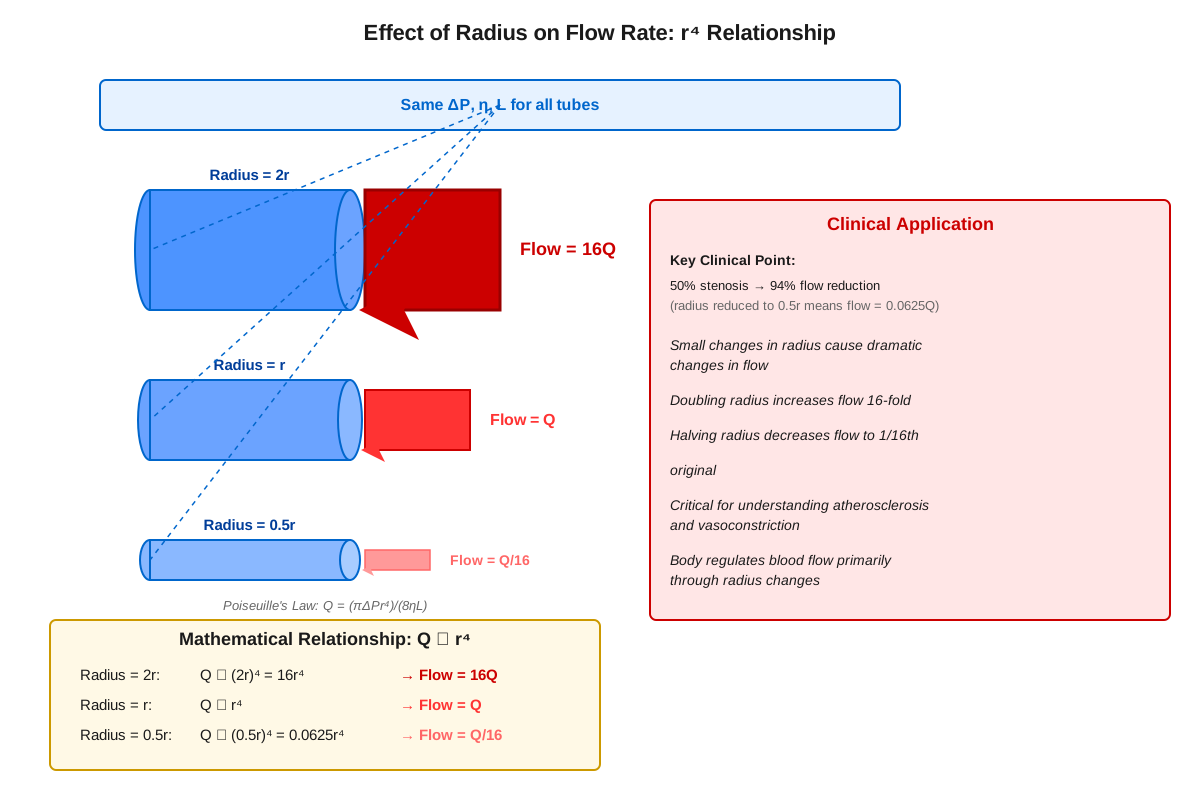
The most clinically significant and frequently tested aspect of Poiseuille law Physics is the r⁴ relationship. Because flow rate depends on the fourth power of the radius, small changes in vessel diameter produce dramatic changes in flow. If the radius doubles, flow increases by a factor of 2⁴ = 16 (assuming all other variables remain constant). Conversely, if radius decreases by half, flow decreases to 1/16 of the original value.
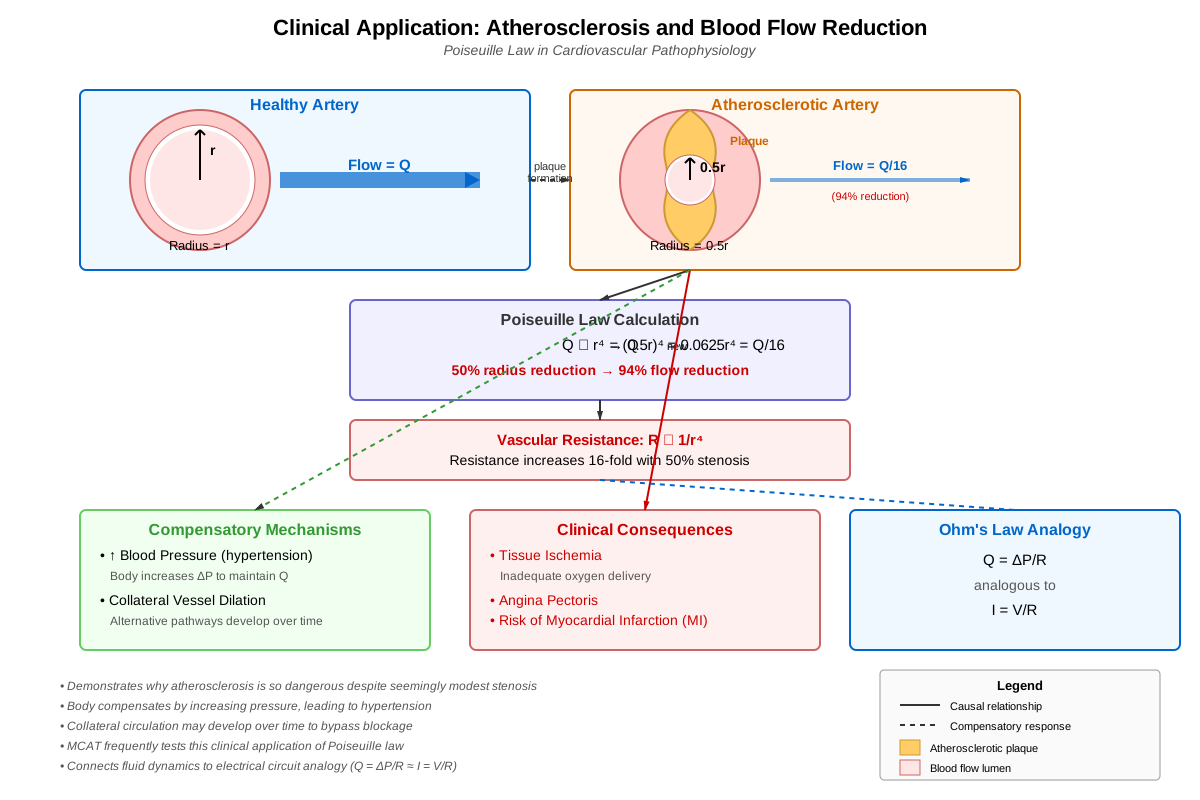
This relationship explains why arterioles, despite being small vessels, serve as the primary site of vascular resistance regulation in the cardiovascular system. Small changes in arteriolar diameter through smooth muscle contraction (vasoconstriction) or relaxation (vasodilation) produce large changes in blood flow to tissues. This principle also explains why atherosclerotic plaque that reduces vessel radius by 50% doesn't just halve blood flow—it reduces it to approximately 6% of normal flow, potentially causing severe ischemia.
Resistance in Fluid Systems
Poiseuille law can be rearranged to define resistance (R) in a fluid system, analogous to electrical resistance in Ohm's law. Rearranging the equation:
ΔP = Q × RWhere resistance is defined as:
R = (8 × η × L) / (π × r⁴)This formulation shows that resistance increases with viscosity and tube length but decreases dramatically with increasing radius (inversely proportional to r⁴). This resistance concept is crucial for understanding total peripheral resistance in cardiovascular physiology, which determines the workload on the heart and influences blood pressure regulation.
Conditions for Poiseuille Law Application
Poiseuille law applies only under specific conditions, and recognizing these limitations is essential for the MCAT:
- Laminar flow: The fluid must flow in smooth, parallel layers without turbulence. This occurs at low Reynolds numbers (typically Re < 2000 for cylindrical pipes)
- Incompressible fluid: The fluid density must remain constant throughout the tube
- Newtonian fluid: The fluid must have constant viscosity regardless of flow rate (blood approximates this in large vessels but not in very small capillaries)
- Rigid, cylindrical tube: The tube walls must not expand or contract, and the tube must have a circular cross-section
- Steady flow: The flow rate must be constant over time, not pulsatile
- No-slip boundary condition: The fluid velocity at the tube wall must be zero
When these conditions are violated—such as turbulent flow in the aorta during peak systole, or pulsatile flow throughout the cardiac cycle—Poiseuille law provides only an approximation. The MCAT may test understanding of these limitations by presenting scenarios where the law doesn't strictly apply.
Viscosity and Its Physiological Relevance
Viscosity (η) represents a fluid's resistance to flow, essentially its "thickness" or internal friction. In the context of blood flow, viscosity depends primarily on hematocrit (the percentage of blood volume occupied by red blood cells). Normal blood viscosity is approximately 3-4 times that of water.
Conditions affecting blood viscosity include:
- Polycythemia: Elevated red blood cell count increases viscosity, decreasing flow rate
- Anemia: Reduced red blood cell count decreases viscosity, increasing flow rate
- Dehydration: Reduced plasma volume increases hematocrit and viscosity
- Temperature: Decreased temperature increases viscosity (relevant in hypothermia)
- Plasma protein concentration: Elevated proteins (as in multiple myeloma) increase viscosity
The MCAT frequently tests scenarios where viscosity changes affect flow, requiring students to predict whether flow increases or decreases based on the inverse relationship between Q and η.
Pressure Gradient and Cardiovascular Physiology
The pressure difference (ΔP) driving flow through the cardiovascular system is the difference between arterial pressure (approximately 100 mmHg mean arterial pressure) and venous pressure (approximately 0-5 mmHg central venous pressure). This pressure gradient is maintained by the pumping action of the heart and determines the driving force for blood flow.
The relationship between pressure gradient and flow is linear—doubling the pressure difference doubles the flow rate (assuming constant resistance). This explains why hypertension (elevated arterial pressure) increases blood flow to tissues, and why the body must regulate blood pressure to maintain appropriate tissue perfusion. The MCAT may present scenarios involving changes in blood pressure and ask students to predict effects on flow or to calculate required pressure changes to maintain constant flow when resistance changes.
Tube Length and Vascular Beds
While tube length (L) appears in the denominator of Poiseuille's equation, it's the least physiologically variable parameter in the cardiovascular system. Blood vessel length changes only with growth, obesity (which increases vascular bed length), or pregnancy (which adds the placental circulation). However, understanding the inverse relationship between flow and length is important for comparing flow through vessels of different lengths.
In series arrangements of vessels, total length is the sum of individual lengths, and total resistance is the sum of individual resistances. In parallel arrangements (like capillary beds), the effective resistance decreases because flow can take multiple paths. The MCAT may test understanding of how series versus parallel vessel arrangements affect total resistance and flow distribution.
Comparison with Related Fluid Dynamics Principles
| Principle | Equation | What It Describes | Key Difference from Poiseuille |
|---|---|---|---|
| Poiseuille Law | Q = (π·ΔP·r⁴)/(8·η·L) | Volumetric flow rate through tube | Includes viscosity; applies to real fluids |
| Continuity Equation | A₁v₁ = A₂v₂ | Conservation of mass in flowing fluid | Describes velocity changes, not flow rate determinants |
| Bernoulli's Equation | P + ½ρv² + ρgh = constant | Energy conservation in ideal fluid | Applies to ideal (inviscid) fluids; ignores viscosity |
| Ohm's Law (analog) | ΔV = I·R | Electrical current through resistor | Mathematical analog; helps understand resistance concept |
Concept Relationships
Poiseuille law integrates multiple fundamental physics concepts into a single comprehensive relationship. The pressure gradient (ΔP) concept connects to the broader topic of pressure in fluids, including hydrostatic pressure and the work done by pressure forces. This pressure difference represents the driving force that overcomes the resistance to flow created by viscosity.
The viscosity (η) term connects to the molecular properties of fluids and the concept of internal friction between fluid layers. Viscosity relates to temperature (via kinetic molecular theory) and to the composition of the fluid (concentration of dissolved substances and suspended particles). In blood, viscosity connects to hematology and the cellular composition of blood.
The radius (r⁴) term connects to geometric principles and the concept of cross-sectional area (A = πr²). The fourth-power dependence arises from the parabolic velocity profile in laminar flow, where fluid velocity is zero at the walls and maximum at the center. This velocity profile connects to the concept of shear stress and the no-slip boundary condition in fluid mechanics.
The length (L) term represents the distance over which viscous forces act to resist flow. Longer tubes provide more surface area for viscous drag, increasing resistance. This connects to the concept of friction in mechanics and energy dissipation.
The complete relationship flows as: Pressure gradient → drives flow → against viscous resistance → through a tube of specific geometry → producing a volumetric flow rate. This chain of causation helps students understand that Poiseuille law is fundamentally about energy: the pressure energy driving flow is dissipated by viscous forces over the length of the tube.
Poiseuille law connects to the continuity equation (A₁v₁ = A₂v₂) by distinguishing between flow rate (Q, volume per time) and flow velocity (v, distance per time). While Poiseuille law determines the volumetric flow rate through a tube, the continuity equation determines how velocity changes when cross-sectional area changes. In a branching vascular system, Poiseuille law determines flow through each vessel, while continuity ensures mass conservation at branch points.
The resistance formulation of Poiseuille law (R = 8ηL/πr⁴) connects to electrical circuit theory through the mathematical analogy between ΔP = Q·R (fluids) and ΔV = I·R (electricity). This analogy helps students understand series and parallel resistance combinations in vascular beds, where total resistance determines cardiac workload.
Quick check — test yourself on Poiseuille law so far.
Try Flashcards →High-Yield Facts
⭐ Flow rate is proportional to the fourth power of radius: Doubling vessel radius increases flow 16-fold; halving radius decreases flow to 1/16 of original
⭐ Poiseuille law applies only to laminar flow: Turbulent flow (high Reynolds number) requires different analysis
⭐ Resistance is inversely proportional to r⁴: Small vessels (arterioles) contribute most to total vascular resistance despite their short length
⭐ Viscosity is inversely proportional to flow rate: Increased hematocrit (polycythemia) decreases flow; decreased hematocrit (anemia) increases flow
⭐ Pressure gradient and flow rate are directly proportional: Doubling the pressure difference doubles the flow (linear relationship)
- The constant 8 in the denominator comes from integrating the parabolic velocity profile across the tube cross-section
- Poiseuille law assumes steady (non-pulsatile) flow, which is an approximation for blood flow in most vessels
- Blood behaves as a Newtonian fluid in vessels larger than approximately 0.5 mm diameter but shows non-Newtonian behavior in capillaries
- Total resistance in series vessels equals the sum of individual resistances: R_total = R₁ + R₂ + R₃
- Total resistance in parallel vessels follows: 1/R_total = 1/R₁ + 1/R₂ + 1/R₃ (resistance decreases)
- Arterioles provide approximately 60-70% of total peripheral resistance despite representing a small fraction of total vessel length
- The MCAT typically provides the Poiseuille equation if calculation is required, but expects conceptual understanding of relationships
Common Misconceptions
Misconception: Poiseuille law applies to all fluid flow situations, including turbulent flow.
Correction: Poiseuille law applies only to laminar flow conditions (low Reynolds number, typically Re < 2000). Turbulent flow, which occurs at high velocities or in large-diameter vessels like the aorta during systole, requires different analysis. The MCAT may present scenarios with turbulent flow where Poiseuille law provides only a rough approximation.
Misconception: Doubling the radius doubles the flow rate.
Correction: Because flow depends on r⁴, doubling the radius increases flow by a factor of 2⁴ = 16, not 2. This is the most commonly tested relationship on the MCAT. Students must recognize that radius changes have dramatically larger effects than equivalent proportional changes in pressure, viscosity, or length.
Misconception: Longer blood vessels always have lower flow rates than shorter vessels.
Correction: While flow is inversely proportional to length (Q ∝ 1/L), the actual flow rate depends on all variables in the equation. A longer vessel can have higher flow than a shorter vessel if it has a larger radius, lower viscosity, or greater pressure gradient. The MCAT tests the ability to consider multiple variables simultaneously.
Misconception: The continuity equation and Poiseuille law are the same thing.
Correction: The continuity equation (A₁v₁ = A₂v₂) describes conservation of mass and relates cross-sectional area to flow velocity, while Poiseuille law describes the volumetric flow rate through a tube based on pressure gradient, radius, viscosity, and length. Continuity applies to ideal fluids and doesn't include viscosity; Poiseuille law applies to real (viscous) fluids. The MCAT may present scenarios requiring students to choose which principle applies.
Misconception: Viscosity and density are the same property.
Correction: Viscosity (η) measures resistance to flow (internal friction), while density (ρ) measures mass per unit volume. A fluid can be dense but not viscous (like mercury) or viscous but not dense (like honey). Poiseuille law includes viscosity but not density (assuming incompressible flow). Blood viscosity depends primarily on hematocrit, not on blood density.
Misconception: Increasing blood pressure always increases blood flow proportionally throughout the body.
Correction: While flow is directly proportional to pressure gradient (Q ∝ ΔP), the body regulates flow through vasoconstriction and vasodilation, which change vessel radius and thus resistance. Increased blood pressure may trigger compensatory vasoconstriction in some vascular beds, actually decreasing flow to those tissues. The MCAT tests understanding of physiological regulation, not just isolated physics principles.
Misconception: All blood vessels contribute equally to total vascular resistance.
Correction: Because resistance is inversely proportional to r⁴, small-diameter vessels (particularly arterioles) contribute disproportionately to total resistance. Arterioles, with radii of 10-100 μm, provide 60-70% of total peripheral resistance, while capillaries (smaller radius but much shorter length and parallel arrangement) contribute less. The MCAT may ask which vessel type contributes most to resistance.
Worked Examples
Example 1: Quantitative Application of Poiseuille Law
Problem: A horizontal tube with radius 2.0 mm and length 10 cm carries water (viscosity = 1.0 × 10⁻³ Pa·s) with a volumetric flow rate of 5.0 mL/s. What pressure difference between the ends of the tube is required to maintain this flow?
Solution:
Step 1: Identify the given information and convert to SI units
- r = 2.0 mm = 2.0 × 10⁻³ m
- L = 10 cm = 0.10 m
- η = 1.0 × 10⁻³ Pa·s
- Q = 5.0 mL/s = 5.0 × 10⁻⁶ m³/s
- ΔP = ?
Step 2: Write Poiseuille's equation and rearrange to solve for ΔP
Q = (π × ΔP × r⁴) / (8 × η × L)Rearranging:
ΔP = (8 × η × L × Q) / (π × r⁴)Step 3: Calculate r⁴
r⁴ = (2.0 × 10⁻³)⁴ = 1.6 × 10⁻¹¹ m⁴
Step 4: Substitute values and calculate
ΔP = (8 × 1.0 × 10⁻³ × 0.10 × 5.0 × 10⁻⁶) / (π × 1.6 × 10⁻¹¹)
ΔP = (4.0 × 10⁻⁹) / (5.03 × 10⁻¹¹)
ΔP ≈ 79.5 Pa
Step 5: Check reasonableness
The pressure difference is approximately 80 Pa (about 0.6 mmHg), which is reasonable for water flowing through a small tube at moderate velocity.
Key Concepts Applied: This problem directly applies the Poiseuille equation, requiring unit conversion and algebraic manipulation. The MCAT may provide the equation but expects students to identify which variables are given and solve for the unknown.
Example 2: Conceptual Application to Cardiovascular Physiology
Problem: A patient with atherosclerosis has plaque buildup that reduces the radius of a coronary artery from 2.0 mm to 1.5 mm. Assuming blood pressure, blood viscosity, and vessel length remain constant, by what factor does blood flow through this vessel change?
Solution:
Step 1: Recognize that this is a proportional reasoning problem
Since only radius changes while all other variables remain constant, we can use the proportional relationship:
Q ∝ r⁴Step 2: Set up the ratio
Q₂/Q₁ = (r₂/r₁)⁴Step 3: Substitute values
Q₂/Q₁ = (1.5 mm / 2.0 mm)⁴ = (0.75)⁴Step 4: Calculate
(0.75)⁴ = 0.316Step 5: Interpret the result
The new flow rate is approximately 0.32 times the original, meaning flow has decreased to about 32% of normal, or a reduction of approximately 68%.
Key Concepts Applied: This problem tests understanding of the r⁴ relationship and proportional reasoning without requiring full equation calculation. The dramatic reduction in flow (68% decrease from a 25% reduction in radius) illustrates why atherosclerosis causes significant ischemia. The MCAT frequently presents this type of conceptual question in clinical contexts.
Clinical Connection: This 68% reduction in coronary blood flow would likely cause angina (chest pain) during exertion when cardiac oxygen demand increases. The patient might require angioplasty or stenting to restore vessel radius and adequate blood flow. This example demonstrates how Poiseuille law directly informs clinical decision-making.
Exam Strategy
When approaching Poiseuille law MCAT questions, first determine whether the question requires quantitative calculation or conceptual/proportional reasoning. Most MCAT questions test conceptual understanding rather than complex calculations. If the question provides specific numerical values for all variables, calculation is likely required; if it describes changes in variables without specific numbers, use proportional reasoning.
Trigger words and phrases that indicate Poiseuille law application include: "blood flow through vessels," "resistance to flow," "viscosity," "vessel radius/diameter," "pressure gradient," "laminar flow," and "volumetric flow rate." Be alert for clinical scenarios describing atherosclerosis, vasoconstriction/vasodilation, hypertension, polycythemia, or anemia—all directly relate to variables in Poiseuille's equation.
For proportional reasoning questions, identify which variable(s) change and which remain constant. Write the proportional relationship (e.g., Q ∝ r⁴ when only radius changes), set up a ratio, and solve. Remember that the r⁴ relationship is the most commonly tested, so be prepared to quickly calculate powers of 2 (2⁴ = 16), 0.5 (0.5⁴ = 0.0625 ≈ 1/16), and other simple fractions.
Process-of-elimination strategies:
- Eliminate answers that show linear relationships when fourth-power relationships are required (e.g., if radius doubles, eliminate answers showing flow doubles rather than increasing 16-fold)
- Eliminate answers that reverse the direction of change (e.g., if radius decreases, flow must decrease, not increase)
- For resistance questions, remember that resistance changes inversely to flow (if flow increases, resistance decreases)
- Eliminate answers that apply Poiseuille law to turbulent flow situations (look for high velocities, large vessel diameters, or explicit mention of turbulence)
Time allocation: Straightforward proportional reasoning questions should take 30-45 seconds. Full calculation questions may require 60-90 seconds. Passage-based questions integrating Poiseuille law with physiology may require 90-120 seconds to read the relevant passage information and solve. If a calculation becomes complex, check whether proportional reasoning or estimation can yield the answer more quickly.
Common question formats:
- "If vessel radius increases by a factor of 2, flow rate will..." (tests r⁴ relationship)
- "Which change would most increase blood flow?" (tests relative importance of variables)
- "A patient with [condition] would experience..." (tests application to clinical scenarios)
- "Calculate the pressure difference required to..." (tests equation application)
Exam Tip: If you forget whether flow is proportional to r⁴ or r², remember that smaller vessels (capillaries) have much higher resistance than larger vessels (arteries) despite similar lengths—this only makes sense with a high-power relationship like r⁴.
Memory Techniques
Mnemonic for Poiseuille equation structure: "Pressure Really Pushes Flow Very Long"
- Pressure (ΔP) in numerator
- Radius (r⁴) in numerator
- Pi (π) in numerator
- Friction/viscosity (η, sounds like "eta") in denominator
- Very long = Length in denominator
- The "8" is just there (remember "ate" = 8)
Visualization for r⁴ relationship: Picture a garden hose. If you double the hose diameter, you don't just double the water flow—you get a massive increase (16×) because water flows faster in the center and there's much more cross-sectional area. Conversely, kinking the hose (reducing radius) dramatically reduces flow, not just proportionally.
Acronym for conditions where Poiseuille applies: "Linda Is Not Circulating Steadily Right"
- Laminar flow (not turbulent)
- Incompressible fluid
- Newtonian fluid (constant viscosity)
- Cylindrical tube
- Steady flow (not pulsatile)
- Rigid walls
Memory aid for resistance formula: Resistance Rises with Viscosity and Length, Drops with Radius
- R ∝ η (viscosity)
- R ∝ L (length)
- R ∝ 1/r⁴ (inverse fourth power of radius)
Conceptual anchor: Think of Poiseuille law as the "fluid version of Ohm's law": ΔP = Q × R (pressure = flow × resistance) parallels ΔV = I × R (voltage = current × resistance). This analogy helps remember that pressure drives flow against resistance, just as voltage drives current against electrical resistance.
Summary
Poiseuille law is a fundamental principle in fluid dynamics that quantitatively describes the volumetric flow rate of viscous fluids through cylindrical tubes under laminar flow conditions. The equation Q = (π·ΔP·r⁴)/(8·η·L) reveals that flow rate is directly proportional to pressure gradient and the fourth power of tube radius, while inversely proportional to fluid viscosity and tube length. The r⁴ relationship is the most clinically significant and frequently tested aspect, explaining why small changes in blood vessel diameter produce dramatic changes in blood flow. For the MCAT, Poiseuille law bridges physics and physiology, appearing in questions about cardiovascular function, vascular resistance, and clinical conditions affecting blood flow. Understanding when the law applies (laminar flow, Newtonian fluids, rigid cylindrical tubes) and when it doesn't (turbulent flow, pulsatile flow) is essential. The resistance formulation (R = 8ηL/πr⁴) connects to electrical circuit analogies and helps explain why arterioles serve as the primary site of vascular resistance regulation. Mastery requires both quantitative problem-solving skills and conceptual understanding of proportional relationships, enabling students to predict how pathological changes in vessel radius, blood viscosity, or pressure gradients affect tissue perfusion.
Key Takeaways
- Poiseuille law (Q = πΔPr⁴/8ηL) describes volumetric flow rate through cylindrical tubes under laminar flow conditions
- Flow rate is proportional to the fourth power of radius (r⁴)—doubling radius increases flow 16-fold, the most dramatic and clinically relevant relationship
- Flow is directly proportional to pressure gradient (ΔP) and inversely proportional to viscosity (η) and length (L)
- Resistance (R = 8ηL/πr⁴) is inversely proportional to r⁴, explaining why arterioles contribute most to total vascular resistance
- Poiseuille law applies only to laminar flow of Newtonian fluids in rigid, cylindrical tubes with steady flow—recognize when these conditions are violated
- Clinical applications include atherosclerosis (reduced radius), polycythemia (increased viscosity), hypertension (increased pressure gradient), and vasoconstriction/vasodilation (radius regulation)
- Use proportional reasoning for most MCAT questions rather than full calculations—identify which variables change and apply the appropriate proportional relationship
Related Topics
- Continuity Equation: Describes conservation of mass in flowing fluids (A₁v₁ = A₂v₂); complements Poiseuille law by relating cross-sectional area to flow velocity rather than flow rate
- Bernoulli's Equation: Describes energy conservation in ideal (inviscid) fluids; contrasts with Poiseuille law which accounts for viscous energy dissipation
- Reynolds Number: Dimensionless parameter predicting laminar versus turbulent flow; determines when Poiseuille law applies
- Cardiovascular Physiology: Blood pressure regulation, cardiac output, total peripheral resistance, and vascular beds all depend on Poiseuille law principles
- Laminar vs. Turbulent Flow: Understanding flow regimes is essential for knowing when Poiseuille law applies and when alternative approaches are needed
- Series and Parallel Resistance: Calculating total resistance in complex vascular networks using circuit theory analogies
Mastering Poiseuille law provides the foundation for understanding fluid dynamics in biological systems and enables progression to more complex topics involving pulsatile flow, compliance, and integrated cardiovascular regulation.
Practice CTA
Now that you've mastered the core concepts of Poiseuille law, it's time to solidify your understanding through active practice. Work through the practice questions to test your ability to apply the equation, use proportional reasoning, and analyze clinical scenarios. Use the flashcards to reinforce high-yield facts and relationships, particularly the r⁴ dependence and conditions for law application. Remember that Poiseuille law is one of the highest-yield topics in MCAT fluids—investing time in practice now will pay dividends on test day. Focus on both quantitative problem-solving and conceptual understanding, as the MCAT tests both skills. You've got this!
Sign up free to keep reading
Create a free AnvayaPrep account to finish this MCAT guide on Poiseuille law — plus flashcards and practice questions.