Overview
Resistance is a fundamental concept in Electricity and Magnetism that describes the opposition to the flow of electric current through a conductor. Understanding resistance is crucial for the MCAT because it forms the foundation for analyzing electrical circuits, understanding physiological phenomena like nerve conduction and cardiac electrophysiology, and solving quantitative problems involving current, voltage, and power. Resistance appears frequently in both passage-based and discrete questions on the Physics section of the MCAT, often integrated with concepts like Ohm's Law, power dissipation, and circuit analysis.
The concept of Resistance Physics extends beyond simple wire circuits to encompass biological membranes, electrochemical cells, and medical devices. On the MCAT, resistance questions typically require students to manipulate equations, understand the relationship between material properties and electrical behavior, and apply conceptual reasoning to novel scenarios. Mastery of resistance enables students to tackle more complex topics including series and parallel circuits, capacitors, and electromagnetic induction.
Resistance MCAT questions often appear in contexts involving medical instrumentation, neurophysiology passages discussing action potentials, or experimental setups measuring electrical properties of materials. The topic bridges pure physics concepts with biological applications, making it particularly high-yield for the interdisciplinary nature of the MCAT. Students must be comfortable with both qualitative reasoning about how resistance changes with various parameters and quantitative problem-solving using resistance-related equations.
Learning Objectives
- [ ] Define Resistance using accurate Physics terminology
- [ ] Explain why Resistance matters for the MCAT
- [ ] Apply Resistance to exam-style questions
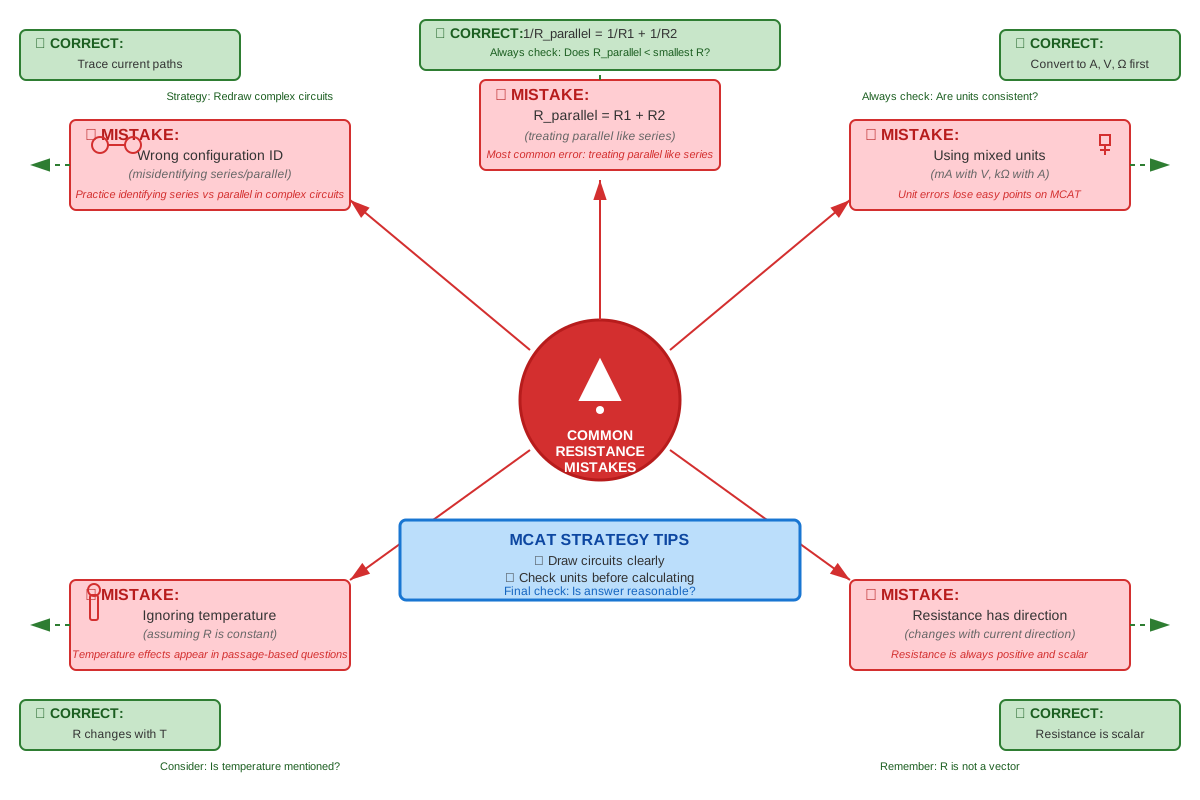
- [ ] Identify common mistakes related to Resistance
- [ ] Connect Resistance to related Physics concepts
- [ ] Calculate resistance using resistivity, length, and cross-sectional area
- [ ] Analyze how temperature affects resistance in conductors and semiconductors
- [ ] Determine equivalent resistance in series and parallel circuit configurations
- [ ] Apply Ohm's Law to solve for current, voltage, or resistance in circuit problems
Prerequisites
- Basic algebra and equation manipulation: Essential for rearranging formulas like Ohm's Law and solving for unknown variables in resistance calculations
- Understanding of electric current: Resistance directly opposes current flow, so comprehending current as charge movement per unit time is foundational
- Knowledge of voltage (electric potential difference): Resistance relates voltage to current, requiring familiarity with voltage as energy per unit charge
- Familiarity with SI units: Resistance problems require unit conversions and dimensional analysis involving amperes, volts, and ohms
- Basic circuit component recognition: Understanding what constitutes a conductor, wire, or resistor enables application of resistance concepts to circuit diagrams
Why This Topic Matters
Clinical and Real-World Significance
Resistance is fundamental to understanding numerous physiological and medical phenomena. The electrical resistance of cell membranes determines how easily ions can cross, affecting nerve signal propagation and muscle contraction. Medical devices like electrocardiograms (ECGs) and electroencephalograms (EEGs) rely on understanding tissue resistance to accurately measure bioelectrical signals. Defibrillators must account for chest wall resistance to deliver appropriate energy levels. Even the design of pacemakers considers the resistance of cardiac tissue to ensure proper current delivery.
MCAT Exam Statistics
Resistance appears in approximately 3-5% of Physics questions on the MCAT, making it a medium-yield topic that students cannot afford to ignore. Questions typically appear as:
- Discrete questions testing direct application of Ohm's Law or resistivity formulas (30% of resistance questions)
- Passage-based questions involving experimental circuits, neurophysiology, or medical instrumentation (50% of resistance questions)
- Pseudo-discrete questions requiring integration with power, energy, or circuit analysis (20% of resistance questions)
Common Exam Contexts
The MCAT frequently presents resistance in passages describing:
- Nerve conduction studies measuring axonal resistance
- Experimental setups with variable resistors (rheostats) or temperature-dependent resistance
- Medical device design requiring optimization of current delivery
- Comparative analysis of different materials' conducting properties
- Circuit troubleshooting scenarios where resistance changes affect overall circuit behavior
Core Concepts
Definition of Resistance
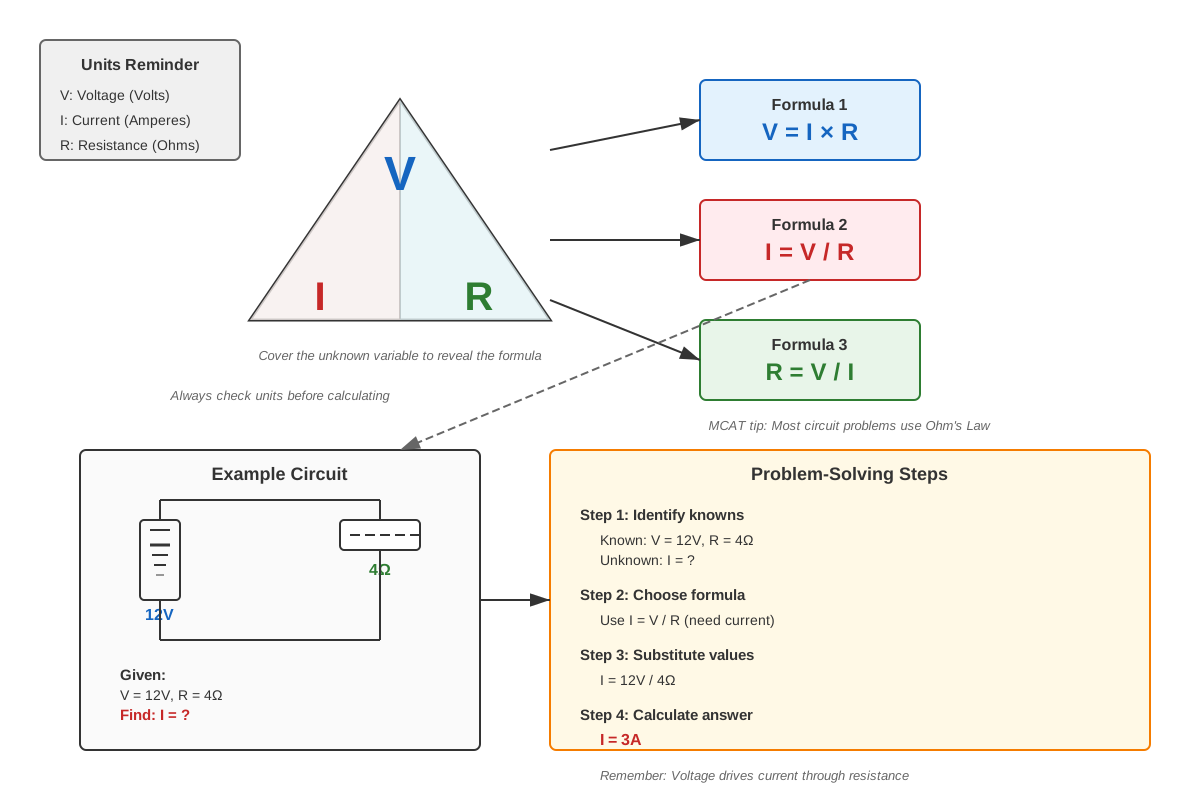
Resistance (R) is the property of a material or component that opposes the flow of electric current. Measured in ohms (Ω), resistance quantifies how much voltage is required to drive a given current through a conductor. The fundamental relationship is expressed through Ohm's Law:
V = IRWhere V is voltage (volts), I is current (amperes), and R is resistance (ohms). This equation reveals that for a constant resistance, voltage and current are directly proportional—doubling the voltage doubles the current. Conversely, for a constant voltage, increasing resistance decreases current proportionally.
Resistance arises from collisions between moving charge carriers (typically electrons) and the atoms of the conducting material. These collisions convert electrical energy into thermal energy, which is why resistors and wires heat up when current flows through them. The microscopic mechanism involves electron scattering from lattice vibrations and impurities in the material.
Resistivity and Geometric Factors
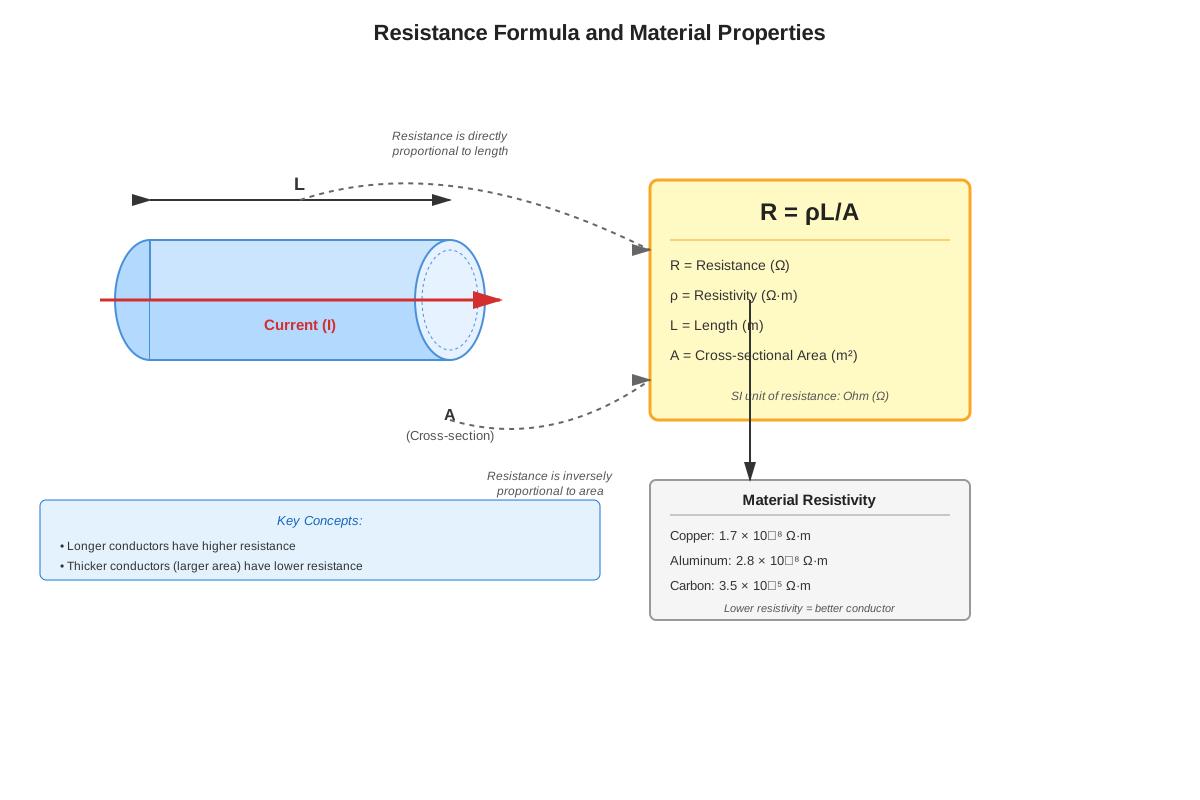
The resistance of a conductor depends on both its material properties and its geometry. Resistivity (ρ, Greek letter rho) is an intrinsic material property that quantifies how strongly a material opposes current flow, independent of its shape or size. The relationship between resistance, resistivity, and geometry is:
R = ρL/AWhere:
- R = resistance (Ω)
- ρ = resistivity (Ω·m)
- L = length of the conductor (m)
- A = cross-sectional area (m²)
This equation reveals several important relationships:
| Parameter Change | Effect on Resistance | Physical Explanation |
|---|---|---|
| Increase length (L) | Resistance increases proportionally | Electrons must travel farther, encountering more collisions |
| Increase cross-sectional area (A) | Resistance decreases inversely | More pathways for current flow, like widening a highway |
| Increase resistivity (ρ) | Resistance increases proportionally | Material intrinsically opposes current more strongly |
| Decrease temperature (metals) | Resistance decreases | Fewer lattice vibrations mean fewer electron collisions |
Temperature Dependence of Resistance
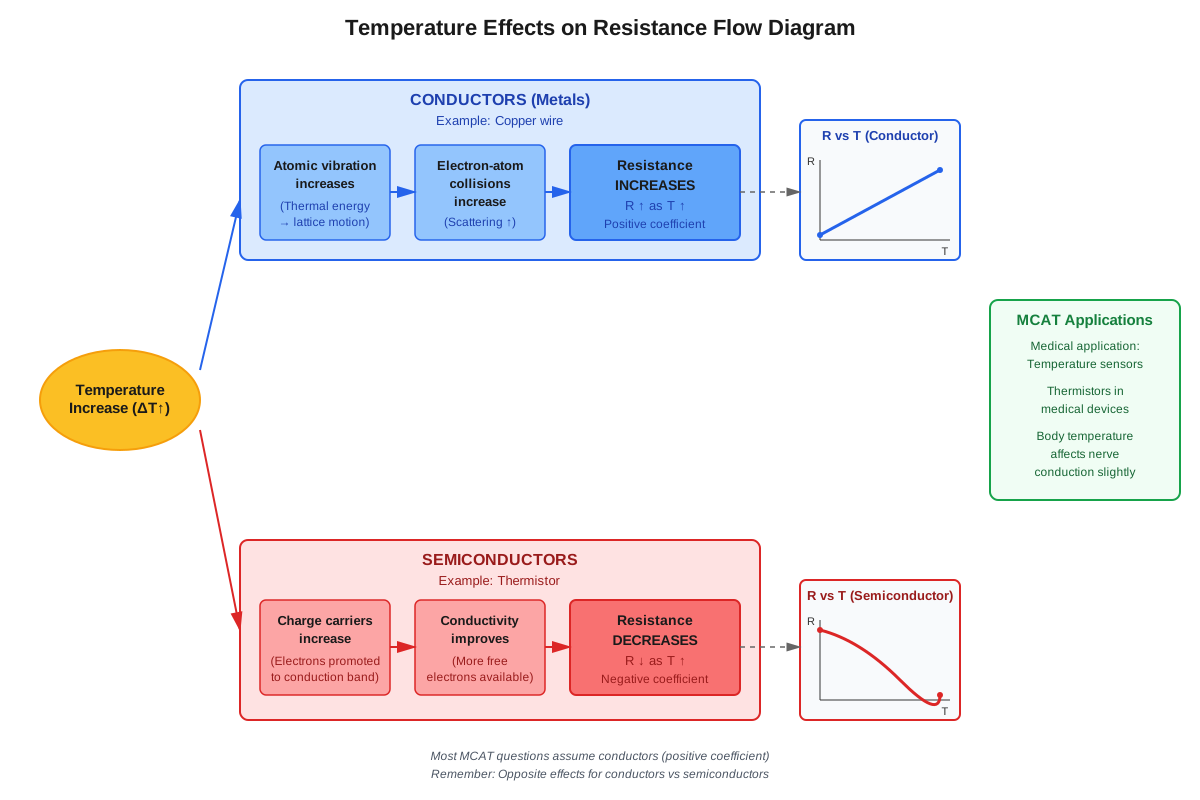
For most metallic conductors, resistance increases with temperature according to:
R = R₀[1 + α(T - T₀)]Where:
- R = resistance at temperature T
- R₀ = resistance at reference temperature T₀
- α = temperature coefficient of resistivity (K⁻¹)
- T = final temperature
- T₀ = reference temperature (usually 20°C)
The temperature coefficient (α) is positive for metals, meaning resistance increases with temperature. This occurs because higher temperatures cause greater atomic vibrations, increasing electron scattering. For the MCAT, remember that heating a metal wire increases its resistance, while cooling decreases resistance.
Semiconductors exhibit the opposite behavior—their resistance decreases with increasing temperature. This occurs because higher temperatures provide energy to promote electrons from the valence band to the conduction band, increasing the number of charge carriers and thus decreasing resistance. This distinction between conductors and semiconductors is occasionally tested on the MCAT.
Power Dissipation in Resistors
When current flows through a resistor, electrical energy converts to thermal energy at a rate given by the power equation:
P = IV = I²R = V²/RAll three forms are equivalent and derived from combining P = IV with Ohm's Law (V = IR). The choice of which form to use depends on which variables are known:
- Use P = IV when both current and voltage are known
- Use P = I²R when current and resistance are known
- Use P = V²/R when voltage and resistance are known
This power dissipation explains why resistors heat up and why electrical devices have power ratings. For the MCAT, understanding that power increases with the square of current (P = I²R) is particularly important for analyzing how changes in circuit parameters affect energy dissipation.
Conductance and Conductivity
Conductance (G) is the reciprocal of resistance and measures how easily current flows:
G = 1/RConductance is measured in siemens (S), where 1 S = 1 Ω⁻¹. Similarly, conductivity (σ, Greek letter sigma) is the reciprocal of resistivity:
σ = 1/ρWhile the MCAT rarely asks directly about conductance, understanding this reciprocal relationship helps with conceptual questions. Materials with high conductivity (low resistivity) are good conductors, while materials with low conductivity (high resistivity) are insulators.
Superconductivity
At extremely low temperatures (near absolute zero), certain materials exhibit superconductivity—a state where electrical resistance drops to exactly zero. While superconductivity is beyond the typical MCAT scope, students should know that it represents the theoretical limit of zero resistance, allowing current to flow indefinitely without energy loss. This concept occasionally appears in passage-based questions about advanced materials or theoretical physics.
Concept Relationships
Resistance serves as a central hub connecting multiple electricity and magnetism concepts. Ohm's Law (V = IR) directly links resistance to voltage and current, forming the foundation for all circuit analysis. This relationship extends to power dissipation through the equations P = I²R and P = V²/R, connecting resistance to energy concepts.
The geometric resistance formula (R = ρL/A) bridges resistance to material properties (resistivity) and physical dimensions, enabling analysis of how conductor shape affects electrical behavior. This relationship connects to current density (J = I/A), which describes current per unit area and relates to resistivity through J = σE (where E is electric field strength).
Temperature effects on resistance connect thermal physics to electrical properties, particularly important for understanding real-world conductor behavior and semiconductor devices. This relationship extends to thermal energy and heat transfer, as power dissipation in resistors converts electrical energy to thermal energy.
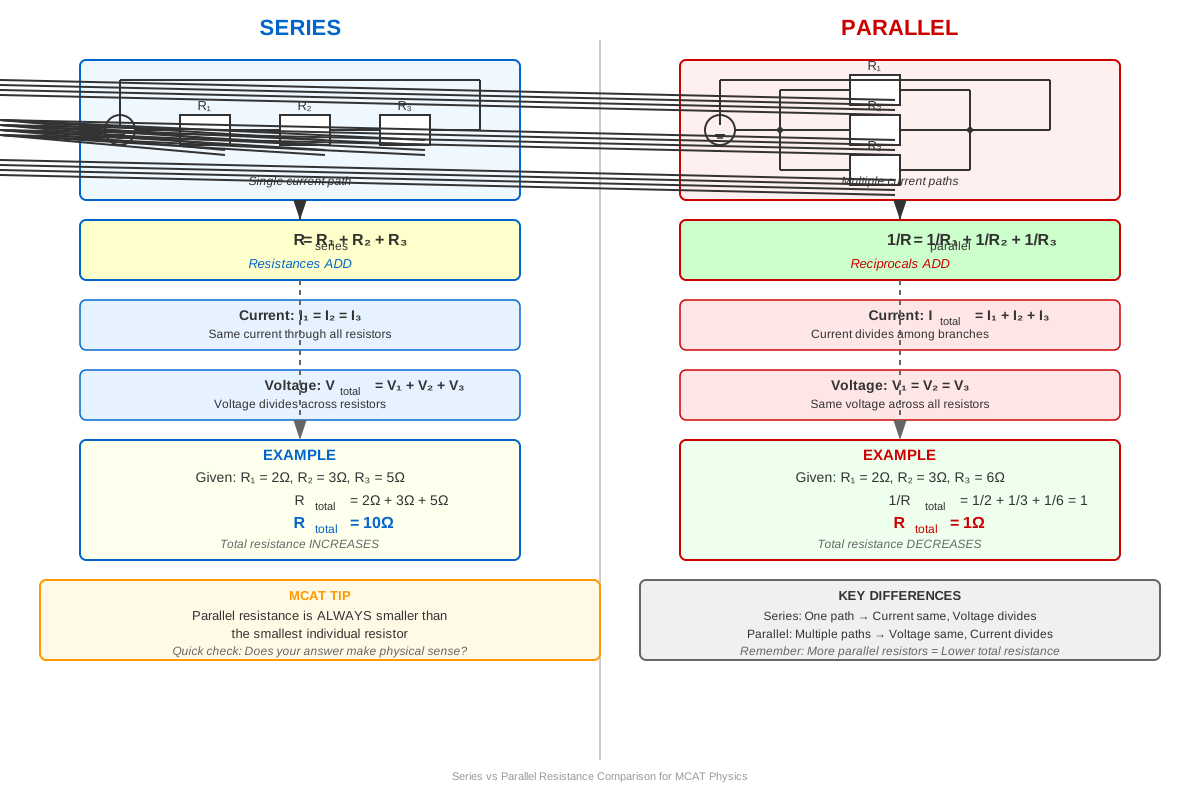
In circuit analysis, resistance combines through specific rules for series circuits (R_total = R₁ + R₂ + R₃...) and parallel circuits (1/R_total = 1/R₁ + 1/R₂ + 1/R₃...), connecting individual component resistance to overall circuit behavior. These relationships are essential for analyzing complex circuits and understanding current distribution.
Conceptual flow: Material properties (resistivity) → Geometric factors (length, area) → Resistance → Ohm's Law → Current and voltage relationships → Power dissipation → Thermal effects → Circuit behavior
High-Yield Facts
⭐ Ohm's Law (V = IR) is the most frequently tested resistance equation on the MCAT, appearing in approximately 60% of resistance-related questions
⭐ Resistance increases linearly with length and decreases inversely with cross-sectional area (R = ρL/A), making a wire twice as long have twice the resistance, while doubling diameter quarters the resistance
⭐ Power dissipated in a resistor can be calculated three equivalent ways: P = IV, P = I²R, or P = V²/R, with the choice depending on known variables
⭐ In series circuits, resistances add directly (R_total = R₁ + R₂ + ...), while in parallel circuits, reciprocals add (1/R_total = 1/R₁ + 1/R₂ + ...)
⭐ For metallic conductors, resistance increases with temperature, while for semiconductors, resistance decreases with temperature
- The SI unit of resistance is the ohm (Ω), equivalent to one volt per ampere (1 Ω = 1 V/A)
- Resistivity is an intrinsic material property measured in ohm-meters (Ω·m), independent of object geometry
- Copper and silver have among the lowest resistivities of common conductors (~10⁻⁸ Ω·m), making them excellent for electrical wiring
- The human body has significant electrical resistance (typically 1,000-100,000 Ω depending on skin moisture), which protects against low-voltage shocks but can be overcome by high voltages
- Superconductors have exactly zero resistance below their critical temperature, allowing persistent currents without energy loss
- Increasing the diameter of a wire by a factor of 2 decreases its resistance by a factor of 4 (since area = πr², doubling radius quadruples area)
- The temperature coefficient of resistivity for copper is approximately 0.004 K⁻¹, meaning resistance increases about 0.4% per degree Celsius
Quick check — test yourself on Resistance so far.
Try Flashcards →Common Misconceptions
Misconception: Resistance "uses up" current as it flows through a circuit
Correction: Resistance does not consume current; the same current flows through all components in a series circuit. Resistance converts electrical energy to thermal energy, but charge (and therefore current) is conserved. What decreases across a resistor is voltage (electrical potential energy per unit charge), not current.
Misconception: A longer wire always has more resistance than a shorter wire
Correction: While length increases resistance for wires of the same material and cross-sectional area (R = ρL/A), a longer wire with sufficiently larger cross-sectional area could have less resistance than a shorter, thinner wire. Resistance depends on the ratio L/A, not length alone.
Misconception: Doubling the voltage across a resistor doubles the power dissipated
Correction: Power increases with the square of voltage (P = V²/R), so doubling voltage actually quadruples the power dissipated. This nonlinear relationship is frequently tested and often missed by students who incorrectly assume linear proportionality.
Misconception: Resistance and resistivity are the same thing
Correction: Resistivity (ρ) is an intrinsic material property independent of size or shape, measured in Ω·m. Resistance (R) is a property of a specific object that depends on both its material (resistivity) and geometry (length and cross-sectional area). Two copper wires have the same resistivity but different resistances if their dimensions differ.
Misconception: In a parallel circuit, the total resistance is the sum of individual resistances
Correction: In parallel circuits, resistances combine through reciprocals: 1/R_total = 1/R₁ + 1/R₂ + ... This means the total resistance is always less than the smallest individual resistance, not greater. Students often confuse series rules (direct addition) with parallel rules (reciprocal addition).
Misconception: All materials' resistance increases with temperature
Correction: While metallic conductors show increased resistance with temperature (positive temperature coefficient), semiconductors exhibit decreased resistance with increasing temperature (negative temperature coefficient). This occurs because higher temperatures in semiconductors create more charge carriers, overwhelming the increased scattering effect.
Misconception: A resistor with higher resistance always dissipates more power
Correction: Power dissipation depends on both resistance and either current or voltage. In a series circuit with constant current, higher resistance does dissipate more power (P = I²R). However, in a parallel circuit with constant voltage, lower resistance dissipates more power (P = V²/R). The relationship between resistance and power depends on circuit configuration.
Worked Examples
Example 1: Calculating Resistance from Geometry and Material Properties
Problem: A copper wire used in a laboratory experiment has a length of 2.5 meters and a circular cross-sectional diameter of 1.0 mm. The resistivity of copper is 1.7 × 10⁻⁸ Ω·m. Calculate the resistance of this wire.
Solution:
Step 1: Identify the relevant equation
We need R = ρL/A since we're given resistivity, length, and can calculate area from diameter.
Step 2: Calculate the cross-sectional area
The wire has a circular cross-section, so A = πr²
- Diameter = 1.0 mm = 1.0 × 10⁻³ m
- Radius = 0.5 × 10⁻³ m
- A = π(0.5 × 10⁻³)² = π(0.25 × 10⁻⁶) = 7.85 × 10⁻⁷ m²
Step 3: Apply the resistance formula
R = ρL/A = (1.7 × 10⁻⁸ Ω·m)(2.5 m) / (7.85 × 10⁻⁷ m²)
R = (4.25 × 10⁻⁸) / (7.85 × 10⁻⁷)
R = 0.054 Ω or 54 mΩ
Step 4: Check reasonableness
This low resistance makes sense for a short, thick copper wire. Copper is an excellent conductor with very low resistivity, and the wire is relatively short with reasonable thickness.
MCAT Connection: This problem type tests understanding of the geometric resistance formula and unit conversions. Watch for diameter vs. radius (a common trap), and remember to convert all measurements to SI units before calculating.
Example 2: Power Dissipation and Circuit Analysis
Problem: A 12 V battery is connected to a 6.0 Ω resistor. Calculate: (a) the current through the resistor, (b) the power dissipated by the resistor, and (c) the total energy dissipated in 5.0 minutes.
Solution:
Part (a): Find current using Ohm's Law
V = IR, so I = V/R
I = 12 V / 6.0 Ω = 2.0 A
Part (b): Calculate power dissipation
We can use any of the three power equations. Since we know V and R:
P = V²/R = (12 V)² / 6.0 Ω = 144 / 6.0 = 24 W
Alternatively, using P = IV (since we now know I):
P = (2.0 A)(12 V) = 24 W ✓
Or using P = I²R:
P = (2.0 A)²(6.0 Ω) = (4.0)(6.0) = 24 W ✓
All three methods yield the same answer, confirming our calculation.
Part (c): Calculate total energy dissipated
Energy = Power × Time
First convert time: 5.0 minutes = 5.0 × 60 = 300 seconds
Energy = 24 W × 300 s = 7,200 J = 7.2 kJ
MCAT Connection: This multi-step problem demonstrates the interconnection between Ohm's Law, power equations, and energy concepts. The MCAT frequently tests whether students can select the appropriate form of the power equation and correctly convert units. Notice that all three power formulas give identical results—this redundancy can serve as a check on your work during the exam.
Key Strategy: When given voltage and resistance, P = V²/R is often fastest. When given current and resistance, P = I²R is most direct. When both current and voltage are known, P = IV is simplest. Choose based on available information to minimize calculation steps.
Exam Strategy
Approaching MCAT Resistance Questions
Step 1: Identify what's given and what's asked
Resistance problems typically provide two of three variables (V, I, R) and ask for the third, or provide geometric/material information to calculate resistance. Quickly note which variables are known and which equation connects them most directly.
Step 2: Check for series vs. parallel circuits
If multiple resistors appear, immediately determine circuit configuration. Series circuits have the same current through all components; parallel circuits have the same voltage across all branches. This distinction determines how resistances combine.
Step 3: Watch for unit conversions
The MCAT loves testing unit awareness. Common traps include:
- Diameter given when radius is needed (remember A = πr², not πd²)
- Millimeters instead of meters for length or diameter
- Milliamperes instead of amperes for current
- Minutes instead of seconds for time in energy calculations
Trigger Words and Phrases
- "In series" → Resistances add directly (R_total = R₁ + R₂ + ...)
- "In parallel" → Reciprocals add (1/R_total = 1/R₁ + 1/R₂ + ...)
- "Power dissipated" → Use P = IV, P = I²R, or P = V²/R depending on known variables
- "Temperature increases" → For metals, resistance increases; for semiconductors, resistance decreases
- "Doubling the diameter" → Area quadruples, so resistance quarters (R ∝ 1/A)
- "Twice as long" → Resistance doubles (R ∝ L)
- "Same material" → Resistivity (ρ) is constant; only geometric factors change resistance
Process of Elimination Tips
When facing resistance questions with answer choices:
- Check dimensional analysis: Resistance must have units of ohms (Ω). If an answer choice has wrong units, eliminate it immediately.
- Assess proportionality: If length doubles, resistance must double (for constant area and material). Eliminate answers showing inverse or quadratic relationships.
- Compare magnitudes: Copper wire resistance should be very small (milliohms to ohms range for typical lengths). Answers showing kilohms for short copper wires are unreasonable.
- Test extreme cases: If a question asks about variable resistance, consider what happens at extremes. For example, as temperature approaches absolute zero for a superconductor, resistance approaches zero—eliminate answers suggesting otherwise.
Time Allocation
- Discrete resistance questions: Allocate 60-90 seconds. These typically require one or two equation applications.
- Passage-based resistance questions: Allocate 90-120 seconds. These may require extracting information from graphs or tables before calculation.
- Multi-step circuit problems: Allocate up to 150 seconds. These require calculating equivalent resistance, then applying Ohm's Law or power equations.
Exam Tip: If a problem seems to require extensive calculation, look for conceptual shortcuts. The MCAT often tests whether you understand relationships (e.g., "resistance doubles when length doubles") rather than requiring precise numerical answers.
Memory Techniques
Resistance Formula Mnemonic: "RHO-LA"
Remember R = ρL/A as "RHO-LA" (like "hola" in Spanish)
- Resistance equals
- RHO (ρ, resistivity)
- Length over
- Area
Ohm's Law Triangle
Visualize a triangle with V on top, I and R on bottom:
    V
   ---
  I | R
Cover the variable you're solving for; the remaining arrangement shows the equation:
- Cover V: V = I × R
- Cover I: I = V / R
- Cover R: R = V / I
Power Equation Selection: "VIR"
Remember the three power equations using "VIR" (like "very important rule"):
- V²/R (when you know voltage and resistance)
- I²R (when you know current and resistance)
- V × I (when you know both voltage and current—the Remaining option)
Series vs. Parallel: "SPAR"
- Series: Plus (resistances add: R₁ + R₂)
- PARallel: Reciprocals (1/R₁ + 1/R₂)
Temperature Effect: "Metal Heats, Resistance Rises"
For metallic conductors, heating increases resistance. For semiconductors, remember the opposite: "Semiconductors: Cool = Cruel" (high resistance when cool).
Geometric Effects: "Long and Thin = High Resistance"
Visualize water flowing through pipes: a long, thin pipe restricts flow more than a short, wide pipe. Similarly, long, thin wires have high resistance, while short, thick wires have low resistance.
Summary
Resistance is the fundamental property quantifying opposition to electric current flow, measured in ohms (Ω) and governed by Ohm's Law (V = IR). The resistance of a conductor depends on both intrinsic material properties (resistivity, ρ) and geometric factors (length and cross-sectional area) through R = ρL/A. For the MCAT, students must master applying Ohm's Law, calculating resistance from geometric parameters, understanding how temperature affects resistance differently in conductors versus semiconductors, and determining power dissipation using P = IV = I²R = V²/R. Resistance combines differently in series circuits (direct addition) versus parallel circuits (reciprocal addition), a distinction critical for circuit analysis. The concept bridges pure physics with biological applications, appearing in contexts ranging from nerve conduction to medical device design, making it essential for MCAT success.
Key Takeaways
- Ohm's Law (V = IR) is the cornerstone equation, relating voltage, current, and resistance in all circuit problems
- Resistance increases with length and decreases with cross-sectional area according to R = ρL/A, where resistivity (ρ) is an intrinsic material property
- Power dissipation in resistors can be calculated using P = IV, P = I²R, or P = V²/R, with formula choice depending on known variables
- Temperature increases resistance in metals (positive temperature coefficient) but decreases resistance in semiconductors (negative temperature coefficient)
- Series resistances add directly (R_total = R₁ + R₂ + ...) while parallel resistances combine through reciprocals (1/R_total = 1/R₁ + 1/R₂ + ...)
- Doubling wire diameter quarters resistance because area depends on radius squared (A = πr²), making resistance inversely proportional to the square of diameter
- All three power equations are equivalent and derived from combining P = IV with Ohm's Law, providing multiple pathways to solve problems and check answers
Related Topics
Series and Parallel Circuits: Building on resistance concepts, this topic explores how multiple resistors combine and how current and voltage distribute in complex circuits. Mastering resistance is essential before tackling equivalent resistance calculations and circuit analysis.
Capacitors and RC Circuits: Capacitors store electrical energy and, when combined with resistors, create time-dependent circuits. Understanding resistance is prerequisite to analyzing how quickly capacitors charge and discharge through resistive elements.
Electric Power and Energy: Resistance directly determines power dissipation (P = I²R), connecting to broader energy concepts including conservation of energy, efficiency, and heat generation in electrical systems.
Kirchhoff's Laws: These fundamental circuit analysis rules (junction rule and loop rule) require fluent application of Ohm's Law and resistance concepts to solve for currents and voltages in complex multi-loop circuits.
Electrochemistry and Galvanic Cells: Internal resistance of batteries and electrochemical cells affects their performance. Understanding resistance enables analysis of real-world battery behavior and efficiency.
Neurophysiology and Action Potentials: Biological membranes exhibit electrical resistance that determines ion flow and signal propagation speed. Resistance concepts underlie understanding of nerve conduction velocity and myelination effects.
Practice CTA
Now that you've mastered the core concepts of resistance, it's time to solidify your understanding through active practice. Attempt the practice questions and flashcards associated with this topic to test your ability to apply Ohm's Law, calculate resistance from geometric parameters, analyze power dissipation, and solve circuit problems under timed conditions. Remember, the MCAT rewards not just knowledge but the ability to apply concepts quickly and accurately under pressure. Each practice problem you solve strengthens your neural pathways and builds the pattern recognition essential for test-day success. You've built a strong foundation—now reinforce it through deliberate practice!
Sign up free to keep reading
Create a free AnvayaPrep account to finish this MCAT guide on Resistance — plus flashcards and practice questions.