Overview
Convex lenses are converging optical devices that refract light rays to meet at a focal point, forming one of the most clinically and practically important topics in Light and Optics for the MCAT. These lenses are thicker at the center than at the edges and are fundamental to understanding how the human eye focuses light, how corrective eyewear functions, and how various medical imaging devices operate. Mastery of convex lenses Physics requires understanding ray diagrams, the thin lens equation, sign conventions, and the relationship between object distance, image distance, and focal length.
For the MCAT, convex lenses represent a high-yield topic that appears frequently in both passage-based and discrete questions within the Physics section. Questions often integrate convex lens principles with biological systems, particularly the eye's lens and cornea, making this topic essential for both the Chemical and Physical Foundations of Biological Systems section and occasionally the Biological and Biochemical Foundations of Living Systems section. Understanding how convex lenses manipulate light provides the foundation for comprehending more complex optical systems, including compound microscopes, telescopes, and the optical components of diagnostic equipment.
The study of convex lenses MCAT content connects directly to broader physics principles including Snell's law of refraction, the nature of electromagnetic radiation, and energy conservation. Additionally, convex lenses serve as the gateway to understanding aberrations in optical systems, depth of field in imaging, and the physics underlying common vision disorders such as hyperopia (farsightedness) and presbyopia. This topic exemplifies how fundamental physics principles apply directly to medical practice and diagnostic technology.
Learning Objectives
- [ ] Define convex lenses using accurate Physics terminology
- [ ] Explain why convex lenses matters for the MCAT
- [ ] Apply convex lenses to exam-style questions
- [ ] Identify common mistakes related to convex lenses
- [ ] Connect convex lenses to related Physics concepts
- [ ] Calculate image position, magnification, and image characteristics using the thin lens equation
- [ ] Construct and interpret ray diagrams for convex lenses with objects at various positions
- [ ] Distinguish between real and virtual images formed by convex lenses and predict their properties
Prerequisites
- Refraction and Snell's Law: Understanding how light bends when transitioning between media of different refractive indices is essential for comprehending how curved lens surfaces redirect light rays
- Basic geometric optics principles: Knowledge of how light travels in straight lines (ray approximation) and reflects off surfaces provides the foundation for ray tracing through lenses
- Sign conventions in physics: Familiarity with coordinate systems and positive/negative directional conventions is necessary for correctly applying the thin lens equation
- Algebraic manipulation: Solving equations with reciprocals and multiple variables is required for lens calculations
- Properties of light as electromagnetic radiation: Understanding light's wave nature and propagation helps explain interference effects and lens behavior at boundaries
Why This Topic Matters
Convex lenses have profound clinical significance in medicine and appear regularly on the MCAT. The human eye itself functions as a complex optical system where the cornea and crystalline lens (both convex) work together to focus light onto the retina. Understanding convex lens physics is essential for comprehending refractive errors, the mechanism of accommodation, cataract formation, and corrective interventions including eyeglasses, contact lenses, and refractive surgery. Medical devices such as ophthalmoscopes, fundus cameras, and surgical microscopes all employ convex lenses as critical components.
From an exam perspective, convex lenses appear in approximately 2-4 questions per MCAT administration, representing roughly 3-5% of physics questions. These questions typically present in three formats: (1) calculation-based problems requiring the thin lens equation, (2) conceptual questions about image formation and characteristics, and (3) passage-based questions integrating lens physics with biological systems, particularly the eye. The AAMC has consistently included passages about vision correction, optical instruments, and photographic systems that require solid understanding of convex lens principles.
Common MCAT passage contexts include: correcting hyperopia with reading glasses, the optical system of microscopes and telescopes, camera lens systems and depth of field, laser focusing systems in medical procedures, and the physics of the eye during accommodation. Discrete questions often test sign convention mastery, the relationship between object distance and image type, and the ability to predict magnification. The integration of physics with biological systems makes this topic particularly high-yield for demonstrating interdisciplinary reasoning—a key competency the MCAT assesses.
Core Concepts
Definition and Structure of Convex Lenses
A convex lens (also called a converging lens) is a transparent optical element with at least one outward-curving surface that causes parallel light rays to converge toward a focal point. The defining characteristic is that the lens is thicker at its center than at its edges. Most convex lenses used in applications are biconvex (curved outward on both surfaces) or plano-convex (one flat surface and one convex surface). The lens operates through refraction at both the front and back surfaces, bending light rays according to Snell's law at each interface.
The optical axis is an imaginary line passing through the center of the lens perpendicular to its surfaces. The optical center (or lens center) is the point on the optical axis where light rays pass through without deviation. The focal point (F) is the location where parallel rays converging after passing through the lens meet. For a convex lens, there are two focal points equidistant from the optical center—one on each side. The focal length (f) is the distance from the optical center to either focal point and represents a fundamental property of the lens determined by its curvature and the refractive index of the lens material.
The Thin Lens Equation
The thin lens equation is the fundamental mathematical relationship governing image formation:
1/f = 1/do + 1/diWhere:
- f = focal length of the lens
- do = object distance (distance from object to lens)
- di = image distance (distance from lens to image)
For convex lenses, the focal length is always positive according to standard sign conventions. Object distance is positive when the object is on the same side as incoming light (real object). Image distance is positive when the image forms on the opposite side from the object (real image) and negative when it forms on the same side as the object (virtual image).
The power of a lens (P) is the reciprocal of focal length measured in meters:
P = 1/fPower is measured in diopters (D), where 1 D = 1 m⁻¹. Convex lenses have positive power values. A lens with a shorter focal length has greater power and bends light more strongly. This concept is particularly relevant for prescribing corrective lenses, where the prescription strength is given in diopters.
Magnification
Magnification (m) describes how much larger or smaller the image appears compared to the object:
m = -di/do = hi/hoWhere:
- hi = image height
- ho = object height
The negative sign in the equation is part of the sign convention. When magnification is positive, the image is upright (same orientation as object); when negative, the image is inverted (flipped). When |m| > 1, the image is larger than the object (magnified); when |m| < 1, the image is smaller (reduced).
Ray Diagrams and Image Formation
Ray diagrams provide a graphical method for determining image location and characteristics. Three principal rays are used:
- Parallel ray: A ray traveling parallel to the optical axis refracts through the lens and passes through the far focal point
- Focal ray: A ray passing through the near focal point emerges from the lens parallel to the optical axis
- Central ray: A ray passing through the optical center continues straight without bending
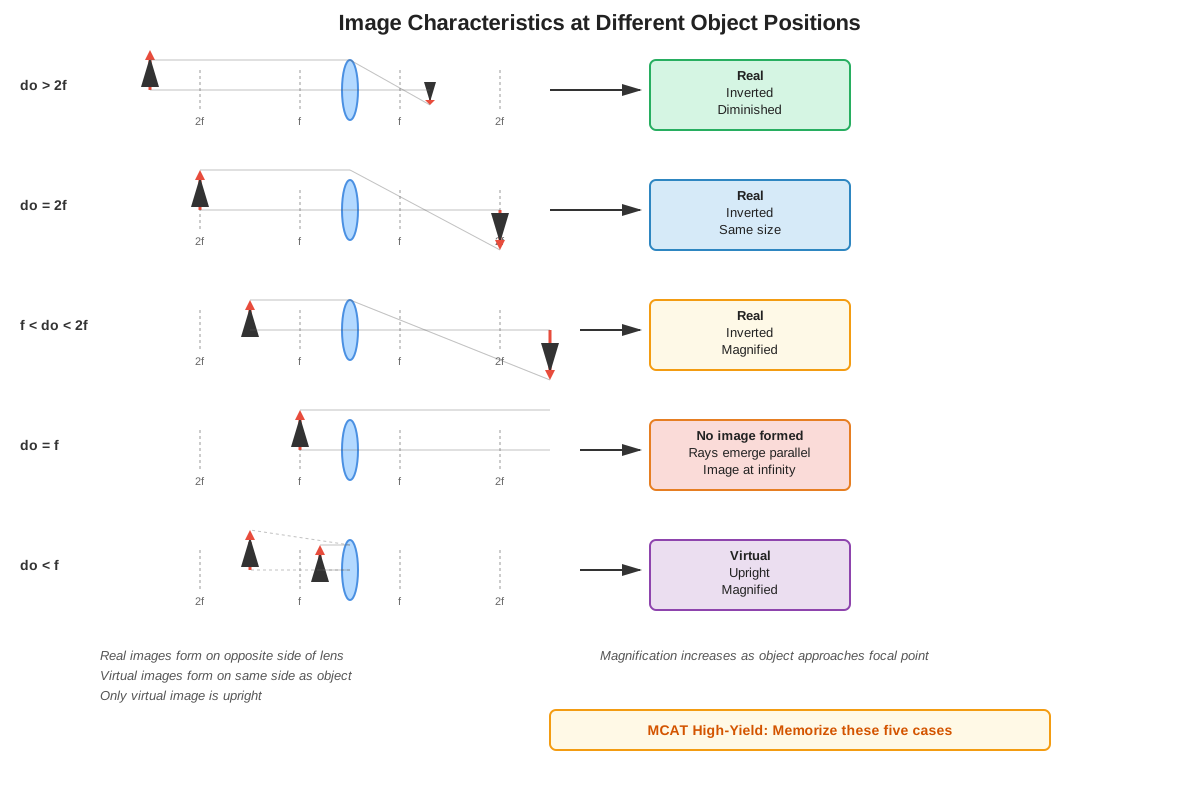
The intersection of any two rays determines the image location. For convex lenses, image characteristics depend critically on object position:
| Object Position | Image Location | Image Type | Image Orientation | Magnification | Example Application | ||
|---|---|---|---|---|---|---|---|
| Beyond 2F | Between F and 2F | Real | Inverted | m | < 1 | Camera | |
| At 2F | At 2F | Real | Inverted | m | = 1 | Photocopier (1:1) | |
| Between F and 2F | Beyond 2F | Real | Inverted | m | > 1 | Projector | |
| At F | At infinity | No image | — | — | Collimating beam | ||
| Inside F | Same side as object | Virtual | Upright | m | > 1 | Magnifying glass |
Real vs. Virtual Images
A real image forms when light rays actually converge at a point. Real images can be projected onto a screen, are always inverted for single convex lenses, and form on the opposite side of the lens from the object. Real images occur when the object is placed beyond the focal point (do > f).
A virtual image forms when light rays appear to diverge from a point but don't actually converge there. Virtual images cannot be projected onto a screen, are upright, and appear on the same side of the lens as the object. For convex lenses, virtual images occur only when the object is placed inside the focal length (do < f), which is how a magnifying glass functions.
The Lensmaker's Equation
While less commonly tested on the MCAT, the lensmaker's equation relates focal length to the physical properties of the lens:
1/f = (n-1)(1/R₁ - 1/R₂)Where:
- n = refractive index of lens material
- R₁ = radius of curvature of first surface
- R₂ = radius of curvature of second surface
This equation demonstrates that focal length depends on both the lens material and its geometry. A lens with more curved surfaces (smaller radii) or made from material with higher refractive index will have shorter focal length and greater power.
Multiple Lens Systems
When multiple lenses are used in combination (as in microscopes or telescopes), the image formed by the first lens becomes the object for the second lens. The total magnification is the product of individual magnifications:
m_total = m₁ × m₂ × m₃ × ...For lenses in contact or very close together, the combined power is the sum of individual powers:
P_total = P₁ + P₂ + P₃ + ...This principle is essential for understanding compound optical instruments and the eye's optical system where the cornea and lens work together.
Concept Relationships
The physics of convex lenses builds directly upon refraction and Snell's law—each curved surface of the lens refracts light according to the change in refractive index between air and the lens material. The cumulative effect of refraction at both surfaces produces the converging behavior characteristic of convex lenses. This relationship flows as: Snell's law → refraction at curved surfaces → light convergence → focal point formation.
Within the topic itself, concepts are hierarchically connected: Lens geometry and focal length → thin lens equation → image position and type → magnification and image characteristics. The focal length serves as the central parameter linking all other properties. Once focal length is known, the thin lens equation determines where images form for any object position, which then determines whether the image is real or virtual, which in turn dictates orientation and relative size.
Convex lenses connect forward to more advanced topics in Light and Optics including lens aberrations (spherical and chromatic), compound optical systems (microscopes and telescopes), and the physics of the human eye. Understanding single convex lenses is prerequisite for analyzing how the cornea and crystalline lens work together, how accommodation changes focal length, and how refractive errors arise. The relationship flows: Single convex lens principles → multiple lens systems → biological optical systems → clinical applications.
The power concept (measured in diopters) creates a bridge between pure physics and clinical medicine, as ophthalmologists and optometrists prescribe corrective lenses using this unit. The relationship focal length → power → clinical prescription demonstrates how fundamental physics directly informs medical practice. Additionally, magnification concepts connect to microscopy and diagnostic imaging, showing how convex lens magnification → compound microscope design → cellular visualization → histopathology.
High-Yield Facts
⭐ Convex lenses always have positive focal length and positive power (measured in diopters)
⭐ When an object is placed beyond the focal point (do > f), a convex lens forms a real, inverted image
⭐ When an object is placed inside the focal point (do < f), a convex lens forms a virtual, upright, magnified image (magnifying glass configuration)
⭐ The thin lens equation (1/f = 1/do + 1/di) applies to all thin lenses with appropriate sign conventions
⭐ Real images form on the opposite side of the lens from the object and can be projected; virtual images form on the same side and cannot be projected
- Power in diopters equals the reciprocal of focal length in meters (P = 1/f)
- When the object is at 2F (twice the focal length), the image forms at 2F on the opposite side with magnification of -1 (same size, inverted)
- Magnification is negative for inverted images and positive for upright images
- The three principal rays (parallel, focal, and central) all intersect at the image location
- For lenses in contact, total power equals the sum of individual powers (Ptotal = P₁ + P₂)
- A shorter focal length indicates stronger converging power and greater bending of light
- The human eye's lens is a convex lens that changes focal length during accommodation
- Convex lenses correct hyperopia (farsightedness) by adding converging power to help focus nearby objects
Quick check — test yourself on Convex lenses so far.
Try Flashcards →Common Misconceptions
Misconception: Convex lenses always magnify objects.
Correction: Convex lenses only magnify when the object is placed inside the focal length (do < f), creating a virtual, upright, magnified image. When the object is beyond the focal point, the image may be reduced (|m| < 1) or magnified (|m| > 1) depending on the specific object distance, but it will be real and inverted.
Misconception: Virtual images are not "real" and therefore don't exist or can't be seen.
Correction: Virtual images are absolutely visible to the eye—in fact, every time you use a magnifying glass, you're viewing a virtual image. The term "virtual" means the light rays don't actually converge at the image location; instead, they appear to diverge from that point. Virtual images cannot be projected onto a screen, but they can be seen by an observer whose eye focuses the diverging rays.
Misconception: The focal length changes depending on where you place the object.
Correction: Focal length is an intrinsic property of the lens determined by its curvature and refractive index—it does not change with object position. What changes with object position is the image distance (di), image type (real vs. virtual), and magnification. The focal length remains constant for a given lens.
Misconception: In the thin lens equation, all values are always positive.
Correction: Sign conventions are critical. For convex lenses, focal length is positive, but image distance can be negative (virtual image) or positive (real image). Object distance is typically positive for real objects but can be negative in multiple-lens systems where the "object" for the second lens is actually a virtual object created by the first lens.
Misconception: Light rays actually bend at the center of the lens.
Correction: Light refracts at the surfaces of the lens where there is a change in refractive index (air-to-glass and glass-to-air interfaces). The "thin lens approximation" treats the lens as infinitely thin for calculation purposes, but physically, refraction occurs at both surfaces. The central ray appears to pass straight through only because it enters perpendicular to the surface at the optical center.
Misconception: A convex lens can only form one type of image.
Correction: Convex lenses are versatile and can form real inverted images, virtual upright images, or no image at all (when the object is at the focal point), depending entirely on object position. This versatility makes them useful in diverse applications from cameras (real, reduced images) to magnifying glasses (virtual, magnified images).
Misconception: The image distance is always greater than the object distance.
Correction: The relationship between do and di depends on object position. When do > 2f, then di < do (reduced image). When f < do < 2f, then di > do (magnified image). When do < f, the image is virtual with negative di. There is no fixed relationship—it varies with object placement.
Worked Examples
Example 1: Calculating Image Position and Characteristics
Problem: A convex lens has a focal length of 20 cm. An object is placed 30 cm in front of the lens. Determine: (a) the image distance, (b) the magnification, (c) whether the image is real or virtual, and (d) whether the image is upright or inverted.
Solution:
(a) Finding image distance using the thin lens equation:
Given:
- f = +20 cm (positive for convex lens)
- do = +30 cm (positive for real object)
- di = ?
Apply the thin lens equation:
1/f = 1/do + 1/di
1/20 = 1/30 + 1/di
Solving for 1/di:
1/di = 1/20 - 1/30
1/di = 3/60 - 2/60 = 1/60
di = +60 cm
(b) Finding magnification:
m = -di/do = -60/30 = -2(c) Image type:
Since di is positive (+60 cm), the image forms on the opposite side of the lens from the object. This indicates a real image that can be projected onto a screen.
(d) Image orientation:
Since magnification is negative (m = -2), the image is inverted (upside down relative to the object).
Additional interpretation: The magnitude of magnification is 2, meaning the image is twice as large as the object. This configuration (object between F and 2F) is used in projectors to create enlarged, inverted images on screens.
Connection to learning objectives: This problem demonstrates application of the thin lens equation and interpretation of sign conventions—both essential MCAT skills. The object placement between F and 2F (20 cm < 30 cm < 40 cm) produces a real, inverted, magnified image beyond 2F, consistent with ray diagram predictions.
Example 2: Magnifying Glass Configuration
Problem: A student uses a convex lens with a power of +5.0 diopters as a magnifying glass to examine a small insect. The insect is positioned 12 cm from the lens. (a) What is the focal length of the lens? (b) Where does the image form? (c) What is the magnification? (d) Describe the image characteristics.
Solution:
(a) Finding focal length from power:
P = 1/f
f = 1/P = 1/5.0 D = 0.20 m = 20 cm
The focal length is +20 cm.
(b) Finding image distance:
Given:
- f = +20 cm
- do = +12 cm (note: do < f, which suggests virtual image formation)
- di = ?
Apply thin lens equation:
1/20 = 1/12 + 1/di
1/di = 1/20 - 1/12
1/di = 3/60 - 5/60 = -2/60 = -1/30
di = -30 cm
(c) Finding magnification:
m = -di/do = -(-30)/12 = +2.5(d) Image characteristics:
The negative image distance (di = -30 cm) indicates the image forms on the same side of the lens as the object—this is a virtual image. The positive magnification (m = +2.5) indicates the image is upright and magnified by a factor of 2.5. The student sees an enlarged, upright image that appears to be 30 cm behind the lens (on the same side as the insect).
Clinical connection: This is exactly how a magnifying glass works and how ophthalmologists use handheld lenses to examine the eye. The object must be placed inside the focal length (do < f) to produce the characteristic virtual, upright, magnified image. This same principle applies when the eye's lens accommodates to view nearby objects—the crystalline lens increases its power to create a focused image of close objects on the retina.
MCAT relevance: This problem type frequently appears in passages about vision, microscopy, or optical instruments. Recognizing that do < f immediately signals virtual image formation is a key time-saving strategy on the exam.
Exam Strategy
When approaching MCAT questions on convex lenses, first identify what type of question you're facing: calculation-based (requiring the thin lens equation), conceptual (requiring understanding of image formation), or application-based (requiring integration with biological systems). For calculation questions, immediately write down the thin lens equation and identify given values with correct signs before attempting algebra.
Trigger words and phrases to recognize:
- "Converging lens" = convex lens
- "Positive power" or "prescription of +X diopters" = convex lens
- "Magnifying glass" = convex lens with object inside focal length
- "Projects an image on a screen" = real image (must be convex lens with do > f)
- "Corrects farsightedness/hyperopia" = convex lens adds converging power
- "Image appears behind the lens" = virtual image (negative di)
Process of elimination strategies:
- If a question asks about image type and the object is inside the focal length, immediately eliminate any answer choices mentioning "real" or "inverted"—the image must be virtual and upright
- If the problem states an image is projected on a screen, eliminate virtual image options
- For magnification questions, if |m| > 1, eliminate "reduced" or "smaller" options; if |m| < 1, eliminate "enlarged" or "magnified" options
- If asked about lens type for correcting hyperopia, eliminate any concave/diverging lens options
Time allocation advice:
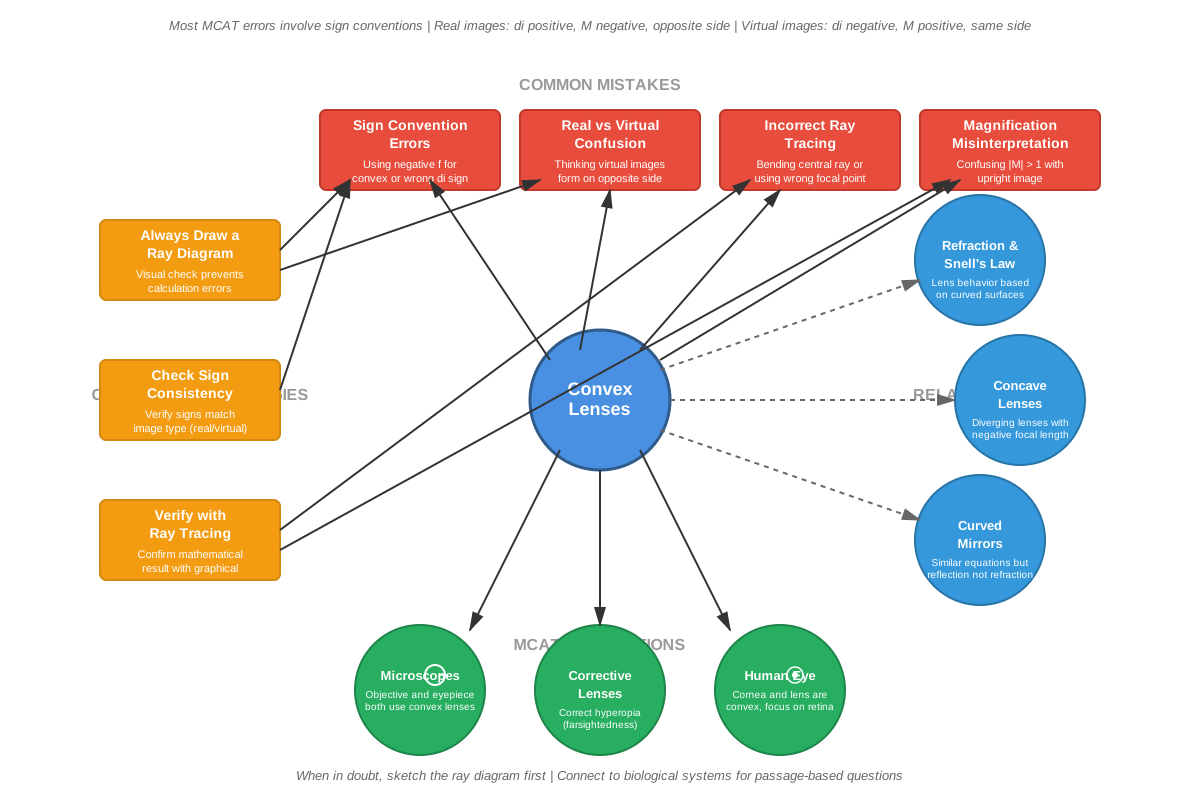
Spend 30-45 seconds setting up calculation problems with the thin lens equation and sign conventions clearly noted. Don't rush this step—sign errors are the most common mistake and waste more time than careful setup. For conceptual questions, quickly sketch a simple ray diagram if you're uncertain—this takes 15-20 seconds but prevents errors. In passages, identify whether the lens system is being used for magnification (microscope, magnifying glass) or image projection (camera, projector) as this immediately constrains possible answers.
Common question patterns:
- Given focal length and object distance, calculate image distance and magnification (direct application)
- Given a clinical scenario (correcting vision), determine required lens power
- Given image characteristics (real/virtual, upright/inverted), determine object position relative to focal point
- Compare two different object positions and predict how image characteristics change
- Multi-step problems involving two lenses where the first image becomes the object for the second lens
Exam Tip: If you forget whether magnification is -di/do or +di/do, remember that real images (positive di) are inverted (negative m), so the negative sign must be in the equation. This logical check can save you from sign convention errors.
Memory Techniques
Mnemonic for image characteristics by object position: "Beyond 2F, Between Reduces; Between F-2F, Beyond Magnifies; Inside F, Virtual Magnifies"
- When object is beyond 2F → image between F and 2F → reduced (|m| < 1)
- When object is between F and 2F → image beyond 2F → magnified (|m| > 1)
- When object is inside F → virtual image → magnified (|m| > 1)
Acronym for principal rays: "PFC" (Parallel, Focal, Central)
- Parallel ray goes through far focal point
- Focal ray (through near focal point) emerges parallel
- Central ray goes straight through center
Visualization strategy for sign conventions:
Picture the lens at the origin of a number line. Everything to the left (object side) where light comes from is the "positive direction" for objects. Everything to the right (where light goes) is the "positive direction" for real images. Virtual images are "behind" the lens on the object side, so they're negative. This spatial visualization prevents sign errors.
Memory aid for real vs. virtual:
"Real images are RIPE" - Real images are Inverted, Projectable, and on the Exit side (opposite from object). If any of these is false, the image is virtual.
Diopter conversion trick:
To quickly convert between focal length and power, remember "Diopters are Divided" - diopters = 1 divided by focal length in meters. A +2.0 D lens has f = 1/2 = 0.5 m = 50 cm. This mental math is faster than writing out the equation.
Magnification sign memory:
"Negative magnification means Not-upright" - if m is negative, the image is inverted (not upright). Positive m means positive orientation (upright).
Summary
Convex lenses are converging optical devices fundamental to understanding both physics and biological vision systems on the MCAT. These lenses, thicker at the center than edges, refract light to create focal points and form images according to the thin lens equation (1/f = 1/do + 1/di). The type, location, orientation, and size of images depend critically on object position relative to the focal point. When objects are beyond the focal length, convex lenses produce real, inverted images that can be projected; when objects are inside the focal length, they produce virtual, upright, magnified images. Mastery requires understanding sign conventions (positive f for convex lenses, positive di for real images, negative di for virtual images), calculating magnification (m = -di/do), and interpreting ray diagrams using three principal rays. Clinical applications include correcting hyperopia, understanding accommodation in the eye, and analyzing optical instruments. Success on MCAT questions demands facility with calculations, conceptual understanding of image formation, and ability to apply lens physics to biological systems.
Key Takeaways
- Convex lenses have positive focal length and power, causing parallel light rays to converge at a focal point
- The thin lens equation (1/f = 1/do + 1/di) with proper sign conventions determines image location for any object position
- Object position relative to focal length determines image type: do > f produces real, inverted images; do < f produces virtual, upright, magnified images
- Real images form on the opposite side of the lens from the object and can be projected; virtual images form on the same side and cannot be projected
- Magnification (m = -di/do) indicates both size change and orientation: negative m means inverted, positive m means upright, |m| > 1 means enlarged
- Power in diopters equals 1/f (in meters) and represents the lens's converging strength—critical for clinical prescriptions
- Convex lenses correct hyperopia by adding converging power to help focus nearby objects on the retina
Related Topics
Concave (Diverging) Lenses: Understanding convex lenses provides the foundation for learning about concave lenses, which have negative focal length and always produce virtual, upright, reduced images. Concave lenses correct myopia (nearsightedness) and are often combined with convex lenses in optical systems.
The Human Eye: The eye functions as a complex optical system where the cornea (fixed convex lens) and crystalline lens (variable convex lens) work together. Mastering convex lens physics enables understanding of accommodation, refractive errors, and corrective interventions.
Compound Optical Instruments: Microscopes and telescopes use multiple convex lenses in combination. Understanding single lens behavior is prerequisite for analyzing how objective and eyepiece lenses work together to produce high magnification.
Lens Aberrations: Real lenses suffer from spherical and chromatic aberrations that limit image quality. This advanced topic builds on ideal thin lens behavior to explain practical limitations in optical systems.
Mirrors and Curved Reflective Surfaces: Concave mirrors behave analogously to convex lenses (converging), while convex mirrors behave like concave lenses (diverging). The same mathematical framework applies with modified sign conventions.
Practice CTA
Now that you've mastered the core concepts of convex lenses, it's time to solidify your understanding through active practice. Work through the practice questions to test your ability to apply the thin lens equation, interpret ray diagrams, and analyze clinical scenarios involving lens systems. Use the flashcards to reinforce high-yield facts and sign conventions until they become automatic. Remember, the MCAT rewards not just knowledge but the ability to apply concepts quickly and accurately under time pressure—practice is what builds that skill. You've built a strong foundation; now strengthen it through deliberate practice!
Sign up free to keep reading
Create a free AnvayaPrep account to finish this MCAT guide on Convex lenses — plus flashcards and practice questions.