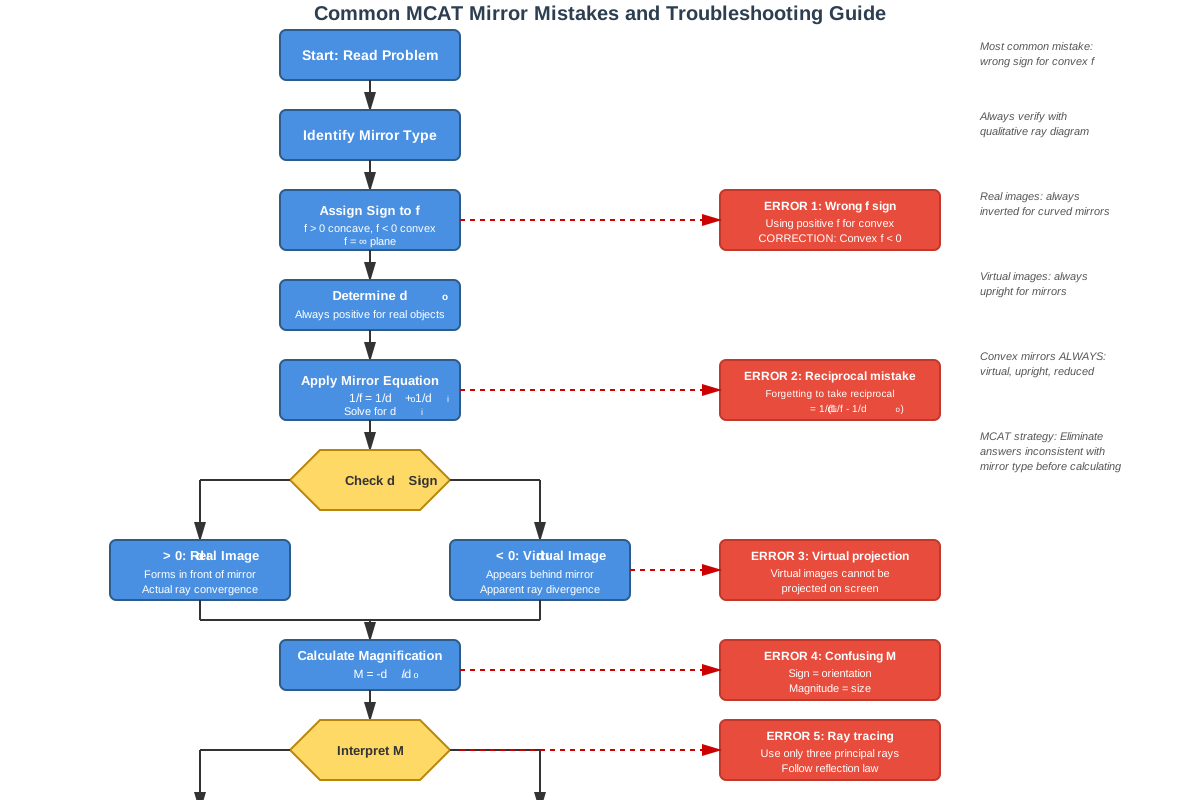
Overview
Mirrors are optical devices that reflect light according to predictable geometric principles, forming images through the systematic redirection of light rays. In the context of Physics and Light and Optics, mirrors represent a fundamental application of the law of reflection and ray tracing techniques that are essential for understanding how light interacts with surfaces. The study of Mirrors Physics encompasses both plane (flat) mirrors and curved mirrors, including concave and convex varieties, each producing distinct image characteristics based on their geometry.
For the Mirrors MCAT preparation, this topic is particularly important because it integrates multiple physics principles including geometric optics, ray diagrams, and mathematical relationships between object distance, image distance, and focal length. The MCAT frequently tests students' ability to predict image properties (location, orientation, magnification, and whether the image is real or virtual) using both qualitative reasoning and quantitative calculations. Questions may appear as standalone problems or embedded within passages discussing optical instruments, vision correction, or experimental setups involving reflected light.
Understanding mirrors provides the foundation for comprehending more complex optical systems such as telescopes, microscopes, and even the human eye. The principles governing mirror behavior directly parallel those of lenses, making mirrors an essential stepping stone in mastering the broader Light and Optics unit. The mathematical framework developed for mirrors—particularly the mirror equation and magnification equation—applies with minor modifications to lens systems, demonstrating the interconnected nature of optical physics concepts tested on the MCAT.
Learning Objectives
- [ ] Define Mirrors using accurate Physics terminology
- [ ] Explain why Mirrors matters for the MCAT
- [ ] Apply Mirrors to exam-style questions
- [ ] Identify common mistakes related to Mirrors
- [ ] Connect Mirrors to related Physics concepts
- [ ] Derive and apply the mirror equation to calculate image distance and focal length
- [ ] Construct accurate ray diagrams for plane, concave, and convex mirrors
- [ ] Predict all image characteristics (real/virtual, upright/inverted, magnified/reduced) for any object position
- [ ] Distinguish between real and virtual images based on light ray convergence
Prerequisites
- Law of Reflection: Understanding that the angle of incidence equals the angle of reflection is fundamental to predicting how light behaves when striking mirror surfaces
- Ray Tracing Basics: Familiarity with representing light as rays traveling in straight lines enables the construction of ray diagrams essential for mirror analysis
- Sign Conventions: Knowledge of coordinate systems and positive/negative value assignments is necessary for correctly applying mirror equations
- Basic Geometry: Understanding angles, triangles, and similar triangles facilitates the derivation and application of magnification relationships
- Real vs. Virtual Images: Conceptual distinction between images formed by actual light convergence versus apparent light divergence underpins all mirror image analysis
Why This Topic Matters
Mirrors appear regularly on the MCAT, typically in 2-4 questions per exam, either as discrete questions or within passages describing optical instruments or experimental setups. The topic matters clinically because mirrors are fundamental components in medical devices such as ophthalmoscopes, otoscopes, dental mirrors, and surgical microscopes. Understanding mirror optics is essential for comprehending how physicians visualize internal body structures and how corrective optical devices function.
From an exam strategy perspective, mirror questions are considered "high-yield" because they test multiple competencies simultaneously: conceptual understanding of light behavior, mathematical problem-solving skills, spatial reasoning through ray diagrams, and the ability to apply sign conventions correctly. The MCAT particularly favors questions that require students to predict image characteristics without calculation, testing true conceptual mastery rather than formula memorization.
Common question formats include: determining image location and characteristics for curved mirrors at various object distances, identifying the type of mirror needed to produce specific image properties, analyzing ray diagrams to determine mirror curvature or focal length, and troubleshooting optical systems where mirrors are components. Passage-based questions often embed mirror concepts within discussions of vision, optical instruments, or light-based measurement techniques, requiring students to extract relevant information and apply mirror principles in context.
Core Concepts
Types of Mirrors
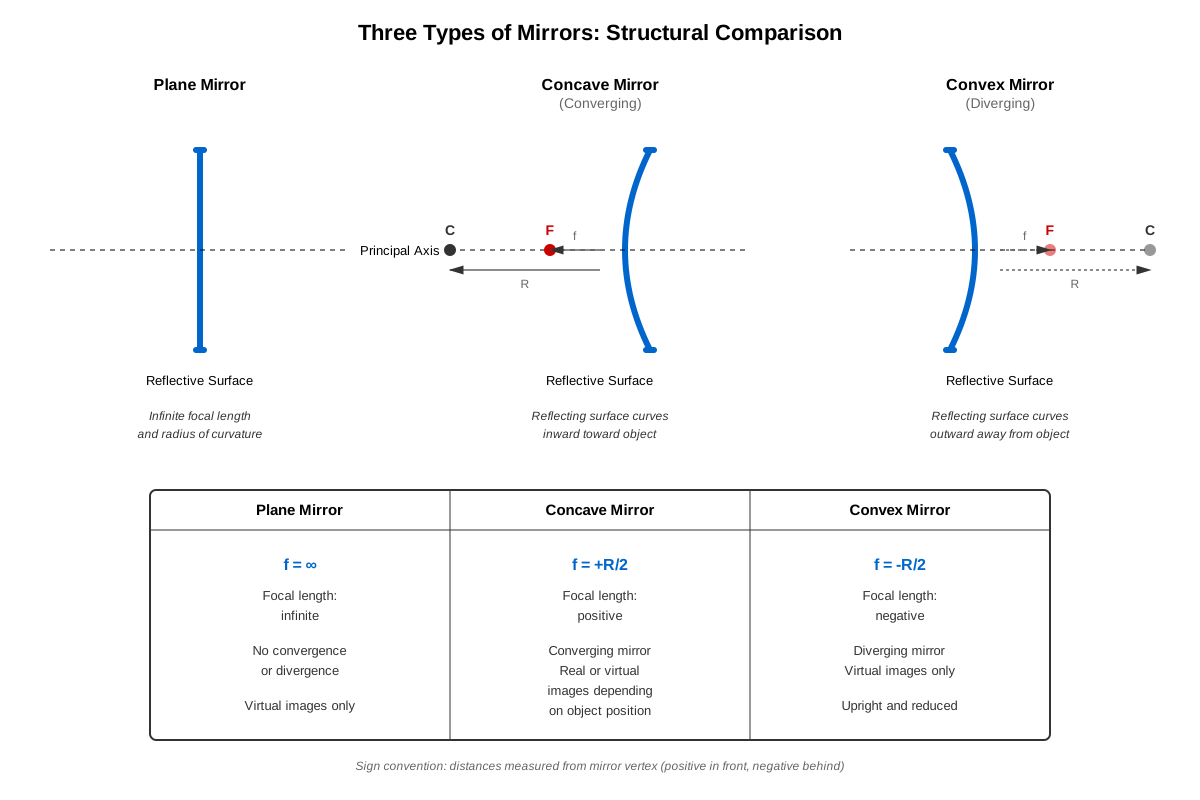
Mirrors are reflective surfaces that redirect light according to the law of reflection. The three primary types tested on the MCAT are plane mirrors, concave mirrors, and convex mirrors, each producing characteristically different images.
Plane mirrors are flat reflective surfaces that produce virtual, upright images of the same size as the object, located at the same distance behind the mirror as the object is in front. The image appears reversed left-to-right (lateral inversion) but maintains the same vertical orientation as the object.
Concave mirrors (also called converging mirrors) curve inward like the interior of a sphere. These mirrors can produce both real and virtual images depending on object position relative to the focal point. The reflective surface faces the center of curvature, causing parallel light rays to converge at the focal point.
Convex mirrors (also called diverging mirrors) curve outward like the exterior of a sphere. These mirrors always produce virtual, upright, and reduced images regardless of object position. The reflective surface faces away from the center of curvature, causing parallel light rays to diverge as if emanating from a focal point behind the mirror.
Key Reference Points and Definitions
The center of curvature (C) is the center of the sphere from which the mirror's curved surface is derived, located at a distance equal to the radius of curvature (R) from the mirror's surface. For concave mirrors, C lies in front of the mirror; for convex mirrors, C lies behind the mirror.
The focal point (F) is the location where parallel light rays converge (concave) or appear to diverge from (convex) after reflection. The focal length (f) is the distance from the mirror surface to the focal point, equal to half the radius of curvature: f = R/2.
The principal axis is the imaginary line passing through the center of curvature and the center of the mirror surface, serving as the reference line for ray diagrams and measurements.
The vertex is the point where the principal axis intersects the mirror surface, serving as the origin for distance measurements.
Sign Conventions
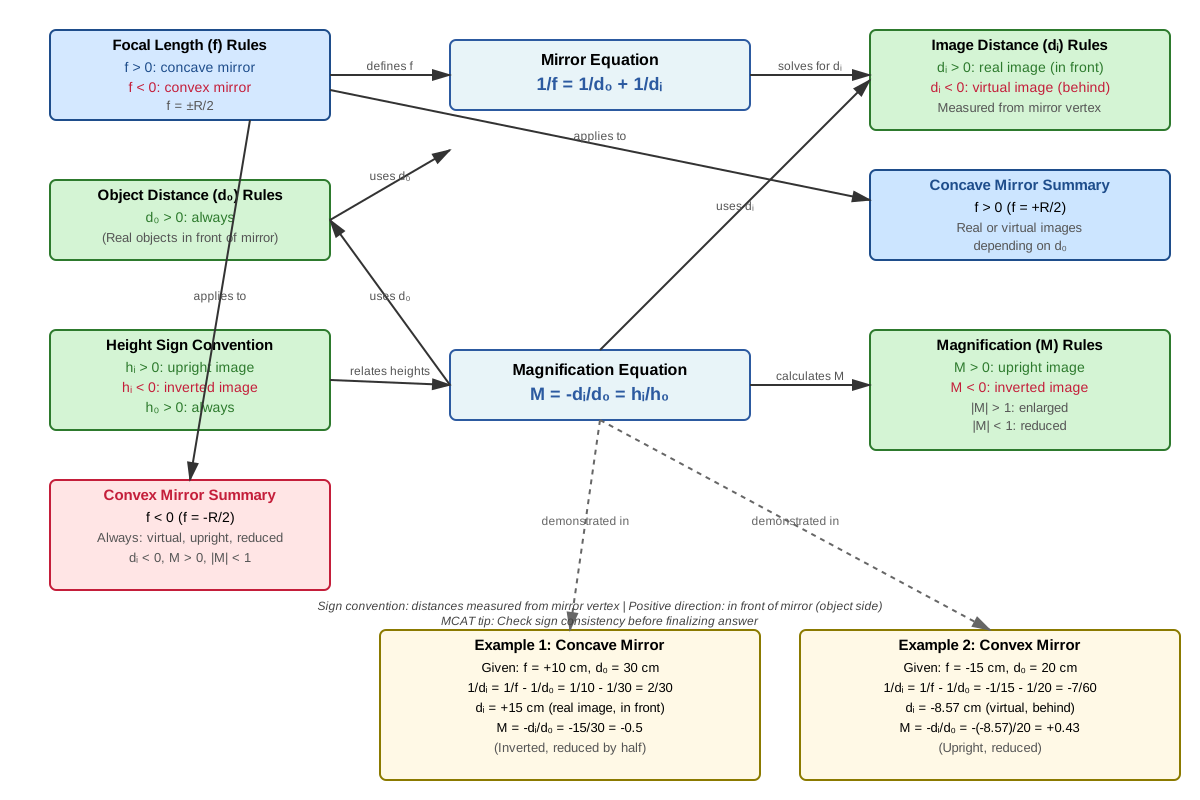
Consistent application of sign conventions is critical for correctly solving mirror problems. The standard convention used in MCAT physics:
| Quantity | Positive | Negative |
|---|---|---|
| Object distance (d₀) | Always (real objects) | Never on MCAT |
| Image distance (dᵢ) | Real image (in front) | Virtual image (behind) |
| Focal length (f) | Concave mirror | Convex mirror |
| Magnification (m) | Upright image | Inverted image |
| Height (h) | Above principal axis | Below principal axis |
The Mirror Equation
The fundamental relationship between object distance (d₀), image distance (dᵢ), and focal length (f) is expressed by the mirror equation:
1/f = 1/d₀ + 1/dᵢThis equation applies to both concave and convex mirrors when proper sign conventions are observed. Rearranging to solve for image distance:
dᵢ = (d₀ × f)/(d₀ - f)Magnification
The magnification (m) describes how much larger or smaller the image appears compared to the object:
m = -dᵢ/d₀ = hᵢ/h₀Where hᵢ is image height and h₀ is object height. The negative sign in the first expression accounts for image inversion. When |m| > 1, the image is magnified; when |m| < 1, the image is reduced; when |m| = 1, the image is the same size as the object.
Ray Tracing for Concave Mirrors
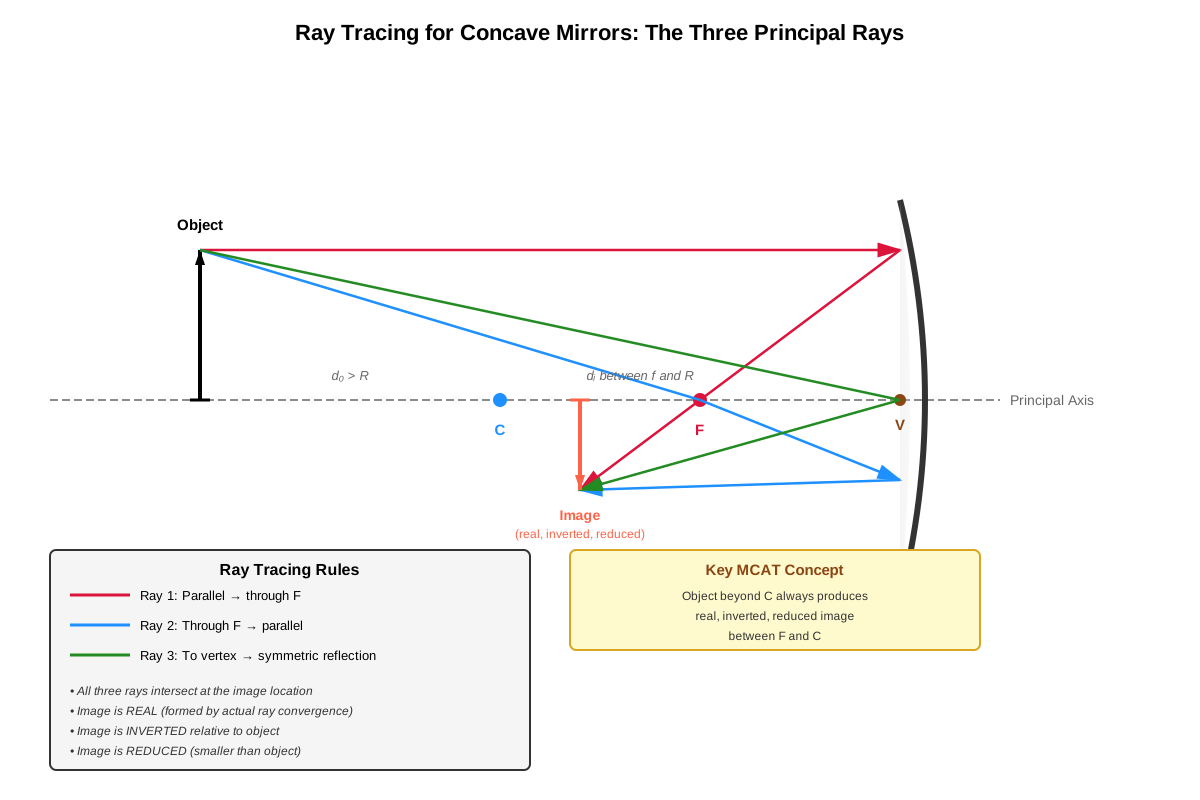
Three principal rays are used to locate images formed by concave mirrors:
- Parallel ray: A ray traveling parallel to the principal axis reflects through the focal point
- Focal ray: A ray passing through the focal point reflects parallel to the principal axis
- Central ray: A ray traveling through the center of curvature reflects back along its original path
The intersection of any two rays determines the image location. For real images, rays actually converge at the image location; for virtual images, rays diverge but appear to originate from the image location when extended backward.
Ray Tracing for Convex Mirrors
For convex mirrors, the principal rays are modified:
- Parallel ray: A ray traveling parallel to the principal axis reflects as if diverging from the focal point behind the mirror
- Focal ray: A ray traveling toward the focal point behind the mirror reflects parallel to the principal axis
- Central ray: A ray traveling toward the center of curvature behind the mirror reflects back symmetrically
Convex mirrors always produce virtual, upright, reduced images located between the mirror surface and the focal point.
Image Characteristics by Object Position (Concave Mirrors)
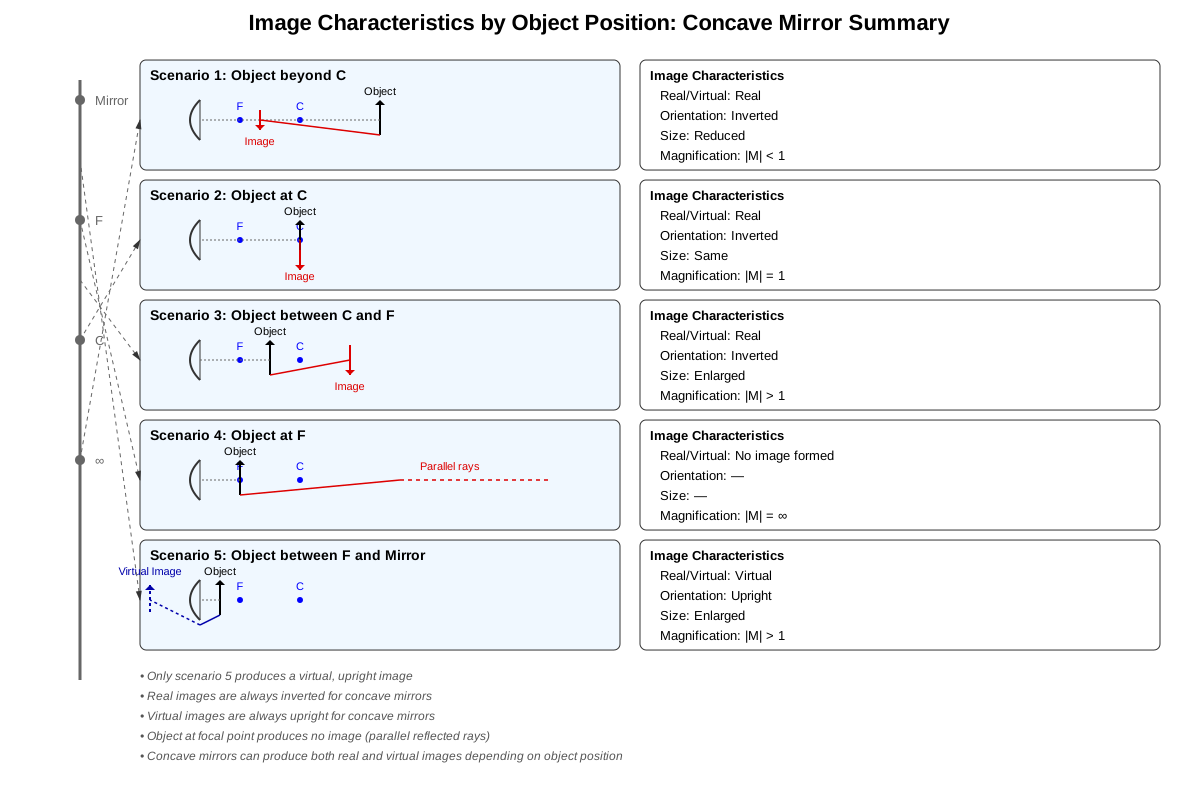
The properties of images formed by concave mirrors depend critically on object position:
| Object Position | Image Location | Image Type | Orientation | Size |
|---|---|---|---|---|
| Beyond C | Between C and F | Real | Inverted | Reduced |
| At C | At C | Real | Inverted | Same size |
| Between C and F | Beyond C | Real | Inverted | Magnified |
| At F | At infinity | Real | Inverted | Infinitely large |
| Between F and mirror | Behind mirror | Virtual | Upright | Magnified |
This table represents the most high-yield information for MCAT mirror questions and should be thoroughly memorized.
Real vs. Virtual Images
Real images form when light rays actually converge at a location in space. These images can be projected onto a screen and are always inverted for single-mirror systems. Real images have positive image distances in standard sign conventions.
Virtual images form when light rays diverge but appear to originate from a location when extended backward. These images cannot be projected onto a screen, are always upright for single-mirror systems, and have negative image distances.
Concept Relationships
The study of mirrors integrates multiple foundational physics concepts into a coherent framework. The law of reflection serves as the fundamental principle → enabling ray tracing techniques → which allow prediction of image formation → characterized by image properties (location, orientation, magnification, real/virtual nature) → quantified through the mirror equation and magnification equation.
Within mirror types, plane mirrors represent the simplest case where the radius of curvature approaches infinity, making them a limiting case of curved mirrors. Concave mirrors and convex mirrors represent opposite curvatures, producing complementary behaviors: concave mirrors can produce both real and virtual images depending on object position, while convex mirrors exclusively produce virtual images.
The relationship between focal length and radius of curvature (f = R/2) connects the geometric properties of the mirror to its optical behavior. This relationship derives from the geometry of reflection at curved surfaces and applies to both concave and convex mirrors with appropriate sign conventions.
Object distance relative to focal length determines all image characteristics for curved mirrors. This relationship creates distinct regions: when d₀ > 2f (beyond C), images are real, inverted, and reduced; when f < d₀ < 2f (between F and C), images are real, inverted, and magnified; when d₀ < f (inside F), images are virtual, upright, and magnified.
The concepts developed for mirrors directly parallel those for lenses, with mirrors using reflection while lenses use refraction. The mathematical framework (mirror equation, magnification equation, sign conventions) transfers almost directly to lens systems, making mirrors an essential foundation for understanding all geometric optics.
Quick check — test yourself on Mirrors so far.
Try Flashcards →High-Yield Facts
⭐ The focal length of a spherical mirror equals half its radius of curvature: f = R/2
⭐ Concave mirrors have positive focal lengths; convex mirrors have negative focal lengths
⭐ Real images have positive image distances and are inverted; virtual images have negative image distances and are upright
⭐ Convex mirrors always produce virtual, upright, and reduced images regardless of object position
⭐ When an object is placed at the focal point of a concave mirror, the reflected rays are parallel and the image forms at infinity
- Plane mirrors always produce virtual images at the same distance behind the mirror as the object is in front (dᵢ = -d₀)
- The magnification equation m = -dᵢ/d₀ applies to all mirror types with proper sign conventions
- When an object is at the center of curvature of a concave mirror, the image forms at the same location with m = -1
- Concave mirrors are used as magnifying mirrors (makeup/shaving mirrors) when the object is placed inside the focal length
- The mirror equation 1/f = 1/d₀ + 1/dᵢ applies to both concave and convex mirrors with appropriate signs
- Convex mirrors provide wider fields of view than plane mirrors, making them useful as security mirrors and vehicle side mirrors
- For concave mirrors, placing an object between F and C produces a real, inverted, magnified image beyond C
- The principal axis is the reference line for all distance measurements and angle determinations in mirror problems
- Ray diagrams require only two of the three principal rays to locate an image, but using all three provides verification
- When solving mirror problems, always check that your calculated image characteristics (real/virtual, upright/inverted) match the signs of your numerical answers
Common Misconceptions
Misconception: Convex mirrors can produce real images if the object is placed far enough away.
Correction: Convex mirrors always produce virtual images regardless of object distance because they cause light rays to diverge. The diverging rays never actually converge in front of the mirror, so no real image can form.
Misconception: The focal point is located on the mirror surface.
Correction: The focal point is located in space at a distance f from the mirror surface (in front for concave, behind for convex). The vertex is the point on the mirror surface where the principal axis intersects.
Misconception: A negative magnification means the image is smaller than the object.
Correction: A negative magnification indicates the image is inverted, not necessarily smaller. The magnitude of m determines size: |m| > 1 means magnified, |m| < 1 means reduced, regardless of sign. For example, m = -2 means the image is inverted and twice as large.
Misconception: Virtual images are not "real" and cannot be seen.
Correction: Virtual images are absolutely visible to the eye—in fact, every time you look in a plane mirror, you see a virtual image. The distinction is that virtual images cannot be projected onto a screen because light rays don't actually converge at the image location; they only appear to diverge from that location.
Misconception: The mirror equation only works for concave mirrors.
Correction: The mirror equation 1/f = 1/d₀ + 1/dᵢ applies to all spherical mirrors (plane, concave, and convex) when proper sign conventions are used. For convex mirrors, f is negative; for plane mirrors, f approaches infinity.
Misconception: When an object is at the focal point, no image forms.
Correction: When an object is at the focal point of a concave mirror, an image does form—at infinity. The reflected rays emerge parallel, meaning they converge at an infinitely distant point. This is why the mirror equation gives dᵢ = ∞ when d₀ = f.
Misconception: The center of curvature and focal point are the same location.
Correction: The focal point is located halfway between the mirror surface and the center of curvature. The center of curvature is at distance R from the mirror, while the focal point is at distance f = R/2.
Worked Examples
Example 1: Concave Mirror Image Characteristics
Problem: An object is placed 30 cm in front of a concave mirror with a focal length of 10 cm. Determine (a) the image distance, (b) the magnification, (c) whether the image is real or virtual, and (d) whether the image is upright or inverted.
Solution:
(a) Finding image distance using the mirror equation:
Given: d₀ = 30 cm (positive, object in front), f = 10 cm (positive, concave mirror)
1/f = 1/d₀ + 1/dᵢ
1/10 = 1/30 + 1/dᵢ
1/dᵢ = 1/10 - 1/30
1/dᵢ = 3/30 - 1/30 = 2/30 = 1/15
dᵢ = 15 cm
(b) Finding magnification:
m = -dᵢ/d₀ = -15/30 = -0.5(c) Real or virtual:
Since dᵢ = +15 cm (positive), the image is real. The positive image distance indicates the image forms in front of the mirror where light rays actually converge.
(d) Upright or inverted:
Since m = -0.5 (negative), the image is inverted. The negative magnification always indicates inversion for single-mirror systems.
Additional interpretation: The magnitude of magnification |m| = 0.5 < 1 indicates the image is reduced to half the object's size. This makes sense because the object is beyond the center of curvature (d₀ = 30 cm > 2f = 20 cm), which always produces real, inverted, reduced images.
Connection to learning objectives: This problem demonstrates application of the mirror equation and magnification equation, proper use of sign conventions, and prediction of image characteristics—all essential MCAT skills.
Example 2: Convex Mirror Application
Problem: A convex security mirror has a focal length of -20 cm. An object is placed 40 cm in front of the mirror. (a) Where is the image located? (b) What is the magnification? (c) Describe all image characteristics.
Solution:
(a) Finding image distance:
Given: d₀ = 40 cm (positive), f = -20 cm (negative, convex mirror)
1/f = 1/d₀ + 1/dᵢ
1/(-20) = 1/40 + 1/dᵢ
1/dᵢ = -1/20 - 1/40
1/dᵢ = -2/40 - 1/40 = -3/40
dᵢ = -40/3 ≈ -13.3 cm
The negative image distance indicates the image is located 13.3 cm behind the mirror (virtual image).
(b) Finding magnification:
m = -dᵢ/d₀ = -(-13.3)/40 = +13.3/40 ≈ +0.33(c) Image characteristics:
- Location: 13.3 cm behind the mirror
- Type: Virtual (dᵢ is negative)
- Orientation: Upright (m is positive)
- Size: Reduced to approximately 1/3 the object size (|m| = 0.33 < 1)
Key insight: This result confirms that convex mirrors always produce virtual, upright, reduced images regardless of object position. Even though the object was placed at a distance equal to twice the focal length (d₀ = 2|f|), the image characteristics remain consistent with all convex mirror images.
Practical application: Security mirrors use convex mirrors specifically because they provide a wide field of view while keeping all images upright and reduced, allowing observers to monitor large areas. The reduced size is acceptable because the priority is coverage, not detail.
Connection to learning objectives: This problem demonstrates understanding of sign conventions for convex mirrors, application of mirror equations, and connection to real-world applications—all valuable for MCAT passages involving optical devices.
Exam Strategy
When approaching MCAT questions on mirrors, begin by identifying the mirror type (plane, concave, or convex) as this immediately constrains possible image characteristics. Look for trigger words such as "converging" (concave), "diverging" (convex), "magnifying mirror" (concave with object inside F), or "security mirror" (convex).
For quantitative problems, always write down the given information with proper signs before attempting calculations. Assign signs according to convention: positive for concave focal lengths and real images, negative for convex focal lengths and virtual images. This single step prevents the majority of calculation errors.
When questions ask about image characteristics without requiring calculation, use the object position relative to focal length as your primary decision tool. For concave mirrors: object beyond C → real, inverted, reduced; object between C and F → real, inverted, magnified; object inside F → virtual, upright, magnified. For convex mirrors, always answer: virtual, upright, reduced.
Exam Tip: If a question provides a ray diagram, verify that rays follow the three principal ray rules before accepting the diagram as accurate. MCAT questions sometimes include incorrect diagrams as distractors.
For process-of-elimination, remember that certain combinations are impossible: convex mirrors never produce real images, real images are never upright (in single-mirror systems), and virtual images are never inverted. Eliminate any answer choice suggesting these impossible combinations immediately.
Time allocation: Straightforward mirror equation problems should take 60-90 seconds. Ray diagram interpretation questions should take 30-45 seconds. Passage-based questions requiring integration of mirror concepts with other physics principles may warrant 90-120 seconds. If a calculation becomes algebraically complex, check whether the question can be answered qualitatively or whether you've made a sign error.
Watch for questions that test conceptual understanding by asking what happens when object position changes. These questions reward understanding the relationship between object distance and image characteristics rather than memorized formulas. Practice predicting how image properties change as an object moves toward or away from a mirror.
Memory Techniques
Mnemonic for concave mirror image positions: "Beyond C makes images Between C and F" and vice versa. When the object is beyond C, the image appears between C and F (reduced). When the object is between C and F, the image appears beyond C (magnified).
Acronym for image characteristics: Use "RUIN" for real images: Real images are Under (below the principal axis, inverted), In front of the mirror, and have Negative magnification.
Visualization strategy: Picture a concave mirror as a "cave" that can "capture" light rays to form real images, while a convex mirror "pushes away" light rays, preventing real image formation. This mental image helps remember that concave mirrors can produce real images while convex mirrors cannot.
Sign convention memory aid: "Positive for Physical" – positive values represent physically present entities (real images in front of the mirror, concave mirrors that physically converge light). Negative values represent virtual or diverging entities.
Focal length relationship: Remember "Half the Radius" or "f = R/2" by visualizing that the focal point is always halfway between the mirror surface and the center of curvature, regardless of mirror type.
Ray tracing sequence: Use "Parallel, Focal, Central" (PFC) to remember the three principal rays in order of ease of drawing. Start with the parallel ray (easiest), then focal ray, then central ray.
Summary
Mirrors represent a fundamental application of geometric optics, utilizing the law of reflection to form images through systematic redirection of light rays. The three mirror types—plane, concave, and convex—each produce characteristic images determined by mirror curvature and object position. Concave mirrors, with positive focal lengths, can produce both real and virtual images depending on whether the object is outside or inside the focal point, making them versatile for applications from magnification to image projection. Convex mirrors, with negative focal lengths, exclusively produce virtual, upright, reduced images, making them ideal for wide-field applications like security monitoring. The mirror equation (1/f = 1/d₀ + 1/dᵢ) and magnification equation (m = -dᵢ/d₀) provide quantitative tools for predicting image location and size, while ray tracing offers qualitative visualization of image formation. Success on MCAT mirror questions requires mastery of sign conventions, understanding the relationship between object position and image characteristics, and the ability to quickly determine whether images are real or virtual, upright or inverted, magnified or reduced. The principles governing mirrors directly parallel those for lenses, making this topic essential foundation for comprehensive understanding of all optical systems.
Key Takeaways
- Concave mirrors have positive focal lengths and can produce real or virtual images; convex mirrors have negative focal lengths and always produce virtual, upright, reduced images
- The mirror equation 1/f = 1/d₀ + 1/dᵢ applies to all spherical mirrors with proper sign conventions: positive for real images and concave mirrors, negative for virtual images and convex mirrors
- Real images form where light rays actually converge (positive dᵢ), are always inverted (negative m), and can be projected; virtual images form where rays appear to diverge from (negative dᵢ), are always upright (positive m), and cannot be projected
- For concave mirrors, object position relative to focal length determines all image characteristics: beyond C gives real/inverted/reduced, between C and F gives real/inverted/magnified, inside F gives virtual/upright/magnified
- Ray tracing using three principal rays (parallel, focal, and central) provides a qualitative method for locating images and verifying calculations
- The focal length equals half the radius of curvature (f = R/2) for all spherical mirrors, connecting geometric and optical properties
- Magnification magnitude indicates size change (|m| > 1 is magnified, |m| < 1 is reduced) while magnification sign indicates orientation (positive is upright, negative is inverted)
Related Topics
Lenses and Refraction: After mastering mirrors, the next logical progression is studying lenses, which use refraction rather than reflection to form images. The lens equation and sign conventions closely parallel those for mirrors, making mirrors essential preparation for lens optics.
Optical Instruments: Understanding mirrors enables comprehension of complex optical devices including telescopes, microscopes, and ophthalmoscopes, which often combine mirrors and lenses to achieve specific imaging goals.
Wave Optics: While mirrors are studied using geometric (ray) optics, wave optics explains phenomena like interference and diffraction that occur with reflected light, providing deeper understanding of light behavior at mirror surfaces.
Vision and the Eye: The eye functions as a complex optical system combining refractive and reflective elements. Understanding mirrors provides foundation for studying how the eye forms images and how vision correction works.
Spherical Aberration: Advanced study of mirrors includes understanding how real mirrors deviate from ideal behavior, particularly spherical aberration where rays far from the principal axis don't converge at the focal point.
Practice CTA
Now that you've mastered the core concepts of mirrors, it's time to solidify your understanding through active practice. Challenge yourself with the practice questions and flashcards designed specifically to test the high-yield concepts covered in this guide. Focus particularly on problems requiring you to predict image characteristics without calculation—these test true conceptual mastery and are exactly what the MCAT rewards. Remember, understanding mirrors isn't just about memorizing equations; it's about developing the spatial reasoning and physical intuition that will serve you throughout the entire Light and Optics unit. You've built a strong foundation—now reinforce it through deliberate practice!
Sign up free to keep reading
Create a free AnvayaPrep account to finish this MCAT guide on Mirrors — plus flashcards and practice questions.