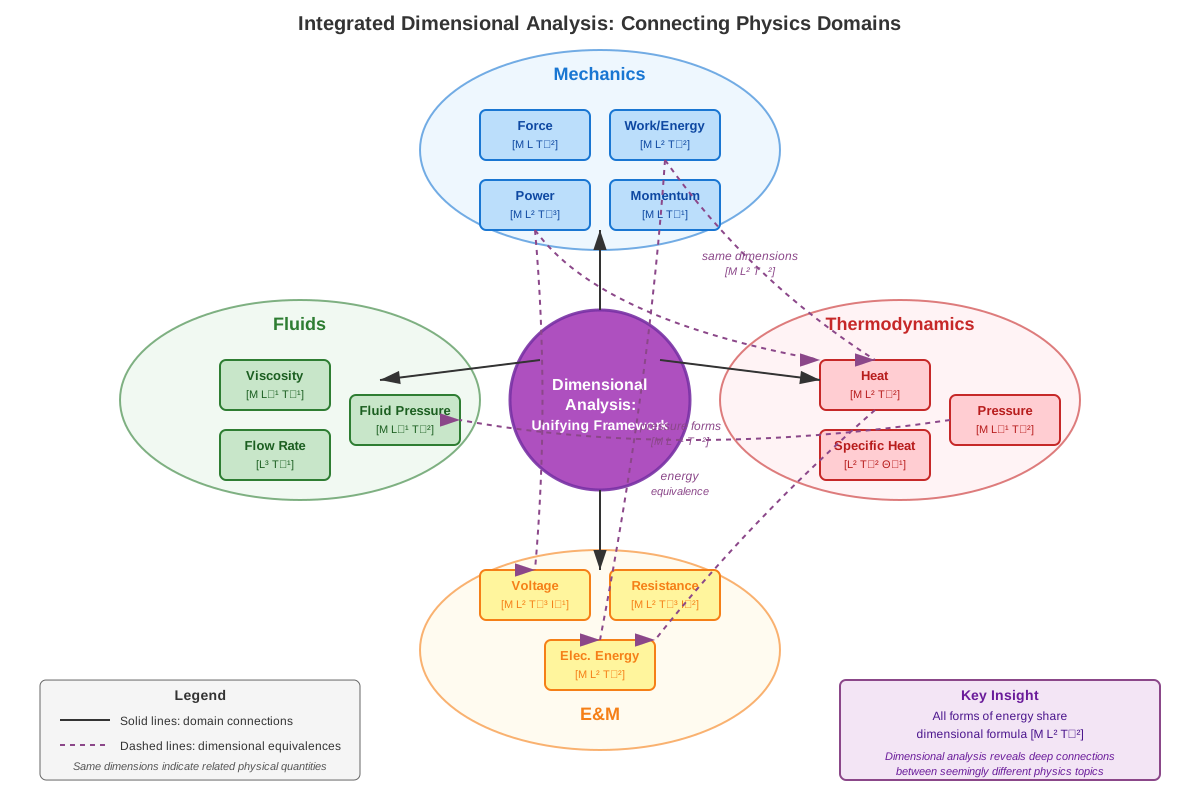
Overview
Dimensional analysis is a powerful mathematical technique that uses the fundamental dimensions of physical quantities—such as mass (M), length (L), time (T), charge (Q), and temperature (Θ)—to verify equations, convert units, and solve problems systematically. In Physics, dimensional analysis serves as both a problem-solving tool and an error-checking mechanism, allowing test-takers to confirm that equations are dimensionally consistent and that calculated answers have the correct units. For the MCAT, mastery of dimensional analysis is essential because it enables rapid verification of complex calculations, helps eliminate incorrect answer choices, and provides a systematic approach to unfamiliar problems where memorized formulas may not immediately come to mind.
The importance of dimensional analysis extends beyond mere unit conversion. This technique forms the foundation for understanding how physical quantities relate to one another across all domains of physics tested on the MCAT—from mechanics and thermodynamics to electricity and fluid dynamics. When confronted with a passage-based question involving multiple variables and unfamiliar contexts, dimensional analysis allows students to reason through relationships between quantities even when specific numerical values seem overwhelming. This metacognitive approach to problem-solving distinguishes high-scoring test-takers who can adapt to novel scenarios from those who rely solely on pattern recognition.
Within the broader Math and Units framework of MCAT Physics, dimensional analysis connects directly to unit systems (SI units, CGS units), scientific notation, significant figures, and order-of-magnitude estimation. It serves as the conceptual bridge between pure mathematics and physical reality, ensuring that every calculation produces not just a number but a meaningful physical quantity with appropriate units. Understanding dimensional analysis deeply will enhance performance across all physics topics, from calculating forces and energies to analyzing fluid flow rates and electrical currents.
Learning Objectives
- [ ] Define dimensional analysis using accurate Physics terminology
- [ ] Explain why dimensional analysis matters for the MCAT
- [ ] Apply dimensional analysis to exam-style questions
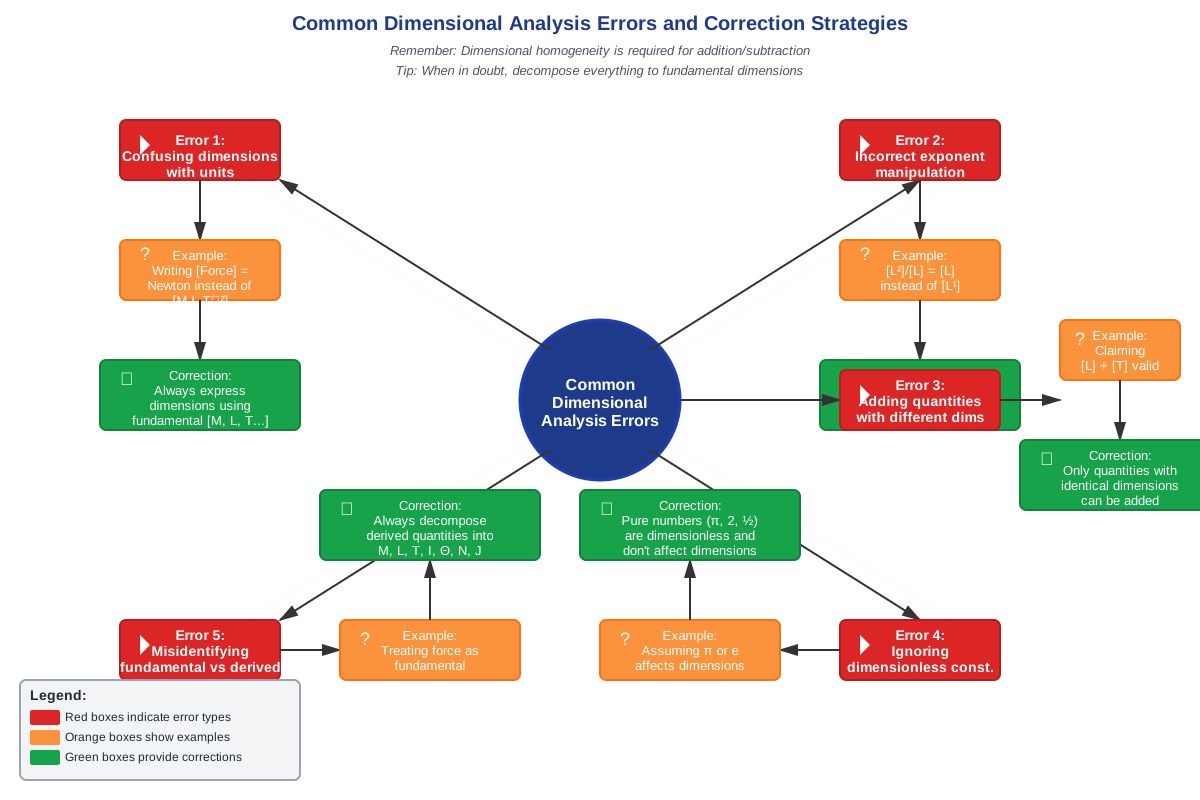
- [ ] Identify common mistakes related to dimensional analysis
- [ ] Connect dimensional analysis to related Physics concepts
- [ ] Derive the dimensions of derived quantities from fundamental dimensions
- [ ] Use dimensional analysis to check the validity of physical equations
- [ ] Construct conversion factors using dimensional analysis for multi-step unit conversions
- [ ] Predict the functional form of relationships between physical variables using dimensional reasoning
Prerequisites
- Basic algebra and equation manipulation: Essential for rearranging dimensional equations and solving for unknown quantities
- Understanding of fundamental SI units: Necessary to recognize base dimensions (meters, kilograms, seconds, amperes, kelvin, moles, candelas)
- Familiarity with common derived units: Required to decompose complex units (Newtons, Joules, Watts, Pascals) into fundamental dimensions
- Scientific notation and exponent rules: Critical for handling dimensional exponents and unit conversions involving powers of ten
- Basic physics quantities: Knowledge of velocity, acceleration, force, energy, and power provides context for dimensional analysis applications
Why This Topic Matters
Dimensional analysis appears frequently on the MCAT, though often embedded within larger physics problems rather than as standalone questions. Approximately 15-20% of physics questions on the MCAT can be solved or verified more efficiently using dimensional analysis, particularly in the Chemical and Physical Foundations of Biological Systems section. This technique proves especially valuable when dealing with passage-based questions that introduce unfamiliar equations or experimental setups where students must reason through relationships between variables.
In clinical and research contexts, dimensional analysis prevents catastrophic errors in medication dosing, radiation exposure calculations, and interpretation of laboratory values. A physician must convert between units (mg/kg to total dose, mL/hr to drops/min) with perfect accuracy, as dimensional errors can lead to patient harm. Research scientists use dimensional analysis to design experiments, ensuring that measured quantities have the expected units and that derived relationships between variables are physically meaningful.
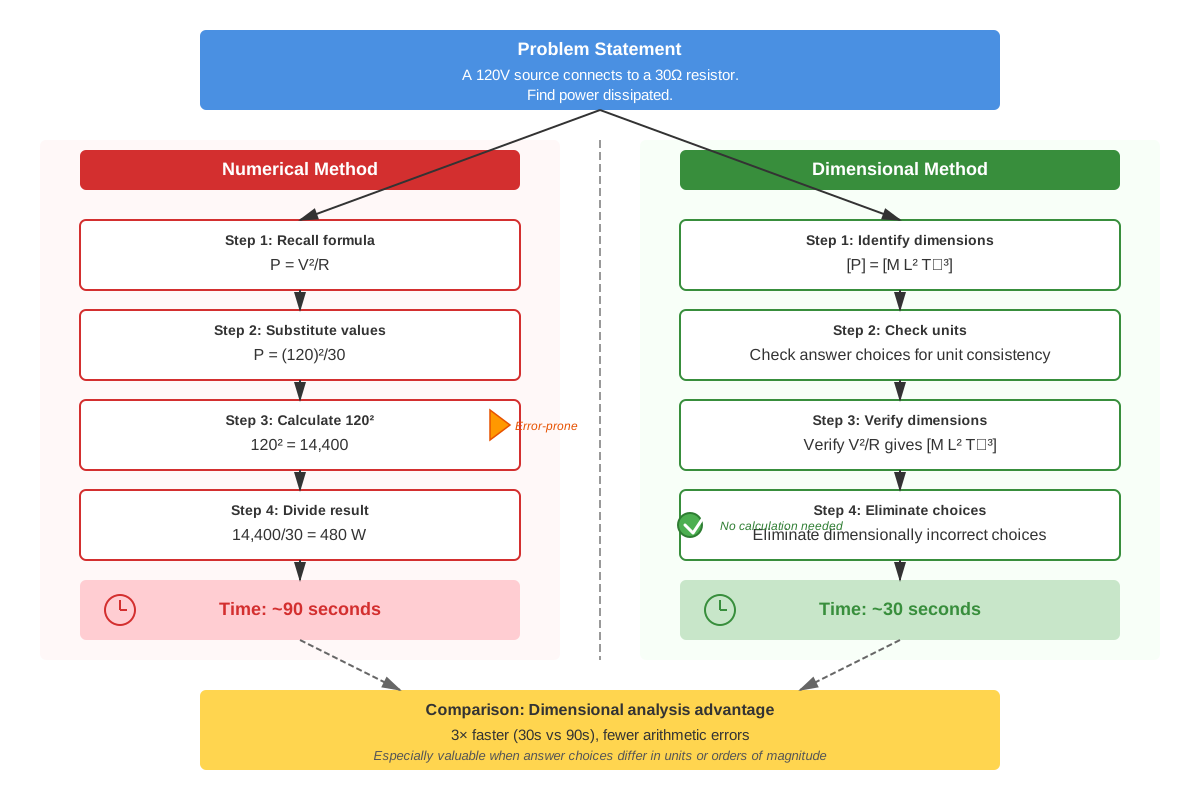
On the MCAT, dimensional analysis most commonly appears in questions involving: (1) unit conversion problems requiring multiple steps, (2) verification of given equations in passage-based questions, (3) elimination of answer choices with incorrect units, (4) estimation problems where exact calculation is impractical, and (5) experimental design questions asking students to identify appropriate measurement units. The technique is particularly high-yield because it can be applied rapidly—often in 15-30 seconds—to eliminate 2-3 incorrect answer choices, dramatically improving odds on difficult questions.
Core Concepts
Fundamental Dimensions
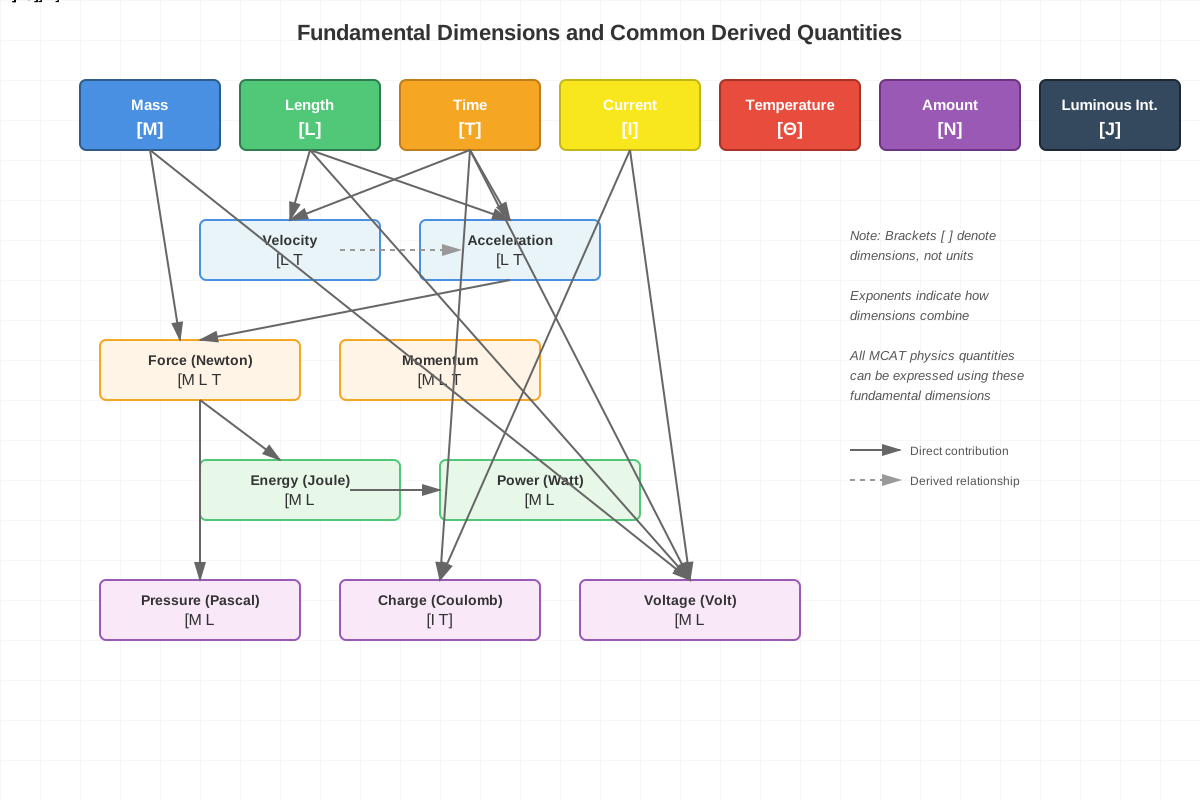
All physical quantities can be expressed in terms of seven fundamental dimensions: mass [M], length [L], time [T], electric current [I], thermodynamic temperature [Θ], amount of substance [N], and luminous intensity [J]. For MCAT purposes, the first five dimensions are most relevant, with amount of substance occasionally appearing in thermodynamics problems. These fundamental dimensions are independent—none can be expressed as a combination of the others—and they form the basis for all derived quantities in physics.
The SI system (Système International) assigns base units to each fundamental dimension: kilogram (kg) for mass, meter (m) for length, second (s) for time, ampere (A) for current, kelvin (K) for temperature, mole (mol) for amount of substance, and candela (cd) for luminous intensity. Understanding that these base units correspond to fundamental dimensions is crucial for dimensional analysis.
Derived Quantities and Their Dimensions
Most physical quantities encountered on the MCAT are derived quantities—combinations of fundamental dimensions. For example, velocity has dimensions [L]/[T] or [LT⁻¹], acceleration has dimensions [LT⁻²], and force has dimensions [MLT⁻²]. The process of determining dimensions for derived quantities involves analyzing the defining equation and substituting fundamental dimensions for each variable.
| Physical Quantity | Symbol | Defining Equation | Dimensions | SI Unit |
|---|---|---|---|---|
| Velocity | v | displacement/time | [LT⁻¹] | m/s |
| Acceleration | a | velocity/time | [LT⁻²] | m/s² |
| Force | F | mass × acceleration | [MLT⁻²] | N (newton) |
| Energy/Work | E, W | force × distance | [ML²T⁻²] | J (joule) |
| Power | P | energy/time | [ML²T⁻³] | W (watt) |
| Pressure | p | force/area | [ML⁻¹T⁻²] | Pa (pascal) |
| Momentum | p | mass × velocity | [MLT⁻¹] | kg·m/s |
| Charge | q | current × time | [IT] | C (coulomb) |
The Principle of Dimensional Homogeneity
The principle of dimensional homogeneity states that any valid physical equation must have the same dimensions on both sides of the equals sign. Furthermore, terms that are added or subtracted must have identical dimensions. This principle provides a powerful error-checking mechanism: if an equation violates dimensional homogeneity, it is definitely incorrect. However, dimensional consistency alone does not guarantee correctness—dimensionless constants and numerical factors cannot be determined through dimensional analysis alone.
For example, in the kinematic equation v² = v₀² + 2ax, each term must have dimensions of [L²T⁻²]:
- v² has dimensions [LT⁻¹]² = [L²T⁻²]
- v₀² has dimensions [LT⁻¹]² = [L²T⁻²]
- 2ax has dimensions [LT⁻²][L] = [L²T⁻²]
The dimensionless constant "2" does not affect the dimensional analysis, illustrating a limitation of the technique.
Systematic Unit Conversion
Dimensional analysis provides a systematic method for unit conversion by treating conversion factors as fractions equal to unity. Each conversion factor is constructed so that the numerator and denominator represent the same physical quantity in different units. By multiplying the original quantity by appropriate conversion factors, unwanted units cancel algebraically, leaving only the desired units.
The systematic approach follows these steps:
- Write the given quantity with its current units
- Identify the target units
- Construct conversion factors as fractions (equivalent quantities in different units)
- Multiply by conversion factors, arranging them so unwanted units cancel
- Verify that only desired units remain
- Perform the numerical calculation
For example, converting 65 miles per hour to meters per second:
65 miles/hour × (1.609 km/1 mile) × (1000 m/1 km) × (1 hour/3600 s) = 29 m/sDimensional Analysis in Problem Solving
Beyond unit conversion, dimensional analysis helps solve physics problems where the exact relationship between variables is unknown but can be deduced from dimensional reasoning. This technique, sometimes called the Buckingham π theorem in advanced applications, allows prediction of how physical quantities must combine to produce a desired result.
Consider determining how the period T of a pendulum depends on its length L, mass m, and gravitational acceleration g. The period must have dimensions [T], so we seek a combination of L, m, and g that produces time dimensions:
- L has dimensions [L]
- m has dimensions [M]
- g has dimensions [LT⁻²]
To obtain [T], we need to eliminate [L] and introduce [T]. The combination L/g has dimensions [L]/[LT⁻²] = [T²], so √(L/g) has dimensions [T]. Mass does not appear in the dimensional analysis, suggesting (correctly) that the period is independent of mass. The actual equation T = 2π√(L/g) includes the dimensionless constant 2π, which cannot be determined through dimensional analysis alone.
Dimensionless Quantities
Some physical quantities are dimensionless—they have no units and represent pure numbers. Common dimensionless quantities include angles (radians), strain (deformation/original length), coefficient of friction, refractive index, and efficiency. Dimensionless quantities often arise as ratios of like quantities or as arguments to transcendental functions (sine, cosine, exponential, logarithm).
Recognizing dimensionless quantities is important because:
- They can be added to or multiplied by any quantity without dimensional inconsistency
- They often represent fundamental physical constants or characteristic ratios
- Arguments of exponential and logarithmic functions must be dimensionless
- Trigonometric functions require dimensionless arguments (angles in radians are technically dimensionless)
Common Dimensional Pitfalls
Several situations require careful attention in dimensional analysis:
Exponential and logarithmic functions: The argument must always be dimensionless. For example, in radioactive decay N = N₀e^(-λt), the product λt must be dimensionless, meaning λ has dimensions [T⁻¹].
Trigonometric functions: While angles are often given in degrees, the radian is the natural dimensionless unit for angles in physics equations. When angles appear in dimensional analysis, they should be treated as dimensionless.
Additive constants: In equations like kinetic energy K = ½mv² + K₀, the constant K₀ must have the same dimensions as K, even though it might equal zero in many contexts.
Concept Relationships
Dimensional analysis serves as the foundational quality-control mechanism for all quantitative physics on the MCAT. It connects directly to unit systems and conversions, providing the systematic method by which quantities expressed in different unit systems can be compared and combined. The technique relies heavily on algebraic manipulation, particularly the cancellation of common factors in numerators and denominators.
The relationship flow proceeds as follows: Fundamental dimensions (M, L, T, I, Θ) → Base SI units (kg, m, s, A, K) → Derived quantities (velocity, force, energy) → Dimensional equations (relationships between quantities) → Unit conversions (systematic transformation between unit systems) → Problem-solving applications (verification, estimation, elimination).
Dimensional analysis enables deeper understanding of physical equations by revealing which variables fundamentally determine a physical phenomenon. This connects to proportional reasoning, where dimensional analysis can predict how changing one variable affects another. For instance, knowing that kinetic energy has dimensions [ML²T⁻²] immediately reveals that doubling velocity (which has dimensions [LT⁻¹]) must quadruple kinetic energy, since velocity appears squared in the dimensional relationship.
The technique also connects to significant figures and precision, as unit conversions must preserve the appropriate number of significant figures. Additionally, dimensional analysis supports order-of-magnitude estimation, allowing rapid approximation of answers by focusing on powers of ten and fundamental dimensional relationships rather than exact numerical calculations.
Quick check — test yourself on Dimensional analysis so far.
Try Flashcards →High-Yield Facts
⭐ All valid physical equations must be dimensionally homogeneous—both sides must have identical dimensions, and all terms added or subtracted must share the same dimensions.
⭐ Force has dimensions [MLT⁻²], energy has dimensions [ML²T⁻²], and power has dimensions [ML²T⁻³]—these are the most commonly tested derived quantities on the MCAT.
⭐ When converting units systematically, construct conversion factors as fractions equal to unity and arrange them so unwanted units cancel algebraically.
⭐ Arguments of exponential, logarithmic, and trigonometric functions must be dimensionless—this principle helps identify the dimensions of constants in unfamiliar equations.
⭐ Dimensional analysis cannot determine dimensionless numerical constants (like 2, π, or ½) in physical equations—it reveals functional form but not exact coefficients.
- Pressure (force per area) has dimensions [ML⁻¹T⁻²], which equals energy per volume [ML²T⁻²]/[L³] = [ML⁻¹T⁻²]
- Momentum [MLT⁻¹] and impulse [MLT⁻¹] have identical dimensions because impulse equals change in momentum
- Viscosity has dimensions [ML⁻¹T⁻¹], which can be remembered as force·time/area or momentum/(area·time)
- Electric potential (voltage) has dimensions [ML²T⁻³I⁻¹], equivalent to energy per charge
- Frequency [T⁻¹] and angular velocity [T⁻¹] have the same dimensions, though they differ by a factor of 2π
- Density [ML⁻³] multiplied by volume [L³] yields mass [M]—a relationship frequently tested in fluid mechanics problems
- Spring constant k has dimensions [MT⁻²] because F = kx requires [MLT⁻²] = k[L]
Common Misconceptions
Misconception: Dimensional analysis can prove an equation is correct. → Correction: Dimensional consistency is necessary but not sufficient for correctness. An equation can be dimensionally correct but still wrong due to incorrect dimensionless constants or functional relationships. Dimensional analysis can only disprove equations (by showing dimensional inconsistency) or narrow possibilities.
Misconception: All conversion factors must be memorized. → Correction: Only a small set of fundamental conversions needs memorization (e.g., 1 inch = 2.54 cm, 1 mile = 1.609 km). Complex conversions are built systematically by chaining these fundamental relationships. The MCAT provides most necessary conversion factors in passages or questions.
Misconception: Angles have dimensions of length because arc length s = rθ. → Correction: Radians are dimensionless because they represent the ratio of arc length to radius (both lengths), so the dimensions cancel. The equation s = rθ is dimensionally consistent: [L] = [L]×[dimensionless]. Degrees are also dimensionless but require conversion to radians in most physics equations.
Misconception: Adding quantities with different units is acceptable if they represent the same type of thing. → Correction: Only quantities with identical dimensions can be added or subtracted. Adding 5 meters to 3 seconds is meaningless. Even adding 5 meters to 3 centimeters requires first converting to common units. This principle helps identify errors in complex calculations.
Misconception: Dimensional analysis works for all physics problems. → Correction: Dimensional analysis has limitations: it cannot determine dimensionless constants, it cannot distinguish between quantities with the same dimensions (like energy and torque, both [ML²T⁻²]), and it provides no information about vector directions. It is a tool to complement, not replace, conceptual understanding and mathematical problem-solving.
Misconception: The dimensions of a quantity change when units are converted. → Correction: Dimensions are fundamental and invariant—they don't change with unit systems. Velocity always has dimensions [LT⁻¹] whether expressed in m/s, mph, or furlongs per fortnight. Only the numerical value and unit labels change during conversion; the underlying dimensional structure remains constant.
Worked Examples
Example 1: Verifying an Unfamiliar Equation
Problem: A passage states that the drag force on a sphere moving through a fluid is given by F_d = 6πηrv, where η is viscosity, r is radius, and v is velocity. Verify this equation is dimensionally consistent and determine the dimensions of viscosity.
Solution:
Step 1: Identify the dimensions of known quantities.
- F_d (force) has dimensions [MLT⁻²]
- r (radius) has dimensions [L]
- v (velocity) has dimensions [LT⁻¹]
- 6π is dimensionless
Step 2: Set up the dimensional equation.
For the equation to be valid: [MLT⁻²] = [η][L][LT⁻¹]
Step 3: Solve for the dimensions of η.
[MLT⁻²] = [η][L²T⁻¹]
[η] = [MLT⁻²]/[L²T⁻¹]
[η] = [ML⁻¹T⁻¹]
Step 4: Verify the result makes physical sense.
Viscosity represents resistance to flow, with SI units of Pa·s (pascal-seconds). Checking: Pa·s = [ML⁻¹T⁻²][T] = [ML⁻¹T⁻¹] ✓
Conclusion: The equation is dimensionally consistent, and viscosity has dimensions [ML⁻¹T⁻¹]. This approach allows verification of unfamiliar equations in MCAT passages without needing prior knowledge of the specific formula.
Example 2: Multi-Step Unit Conversion
Problem: A patient requires a medication at 15 mg/kg body weight. The patient weighs 165 pounds, and the medication is supplied as a solution containing 50 mg/mL. How many milliliters should be administered?
Solution:
Step 1: Convert patient weight to kilograms.
165 lb × (1 kg/2.205 lb) = 74.8 kgStep 2: Calculate total medication dose needed.
74.8 kg × (15 mg/1 kg) = 1122 mgStep 3: Convert medication mass to volume using the concentration.
1122 mg × (1 mL/50 mg) = 22.4 mLStep 4: Verify dimensional consistency throughout.
- Step 1: [M] × [M]/[M] = [M] ✓
- Step 2: [M] × [M]/[M] = [M] ✓
- Step 3: [M] × [L³]/[M] = [L³] ✓
Alternative approach using one continuous calculation:
165 lb × (1 kg/2.205 lb) × (15 mg/1 kg) × (1 mL/50 mg) = 22.4 mLNotice how each conversion factor is arranged so unwanted units cancel:
- lb cancels with lb in denominator
- kg cancels with kg in denominator
- mg cancels with mg in denominator
- Only mL remains
Conclusion: The systematic dimensional analysis approach ensures correct unit cancellation and reduces calculation errors. This method is particularly valuable under time pressure on the MCAT, where tracking units prevents costly mistakes.
Exam Strategy
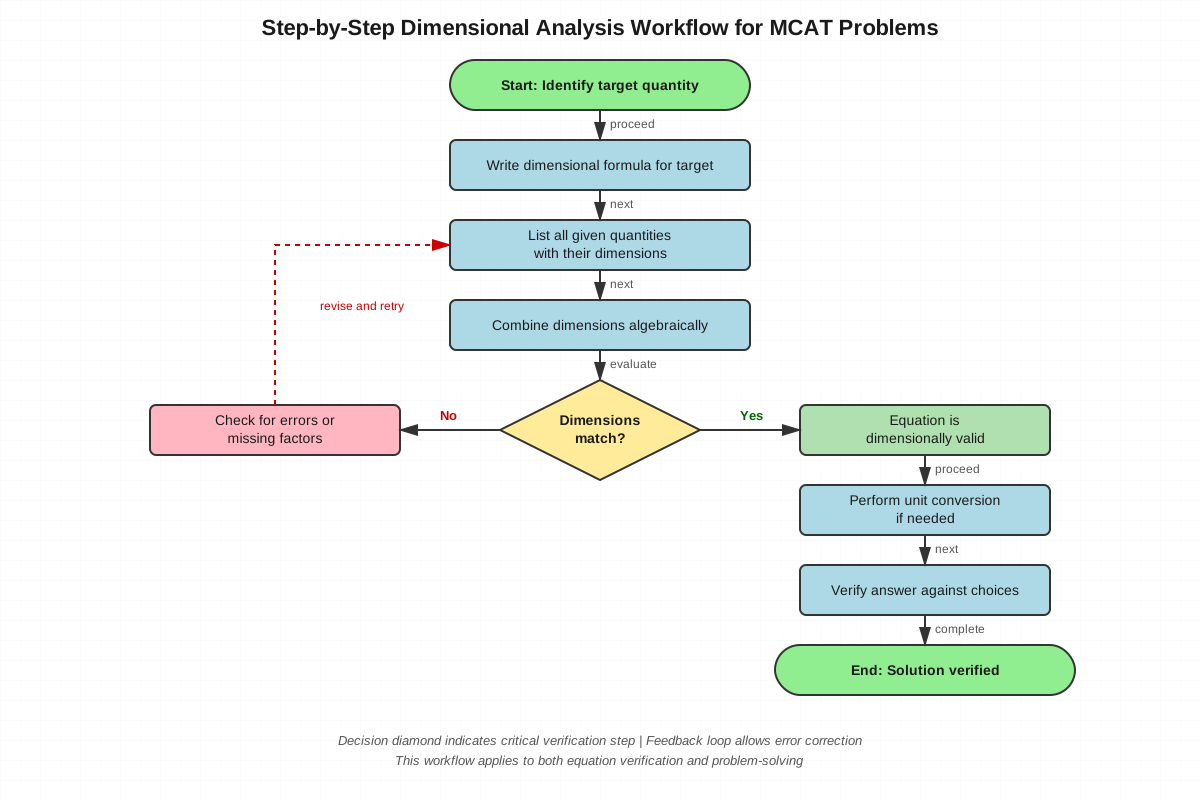
When approaching MCAT questions involving dimensional analysis or unit conversions, follow this systematic strategy:
Immediate unit check: Before performing any calculation, examine the answer choices to identify the expected units. If answer choices have different units, dimensional analysis may allow immediate elimination of incorrect options. Approximately 30% of MCAT physics questions can be narrowed to 2-3 choices through unit analysis alone.
Trigger words to recognize: Watch for phrases like "expressed in terms of," "convert to," "what are the units of," "dimensionally equivalent," or "which equation is consistent with." These signal that dimensional analysis is the intended approach. Passages introducing novel equations or experimental parameters often require dimensional verification.
Systematic conversion setup: For multi-step conversions, write out the entire conversion chain before calculating. This prevents errors and allows verification that units will cancel correctly. On scratch paper, use the format: (given value)(conversion factor 1)(conversion factor 2)... = result. Cross out units as they cancel to ensure only desired units remain.
Estimation before calculation: Use dimensional analysis combined with order-of-magnitude reasoning to estimate the expected answer range. If your calculated result differs by more than a factor of 10 from your estimate, recheck your work. This metacognitive strategy catches errors in unit conversion or misplaced decimal points.
Process of elimination: When an equation or expression is given in a passage, quickly check dimensional consistency of answer choices. Any choice with incorrect dimensions can be eliminated immediately. This is especially powerful in "which of the following could represent..." questions where multiple expressions are offered.
Time allocation: Simple unit conversions should take 30-45 seconds. Complex dimensional analysis problems (verifying equations, determining dimensions of unknown quantities) warrant 60-90 seconds. If a problem requires more time, flag it and return after completing easier questions. Dimensional analysis should accelerate problem-solving, not slow it down.
Memory Techniques
"MLT-IC" mnemonic: The five most important fundamental dimensions for MCAT physics are Mass, Length, Time, electric I (current), and temperature (think "Celsius" or "Θ"). Remember: "Most Learning Takes Intense Concentration."
Force-Energy-Power cascade: Memorize the dimensional progression:
- Force = [MLT⁻²] (mass × acceleration)
- Energy = [ML²T⁻²] (force × length, one more L)
- Power = [ML²T⁻³] (energy/time, one more T⁻¹)
Each step adds one dimension, creating a memorable pattern.
"Per means divide" rule: When a unit includes "per" (miles per hour, joules per second), it indicates division. "Per" always means the following unit goes in the denominator. This simple rule prevents confusion in setting up conversion factors.
Pressure-Energy equivalence: Remember that pressure and energy density have the same dimensions [ML⁻¹T⁻²]. Visualize: pressure is force per area [MLT⁻²]/[L²], while energy density is energy per volume [ML²T⁻²]/[L³]. Both simplify to [ML⁻¹T⁻²]. This connection appears frequently in thermodynamics and fluid mechanics.
Conversion factor orientation: Always write conversion factors with the "new unit" in the numerator and "old unit" in the denominator. This ensures proper cancellation. Visualize an arrow pointing from old → new: (old unit) × (new unit/old unit) = new unit.
Dimensional homogeneity check: Before submitting any calculated answer, ask: "Do my units make sense for what the question asks?" This 3-second check catches a surprising number of errors and should become automatic.
Summary
Dimensional analysis is a fundamental mathematical technique in physics that uses the fundamental dimensions of physical quantities—mass, length, time, current, and temperature—to verify equations, convert units systematically, and solve problems through dimensional reasoning. The principle of dimensional homogeneity requires that all valid physical equations have consistent dimensions on both sides and that only quantities with identical dimensions can be added or subtracted. On the MCAT, dimensional analysis serves multiple strategic purposes: rapid verification of complex equations presented in passages, systematic multi-step unit conversions, elimination of answer choices with incorrect units, and estimation of expected answer ranges. While powerful, the technique has limitations—it cannot determine dimensionless numerical constants, distinguish between quantities with identical dimensions, or provide information about vector directions. Mastery of dimensional analysis requires understanding how derived quantities (force, energy, power, pressure) relate to fundamental dimensions, recognizing that arguments of transcendental functions must be dimensionless, and applying systematic conversion factor methods where unwanted units cancel algebraically. This skill accelerates problem-solving across all physics domains tested on the MCAT and serves as an essential error-checking mechanism under time pressure.
Key Takeaways
- Dimensional analysis verifies equation validity through the principle of dimensional homogeneity—both sides of any physical equation must have identical dimensions
- The five most important fundamental dimensions for MCAT physics are mass [M], length [L], time [T], electric current [I], and temperature [Θ]
- Force [MLT⁻²], energy [ML²T⁻²], and power [ML²T⁻³] form a dimensional cascade where each quantity adds one dimension to the previous
- Systematic unit conversion uses conversion factors arranged as fractions equal to unity, positioned so unwanted units cancel algebraically
- Dimensional analysis cannot determine dimensionless constants or distinguish between quantities with identical dimensions, but it can immediately eliminate dimensionally inconsistent answer choices
- Arguments of exponential, logarithmic, and trigonometric functions must always be dimensionless—this principle helps identify dimensions of unknown constants
- Approximately 15-20% of MCAT physics questions can be solved more efficiently or verified using dimensional analysis, making it a high-yield strategic tool
Related Topics
Unit Systems and Conversions: Builds directly on dimensional analysis by exploring SI, CGS, and imperial unit systems in detail, including conversion factors between systems and the historical development of standardized units.
Order of Magnitude Estimation: Extends dimensional analysis by combining it with approximation techniques to rapidly estimate answers without detailed calculation—essential for time management on the MCAT.
Significant Figures and Precision: Complements dimensional analysis by addressing how many digits to retain in calculations and conversions, ensuring answers reflect appropriate measurement precision.
Vector Analysis: Adds directional information to dimensional analysis, exploring how physical quantities with magnitude and direction (displacement, velocity, force) behave under mathematical operations.
Proportional Reasoning: Uses dimensional relationships to predict how changing one variable affects another, connecting to graphical analysis and functional relationships tested throughout MCAT physics.
Practice CTA
Now that you've mastered the core concepts of dimensional analysis, it's time to solidify your understanding through active practice. Attempt the practice questions and flashcards associated with this topic, focusing on applying dimensional analysis to verify equations, convert units systematically, and eliminate incorrect answer choices. Remember that dimensional analysis is a skill that improves dramatically with deliberate practice—each problem you work through strengthens your ability to recognize dimensional relationships instantly on test day. Challenge yourself with increasingly complex multi-step conversions and unfamiliar equations from passages. Your investment in mastering this foundational technique will pay dividends across every physics topic on the MCAT, giving you confidence and speed when it matters most.
Sign up free to keep reading
Create a free AnvayaPrep account to finish this MCAT guide on Dimensional analysis — plus flashcards and practice questions.